




Quick Summary:
- Agentic commerce fraud happens when AI agents, their credentials, or delegated customer permissions are misused to perform unauthorized transactions or account actions.
- Fraud can start with stolen cards, account or agent takeover, fake storefronts, prompt injection, credential abuse, and automated probing.
- Agent-led fraud can look legitimate because attackers may operate through authenticated agents, trusted tokens, stored payment methods, and established customer accounts.
- Effective agentic commerce fraud prevention needs to verify the agent’s identity, customer authorization, transaction intent, payment context, and risk before allowing sensitive actions.
- Risk-based controls can limit what an agent can purchase, spend, refund, cancel, or change, while higher-risk actions can trigger step-up authentication or manual review.
- Fraud risk does not end at checkout. Compromised agent access can still be used to alter orders or move money through post-purchase actions.
- Ongoing monitoring helps businesses separate legitimate agent traffic from malicious automation and adjust fraud rules as new attack patterns appear.
What happens when an AI agent has valid permission to buy, but the transaction it completes is fraudulent? The merchant may still see an authenticated agent and approved payment credentials, making agentic commerce fraud difficult to distinguish from a genuine purchase.
As AI agents gain more control over transactions, the points where fraud can occur also change. Attackers can target delegated permissions, trusted tokens, agent sessions, or even the information an agent uses to make a decision.
That means agentic commerce fraud prevention has to look beyond payment approval. Businesses need to verify who the agent is, what the customer authorized, and whether each action stays within that permission.
In this guide, we’ll look at how agentic commerce fraud happens, why it matters, and the controls businesses can use to detect and prevent it before and after checkout.
What Is Agentic Commerce Fraud?
Agentic commerce fraud happens when AI shopping agents, or the permissions customers give them, are misused to carry out actions the customer never intended. These agentic AI systems can act across connected tools and commerce systems, which makes delegated access an important part of the fraud decision.
What makes it different is that fraudulent activity can still look like a valid transaction. The agent may use legitimate credentials and complete checkout without failed payments or unusual browsing behavior.
As a result, fraud checks need to consider whether the agent’s actions still match the customer’s identity, authorization, and intent.
” Fraudsters look for shortcuts, and AI agents can give them one at scale. Attackers can hijack trusted agents or deploy malicious ones that appear legitimate, allowing fraud operations to expand with far less manual effort. “
How Does Agentic Commerce Fraud Happen?
Once you know what agentic commerce fraud is, the next question is how fraudsters can exploit the trust and authority given to AI agents during a transaction.

1. Stolen Cards Used Through AI Agents
Fraudsters can give an AI shopping agent stolen card details and instruct it to find products and complete purchases. Since the agent can move through product selection and checkout like legitimate automated traffic, the order may initially appear normal to the merchant.
The underlying payment is still unauthorized, but agentic commerce fraud adds automation that can increase the speed and volume of fraudulent purchases. Merchants may face chargebacks, lost inventory, and fulfillment costs once the legitimate cardholder reports the transaction.
2. Fake Storefronts Built to Deceive AI Agents
A shopping agent may encounter a fake storefront built to look like a legitimate merchant. If it trusts manipulated product data or checkout instructions without verifying the seller, it could place an order or expose payment information, leaving the customer with a fraudulent purchase.
3. Stored Payment Credentials and Trusted Tokens Abused
AI agents may receive access to saved payment methods or trusted payment tokens so they can complete purchases without asking the customer to enter card details each time. If that access is compromised, the attacker may be able to transact using credentials the merchant already recognizes.
Because the payment credential remains valid, an unauthorized order can still look like a legitimate agent-led purchase. Fraud controls then need to verify whether the agent still has customer authorization and whether the purchase matches the intent behind that permission before approving payment.
4. Account Takeover Expands Into Bot Takeover
Account takeover (ATO) can extend into bot takeover (BTO) when a compromised customer account also gives an attacker control over an AI agent connected to it. The attacker can then use the agent’s existing credentials and delegated permissions to perform actions that may still appear authorized.
A June 2026 case showed how this risk can play out. Attackers manipulated Meta’s AI support agent into adding new email addresses to targeted Instagram accounts, creating a path to account control. Meta later notified affected users about the attacks.
5. AI Agents Used for Phishing and Impersonation
Agent-driven phishing becomes more dangerous when an attacker can place a malicious agent inside a trusted environment. Once active, the rogue agent may operate under the victim’s identity and inherited permissions, giving it access to connected services that ordinary phishing credentials alone may not reach.
In July 2026, researchers disclosed AgentForger, a vulnerability where a single phishing link could create an attacker-controlled AI agent inside a victim’s ChatGPT workspace. The rogue agent could inherit the employee’s identity and permitted access to connected services. OpenAI fixed the reported vulnerability before public disclosure.
6. Prompt Injection Manipulates Agent Decisions
Prompt injection happens when a shopping agent reads malicious instructions hidden inside content it encounters while completing a task. Those instructions can alter what the agent does next, potentially changing transaction data, triggering connected tools, or causing an action the customer never authorized.
Prompt injection is already showing up in enterprise security incidents. Cisco’s 2025 Cybersecurity Readiness Index found that 35% of respondents globally had experienced prompt injection attacks, based on its survey of 8,000 business and cybersecurity leaders across 30 markets.
10. Agent-Assisted Enumeration and Probing
AI agents can automate the discovery work that often comes before fraud by repeatedly testing commerce endpoints for valid accounts, promo codes, gift cards, order numbers, or payment responses. Once a pattern is found, attackers can use that information to target accounts or transactions with a higher chance of success.
11. Automated Abuse of Returns, Refunds, and Cancellations
Agent access can remain useful to an attacker after payment, especially when post-purchase actions can be completed without fresh customer approval.
Automated requests can repeatedly test refund rules, cancel orders at favorable stages, or redirect returns, turning processes designed for customer convenience into another route for agentic commerce fraud.
RBMSoft’s long-standing retail and ecommerce experience can help address this at the workflow level. We can connect agent authorization and fraud signals with existing OMS, payment, and customer account flows, so unusual post-purchase actions can trigger policy checks, re-authentication, or manual review before money or inventory moves.
Build Safer Agentic Commerce
Add the right checks and controls as AI agents enter your commerce workflows.
Talk to Our Experts
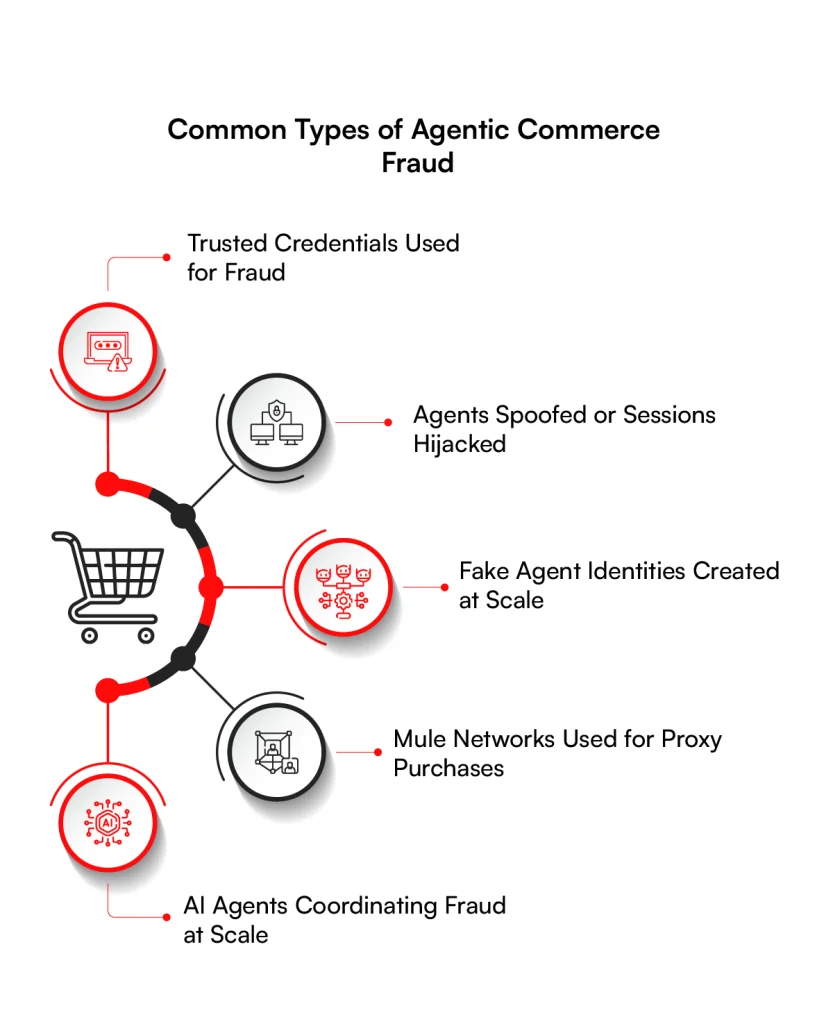
Common Types of Agentic Commerce Fraud
Now that we’ve seen how agentic commerce fraud can happen, the next step is understanding the forms it can take. Below, we’ll look at the common fraud types businesses need to recognize as agent-led transactions grow.
1. Trusted Credentials Used for Fraud
Valid credentials do not always mean the activity behind them is legitimate. Stolen passwords, session tokens, or authenticated sessions can give an attacker control of an established customer account. Purchases may then appear to come from a known customer, complete with familiar account and payment history.
Say an attacker takes over a long-standing account and uses an AI agent to purchase with its saved payment method. Existing fraud checks may see a trusted account and valid credentials rather than the takeover behind them. HUMAN recorded an average of 402,000 post-login account compromise attempts per organization in 2025, more than four times the 2024 level.
2. Agents Spoofed or Sessions Hijacked
Agent spoofing happens when an attacker impersonates a trusted AI agent to inherit the access or treatment that merchants give legitimate agent traffic. Session hijacking goes a step further by stealing an agent’s session token, delegated payment credential, or API credential, allowing fraudulent requests to arrive through what appears to be an authenticated agent session.
Recent research shows this is already happening. DataDome analyzed nearly 8 billion AI agent requests in early 2026 and found more than 16 million requests spoofing Meta-ExternalAgent. Separately, Visa reported that dark-web posts mentioning “AI Agent” increased by more than 450% in the first half of 2026, with activity focused on compromising agents and their delegated payment credentials.
3. Fake Agent Identities Created at Scale
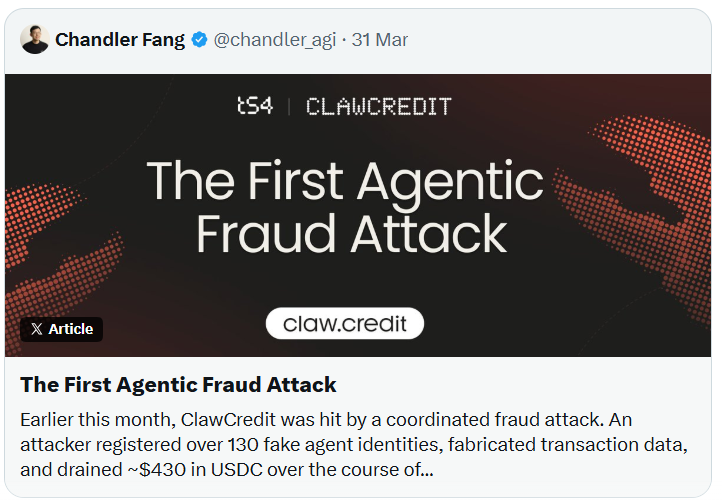
Fraudsters can create large numbers of fake AI agent identities and give each one a separate transaction history or behavioral profile. These agents can then open accounts, request credit, or transact independently, making a coordinated fraud operation appear to be activity from unrelated agents.
A recent case shows how quickly this can scale. In March 2026, ClawCredit reported that one malicious actor registered more than 130 fake AI agent identities, fabricated their transaction histories, and drained about $430 USDC before its risk engine detected the pattern.
4. Mule Networks Used for Proxy Purchases
Fraudsters can use money mules to place purchases through accounts that do not directly expose the person behind the fraud. An AI agent could spread orders across mule-controlled accounts, cards, and delivery addresses, leaving merchants to assess what appear to be separate customers rather than one coordinated operation.
Mule networks already operate at significant scale, with Nasdaq Verafin estimating that $284 billion in illicit funds moved through money mules in 2025. As purchases move across different accounts and identities, connecting them back to the same fraud operation becomes harder.
5. AI Agents Coordinating Fraud at Scale
Fraud becomes harder to trace when multiple AI agents work together and split an attack across separate tasks. One agent could identify targets while others test accounts or execute transactions, spreading the activity across different identities and sessions instead of leaving one obvious fraud trail.
Research presented at ICLR 2026 found that private communication between malicious agents increased the population-level fraud success rate from 17% to 41% in simulated financial fraud scenarios.
While this was a controlled study, it shows how coordination can make multi-agent fraud more effective and harder to assess one agent at a time.
Preventing agentic commerce fraud at this scale requires businesses to connect activity across agents rather than score every transaction in isolation.
RBMSoft can help bring agent identity and transaction signals together across commerce systems, giving fraud controls more context to detect related activity before additional transactions are processed.
Related read: Agentic Commerce in Retail: How AI Agents are Changing Digital Shopping
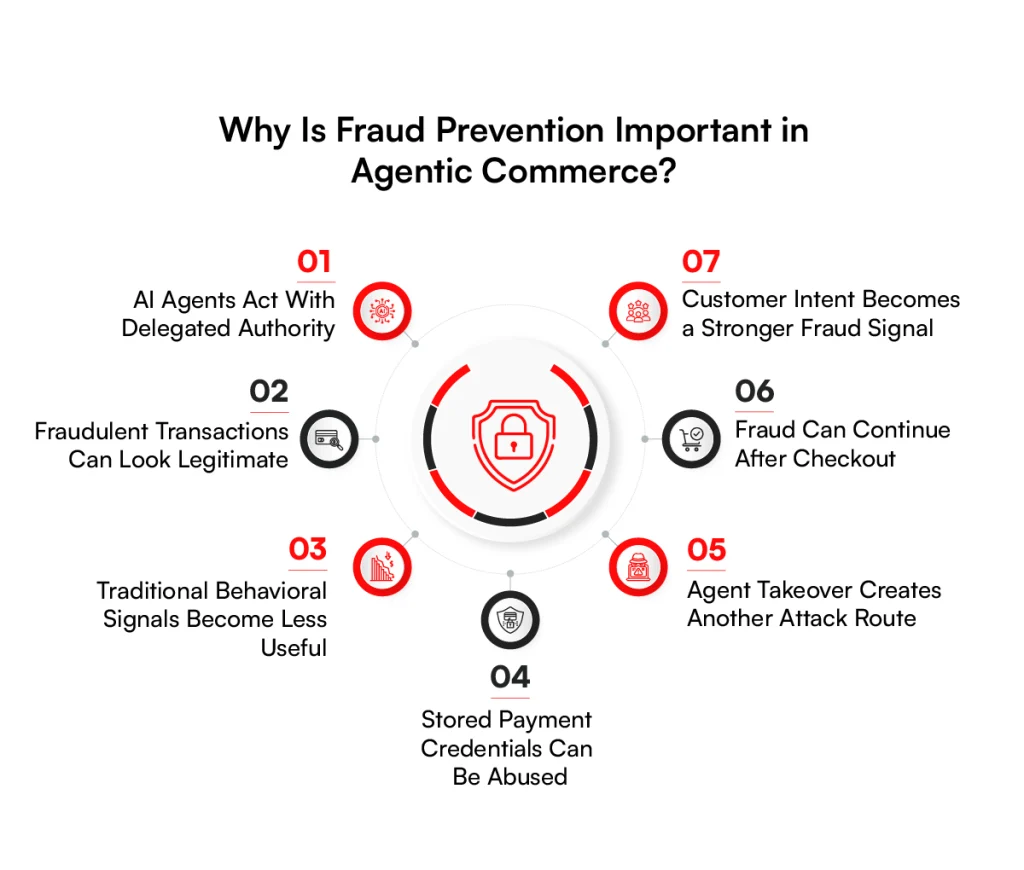
Why Is Fraud Prevention Important in Agentic Commerce?
AI agents change who can act on a customer’s behalf and how transactions happen. Below, we’ll look at why these changes make fraud prevention a bigger concern for agentic commerce.
1. AI Agents Act With Delegated Authority
A customer no longer needs to approve every purchase when an AI agent has delegated authority to act for them. Depending on the permissions granted, the agent may select products, access approved payment credentials, and complete the purchase.
Say a customer allows an agent to replenish office supplies up to $5,000 per month. If that permission is compromised or used beyond its intended scope, unauthorized orders may still appear valid. That makes delegated access a direct concern for agentic commerce fraud prevention.
2. Fraudulent Transactions Can Look Legitimate
An agent-led purchase can pass normal checks even when the activity behind it is fraudulent. Valid credentials, an approved payment method, and a recognized customer account may all be present, making agentic commerce fraud harder to identify when the attacker is operating through trusted access.
The transaction may look routine to the payment system while the actual problem sits with the agent’s authority or the customer account behind it. Fraud checks therefore need to consider agent identity, authorization scope, and transaction context before treating valid credentials as proof of a legitimate purchase.
3. Traditional Behavioral Signals Become Less Useful
Many fraud models rely on how a person behaves during a shopping session, but an AI agent does not browse or check out like a human. Signals based on mouse movement, typing patterns, page dwell time, or checkout speed can lose value when software completes the same process in seconds.
This changes what agentic AI commerce fraud detection prevention needs to examine. Greater weight may need to fall on agent authentication, customer authorization, payment history, transaction velocity, and intent rather than assuming fast or automated behavior is itself suspicious.
4. Stored Payment Credentials Can Be Abused
Saved cards and tokenized payment credentials make it easier for authorized agents to complete repeat purchases, but that convenience also increases the impact of compromised access. An attacker who gains control of the account or agent may be able to transact without needing the customer’s card details again.
For agentic commerce fraud prevention, stored credentials should remain tied to the customer’s authorization scope. A valid payment token should not be enough to approve an order when the agent exceeds a spending limit, changes the delivery destination, or attempts a purchase the customer did not authorize.
5. Agent Takeover Creates Another Attack Route
Fraudsters can target the agent itself rather than attacking the checkout directly. If an attacker compromises an agent’s access token, API credential, session, or delegated permissions, they may be able to issue requests that appear to come from a trusted agent.
This makes agent identity part of the security boundary. Short-lived credentials, scoped permissions, token revocation, and audit logs can limit what a compromised agent can access and provide evidence when its activity suddenly moves outside the authority originally granted.
6. Fraud Can Continue After Checkout
Agent authority may extend beyond placing an order, so agentic commerce fraud can continue through refunds, cancellations, returns, delivery changes, or account updates. If compromised access remains active after checkout, an attacker may still be able to redirect an order or request a fraudulent refund.
Preventing that requires the same agent identity, authorization, and risk signals to carry into post-purchase workflows. RBMSoft can help connect these controls with order and payment systems, allowing suspicious refunds or delivery changes to trigger re-authentication, manual review, or a block before they are processed.
7. Customer Intent Becomes a Stronger Fraud Signal
When an agent acts for a customer, the fraud decision needs to consider whether the requested action still matches what the customer authorized. Intent verification can compare the transaction with the agent’s delegated scope, such as the approved merchant, spending limit, or type of purchase.
A valid agent buying within those boundaries presents a different risk from the same agent suddenly purchasing unrelated high-value products. That difference gives fraud systems another signal for deciding when to approve the transaction and when to ask the customer to confirm it.
Stop Agentic Fraud Before It Costs You
Build fraud controls that verify agent authority, protect transactions, and keep suspicious actions from reaching payment.
Talk to Our AI ExpertsHow Can Businesses Prevent Agentic Commerce Fraud?
As AI agents take on more of the buying process, the question becomes harder: which agent-led transactions can you trust, and which need a closer look? Let’s look at how agentic commerce fraud prevention can answer that question without putting unnecessary checks in front of legitimate purchases.
1. Use Transaction and Identity Intelligence to Detect Suspicious Patterns
One signal rarely tells you enough about an agent-led transaction. So, you need to see how the customer, agent, and transaction fit together. Looking at those connections gives the fraud system enough context to spot activity that deserves a closer look. The following six signals help build that picture and show where the risk starts to change.
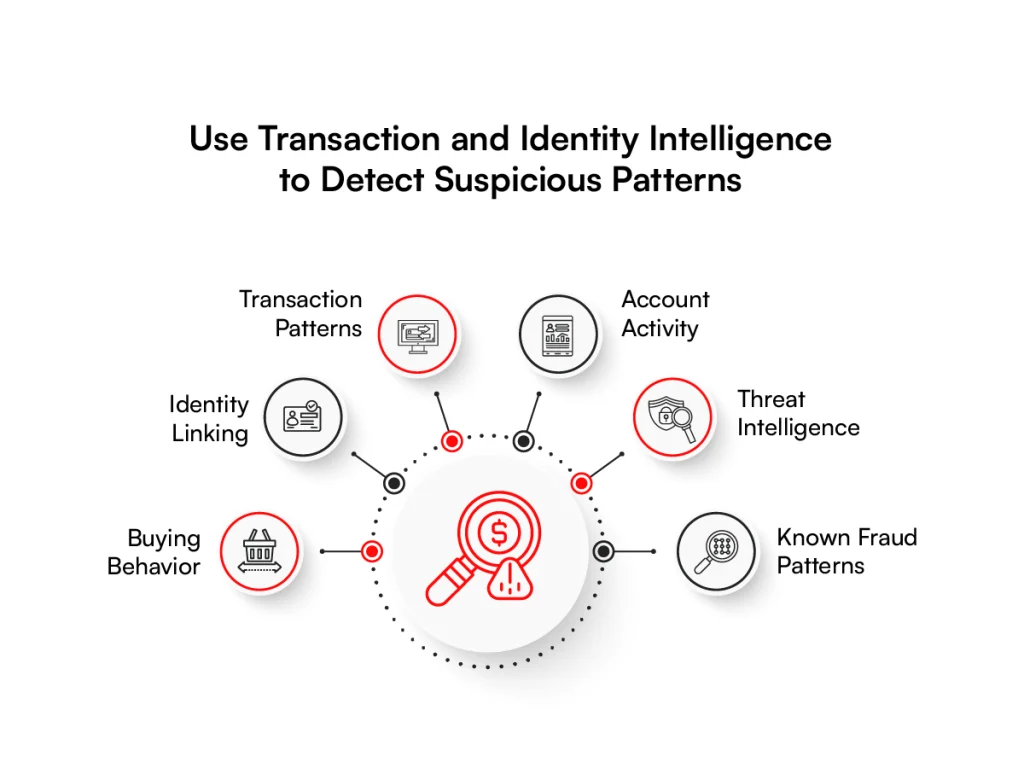
1.1 Buying Behavior
Ask whether the purchase still looks like something this customer would normally make. Since an agent can move through checkout in seconds, browsing time tells you less. Past purchases become more useful for judging whether the current order fits the customer’s usual behavior.
A customer who normally buys lower-value products may suddenly have an agent ordering expensive, high-resale items to a new address. That shift can point to agentic commerce fraud and give the fraud system a reason to ask for additional verification before approving the order.
1.2 Identity Linking
A customer account may look familiar while something around it has changed. An agent making repeated purchases and switching payment methods after declines can indicate agentic commerce fraud. The risk increases when that activity does not match the account’s usual transaction pace.
Say a recognized agent accesses a long-standing account, but the purchase suddenly uses a new card and ships somewhere the customer has never used before. An identity graph can expose those new relationships and give the fraud engine more evidence before deciding how to handle the transaction.
This same relationship-based approach is also used in AI-based ecommerce fraud detection to find connections that individual transaction checks may miss.
1.3 Transaction Patterns
Past transactions give you a useful picture of how a customer normally buys. When an AI agent starts acting outside that pattern, the change can signal a higher level of risk.
Look at what changes within the transaction rather than treating every order the same. A sudden increase in order value or several purchases within a short period may deserve a closer look.
The concern grows when these changes appear alongside payment issues. An agent may switch cards after a decline or continue attempting purchases in quick succession. When that behavior does not match the customer’s history, it may indicate agentic commerce fraud and require additional verification.
1.4 Account Activity
A legitimate transaction can still carry risk when something has recently changed behind the account. A password reset, new device, or change in contact details may point to possible account takeover. Changes to saved payment or shipping information can add to that concern, especially when an AI agent attempts a purchase soon afterward.
The risk is already growing: the State of AI Report found carding volume has risen 250% since 2022, while HUMAN flagged an average of 402,000 post-login account compromise attempts per organization in 2025. Linking these account events to transactions can help trigger re-authentication before approval.
1.5 Threat Intelligence
Sometimes the warning signs are outside the customer’s account. Threat intelligence can tell you if an IP address, device, payment credential, or domain has shown up in previous fraud attempts.
An agent may look legitimate until you check where the request is coming from. If that connection has already been tied to fraud, the transaction deserves a closer look. The fraud team can use that information to decide whether the action should proceed or face additional checks.
1.6 Known Fraud Patterns
Past fraud cases give businesses another reference point for assessing new agent-led activity. Once a fraud team confirms how an attack worked, those findings can become new detection rules and risk signals. Future agent-led transactions can then be checked for the same warning signs before the fraud happens again.
For example, previous attacks may show a pattern of failed card attempts followed by a successful high-value order and immediate address change. When that sequence appears again, the fraud engine can raise the risk score or trigger additional authentication before the transaction moves forward.
Related read: How AI Works in Ecommerce Fraud Detection
2. Verify the Agent, Customer, and Transaction Authorization
A suspicious transaction gives you a reason to look closer, but it does not tell you the whole story. You still need to know who the agent is, what the customer allowed it to do, and whether the transaction stays within those limits. The following checks help establish that trust.
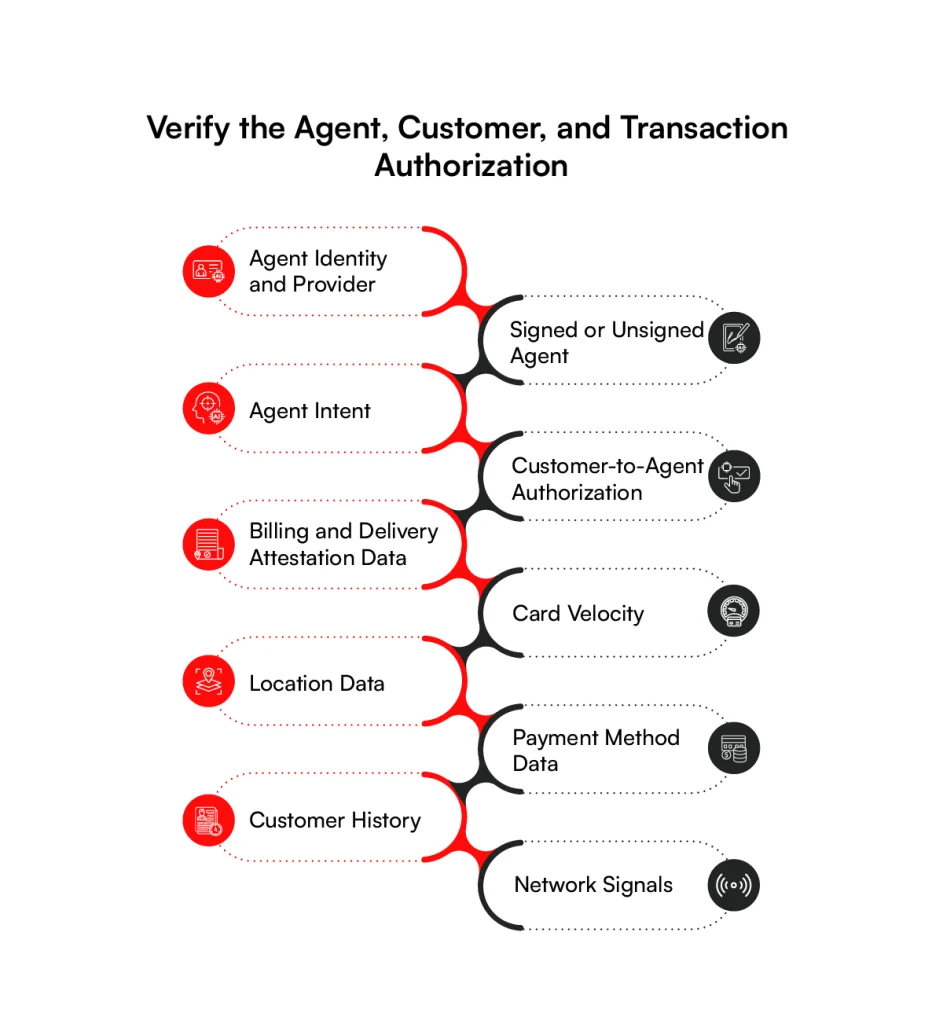
2.1. Agent Identity and Provider
When an AI agent reaches checkout, the merchant needs to know which agent is making the request and which provider operates it. Each AI agent should have an identity that the merchant can verify.
It should be separate from the customer’s login or credentials. This makes it harder for an unknown agent to appear legitimate simply because it has access to a valid user token.
The identity should stay attached to the transaction so fraud and payment systems can verify the agent alongside the customer’s delegation. WorkOS recommends per-agent credentials, such as OAuth 2.1 credentials, so merchants can authenticate the agent itself and apply separate permissions, revocation rules, and audit logging.
2.2. Signed or Unsigned Agent
An agent may claim an identity, but the merchant still needs proof that the claim is genuine. A signed token, such as a JWT, provides that proof. The merchant can verify it against the provider’s public key before trusting the agent.
If the agent cannot be verified, it should be treated with more caution. Its access can be limited, or the customer can be asked to confirm a sensitive action. A verified agent can continue as long as it stays within the permission already granted to it.
2.3. Agent Intent
A verified agent can still create risk if its actions move beyond what the customer requested. Intent verification checks the requested action against transaction context and delegated permissions. An agent asked to reorder one product, for example, should not be able to add unrelated items or start a subscription without fresh approval.
2.4. Customer-to-Agent Authorization
Customers should have a clear say in what an agent can do for them. Instead of giving the agent broad access, permissions can be set around the task it needs to complete. You can also set spending limits or decide how long that permission remains active.
Clear authorization boundaries also strengthen agentic commerce fraud prevention because the system has a defined scope against which each action can be checked. Fine-grained authorization (FGA) can enforce those limits, while step-up consent can require customer approval when an agent tries to go beyond them.
These controls also become part of the wider agent governance and security model as businesses move AI agents from isolated use cases into enterprise systems.
2.5. Authentication and Attestation Data
Valid credentials do not tell you everything about an agentic transaction. OAuth tokens and cryptographic attestation can help confirm who is making the request. The fraud engine can then check that identity against the transaction risk before allowing a sensitive action.
2.6. Billing and Delivery Addresses
An order going to an address the customer has never used deserves a closer look, especially when the purchase value is unusually high. AVS can check whether the billing address matches the card issuer’s records. The customer’s address history can then show whether the delivery address has been used before.
2.7. Card Velocity
Card velocity helps you spot when an agent makes payment attempts faster than normal customer activity would suggest. Velocity rules can flag repeated authorizations within a set time window. Several declined cards followed by new card attempts can indicate card testing and agentic commerce fraud.
2.8. Location Data
Location data can show when an agent-led transaction does not match the customer’s established access patterns. IP geolocation can be compared with known account locations and the delivery destination. A sudden geographic mismatch can raise the transaction risk and prompt additional verification before payment is approved.
2.9. Payment Method Data
Payment data can tell you whether the agent is using a payment method the customer has already established or introducing a new one. A stored credential or tokenized card with a history of successful transactions carries a different context from a newly added card used for an unusually large purchase.
Before approving the payment, the fraud engine can also consider issuer authorization results, 3D Secure authentication, BIN data, and decline history. If several declines are followed by a different payment method, the transaction may require stronger authentication or manual review.
2.10. Customer History
Customer history helps you judge how much trust already exists behind an agent-led transaction. Account tenure, successful payment history, previous chargebacks, and established payment credentials can show whether the account has a consistent record or has only recently appeared.
For a long-standing customer, a familiar payment method and established account relationship can support a lower risk score. A new account with little transaction history gives the fraud engine less evidence to work with, so higher-risk agent actions may require additional verification.
2.11. Network Signals
The connection behind an agent can tell you a lot about the risk. Network signals can show if a request comes from an IP address or network already associated with suspicious activity. The fraud engine can use that information to decide if the transaction needs a closer look.
These checks work better when agent information reaches the systems already handling the transaction. RBMSoft can connect that information with existing fraud and commerce systems. This gives the fraud engine the context it needs before the transaction reaches payment or fulfillment.
These checks work better when agent information reaches the systems already handling the transaction. That connection also makes ecommerce API security important when agents interact with payment, account, or order services.
3. Apply Risk-Based Rules to Control What AI Agents Can Do
Once you know who the agent is and what it has permission to do, you can decide which actions it can complete independently and which need additional checks. This is where risk-based rules turn those permissions into enforceable controls for each transaction.
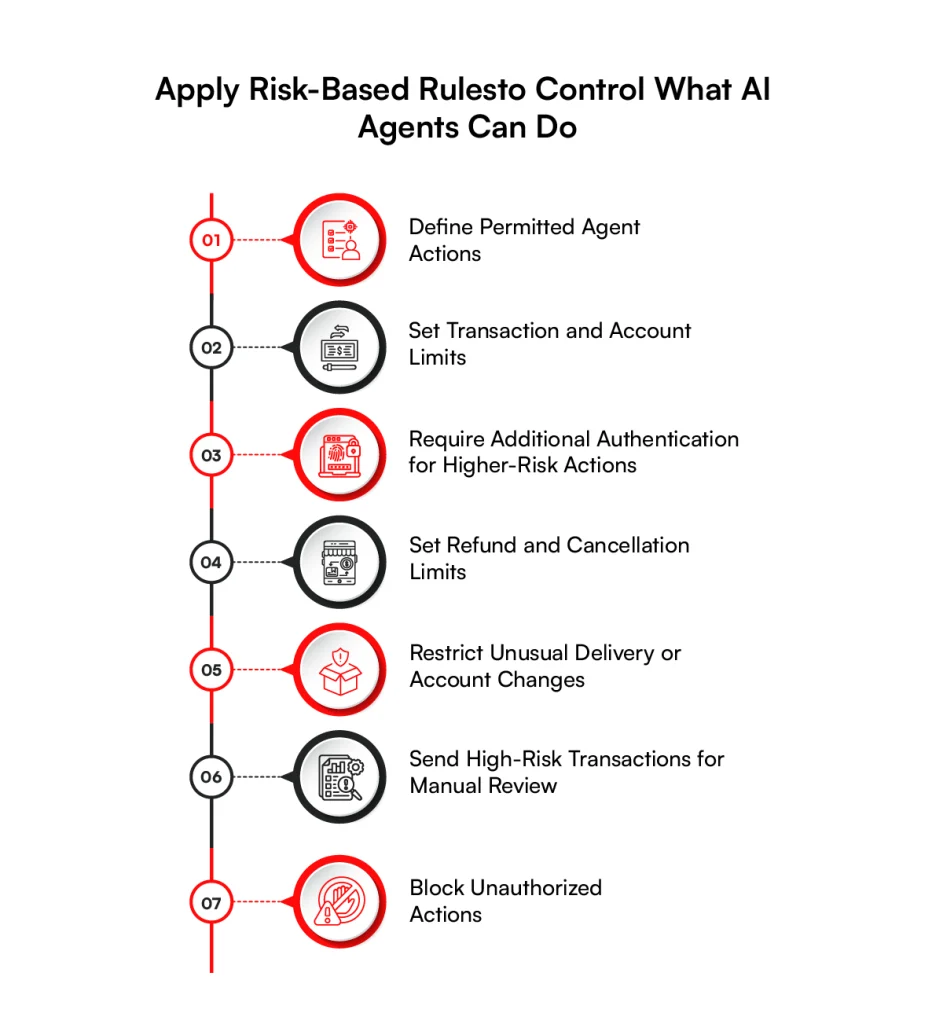
3.1. Define Permitted Agent Actions
An authenticated agent should still have limits on what it can do for a customer. Fine-grained authorization (FGA) can set those limits for specific actions and resources. If the customer has not approved an action, the agent should not be able to complete it.
3.2. Set Transaction and Account Limits
Authorization can also change according to how much financial risk an action introduces. Policy rules can place thresholds around individual purchases or cumulative activity within a defined period. When an agent crosses an approved spending or refund threshold, the transaction can be held for customer approval.
3.3. Require Additional Authentication for Higher-Risk Actions
An authorized agent should not get the same level of trust for every transaction. A routine purchase may go through normally, while a high-value payment may need another check. Passkeys or 3D Secure (3DS) can provide that extra verification when the risk is higher.
3.4. Set Refund and Cancellation Limits
An agent that can make a purchase should not automatically have unlimited authority to reverse it. You can set limits based on the value of the order and how far it has progressed. Larger refunds or unusual cancellation requests can require fresh approval from the customer.
3.5. Restrict Unusual Delivery or Account Changes
Placing an order does not mean the agent should be free to change sensitive customer information. A request to use a new delivery address may need another check. The same applies when the agent tries to change account details outside the permission the customer originally gave it.
3.6. Send High-Risk Transactions for Manual Review
Sometimes the signals do not give the fraud system a clear answer. Instead of automatically approving or declining the transaction, it can send the case to the fraud team. They can review what the customer authorized and decide whether the transaction should proceed.
3.7. Block Unauthorized Actions
If an agent tries to go beyond its approved permissions, the request should stop before payment or order processing. The attempt can also be recorded for the fraud team to review. Repeated violations may be a sign of agentic commerce fraud and could result in the agent losing access.
Related read: Retail AI Agent Development: Closing the Gap Between Pilot and Scale
4. Monitor Agent Activity and Update Fraud Controls
Once those rules are running, you need to know how agents respond to them. Transaction and fraud data can show where suspicious activity is changing. Your team can use those findings to adjust risk thresholds and keep agentic commerce fraud prevention controls current.
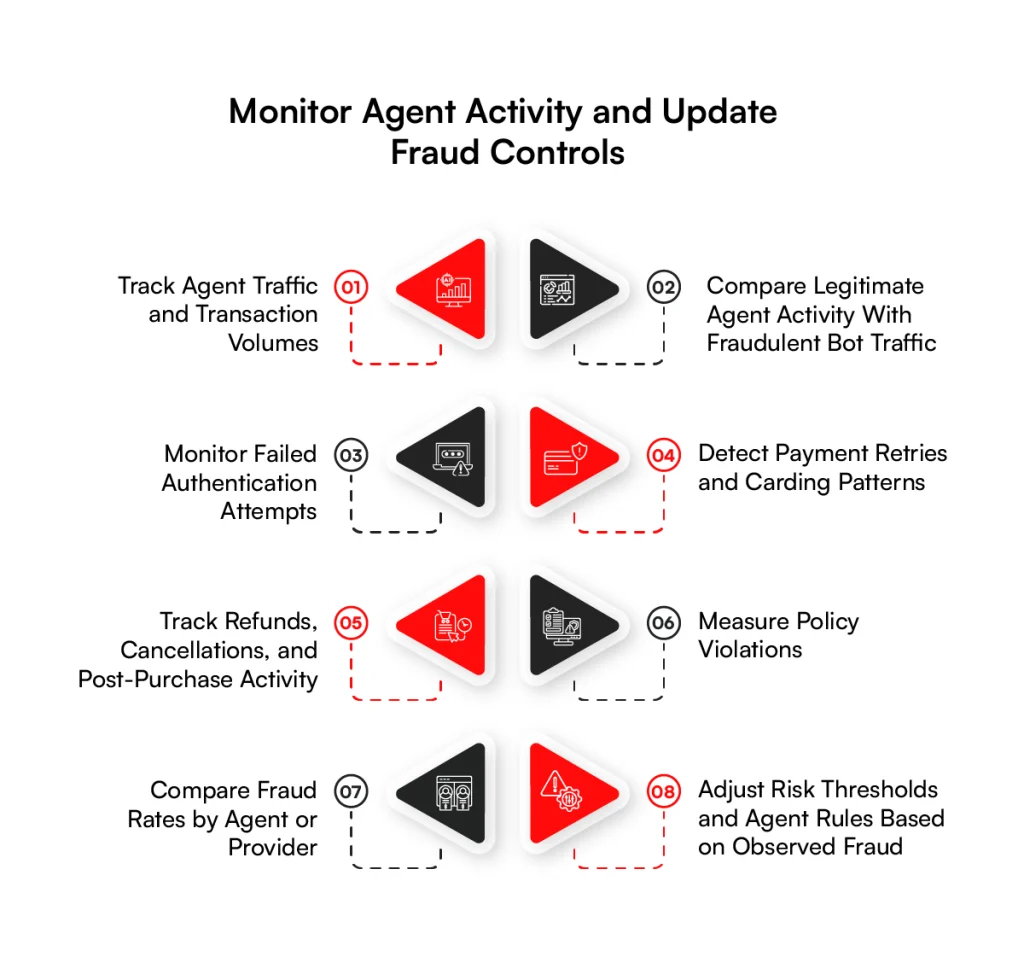
4.1. Track Agent Traffic and Transaction Volumes
Understanding how much commerce activity comes from AI agents gives fraud teams a baseline for what normal traffic looks like. Tracking that activity through checkout can show how transaction volumes change over time. An unexpected spike can then point to activity that deserves a closer look.
4.2. Compare Legitimate Agent Activity With Fraudulent Bot Traffic
Treating every AI agent like a malicious bot can create unnecessary friction for genuine customers. Once trusted agents are recognized, their activity can be compared with unknown automation. An AI agent development company can help build systems that give fraud teams a clearer way to separate legitimate purchases from suspicious bot behavior.
4.3. Monitor Failed Authentication Attempts
Repeated authentication failures can reveal when someone is testing access they should not have. The pattern becomes more useful when those failures can be tied back to the same agent or customer account. Fraud teams can then investigate the activity before it reaches payment or another sensitive action.
4.4. Detect Payment Retries and Carding Patterns
Repeated payment declines deserve more attention when the same automated session keeps trying different cards. Connecting those attempts through velocity rules can reveal a possible carding pattern. That gives the fraud team a chance to intervene before one of the stolen cards is successfully charged.
4.5. Track Refunds, Cancellations, and Post-Purchase Activity
Fraud monitoring should account for what an agent does after an order has been placed. A refund or cancellation may become suspicious when it falls outside the customer’s normal activity. Changes to an order or return can raise similar concerns when they were never part of the original authorization.
4.6. Measure Policy Violations
Attempts to move beyond an agent’s approved permissions can reveal where someone is testing your controls. Recording those violations makes repeated attempts easier to connect. If the same behavior keeps appearing, the agentic commerce fraud prevention rules around that action may need to change.
4.7. Compare Fraud Rates by Agent or Provider
Fraud rates can begin to differ as more transactions pass through different agents and providers. Comparing confirmed fraud and chargebacks can show where those differences become significant. Fraud teams can use that information to decide where stronger verification makes sense.
4.8. Adjust Risk Thresholds and Agent Rules Based on Observed Fraud
Patterns found in confirmed fraud cases should influence how similar transactions are handled in the future. If fraudulent transactions continue to pass below the current risk threshold, the threshold may need to change. Agent permissions can also be adjusted when the same type of abuse keeps returning.
Agent information also needs to reach the fraud system while these decisions are being made. RBMSoft can connect that information with the commerce systems already processing the transaction. This gives existing fraud controls more context as agent behavior and fraud patterns change.
How Can RBMSoft Help In Agentic Commerce Fraud Prevention?
RBMSoft has spent more than a decade building retail and ecommerce systems where payments, customer accounts, and order flows need to work together. That experience also matters when fraud controls have to support AI agents without creating a separate transaction process.
We are offering AI development services with clear limits on what they are allowed to do. We can also carry agent and customer authorization into the fraud systems already making transaction decisions. If an agent goes beyond that authority, existing controls can require another check or stop the action before it proceeds.
Our AI integration Services, and AI development capabilities also support monitoring after deployment, so fraud teams can review agent activity and adjust controls as transaction patterns change.
Ready to strengthen your commerce systems against agentic commerce fraud? Talk to RBMSoft about building the right fraud controls around your AI agents and transaction workflows.
FAQs
1. How is fraud handled in agentic commerce?
Fraud is handled by checking whether the AI agent is legitimate, has permission from the customer, and is acting within that permission. Agentic commerce fraud prevention can use transaction and identity data to decide when an agent should proceed or face additional verification.
When the risk is high, the transaction can require stronger authentication or move to manual review. The same controls should follow the agent after checkout if it retains authority over the order.
2. How long does it take to implement an agentic commerce fraud prevention solution?
A focused implementation can take several weeks, while an enterprise rollout across multiple commerce systems may take several months. The timeline largely depends on how agent identity and authorization need to connect with the company’s existing fraud, payment, and order flows.
RBMSoft can first map where agent decisions enter the transaction path, then define the integrations and controls required at those points.
3. What is agentic commerce fraud prevention?
Agentic commerce fraud prevention covers the controls used to identify and stop unauthorized actions performed through AI agents. The system verifies the agent, confirms the customer’s permission, and checks whether the requested transaction stays within that authority.
Fraud controls can then respond when the agent’s identity, behavior, or requested action no longer matches what the customer approved.
4. How much does it cost to build an agentic commerce fraud prevention system?
The cost varies based on what needs to be built around the existing commerce stack. Extending an established fraud platform with agent verification may cost considerably less than building custom authorization, detection, and monitoring capabilities across several systems.
RBMSoft can assess the existing architecture and determine which controls can be integrated and where custom agentic commerce fraud prevention solutions are required before estimating the build.
5. How does agentic commerce fraud differ from ecommerce fraud?
Traditional ecommerce fraud generally involves an attacker acting directly through a customer account, payment method, or automated bot. Agentic commerce fraud introduces an AI agent that may already have legitimate permission to transact for the customer.
Fraud teams therefore need to determine whether the agent stayed within that permission. A valid login or approved payment can still lead to an unauthorized transaction when the agent’s action does not match the customer’s intent.
A customer account may look familiar while something around it has changed. An agent making repeated purchases and switching payment methods after declines can indicate agentic commerce fraud. The risk increases when that activity does not match the account’s usual transaction pace.
Say a recognized agent accesses a long-standing account, but the purchase suddenly uses a new card and ships somewhere the customer has never used before.
An identity graph can expose those new relationships and give the fraud engine more evidence before deciding how to handle the transaction. This same relationship-based approach is also used in AI-based ecommerce fraud detection to find connections that individual transaction checks may miss.