





Quick Summary:
- Ecommerce fraud is becoming more advanced, making traditional rule-based and manual detection methods less effective for modern businesses.
- AI improves fraud prevention by analyzing large volumes of data in real time, identifying suspicious behavior, and continuously adapting to new fraud patterns.
- Technologies such as machine learning, behavioral analytics, device fingerprinting, and real-time risk scoring help businesses detect fraud more accurately.
- AI-driven fraud detection reduces false positives, lowers manual workload, speeds up response times, and protects the customer experience.
- Agentic AI takes fraud prevention further by autonomously blocking risky transactions, triggering verification, and escalating complex cases in real time.
- A successful implementation requires the right strategy, proper integration, continuous learning, and a trusted technology partner to scale securely.
In an ecommerce business, fraud is more critical than sales, inventory, and customer experience. From fake orders and payment scams to account takeovers and chargebacks, these ecommerce frauds have become more sophisticated and harder to detect.
What makes it even more frustrating is that traditional fraud prevention methods often create new problems of their own. They can be slow, heavily manual, and prone to false positives that block genuine customers during checkout.
If you are growing quickly, the challenge becomes even bigger. Higher transaction volumes mean more opportunities for fraud, more alerts to review, and more pressure on your team to make the right decisions fast.
At the same time, customers expect a smooth and secure buying experience. They want instant approvals, frictionless payments, and trust in your platform.
Balancing security with convenience is not easy, especially when your fraudsters have Gen AI in their hands.
- They use LLMs to draft more contextually relevant phishing emails without typos or grammatical errors.
- They target voice authentication systems at banks, cloning a customer’s voice using deepfake technology if they obtain voice samples via spam calls.
According to the Data by Mastercard:
- Synthetic identity fraud – 61%
- Impersonation scams – 60%
- Cross-border fraud – 54%
- Buy Now, Pay Later (BNPL) abuse – 42%
- Deepfakes – 21%
Thus, with this AI’s double-edged impact, ecommerce businesses are stepping up as well, deploying AI to fight back faster.
- AI helps businesses detect suspicious activity in real time, analyze massive volumes of transaction data, and adapt quickly as fraud tactics evolve.
- Instead of relying only on fixed rules and delayed reviews, AI can analyze transactions in real time, learn from new fraud patterns, and make smarter decisions instantly.
- LLMs are also being adopted to predict a customer’s next transaction, helping payments firms preemptively assess risks and block fraudulent transactions.
- AI trains your fraud systems using thousands of complex, evolving patterns that rarely appear in historical data. This enables detection models to recognize sophisticated criminal tactics before they impact real-world transactions.
In this blog, you will explore how AI for ecommerce fraud detection is revolutionizing, the technologies behind it, and how to implement it effectively in your business.
Market Trends for AI Fraud Detection in Ecommerce
Agentic commerce fraud is becoming more complex, and traditional systems are struggling to keep up. Businesses need faster, smarter ways to detect threats, which is where AI comes in.
It helps analyze large volumes of transaction data, identify unusual patterns, and stop fraud in real time. This shift from reactive to proactive detection is exactly why AI adoption is accelerating.
The market growth reflects this demand. The global AI-driven fraud analytics market in ecommerce was valued at around USD 2.98 billion in 2024 and is expected to grow at a strong CAGR of 22.7%, reaching approximately USD 24.53 billion by 2033.
This growth is fueled by increasing digital transactions, the expansion of online shopping platforms, and the rising sophistication of fraud attempts.
Businesses are moving toward AI-powered, real-time fraud detection systems that are more adaptive, scalable, and effective in handling modern threats.
Is your store protected against fraud?
See how AI-powered fraud detection can stop chargebacks, counterfeits, and suspicious orders, before they cost you revenue.
Get a FREE Fraud Risk Assessment
Variations and Types of Ecommerce Fraud Detection Techniques
Ecommerce businesses use a combination of techniques to detect and prevent fraud. Each method addresses a specific layer of risk, but most traditional approaches still operate in silos and struggle to keep pace with modern fraud tactics. Here is a closer look at the key techniques used today.
- Multi-factor authentication (MFA)
MFA strengthens account security by requiring users to verify their identity through multiple steps, such as OTPs, authentication apps, or biometrics.
It significantly reduces the risk of unauthorized access, especially when credentials are stolen. However, if not implemented thoughtfully, it can add friction to the user experience and lead to drop-offs during checkout or login.
- Machine learning and artificial intelligence
Early implementations of machine learning help analyze transaction patterns and flag suspicious behavior based on historical data.
These systems can improve detection accuracy over time, but many traditional models rely heavily on static rules and require constant tuning to remain effective against new fraud patterns.
- IP address analysis
This method evaluates where a user is accessing the platform from. Sudden changes in location or suspicious IP behavior can signal risk.
However, tools like VPNs make it easier for fraudsters to disguise their true location.
- Regular security audits and updates
Routine audits help identify system vulnerabilities, outdated software, and potential entry points for attackers.
Keeping systems up to date is essential for maintaining baseline security. The limitation is that audits are periodic, so they may not catch threats that emerge between review cycles.
- Employee training and awareness
Employees play a crucial role in fraud prevention, especially in identifying phishing attempts, suspicious emails, or unusual system activity.
Regular training helps them recognize common fraud tactics such as fake payment confirmations, social engineering attacks, or unauthorized access requests.
This human layer of defense is important because not all threats can be detected by automated systems alone.
However, relying on human awareness comes with limitations. People can overlook subtle warning signs, especially when dealing with high workloads or repetitive tasks.
Inconsistency in judgment and occasional lapses in attention create gaps that fraudsters can exploit.
While training reduces risk, it cannot eliminate it, which is why it needs to be supported by more reliable, technology-driven detection methods.
- User behaviour analysis
This method tracks how users interact with a platform, including browsing habits, login frequency, and transaction patterns.
Any deviation from normal behavior can signal potential fraud. While useful, traditional systems may struggle to process behavioral data in real time or at scale.
- Real-time transaction monitoring
Real-time transaction monitoring evaluates every transaction the moment it happens by analyzing data points such as purchase value, location, device details, and user history.
This instant assessment allows businesses to detect suspicious activity and take action before the transaction is completed, reducing the chances of fraud slipping through.
The challenge lies in handling both speed and scale. Ecommerce platforms process thousands of transactions simultaneously, and each one must be assessed within milliseconds without slowing down the checkout experience.
Traditional systems often rely on fixed rules, which struggle to capture subtle or evolving fraud patterns in such high-volume environments.
Another key issue is accuracy. Without advanced intelligence, these systems tend to flag legitimate transactions as risky, leading to false positives. This can frustrate genuine customers and impact conversions.
To be effective, real-time monitoring needs to understand context and adapt continuously, rather than relying only on rigid rule-based checks.
- Fraud orchestration
Fraud orchestration integrates multiple fraud detection tools, data sources, and workflows into a single, coordinated system, enabling businesses to evaluate transactions across several layers, including payment validation, identity checks, and behavioral analysis.
This improves visibility and decision-making, as all signals are processed together instead of in isolation.
However, the challenge lies in integrating different systems that may use varied data formats and logic, ensuring they work seamlessly without delays.
As more tools and rules are added, the system becomes increasingly complex to manage, requiring continuous monitoring, updates, and optimization to avoid inefficiencies or slow transaction processing.
- Fraud analysis
Fraud analysts review flagged transactions to determine whether they are genuine or malicious. This step helps refine detection rules over time, but it is often slow and reactive, relying heavily on manual effort.
- Employing address and card verification systems
Verification tools like AVS and CVV checks confirm whether the billing details match the card information. They are useful for filtering out basic fraud attempts, but are not strong enough to stop more sophisticated attacks.
- Utilising biometrics and behavioural analytics
Biometric verification uses unique identifiers, such as fingerprints or facial recognition, while behavioral analytics monitors interaction patterns, such as typing speed or device usage.
These methods offer deeper security but require advanced infrastructure and higher implementation effort.
Individually, these techniques provide value, but they often operate in silos and struggle against modern, fast-evolving fraud tactics.
However, their gaps and limitations set the stage for more advanced AI-driven approaches that can detect fraud more quickly and accurately.
How AI-Based Fraud Detection Works in Ecommerce?
AI for ecommerce fraud detection works by combining multiple data signals, learning from past activity, and making instant decisions on every transaction.
Instead of relying on static rules, it continuously learns what normal behavior looks like and flags anything that seems unusual. This allows businesses to detect both known and unknown fraud patterns while maintaining a smooth customer experience.
Here is how the key components work together.
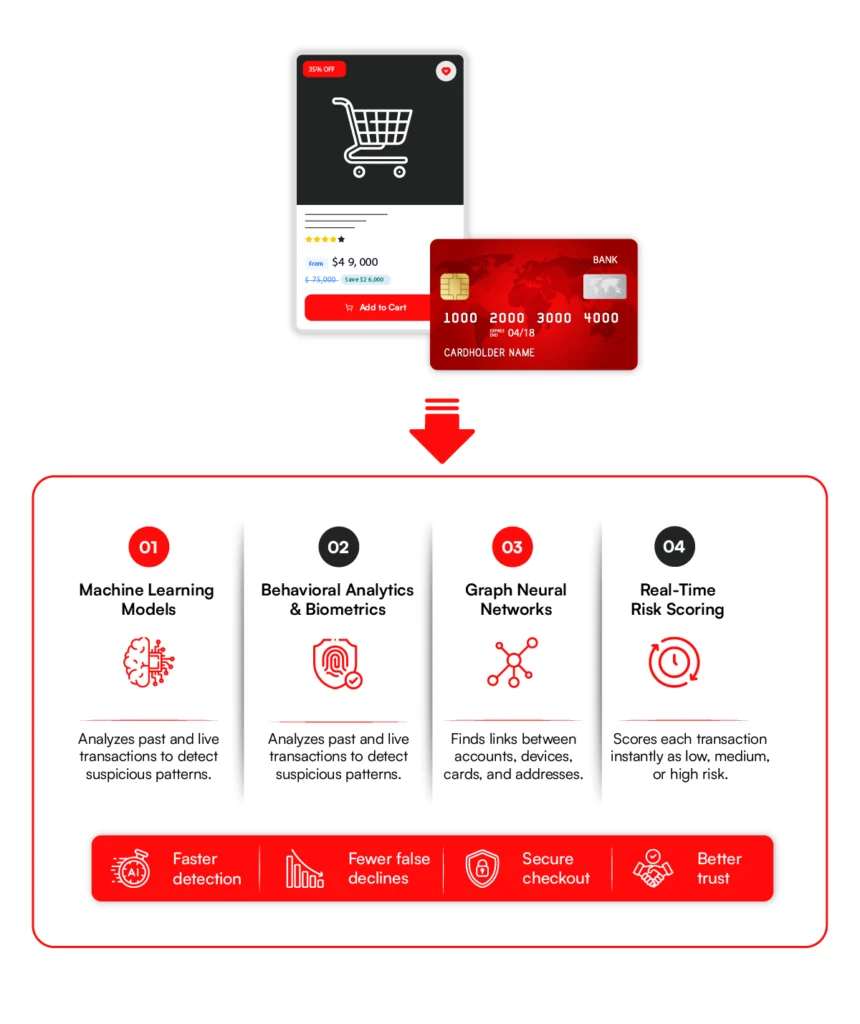
1. AI & Machine Learning (ML) Models
Machine learning forms the backbone of AI fraud detection. These models analyze historical and real-time data to identify patterns, predict risks, and improve accuracy over time.
- Supervised Learning
In supervised learning, the model is trained on historical data labeled as fraudulent or legitimate. It learns patterns such as unusual purchase amounts, mismatched billing details, or sudden changes in buying behavior.
Once trained, it can quickly classify new transactions based on what it has learned. The more quality data it receives, the better it becomes at detecting fraud with higher precision.
- Unsupervised Learning (Anomaly Detection)
Unsupervised learning does not depend on labeled data. Instead, it builds a baseline of what normal behavior looks like across users and transactions. When a transaction deviates from this baseline, it is flagged as suspicious.
This approach is particularly useful for identifying new or emerging fraud tactics that have not been seen before, making it a critical layer in modern fraud detection.
- Deep Learning and Neural Networks
Deep learning models handle highly complex and large-scale data. They can analyze sequences of user actions, device interactions, and transaction flows to detect subtle patterns that simpler models might miss.
For example, they can identify coordinated fraud attempts or detect patterns across multiple sessions. These models are especially effective in high-volume environments where fraud signals are not always obvious.
2. Behavioral Analytics and Biometrics
AI goes beyond transaction data to focus on how users behave throughout their journey.
- User Entity and Behavior Analytics (UEBA)
UEBA creates detailed profiles for each user based on their typical behavior. This includes login frequency, browsing patterns, purchase habits, and even the time of activity.
When a user suddenly behaves differently, such as logging in from a new location and making a high-value purchase, the system flags it as a potential risk. This helps in identifying account takeovers and insider threats.
- Behavioral Biometrics
Behavioral biometrics analyzes how users interact with a platform. It tracks patterns like typing speed, mouse movements, scrolling behavior, and touch gestures.
These patterns are unique to each user and difficult to replicate, even if login credentials are stolen. This adds an invisible layer of security that works in the background without disrupting the user experience.
- Device Fingerprinting
Device fingerprinting collects information about the user’s device, such as browser type, operating system, screen resolution, and installed plugins. This data is used to create a unique device identity.
Even if fraudsters change accounts or use different IP addresses, the system can recognize suspicious devices and link them to past fraudulent activity.
3. Graph Neural Networks (GNNs)
Graph Neural Networks take fraud detection a step further by focusing on relationships rather than isolated events. In ecommerce, fraud rarely happens in a vacuum. Fraudsters often operate in networks using multiple accounts, shared devices, similar payment methods, or even common shipping addresses.
GNNs map these connections into a graph structure in which users, devices, transactions, and payment details serve as nodes, and their relationships form links.
Instead of evaluating a single transaction in isolation, the model examines how it is connected to other activities in the system.
This makes it possible to uncover patterns that are otherwise invisible. For example, a new account may look legitimate in isolation, but if it is linked to previously flagged devices or shares behavioral similarities with known fraudulent accounts, the system can detect the risk early.
Another advantage is the ability to detect coordinated fraud rings. Fraudsters often create clusters of accounts that interact in subtle ways to avoid detection.
GNNs can identify these clusters by analyzing how entities are connected over time, helping businesses stop large-scale fraud operations instead of just individual cases.
4. Real-Time Risk Scoring
Real-time risk scoring is where all AI components come together to make instant decisions. Instead of relying on a simple approve-or-decline logic, AI assigns a dynamic risk score to every transaction as it occurs.
This score is calculated using multiple inputs, including transaction value, user behavior, device data, location, historical activity, and even network-level insights from models such as GNNs. Each factor contributes to an overall risk profile, which is evaluated within milliseconds.
What makes this powerful is the flexibility in decision-making. A low-risk transaction moves through seamlessly, ensuring a smooth customer experience.
A medium-risk transaction may trigger additional verification steps, such as OTP or biometric checks. A high-risk transaction can be blocked instantly or sent for deeper review.
The complexity lies in balancing security with user experience. If the system is too strict, it may block genuine users. If it is too lenient, fraud can slip through. AI continuously learns from outcomes, adjusting scoring thresholds and improving accuracy over time.
This adaptive scoring approach allows businesses to respond to threats in real time while minimizing friction for legitimate customers, which is something traditional rule-based systems struggle to achieve.
Real Examples of AI for Ecommerce Fraud Detection
Many of the world’s leading platforms already use AI for ecommerce fraud detection to fight at scale. Their success shows how artificial intelligence can protect businesses, customers, and marketplaces while maintaining a smooth buying experience.
- Amazon uses AI innovations to stop fraud and counterfeits
Amazon has invested heavily in AI-driven brand protection systems to detect fraud, counterfeit products, and policy abuse across its marketplace. According to its 2024 Brand Protection Report, Amazon’s proactive AI controls blocked more than 99% of suspected infringing listings before brands even needed to report them.
This shows how AI can move fraud prevention from reactive takedowns to proactive detection.
Amazon also uses machine learning, automation, and expert investigations to monitor seller activity, product listings, and suspicious behavior patterns at a massive scale. Its Transparency program has verified billions of product units as genuine, helping reduce counterfeit risks for customers.
By combining AI with human expertise, Amazon can identify threats faster and protect trust across a complex global marketplace.
- Shopify’s machine learning technology predicts and flags fraud
Shopify uses machine-learning models trained on billions of transactions from millions of merchants to detect fraudulent orders in real time.
The system evaluates signals such as country, IP address, payment details, wallet type, and customer behavior to assess risk before an order is fulfilled. This allows merchants to make faster and more informed decisions.
What makes Shopify’s approach powerful is continuous learning. As fraud patterns evolve, the models are updated with new signals and historical outcomes, helping improve detection accuracy over time.
Shopify has also used AI-driven interventions to stop millions of fraudulent authorization attempts while still maintaining high approval rates for legitimate buyers. This balance between fraud prevention and customer experience is where AI delivers real business value.
What Amazon & Shopify knew before the order shipped — now you can too.
AI lets Amazon and Shopify detect threats before fulfilment, preventing a brand from being harmed. You can apply the same logic to your store, without building it from scratch.
Build Your Fraud Detection StackAgentic AI in eCommerce Fraud Detection: Beyond Detection to Autonomous Action
Traditional AI can detect suspicious activity, score risk, and send alerts. That is valuable, but many businesses still depend on human teams to review cases, make decisions, and trigger the next step.
In fast-moving eCommerce environments, delays can lead to chargebacks, lost revenue, and poor customer experiences. This is where Agentic AI changes the model.
Agentic AI does not just identify fraud signals. It can reason through context, choose the best next action, and execute approved responses automatically. Instead of stopping at detection, it helps your business respond in real time with speed and consistency.
From Reactive to Autonomous: How Agentic AI Changes the Game
Most traditional fraud systems are reactive. They flag suspicious behavior after it happens and wait for manual review. That creates queues, slows approvals, and gives fraudsters more time to act. Agentic AI moves fraud prevention into an autonomous model.
It continuously monitors transactions, user behavior, devices, and account activity. When it spots unusual patterns, it can instantly decide whether to approve, block, request verification, hold an order, or escalate the case.
This means your fraud strategy becomes faster, smarter, and available around the clock. Instead of responding after damage is done, you prevent problems before they grow.
What Agentic AI Actually Does When It Detects Fraud
When Agentic AI detects suspicious activity, it does more than send an alert. It evaluates the full context using real-time data, past transaction history, device signals, and behavioral patterns. Then it takes the most appropriate next step based on business rules and risk thresholds.
For example, it may allow a low-risk order to proceed without friction, request OTP verification for a medium-risk transaction, or instantly block a high-risk purchase.
It can also freeze suspicious accounts, route cases to analysts, trigger customer notifications, or update internal systems automatically. Because it learns from outcomes, it keeps improving its decisions over time. This helps reduce false positives while strengthening protection.
Challenges and Limitations of Existing Ecommerce Fraud Detection Methods that AI Solves
Traditional fraud detection methods still play an important role, but they come with limitations that become more obvious as businesses scale. The problem is that they cannot keep up with the speed, volume, and complexity of modern fraud.
1. Time-Consuming
Many systems rely on sequential checks or delayed reviews rather than on instant decision-making. A transaction gets flagged, enters a queue, and waits for validation.
This process creates delays that are impractical in an environment where thousands of transactions occur every minute. Fraudsters exploit this gap and carry out multiple fraudulent activities before any action is taken.
2. Labor-Intensive
Fraud detection still relies heavily on manual effort, especially in traditional setups. Teams are constantly monitoring alerts, reviewing flagged transactions, and investigating suspicious activities throughout the day. This is not a one-time task but an ongoing process that demands attention and consistency.
The complexity increases when a single transaction generates multiple risk signals across systems such as payment gateways, device-tracking tools, and behavioral analytics platforms. Analysts are expected to piece together all this fragmented information, understand the context, and make quick decisions.
As transaction volumes grow, this workload becomes harder to manage, making it difficult to scale without significantly increasing operational costs and resources.
3. Prone to Human Error
When systems depend heavily on manual review, inconsistency becomes inevitable. Analysts must process large amounts of data quickly, often under pressure. This leads to missed fraud signals or incorrect flags on genuine users. As the system becomes more complex, it becomes harder for humans to make accurate decisions every time.
4. Reactive Rather than Proactive
Traditional approaches rely on identifying patterns that have already been seen before. This means they act only after fraud indicators appear. The problem is that modern fraud evolves quickly. By the time a pattern is recognized and rules are updated, attackers have already found new ways to bypass the system.
5. Lack of adaptability
Rule-based systems are inherently rigid. When new fraud patterns emerge, these systems cannot adjust automatically. Updates require manual intervention, testing, and deployment, which takes time. During this lag, fraudsters can repeatedly exploit system gaps.
The more complex the fraud landscape becomes, the harder it is for static systems to keep up. This lack of real-time adaptability limits the effectiveness of traditional detection methods in dynamic environments.
6. High Maintenance
Over time, fraud detection systems accumulate a large number of rules, exceptions, and integrations. What starts as a simple setup gradually turns into a highly complex system that is difficult to manage.
Maintaining this system requires continuous monitoring, frequent updates, and careful balancing to avoid false positives. Even small adjustments can impact the overall performance.
This ongoing maintenance not only consumes resources but also makes the system less agile and harder to optimize.
Advantages of AI for Fraud Detection in Ecommerce
AI has changed the way ecommerce businesses approach fraud prevention. Traditional systems often rely on static rules, delayed reviews, and manual effort, which can slow down operations and frustrate customers.
AI brings a smarter approach by analyzing large volumes of data in real time, learning from new patterns, and making faster, more accurate decisions. This helps businesses strengthen security while maintaining a seamless customer experience.
- Enhancing User Experience
A major advantage of AI is its ability to protect transactions without creating unnecessary friction for genuine customers. Traditional fraud systems may block users simply because they are shopping from a new device or placing a higher-value order than usual.
AI looks more deeply into context by evaluating purchase history, browsing behavior, device patterns, and other signals before making a decision.
This means legitimate shoppers can complete their purchases smoothly, while only suspicious transactions are challenged with extra verification steps. The result is a faster checkout process, fewer declined orders, and a better overall customer experience that supports loyalty and repeat purchases.
- Real-time detection and ongoing adaptation
Fraud happens quickly, which is why delayed detection can be costly. AI systems analyze transactions the moment they occur, often within milliseconds, allowing businesses to stop suspicious activity before payment is approved or goods are shipped.
What makes AI even more valuable is its ability to continuously learn. As fraudsters change tactics, AI models update themselves based on new transaction data, outcomes, and emerging behaviors.
This ensures the system becomes smarter over time, rather than becoming outdated like traditional rule-based methods.
- Minimizing false positives
False positives occur when a legitimate customer is incorrectly flagged as fraudulent. This is a common problem with static fraud rules and can lead to lost sales, abandoned carts, and poor customer trust. AI reduces false positives by using a broader and more intelligent set of signals.
It can evaluate whether an unusual transaction still aligns with a customer’s normal behavior, purchase habits, or device history. By understanding context rather than relying on one suspicious trigger, AI makes more balanced decisions and protects revenue that might otherwise be lost.
- Harnessing big data
Modern ecommerce platforms generate massive amounts of data from transactions, user sessions, devices, locations, and payment methods.
Manual teams and basic systems cannot effectively process this scale of information. AI thrives in data-rich environments.
It can analyze millions of data points at once, uncover hidden relationships, and detect subtle fraud patterns that would be impossible to spot manually.
This ability to turn raw data into actionable intelligence gives businesses a strong competitive and security advantage.
- Reduced manual workload
Traditional fraud prevention often requires teams to manually review flagged transactions, investigate disputes, and manage chargebacks. As order volumes grow, this workload increases significantly and becomes expensive to sustain.
AI automates much of this process by scoring transactions instantly, filtering low-risk orders, and highlighting only high-priority cases for review. This allows fraud teams to focus their time on complex investigations and strategic improvements rather than on repetitive day-to-day screening.
- Faster response times
Delays in fraud checks can slow checkout experiences or allow suspicious orders to proceed too far into the fulfillment process. AI enables immediate decisions by instantly assessing transaction risk and recommending the next action.
Low-risk transactions are approved quickly, medium-risk transactions may require verification, and high-risk transactions can be blocked immediately.
Faster responses help reduce fraud losses, improve operational efficiency, and keep the customer journey smooth during busy sales periods.
Implementing AI for Ecommerce Fraud Detection
Implementing AI for fraud detection in ecommerce requires a structured approach that aligns technology with your business model, transaction flow, and customer experience goals.
When done right, AI can reduce fraud losses, improve approval rates, and create a smoother shopping journey. Here is how to approach the implementation step by step.
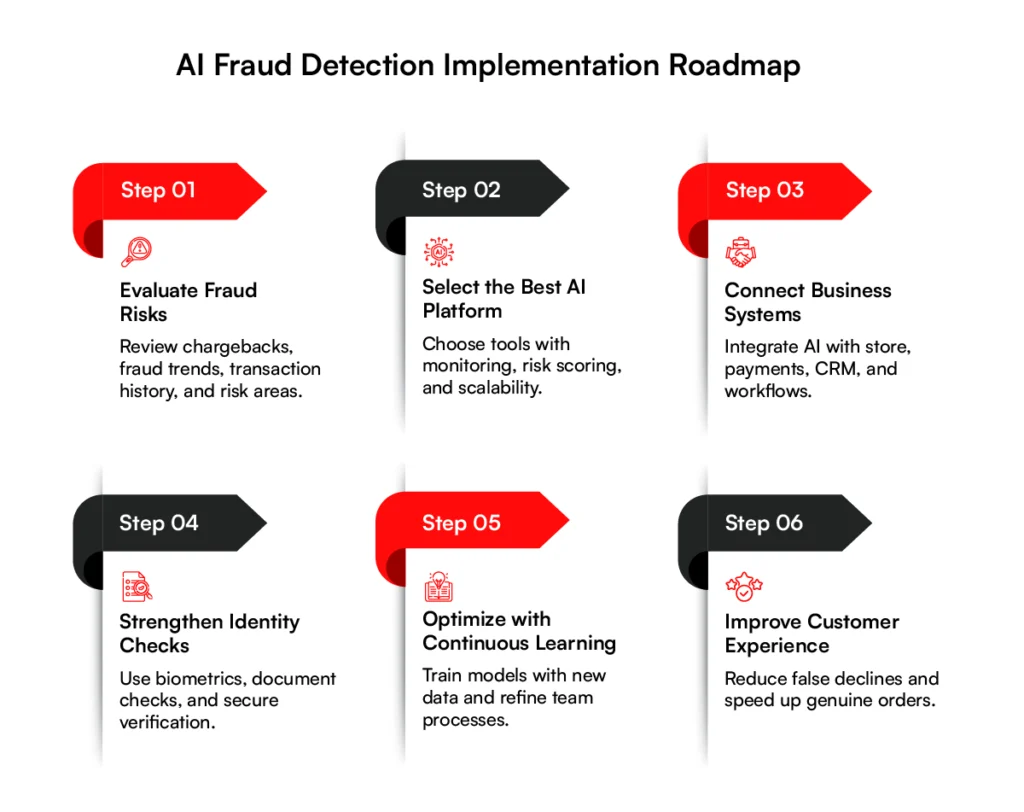
Step 1: Assessing the Needs and Scope
The first step is understanding where fraud risks exist in your current system. Review your transaction history, chargeback trends, refund abuse cases, account takeovers, and payment failures.
Look for recurring patterns such as fraud from certain regions, unusual order values, or spikes during sales campaigns.
You should also evaluate your transaction volume, product category, and customer base. A business selling digital products may face different fraud risks than one shipping physical goods.
Defining the scope early helps you choose an AI that matches your actual needs instead of overinvesting or underpreparing.
Step 2: Choosing the Right AI Solution
Once you know your risks, the next step is selecting the right platform or tool. Look for features such as real-time transaction monitoring, machine learning risk scoring, behavioral analytics, device fingerprinting, and identity verification.
Scalability is also important, especially if your business expects seasonal spikes or rapid growth.
The solution should integrate easily with your ecommerce platform, payment gateway, CRM, and existing workflows. It is also smart to run a pilot test with live or sample transactions before full deployment. This helps measure accuracy, false positive rates, and customer impact.
Step 3: Integration
After selecting a solution, connect it to your store through APIs, plugins, or direct platform integrations. During this stage, the AI system starts receiving transaction data, customer behavior signals, and payment information to evaluate risk.
Integration should be handled carefully to avoid disrupting checkout performance. Businesses also need to ensure secure data transfer, encryption, and compliance with privacy regulations. A smooth integration allows fraud checks to happen invisibly in the background while customers continue shopping without delays.
Step 4: AI-Based Identity Verification
Identity verification adds another layer of protection, especially for high-risk transactions or new accounts. AI can verify users through facial recognition, document matching, behavioral biometrics, voice recognition, or one-time authentication checks.
This helps prevent account takeovers, fake account creation, and identity theft. Instead of challenging every customer, AI applies verification only when risk signals justify it, keeping friction low for legitimate buyers while tightening security where needed.
Step 5: Training and Continuous Learning
AI systems perform best when they are continuously refined. After implementation, models should be trained using your transaction outcomes, chargeback data, fraud cases, and legitimate customer behavior. This helps the system adapt to your business-specific fraud patterns.
Internal teams also need training. Staff should understand how to interpret alerts, review flagged transactions, and fine-tune settings when necessary. Since fraud tactics evolve constantly, ongoing learning for both the AI system and your team is essential.
Step 6: Enhancing Customer Service
Fraud prevention should not come at the cost of customer satisfaction. AI can improve service by reducing unnecessary declines, speeding up approvals, and minimizing checkout interruptions for genuine shoppers.
It can also support customer service teams by identifying suspicious disputes more quickly, prioritizing cases, and providing better context during investigations.
When fraud detection and customer experience work together, businesses protect revenue while building trust and loyalty.
Ready to Protect Your Business From Fraud?
Get a personalised implementation plan built around your current systems, transaction volume, and risk profile, so you start with the steps that matter most.
Start My Implementation PlanHow RBMSoft Helps Ecommerce Businesses with AI-Powered Fraud Detection?
Traditional prevention methods are no longer enough to protect growing online businesses. To stay ahead, brands need intelligent systems that can detect threats in real time, reduce false positives, and create a seamless customer experience.
At RBMSoft, we help businesses turn complex commerce data into actionable intelligence through advanced analytics, automation, and AI-powered solutions.
Whether you want to improve fraud detection or optimize operations, our team builds scalable strategies tailored to your business goals.
With deep expertise in IT services for ecommerce, we support brands in creating smarter, more secure digital ecosystems that are built for growth.
Our capabilities include:
- AI-driven fraud detection models for real-time transaction monitoring
- Customer behavior analytics to identify suspicious activity and buying trends
- Chargeback analysis and risk scoring frameworks
- Dashboard creation for fraud insights, KPIs, and operational visibility
- Predictive analytics for customer lifetime value and churn prevention
- Secure payment workflow optimization and checkout intelligence
- Custom ecommerce solutions development for modern retail platforms
- Intelligent automation and tailored AI development services for evolving business needs
As fraud challenges continue to grow, data-backed decision-making becomes essential. RBMSoft helps you move beyond reactive protection and build a proactive ecommerce business powered by analytics, intelligence, and long-term scalability.
FAQs
1. Why is AI-powered fraud detection more effective than traditional rule-based systems in ecommerce?
Traditional rule-based systems depend on fixed conditions, which fraudsters can quickly learn and bypass. AI-powered systems continuously analyze behavior, transactions, and evolving risk signals in real time.
They adapt faster, reduce false positives, and improve accuracy with every new data point. This makes AI for fraud detection in ecommerce more effective for businesses that need scalable, real-time protection without slowing down genuine customer transactions.
2. Who offers AI-based ecommerce fraud detection?
Many payment providers, fraud prevention platforms, and enterprise security vendors offer advanced fraud solutions for online businesses. Options range from tools built into payment gateways to dedicated platforms specializing in risk scoring, identity checks, and behavioral analytics.
Businesses should compare features, integrations, and scalability before choosing. The right AI-based ecommerce fraud detection provider depends on your transaction volume, fraud risks, and operational complexity.
3. What is AI fraud detection in ecommerce and how does it improve efficiency for enterprises?
AI fraud detection uses machine learning, automation, and data analytics to identify suspicious activity instantly. It improves enterprise efficiency by reducing manual reviews, accelerating approvals, and lowering chargeback costs.
Instead of reviewing every alert manually, teams can focus on high-risk cases only. This is especially useful when managing ecommerce application fraud across multiple channels, regions, and payment systems at scale.
4. What types of ecommerce fraud can AI detect and prevent in real time?
AI can detect account takeovers, stolen card usage, refund abuse, fake account creation, bot attacks, triangulation fraud, and suspicious checkout behavior. By analyzing user actions, device signals, and transaction anomalies instantly, it can block risky activity before completion.
Businesses facing growing ecommerce application fraud use these systems to stop both known and emerging threats with faster response times and better accuracy.
5. How does data integration improve the accuracy of AI-based fraud detection in ecommerce platforms?
Data integration combines signals from payment gateways, CRM systems, devices, browsing activity, and order history into one unified view. This helps AI understand transaction context instead of relying on isolated alerts.
Better context means fewer false positives and stronger fraud detection accuracy. Strong integrations are essential for AI-based ecommerce fraud detection, especially for businesses operating across multiple sales channels and platforms.
6. What are the data privacy and compliance risks of using AI in ecommerce fraud prevention?
The main risks include mishandling personal data, unclear consent processes, cross-border data transfers, and weak data governance. Businesses must align fraud systems with privacy laws such as GDPR, PCI DSS, and regional regulations.
Secure storage, encryption, and transparent policies are critical. When using Gen ai for ecommerce fraud detection, companies should also monitor model access, outputs, and data retention practices carefully.
7. What is the expected ROI timeline after implementing AI-based fraud prevention solutions?
ROI timelines vary based on order volume, fraud rates, and operational inefficiencies. Many businesses start seeing measurable gains within a few months through reduced chargebacks, fewer manual reviews, and improved approval rates.
Larger enterprises may realize stronger long-term returns as models learn and optimize over time. Solutions using AI and ML fraud detection for ecommerce often deliver compounding value as transaction data grows.
8. How much do AI fraud prevention solutions cost for small, mid-size, and enterprise ecommerce stores?
Costs depend on provider, transaction volume, and features such as device fingerprinting or identity verification. Small stores may use affordable subscription tools, mid-size brands often choose usage-based pricing, and enterprises usually require custom contracts.
Businesses should compare fraud losses versus solution costs. Advanced Gen ai for ecommerce fraud detection platforms may cost more initially but often reduce long-term risk significantly.
9. What are the latest ecommerce fraud rates and trends businesses should know?
Fraud continues to rise as digital transactions increase worldwide. Businesses are seeing more account takeovers, friendly fraud, refund abuse, and automated bot attacks. Mobile commerce growth has also expanded risk surfaces.
Many brands now prioritize real-time monitoring because ecommerce application fraud evolves quickly. Staying informed on fraud trends helps businesses strengthen prevention strategies before losses impact growth.
10. Are AI-based fraud detection solutions affordable for small and mid-sized ecommerce businesses?
Yes, many providers now offer flexible pricing models designed for growing businesses. Small and mid-sized stores can start with basic monitoring, automated alerts, and scalable risk scoring without enterprise-level budgets.
Cloud-based tools make adoption easier and faster. Modern AI and ML fraud detection for ecommerce solutions are no longer limited to large corporations with massive security teams.
11. What is the best practice for maintaining and optimizing fraud prevention systems in ecommerce?
The best approach is continuous optimization. Businesses should review fraud trends regularly, retrain models with fresh data, audit rules, and monitor false positives closely. Strong collaboration between operations, payments, and customer service teams also improves outcomes.
A well-maintained AI-based ecommerce fraud detection system should evolve with customer behavior, seasonal demand, and emerging attack patterns to remain effective.