


Quick Summary
- Cloud providers secure the physical systems. Access controls, outside tool connections, storage permissions, and customer data are the customer’s responsibility. Most e-commerce breaches start at that dividing line.
- The leading e-commerce security failure in 2026 is open or incorrect settings, not hacking. Public storage buckets and exposed databases sit undetected for months, entirely on the customer’s side of that line.
- Third-party plugins and vendor connections account for 44.5% of cloud breaches, making supply chain attacks the fastest-growing way attackers get in across e-commerce (Google Cloud Threat Horizons, H1 2026).
- Ransomware now targets cloud backups directly. Restoring from a recent backup is no longer a reliable recovery option.
- Automated password attacks, high-volume connection testing, and AI-generated identity fraud are projected to account for 42% of all attacks by end of 2026, moving faster than hand-run security checks can respond.
- Client-side skimming attacks capture payment data at the browser before the server processes it. Most platforms built before 2024 lack defenses against them. PCI DSS v4.0 was updated specifically to close this gap.
- The average e-commerce breach costs $4.88 million before fines, legal fees, and lost customers.
- Investing in cloud security before a breach costs three to five times less than responding after one.
If you think that ecommerce cloud security is the responsibility of the cloud provider, your online store is most likely unsafe.
Cloud platforms like AWS, Azure, and Google take care of mostly the physical infrastructure. Everything else is your responsibility. I’m talking about access controls on the database, third-party plugin permissions, storage bucket configurations, and so on.
In this article, we cover seven e-commerce application protection risks causing the most damage to cloud-hosted stores in 2026. We’ll dive into how each one works, why it evades detection longer than it should, and what your team needs to implement before a breach forces the decision.
What are the Biggest Cloud Security Risks in E-Commerce Applications?
Most e-commerce businesses lock the front door and leave the back wide open. Here are the cloud security risks that attackers walk through every day.
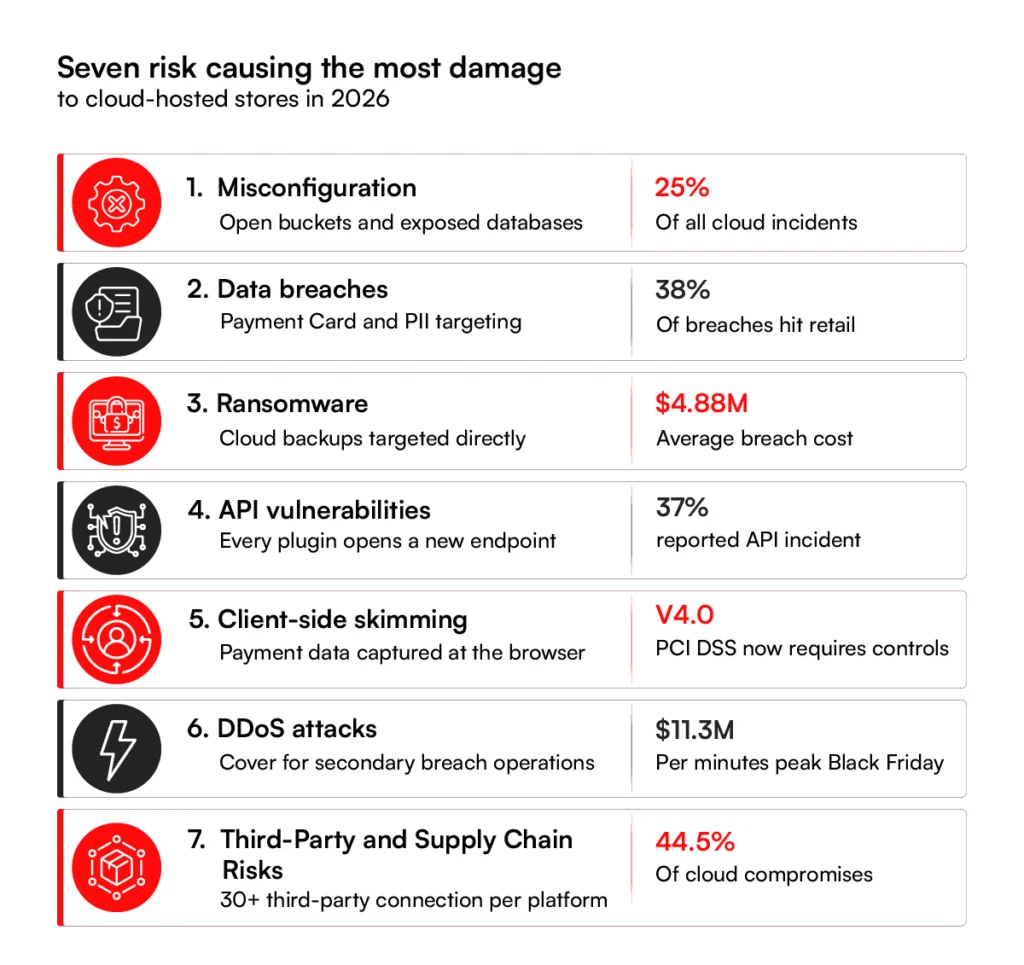
1. Cloud Misconfigurations
A developer opens a database for testing and forgets to close it. Weeks later, customer names, addresses, and order histories are still sitting open. An attacker does not need to break in. They just need to find it first.
Gartner projects that 99% of cloud security failures through 2026 will trace back to the customer (you), mostly through open or incorrect settings.
Automated policy controls and continuous monitoring catch these gaps without waiting for a manual review. Without them, your setup changes faster than any scheduled check can keep up with.
2. Data Breaches
Your firewall watches your platform. It does not watch every vendor connected to it. A compromised shipping provider or analytics tool can hand attackers direct access through a connection your security team never flagged. By the time most businesses notice, the attacker has been inside for weeks.
Payment card data and personal customer information are the top targets. Shopify reports that 46% of retail breaches involve customer personal data. Emails and internal documents exposed in the same breach can do lasting damage to how customers see your brand.
Data security for e-commerce in cloud environments designed around your perimeter provides no protection for the vendor channels that sit outside it.
3. Ransomware Attacks
Ransomware has evolved past encrypting local files. Attackers now go directly after cloud backups first, removing the recovery option before the main attack runs. By the time the intrusion is detected, the backup you planned to restore from may already be gone.
For e-commerce platforms running transactions around the clock, the damage adds up fast. Every hour of downtime during a peak sales period costs revenue that no recovery effort can bring back. Staff may also be forced into manual processes for fulfillment, creating bottlenecks across the supply chain.
In this case, recovery plans work when the backup environment uses separate access credentials and is isolated from the systems an attacker may already control.
4. API Vulnerabilities
Every integration you add to your store (payment, shipping, analytics) opens a channel that can be tested for weaknesses. Salt Security found that 37% of retail businesses reported an API-based security incident in 2024. And the most commonly exploited attack type requires no specialized tools to execute.
An attacker can change a single number in a request and pull another customer’s order history or payment details. Proper access controls on every connection point are the only thing standing between that data and anyone who knows how to look.
5. Client-Side Skimming
Skimming attacks steal payment data at the browser level before your server ever sees it. Malicious code injected into a checkout page captures card details as a customer types, then sends that data to an outside server. Your payment processor completes the transaction normally, and your logs show nothing unusual.
PCI DSS v4.0 was updated specifically to address this attack type, introducing requirements for script monitoring and content security policies on payment pages. Platforms built before these requirements came into effect, or updated incrementally rather than rebuilt to the current standard, frequently lack the controls to detect injected code. If your checkout environment has not been assessed against v4.0 requirements, that assessment is the right place to start.
6. DDoS Attacks
DDoS attacks flood your system to occupy your security team while a separate intrusion runs in parallel. While you see service degradation as the visible issue; data exfiltration or malware deployment is often the actual objective. By the time traffic normalizes and your team’s attention returns to monitoring, the secondary attack has already completed.
Cloudflare reported a clear rise in DDoS attacks targeting e-commerce in 2024, with retail among the most affected industries. Black Friday and holiday sale periods carry the highest risk. A 20-minute outage during a flash sale costs far more than the technical recovery that follows.
DDoS protection for cloud-hosted e-commerce platforms needs to be always-on. Activating it after the first packets arrive means the secondary attack is already underway.
E-commerce businesses are prime targets because they facilitate large volumes of transactions and handle valuable customer data. Cybersecurity Ventures expects global cybercrime costs to grow by 15 percent per year over the next five years, reaching USD 10.5 trillion annually by 2025.
7. Third-Party and Supply Chain Risks
The average enterprise e-commerce platform connects to more than 30 third-party services. Ecommerce replatforming is typically when most of those connections get added, often faster than security reviews can keep up. Payment gateways, shipping connections, review platforms, email tools, and returns portals all sit between your platform and your customer data.
You assume your vendors manage their own security. Your vendors assume you monitor what flows through their connections. When a breach happens anywhere in that chain, it reaches your platform. Your customers hold you responsible regardless of where it started.
The following three controls reduce this exposure without requiring a dedicated security function. First, require vendors to complete a security questionnaire before go-live. Second, include contract terms that define security standards and breach notification timelines. Third, monitor third-party connection traffic on an ongoing basis for anything outside normal patterns.
Most e-commerce platforms carry at least three of these vulnerabilities without knowing it. Find out where you stand before an attacker does.
Book a Free Consultation
Why Is Cloud Security Risk a Growing Concern?
E-commerce platforms store payment data, personal customer records, and order histories at a scale that makes them a consistently high-value target. Here are five structural factors that are actively expanding your exposure regardless of how your security posture compares today to a year ago.
1. Retail Platforms are Top Cybercrime Targets
A successful breach against an e-commerce platform pays out more than once. Stolen payment card data and customer credentials trade actively on dark web marketplaces. Attackers also use a compromised platform as a launchpad — with access to a retailer’s customer base, they run targeted phishing and fraud campaigns against customers who already trust that brand.
Cybersecurity Ventures projected global cybercrime costs would reach $10.5 trillion a year by 2025. The attack surface keeps expanding because every new vendor connection, integration, and customer touchpoint is a potential entry point, and the payout for finding one justifies the automated scanning that finds them at scale.
2. Attackers Now Operate at Machine Speed
Automated tools now scan for weaknesses, generate phishing content, and probe connection points at a volume no human team can match unaided. Fortinet’s 2025 Global Threat Landscape Report recorded a 16.7% increase in global automated scanning in 2024, reaching 36,000 attack probes per second. Another study found out that phishing campaigns built with these tools now achieve a 54% click-through rate, compared to 12% for traditional phishing.
Teams running manual detection cannot respond at that speed. As per IBM, organizations that use automated security monitoring identify breaches 108 days faster and cut breach costs by 43%. Whether an incident stays contained or becomes a breach that must be disclosed often comes down to how quickly it is caught.
3. Multi-Cloud Environments Create Blind Spots
Managing cloud security for ecommerce gets significantly harder when your platform runs across more than one cloud provider. A 2024 State of the Cloud Report found that 89% of enterprises now run across AWS, Azure, and Google Cloud at the same time. Each provider uses its own identity model, activity logs, access controls, and default settings.
The exposure compounds at the points where those providers connect. A storage bucket configured correctly inside one provider can expose data when it interacts with a misconfigured resource in another. Tenable’s research confirms that a single misconfiguration in one provider can spread across the full environment through cross-provider connections. Without a unified monitoring layer across all providers, there is no reliable way to tell who accessed what, through which path, or when.
4. Regulatory Requirements Keep Expanding
PCI DSS v4.0 came into full effect in 2025 and introduced requirements that platforms built for the previous standard will not automatically meet. The new version mandates a detailed risk review for each individual control, stronger user verification, and specific defenses against checkout page skimming — the attack type we covered earlier in this article. The retail and ecommerce businesses with outdated compliances quickly become a bigger target for bad actors.
US state privacy laws add further complexity. Virginia, Colorado, and Texas have each passed customer data laws with different definitions, thresholds, and enforcement timelines. Exposure depends on where customers live, not where the business is registered. More states are still adding legislation.
5. Most Smaller Retailers Have No Dedicated Security Staff
Most small and mid-sized e-commerce businesses carry full security and compliance obligations without dedicated security staff. Security work falls to developers or operations generalists carrying other responsibilities. ISC2 reported a global cybersecurity workforce gap of 3.4 million in 2023, a shortage that hits smaller organizations hardest because they cannot match the compensation that draws specialist talent to larger platforms.
The structural problem is that the attack surface does not scale down with business size. The practical response for a resource-constrained organization is to reduce the manual work through automation and managed tooling. Security architecture decisions made during a replatforming project — which integrations get access controls, which monitoring runs automatically from day one — determine how exposed you remain regardless of team size.
Key Security Measures for E-Commerce Cloud Platforms and Applications
Now that we have covered why and how cybersecurity risks impact retail and ecommerce businesses, let’s take a look at some of the measures you can take to avoid being a victim of such attacks. The key security measures in cloud security risk for e-commerce applications are mapped by the layer below.
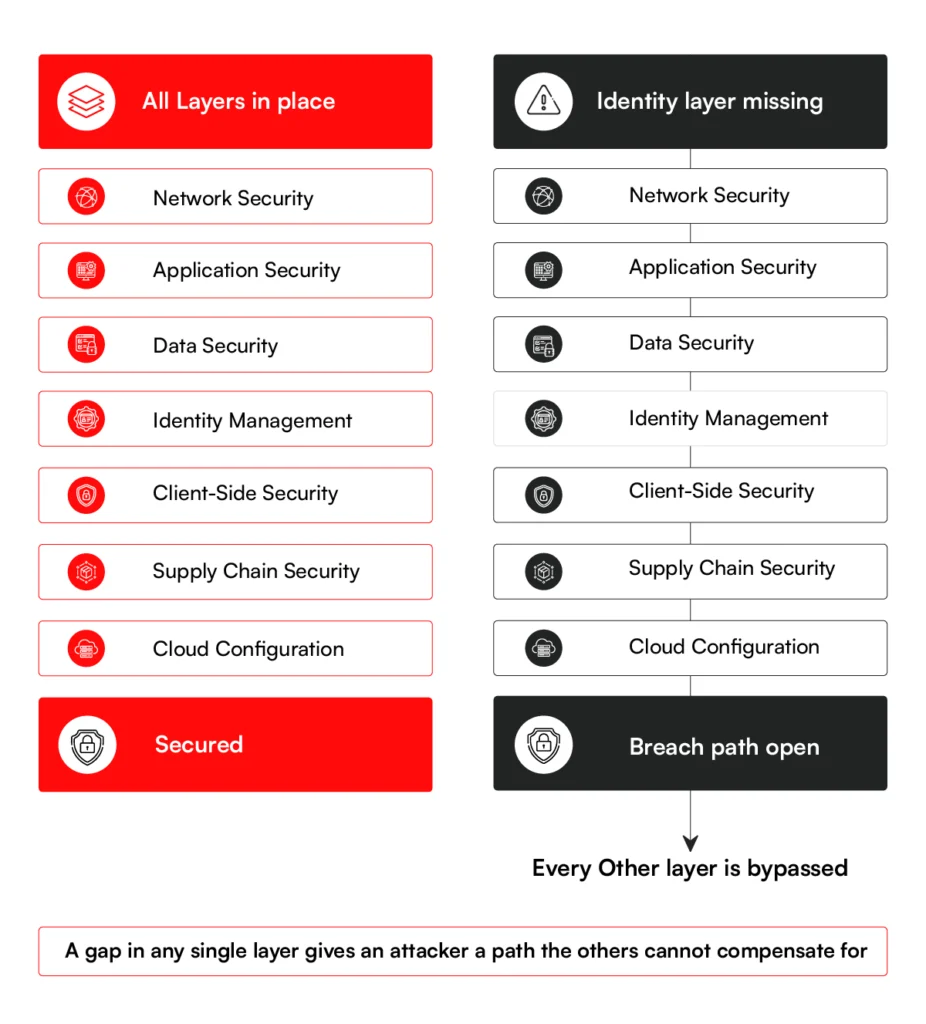
1. Network Security: Make DDoS Protection Automatic Across Your Full Environment
DDoS protection that requires manual activation does not work. Network-layer controls need to run autonomously to block traffic floods before they knock your platform offline. Cloudflare’s Q3 2024 DDoS Threat Report recorded nearly 6 million attacks in a single quarter, a 55% year-over-year increase, with retail consistently among the most targeted industries.
Your ecommerce platform already has network protection. However, the important question to ask is whether that protection operates automatically across your full environment, including the vendor connections carrying traffic in from outside your perimeter.
2. Application Security: Scan for Vulnerabilities After Every Code Change Shadow IT
The application layer is where attacks that pass through your network controls land. Vulnerability scans and secure coding standards both need to cover your full platform on an ongoing basis, well beyond the launch.
A plugin added six months after go-live or a code library updated to resolve a separate issue introduces the same class of weakness a pre-launch scan would have caught on day one.
The update cycle that keeps components compatible with your platform is the same cycle that can introduce new risks in your live environment.
Your vulnerability scans should cover the complete dependency stack: plugins, third-party libraries, and integrations included, not just core platform code. Scoping either to core code only means the most frequently updated parts of your environment are the least reviewed.
The use of shadow IT increases the tools and platforms that carry significant risks. Within organizations, increased governance policies must be enforced.
3. Data Security: Keep Encryption Keys Separate from the Data They Protect
Where most encryption implementations fail is in key management. Keys stored in the same environment as the data they protect are accessed together in a breach, making the encryption effectively redundant. Dedicated key management services maintain those keys in a separate, access-controlled environment. It’s this separation that makes encryption a meaningful control in a breach scenario.
Data masking lets your team work with customer records for testing and analytics without exposing real values — an important operational control for the majority of use cases where the full record is unnecessary.
4. Identity Management: Enable 2FA and Strict Role-based Access Control
Stolen credentials are the most common initial access vector in cloud breaches. Microsoft’s research found that two-step verification blocks 99.9% of account takeover attempts, making it the highest-leverage control available for admin accounts. Every administrative login without it is a single leaked password away from direct access to your cloud environment.
Two-step verification stops the initial access. Role-based access controls determine how far it reaches. A compromised account scoped to marketing functions cannot pull payment records or reach admin controls. The same account with open access across systems can. The blast radius of a credential breach is largely set by the access model you have in place before the incident happens.
Permissions also accumulate over time without a process to review them. A contractor account left active after a project ends, or elevated permissions granted for a one-time task that were never removed, create unnecessary exposure with no legitimate use. Just-in-time access is the cleanest architectural solution for such vendor engagements.
For organizations that cannot implement it across their full environment, scheduled access reviews at a fixed interval achieve most of the same protection and require no additional tooling to operate.
5. Client-Side Security: Add Script Monitoring and Content Security Policies
Skimming attacks inject malicious code into your checkout page and capture payment details as customers type, routing that data to an external server before your payment processor sees the transaction. Nothing in your server logs signals that anything went wrong — the transaction completes normally and the data is already gone.
Content security policies define which scripts are permitted to run on your checkout pages. Script monitoring tracks what is actually running in real time and flags anything outside the approved list before it can execute. PCI DSS v4.0 requires both controls specifically because checkout skimming operates entirely outside every server-side defense — no other layer in your security stack intercepts it.
If your checkout environment was built or last assessed before the 2022 PCI DSS v4.0 requirements came into effect, a compliance review against the current standard is where to start.
6. Supply Chain Security: Monitor Vendor Traffic Continuously
Your vendors do not appear on your network diagram, but several of them have live connections into your platform. Payment gateways, shipping tools, and point-of-sale connections are among the most exposed parts of cloud security for POS and ecommerce systems because they sit directly between your environment and your customer data.
Before any connection goes live, run a vendor security questionnaire covering their access controls, encryption standards, and breach notification process. Set contractual terms that define security requirements and response timelines. After launch, monitor third-party connection traffic for anything outside normal patterns. A vendor whose connection suddenly pulls three times its usual data volume at 2am is worth investigating before assuming it is a scheduled update.
7. Cloud Configuration: Replace Manual Audits with Automated Scanning
Gartner projects that through 2026, 99% of cloud security failures will be the customer’s fault. The provider manages the physical setup and core services. Access controls, storage permissions, encryption choices, and configuration settings are entirely your responsibility.
Cloud Security Posture Management (CSPM) tools scan your environment continuously against security benchmarks, surfacing open storage buckets, excessive permissions, missing encryption settings, and policy violations as they appear. Manual configuration audits cannot keep pace with an environment where settings change daily through development work, vendor integrations, and platform updates.
Automated scanning closes the gap between when a misconfiguration is introduced and when it is found.
8. Patch Management: Apply Patches on a Fixed Schedule and Prioritize Known Exploited Vulnerabilities First
Flexera’s research found that 60% of breaches involve a weakness for which a fix was already available at the time of the incident. The problem is the absence of a process disciplined enough to apply them before attackers find the gap.
E-commerce platforms accumulate plugins, outside code libraries, platform updates, and add-on dependencies over time. Each component that goes without an update adds to a backlog an attacker will eventually find useful. A patch process with a fixed schedule, full coverage, and a tracking system for what has and has not been updated closes the gap between when a fix ships and when it gets applied.
9. Employee Security Training: Run Phishing Simulations
The Verizon 2024 Data Breach Investigations Report found the human element present in 68% of confirmed breaches. Phishing, reused passwords, and social engineering account for more initial access than any technical vulnerability class. No technical control compensates for an admin who clicks a malicious link or a developer who reuses credentials across systems.
Regular phishing simulations show you where the gaps are before an attacker finds them. Security awareness training covering password habits, social engineering, and data handling builds routines that hold up under pressure. For instance, it’s compulsory for every employee to undergo cybersecurity awareness training. The training helps build the behavioral habits that carry protection across the parts of the attack surface that the technical stack cannot see.
Challenges in Managing Cloud Security
Most e-commerce teams know what good security looks like. Getting it to work in a live environment is a different problem. Here are the five places it breaks down.
1. Installing Monitoring Tools Is Not the Same as Running a Monitoring Program
The challenge in multi-cloud visibility is rarely the absence of tooling. CSPM dashboards, unified activity logs, and cloud management consoles exist for exactly this problem. The challenge is that someone has to review what those tools surface, triage what matters, and act on it within a window that is useful.
For e-commerce teams where security monitoring sits alongside development work, fulfillment operations, and customer support, the proportion of reviewed alerts is lower. An alert that goes unread for three days isn’t much different from having no alert at all.
The fix for this is to build a process that converts monitoring into action. That means defined alert tiers that separate urgent from routine, named ownership for who investigates each tier, and a review cadence treated as an operational commitment. The tools your team already has are only as useful as the process running behind them.
2. When Security Falls to Developers, Specific Gaps Appear
As mentioned earlier, security becomes the responsibility of generalists and developers at smaller ecommerce orgs. Developers prioritize delivery. When a security control slows a build or requires a change to a working integration, it gets deferred. Patch schedules slip under feature deadlines. Vendor security reviews get skipped during replatforming projects when new connections are being added faster than any review process can keep pace. Access permissions accumulate because revoking them requires knowing they exist and someone making it a priority.
Most smaller retailers fill that gap through IT services for ecommerce that cover security monitoring, system management, and compliance support under one arrangement. However, the risk is coverage. Without a clear written agreement defining exactly what the provider monitors and what your internal team handles, gaps appear between what each side assumes the other is watching. Those gaps rarely surface until something goes wrong and both sides are working out whose job it was.
3. Most Teams Fix the Same Compliance Gap Multiple Times
GDPR, PCI DSS v4.0, CCPA, and US state privacy laws each carry separate control requirements, documentation standards, and audit timelines. Running independent compliance programs for each one is not practical for most e-commerce teams.
The overlap between frameworks is rarely mapped in a way that reduces the workload. A single encryption control can satisfy requirements across PCI DSS, GDPR, and CCPA at the same time. Without a shared control map that lays out your existing controls across every applicable framework at once, you end up fixing the same gap four separate times under four separate audits. Building that map once reduces both the audit burden and the chance of missing a requirement that only becomes visible when frameworks are reviewed together.
4. Unofficial Tools and Connections Accumulate Risks
Unofficial tools and connections build up at the team level without anyone tracking them. A marketing team connects a new analytics platform to pull conversion data. A developer uses a personal cloud account to test a connection. A product manager installs a plugin that links directly to your storefront. None of these go through a security review.
Each unapproved connection bypasses the access controls, activity logs, and vendor checks your security program depends on. This does not create one large weakness. It creates dozens of small ones that sit unmonitored until an attacker finds one worth using. A simple review process before any new tool connects to your platform is the only way to keep that surface from growing faster than you can track it.
5. Misunderstanding Shared Responsibility
AWS, Azure, and GCP secure the physical infrastructure and base services. Access controls, encryption settings, user permissions, storage configurations, and compliance obligations sit on your side of that line. Most e-commerce businesses understand this in principle. Fewer apply it consistently in practice.
The operational problem is that cloud hosting feels comprehensive. A retailer moving to a managed cloud platform reasonably assumes that operating on infrastructure designed, maintained, and monitored by a major technology provider improves their security posture. That assumption is correct for the layers the provider manages. It is systematically wrong for the configuration layer on top of those services, which the provider neither controls nor monitors on your behalf.
The Real Cost of Cloud Security Failures in E-Commerce Applications
The financial consequences of a cloud security failure extend well beyond the incident itself. Here is what a cloud security failure actually costs, mapped across every stage of an incident.
| Breach Consequence | Estimated Impact |
| Average Breach Cost (IBM 2024) | $4.88 million |
| GDPR Maximum Fine | 4% of global annual revenue |
| PCI DSS Non-Compliance Fines | $5,000 to $100,000 per month |
| Customer Attrition Post-Breach | 70% of affected customers stop shopping |
| Peak-Hour Revenue Loss | Millions per minute at scale |
| Class-Action Legal Costs | Frequently exceeds original incident response bill |
1. Direct Financial Losses
IBM’s report puts the global average breach cost at $4.44 million. That figure covers detection, escalation, investigation, and notification. It does not include regulatory fines, ongoing legal costs, or the revenue lost from customers who stop shopping with you after the incident. Each of those categories adds to the total independently of what IBM measures.
The same report found that 70% of breached organisations experienced significant business interruption after the incident. For e-commerce businesses running on tight margins, the damage does not need to reach $4.88 million to be serious. A fraction of that cost landing at the wrong point in the financial year can be enough to stall operations entirely.
2. Regulatory Fines
GDPR penalties can reach 4% of global annual revenue per violation. For a retailer at $50 million in annual revenue, that is a potential $2 million fine, and that is before factoring in any other breach cost. PCI DSS non-compliance adds monthly fines between $5,000 and $100,000. Card networks can also remove your ability to process payments, which stops your business from trading entirely.
It is worth noting that regulators measure whether your controls met the required standard at the time of the audit. Your customers do not need to have been harmed for the fine to land. A failed audit costs you regardless of whether an attacker ever reached your data.
3. Reputational Damage
Vercara surveyed 1,000 US adults in November 2024 about brand trust after security incidents. 70% said they would stop shopping with a brand that had suffered a breach. 58% said they would no longer see that brand as trustworthy.
The difficult part is that customers who leave rarely say why. Purchase frequency drops, subscriptions lapse, and referral traffic slowly erodes away over the months after an incident. By the time the pattern shows up in your numbers, the breach investigation is long closed and the connection is hard to measure. Of everything on this list, reputational damage is the cost that stays longest.
4. Operational Disruption
Adobe Analytics recorded average US e-commerce spending at $11.3 million per minute during peak Black Friday 2024 hours. Shopify merchants processed $4.6 million per minute at their peak. A 20-minute breach-related outage in that window removes revenue that no recovery effort can bring back.
Smaller retailers face the same problem at a smaller scale. The ad spend, stock position, and customer acquisition investment behind a flash sale all return nothing if the platform goes down during the sale window.
5. Long-Tail Costs
Breach investigation firms, legal counsel, and on-call security firms keep billing weeks after the breach is contained. Paying for ecommerce application protection services after a breach costs significantly more than the same investment made before one. Credit monitoring for affected customers adds a cost per person that scales directly with the number of records exposed.
Group lawsuits involving payment data or personal information add another layer that takes years to work through. Legal fees from these cases frequently exceed the original response bill, and settlements rarely close quickly.
The average breach costs $4.88 million. A security assessment costs nothing. Book yours today.
Book a Free AssessmentBest Practices for E-Commerce Cloud Security
Controls that are set up correctly and tested regularly hold up under pressure. Controls that are installed and forgotten do not. The best practices for cloud security in e-commerce applications below each map directly to a specific risk covered earlier in this guide.
- Encrypt all customer data: Apply AES-256 across names, addresses, and loyalty data. They all carry the same regulatory risk as payment records. And keep encryption keys in a dedicated management service, separate from the data they protect.
- Enable two-step verification without exception: Microsoft’s research found it blocks 99.9% of account takeover attempts. Apply it to every admin account and cloud console.
- Scope every account to minimum required access: Use role-based controls and review permissions on a fixed schedule. Just-in-time access — permissions granted for a specific task and removed automatically when it ends — is best option for vendor engagements.
- Add script controls to your checkout pages: Content security policies define which scripts are permitted to run; real-time script monitoring flags anything outside that list. PCI DSS v4.0 requires both. If your checkout environment predates the 2022 requirements, a compliance review is the starting point.
- Vet vendors before go-live and monitor them after: Require authentication on every request and put breach notification timelines in the contract before any connection goes live. After launch, monitor third-party traffic continuously for volume anomalies. Vetting at onboarding is the starting point, not the control.
- Treat every access request as unverified until it passes a check: The assumption that internal requests are inherently trusted is what lets a compromised account move laterally across systems after initial access.
- Segment your environment into isolated zone: A breach in one area should not be able to reach another without passing an additional verification layer. IBM’s 2025 Cost of a Data Breach Report found Zero Trust architecture reduces average breach costs by $1.76 million.
- Verify the device: Confirm that the device making a request meets your security requirements before access opens. A valid credential on an unmanaged personal device carries a materially different risk profile than the same credential on a monitored, policy-compliant machine.
- Run automated security monitoring across your full environment: Cover every cloud provider, application, and vendor connection. IBM’s 2025 report puts the average breach lifecycle at 241 days; most of the financial damage accumulates in the detection window, not the response.
- Set specific anomaly alerts: Flag failed login clusters on the same account, large data exports outside business hours, access from unexpected locations, and sudden connection volume spikes from individual vendors.
- Map your controls across compliance frameworks: A single AES-256 implementation, correctly documented, satisfies data-at-rest requirements under PCI DSS v4.0, GDPR, and CCPA simultaneously. Without the map, teams fix the same gap multiple times under separate audit cycles.
- Define incident roles before you need them: Name who declares an incident, who leads the investigation, and who handles external communication. Regulators, card networks, and customers require different messaging on different timelines. Every role needs a named backup.
- Map your notification obligations in advance: GDPR’s 72-hour window, applicable U.S. state law deadlines, and card network requirements all run in parallel from the moment you become aware of a breach.
- Prepare customer communication templates now: Writing them under a live breach, with legal counsel involved and regulators asking questions, introduces delays that compound the reputational damage the communication is meant to limit.
- Document investigation steps in the correct sequence: Containment actions taken in the wrong order can destroy forensic evidence needed for regulatory response and litigation.
- Run a tabletop exercise once a year: IBM’s 2025 report found a tested incident response plan saves an average of $2.66 million per breach — the largest single cost reduction of any control IBM tracks.
RBMSoft has secured cloud platforms for Big Lots, DSW, and PetMeds. Let us do the same for yours.
Talk to a Security ExpertReady to Secure Your E-Commerce Cloud Environment?
The threats, risk factors, and controls we discussed in this article are only useful if they translate into decisions. The practical starting point is an honest assessment of where your current platform stands against the controls discussed. Which layers are in place and tested? Which are installed but unmonitored? And which are absent? That gap analysis is what turns a security checklist into a prioritized roadmap your team can actually execute against.
Closing those gaps consistently, across a platform that changes with every release cycle, is where most e-commerce teams need support. RBMSoft has built and maintained cloud security infrastructure for retailers including Big Lots, DSW, and PetMeds. We treat compliance, architecture, and ongoing monitoring as engineering commitments rather than pre-audit exercises.
Contact RBMSoft today for an honest review of your current security state and a practical plan for closing the gaps.
FAQs
1.How to improve cloud security for ecommerce businesses?
Start with the areas that cause the most breaches. Audit cloud storage permissions, enforce MFA on every admin account, inventory every third-party integration, and deploy a CSPM tool that scans continuously rather than on a manual schedule.
The critical shift is treating cloud security for ecommerce businesses as an ongoing operational function, not a one-time setup. Permissions accumulate, plugins get added without review, and environments change daily. A fixed review cadence catches those gaps before an attacker does.
2.What security features should I look for in an ecommerce cloud hosting provider?
Look for four things: DDoS protection and network isolation at the infrastructure layer, encryption at rest and in transit with separate key management, MFA and role-based access controls for identity, and compliance documentation that supports PCI DSS v4.0, GDPR, and CCPA.
What most businesses miss is that no provider covers all of this on your behalf. Access controls, storage permissions, and compliance obligations sit with you regardless of which provider you choose.
3.What are the security features offered by popular commerce cloud platforms?
Shopify covers PCI DSS compliance and SSL at the platform level but does not manage third-party plugin security. Magento gives more configuration flexibility but puts patching, access controls, and compliance tooling entirely on your team. Salesforce Commerce Cloud includes DDoS protection and encryption but leaves API layer and client-side script security to you, particularly in headless setups.
The pattern across all major platforms is the same. Infrastructure-level security is largely covered. API protection, script monitoring, vendor vetting, and identity management require additional controls your team implements on top.
4.What is the best cloud security for e-commerce?
The best cloud security for e-commerce is a layered stack, not a single product. The practical starting point is five controls: a CSPM tool for configuration monitoring, a WAF for application protection, MFA and RBAC for identity, script integrity monitoring for skimming protection, and a SIEM for real-time detection.
The right stack depends on your platform, provider mix, and transaction volume. What does not change is the shared responsibility principle: the provider covers the infrastructure and your team covers everything built on top of it.
5.How to handle security compliance in headless commerce architecture?
Headless commerce splits compliance obligations across three separate layers. The frontend needs script monitoring and content security policies on every payment field. The API layer needs object-level access controls, rate limiting, and authentication on every endpoint. Neither layer protects the other automatically.
The most practical approach is a compliance matrix that maps PCI DSS v4.0, GDPR, and CCPA requirements to the specific layer responsible for each, with automated scanning running against each layer independently.
6.Who is the best ecommerce application protection vendor for enterprise retail?
It depends on the gap. For API security, Salt Security and Noname Security are established options for complex retail environments. For WAF and DDoS protection, Cloudflare and Imperva have strong retail track records. For CSPM across multi-cloud environments, Wiz and Orca Security cover the configuration monitoring layer most enterprise retailers need.
For retailers that need a development and security partner rather than a point product, RBMSoft has built PCI DSS v4.0-compliant platforms for enterprise retailers including Big Lots, DSW, and PetMeds across AWS, Azure, and Google Cloud.
7.Which application security solution scales during Black Friday traffic spikes?
Cloud-native WAF solutions from Cloudflare, AWS Shield, and Azure DDoS Protection are built to absorb volumetric spikes without manual intervention. Rate limiting and bot detection rules need to be configured and stress-tested against peak traffic volumes before the event, not after. A limit calibrated for average daily traffic will block legitimate customers during a flash sale.
Scalability during Black Friday is an architecture question as much as a product question. Adobe Analytics recorded average US e-commerce spending at $11.3 million per minute during peak Black Friday 2024 hours. A security control that has not been tested at that volume creates its own operational risk during the window where downtime is most expensive.
8.What security stack should a large ecommerce company implement?
A large ecommerce company should implement security across seven layers: network controls including WAF and DDoS protection, application vulnerability scanning, AES-256 data encryption with dedicated key management, MFA and RBAC for identity, script integrity monitoring on all checkout pages, vendor vetting and API monitoring for supply chain exposure, and a CSPM tool for continuous cloud configuration auditing.
The stack needs a SIEM pulling logs from every layer in real time and Zero Trust architecture ensuring a breach in one layer cannot reach adjacent systems. A compliance matrix mapping PCI DSS v4.0, GDPR, and CCPA to specific controls reduces audit overhead and closes gaps that independent audits miss.
9.What is the cost of ecommerce application protection?
Point products covering individual layers typically run between $30,000 and $150,000 annually for a mid-market retailer. Enterprise retailers with multi-cloud environments should expect significantly higher costs across a full stack.
The more useful comparison is proactive versus reactive. IBM’s 2024 Cost of a Data Breach Report put the average breach cost at $4.88 million. Investing in ecommerce application protection before a breach costs three to five times less than responding after one.