





Table of Contents
Key Takeaways:
- D2C furniture ecommerce gives brands greater control over customer experiences, pricing, branding, and first-party data while improving profit margins.
- Success depends on more than just launching an online store. Choosing the right technology stack, creating seamless customer journeys, and integrating business systems are equally important.
- Emerging technologies like AI, AR, 3D commerce, and headless architecture are transforming how customers discover, customize, and purchase furniture online.
- Overcoming challenges such as logistics, inventory management, customer trust, and fulfillment is essential to building a scalable and profitable furniture ecommerce business.
- Future-ready furniture brands are embracing innovation by investing in personalized shopping experiences, recommerce initiatives, and digital technologies that support long-term growth.
Today’s customers want to explore products in detail, visualize how furniture will look in their homes, compare customization options, receive personalized recommendations, and enjoy a smooth buying experience from start to finish.
At the same time, you’re expected to manage complex inventory, coordinate large-item deliveries, maintain consistent customer experiences across channels, and keep up with rapidly changing technology. Meeting all these expectations while growing your business can quickly become overwhelming.
This is where a well-planned D2C furniture ecommerce strategy makes the difference. It allows you to build stronger customer relationships, create memorable shopping experiences, and operate with greater control over your brand and sales.
However, success depends on much more than choosing the right ecommerce platform. You need the right strategy, technology, customer experience, and long-term vision to stand out in an increasingly competitive market. In this article, we’ll explore everything you need to know about building a successful D2C furniture ecommerce business.
What is D2C Furniture Ecommerce?
D2C (Direct-to-Consumer) furniture ecommerce is a business model in which you sell furniture directly to your customers through your own ecommerce website or mobile app, rather than relying on distributors, wholesalers, or third-party retailers. This gives you complete control over how customers discover, purchase, and interact with your brand.
Instead of sending customers to a marketplace, you create a shopping experience that reflects your brand. You can offer product customization, share detailed product information, deliver personalized recommendations, and build long-term relationships by owning every customer interaction.
As more shoppers choose to buy furniture online, the D2C model gives brands a better opportunity to stand out, improve customer loyalty, and grow on their own terms. So, why are more furniture brands making this shift?
Why Furniture Brands are Adopting the D2C Model
The furniture industry has changed significantly over the last few years. Today’s customers expect convenience, personalization, and a seamless online shopping experience.
To meet these expectations while staying competitive, many furniture brands are shifting to the D2C model. Here’s why.
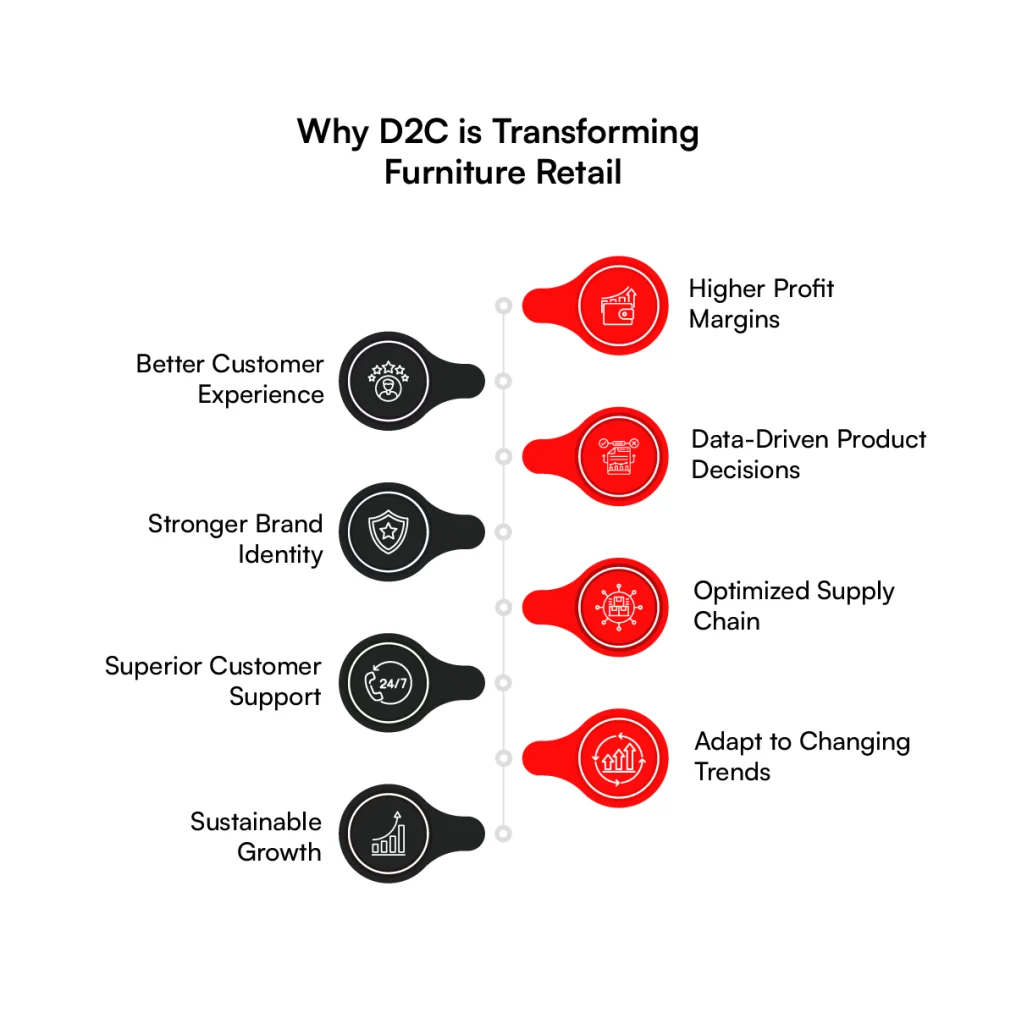
1. Cutting Out Middlemen and Increasing Profit Margins
Selling directly to customers removes the need for wholesalers and retailers. This helps you reduce intermediary costs, improve profit margins, and reinvest those savings into product innovation, marketing, or better customer experiences.
2. Enhanced Control Over the Customer Experience
You control every touchpoint, from your website and product pages to checkout, delivery, and after-sales support, with a D2C model. This allows you to deliver a consistent brand experience and build stronger customer relationships.
3. Leveraging Data for Better Product Development
Every customer interaction generates valuable insights. By analyzing browsing behavior, purchase patterns, and customer feedback, you can identify trends, refine existing products, and develop new collections that align with customer demand.
4. Creating a Unique Brand Identity
Your ecommerce store becomes more than just a sales channel. It becomes a platform to showcase your brand story, craftsmanship, product quality, and values. This helps you differentiate your business in a crowded furniture market.
5. Streamlined Supply Chain and Inventory Management
Selling directly gives you better visibility into inventory levels and customer demand. This makes it easier to optimize stock, reduce overproduction, improve order fulfillment, and respond more quickly to market changes.
6. Seamless Customer Support and After-Sales Service
Furniture purchases often involve questions about materials, dimensions, delivery, or assembly. A D2C approach allows you to provide timely support before and after the sale, creating a better customer experience and increasing loyalty.
7. Agile Adaptation to Changing Consumer Preferences
Consumer preferences evolve quickly. Whether customers are looking for sustainable materials, modular furniture, or customizable products, a D2C model allows you to introduce new offerings faster without waiting for traditional retail channels.
8. Supporting Sustainability and Ethical Practices
Many customers prefer buying from brands that prioritize responsible sourcing and sustainable manufacturing. Selling directly allows you to communicate these efforts more effectively, improve supply chain transparency, and strengthen customer trust.
Adopting the D2C model offers significant opportunities, but success depends on building the right foundation. Let’s look at the key considerations for building a successful D2C furniture ecommerce brand.
Build a D2C Store That Sells
We help you build a scalable platform that delivers exceptional customer experiences and supports long-term growth.
Talk to an expert
Key Considerations for Building a D2C Furniture Ecommerce Brand
Building a successful D2C furniture brand goes beyond launching an ecommerce website. Your platform should make it easy for customers to explore products, make confident purchase decisions, and interact with your brand at every stage of their journey. Here are some key considerations to keep in mind.
1. Build a Self-Serve Product Experience Online
When customers shop for furniture online, they don’t have a salesperson to answer their questions. Your website should provide everything they need to make informed decisions.
Include detailed product descriptions, high-quality images, multiple viewing angles, dimensions, material information, customization options, and tools like 3D visualization or AR where possible. The easier it is for customers to understand your products, the more confident they’ll feel about making a purchase.
2. Treat Customer Data as a Core Business Asset
Every interaction on your website provides valuable insights. You can deliver personalized product recommendations, improve marketing campaigns, and make better inventory and product decisions by tracking browsing behavior, purchase history, and customer preferences.
Using customer data effectively helps you create shopping experiences that keep customers coming back.
3. Design for Omnichannel
Your customers may discover your brand on social media, browse products on your website, visit a showroom, and complete their purchase on a mobile device.
Creating a connected experience across all these touchpoints helps build trust and makes shopping more convenient. Ensure your inventory, customer information, and order history stay synchronized across every sales channel.
4. Go Multi-Market Without Multiplying Complexity
As your business grows, you may want to sell in different regions or countries. Your ecommerce platform should support multiple currencies, languages, tax rules, and shipping options without requiring separate systems for each market. A scalable platform makes it easier to expand while maintaining a consistent brand experience.
Keeping these priorities in mind helps you create a furniture ecommerce business that is customer-centric, scalable, and efficient. The next step is ensuring your technology can support those goals.
Technology Stack Required for a Furniture Ecommerce Platform
The success of your furniture ecommerce business depends not only on what you sell but also on the technology powering your online store.
The right technology stack helps you deliver fast performance, seamless shopping experiences, and the flexibility to scale as your business grows. Here are some of the most popular options to consider.
1. SaaS Ecommerce Platforms
If you want to launch quickly with minimal development effort, SaaS ecommerce platforms offer built-in capabilities for product management, secure payments, order processing, and third-party integrations.
They are suitable for brands that need a reliable and scalable solution without managing complex infrastructure.
2. MERN Stack (MongoDB, Express, React, Node.js)
For businesses that require complete flexibility, the MERN stack is a popular choice. It enables developers to build custom furniture ecommerce platforms with tailored features such as product configurators, personalized shopping experiences, advanced search, and seamless integrations with ERP, CRM, or inventory management systems. A custom-built solution also gives you greater control over performance and future enhancements.
3. Headless Commerce
Headless commerce development separates the front end from the back end of your ecommerce platform. This allows you to create unique shopping experiences across websites, mobile apps, kiosks, and other digital channels while managing products and orders from a single backend.
It is a great option if you want to deliver highly personalized experiences and adapt quickly to changing customer expectations.
4. Low-Code Builders
Low-code platforms help businesses develop ecommerce solutions faster by reducing the amount of custom coding required. They are well suited for building internal tools, customer portals, or simple ecommerce solutions when speed and cost efficiency are priorities.
However, as your business grows or requires more advanced functionality, you may need to transition to a more customizable platform.
The right choice of technology stack depends on your business goals, growth plans, customization requirements, and integration needs. Even with the right technology in place, building a furniture ecommerce platform comes with its own set of challenges that require careful planning and execution.
Modernize Your Online Store
Outdated technology can limit growth. Upgrade to a flexible ecommerce platform that delivers better performance and customer experiences.
Contact usCommon Challenges in Furniture Ecommerce Development
Furniture ecommerce development involves high-value products, longer buying cycles, and complex logistics, which means you’ll need to overcome several challenges to deliver a seamless customer experience.
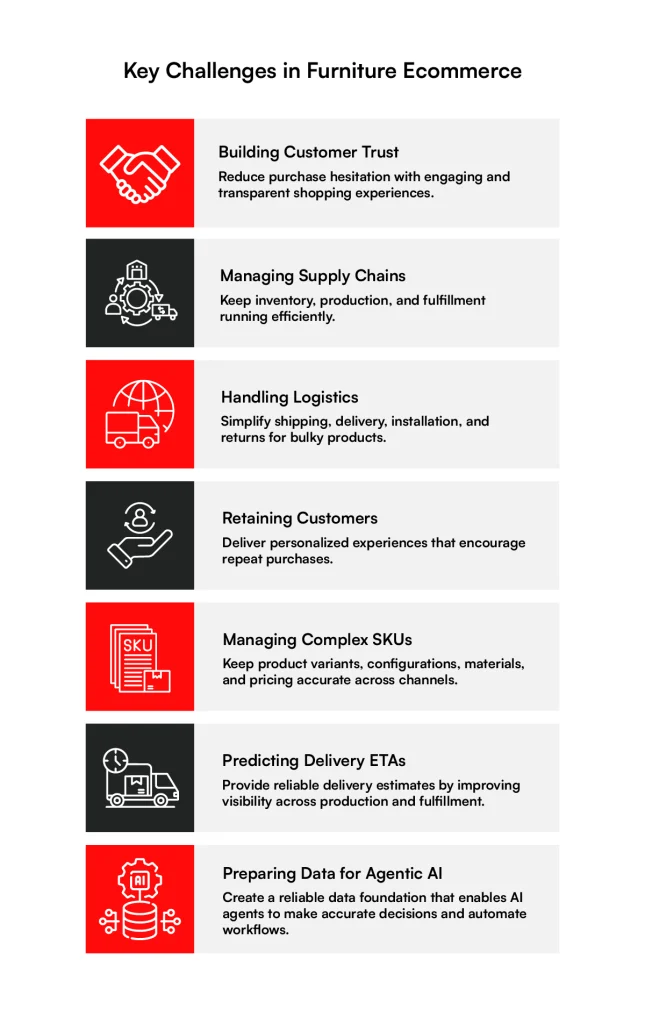
1. Building Brand Trust
Buying furniture online is a significant investment for most customers. They want to feel confident about the quality, durability, and appearance of a product before making a purchase.
High-quality images, detailed product descriptions, customer reviews, transparent pricing, and clear return policies can help build trust and reduce hesitation. Offering features like 3D product visualization or AR can further boost buyer confidence.
2. Complex SKU and Variant Management
Furniture catalogs can include thousands of product variations based on fabric, swatch, wood type, finish, color, size, and configuration.
Managing these complex relationships manually can make even simple catalog changes slow to reflect across channels. A centralized product data approach helps businesses maintain consistency and manage complex assortments at scale.
3. Supply Chain and Manufacturing Challenges
Managing inventory and production can become complicated, especially if you offer made-to-order or customizable furniture. Delays in manufacturing, material shortages, or inaccurate inventory data can impact delivery timelines and customer satisfaction.
Connecting your ecommerce platform with inventory and production systems helps improve visibility and keeps operations running smoothly.
4. Predicting ETAs for Made-to-Order Furniture
Providing accurate delivery estimates can be difficult when orders move through multiple production and fulfillment stages. Material availability, customization, manufacturing schedules, quality checks, and shipping can all affect the final delivery date. Better data visibility across these processes helps brands provide more reliable ETAs and set realistic customer expectations.
5. Building a Reliable Data Foundation for Agentic AI
Agentic AI for retail can help furniture retailers automate workflows, improve customer service, optimize inventory and fulfillment, and make faster operational decisions. However, its effectiveness depends on the quality of the data behind it.
Poorly structured product information, outdated inventory, fragmented order data, and disconnected customer records can lead to inaccurate recommendations and unreliable AI-driven decisions. As ecommerce operations become more complex, building a centralized, accurate, and connected data foundation is essential for enabling AI agents to work reliably at scale.
6. Logistics and Fulfillment
Shipping furniture is more complex than delivering smaller products. Large items require specialized packaging, reliable shipping partners, and careful handling to avoid damage during transit. Coordinating deliveries, managing installation services, and handling returns efficiently are all essential for creating a positive customer experience.
7. Customer Experience and Retention
Winning a customer is only the beginning. Keeping them engaged requires personalized recommendations, responsive customer support, timely order updates, and hassle-free after-sales service. A smooth shopping experience encourages repeat purchases and turns satisfied customers into loyal brand advocates.
These challenges can be addressed with the right technology architecture, connected systems, reliable data, and customer-centric ecommerce practices. The need becomes even more critical as product catalogs expand, because fragmented data and manual processes can compound across SKU management, inventory, fulfillment, delivery estimates, and AI-driven workflows.
At RBMSoft, we apply these principles when building and modernizing furniture ecommerce ecosystems. We also developed Arvyn, a catalog intelligence platform that brings complex product data together and makes it easier to manage at scale.
Arvyn helps improve SKU visibility and supports more accurate ETA predictions by structuring and connecting product information across systems.
It creates the reliable data foundation needed for AI agents to work effectively. This approach helps furniture brands reduce operational complexity while creating a stronger foundation for future ecommerce growth.
Successful D2C Furniture Ecommerce Examples
Building a successful D2C furniture ecommerce business requires more than an attractive online storefront. Behind every seamless shopping experience is a technology foundation that simplifies operations, improves product management, and supports long-term growth.
Here’s an example of how the right ecommerce solution helped a luxury furniture retailer overcome operational challenges and prepare for future expansion.
RBMSoft’s Luxury Furniture Ecommerce Transformation
A leading luxury furniture retailer partnered with RBMSoft to modernize its ecommerce platform and overcome challenges caused by fragmented SKU data across multiple legacy systems. Manual SKU mapping made product management time-consuming, affected data accuracy, and slowed day-to-day operations.
We developed a custom ecommerce solution that centralized SKU management, streamlined data migration, and enhanced product search capabilities. The implementation followed a phased approach, beginning with international SKU-level data as a pilot to refine the migration process before moving to the larger North American assortment.
The solution was developed iteratively with the client’s business teams, allowing RBMSoft to continuously test, refine, and align the application with existing workflows.
Alongside development, we provided technical consultation to help rethink backend processes, reduce manual effort, and improve product data management. The phased implementation also created a structured path for scaling the solution across the retailer’s growing catalog.
As a result, the retailer reduced SKU mapping time by 40%, improved data integrity, and automated several manual processes. This transformation helped create a scalable ecommerce platform that supports operational efficiency while delivering a better experience for both the business and its customers.
This success story reflects a broader shift across the furniture industry, where digital commerce is becoming a key driver of growth. The latest market statistics further highlight how online furniture sales continue to gain momentum.
Lead the Future of Furniture
Stay ahead of changing customer expectations with a custom ecommerce platform built for innovation and growth.
Upgrade My StoreMarket Statistics of Furniture Ecommerce & Furniture Sales Online
The furniture ecommerce market is experiencing steady growth as more consumers choose to research and purchase furniture online. According to industry data, the global furniture ecommerce market was expected to generate around $28.15 billion in revenue in 2024 and is projected to grow at a 5% CAGR through 2031.
North America currently leads the market, while the Asia-Pacific region is expected to witness the fastest growth due to increasing internet penetration and urbanization.
Consumer behavior is also changing. Buyers now expect more than just an online catalog. They want personalized recommendations, interactive product experiences, flexible delivery options, and the confidence to purchase high-value furniture without visiting a showroom.
However, furniture remains one of the most challenging ecommerce categories, with an average online conversion rate of just 1.27%. This highlights the need for technologies that reduce purchase uncertainty and improve the overall shopping experience.
How AI is Revolutionizing Furniture Ecommerce
Artificial intelligence is helping furniture brands bridge the gap between online browsing and confident purchasing. Here are some of the technologies reshaping the industry.
1. 3D Commerce
Interactive 3D product models allow customers to inspect furniture from every angle, zoom into details, and understand product dimensions before buying. This creates a more engaging shopping experience and helps reduce purchase hesitation.
2. AI and Augmented Reality (AR)
AR enables customers to place virtual furniture in their own rooms using a smartphone or tablet. Instead of imagining how a sofa or dining table will look, shoppers can see it in their actual space, making buying decisions much easier.
3. Computer Vision
Computer vision improves product discovery by allowing customers to search using images rather than keywords. It can identify furniture styles, colors, and similar products, helping shoppers find exactly what they’re looking for with less effort.
4. AI-Driven Recommendations
AI analyzes browsing behavior, purchase history, and customer preferences to recommend products that are most relevant to each shopper. Personalized recommendations not only improve the shopping experience but also increase average order value through complementary product suggestions.
5. Chatbots and AI Assistants
AI-powered chatbots provide instant assistance throughout the customer journey. They answer product questions, recommend furniture based on customer requirements, assist with order tracking, and offer 24/7 support, improving both customer satisfaction and operational efficiency.
6. IoT Integration
Smart furniture integrated with IoT technology is creating new opportunities for connected living. Brands can offer features such as remote control, predictive maintenance, and product performance insights while gathering valuable usage data to improve future product development.
Conclusion
The furniture ecommerce landscape is evolving rapidly, and brands that invest in the right digital strategy are better positioned to meet rising customer expectations and achieve sustainable growth.
Whether you’re building a new D2C platform or upgrading an existing one, success depends on delivering seamless shopping experiences, adopting the right technologies, and creating a scalable foundation for the future.
At RBMSoft, a furniture ecommerce development company, we help furniture brands build custom ecommerce solutions that align with their business goals and customer needs.
From strategy and development to integration and ongoing support, we create future-ready platforms that drive engagement, improve operational efficiency, and support long-term growth.
Our capabilities include:
- Custom furniture ecommerce platform development
- Shopify Plus, Headless Commerce, and MERN stack development
- AI, AR, and 3D product experience integration
- ERP, CRM, and third-party system integrations
- Ongoing maintenance, optimization, and support
RBMSoft builds future-ready furniture ecommerce solutions that help you increase conversions, streamline operations, and deliver exceptional customer experiences.
FAQs
1. How can furniture ecommerce brands increase online sales?
Furniture brands can increase online sales by improving product discovery, offering 3D visualization and AR experiences, personalizing recommendations, simplifying the checkout process, and investing in SEO and targeted marketing.
A strong furniture ecommerce development strategy also ensures your website delivers fast performance, seamless navigation, and a smooth customer journey that encourages conversions.
2. Should furniture manufacturers sell directly to consumers (D2C)?
Yes, the D2C model gives furniture manufacturers greater control over pricing, branding, customer relationships, and first-party data.
It also helps improve profit margins by eliminating intermediaries. Investing in ecommerce development for furniture store enables manufacturers to create personalized shopping experiences while building long-term customer loyalty.
3. Which ecommerce platform is best for furniture retailers?
The right platform depends on your business goals. Shopify Plus and BigCommerce are ideal for businesses looking for quick deployment and built-in ecommerce features.
If you require advanced customization, integrations, and scalability, custom furniture ecommerce website development using technologies like the MERN stack or headless commerce may be a better choice.
4. Should furniture companies migrate to headless commerce?
Headless commerce is an excellent option for brands that want greater flexibility and omnichannel capabilities. It separates the front end from the backend, allowing you to create engaging shopping experiences across websites, mobile apps, and other digital channels.
Many businesses include headless architecture as part of their furniture ecommerce platform development strategy to support future growth.
5. How are AI agents changing furniture ecommerce?
AI agents are transforming furniture ecommerce by providing instant customer support, answering product questions, assisting with order tracking, and delivering personalized product recommendations.
They help improve customer satisfaction while reducing the workload on support teams, making them an important component of modern furniture ecommerce solution offerings.
6. How do you design and develop a furniture ecommerce store?
Start by understanding your business requirements, customer expectations, and growth plans. Then choose the right technology stack, create an intuitive user experience, integrate essential business systems, and optimize your store for performance and mobile devices.
Successful furniture ecommerce development focuses on delivering both a great customer experience and efficient business operations.
7. What features should every furniture ecommerce website have?
A furniture ecommerce website should include advanced search and filtering, high-quality product images, 3D visualization or AR, secure payment gateways, customer reviews, product customization, order tracking, and seamless checkout. Professional furniture ecommerce website development ensures these features work together to create a frictionless shopping experience.
8. How can furniture retailers improve inventory management?
Integrating your ecommerce platform with ERP, warehouse management, and inventory systems provides real-time stock visibility and reduces fulfillment errors. Businesses investing in ecommerce development for furniture store often prioritize inventory synchronization to improve operational efficiency and deliver accurate product availability.
9. How do we modernize a legacy furniture ecommerce platform?
Modernization typically involves migrating to a scalable platform, improving performance, redesigning the user experience, integrating AI capabilities, and connecting ERP, CRM, and other business systems.
Working with an experienced furniture ecommerce development company helps ensure a smooth transition with minimal disruption to your operations.
10. How much does it cost to build a furniture ecommerce platform?
The cost depends on factors such as platform selection, custom features, third-party integrations, AI capabilities, design complexity, and ongoing maintenance.
A basic ecommerce store costs significantly less than a fully customized solution. Discussing your business goals with a development partner helps you estimate the investment required for furniture ecommerce development.
11. What ERP integrates best with furniture ecommerce?
Popular ERP solutions such as Microsoft Dynamics 365, SAP, Oracle NetSuite, Odoo, and Acumatica integrate well with furniture ecommerce platforms.
The ideal choice depends on your business size, operational requirements, and existing technology ecosystem. Strong ERP integration is a key part of ecommerce development for furniture store projects.
12. How is Generative AI transforming furniture ecommerce?
Generative AI helps automate product descriptions, create personalized marketing content, improve customer support, generate design inspiration, and power conversational shopping experiences. It also enables brands to deliver more engaging and efficient digital experiences while reducing manual effort.
13. Can AI improve furniture product recommendations?
Yes. AI analyzes browsing behavior, purchase history, and customer preferences to recommend products that match individual tastes. It can also suggest complementary products, improving the shopping experience while increasing average order value and customer satisfaction.