

Table of Contents
Quick Summary:
- The agentic enterprise marks the next stage of digital evolution by shifting from reactive automation to intelligent and autonomous systems.
- Six core features: autonomous operations, proactive decision-making, hyper-personalization, hybrid workforce, built-in governance, and continuous learning.
- Agentic enterprises deliver faster execution, lower costs, better risk detection, higher customer loyalty, and more innovative teams.
- A modern architecture powered by four new layers (Agentic, Semantic, AI/ML, and Orchestration) enables safe and scalable intelligence.
- Successful transformation follows a clear six-step roadmap: vision and pilots, foundation modernization, people empowerment, process redesign, governance setup, and continuous optimization.
- Common challenges can be overcome with proper strategy, strong architecture, and expert guidance from an experienced AI development company.
Your teams work hard every day, yet critical decisions still get delayed, customers complain about slow or generic responses, and valuable employees spend too much time on repetitive tasks instead of driving real innovation.
You have invested heavily in automation and AI, still the systems remain reactive, rigid, and disconnected. Opportunities slip away while problems escalate before anyone notices.
Traditional automation and basic AI assistants have taken you far, but they fall short in a fast-moving, always-on world. Your enterprise needs faster processes that can sense, think, act, and learn on its own while keeping human intervention in control.
Agentic enterprise represents the next stage of digital evolution. Intelligent AI agents work as active partners with your teams, handling entire workflows autonomously, making proactive decisions, and delivering hyper-personalized experiences at scale.
In this article, we will explore what an agentic enterprise really looks like, the modern architecture that powers it, and the practical steps to get there.
5 Key Features of an Agentic Enterprise
With Agentic AI, your organization doesn’t have to wait for instructions, they immediately act. Instead it senses opportunities, makes smart choices, and executes tasks on its own while keeping humans firmly in control.
That is exactly what an agentic enterprise delivers. It moves far beyond traditional automation or simple AI assistants. Here, intelligent AI agents work as active partners alongside your teams.
Let us explore the core features that define this new stage of digital evolution.
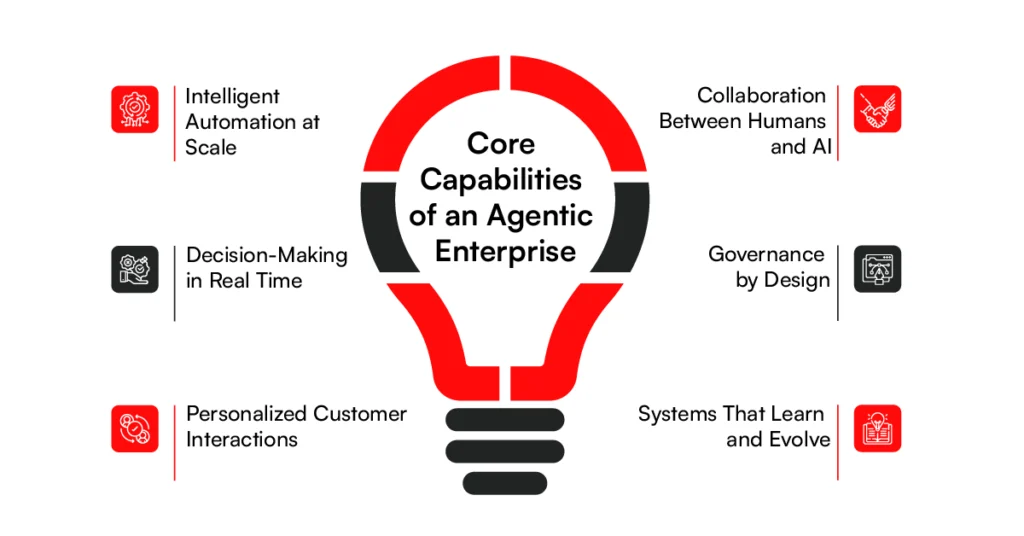
1. Autonomous Operations & Efficiency
In an agentic enterprise, systems handle end-to-end workflows with minimal human intervention. AI agents break down complex goals into smaller steps, interact with multiple tools and data sources, and complete tasks end-to-end.
Instead of just following scripts, they reason, plan, and act independently while staying aligned with business objectives.
This autonomy drives remarkable efficiency.
- Routine processes run 24/7 without fatigue
- Errors drop significantly
- Teams free up hours that once went to manual coordination
2. Proactive Decision-Making
Agentic AI enterprises shift from reactive to proactive. AI agents constantly monitor data streams, detect patterns, and anticipate needs before problems arise or opportunities slip away. They analyze situations in real time and evaluate possible options.
Based on that, they initiate actions such as rerouting resources, escalating critical issues, or reaching out to customers at the right moment.
Over time, this creates a decisioning layer that runs continuously in the background, supporting every function of the business. Teams are no longer overwhelmed by data because the system translates signals into clear, timely actions. Decision-making becomes faster, more consistent, and aligned with business goals.
3. Hyper-Personalization & Enhanced CX
Customers today expect experiences that feel uniquely tailored to them. Agentic enterprises make this possible at scale. AI agents pull together customer history, behavior, preferences, and context in real time.
They then deliver individualized recommendations, communications, and solutions that feel thoughtful rather than generic. Whether it is a support interaction, a product suggestion, or a proactive service offer, every touchpoint becomes relevant. The result is deeper engagement and stronger relationships.
3. Hybrid Workforce Revolution
The agentic enterprise creates a true partnership between humans and AI. Intelligent agents take over repetitive, data-heavy, and time-consuming work. Teams can then focus on creativity, strategy, and complex problem-solving.
This hybrid model boosts productivity without replacing jobs. It elevates roles, reduces burnout, and unlocks higher levels of innovation across the organization.
It also changes how teams collaborate, with AI agents acting as active contributors that can execute, recommend, and adapt in real time. As this collaboration matures, organizations start designing roles and workflows around human and AI strengths together.
4. Built-in Governance
Clear rules, oversight mechanisms, and human approval gates ensure that AI agents operate within defined boundaries. Security, compliance, ethics, and risk controls are embedded directly into the system rather than added as an afterthought.
Leaders maintain visibility and control at all times, so the organization moves faster while staying safe and trustworthy.
5. Continuous Learning and Adaptation
Markets, customer needs, and technologies change constantly and agentic AI enterprise learns and evolves with them. AI agents improve over time by analyzing outcomes from previous actions, incorporating new data, and refining their approaches.
They adapt to shifting conditions without requiring constant reprogramming. This in-built learning capability keeps your organization agile, resilient, and always improving.
Lead the Era of Intelligent Enterprises
The organizations that define the next decade are building agentic capabilities right now. Know your exact investment and take the first step toward becoming one of them.
Start My Agentic Journey Today
Architecture of the Agentic Enterprise
Traditional IT systems were built for humans who think and act through applications but Agentic architecture changes the whole concept. It creates a powerful platform where humans, AI agents, and existing systems work together seamlessly.
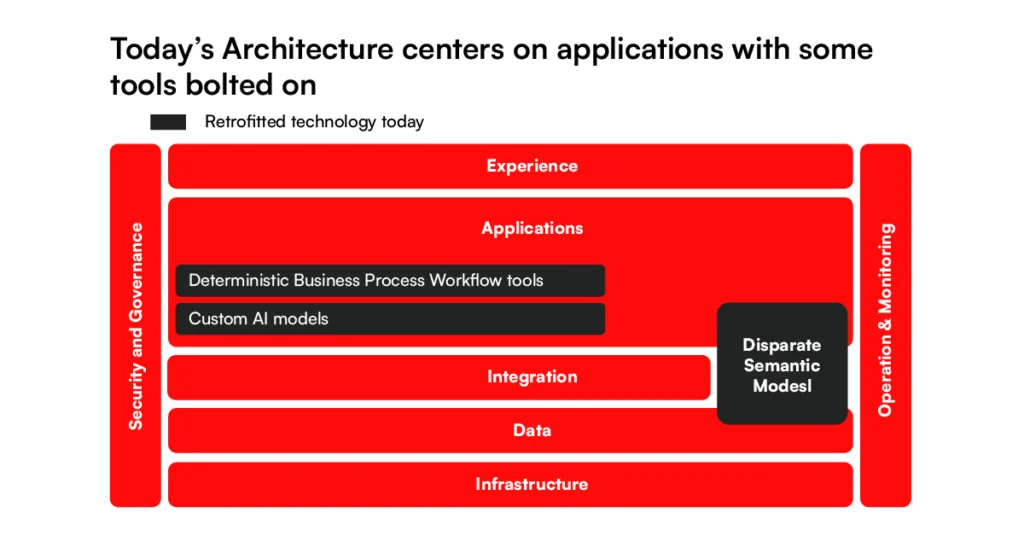
Traditional Architecture vs Agentic Architecture
Traditional enterprise IT architecture has five main layers: Infrastructure, Data, Integration, Application, and Experience. Security and IT Operations cut across all layers. In this setup, humans handle most intelligence and decisions.
The system supports only limited AI pilots. Silos, lack of shared understanding, and weak orchestration make it hard to scale intelligent agents.
Agentic architecture keeps the original five layers and the cross-cutting Security and IT Operations. It then adds four powerful new layers on top. These new layers solve the specific needs of AI agents.
They enable agents to sense, reason, plan, act, collaborate, and learn at scale. The traditional layers also evolve. For example, the Data layer becomes more unified and AI-ready. The Application layer turns into flexible, composable services that agents can use dynamically.
The result is a modern, 11-layer stack that supports dynamic, goal-driven work while keeping strong human oversight and governance.
The 4 New Layers
Here are the four new layers and the important role each one plays:
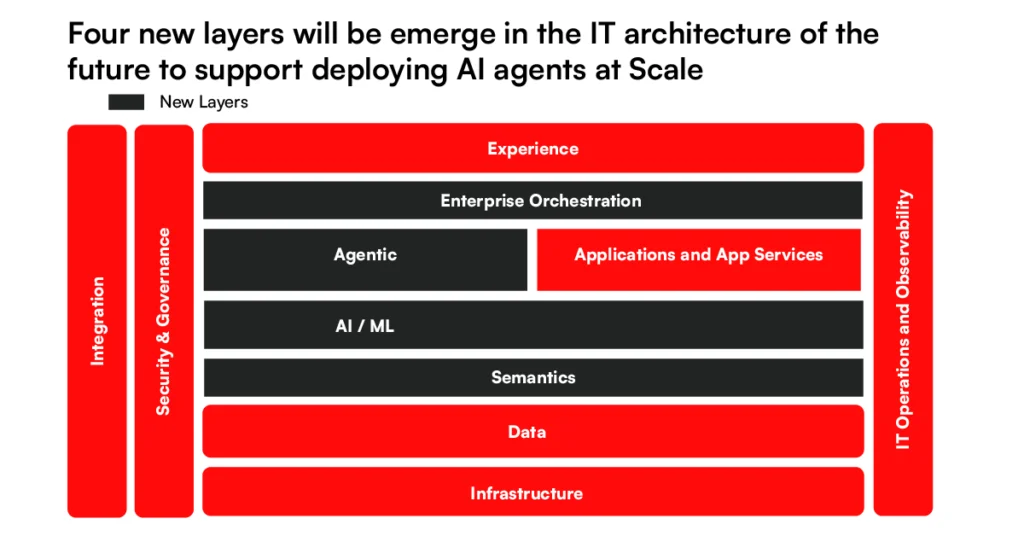
- Agentic Layer: This layer serves as the dedicated home for building, running, and managing AI agents at scale. It handles planning, reasoning, memory, tool usage, and agent lifecycles.
Agents can discover each other, collaborate, and break down complex goals into steps. It turns static applications into dynamic services that agents compose on the fly. This layer moves you from simple rule-based bots to truly adaptive, goal-oriented agents.
- Semantic Layer: This layer builds an enterprise ontology, business glossary, and knowledge graph. It translates natural language into precise queries and gives agents shared context across different systems.
Agents can now reason consistently and understand relationships in your data. It bridges the old data silos and creates a unified understanding for multi-agent workflows.
- AI/ML Layer: This acts as the central intelligence hub for all your AI and machine learning models. It manages the full lifecycle of foundation models, domain-specific models, and tools like retrieval-augmented generation.
Models become shared enterprise services instead of being locked inside single applications. It includes strong governance, safety checks, monitoring, and easy access for agents. This layer ensures your AI is reusable, scalable, and trustworthy.
- Enterprise Orchestration Layer: This layer coordinates complex, multi-step processes that involve many agents, humans, and systems.
- It blends autonomous agent actions with centralized oversight.
- It models workflows, enforces rules and KPIs, maintains shared context, and optimizes processes over time.
- It keeps everything aligned with business goals while allowing flexibility.
This moves you from rigid, human-centric processes to dynamic, blended orchestration.
These four new layers sit on top of your evolved traditional foundation. Together, they create a flexible, intelligent platform. Agents gain the ability to reason and act.
Humans retain control through governance and oversight. Security and observability run across everything to keep operations safe and measurable.
6 Steps to Become an Agentic Enterprise
Becoming an agentic enterprise demands clear vision, strong foundations, empowered people, redesigned processes, robust governance, and continuous optimization.
Follow these six practical steps to become a fully functioning agentic organization that delivers real business value.
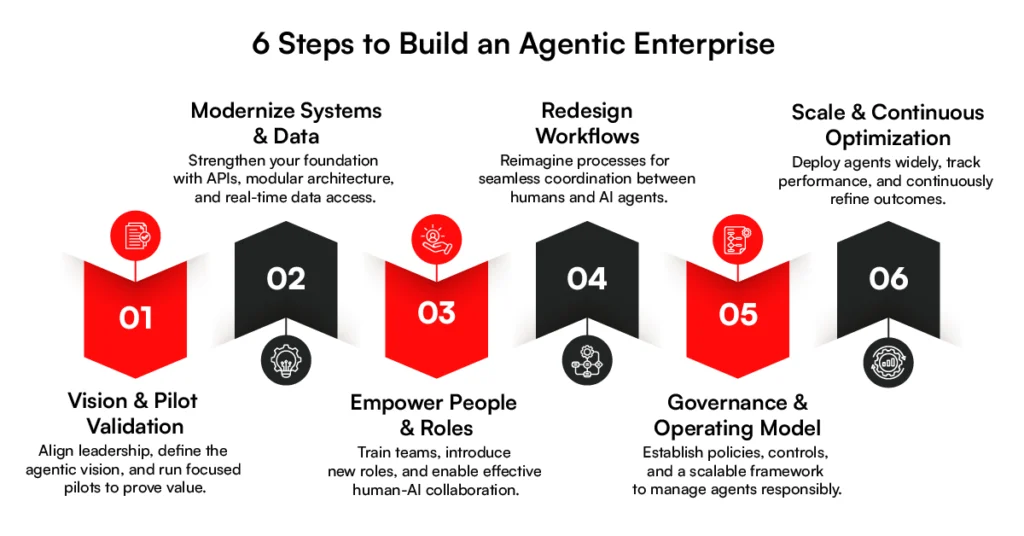
1. Define Vision & Run Proof-of-Value Pilots
- Begin by aligning your leadership team on a clear agentic future
Gather leaders from IT, business, HR, and operations. Together, you create a shared vision statement that answers why agentic AI matters and how it amplifies human potential rather than replacing people.
- Next, you identify high-impact use cases where agents can deliver quick wins
Good starting points include customer service, IT operations, workflow orchestration, code reviews, or defect triage. You assess your current readiness across people, processes, data, and technology using a simple maturity model.
- Then you launch focused Proof-of-Value pilots
Keep them small and scoped to one or two processes. In these pilots, your teams test agent reasoning, autonomy, tool usage, and collaboration with humans. You measure real metrics such as speed, accuracy, risk levels, and ROI while tracking governance and compliance.
This step delivers fast clarity and confidence. You see tangible results in weeks instead of months. Leadership gains buy-in because they witness real value. Risks surface early, so you can address them before scaling.
The outcome is a solid foundation, organizational momentum, and a roadmap that guides every future step with data-backed decisions.
2. Assess Portfolio & Modernize Foundations
- Map all Assets
Start by mapping all your current applications, systems, data sources, and integration points. Create a clear inventory that shows what works well and what creates friction.
- Identify legacy systems that block agentic capabilities
Look for tightly coupled monoliths, outdated APIs, poor data quality, and missing observability. Pinpoint areas where agents would struggle to access data or take reliable actions.
- Next, prioritize modernization efforts
Focus first on building clean, reusable APIs and moving toward modular, composable architectures. Strengthen your data foundation with unified access, real-time capabilities, and semantic readiness. Add strong observability so agents can monitor outcomes and learn from every action.
- Modernize your infrastructure
Modernizing infrastructure supports AI-scale compute and elasticity. This step ensures agents can discover tools, call services securely, and operate without constant manual fixes. Agents gain reliable access to systems and data.
You reduce integration headaches and future-proof your technology stack. Teams move faster because they work on a clean, agent-ready foundation instead of fighting old constraints.
By the end of this step, you will have a solid base that supports scalable agent deployment. Your enterprise stands ready for intelligent automation without hidden technical debt holding you back.
3. Prepare and Empower Your People
- Start by rolling out practical training programs
Teach employees how agents reason and make decisions. Show them how to set goals for agents, monitor results, and intervene when necessary. Include hands-on sessions, so teams learn to collaborate effectively with AI.
- Agent Orchestrators
Simultaneously, introduce new roles such as agent orchestrators, process owners, and AI catalysts. These positions give clear ownership and help bridge the gap between humans and agents.
- Focus on cultural change
Encourage teams to see agents as capable partners. Leaders must model this mindset and celebrate early wins to build confidence.
The result is a confident workforce that knows how to guide and work alongside AI agents every day. Your employees feel empowered instead of threatened. They shift from routine tasks to higher-value creative and strategic work. Job satisfaction improves, and innovation rises.
4. Redesign Processes for Human-AI Orchestration
- Now it is time to move beyond simple automation
You redesign your core processes from the ground up for true human-AI collaboration.
- Stop thinking in terms of automating single tasks
Instead, reimagine entire end-to-end workflows. Identify where AI agents can take full ownership using their reasoning and action capabilities. At the same time, keep human judgment for complex decisions or ethical choices.
- Remove unnecessary manual handoffs that slow things down
Augment steps where human insight still adds real value. Create seamless orchestration so agents handle routine work while humans focus on oversight, exceptions, and innovation.
This redesign delivers smoother, faster processes that feel intelligent rather than robotic. Teams experience less friction and greater impact.
The outcome is a living process model where humans and agents work together naturally, producing better results with less effort.
5. Build Governance, Platform & Center of Excellence
- This step focuses on building the backbone for responsible growth
First, establish a centralized platform to deploy, monitor, and manage agents across the enterprise. This platform should provide real-time visibility into agent actions, performance metrics, and decision trails.
- At the same time, create a dedicated AI Center of Excellence (CoE)
Bring together experts from technology, legal, compliance, security, and business teams. The CoE defines clear standards, guardrails, and best practices for agent development and usage.
- Prioritize Compliance & Security
Focus on critical areas such as security protocols, regulatory compliance, ethical guidelines, and data quality. Build reusable templates, approval workflows, and risk-assessment frameworks so that every new agent follows the same disciplined approach.
This step gives you confidence to scale. You maintain control even as the number of agents grows.
Teams across the organization can innovate faster because they have clear rules and reliable support. The result is a governed, secure, and scalable agentic environment that protects the business while enabling rapid progress.
6. Roll Out, Measure, and Continuously Optimize
You have laid the groundwork. Now take the agents live.
- Start by integrating agents into real production workflows
Roll them out gradually and thoughtfully. Keep human-in-the-loop controls for sensitive or high-stakes decisions until agents consistently prove their reliability and accuracy.
- Once agents are active, focus on measurement
Track important metrics such as cycle time, cost savings, quality improvements, error reduction, and user adoption rates. Gather direct feedback from employees who work alongside the agents every day.
- Use these insights to drive continuous improvement
Refine agent prompts, enhance orchestration between humans and AI, strengthen governance policies, and adjust decision boundaries where needed.
- Treat optimization as an ongoing cycle rather than a final milestone
Regularly review performance, incorporate new learnings, and evolve agent capabilities as business conditions change.
This step transforms your agentic initiative from pilot success into sustained enterprise-wide value. You create a dynamic system that keeps getting better, more efficient, and more intelligent over time.
What Would Your Business Look Like Fully Agentic?
Most enterprises underestimate how quickly the transformation can happen and how affordable it is to get started. One conversation will change how you see the possibilities.
Show Me My Agentic Future5 Challenges Enterprises Face in Agentic AI Adoption (and How to Overcome Them)
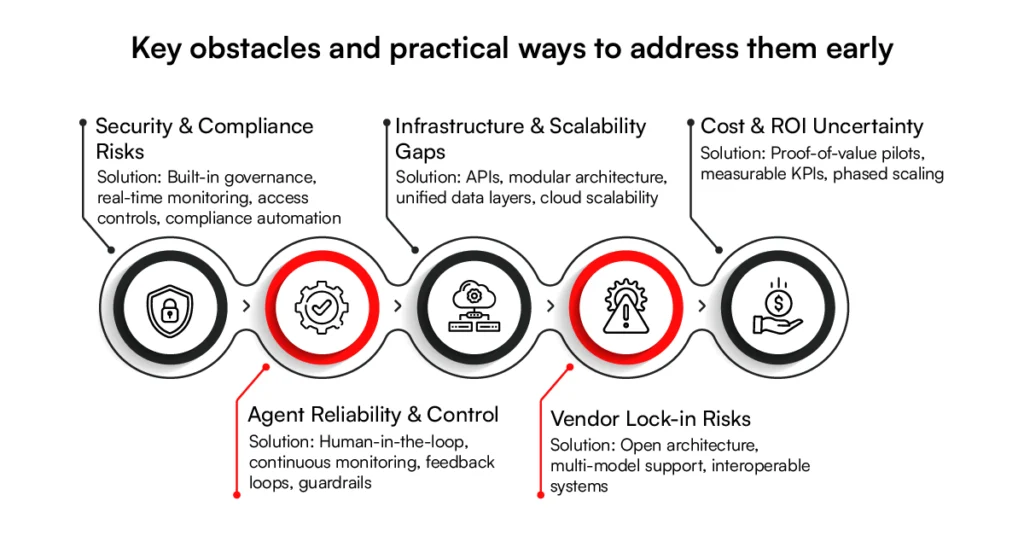
Moving toward an agentic AI enterprise brings exciting possibilities, yet it also presents several real obstacles. Most organizations encounter the same set of challenges. The difference lies in how you address them early.
Here is a practical look at the five biggest hurdles and effective ways to tackle each one.
1. Security and Compliance Challenges
Autonomous agents interact with multiple systems and handle sensitive information. This raises serious concerns around data privacy, unauthorized actions, and regulatory requirements. Many leaders fear violations of GDPR, the EU AI Act, or industry-specific rules.
The risk becomes more specific when an AI agent can make purchases or act on a customer’s behalf. In commerce, agentic commerce fraud prevention helps businesses verify that the agent is legitimate and still acting within the customer’s permission.
Real-time monitoring and clear approval rules can then help teams identify actions that need another check before they proceed.
3. Reliability and Controllability of AI Agents
Unlike traditional automation, agentic AI can sometimes produce unexpected results. Agents may misinterpret context or take actions that deviate from intended goals, especially in complex or high-risk scenarios.
You address this by designing clear oversight mechanisms. Introduce human review points for critical decisions, implement continuous performance monitoring, and add self-correction capabilities.
Regular testing and feedback loops keep agents reliable and aligned with business expectations.
3. Infrastructure and Scalability Issues
Running intelligent agents at enterprise scale demands significant computing resources, fast networks, and seamless integration with existing systems.
Older infrastructure often struggles to support dynamic multi-agent workflows and can quickly become a bottleneck.
The solution starts with targeted modernization. Build modular APIs, unified data access layers, and elastic cloud infrastructure. This creates a flexible foundation that grows smoothly as your agent ecosystem expands.
4. Vendor Lock-in and Forward Compatibility Concerns
Many agent platforms tie you to specific models or vendors. When technology advances rapidly, switching or upgrading becomes painful and expensive.
Avoid this trap by choosing open and interoperable architectures. Adopt standard protocols, support multiple models, and design your system so components can be swapped or upgraded without major disruption. This keeps your options open for future improvements.
5. Cost and ROI Uncertainty
Leaders often worry about the high initial investment required for agentic AI. They question whether the returns will justify the spend, especially when many benefits are indirect or long-term.
The best way forward is to start small with focused Proof-of-Value pilots. These pilots deliver quick, measurable wins in areas such as cycle time reduction or error reduction. They also help build internal confidence before committing larger budgets.
A structured measurement framework makes ROI clearer over time. Track both quantitative metrics, such as cost savings and speed gains, along with qualitative improvements in employee productivity and customer experience. This approach removes uncertainty and supports confident scaling.
6 Key Benefits of Developing an Agentic Enterprise
Once the features of an agentic enterprise begin to work together, the impact becomes very visible. You can reshape how speed, decisions, customer experience, and workforce productivity come together across the business.
1. Faster Execution, Lower Costs, Reduced Errors, and 24/7 Efficiency
- When AI agents take ownership of workflows, execution no longer depends on manual handoffs or limited working hours.
- Tasks move continuously across systems, decisions happen in real time, and processes run without constant supervision. This reduces delays, minimizes human error, and keeps operations running around the clock.
- You move from fragmented execution to always-on, end-to-end operations.
2. Early Risk Detection, Faster Responses, and Better Forecasting
- Agentic systems can identify anomalies, risks, and opportunities much earlier because they continuously monitor data and patterns.
- Instead of waiting for reports or escalations, the system flags issues and initiates responses as they emerge. This improves how quickly you react and how accurately you plan.
3. Higher Customer Satisfaction, Loyalty, and Revenue
- Agentic AI enterprises create more consistent and context-aware customer interactions. AI agents ensure that responses are timely, relevant, and personalized across channels.
- Every interaction builds on prior context, which leads to smoother experiences and stronger relationships.
- Over time, this directly influences retention, loyalty, and revenue growth.
4. Employees Focus on High-Value Work
- As AI agents handle repetitive and execution-heavy tasks, employees are no longer tied up in routine work. They can focus on areas that require judgment, creativity, and strategic thinking.
- This shift improves productivity and also changes how people experience their roles at work.
5. Strong Compliance, Reduced Risks, and Greater Trust
- With governance embedded into agentic systems, every action taken by AI is aligned with policies, permissions, and regulatory requirements.
- This reduces the chances of non-compliance and ensures that decisions are traceable and auditable.
- Instead of reacting to risks after they occur, the system operates within controlled boundaries from the start. Trust becomes a built-in outcome of the system’s operation.
6. Automatic Adaptation, Ongoing Improvement, and Long-Term Resilience
- Agentic enterprises are not static systems. They learn and improve as they operate.
- AI agents continuously refine how they execute tasks and make decisions, informed by feedback and new data. This allows the organization to adapt to change without constantly redesigning processes.
- Over time, this creates a resilient business capable of evolving with changing conditions.
How Much Does it Cost to Build an Agentic Enterprise?
The cost of building an agentic AI system depends on several factors, including system complexity, integration requirements, infrastructure, and the level of autonomy required.
For early-stage pilots or small automation projects, development costs may start around $30,000 to $80,000.
More advanced enterprise-grade systems with multi-agent architectures, cross-platform integrations, and governance layers can range from $100,000 to $500,000 or more, depending on scale and level of customization.
Many organizations begin with a focused pilot use case before expanding to larger enterprise deployments
AI Agents Cut Operational Costs by 40%
Enterprises deploying agentic AI report faster cycle times, fewer errors, and measurable ROI within the first quarter. Find out exactly what it costs to get there.
Get My Custom Cost EstimateConclusion
The agentic enterprise is not just another technology trend. It is the next stage of digital evolution for enterprises. In a world that moves faster every day, organizations that continue to rely on reactive systems and traditional automation will struggle to keep pace.
Those that embrace agentic capabilities will sense opportunities earlier, respond faster, deliver exceptional customer experiences, and unlock the true potential of their people.
At RBMSoft, as a leading AI development company, we specialize in helping enterprises make this powerful transition smoothly and confidently.
We help you design, implement, and scale a complete agentic enterprise that aligns with your business goals, values, and existing systems.
Here is how RBMSoft can help you become a truly agentic enterprise:
- End-to-end Agentic Transformation Roadmap – We work with your leadership to define a clear vision and create a practical, phased roadmap tailored to your industry and maturity level.
- Agentic Architecture Design & Implementation – Our experts design and build the modern architecture with Agentic, Semantic, AI/ML, and Enterprise Orchestration layers that support scalable, secure, and intelligent operations.
- Custom AI Agent Development – We develop intelligent, goal-oriented agents that handle complex workflows while maintaining strong human oversight and governance.
- People Enablement & Change Management – We design training programs, define new roles, and drive cultural change so your teams embrace and excel in the hybrid human-AI environment.
- Governance, Security & Compliance Framework – We embed responsible AI practices, compliance guardrails, and real-time monitoring from day one to minimize risks.
- Pilot to Production Support – From successful Proof-of-Value pilots to full-scale rollout and continuous optimization, we stay with you at every step to ensure measurable business impact.
The future belongs to enterprises that can think, act, and adapt autonomously.
FAQ’s
1. What is an agentic enterprise?
An agentic enterprise is a modern organization where AI agents are embedded into core systems to autonomously plan, make decisions, and execute workflows.
Instead of relying only on human input or static automation, these enterprises operate through intelligent systems that continuously adapt, coordinate across functions, and drive outcomes, with humans overseeing governance, strategy, and exception handling.
2. How do AI agents and autonomous workflows work together?
AI agents act as the decision-making layer within autonomous workflows, while workflows define how tasks are structured and executed. Agents analyze data, determine next steps, and trigger actions across systems, enabling workflows to run dynamically.
This combination allows enterprises to move from rigid, rule-based processes to flexible systems that can respond, adapt, and complete tasks end-to-end with minimal human involvement.
3. What role do AI agents play in an agentic enterprise?
AI agents serve as the core execution units in an agentic enterprise. They interpret data, make contextual decisions, interact with enterprise systems, and carry out tasks across workflows.
Beyond simple automation, they coordinate across tools, manage dependencies, and continuously improve outcomes, enabling businesses to operate with greater speed, accuracy, and scalability while reducing reliance on manual intervention.
4. How much does it cost to build an agentic enterprise?
The cost of building an enterprise agentic platform varies depending on factors like system complexity, data readiness, and the scale of implementation.
Investments typically include infrastructure modernization, API development, agent design, orchestration platforms, and governance layers.
Rather than a one-time expense, it is typically a phased investment that scales as organizations move from pilot use cases to enterprise-wide adoption.
5. How much time does it take to develop agentic enterprises?
The timeline to develop an enterprise agentic platform depends on organizational maturity and scope. Initial pilots or proofs-of-concept can take a few weeks to a few months.
However, building a fully scaled agentic enterprise with integrated systems, workflows, and governance typically takes several months to over a year, as it involves iterative development, testing, and alignment across business and technology teams.