
Table of Contents
Quick Summary:
- Custom software is built specifically for your business, your workflows, your data, and your rules, unlike off-the-shelf tools built for a general market.
- It scales on your terms, integrates cleanly with existing systems, and gives you full ownership of the codebase and roadmap.
- The upfront investment is higher than a software license, but the total cost over two to four years is typically lower once licensing fees, add-ons, and workaround overhead are factored in.
- This guide covers what custom software development is, how the process works across seven stages, and what it realistically costs in 2026 across small business, mid-market, and enterprise segments.
- It also covers when building makes more sense than buying, and how to choose the right custom software development partner.
The best software for your business doesn’t exist yet. And this is a fact that hands you your sharpest competitive edge in 2026. The question that actually decides who wins is brutally simple:
Does the software belong to you, or do you belong to the software?
Presently, your competitors are twisting their operations to fit inside someone else’s rigid “standard” platform, where they are paying for even those modules and features they’ll never require. But you could operate in a way that a SaaS vendor never imagined. You can build the exact piece of technology that finally works with you instead of against you.
These data leave no room for debate:
1. In a 2023 Deloitte survey, 48% of executives stated that custom software provided a significant competitive advantage by enabling unique features that competitors couldn’t replicate.
2. According to a 2023 Gartner survey, 63% of companies reported that off-the-shelf software required significant customization to meet their specific needs.
3. Research by IDC in 2023 found that 55% of companies experienced integration issues when using off-the-shelf software, leading to operational inefficiencies.
4. A 2023 Forrester study revealed that while the initial cost of custom development is 30-50% higher, it results in a 25% reduction in total cost of ownership (TCO) over five years compared to off-the-shelf solutions.
5. In 2023, a report by Accenture showed that 47% of companies using custom software experienced a 30% improvement in data consolidation and business intelligence capabilities compared to those using off-the-shelf solutions.
Custom software development enables you to engineer something that is meant for your workflows, your users and your growth trajectory, with no forced compromises and no shelf tax.
This guide breaks down what custom software development actually is, when you need it, what it costs (and why), and how to choose a partner who builds for your outcomes.
Your Competitors Are Already Building Ahead
Companies that delay custom development today will spend twice as much catching up tomorrow. One conversation is all it takes to find out where you stand.
Request a Gap Analysis
What Is Custom Software Development?
Custom software development is the process of designing, building, and deploying software built entirely around one organisation’s needs. Not adapted from a generic product. Not stretched to fit a workflow it was never designed for. Built from the ground up to do exactly what your business requires.
Unlike off-the-shelf tools built for the broadest possible market, custom software development solutions are built for a specific company, team, and set of problems. Every feature earns its place. Every workflow reflects how your business actually operates, not how a product manager at a software vendor assumed it might.
This applies across every type of solution a business might need. Web platforms, mobile applications, ERP systems, CRM tools, inventory engines, and customer portals can all be developed this way. What makes them custom is not the technology. It is the intent: built to solve your problem, not to serve a general market.
The Global Custom Software Development Market is estimated to reach $350.78 billion by 2034 with a CAGR of 22.82%. The increased demand for customized software that integrates seamlessly with cloud-based systems and the growing adoption of AI automation across sectors are fueling market growth.
Behind that number is a straightforward shift: more organizations have reached the ceiling of what generic software can do for them.
Custom Software Development VS Off-The Shelf Software
Every software decision a business makes is ultimately a trade-off between speed and fit. Off-the-shelf software gets you moving fast. Custom software development gets you moving in the right direction. Which one matters more depends entirely on where your business is and where it needs to go.
Neither option is universally better. The mistake most organisations make is treating this as a values question rather than a business one.
| Dimensions | Custom Software Development | Off-the-Shelf Software |
| Upfront Cost | Higher initial investment; scope-dependent | Lower upfront licensing fees apply immediately |
| Time to Deploy | Weeks to months, depending on complexity | Days to weeks |
| Workflow Fit | Built exactly around your processes | You adapt your processes to fit the software |
| Scalability | Scales with your business on your terms | Constrained by the vendor’s product roadmap |
| Integration | Designed to connect with existing systems | Often requires third-party tools or workarounds |
| Ownership | You own the codebase and the roadmap | Vendor controls updates, pricing, and continuity |
| Security | Built around specific compliance needs | Shared architecture is a known target for attacks |
| Long-term Cost | Lower total cost of ownership (5+ years) | Licensing, upgrades, and add-on costs compound |
When Off-the-Shelf Makes Sense?
Off-the-shelf software is the right call in specific, well-defined situations. A business that needs a payroll tool, a project management board, or a standard email platform has no compelling reason to build from scratch. These are solved problems with mature, reliable products already on the market.
The calculus shifts once your needs become specific. Research shows that over 40% of developer challenges with packaged platforms are due to customisation, underscoring how difficult it is to adapt these solutions to niche requirements.
For generic operational functions with no competitive dimension, off-the-shelf wins on speed and cost every time. For anything that touches how you serve customers, manage inventory, price products, or differentiate from competitors, it rarely does.
Off-the-shelf also makes sense when a business is early-stage and still validating its processes. There is no value in building custom software development solutions around workflows that have not yet stabilized.
When Custom Development Is the Right Call?
The signal that custom development has become the right call is not a single moment. It accumulates. Teams start building workarounds inside tools that were supposed to simplify their work. Data sits in separate systems that do not talk to each other.
A new market opportunity requires a capability that the existing software cannot support, and the vendor has no timeline for adding it.
Integration challenges with off-the-shelf platforms tend to grow over time. In fact, 90% of organizations face data silos, underscoring how fragmented systems create persistent integration burdens. Eventually, the cost of maintaining and connecting these systems outweighs the cost of building a tailored solution.
Custom software development for enterprise organizations reaches this inflexion point sooner because the operational complexity is higher and the cost of inefficiency at scale is higher.
A retailer managing hundreds of SKUs across physical and digital channels, a logistics company with carrier-specific pricing logic, or a financial services firm with proprietary compliance workflows will outgrow any generic platform. The question is only when.
Custom software development for small businesses reaches the same point under different conditions. Not complexity of scale, but specificity of model.
A business with a genuinely differentiated way of operating, one that gives it an edge over larger competitors, cannot afford to run that differentiation on the same software its competitors use.
Key Benefits of Custom Software Development
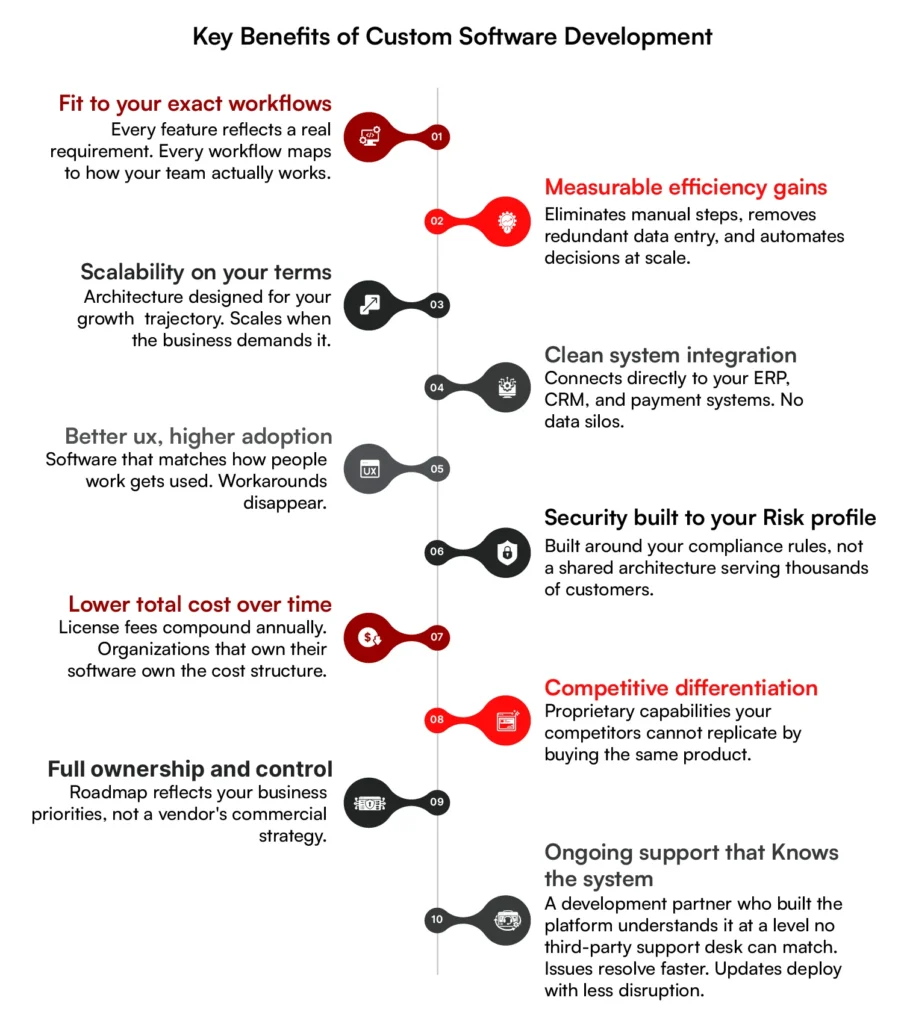
Custom software development is not a technology investment in the traditional sense. It is an operational investment. The return shows up in how efficiently a business runs, how quickly it responds to change, and whether the tools its teams use every day are working for the business or against it.
- Fit to your exact workflows: Off-the-shelf software is built around assumptions about how businesses operate. Custom business software development is built around how your business actually operates. Every feature reflects a real requirement. Every workflow maps to how your team works, not how a vendor’s product manager assumed they might.
- Measurable efficiency gains: When software eliminates manual steps, reduces redundant data entry, and automates decisions that previously required human intervention, productivity gains compound quickly across a business. The gains are not incidental. They are the point.
- Scalability on your terms: Generic platforms scale within the limits their architects designed for a broad market. When a business outgrows those limits, it either pays for workarounds or replaces the platform entirely. Custom software scales because the architecture was designed for your growth trajectory from the start.
- Clean system integration: Most businesses already have systems in place. ERP platforms, CRM tools, warehouse management software and payment processors. Custom software development solutions connect directly with those systems, eliminating data silos and manual reconciliation that accumulate when tools do not communicate with each other.
- Better user experience, higher adoption: Software that matches the way people work gets used. Software that forces people to adapt their workflows to a tool’s logic gets worked around, quietly, at scale, in ways that rarely appear in any report but always show up in productivity numbers.
- Security built to your risk profile: Off-the-shelf software carries a structural security disadvantage. Its architecture is publicly known, its vulnerabilities are widely shared, and its patches apply to every customer simultaneously. Custom software is built around your specific compliance requirements, data classification rules, and access control needs.
- Lower total cost over time: The initial investment in custom software development is higher than a software license. Over two to four years, the economics routinely reverse. License fees compound annually. Vendor price increases arrive with every renewal. Add-ons required to make generic software fit specific needs generate their own ongoing costs. Organizations that own their software own the cost structure.
- Competitive differentiation: Businesses running on the same platforms as their competitors have limited ability to differentiate through operations. Custom software makes proprietary capabilities possible. A pricing engine, a customer experience layer, or an internal tool that gives the business an advantage its competitors cannot easily replicate by purchasing the same product.
- Full ownership and control: With off-the-shelf software, every significant product decision rests with the vendor. Feature roadmap, pricing, data portability and deprecation timelines. With custom software, those decisions stay inside the organization. The roadmap reflects business priorities, not a vendor’s commercial strategy.
- Ongoing support that knows the system: A development partner who built the platform understands it at a level no third-party support desk can match. Issues get resolved faster, updates deploy with less disruption, and new requirements get incorporated by a team that already understands the full system context.
McKinsey research found that enterprises with high-performing IT organizations achieve up to 35% higher revenue growth than their peers.
That gap does not come from technology alone. It comes from technology that fits the business well enough to become a genuine operational advantage.
Types of Custom Software Solutions
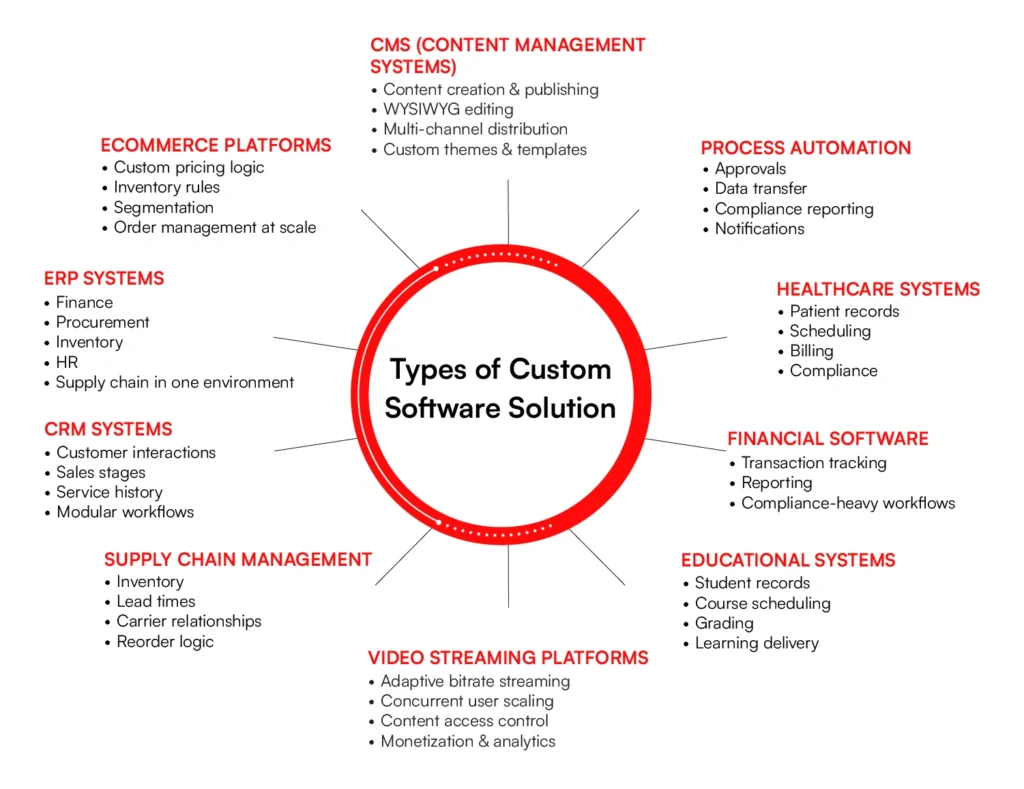
Custom software development solutions are not defined by a single category. They span every function where a business needs technology to work a specific way, at a specific scale, for a specific set of users. The examples below represent the most common solution types commissioned by businesses across industries.
- Ecommerce Platforms
A retail business selling across physical stores, a website, and third-party marketplaces needs more than a standard storefront. The architecture decisions made at the platform level determine how well it scales, integrates, and performs under real retail load.
For a detailed breakdown, see our guide to ecommerce architecture for 2026.
Custom ecommerce platforms are built to handle the specific pricing logic, inventory rules, customer segmentation, and order management workflows that generic platforms approximate but rarely get right at scale.
- Enterprise Resource Planning systems
ERP systems connect a business’s core operational functions into a single environment. Finance, procurement, inventory, human resources, and supply chain. A custom ERP is built around the specific processes a business already runs rather than forcing the business to restructure its operations around a vendor’s template.
- Customer Relationship Management systems
Custom CRM software tracks the customer interactions, sales stages, and service histories that matter to a specific business. It does not include unused modules, irrelevant fields, or licensing tiers that come with platforms built for every industry at once.
- Content Management Systems (CMS)
These software platforms allow businesses or individual users to create, publish, and manage digital content such as blogs, websites, and online stores. Beyond this, CMS solutions also offer customizable features for content distribution.
Modern CMS platforms go far beyond basic content handling. They offer user-friendly WYSIWYG editors, customizable themes and templates, and powerful content distribution tools that support multi-channel publishing across websites, mobile apps, social media, and email.
- Supply Chain Management systems
For businesses managing relationships with multiple suppliers, manufacturers, and distributors, a custom SCM system provides the visibility and control that off-the-shelf tools with generic workflows cannot. Inventory levels, lead times, carrier relationships, and reorder logic are all configured around real operational requirements rather than industry averages.
- Business Process Automation software
Repetitive internal processes, document approvals, data transfers between systems, compliance reporting, and notification workflows can all be automated through custom-built software. The result is reduced manual effort, fewer errors, and staff time redirected toward work that actually requires human judgment.
- Healthcare information systems
Hospitals, clinics, and healthcare networks operate under regulatory requirements and clinical workflows that are specific enough to make generic software a poor fit. Custom healthcare platforms manage patient records, appointment scheduling, billing, and compliance reporting in ways that reflect how a specific organization actually delivers care.
- Financial and accounting software
Custom financial software handles the transaction tracking, reporting structures, and compliance obligations of a specific business. For organizations in regulated industries or with complex multi-entity structures, a custom build is often the only way to meet reporting requirements without costly manual intervention at period-end.
- Educational management systems
Schools, universities, and online learning providers use custom platforms to manage student records, course scheduling, grading, and learning delivery.
A custom learning management system is built around the institution’s specific curriculum structure and assessment model, rather than a standardized framework designed for the broadest possible market.
10. Video Streaming Platform
Businesses building a video streaming platform need infrastructure that handles adaptive bitrate delivery, concurrent viewer load, content access controls, monetization logic, and analytics in one connected system.
A custom-built streaming platform manages all of it, configured around how the business actually delivers content, whether that is subscription video, live sports broadcasting, corporate training, or pay-per-view events. Generic media tools approximate pieces of this. A purpose-built platform handles the complete picture without the workarounds.
This list covers the most common types. The actual range of custom software application development is broader. Any business function where the existing tools create friction, require workarounds, or cannot scale with the organization is a candidate for a purpose-built solution.
Custom Software Development Across Industries
Custom software development delivers the most value in industries where operational complexity is high, regulatory requirements are specific, or the customer experience is a direct competitive differentiator. The industries below represent the clearest examples of each.
- Retail and ecommerce
Retail businesses operate across more variables than most generic platforms were designed to handle. Pricing rules that differ by location, customer segment, or channel. Inventory that moves across warehouses, stores, and third-party fulfilment partners. Loyalty programs with logic that no standard CRM models can accurately represent.
RBMSoft has built custom platforms for retailers, including Big Lots, DSW, and FleetFarm, each requiring a solution engineered around the business’s specific operational structure rather than adapted from a generic template.
- Healthcare
Hospitals, clinics, and healthcare networks operate under compliance requirements and clinical workflows specific enough to make off-the-shelf software a poor fit in most cases.
Patient data management, appointment scheduling, billing, and regulatory reporting all carry obligations that generic platforms meet only partially. Custom healthcare software is built around the exact compliance framework and care delivery model of the organization using it.
- Financial services
Banks, credit unions, insurance carriers, and financial advisory firms operate in one of the most heavily regulated environments in any industry.
Transaction processing, risk assessment, fraud detection, and compliance reporting all require precision that generic financial software approximates rather than delivers. For organizations where a reporting error carries regulatory consequences, approximate is not sufficient.
- Manufacturing
Manufacturers managing production planning, quality control, supply chain coordination, and preventive maintenance across multiple facilities need software that reflects their specific production environment.
A custom manufacturing platform connects those functions in ways a generic ERP configured for an industry average cannot. The operational leverage from getting this right at scale is significant.
- Education
Schools, universities, and online learning providers have student management, curriculum delivery, and assessment requirements that differ enough between institutions to make standardized platforms a frequent source of friction.
Custom educational software reflects the institution’s specific academic structure, grading model, and administrative workflow rather than a framework built for the broadest possible market.
- Travel and Hospitality
Travel and hospitality businesses operate across a web of booking engines, property management systems, loyalty programs, pricing models, and supplier networks that generic software was never designed to unify.
A custom platform connects these functions into a single operating environment, giving airlines, hotel chains, tour operators, and online travel agencies the control their off-the-shelf tools cannot provide.
RBMSoft works with travel and hospitality organizations to modernize legacy infrastructure, build intelligent booking systems, and deploy dynamic pricing logic that responds to real demand rather than static seasonal rules.
- Real estate
Real estate businesses manage property listings, client relationships, transaction workflows, and compliance requirements across a cycle that moves too fast for disconnected tools to keep up with.
A custom real estate platform brings listing management, document workflows, agent coordination, and client communication into one environment built around how the business actually operates.
Whether the need is a client-facing property search portal, an internal transaction management system, or a data layer that connects multiple offices and MLS feeds, a purpose-built solution removes the friction that generic CRM and listing tools accumulate over time.
- Non-Profit Organizations
Non-profits manage donor relationships, grant tracking, volunteer coordination, and program reporting under constraints that most commercial CRM and project management tools were not designed for.
A custom platform built around an organization’s specific mission and reporting obligations removes the administrative overhead that accumulates when generic tools are pressed into service for purposes they were not designed for.
The common thread across every industry on this list is the same. Where the gap between how a business actually operates and what the available software supports is wide enough to create real cost, risk, or competitive disadvantage, custom software development solutions close that gap in a way that no configured off-the-shelf product can fully replicate.
Custom Software Development Across Enterprise Departments
Every department has workflows, data structures, and reporting needs that generic software approximates but rarely gets right. Custom software built for specific functions removes the workarounds and gives each team a tool that fits how they actually work.
Human Resources (HR)
HR teams manage hiring pipelines, onboarding workflows, performance review cycles, payroll processing, and compliance reporting across a set of variables that no two organizations handle the same way.
A custom HR platform is built around the specific policies, approval structures, and data fields a business actually uses, rather than the generic frameworks that commercial HR software applies to every client regardless of how they operate.
The result is faster hiring cycles, cleaner employee records, and compliance documentation that reflects the organization’s actual obligations rather than a one-size-fits-all template.
Finance and Accounting
Finance teams operate under reporting requirements, approval hierarchies, and audit obligations that are specific enough to make generic accounting software a frequent source of manual workaround.
A custom finance platform handles the transaction structures, multi-entity consolidations, and period-end reporting workflows of a specific organization, built around how that organization actually closes its books rather than how accounting software vendors assume it should.
For businesses in regulated industries or those managing complex intercompany structures, the precision a custom build provides is not a preference. It is a requirement.
Sales and Marketing
Sales and marketing teams generate more data than most off-the-shelf CRM and campaign tools were designed to make useful.
Lead scoring logic, pipeline stage definitions, attribution models, and customer segmentation rules all vary significantly between organizations, and the standard configurations generic platforms rarely match how a business actually qualifies and converts prospects.
A custom sales and marketing platform is built around the specific funnel, data structure, and reporting needs of the business, giving revenue teams visibility into what is actually driving results rather than the metrics a vendor decided to surface by default.
Customer Service
Customer service operations run on response time, case routing logic, and the ability to pull complete customer context without switching between systems.
Generic helpdesk platforms handle the basics well but create friction the moment a business has specific escalation rules, product-specific workflows, or service-level obligations that do not map to a standard ticketing model.
A custom customer service platform connects case management directly to order history, product data, and account records, giving support teams everything they need in one view rather than across three tabs and two copy-paste steps.
Research and Development (R&D)
R&D teams work with project timelines, experimental data, intellectual property documentation, and collaboration workflows that no standard project management tool was designed to support well.
Custom software for R&D departments brings together experiment tracking, version control for research assets, resource allocation, and cross-team collaboration into a single environment built around how the team actually conducts and records its work.
For organizations where the speed and organization of the research process is itself a competitive advantage, a purpose-built platform removes the friction that accumulates when generic tools are stretched beyond what they were designed to do.
Scale Seamlessly With Custom APIs
Our custom-built software development solution for your Finance, HR, or Sales team changes that math permanently. Our slots are limited; secure yours before your industry peers do.
Get Service AssistanceAdvanced Technology Capabilities to Power Your Custom Software Development Solution
Custom software delivers the most value when the right technology is embedded from the start, not bolted on later. Each capability below shapes what a platform can do, how it scales, and how much competitive ground it can cover.
Artificial Intelligence
Custom software built with AI can make decisions, surface insights, and automate judgment-based tasks that would otherwise require constant human input.
Pricing logic that adjusts to demand signals, content recommendations that improve with every interaction, and document processing that extracts and routes data without manual review are all examples of AI applied to specific business problems. The more advanced and business-specific these AI capabilities become, the more they can influence overall AI software development cost.
When the underlying model is trained on a company’s own data and integrated into its specific workflows, the results are measurably more accurate than what a generic AI tool applied to a generic problem can produce.
Machine Learning
Machine learning gives custom software the ability to improve over time based on the patterns it encounters.
A fraud detection system that gets sharper as it processes more transactions, a demand forecasting engine that refines its predictions as seasonal data accumulates, or a customer churn model that updates as behavior changes — all of these are built on ML logic that operates continuously in the background.
The value is not in the technology itself but in what the model is trained to predict and how that prediction connects to a specific business decision.
Big Data
Most businesses generate far more data than their existing tools can process or make useful. Custom software built on a big data architecture can ingest, store, and analyze data at a scale and speed that standard reporting tools cannot match.
This matters most for organizations that need to act on patterns across millions of transactions, track behavior across large customer bases in real time, or consolidate data from multiple operational systems into a single source of truth.
The architecture decisions made at this layer determine how useful that data becomes as the business grows.
Blockchain
Blockchain integration adds a layer of tamper-resistant record-keeping to custom software where transaction integrity, auditability, or multi-party trust is a requirement.
Supply chain platforms that need to verify the provenance of goods across multiple suppliers, financial systems that require immutable audit trails, or contract workflows where multiple parties need a single verifiable record are all use cases where blockchain addresses a problem that a standard database architecture cannot.
The technology is most valuable when the business problem genuinely requires distributed trust, not simply as a feature.
Internet of Things (IoT)
Custom software that connects to physical devices and equipment opens up a category of operational intelligence that data entered manually can never provide.
A manufacturer monitoring real-time machine health data to prevent unplanned downtime, a logistics company tracking fleet location and condition across hundreds of vehicles, or a retailer managing environmental controls across multiple store locations are all running on IoT integrations where the software responds to the physical world rather than waiting for someone to report what happened.
The custom layer sits between the devices and the business logic, translating sensor data into decisions.
Computer Vision
Computer vision allows custom software to interpret and act on visual information without human review. Quality control systems that inspect products on a production line, retail platforms that process shelf imagery to detect stock gaps, or security systems that identify access events across a facility are all examples where image analysis is embedded directly into an operational workflow.
The value comes from the precision and speed at which the system can process volume that no human team could match, connected to actions that the business has already defined.
Augmented Reality (AR)
Augmented reality overlays digital information onto the physical environment, and custom AR software is built around the specific context in which that information is most useful.
A warehouse picker guided by AR instructions that appear over the correct bin, a field technician seeing equipment diagnostics overlaid on the machine in front of them, or a customer configuring a product in their own space before purchasing are all use cases where AR reduces error, speeds up a process, or removes a decision that previously required specialist knowledge.
Virtual Reality (VR)
Custom virtual reality applications create fully immersive environments built around a specific training, design, or experience objective.
Organizations using VR for employee training eliminate the cost and risk of practicing high-stakes procedures in a live environment. Architecture and engineering firms walk clients through spaces that have not yet been built.
Healthcare providers run clinical simulations that would be impossible to replicate at the required scale in a physical setting. A custom VR build is engineered around the scenario the business needs to simulate, not a general platform that approximates it.
Tech Stacks Deployed in Custom Software Development
The right technology stack determines how well a platform performs, integrates, and scales. RBMSoft deploys proven technologies across every layer, selected based on the specific requirements of each engagement.
| Category | Technologies |
| Frontend | HTML, CSS, JavaScript, Angular, React, Vue.js, Next.js, TypeScript |
| Backend | .NET, Java, Python, PHP, Node.js, C++, Go |
| Mobile | React Native, Android, iOS, Flutter |
| AI/ML | TensorFlow, PyTorch, Scikit-learn, spaCy, Google Document AI |
| Generative AI & LLMs | OpenAI, AWS Bedrock, Azure OpenAI, Google Gemini, Meta LLaMA, Anthropic Claude |
| Agentic AI & Automation | LangChain, LangGraph, GitHub Copilot, Playwright, Selenium |
| Vector Databases (RAG) | Qdrant, ChromaDB, Pinecone |
| E-Commerce Platforms | Shopify, Adobe Commerce, Salesforce Commerce Cloud, Oracle ATG, WooCommerce |
| Search & Discovery | Algolia, Elasticsearch, Coveo, Lucidworks Fusion, OpenSearch |
| MarTech & CMS | Adobe Experience Manager, WordPress, Contentful, Salesforce |
| Cloud | AWS, Google Cloud Platform, Microsoft Azure, Akamai |
| DevOps & SRE | Terraform, Jenkins, GitLab, GitHub, Docker, Kubernetes, Azure DevOps |
| Monitoring & Observability | Datadog, Splunk, Grafana, Prometheus, Sumo Logic, AWS CloudWatch, Zabbix, Nagios |
| Data Engineering | Apache Kafka, Apache Spark, Apache Flink, Airflow, Databricks, AWS Glue |
| Data Warehousing & BI | Snowflake, Redshift, ClickHouse, Apache Druid, Power BI, Tableau, Looker |
| Databases | MySQL, PostgreSQL, MongoDB, Microsoft SQL Server, Oracle, Redis, AWS S3, SingleStore |
| Security & Identity | OAuth, OKTA, Azure Active Directory, GCP IAM, AWS Shield, WAF, Keycloak, SAML |
How to Choose the Best Technology Stack?
Choosing a technology stack is one of the most consequential decisions in a custom software development engagement. The wrong choice shows up gradually, in performance ceilings, integration friction, and rebuilds that could have been avoided.
The right stack depends on the specific problem being solved, the systems it needs to connect with, and where the business expects to be in two to four years.
- Favor widely supported languages
Languages built on C-style syntax, such as Java, C#, PHP, Python, and JavaScript, share enough structural similarity that developers can move between them with relatively low friction. This matters for long-term maintenance, team scalability, and finding development talent as the platform evolves.
- Choose technologies backed by stable organizations
Languages and frameworks maintained by established organizations, Microsoft, Google, Oracle, and the major open-source communities, carry significantly lower risk of deprecation. A stack built on actively maintained technology is a platform the business can rely on years from now.
- Consider community size and ecosystem depth
A large developer community means a wider library of pre-built packages, faster resolution of known issues, and easier access to skilled developers. Stacks with strong ecosystems reduce development time and long-term maintenance cost.
- Build for integration from the start
Most custom software must connect to existing systems. ERP platforms, CRMs, payment processors, and legacy databases all have integration requirements that should shape stack decisions before a line of code is written, not after.
- Prioritize operating system and infrastructure flexibility
Stacks that run cleanly across Windows, Linux, and cloud environments give the business more control over hosting costs and deployment options over time. Locking into a single operating environment limits those choices unnecessarily.
- Account for security and compliance requirements
Businesses in regulated industries need stacks that natively support the access control, encryption, and audit logging their obligations require. Security architecture built in from the start costs far less than compliance retrofitted after the fact.
- Plan for scale, not just current load
A platform engineered for today’s traffic that cannot expand without structural changes is a short-term solution. The architecture should reflect realistic growth expectations, because rebuilding a system that has outgrown its stack is one of the most avoidable costs in software development.
The technology decision works best when it follows the business requirement. A development partner who starts with a preferred stack and works backward to the problem is optimizing for the wrong outcome.
The Custom Software Development Process
Most software development projects do not fail in development. They fail in the weeks before development starts, when requirements are assumed rather than documented, and decisions that should take an hour become deferred until they cost ten times more to reverse.
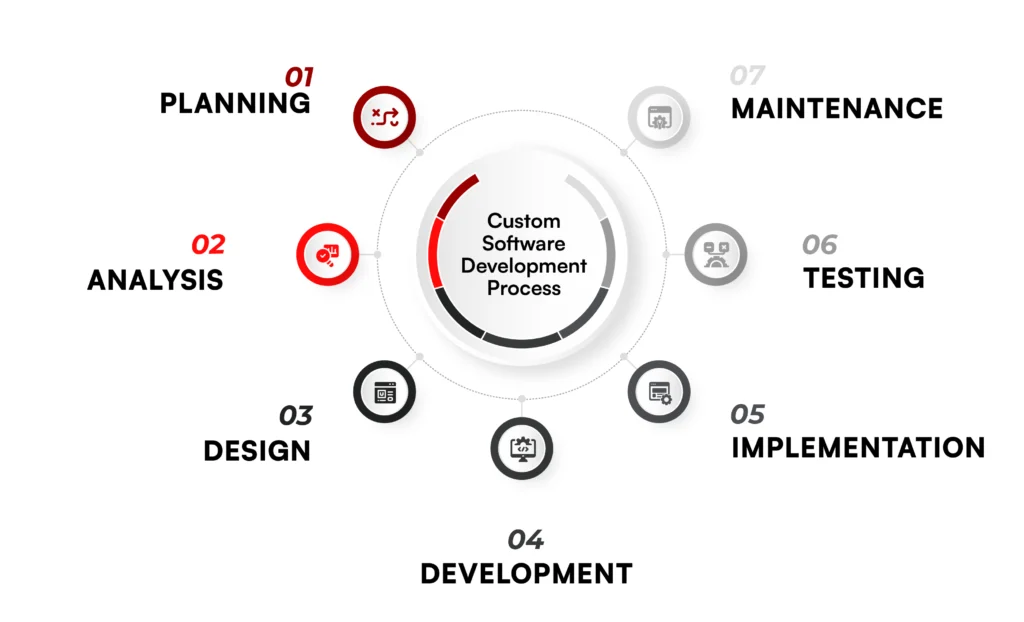
The custom software development process follows a defined sequence of seven phases. Each one feeds the next. Skipping or compressing any of them does not save time. It shifts the cost further down the timeline, making it harder to contain.
Step 1: Project Planning and Scope Definition
Before any requirement is written or any design is sketched, the project needs a foundation. This phase defines the scope, sets the budget parameters, identifies key stakeholders, and establishes the delivery methodology, whether Agile or Waterfall.
Whether you are approaching custom software development for a small business or a large enterprise rollout, a project without a clear plan does not fail at launch. It fails here, quietly, before anyone notices.
Step 2: Requirement Analysis and Business Discovery
This is where the business problem gets translated into a technical brief. The custom software development team works with stakeholders to document what the software must do, what workflows it must support, what systems it must connect to, and what a successful outcome looks like in measurable terms.
The quality of this phase determines the accuracy of every estimate, timeline, and cost projection that follows.
Step 3: System Design and Architecture
With requirements confirmed, the custom software design and development phase begins before a single line of code is written.
This covers how data flows through the system, how the software connects to existing infrastructure, what the user interface logic looks like, and which technology stack best meets the business’s performance and scalability requirements.
The principles applied at this stage determine how well the platform performs and scales over its entire lifespan. For a deeper look at what sound system design involves, see our guide to software system design principles for scalable systems.
Step 4: Software Development and Engineering
Engineering begins. Code is written in structured sprints or sequential phases, depending on the chosen methodology.
Each component is built against the requirements and architecture defined in the preceding phases. This is the longest phase of any custom software application development engagement and the one most dependent on the quality of the work done before it started.
Step 5: Quality Assurance and Testing
Testing runs in parallel with development, not as a final gate after the build is complete. Individual components are tested continuously as they are built, catching issues when they are cheapest to fix.
For custom software development for enterprise organizations in particular, quality assurance covers functional testing, performance testing, security audits, and user acceptance testing before any code moves toward deployment.
Step 6: Deployment and Implementation
The custom business software development moves from a controlled development environment into live business operations. This phase includes data migration, system configuration, user training, and a structured rollout plan.
A technically sound platform introduced without adequate change management will underperform regardless of its quality.
Organizations working with custom software development outsourcing partners should pay particular attention to this phase, ensuring the handover process is documented and supported.
Step 7: Ongoing Maintenance and Support
Post-deployment support is not optional. As the business grows, regulations change, and user needs evolve, the custom software development solutions must evolve with them.
Most engagements carry an annual maintenance budget of 15 to 20% of the original build cost to cover security patches, performance optimization, and incremental feature development.
Understanding custom software development pricing at this stage is just as important as the upfront build cost, because maintenance compounds steadily year on year.
Software Development Methodology: Agile or Waterfall
The methodology a development team uses determines how much visibility and control you have over cost and scope as the project progresses.
Waterfall plans the entire project upfront and executes in a fixed sequence, which gives predictable timelines but little flexibility when requirements change mid-build.
Agile breaks the project into shorter delivery cycles, with working software reviewed at each stage, allowing course corrections before they become expensive and keeping business priorities driving the roadmap rather than a specification document written months earlier.
For most custom software development for enterprise engagements, Agile is the default. For smaller, well-defined projects where scope is unlikely to shift, Waterfall remains a viable option.
The right answer depends less on a preferred methodology and more on how clearly the business can define what it needs before the first sprint begins.
Factors to consider when building custom software
The decisions made before development begins have more influence on the outcome than any made during it. These are the factors that determine whether a custom software project delivers on its business case or becomes an expensive lesson in what to do differently next time.
- Clarity of requirements
Incomplete requirements at kickoff are the single biggest driver of budget overrun and timeline extension in custom software projects. Every major decision deferred at the start gets made mid-build, where it costs significantly more to implement and often requires reworking what has already been done.
- Budget and total cost of ownership
The build cost is only part of the financial picture. Maintenance, security updates, integration work, and incremental feature development compound steadily after deployment. A realistic budget accounts for ongoing costs from the start, not just the initial development figure.
- Scalability requirements
A platform built for current usage that cannot grow without structural changes is a short-term solution. Architecture decisions made during the design phase determine how the system performs as user volume, data volume, and operational complexity increase.
- Integration complexity
Custom software rarely operates in isolation. The number of existing systems it must connect to, and the maturity of their APIs and data structures, directly affects both the cost and the timeline of the build. Integration requirements need to be mapped in full before architecture begins.
- Security and compliance obligations
Businesses in regulated industries carry data handling, access control, and audit obligations that need to be designed into the platform from the start. Security built in from the architecture phase costs a fraction of what remediation costs after the platform is live.
- User experience and adoption
Software that does not match how people actually work gets worked around, regardless of how technically sound it is. UX decisions made during design should reflect real workflows and real user behavior, not assumptions about how the system should be used.
- Choice of development partner
The vendor who builds the platform makes decisions daily that affect how well it performs, how cleanly it integrates, and how maintainable it remains after delivery. Relevant experience, a defined requirement analysis process, and structured post-deployment support matter more than hourly rate when evaluating who to work with.
- Post-launch maintenance planning
Deployment is not the end of the engagement. A platform that is not actively maintained degrades in security, performance, and relevance as the business and its environment change. Budgeting 15 to 20% of the original build cost annually for maintenance is the standard benchmark, and it should be planned for before the project starts.
Cost of Custom Software Development
The most common mistake organizations make when budgeting for custom software development is treating the build cost as the total cost. It is not. Initial development typically accounts for 20 to 50% of a platform’s total cost over its useful life.
Maintenance, security updates, integration work, and feature evolution compound steadily year-on-year. Any pricing conversation that does not start there is incomplete.
There is a second variable most first-time buyers also underestimate: scope drift. A McKinsey and University of Oxford study of large IT projects found they run 45% over budget on average, and deliver 56% less value than originally projected.
In most cases, the root cause is not poor execution. It is a requirement that was not fully defined before development began. Decisions deferred at the start always get made mid-build, and mid-build decisions cost significantly more.
With that framing in place, here is what the market looks like across business segments.
What Each Segment Typically Spends
The ranges below reflect custom software development pricing benchmarks consistent across published US market data. They assume a US-based or nearshore delivery model with professional project management in place.
| Business Segment | Typical Cost Range | Typical Timeline | Example Use Case |
| Small Business | $40,000 to $150,000 | 2 to 5 months | Custom inventory or booking platform replacing disconnected spreadsheets and generic tools across one or two locations. |
| Mid-Market | $150,000 to $500,000 | 5 to 10 months | Multi-location retail operations platform connecting POS, warehouse management, and customer data into a single system. |
| Enterprise | $500,000 to $2,000,000+ | 10 to 24 months | ERP modernization or a compliance-grade platform spanning multiple business units with legacy system integration requirements. |
| With Embedded Intelligence | +$50,000 to $500,000 | +2 to 5 months | Demand forecasting engine, dynamic pricing layer, or fraud detection module built into an existing custom platform. |
Factors Affecting the Cost of Software Development
Three variable drives cost more than any other. The first is scope clarity at kickoff. Projects that enter development with vague or partial requirements routinely finish 30 to 50% over the original estimate. The second is team geography.
US-based development teams charge $100 to $250 per hour. Offshore teams in South Asia run $20 to $50 per hour. The rate difference matters, but the governance model sitting above the team matters more. The third is integration complexity.
A standalone platform costs far less than one required to connect to three existing enterprise systems, each with different data structures, legacy architectures, and varying API maturity levels.
Custom software development for small businesses and mid-market organizations also entails ongoing maintenance costs that are rarely included in initial proposals. Budget 15 to 20% of the original build cost annually to keep the platform secure, current, and performing reliably.
For a $200,000 project, that is $30,000 to $40,000 per year before any new feature development is considered.
Hidden Costs of Software Development
The build cost is the number most organizations focus on when evaluating a custom software development investment.
It is also the least complete number in the entire financial picture. The costs that appear after the contract is signed, and often after the platform goes live, are the ones that catch organizations off guard.
- Scope expansion
Requirements that were vague or incomplete at kickoff do not disappear. They surface mid-development as change requests, each of which carries a cost in time and money.
A McKinsey study found large IT projects run 45% over budget on average, and incomplete requirements are the primary cause. Every decision deferred at the start gets made later at a higher price.
- Integration work
Connecting a new platform to existing ERP systems, CRMs, payment processors, or legacy databases is rarely as straightforward as the initial estimate reflects. Undocumented APIs, inconsistent data structures, and legacy systems with limited connectivity all add scope that was not fully visible before development began.
- Infrastructure and hosting costs
Cloud infrastructure costs scale with usage, and platforms that were not architected with cost efficiency in mind can generate hosting bills that grow faster than the business anticipated.
Compute, storage, bandwidth, and third-party service fees all compound as the platform matures.
- Quality assurance and testing
Thorough testing takes time, and time costs money. Organizations that compress QA timelines to hit a launch date typically pay for it in post-launch bug fixes and emergency patches, which cost significantly more to address in a live environment than they would have during development.
- Training and change management
A technically sound platform that teams do not know how to use delivers a fraction of its potential value.
User training, documentation, and the productivity dip that accompanies any significant workflow change are real costs that rarely appear in development proposals.
- Post-launch maintenance
Security patches, performance optimization, bug resolution, and incremental feature development are ongoing obligations, not optional extras.
The standard benchmark is 15 to 20% of the original build cost annually. For a $300,000 platform, that is $45,000 to $60,000 per year before any new development is factored in.
- Compliance and security updates
Regulatory requirements change, and the platform must change with them. GDPR updates, PCI DSS revisions, and industry-specific compliance obligations generate development work that was not part of the original scope and cannot be deferred without risk.
The organizations that manage these costs most effectively are the ones that plan for them before the project starts, not after the first invoice arrives.
Strategies to Optimize the Cost of Software Development
Cost optimization in custom software development is not about spending less. It is about spending where it matters. The organizations that manage it most effectively do so before a line of code is written, not after the budget has already been exceeded.
- Define requirements completely before development begins
Incomplete requirements are the single largest driver of cost overrun in any custom software project. Every requirement that gets clarified mid-build requires rework that could have been avoided.
Time spent on thorough business discovery and requirement documentation at the start is the most cost-effective investment in the entire project.
- Build an MVP first
Releasing a minimum viable product with core functionality before building the full platform allows the business to validate the most critical assumptions with real users before committing to the full scope.
Features that seemed essential at the planning stage often prove less valuable in practice, and the reverse is equally true. An MVP reduces the risk of building the wrong thing at full cost.
- Adopt Agile delivery
Agile breaks development into short delivery cycles with working software reviewed at each stage. This gives the business visibility into what is being built throughout the project, not just at the end, and allows priorities to be adjusted before they become expensive to change. It also catches misalignments early, when they are still cheap to fix.
- Choose the right delivery model
US-based development teams carry higher hourly rates than nearshore or offshore alternatives, but the rate difference only matters if the governance model sitting above the team is strong enough to maintain quality and communication.
A well-managed nearshore engagement can deliver significant cost savings without the coordination overhead that poorly managed offshore models typically generate.
- Plan for maintenance from day one
Organizations that budget for ongoing maintenance before the project starts make better architectural decisions during development.
Platforms built with long-term maintainability in mind cost less to update, less to secure, and less to extend than those where maintenance was treated as an afterthought.
- Avoid over-engineering the initial build
Building for every possible future scenario increases upfront cost without a guaranteed return. A well-architected platform can be extended as the business grows.
The goal at launch is a system that solves the defined problem reliably, with an architecture that supports growth, not one that tries to anticipate every growth scenario before it exists.
- Invest in quality assurance throughout development
Testing that runs in parallel with development catches issues when they are cheapest to fix. Compressing QA timelines to reduce cost or accelerate delivery consistently produces the opposite result, with post-launch bug fixes and emergency patches costing several times more than the testing that would have prevented them.
Know Exactly What Your Software Will Cost
Walk away from a single conversation with a clear, itemized estimate, no guesswork, no hidden costs, just a transparent roadmap.
Get Custom Quote NowHow to Measure the ROI of Custom Software Development?
ROI on custom software is not a single number calculated at launch. It accumulates over time as the platform eliminates costs, increases revenue, and creates operational advantages that compound as the business grows.
- Start with a pre-launch baseline
Document the current cost of the process being replaced, including staff time, error rates, manual workarounds, and third-party tool licensing. This becomes the reference point against which post-launch performance is measured.
- Measure direct cost reduction
Hours of manual work eliminated, headcount redeployed, licensing fees removed, and error-related costs prevented are all quantifiable from the first month of operation.
- Track productivity gains
Time saved across a team compounds quickly. Assign a realistic labor cost to recovered capacity and it becomes a measurable line in the ROI calculation.
- Quantify revenue impact
Conversion rate improvements, faster order processing, reduced customer churn, and new revenue capabilities all contribute to the return and require consistent tracking before and after deployment.
- Account for error and risk reduction
Compliance failures, billing errors, and data entry mistakes carry real financial consequences. A platform that reduces their frequency generates a return that is easy to underestimate until one of those errors is cost properly.
- Calculate total cost of ownership
ROI is only meaningful when set against the full cost of the investment, not just the build cost. Factor in ongoing maintenance, hosting, support, and incremental development.
- Set a realistic payback timeline
Most custom software investments reach payback between 18 months and three years. Focused solutions with a single well-defined problem at their core typically reach payback faster than enterprise platforms with complex integration requirements.
In-House vs. Outsourced Development
The decision between building an in-house development team and working with an external partner is not a technology decision.
It is a business decision about where your organization wants to concentrate its management capacity, how quickly you need to move, and how much of your competitive advantage actually lives in the software itself.
Neither model is universally superior. Both carry real trade-offs that look different depending on the size of your organization, the complexity of what you are building, and your appetite for managing technical teams alongside your core business.
How the Two Models Compare
| Dimension | In-House Team | Outsourced Development |
| Upfront Cost | High — Recruitment, salaries, benefits, and tooling. | Engagement-based — Cost begins when work begins. |
| Time to Start | 6 to 12 weeks to hire and onboard. | 1 to 4 weeks to mobilize an external team. |
| Quality Control | Direct — You manage every decision in real time. | Requires documentation and structured review cycles. |
| IP & Security | Fully internal by default. | Contractually protected; depends on agreement. |
| Scalability | Slow — Each addition requires a new hire cycle. | Fast — Team size adjusts to project phase. |
| Long-Term Cost | Fixed overhead regardless of project volume. | Variable — Scales with scope; lower between projects. |
| Skill Availability | Limited to your local hiring market. | Access to specialized talent globally. |
How Can RBMSoft Help You Build Custom Software Solutions?
RBMSoft has delivered custom solutions across more than 3,000 digital projects spanning 35 industries.
With a focused specialization in high-transaction ecommerce and retail environments, the team has built platforms for Big Lots, DSW, PetMeds, FleetFarm, and Beach Body, each engineered around the specific operational needs of the business rather than adapted from a generic template.
The approach is consistent across every engagement. Deep requirement analysis before development begins, architecture designed for where the business is going rather than where it is today, and ongoing support from the team that built the system.
If you are evaluating whether custom software development services are the right move for your organization, the most useful next step is a direct conversation about the problem you are trying to solve.
Schedule a Consultation with RBMSoft
FAQs
1. How long does custom software development take?
Timeline depends on scope. A focused small business solution with well-defined requirements typically takes two to five months from kickoff to deployment. A mid-market platform integrating multiple existing systems runs five to ten months.
Enterprise-grade builds involving legacy system migration, compliance requirements, or multi-unit rollouts commonly take ten to twenty-four months. The single biggest driver of timeline overrun is requirements that are incomplete at the start of development, not the complexity of the build itself.
2. What does custom software development cost?
For US-based projects, small business solutions typically range from $40,000 to $150,000. Mid-market platforms run $150,000 to $500,000. Enterprise systems start at $500,000 and scale beyond $2,000,000 for complex, multi-system builds.
These figures cover initial development. Budget an additional 15 to 20% of the build cost annually for maintenance, security updates, and incremental improvements. Total cost of ownership over two to four years is almost always the more relevant number than the upfront build cost.
3. What is the difference between custom software and SaaS?
SaaS is software built for a broad market and licensed on a subscription basis. You access it, configure it within defined limits, and depend on the vendor for every update, pricing change, and product decision.
Custom software is built for your organization specifically. You own the codebase, control the roadmap, and are not subject to a vendor’s commercial strategy. SaaS works well for standardized functions. Custom software is the right choice when the function is specific enough that no standardized product serves it well.
4. Can custom software integrate with our existing systems?
Yes, and integration with existing systems is one of the primary reasons organizations commission custom builds in the first place. A properly scoped custom software development engagement maps every integration requirement before architecture begins.
ERP platforms, CRM tools, payment processors, warehouse management systems, and third-party data feeds can all be connected. The complexity and cost of integration depends on the maturity of the existing systems’ APIs and the quality of their underlying data.
5. When does it make sense to build rather than buy?
The clearest signal is when the gap between what available software does and what your business actually needs is wide enough to create real operational cost. Teams building workarounds inside tools that were supposed to simplify their work.
Data sitting in systems that do not communicate with each other. A growth opportunity that existing software cannot support. Any of these conditions, sustained over time, typically means the cost of staying on generic software has already exceeded the cost of building something that fits.
5. What happens after the software is deployed?
Deployment is not the end of the engagement. Software requires ongoing maintenance to stay secure, current, and aligned with how the business evolves.
Most custom software development solutions are supported post-deployment through a structured maintenance arrangement covering security patches, performance monitoring, bug resolution, and feature development as new requirements emerge.
The team that built the platform is best positioned to support it, because they understand the architecture at a level no third-party support desk can replicate.
6. How do I choose the right custom software development partner?
Four things matter more than anything else. First, relevant experience in your industry or with your type of problem. Second, a defined process for requirement analysis before development begins, not after.
Third, transparent communication on timeline, cost, and risk throughout the engagement. Fourth, post-deployment support that does not disappear after launch. Case studies with named clients and measurable outcomes are the most reliable signal that a vendor delivers what they propose.
7. What is custom software development?
Custom software development is the process of designing, building, and deploying software built entirely around one organization’s workflows, data, and business logic. Unlike off-the-shelf products, it is not adapted from a generic tool. It is engineered from the ground up to solve a specific business problem for a specific organization.
8. Why is custom software development important?
Custom software development matters because generic tools are built for a broad market, not your business. When off-the-shelf software requires workarounds, creates data silos, or limits growth, the cost of staying on that platform exceeds the cost of building something that fits. Custom software eliminates vendor dependency and compounds efficiency gains over time.
9. What is the custom software development process?
The custom software development process follows seven stages: discovery and business analysis, requirement documentation, system design, development, testing, deployment, and ongoing maintenance. Requirements that are incomplete at the start are the single biggest driver of budget overrun. Each stage feeds the next and skipping any of them increases cost downstream.
10. How much does custom software development cost?
Custom software development pricing in the US typically breaks down as:
- Small business: $40,000 to $150,000
- Mid-market: $150,000 to $500,000
- Enterprise: $500,000 to $2,000,000 and above
Budget an additional 15 to 20% of the build cost annually for maintenance. Total cost of ownership over two to four years is the more relevant number than the upfront build figure.
11. How long does custom software development take?
- Small business solutions: two to five months
- Mid-market platforms: five to ten months
- Enterprise builds: ten to twenty-four months
Incomplete requirements at kickoff are the single biggest cause of timeline overrun, not the complexity of the build itself.
12. What is the difference between custom software and off-the-shelf software?
Custom software development is built around your workflows. Off-the-shelf software requires you to adapt your workflows to fit the product. Off-the-shelf wins on speed and upfront cost. Custom software development solutions win on fit, scalability, ownership, and total cost over two to four years.
13. What are the best practices for custom software development?
The most important best practices for custom software development are:
- Document requirements fully before development begins
- Run testing in parallel with development, not at the end
- Design integrations from the start, not as an afterthought
- Budget for post-launch maintenance from day one
- Choose a partner with experience in your specific industry
14. How to integrate AI into existing custom software?
AI integration into custom software development works best when it targets a specific measurable problem: demand forecasting, dynamic pricing, fraud detection, or intelligent routing.
Define the business problem first, confirm the underlying data is clean enough to train a model, then build the integration. AI added without a defined success metric rarely justifies the investment.
15. How to choose a custom software development company?
When evaluating custom software development companies, prioritize four things: relevant case studies with named clients in your industry, a defined requirement analysis process before development begins, transparent communication on cost and timeline, and structured post-deployment support.
For custom software development outsourcing, also verify IP ownership terms and time-zone overlap before signing.
16. Who does the best custom software development?
The best custom software development partners invest heavily in requirement analysis before writing code, communicate transparently on cost and risk, and provide structured post-launch support.
For custom software development for enterprise, prioritize legacy integration capability and compliance experience. For custom software development for small businesses, prioritize clear scoping and governed pricing models.
17. What happens after the software is deployed?
Custom software development solutions require ongoing maintenance after deployment. This covers security patches, bug fixes, performance monitoring, and new feature development. Budget 15 to 20% of the original build cost annually.
The team that built the platform is best positioned to support it as they understand the architecture at a level no third-party support desk can replicate.
18. What are the current market trends in custom software development?
Three trends are shaping custom software development in 2026:
- Low-code and no-code tools are lowering entry costs for simpler builds, with Gartner forecasting 75% of new enterprise applications will use these technologies by 2026
- AI integration is becoming standard in custom software application development at mid-market and enterprise level
- Cloud-native architecture is now the default, delivering better scalability, uptime, and cost alignment with actual usage
19. What are the main challenges in custom software development?
The most common challenges in custom software development are incomplete requirements at kickoff, scope drift mid-build, underestimated integration complexity with legacy systems, poor vendor selection, and inadequate post-launch maintenance planning.
A McKinsey study found large IT projects run 45% over budget on average, with incomplete requirements as the primary cause.