- Retail AI
- Services
Looking for a more specific outcome? We’ll build a solution to get you there.
- Industries
Looking for a more specific outcome? We’ll build a solution to get you there.
- About
- Case Studies
- Resources
- Arvyn
Looking for a more specific outcome? We’ll build a solution to get you there.
Looking for a more specific outcome? We’ll build a solution to get you there.
Ecommerce app development services that hold up on sale day, not just in a demo. Our ecommerce application development company builds web, mobile, and marketplace apps, ready for real shopping traffic.






From consulting to deployment, our ecommerce app development services cover every stage your business needs to launch, migrate, or modernize a storefront that converts and holds up under real traffic. As a full-stack ecommerce application development services provider, we own the backend, frontend, and everything that connects them.
Many ecommerce app projects run into problems long before development begins. Our ecommerce app consulting services start by evaluating your existing storefront, business goals, customer journey, and technology stack. With experience building custom ecommerce solutions and integrating complex business systems, we identify technical gaps, benchmark your business against competitors, and create an ROI-focused roadmap before development begins.
Our consultants work alongside your team to define the product scope, select the right tech stack, and build a development roadmap tied to measurable outcomes. You get a clear plan your engineers can execute against, not a strategy deck that sits in a folder. Every consulting engagement we run is designed to feed directly into the build, so nothing gets lost between planning and delivery.
Every ecommerce business has different operational and customer experience requirements. Our developers build custom ecommerce apps around your workflows instead of forcing your business to fit a standard template. We follow API-first development, scalable architecture, secure coding standards, and rigorous testing while integrating your existing commerce, ERP, CRM, and payment systems to deliver an app that’s reliable, easy to maintain, and ready to grow with your business.
Successful ecommerce apps are built around customer behavior, not design trends. Our ecommerce UI/UX team studies how your customers search, compare, and purchase products before designing a single screen. Using user journey mapping, interactive prototypes, and usability testing, we create shopping experiences that reflect your brand, simplify navigation, increase average order value, and encourage repeat purchases.
Our ecommerce web app development services help businesses build fast, SEO-friendly ecommerce websites and progressive web apps that deliver consistent shopping experiences across every device. Using responsive design, Core Web Vitals optimization, and scalable development practices, we create web applications that attract more organic traffic, improve customer engagement, and generate more revenue.
As your seller network grows, manual vendor management, delayed payouts, and inconsistent product data can quickly become operational bottlenecks. Our marketplace specialists build scalable platforms with automated onboarding, centralized catalog management, commission automation, and secure payment workflows, helping you expand your marketplace without adding unnecessary operational complexity.
Payment integration requires more than connecting a gateway. Our team develops secure, scalable payment solutions using API-first architecture, PCI DSS best practices, encryption, webhook automation, and comprehensive testing to ensure every transaction is processed reliably across your ecommerce platform and connected business systems, helping reduce payment failures and improve customer confidence.
Legacy ecommerce platforms often become difficult to scale, expensive to maintain, and slow to support new customer experiences. Our modernization specialists assess your existing architecture, identify migration risks, and execute phased migrations using API-first development, cloud-native practices, and automated testing. We preserve business-critical data, SEO performance, and system integrations while minimizing disruption, helping your business modernize faster without interrupting day-to-day operations.
Keeping an ecommerce app reliable requires continuous monitoring, regular optimization, and rapid issue resolution. Our support engineers provide proactive application monitoring, security updates, performance tuning, and preventive maintenance backed by defined support processes and ongoing health checks. By identifying issues before they affect customers, we help businesses maximize uptime, protect revenue, and deliver a consistently reliable shopping experience.
Tell us where customers are dropping off today. We will tell you what an app can fix.
Challenges
A beauty and skincare brand ran on a website-only storefront, giving mobile shoppers no dedicated experience and no way to browse, review, or reorder without switching to desktop.
Solution:
RBMSoft delivered end-to-end ecommerce mobile app development services, building native iOS and Android apps with discovery feed, product search, streamlined billing and shipping, and rating and review functionality synced directly from the existing website. Mobile app engagement climbed 27% within the first two quarters post-launch.
Challenges
A restaurant group ran food ordering and table booking entirely by hand, with no digital system connecting kitchen staff, floor staff, and customers, and no way to scale service without adding headcount.
Solution:
RBMSoft replaced the manual process with native Android and iOS apps covering menu selection, table reservations, and order management for both staff and customers in one connected platform. As part of our broader ecommerce application development services, we built the backend database, staff-facing menu tools, and customer ordering flow as a single system. The app now processes more than 4,000 digital orders a day.
Challenges
A global retailer had strong brand recognition but only a website presence in a key growth region, leaving mobile-first shoppers, the majority of the brand’s target audience, without a dedicated way to browse and buy.
Solution:
Our ecommerce app development services delivered native iOS and Android apps that preserved the brand’s existing design system exactly while adding multi-currency and multi-language support for the new region. We built a caching layer for faster performance and push notifications to drive repeat engagement. The app crossed 100k downloads and brought in more than 50k new users within the region.
Different retail models need different apps. Our ecommerce application development services cover every app type, matching each one to your catalog, your customers, and your channel mix before a single screen gets designed.
B2C apps are built for volume, speed, and minimal purchase friction. Customers browsing on their own time expect the shortest possible path from discovery to checkout, and every extra step in that path is a chance for them to close the app and buy somewhere else.
We design and build B2C ecommerce apps that minimize friction end to end through features like saved payment methods, one-tap reorders, and intelligent search. The result is an app built to convert casual browsing into a completed purchase, not just display a catalog.
B2B buyers order in bulk, on account terms, and through approval chains that a consumer storefront doesn’t entertain. Pricing is often negotiated per account, order volumes are larger, and the purchase decision usually involves more than one person before it’s approved.
We build B2B apps with tiered and account-based pricing, quote and approval workflows, and catalogs that reflect what each buyer is actually authorized to purchase. The app is designed around how business buyers work.
Peer-to-peer and resale or second hand Goods Marketplace apps run on trust between strangers which makes the platform’s job fundamentally different from a standard storefront. Buyers and sellers need confidence that a listing is accurate, a payment is safe, and a dispute will get resolved fairly.
We build the listing, escrow, and dispute-handling logic that lets individual buyers and sellers transact safely without your team mediating every exchange. Verification, ratings, and secure payment holding are built into the core architecture.
Marketplace apps coordinate multiple sellers, commissions, and fulfillment paths inside a single storefront, which means the platform has to manage relationships with vendors as carefully as it manages the customer experience.
We build the seller onboarding, listing management, and payout logic that keeps a multi-vendor marketplace running without manual reconciliation. Commission structures, inventory ownership, and fulfillment routing are all handled inside the same platform, so your team isn’t stitching together spreadsheets behind the scenes.
Subscription apps need recurring billing, flexible scheduling, and churn-reducing account management built in from day one, because the entire business model depends on customers staying subscribed longer than it costs to acquire them.
We build the logic that lets customers pause, swap, or skip a delivery without calling support, along with dunning management for failed payments and win-back flows for customers who cancel. Retention is treated as a core feature, not a metric we check after launch.
On-demand apps run on real-time logistics, order tracking, delivery windows, and driver or staff coordination, all happening at once, which means the app has to stay accurate under conditions that change by the minute.
We build the backend and customer-facing tracking experience together, so delivery and pickup promises hold up under real order volume. Live location tracking, dynamic ETA updates, and staff coordination tools are built as one connected system rather than separate tools bolted together.
Quick commerce runs on a different clock than standard delivery. With orders placed and fulfilled in minutes, it puts pressure on inventory accuracy and routing that a standard ecommerce app was never designed to handle.
We build the dark-store inventory logic, hyperlocal routing, and real-time ETA tracking that ultra-fast delivery depends on. Inventory across micro-fulfillment locations stays synced in real time, so the app never promises a product that isn’t actually on the shelf.
Social commerce sells inside the feed, which means the purchase decision and the purchase itself have to happen in the same place a customer is already scrolling.
We build in-app checkout, shoppable posts, and catalog sync into the social platforms your customers already spend time on, so a purchase never requires leaving the app they’re browsing in. Product catalogs stay synced automatically, so what’s tagged in a post always matches what’s actually in stock.
Building separate native apps isn’t always the right investment for every ecommerce business. As part of our ecommerce web app development services, we build Progressive Web Apps using modern web standards, responsive design, service workers, and performance optimization best practices to deliver fast, installable shopping experiences across devices. The result is a single application that’s easier to maintain, reaches customers directly through the web, and helps improve engagement, mobile conversions, and development efficiency.
Traditional ecommerce platforms often slow innovation because every frontend change depends on backend development. Our headless commerce specialists build modular, API-driven architectures that simplify integrations, accelerate feature releases, and support consistent shopping experiences across web, mobile, marketplaces, and future digital channels. The result is a commerce platform that’s easier to scale and maintain as your business grows.
Getting from an idea to a live storefront takes more than good design. We work in defined stages, each one accountable to a clear output, so your app reaches launch on time and performs the way we said it would.
Before anything gets designed, we sit down with your team and figure out where the app actually needs to earn its keep. As an ecommerce app development agency, we review your current storefront, conversion data, and customer journey to identify the issues that are quietly costing you sales before development begins.
A storefront lives or dies on how easy it is to buy something. We design the browsing, cart, and checkout experience around your actual customers, not a generic template, and decide the underlying architecture, native, hybrid, PWA, or headless, based on how they shop and where your traffic actually comes from.
This is where the app gets built, and where most of the risk in a project either gets caught or gets missed. We build against your actual product data from the start and test continuously, rather than waiting until the end to see what breaks.
Going live is the start of the relationship, not the end of the project. We monitor performance, patch security issues, and keep tuning the app against the outcomes we agreed on at the start.
Before anything gets designed, we sit down with your team and figure out where the app actually needs to earn its keep. As an ecommerce app development agency, we review your current storefront, conversion data, and customer journey to identify the issues that are quietly costing you sales before development begins.
A storefront lives or dies on how easy it is to buy something. We design the browsing, cart, and checkout experience around your actual customers, not a generic template, and decide the underlying architecture, native, hybrid, PWA, or headless, based on how they shop and where your traffic actually comes from.
This is where the app gets built, and where most of the risk in a project either gets caught or gets missed. We build against your actual product data from the start and test continuously, rather than waiting until the end to see what breaks.
Going live is the start of the relationship, not the end of the project. We monitor performance, patch security issues, and keep tuning the app against the outcomes we agreed on at the start.
Mobile is no longer a secondary channel for retail, it’s the primary one, and the gap between a native app and a mobile browser is showing up directly in conversion and retention data across the industry.
Every industry has different buying journeys, operational challenges, and customer expectations. Our ecommerce specialists combine industry expertise with proven engineering practices to build applications that fit your business processes, integrate with your existing systems, and support long-term growth.
A size chart and a return policy decide more sales than most fashion brands realize. Shoppers in this category browse heavily before buying, and a return process that feels risky or slow is often the real reason a cart gets abandoned, not the price.
Our team studies how fashion shoppers discover, compare, and purchase products before designing the shopping journey. Using customer behavior insights, mobile commerce best practices, and usability testing, we create shopping experiences that reduce purchase hesitation, simplify returns, and encourage repeat purchases while maintaining a consistent brand experience.

Nothing in this category forgives a stale inventory count. A customer buying an item that’s actually out of stock in the warehouse, or a delivery window that quietly slips, is one of the fastest ways to lose someone’s weekly order for good.
Grocery ecommerce depends on accurate inventory, reliable fulfillment, and real-time system communication. Our engineers integrate ecommerce platforms with inventory, warehouse, and delivery systems to keep stock levels synchronized and orders moving efficiently. This helps businesses improve order accuracy, reduce fulfillment errors, and support growing order volumes with confidence.

Repeat purchases carry this category more than any other, which means the app’s job isn’t just the first sale, it’s making sure the second and third one happen without a customer having to think about it.
We design beauty ecommerce apps around customer retention rather than one-time purchases. By combining loyalty programs, subscription management, personalized recommendations, and seamless commerce integrations, we help brands increase customer lifetime value while keeping the buying experience simple and consistent.

Buyers in this category research before they buy, comparing specs, reading reviews, and checking warranty terms across more than one seller before committing. An app that treats this like an impulse-purchase category loses the sale to whoever gave the shopper more information.
Building a successful marketplace requires reliable seller operations behind the storefront. Our engineers develop scalable marketplace platforms with vendor onboarding, catalog management, warranty tracking, and secure integrations that support business growth while giving customers the information they need to buy with confidence.

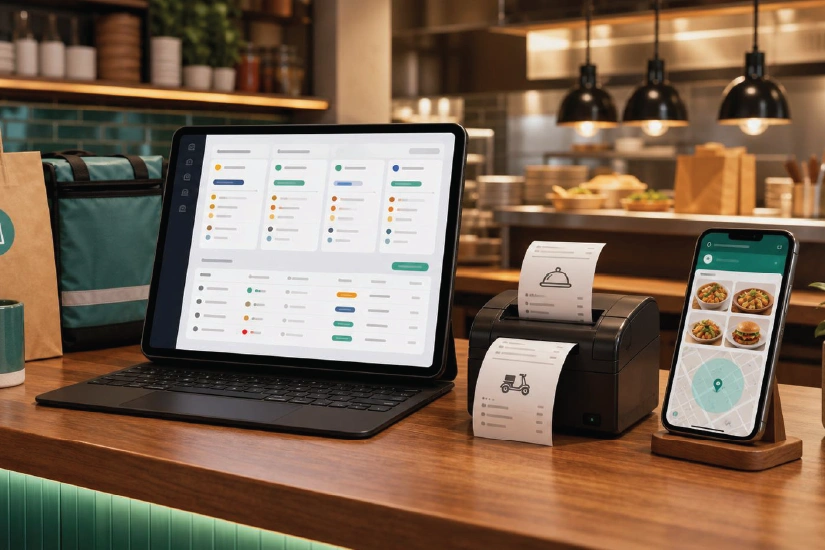
Running food ordering and table bookings by hand puts a hard ceiling on how much a restaurant group can grow without adding headcount for every new location. Kitchen staff, floor staff, and customers all need to be looking at the same information in real time.
Our developers build integrated ordering and restaurant management platforms that connect customers, kitchens, and front-of-house operations in real time. Using scalable architecture and reliable system integrations, we help restaurant groups expand to new locations without increasing operational complexity.
Expanding into a new region exposes gaps that don’t show up in a brand’s home market. Currency formats, local payment preferences, language, and regional shopping expectations all influence whether customers complete a purchase.
Our developers build ecommerce applications for global expansion by following localization best practices, integrating regional payment providers, and implementing multi-currency and multilingual support. This approach helps brands deliver consistent shopping experiences across markets while making future regional launches faster and easier to manage.
This is a considered purchase, and considered purchases stall when a customer can’t picture how something will actually look or fit in their space. Financing questions and delivery logistics add more hesitation on top of that.
Our developers combine product visualization, flexible payment options, delivery scheduling, and reliable backend integrations into one seamless shopping experience. This helps customers make informed buying decisions, reduces purchase hesitation, and improves conversion rates for high-value products.

Business buyers don’t shop the way consumers do. Pricing is negotiated per account, orders are larger, and someone else often has to approve the purchase before it goes through.
Our developers build B2B ecommerce applications around procurement workflows, account-specific pricing, approval hierarchies, and ERP integration. The result is a platform that matches how business buyers actually purchase, making complex ordering faster, more accurate, and easier to manage.

Most ecommerce app projects don't fail because of technology. They fail when customer behavior, operational workflows, and system integrations aren't considered early enough. Our ecommerce specialists identify and address these challenges during planning and development to reduce implementation risks and improve long-term business performance.
Challenge: Technical debt from a wrong early stack decision can consume more than 20% of a development team's ongoing capacity, according to McKinsey research, turning what should be feature work into permanent cleanup. Get the foundation wrong, and every future release gets slower and more expensive.
Solution: We select the stack based on your traffic patterns, catalog size, and growth plan, not what's trending, so the foundation still fits your business three years from now.
Challenge: 60% of customers are unlikely to return to a site or app after encountering an error, and an app that only gets tested on the newest flagship phone is guaranteed to hit bugs the moment a customer opens it on anything older.
Solution: We build and test across device tiers, screen sizes, and OS versions from the start, so the experience holds up consistently no matter what phone a customer is actually using.
Challenge: Mobile web cart abandonment runs around 75%, and conversions drop by 7% for every additional second a page takes to load, meaning friction is measurable, not a matter of opinion.
Solution: We design checkout around the fewest possible steps, saved payment methods, and one-tap repeat purchase, then test it against real shopping behavior before launch.
Challenge: 93% of large ecommerce businesses report downtime costs exceeding $300,000 per hour, and Black Friday traffic can spike up to 30 times a normal day's volume, exactly when an app has zero margin for error.
Solution: We load-test every build against your actual expected peak-traffic numbers, not average-day volume, so the app holds up when a sale starts instead of buckling under the first wave of demand.
Challenge: 40% of customers who encounter a stockout complete their purchase somewhere else entirely, rather than waiting or substituting, which means a sync failure doesn't just delay a sale, it hands it to a competitor.
Solution: We build real-time inventory sync across online, in-store, and marketplace channels, so what the app shows a customer is what's actually available to ship or hand over at pickup.
Challenge: 40% of project budget overruns tied to system integration work come from data integration costs specifically, the exact category multi-gateway, multi-currency payment setups fall into.
Solution: We map every payment gateway and regional requirement before development starts, so checkout works reliably the same whether a customer is paying by card, wallet, or buy-now-pay-later.
Challenge: Non-compliant merchants can face PCI-DSS fines of up to $100,000 per month until the issue is fixed, and the average cost of a data breach has reached $4.45 million industry-wide, costs that dwarf what compliance would have cost to build in from the start.
Solution: We define compliance requirements in the first stage of every build, with PCI-DSS, GDPR, and CCPA controls scoped before a line of code is written.
Challenge: A study of over 5,400 IT projects found they run 45% over budget on average while delivering 56% less value than predicted, a pattern that repeats whenever scope isn't locked before development starts.
Solution: We agree on scope, deliverables, and measurable outcomes before development starts, so you know what the app costs before the build begins, not somewhere in the middle of it.
Pick the one that hits closest to home. We’ll walk you through exactly how we’d fix it.
Every ecommerce application is designed around the security, privacy, and regulatory requirements relevant to your business. As an ecommerce app development agency, we implement secure architecture and compliance best practices from the start, reducing risk without delaying delivery.

"The team absolutely responded to our needs."
"The most impressive part about the company is its people."
"The team delivered on time and was responsive to our needs."
"Their ability to adapt to changes and proactively manage potential roadblocks is commendable."
Every tool in this stack is chosen for what it does in a live storefront under real shopping traffic, not because it’s popular. We use each one because it solves a specific part of the build better than the alternatives.
Mobile & Cross-Platform

Flutter

Android (Kotlin)

React Native

iOS (Swift)

SwiftUI

Jetpack Compose
Web & Progressive Web Apps

Next.js
React

Vue.js
service workers for offline-capable PWAs
Backend for Mobile

Python (FastAPI)

Java (Spring Boot)

Go
Node.js

Shopify Plus

Adobe Commerce

Salesforce Commerce Cloud

BigCommerce

Commercetools

Medusa.js
Server-Side

PostgreSQL

MongoDB

Elasticsearch

Redis
On-Device (Offline Cart & Catalog)

SQLite
Room

Core Data

Realm

GraphQL
REST APIs

WebSocket

gRPC

Stripe
Adyen

Braintree

Razorpay

PayPal

Apple Pay / Google Pay

Klarna
regional and local gateways

Firebase Cloud Messaging (FCM)

Apple Push Notification service (APNs)

Braze — cart recovery

OneSignal
order updates, and re-engagement built into the app, not bolted on after launch

Firebase Analytics

Mixpanel

AppsFlyer
Adjust — tracking install sources
in-app behavior, and conversion funnels specific to app usage, not just web traffic
Infrastructure

AWS

Azure

GCP

Docker

Kubernetes (K8S)
CI/CD & App Store Release Tooling

Fastlane

GitHub Actions

TestFlight

Google Play Console

App Center
Crash & Performance Monitoring

Firebase Crashlytics

Sentry

Datadog

OAuth 2.0

Auth0

AWS Cognito

biometric authentication

AES-256 encryption

TLS 1.3

PCI-DSS aligned architecture
Mobile

Appium

XCTest

Espresso
Web & API

Playwright

Cypress

Postman

BrowserStack
Successful ecommerce apps require more than strong development skills. Our ecommerce retail app development services combine ecommerce expertise, scalable engineering, and proven delivery practices to build applications that integrate with your existing systems, perform reliably under growth, and support your business long after launch.
Successful ecommerce apps begin with a clear understanding of your business, not assumptions. Our consultants analyze your product catalog, customer journeys, operational workflows, and technology stack before development starts, creating a delivery roadmap that reduces project risks and aligns every decision with your business goals.
Reliable ecommerce apps are designed for real shopping traffic, not just successful demos. Our engineers validate every application through performance, load, and stress testing using production-like scenarios, ensuring your app performs consistently during flash sales, seasonal peaks, and high transaction volumes.
A successful ecommerce app works with your existing systems instead of replacing them. Our integration specialists connect ERP, CRM, inventory, payment, shipping, and fulfillment platforms using secure APIs and proven integration practices, keeping business operations connected throughout implementation.
Maintaining a high-performing ecommerce app requires continuous monitoring and improvement. Our support engineers provide proactive monitoring, security updates, performance optimization, and structured release management, helping your application remain reliable as customer demand, traffic, and business requirements continue to grow.
Stop watching customers abandon carts on a checkout flow that was never built for how they actually shop. Our ecommerce retail app development services take your app from strategy through launch, helping you deliver a storefront that converts more shoppers into customers from day one.


The cost depends on your catalog size, integrations, and platform choice. As an ecommerce app development company, we scope every project before development begins, giving you a fixed price instead of an estimate that grows during the build.
The cost ranges from a focused single-platform build to a multi-channel enterprise solution, depending on features, integrations, and business requirements. A reliable top ecommerce app development company will define the exact scope and cost during the discovery phase before development begins.
Four things drive it most: integration count, checkout complexity, native vs. cross-platform choice, and compliance requirements. Our ecommerce mobile app development services map all of these before a line of code is written.
The right technology stack depends on your business goals, expected traffic, and integration requirements. An experienced ecommerce mobile app development company will recommend the architecture that best supports long-term performance, whether that’s headless commerce, native apps, or cross-platform development.
A focused single-platform app typically takes eight to twelve weeks after discovery, while enterprise projects can take sixteen to twenty-four weeks. An ecommerce mobile app development company will provide a realistic timeline based on your features, integrations, and testing requirements.
Every MVP should include product search, a shopping cart, secure checkout, payment integration, order tracking, and customer accounts. An ecommerce mobile app development company can help prioritize additional features based on your business goals and customer needs.
It depends on your markets. Stripe and Adyen cover broad international processing, Apple Pay and Google Pay cut mobile friction, and Razorpay or regional gateways matter for specific markets. Most enterprise builds integrate more than one.
PCI-DSS for payment data, CCPA for California residents’ personal data, and ADA accessibility standards for public-facing storefronts. We map these during scoping for every US-market build.
The best ecommerce app developers combine commerce expertise with strong engineering and integration capabilities. RBMSoft builds custom ecommerce apps around your business model, customer journeys, and existing systems, with expertise spanning UI/UX, payment and ERP integrations, performance engineering, security, and post-launch support.
Annual maintenance typically includes hosting, monitoring, security updates, performance optimization, bug fixes, and platform upgrades. A reliable ecommerce mobile app development company will offer structured maintenance plans to keep your application secure and performing at its best.
Yes. As a custom ecommerce app development company, we integrate AI-powered product recommendations, personalized shopping experiences, intelligent search, and customer support into existing ecommerce applications without requiring a complete rebuild.
Vision. Expertise. Results.
Our team guarantees exceptional results.
We've streamlined processes to maximize efficiency.
We are the trusted choice for repeat clients worldwide.