


Table of Contents
Key Takeaways:
- Healthcare eCommerce extends beyond online pharmacies to include telemedicine, medical equipment stores, and B2B healthcare marketplaces.
- Security, compliance, and data privacy are fundamental to building a trusted healthcare ecommerce platform.
- Custom development enables greater scalability, flexibility, and seamless integrations with existing healthcare systems.
- AI, cloud technologies, and automation are reshaping healthcare ecommerce by improving customer experiences and operational efficiency.
- As the market continues to grow, investing in healthcare ecommerce can help your business stay competitive and future-ready.
Healthcare eCommerce is the process of buying and selling healthcare products and services through websites, mobile apps, and online marketplaces.
Whether you’re running a hospital, pharmacy, medical supply business, or healthcare organization, it gives you a faster and more convenient way to sell products and serve your customers online.
Think about how you shop for clothes or groceries online. Healthcare eCommerce works in a similar way, except it’s built specifically for the healthcare industry.
Your customers can order prescription medications, medical devices, wellness products, diagnostic kits, or even healthcare services, all from a secure digital platform.
But ecommerce healthcare is much more than a typical online store. If you’re selling healthcare products, you need features that a regular ecommerce platform doesn’t offer.
For example, your platform may need to verify prescriptions before processing an order, manage inventory across multiple warehouses, support secure payment options, and comply with healthcare regulations.
You can also integrate it with your ERP, CRM, and logistics systems to automate order processing, track inventory in real time, and deliver a better customer experience.
Types of Healthcare ecommerce solutions for the healthcare industry
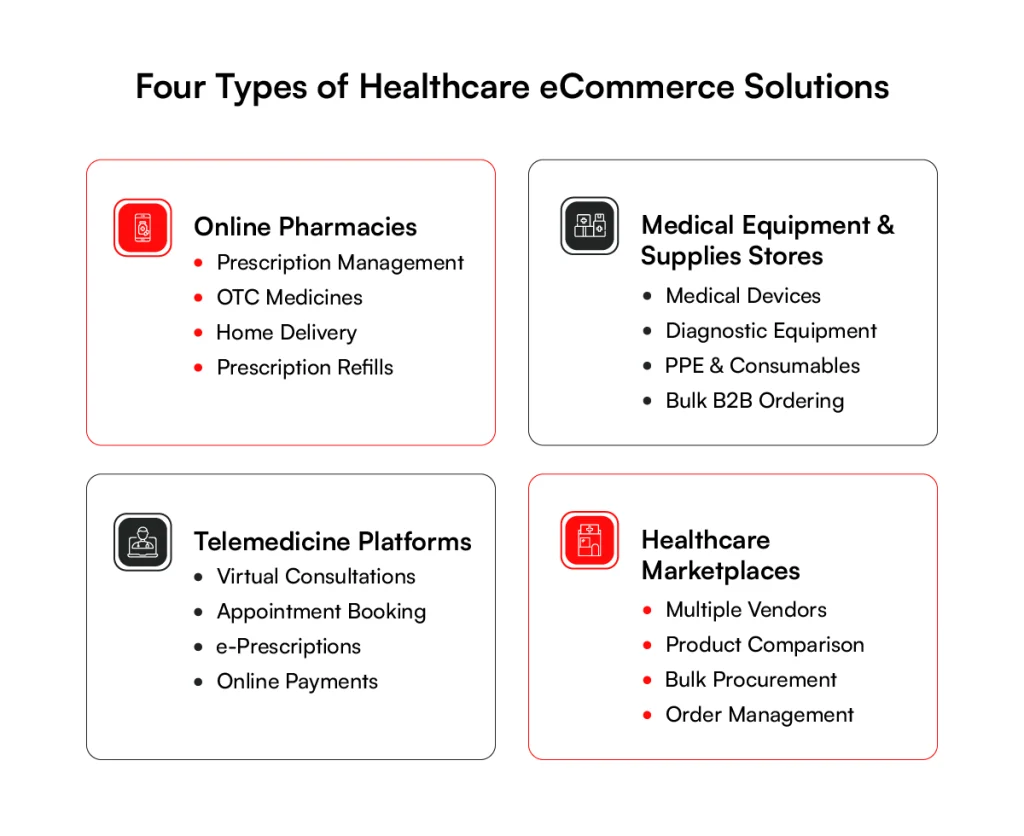
Healthcare eCommerce is not limited to online pharmacies. The type of ecommerce solution you need depends on your business model, the products or services you offer, and the customers you serve. Here are the most common types of healthcare ecommerce solutions for the healthcare industry.
1. Online Pharmacies
An online pharmacy allows your customers to order prescription and over-the-counter medications through your website or mobile app. They can upload prescriptions, request refills, compare products, choose home delivery or in-store pickup, and make secure online payments.
You can also automate refill reminders, provide real-time order tracking, and make medication management much more convenient for your customers.
2. Medical Equipment and Supplies Stores
If your business sells medical equipment and supplies, an ecommerce platform makes it easier for hospitals, clinics, laboratories, and other healthcare organizations to purchase what they need online.
You can create detailed product catalogs, offer contract pricing and bulk ordering, and display real-time inventory availability. Whether you’re selling surgical instruments, diagnostic devices, or personal protective equipment (PPE), your customers can quickly find and order the products they need.
3. Telemedicine Platforms
A telemedicine platform combines virtual healthcare services with ecommerce capabilities. Your patients can book appointments, pay consultation fees, connect with healthcare professionals through video calls, receive digital prescriptions, and purchase recommended medications or healthcare products without leaving the platform. Everything happens in one place, creating a smoother and more convenient patient experience.
4. Healthcare Marketplaces
A healthcare marketplace connects multiple buyers and sellers through a single platform. Instead of purchasing from one supplier, hospitals, pharmacies, clinics, and medical organizations can compare products, prices, and availability from different vendors before placing an order.
This gives buyers more options while helping suppliers reach a larger customer base and simplifying the procurement process.
No matter which type of healthcare ecommerce solution you choose, the objective is the same. It should make it easier for your customers to access healthcare products or services while helping you improve operational efficiency and deliver a better buying experience.
Find the Right Healthcare eCommerce Solution
Our experts can help you choose and build a platform tailored to your workflows and growth goals.
Contact us
Core Key Features of Healthcare eCommerce
A healthcare ecommerce platform needs more than the standard features you’d expect from an online store. Your platform may need to handle prescriptions, sensitive patient information, regulated products, insurance workflows, and complex inventory operations, all while delivering a smooth buying experience.
The engineering behind each feature matters just as much as the feature itself. A well-designed architecture, secure APIs, reliable integrations, and scalable infrastructure can help you build a platform that remains secure and responsive as your business grows.
1. Prescription & Refill Management
Prescription management is a core requirement for online pharmacies and healthcare ecommerce platforms that sell prescription medications.
Your customers should be able to upload prescriptions, request refills, view medication history, receive reminders, and track orders from their accounts.
From an engineering perspective, prescription workflows should use secure file storage, encrypted data transmission, strict access controls, and audit trails. You should also separate prescription data from general ecommerce data and ensure that only authorized users or pharmacists can access it.
For recurring medications, event-driven workflows can automatically trigger refill reminders and notifications based on prescription schedules. This reduces manual work while helping customers stay on top of their medications.
2. Telehealth Integration
Connecting telehealth with ecommerce creates a more complete digital healthcare experience. Your customers can book an appointment, consult a healthcare professional, receive a digital prescription, and purchase recommended products without moving between different platforms.
You can implement this using secure APIs that connect video consultation services, appointment systems, prescription workflows, and ecommerce functionality. A modular architecture makes it easier to update individual services without affecting the entire platform.
For example, a patient who receives a prescription during a virtual consultation can move directly to the relevant product page, complete the purchase, and track delivery through the same account.
3. Security & Access Control
Security needs to be built into your ecommerce architecture from the beginning because healthcare platforms can process sensitive patient, prescription, and payment information.
Use encryption for data in transit and at rest, secure API authentication, multi-factor authentication, role-based access control, and strong session management.
You should also follow the principle of least privilege so employees, pharmacists, healthcare providers, and administrators only access the information required for their roles.
Regular vulnerability testing, dependency updates, security monitoring, and audit logging should form part of your ongoing engineering practices rather than being treated as a one-time implementation task.
4. Real-Time Inventory & Product Traceability
Healthcare businesses often manage products with expiration dates, batch numbers, lot numbers, and serial numbers. Your ecommerce platform therefore needs more than a basic stock counter.
A real-time inventory architecture can synchronize stock across ecommerce stores, warehouses, pharmacies, and ERP systems. Event-driven systems such as Kafka or RabbitMQ can help distribute inventory updates across connected services without relying on constant manual synchronization.
Product traceability is particularly important for pharmaceuticals and medical devices. Your system can maintain batch, lot, and serial number information throughout the fulfillment process, making it easier to identify affected products during recalls or quality investigations.
5. Insurance & Claims Integration
Insurance integration can simplify the purchasing process for customers while reducing administrative work for your team. Depending on your business model, customers may be able to verify coverage, view eligible products, estimate out-of-pocket costs, and submit claims through the platform.
This typically requires secure integration with insurance systems and carefully designed APIs. You should also avoid storing unnecessary insurance information and apply appropriate access controls to protect sensitive data.
6. Advanced Search & Product Discovery
Healthcare ecommerce platforms can contain thousands of medications, medical devices, supplies, and wellness products. A basic keyword search may not be enough to help customers find what they need.
Search technologies such as Elasticsearch or OpenSearch can support faster search, filtering, autocomplete, synonyms, and faceted navigation. You can also use AI-powered search to understand natural-language queries and improve product discovery.
For example, a customer searching for “blood pressure monitor for home use” could receive relevant products based on product specifications, rather than simply matching the exact words in the product title.
7. Product Comparison
Healthcare products often have detailed specifications that customers need to evaluate before purchasing. A comparison feature can allow users to review product specifications, pricing, certifications, compatibility, and other relevant information side by side.
From an engineering perspective, maintaining structured product attributes through a Product Information Management (PIM) system can make comparison functionality much easier to implement and maintain. It also helps keep product information consistent across different sales channels.
8. AI-Powered Chatbots & Personalization
AI can make healthcare ecommerce experiences more responsive and personalized. Chatbots can answer common questions, help users navigate the catalog, provide order updates, and route complex queries to human support teams.
You can also use recommendation engines to suggest relevant products based on browsing behavior, purchase history, or other permitted data.
However, healthcare platforms should apply strict safeguards around AI-generated recommendations and avoid presenting automated outputs as medical advice. A human escalation path should always be available when a customer needs professional assistance.
9. Secure & Flexible Payments
Your checkout should support secure payment methods that match your customers’ needs. Depending on your business model, this could include cards, digital wallets, bank transfers, subscriptions, or B2B payment workflows.
Rather than handling sensitive card data directly, you can integrate established payment gateways such as Stripe, Adyen, or PayPal through secure APIs. Tokenization can also help reduce the amount of sensitive payment information stored within your own environment. For B2B healthcare ecommerce, you may additionally need features such as purchase orders, credit limits, negotiated pricing, and account-level payment terms.
10. Data Analytics Dashboard
A healthcare ecommerce analytics dashboard can give you visibility into sales, customer behavior, inventory, order fulfillment, and operational performance. Instead of querying your transactional database directly for every report, you can use a dedicated analytics or data warehouse layer.
This separates reporting workloads from core ecommerce operations and helps maintain platform performance as your data volume grows.
Your team can then monitor metrics such as product demand, abandoned carts, refill patterns, inventory turnover, and order fulfillment performance to make better decisions.
11. Multilingual & Multi-Regional Support
Expanding into different markets requires more than translating your product pages. Your platform may need to support multiple languages, currencies, tax structures, payment methods, shipping rules, and regional compliance requirements.
A localization-ready architecture should separate translatable content from application logic and avoid hardcoding currencies, formats, or region-specific rules. This allows you to add new markets without rebuilding core ecommerce functionality.
12. API-First Integration Architecture
Healthcare ecommerce rarely operates as a standalone system. Your platform may need to communicate with ERP, CRM, EHR/EMR, pharmacy management, warehouse, shipping, payment, insurance, and telehealth systems.
An API-first architecture gives these systems a consistent way to exchange data. Well-documented REST or GraphQL APIs, webhooks, authentication standards, and proper error handling can make integrations easier to maintain as your technology ecosystem evolves.
You should also design integrations to handle failures gracefully. Retry mechanisms, idempotency, logging, and monitoring can prevent duplicate orders or inconsistent data when an external service becomes temporarily unavailable.
13. Performance & Scalability
Healthcare ecommerce platforms need to remain responsive during traffic spikes, promotional campaigns, seasonal demand, or sudden increases in product searches and orders.
You can improve scalability through cloud infrastructure, caching, load balancing, database optimization, asynchronous processing, and horizontal scaling. A modular or microservices-based architecture can also allow high-demand components to scale independently when necessary.
The goal isn’t simply to support more users. Your architecture should maintain performance and reliability as your product catalog, order volume, integrations, and customer base grow.
When these features work together, your healthcare ecommerce platform becomes much more than an online store. It helps you streamline operations, improve customer experiences, and build a secure, scalable solution that supports your business as it grows.
Advanced Technology Stack for Healthcare Ecommerce
No matter what type of healthcare ecommerce solution you’re building, the technology behind it plays a critical role in its success.
Whether you’re launching an online pharmacy, a medical equipment store, a healthcare marketplace, or a telemedicine platform, you need a technology stack that delivers security, scalability, performance, and a seamless user experience.
Here’s a look at the key technologies that power modern ecommerce healthcare platforms.
1. Frontend Technologies
The frontend is what your customers interact with every day. It determines how easily they can browse products, upload prescriptions, schedule appointments, compare products, and track orders across web and mobile applications.
Common technologies
- React.js
- Next.js
- Angular
- Vue.js
- Flutter
- React Native
- Swift (iOS)
- Kotlin (Android)
Commonly used in
- Online pharmacies
- Medical equipment stores
- Telemedicine platforms
- Healthcare marketplaces
2. Backend Development
The backend is the engine that keeps your platform running. It manages user accounts, product catalogs, prescriptions, appointments, payments, inventory, vendors, and order processing while ensuring everything works together smoothly.
Common technologies
- Node.js
- Java (Spring Boot)
- Python (Django, FastAPI)
- .NET Core
Supporting technologies
- REST APIs
- GraphQL
- RabbitMQ
- Apache Kafka
Commonly used in
- All healthcare ecommerce solutions
3. Databases & Data Management
Your platform needs a reliable database to securely store customer information, product catalogs, prescriptions, appointments, transactions, and inventory data. The right database ensures fast performance and easy data management as your business grows.
Common technologies
- PostgreSQL
- MySQL
- MongoDB
- Redis
Commonly used in
- All healthcare ecommerce solutions
4. Cloud Infrastructure & DevOps
As your business grows, your platform should be able to handle increasing traffic without compromising performance. Cloud infrastructure provides scalability, reliability, disaster recovery, and secure hosting, while DevOps tools simplify deployments and ongoing application management.
Cloud platforms
- Amazon Web Services (AWS)
- Microsoft Azure
- Google Cloud Platform (GCP)
Deployment technologies
- Docker
- Kubernetes
Commonly used in
- All healthcare ecommerce solutions
5. Search & Product Discovery
Healthcare ecommerce platforms often manage thousands of products. Advanced search technologies help your customers quickly find medications, medical devices, or healthcare products using filters, keywords, and intelligent search capabilities.
Common technologies
- Elasticsearch
- OpenSearch
- Algolia
Commonly used in
- Online pharmacies
- Medical equipment stores
- Healthcare marketplaces
6. Security & Compliance Technologies
ecommerce healthcare platforms process sensitive patient and payment information, so security should be built into every layer of your application. Strong authentication, encryption, and access controls help protect customer data while supporting regulatory compliance.
Common technologies
- OAuth 2.0
- JWT
- Multi-Factor Authentication (MFA)
- Role-Based Access Control (RBAC)
- SSL/TLS Encryption
Compliance standards
- HIPAA
- PCI DSS
- GDPR
Commonly used in
- All healthcare ecommerce solutions
7. Payment Technologies
Your customers expect a fast, secure, and flexible checkout experience. Payment gateways enable you to accept payments for medications, medical devices, consultations, subscriptions, and other healthcare services while maintaining high security standards.
Common technologies
- Stripe
- Stripe Connect (for marketplaces)
- PayPal
- Adyen
- Authorize.net
Commonly used in
- All healthcare ecommerce solutions
8. Business Software Integrations
Your ecommerce platform shouldn’t operate in isolation. Integrating it with your existing business systems helps automate inventory management, procurement, customer management, and order fulfillment while reducing manual work.
Common integrations
- ERP
- CRM
- Warehouse Management Systems (WMS)
- Product Information Management (PIM)
- Shipping APIs
Commonly used in
- Online pharmacies
- Medical equipment stores
- Healthcare marketplaces
9. Communication & Notifications
Keeping your customers informed throughout their buying journey improves both engagement and trust. Automated notifications ensure they receive timely updates about prescriptions, appointments, deliveries, and account verification.
Common technologies
- Twilio
- Firebase Cloud Messaging
- SendGrid
- Amazon SNS
Common use cases
- Prescription reminders
- Order updates
- Appointment reminders
- OTP verification
Commonly used in
- Online pharmacies
- Telemedicine platforms
The right technology stack does much more than power your healthcare ecommerce platform. It helps you build a secure, scalable, and connected solution that delivers a better experience for your customers while supporting your business as it grows.
Along with choosing the right technologies, you’ll also need to ensure your platform complies with healthcare, data privacy, and payment regulations.
Compliance Checklist for Healthcare eCommerce
Building a healthcare ecommerce platform involves much more than creating an online store. Depending on your business, you may handle patient information, prescriptions, payment details, or regulated medical products.
That means compliance isn’t optional. It’s an essential part of protecting sensitive data, reducing security risks, and earning the trust of your customers and healthcare partners.
Here are the key compliance and security requirements you must consider.
1. HIPAA Compliance for Protected Health Information (PHI)
If your platform collects, stores, or shares Protected Health Information (PHI) in the United States, you’ll need to comply with the Health Insurance Portability and Accountability Act (HIPAA).
This means implementing administrative, technical, and physical safeguards that protect patient data and ensure only authorized users can access sensitive information.
2. GDPR Compliance for EU Customer Data
If you serve customers in the European Union, your platform should comply with the General Data Protection Regulation (GDPR).
This requires you to collect only the data you need, obtain user consent where necessary, and give customers greater control over how their personal information is stored, processed, and shared.
3. PCI DSS-Compliant Payment Processing
If you accept online payments, protecting payment information should be one of your top priorities. Using PCI DSS-compliant payment gateways helps secure cardholder data, reduce the risk of payment fraud, and create a safer checkout experience for your customers.
4. FDA Compliance for Medical Devices
If you’re selling regulated medical devices in the United States, you’ll need to comply with FDA requirements for product registration, labeling, and quality standards.
Your ecommerce platform should also maintain accurate product information and support traceability, making it easier to manage recalls and meet regulatory requirements.
5. DSCSA Support for Prescription Drug Traceability
If your business operates an online pharmacy or distributes prescription medications, you’ll also need to comply with the Drug Supply Chain Security Act (DSCSA).
Features such as product serialization, lot tracking, and detailed transaction records help you track prescription drugs throughout the healthcare supply chain management and reduce the risk of counterfeit medications reaching patients.
6. End-to-End Encryption
Your customers trust you with sensitive information, so protecting that data should be built into every part of your platform. End-to-end encryption and secure communication protocols help safeguard data during transmission and storage, reducing the risk of unauthorized access.
7. Multi-Factor Authentication (MFA)
Passwords alone are no longer enough to protect user accounts. Multi-factor authentication (MFA) adds an extra layer of security by requiring users to verify their identity using an additional authentication method. This helps protect patient, healthcare provider, and administrator accounts from unauthorized access.
8. Role-Based Access Control (RBAC)
Not everyone in your organization needs access to the same information. Role-Based Access Control (RBAC) allows you to define permissions based on user roles, ensuring employees, healthcare professionals, administrators, and customers can only access the data relevant to their responsibilities.
9. Comprehensive Audit Logs
Keeping track of user activity is essential for both security and compliance. Audit logs record login attempts, user actions, system changes, and transactions, giving you complete visibility into what’s happening on your platform. They also make it easier to investigate security incidents and demonstrate compliance during regulatory audits.
10. Regular Security Assessments and Vulnerability Testing
Compliance isn’t something you achieve once and forget about. As new threats and regulations emerge, your platform should be regularly tested and updated.
Routine vulnerability assessments, penetration testing, software updates, and security audits help identify potential risks before they become serious problems and ensure your platform continues to meet industry standards.
Meeting these compliance requirements helps you build a healthcare ecommerce platform that’s secure, trustworthy, and ready to support long-term growth.
The next step is making sure your platform integrates seamlessly with the business systems that manage inventory, customer relationships, payments, and healthcare operations.
Key Software or Solutions Integrations into Healthcare eCommerce
An ecommerce healthcare platform becomes far more effective when it integrates with the systems your business already uses. These integrations eliminate manual data entry, improve operational efficiency, and keep information synchronized across departments.
Whether you’re managing an online pharmacy, a medical equipment store, or a healthcare marketplace, the following integrations are commonly used.
1. Enterprise Resource Planning (ERP)
An ERP integration connects your ecommerce platform with core business functions such as inventory, procurement, finance, and order management. This ensures stock levels, pricing, purchase orders, and invoices remain consistent across all systems.
Popular solutions
- SAP S/4HANA
- Oracle NetSuite
- Microsoft Dynamics 365
- Odoo
2. Customer Relationship Management (CRM)
CRM software helps you manage customer interactions, sales activities, and support requests from a single platform. You can personalize customer communication, track purchase history, and automate follow-ups by integrating a CRM with your healthcare ecommerce solution. It will deliver better customer experiences throughout the buying journey.
At RBMSoft, we develop and integrate custom CRM solutions that seamlessly connect with your ecommerce platform, helping you centralize customer data, streamline sales processes, and build stronger long-term customer relationships.
Popular solutions
- Salesforce
- HubSpot
- Microsoft Dynamics 365 CRM
- Zoho CRM
3. Inventory and Warehouse Management Systems (WMS)
Inventory and warehouse integrations provide real-time visibility into product availability and automate stock updates as orders are placed or fulfilled. This helps prevent stockouts, reduces manual errors, and improves order accuracy.
Popular solutions
- SAP Extended Warehouse Management (EWM)
- Oracle Warehouse Management
- Manhattan Associates
- Fishbowl
4. Payment Gateways
Secure payment integrations allow customers to complete transactions using their preferred payment methods while protecting sensitive financial information.
Popular solutions
- Stripe
- PayPal
- Authorize.net
- Adyen
5. Shipping and Logistics Solutions
Shipping integrations automate order fulfillment, label generation, shipment tracking, and delivery notifications. Customers can monitor their orders in real time while businesses streamline logistics operations.
Popular solutions
- FedEx
- UPS
- DHL
- ShipStation
6. Product Information Management (PIM)
A PIM system centralizes product information, including descriptions, images, specifications, certifications, and pricing. This ensures accurate and consistent product data across ecommerce websites, marketplaces, and mobile applications.
Popular solutions
- Akeneo
- Pimcore
- Salsify
7. Marketing Automation Platforms
Marketing automation tools help healthcare businesses engage customers through personalized email campaigns, abandoned cart reminders, promotional offers, and customer segmentation.
Popular solutions
- HubSpot Marketing Hub
- Mailchimp
- Klaviyo
- Salesforce Marketing Cloud
8. Analytics and Business Intelligence
Analytics platforms combine data from sales, customers, inventory, and marketing into interactive dashboards. These insights help organizations understand customer behavior, forecast demand, monitor product performance, and make informed business decisions.
Popular solutions
- Microsoft Power BI
- Tableau
- Looker
By integrating these business systems, healthcare ecommerce platforms create a connected ecosystem where data flows seamlessly across operations. The result is faster order processing, better inventory visibility, improved customer experiences, and more informed decision-making.
Not Sure Where to Start?
We’ll help you choose the right healthcare ecommerce solution based on your business goals and operational needs.
Get Expert GuidanceUse cases of Healthcare Ecommerce with Real-World Examples
Here are a few real-world examples of how healthcare ecommerce is being used across the industry.
1. Online Pharmacy: Amazon Pharmacy
If your business sells prescription medications, an online pharmacy platform can simplify the entire purchasing process for your customers.
They can upload prescriptions, request refills, compare medication prices, place orders online, and have their prescriptions delivered to their doorstep.
Amazon Pharmacy is a great example of this model. The platform allows customers to manage prescriptions digitally, verify insurance, set up automatic refills, and receive home delivery.
By combining ecommerce with pharmacy services, Amazon has made purchasing prescription medications faster and more convenient for millions of customers.
2. Telehealth Platform: Sesame
Healthcare ecommerce isn’t limited to selling physical products. You can also build a platform that allows patients to book appointments, pay consultation fees, and access virtual healthcare services online.
Sesame follows this approach by connecting patients directly with healthcare providers through an online marketplace.
Patients can search for doctors, compare consultation prices, schedule appointments, pay online, and attend virtual visits. This creates a seamless experience while making healthcare services more accessible and transparent.
3. Medical Supply Marketplace: Cardinal Health
If your business supplies hospitals, clinics, laboratories, or pharmacies, ecommerce can streamline procurement and inventory management.
Instead of relying on manual ordering processes, healthcare organizations can browse product catalogs, place bulk orders, and track deliveries through a centralized platform.
Cardinal Health offers digital procurement solutions that help healthcare providers purchase pharmaceuticals, medical supplies, laboratory products, and surgical equipment online.
Its platform simplifies purchasing, improves inventory visibility, and helps healthcare organizations keep critical supplies available when they’re needed most.
These examples show that healthcare ecommerce can support a wide range of business models, from direct-to-consumer pharmacies and virtual healthcare platforms to enterprise procurement portals.
The right solution depends on your business goals, target audience, and the healthcare services or products you offer.
Once you’ve identified the type of platform you want to build, the next step is understanding how to turn that idea into a secure, scalable, and compliant healthcare ecommerce solution.
Let’s walk through the healthcare ecommerce development process.
How to Develop a Healthcare eCommerce Solution
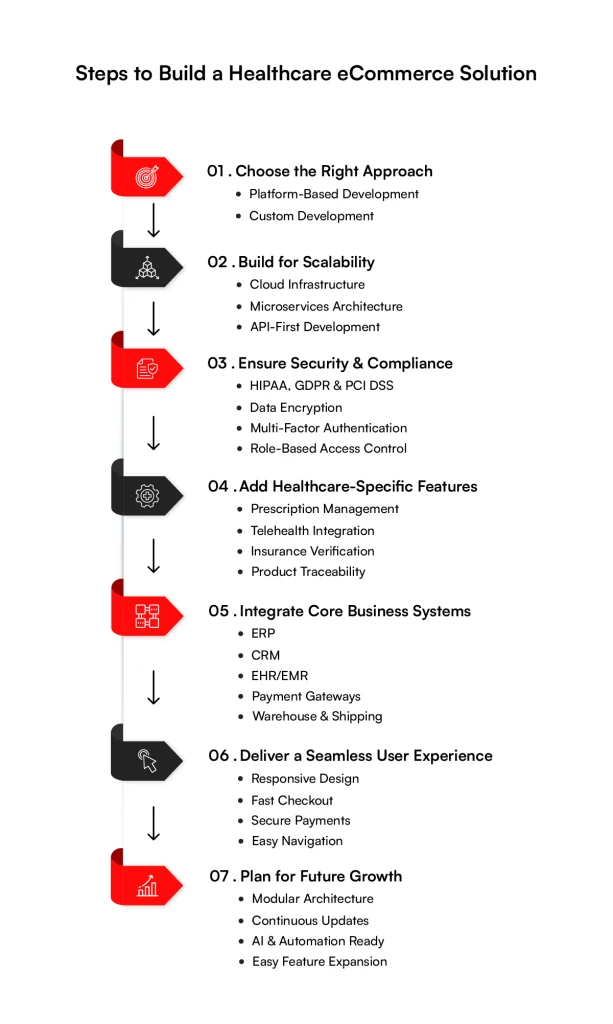
Developing a healthcare ecommerce solution is very different from building a traditional online store.
Along with creating a seamless shopping experience, you also need to protect sensitive data, comply with healthcare regulations, integrate with existing healthcare systems, and ensure your platform can scale as your business grows.
Start with the Right Development Approach
The first decision you’ll need to make is whether to build on an existing ecommerce platform or develop a custom solution.
1. Platform-Based Development
If you’re launching a simple online pharmacy or medical supply store with standard ecommerce requirements, platforms like Shopify, Adobe Commerce (Magento), WooCommerce, or BigCommerce can help you get to market quickly. These platforms provide built-in ecommerce functionality, payment integrations, and product management tools.
However, they may become limiting as your business grows or when you need advanced healthcare capabilities such as prescription verification, telemedicine integration, insurance processing, or complex procurement workflows.
Top 5 Platforms for Healthcare eCommerce Development
Choosing the right ecommerce platform is one of the most important decisions you’ll make when building a healthcare ecommerce solution.
The ideal platform should support your current business needs while giving you the flexibility to scale, integrate with healthcare systems, and meet regulatory requirements as your business grows.
Here are five of the most popular platforms for healthcare ecommerce development.
1.1 Adobe Commerce
Adobe Commerce offers extensive customization and is well suited to healthcare businesses with complex B2B and enterprise requirements. You can customize catalogs, pricing, customer accounts, checkout workflows, promotions, and integrations to support more specialized business processes.
Its flexibility also means implementation can become technically complex. You may need experienced developers to customize the platform, build APIs, connect ERP or CRM systems, optimize performance, and maintain security as the platform evolves.
For a healthcare ecommerce project, your development team may need to build custom modules for prescription workflows, healthcare-specific product data, B2B purchasing, inventory synchronization, or external healthcare system integrations.
Where RBMSoft can help: RBMSoft can customize Adobe Commerce to fit your healthcare workflows, develop custom extensions, integrate third-party systems, and optimize the platform for scalability and performance.
1.2 Shopify Plus
Shopify Plus provides a managed ecommerce environment that can help you launch and scale an online healthcare store without managing the underlying infrastructure yourself.
Its intuitive administration, hosted architecture, and extensive app ecosystem make it attractive for businesses with relatively straightforward ecommerce requirements.
The trade-off is customization. Shopify Plus works within the platform’s architecture and extension model, which can become restrictive when you need highly specialized healthcare workflows or deeper control over the underlying application.
For example, a basic medical supply store may fit Shopify Plus well. A healthcare business requiring complex prescription verification, custom insurance workflows, sophisticated procurement logic, or extensive integration with healthcare systems may require additional applications, APIs, and custom development.
Where RBMSoft can help: RBMSoft can extend Shopify Plus through custom applications, APIs, third-party integrations, and tailored ecommerce functionality while helping you determine where Shopify’s capabilities are sufficient and where a custom solution may be more appropriate.
1.3 BigCommerce
BigCommerce is a scalable SaaS ecommerce platform with APIs, multi-channel capabilities, B2B functionality, and flexible integration options. It can work well for healthcare businesses that need standard ecommerce capabilities alongside integrations with ERP, CRM, payment, fulfillment, and other business systems.
However, businesses with highly specialized workflows may eventually encounter limitations compared with a fully custom architecture. You may need external services or custom applications to handle functionality that falls outside the platform’s standard capabilities.
This becomes particularly relevant for healthcare businesses managing complex procurement processes, multiple suppliers, specialized pricing structures, regulated products, or healthcare-specific customer workflows.
Where RBMSoft can help: RBMSoft can build custom integrations and supporting applications around BigCommerce, helping you connect the platform with your existing technology ecosystem and extend its capabilities where standard functionality falls short.
1.4 WooCommerce
WooCommerce gives you considerable flexibility because it operates within the WordPress ecosystem and supports a large number of plugins and extensions.
It can be a practical option for smaller healthcare businesses that need a cost-effective ecommerce solution with moderate customization.
However, relying heavily on third-party plugins can introduce challenges. Different plugins may have compatibility issues, security vulnerabilities, inconsistent update cycles, or overlapping functionality. As your business grows, maintaining a large collection of extensions can also make the platform harder to manage.
Healthcare businesses handling sensitive information or complex workflows should therefore avoid treating plugins as a substitute for proper engineering.
Custom development, secure integrations, performance optimization, and ongoing maintenance may become necessary as the platform scales.
Where RBMSoft can help: RBMSoft can develop custom WooCommerce functionality, integrate healthcare and business systems, optimize performance, and reduce reliance on unnecessary third-party extensions.
1.5 Commercetools
Commercetools takes a different approach from traditional ecommerce platforms. Its API-first, headless architecture gives enterprises greater control over the customer experience and allows commerce functionality to connect with other applications and services.
This flexibility makes it well suited for healthcare organizations that need customized digital experiences across websites, mobile applications, marketplaces, or multiple commerce channels.
At the same time, headless commerce requires stronger technical capabilities because your team is responsible for building and maintaining more of the application layer.
You’ll typically need experienced frontend and backend developers, API integration expertise, cloud and DevOps capabilities, and a strong understanding of distributed systems. You may also need to build healthcare-specific services around the commerce engine rather than relying on built-in features.
Where RBMSoft can help: RBMSoft can help implement commercetools-based architectures, develop custom frontend and backend components, build healthcare-specific services, and integrate the platform with ERP, CRM, EHR/EMR, payment, inventory, and other systems.
While there are ready-made ecommerce platforms available, many healthcare organizations choose custom development because it gives them greater flexibility, stronger security, and the ability to support complex healthcare workflows.
2. Custom Healthcare eCommerce Development
Custom healthcare ecommerce development gives you control over the architecture, data flows, interoperability, security, and scalability of your platform.
You can use modular or microservices-based architecture to separate commerce, patient access, inventory, payments, and other services, making the system easier to scale and evolve.
An API-first approach can connect your ecommerce layer with EHR/EMR, ERP, CRM, pharmacy, insurance, telehealth, and payment systems. Healthcare interoperability standards such as HL7 and FHIR can help maintain reliable data exchange across connected systems.
You can also build cloud-native infrastructure, zero-trust security, role-based access, continuous logging, and compliance controls into the architecture. Data platforms and AI/GenAI capabilities can then support predictive analytics, personalization, automation, and intelligent workflows as your platform evolves.
RBMSoft brings these capabilities together through healthcare-focused product engineering, cloud modernization, interoperability, data engineering, AI integration, workflow automation, and continuous platform operations. This allows you to build an ecommerce ecosystem that is not only functional today, but also ready for modernization and scale.
3. Architect for Scalability Before Development
Start by deciding how your platform will handle growth before writing the core application. Define the expected product catalog, traffic, transaction volume, warehouses, suppliers, and sales channels, then choose an architecture that can support them.
Cloud infrastructure, modular or microservices architecture, APIs, caching, load balancing, and asynchronous processing can help you scale individual components without rebuilding the entire platform. This is particularly useful when product search, checkout, inventory, or order processing experiences different levels of demand.
4. Build Security and Privacy into the Architecture
Don’t treat security as something you add before launch. Start by mapping sensitive data and deciding how it will be collected, stored, transferred, accessed, and retained.
Implement encryption, secure APIs, role-based access controls, multi-factor authentication, audit logging, and continuous monitoring as part of the core architecture. Your compliance requirements, including HIPAA, GDPR, PCI DSS, and applicable regional regulations, should influence these decisions from the beginning.
5. Engineer Healthcare-Specific Workflows
Map your healthcare processes directly into the platform rather than trying to fit them into standard ecommerce workflows.
Depending on your business model, this could include prescription validation, telehealth consultations, insurance verification, medication refills, batch and lot tracking, serialization, or B2B procurement.
Use workflow automation and event-driven processing where appropriate to reduce manual intervention. For example, a refill workflow can automatically trigger reminders, verify inventory, and initiate the next stage of fulfillment based on predefined rules.
6. Connect Your Healthcare and Business Systems
Build the ecommerce platform as part of your wider technology ecosystem. Integrate ERP, CRM, EHR/EMR, pharmacy management, payment, insurance, warehouse, shipping, and telehealth systems through secure APIs.
Use REST, GraphQL, webhooks, or event-driven architecture depending on the integration. Add authentication, validation, retry logic, error handling, and monitoring so a failure in one connected system doesn’t create duplicate orders or inconsistent data.
7. Add GenAI and Agentic AI Where They Create Value
Introduce AI as part of the platform architecture rather than adding a standalone chatbot after development. GenAI can support conversational product discovery, customer support, knowledge search, and personalized experiences using approved business data.
Agentic AI can go further by connecting AI agents to controlled tools and APIs to perform tasks such as checking order status, identifying inventory issues, or initiating predefined workflows.
Use permissions, audit trails, human escalation, and clear boundaries to ensure AI operates safely, particularly when handling healthcare-related information.
8. Design the Experience for Performance and Long-Term Growth
Build the user experience around the way your customers actually purchase and manage healthcare products. Make product discovery, prescription uploads, comparisons, consultations, payments, refills, and order tracking straightforward.
At the engineering level, optimize page performance, APIs, databases, search, and checkout flows. Build the platform with a modular, API-first approach so you can introduce new products, markets, integrations, AI capabilities, and sales channels without rebuilding the entire system.
Continuous monitoring, security testing, performance testing, and regular updates will then help you keep the platform reliable as your business evolves.
Developing a healthcare ecommerce solution requires much more than assembling standard ecommerce features.
By focusing on scalability, security, compliance, healthcare-specific workflows, and seamless integrations, you can build a platform that supports your business today while remaining ready for tomorrow’s opportunities.
Need a Custom Healthcare Platform?
Off-the-shelf platforms don’t always meet healthcare requirements. Build a solution that’s designed for your business.
Talk to an ExpertHealthcare eCommerce Software or App Development Cost
One of the first questions you’ll probably ask before starting your project is, “How much does it cost to build a healthcare ecommerce solution?” The cost of developing a healthcare ecommerce solution can vary significantly based on its complexity, features, integrations, and compliance requirements.
In general, development costs can range from $30,000 to $500,000+, with basic platforms at the lower end and enterprise-grade solutions requiring a much higher investment.
The answer depends on what you’re building. A simple online pharmacy will cost much less than a multi-vendor healthcare marketplace or an enterprise procurement platform with ERP integration, inventory management, and regulatory compliance.
The more complex your workflows and integrations become, the higher your development investment will be.
| Project Complexity | Estimated Cost* |
| Basic healthcare ecommerce platform | $30,000 – $70,000 |
| Mid-sized healthcare ecommerce solution | $70,000 – $180,000 |
| Enterprise healthcare ecommerce platform | $180,000 – $500,000+ |
These are general estimates. Your actual development cost will depend on your business requirements, technology choices, integrations, compliance needs, and development partner.
Healthcare eCommerce Market Trends and Statistics
According to industry estimates, the global healthcare ecommerce market was valued at approximately USD 346.5 billion in 2023 and is expected to reach USD 738.8 billion by 2028, growing at a compound annual growth rate (CAGR) of 16.3%.
Here are the key trends driving that growth.
1. Direct-to-Consumer (D2C) Healthcare Platforms
Healthcare brands are increasingly selling directly to consumers instead of relying solely on pharmacies and distributors. Patients can purchase prescription medications, wellness products, supplements, and at-home diagnostic kits directly from healthcare providers or manufacturers.
This model helps you build stronger customer relationships, offer personalized experiences, and create recurring revenue through subscription services and automatic prescription refills.
2. Smarter Fulfillment Technology
As customer expectations continue to rise, healthcare organizations are investing in smarter fulfillment solutions to deliver products faster and more accurately.
Technologies such as automated warehouses, real-time inventory tracking, AI-powered demand forecasting, and route optimization help reduce delivery times while minimizing stock shortages.
The global healthcare ecommerce fulfillment services market alone is expected to grow from USD 3.5 billion in 2025 to nearly USD 7.7 billion by 2033, highlighting the increasing focus on logistics and supply chain optimization.
3. Omnichannel Pharmacy Experiences
Today’s customers don’t think in channels. They expect to start their healthcare journey on one device and continue it on another without any disruption.
Modern pharmacy platforms now combine websites, mobile apps, physical stores, and customer support into a single connected experience. Your customers can refill prescriptions online, choose home delivery or in-store pickup, receive reminders, and track their orders from one account.
4. AI and Predictive Personalization
Artificial intelligence is quickly becoming a competitive advantage in healthcare ecommerce. Businesses are using AI to recommend relevant products, personalize search results, automate customer support, predict medication refill schedules, and forecast inventory demand.
As AI adoption continues to grow, healthcare organizations are investing heavily in intelligent commerce experiences that improve operational efficiency while delivering more personalized customer interactions.
5. Telehealth and Integrated Digital Care
Telehealth is no longer a standalone service. Many healthcare organizations now combine virtual consultations, digital prescriptions, online payments, and ecommerce into a single platform.
This allows patients to consult a healthcare professional, receive an electronic prescription, and purchase recommended medications without switching between different applications. The result is a faster, more connected healthcare experience that benefits both providers and patients.
Conclusion
At RBMSoft, we help healthcare organizations build custom digital commerce solutions tailored to their workflows and regulatory requirements.
Our team provides end-to-end ecommerce software development services, helping you create secure, scalable platforms that improve operational efficiency and deliver better customer experiences.
Our capabilities include:
- Custom healthcare ecommerce platform development
- ERP, CRM, EHR/EMR, and third-party system integrations
- HIPAA-compliant and secure application development
- AI-powered automation and analytics
- Ongoing support, maintenance, and platform modernization
As a trusted provider of healthcare IT services, we combine healthcare expertise with modern technologies to build future-ready ecommerce solutions for the healthcare industry that help your business grow with confidence.
Frequently Asked Questions (FAQs)
1. How much does it cost to build a healthcare ecommerce solution?
The cost depends on the type of platform you want to build, the features you need, and the level of customization required. A basic healthcare ecommerce solution may cost significantly less than an enterprise-grade b2b ecommerce platform for healthcare industry with custom integrations, AI capabilities, and compliance features.
Other factors that influence pricing include third-party integrations, cloud infrastructure, security requirements, and ongoing maintenance.
2. How long does it take to develop a healthcare ecommerce software or app?
The development timeline varies based on the project’s complexity. A basic solution can typically be developed in 3 to 6 months, while a fully customized platform with advanced features such as prescription management, telehealth integration, ERP connectivity, and AI capabilities may take 6 to 12 months or longer.
Working with an experienced partner in healthcare ecommerce platform development can help streamline the process and reduce time to market.
3. What are the ongoing costs of healthcare ecommerce application development after launch?
Launching your platform is only the beginning. Ongoing costs typically include cloud hosting, security monitoring, software updates, bug fixes, feature enhancements, compliance audits, third-party service subscriptions, and technical support.
Regular maintenance ensures your ecommerce solutions for the healthcare industry remain secure, compliant, and capable of supporting changing business requirements.
4. How do you build a custom healthcare ecommerce site or software?
Building a custom healthcare ecommerce solution starts with understanding your business workflows and user requirements.
The platform is then designed with the right architecture, followed by UI/UX design, frontend and backend development, third-party integrations, security implementation, compliance validation, testing, and deployment.
Custom healthcare ecommerce platform development allows you to build features such as prescription management, insurance verification, telemedicine, and procurement workflows that standard ecommerce platforms may not fully support.
It is also the preferred approach for organizations building a b2b ecommerce platform for the healthcare industry with unique operational requirements.
5. How can you integrate AI into an existing healthcare ecommerce solution or software?
AI can enhance your existing platform in several ways without requiring a complete rebuild. You can integrate AI-powered product recommendations, intelligent search, customer support chatbots, demand forecasting, inventory optimization, predictive analytics, and personalized shopping experiences.
AI can also automate routine tasks and help improve operational efficiency. As more organizations invest in ecommerce solutions for the healthcare industry, AI is becoming an important differentiator for delivering better customer experiences and smarter business operations, especially for enterprises operating a b2b ecommerce platform for the healthcare industry.