

Quick Summary:
- Automotive ecommerce solutions development creates online platforms for manufacturers, distributors, retailers, and aftermarket businesses to sell vehicles, parts, accessories, and services.
- A successful platform includes vehicle fitment, advanced search, real-time inventory, secure checkout, and B2B purchasing capabilities.
- ERP, CRM, warehouse, payment, shipping, and AI integrations keep product data, inventory, and orders synchronized across the business.
- Security and compliance, including PCI DSS, GDPR, CCPA, and product traceability requirements, should be built into the platform from the start.
- SaaS, open-source, and custom development each offer different levels of cost, flexibility, and long-term control.
- Development costs typically range from $15,000 for SaaS implementations to $500,000+ for enterprise-grade custom platforms, depending on features, integrations, and project complexity.
- Choosing the right development approach helps reduce ordering errors, improve customer experience, and support future business growth.
Ordering the wrong automotive part is frustrating for customers and expensive for businesses. Missing fitment information, inaccurate inventory, and incomplete product details often lead to abandoned carts, product returns, and additional support requests.
The problem becomes even bigger as product catalogs expand and business systems become more connected. Standard ecommerce platforms often struggle to support vehicle fitment, account-specific pricing, ERP integration, and real-time inventory across multiple sales channels.
Automotive ecommerce development goes beyond building an online store. The right platform depends on your products, customers, sales model, and the business systems that support daily operations.
This article covers the platform options, essential features, integrations, development costs, and the key decisions involved in building an automotive ecommerce solution.
Why Automotive Businesses Are Investing in eCommerce
Customers now expect to compare vehicles or parts, check availability, and buy online. Automotive ecommerce development helps businesses meet those expectations with connected, digital buying experiences.
The biggest benefits include:
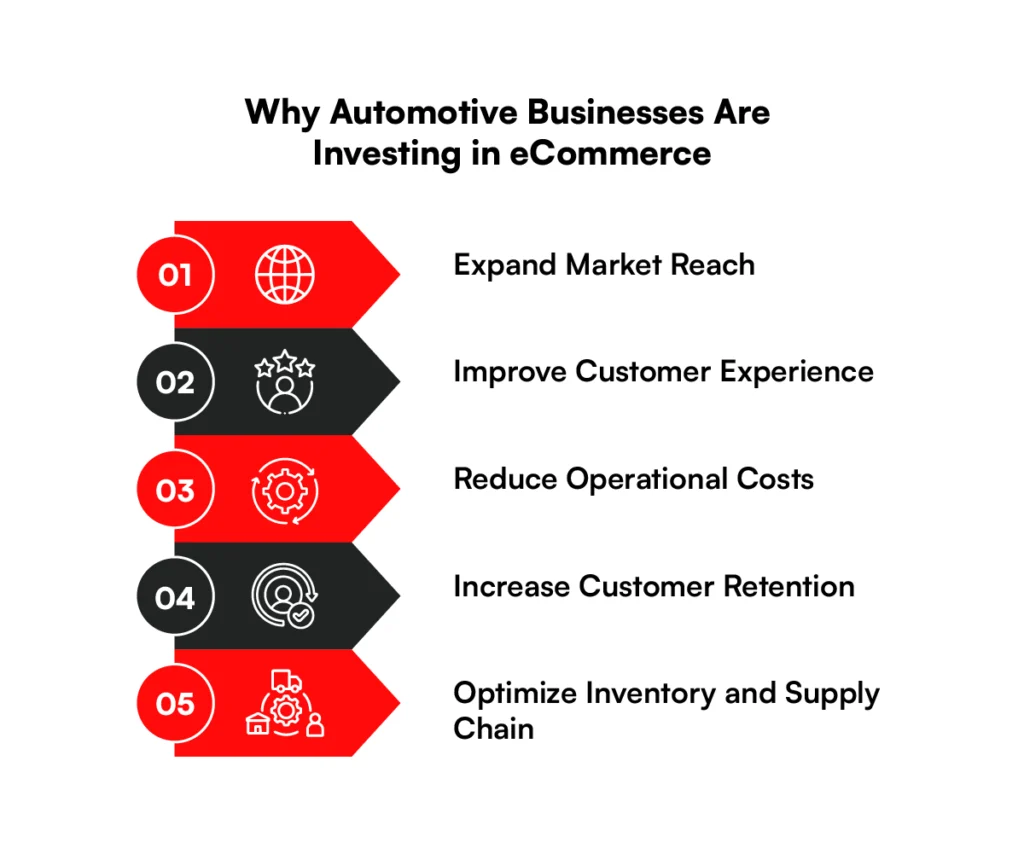
1. Expand Market Reach
Growth becomes difficult when sales depend only on physical locations or regional dealer networks. An online commerce platform removes those geographic limits by making products available to customers wherever demand exists.
This also creates new revenue opportunities through direct-to-consumer sales, online marketplaces, and B2B portals without the cost of expanding the physical footprint. For executives, the value lies in growing revenue from existing operations rather than opening additional locations.
2. Improve Customer Experience
Automotive purchases often involve technical specifications, vehicle compatibility, and multiple product choices. Customers expect clear information and a buying process that helps them make the right decision without unnecessary effort.
A well-designed platform gives buyers accurate fitment information, detailed product content, transparent pricing, and real-time order updates. When customers can confidently complete purchases on their own, businesses reduce sales friction while improving conversion rates and customer satisfaction.
3. Reduce Operational Costs
Many automotive businesses still spend significant time processing orders manually, updating inventory across different systems, or responding to routine customer inquiries. These repetitive tasks increase operating costs as the business grows.
An ecommerce platform automates much of this work by connecting sales, inventory, and order management into one process. This allows teams to handle higher order volumes without increasing headcount at the same pace, improving operating efficiency over time.
4. Increase Customer Retention
Automotive buying rarely ends with a single purchase. Vehicles require ongoing maintenance, replacement parts, and accessories throughout their lifespan. Digital commerce gives businesses more opportunities to stay connected with customers and encourage repeat sales.
Features such as saved vehicle profiles, order history, personalized recommendations, and simplified reordering make repeat purchases easier.
For companies selling maintenance parts and replacement components, these repeat transactions create a steady source of recurring revenue.
5. Optimize Inventory and Supply Chain
Inventory problems affect every part of the business. Overstock increases carrying costs, while stock shortages lead to delayed deliveries, canceled orders, and lost customers.
Modern automotive ecommerce solutions development connects inventory, warehouses, suppliers, and business systems so inventory data stays current across every sales channel.
Better visibility helps leaders make faster purchasing decisions, improve inventory turnover, and keep products available where customer demand is highest.
As these business priorities continue to shape the industry, the next step is understanding which type of automotive eCommerce platform best supports your business model and long-term growth plans.
Build an Automotive Store That Sells More
Turn complex buying journeys into a faster, more accurate shopping experience with a platform built for your business.
Talk to Our Experts
Types of Automotive eCommerce Platforms
The right automotive ecommerce platform reflects your products, customers, and sales model. Different platform types support everything from vehicle sales to B2B commerce.
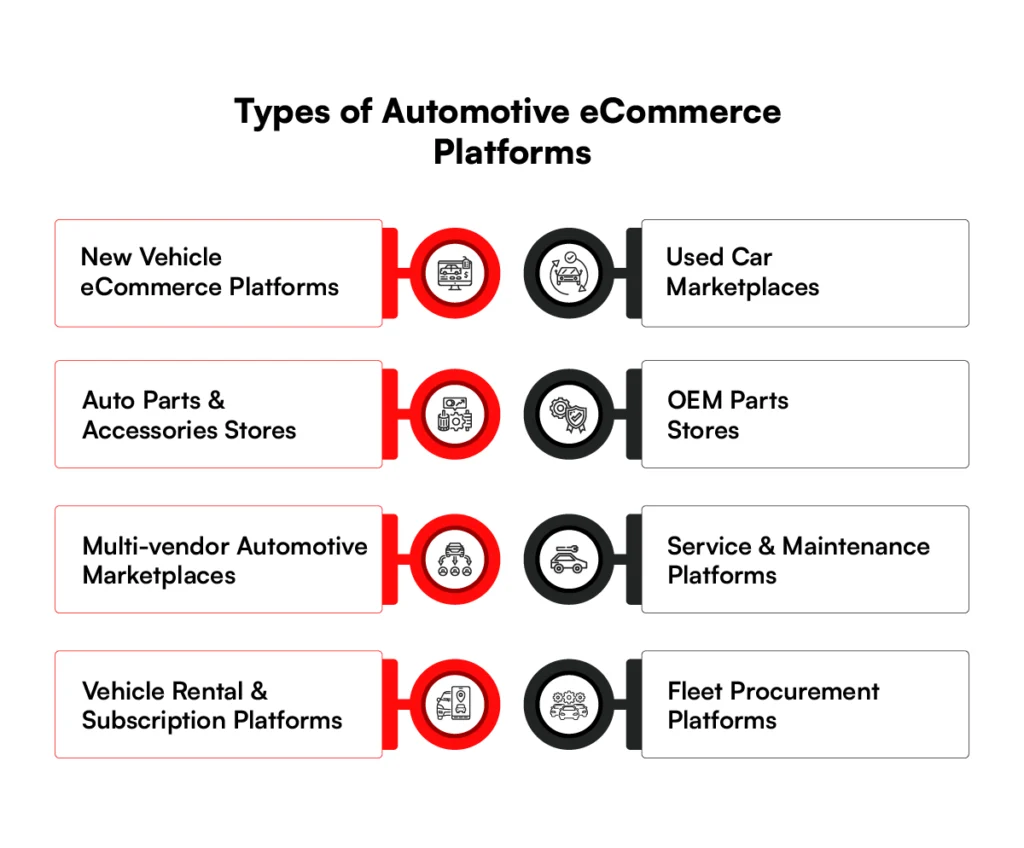
1. New Vehicle eCommerce Platforms
New vehicle platforms bring the vehicle buying process online. Buyers can browse inventory, compare models, customize configurations, apply for financing, and complete purchases from a single platform.
For dealerships and manufacturers, this reduces sales delays and gives customers more flexibility throughout the buying journey.
2. Used Car Marketplaces
Used car marketplaces connect buyers with dealerships, certified pre-owned programs, and independent sellers. Vehicle history reports, inspection records, financing options, and price comparisons help buyers evaluate vehicles before making a purchase.
3. Auto Parts & Accessories Stores
Auto parts and accessories stores sell replacement parts, performance upgrades, tools, and vehicle accessories through a digital storefront. Vehicle fitment search, detailed specifications, and live inventory reduce ordering mistakes and help buyers select parts that match their vehicles.
4. OEM Parts Stores
OEM parts stores focus on genuine replacement components supplied by the original vehicle manufacturer. These platforms serve customers who need factory-approved parts and are commonly operated by manufacturers, authorized dealers, and approved distributors.
5. Multi-vendor Automotive Marketplaces
Multi-vendor marketplaces allow multiple suppliers and dealers to sell through one online platform. Buyers can compare products, pricing, and delivery options from different sellers, while each vendor manages its own inventory and orders independently.
6. Service & Maintenance Platforms
Service and maintenance platforms allow vehicle owners to schedule repairs, inspections, routine servicing, and tire replacement online. Many also support digital quotes, appointment management, and service tracking from a single account.
7. Vehicle Rental & Subscription Platforms
Vehicle rental and subscription platforms provide short-term and long-term access to vehicles without requiring ownership. Customers choose a rental period or subscription plan, complete payments online, and manage bookings through the same platform.
8. Fleet Procurement Platforms
Fleet procurement platforms are designed for organizations that purchase and manage multiple vehicles. They centralize bulk purchasing, contract pricing, approval workflows, maintenance planning, and fleet reporting, helping businesses manage large fleets more efficiently.
The right platform depends on what your business sells and who it serves. The next section looks at the common challenges businesses face when building and managing an automotive eCommerce platform.
Common Challenges in Automotive eCommerce
Automotive eCommerce presents challenges that most online retailers do not face. Businesses must match products to specific vehicles, keep inventory accurate across multiple sales channels, and support both individual buyers and commercial customers. These operational challenges often determine how well an online business performs.
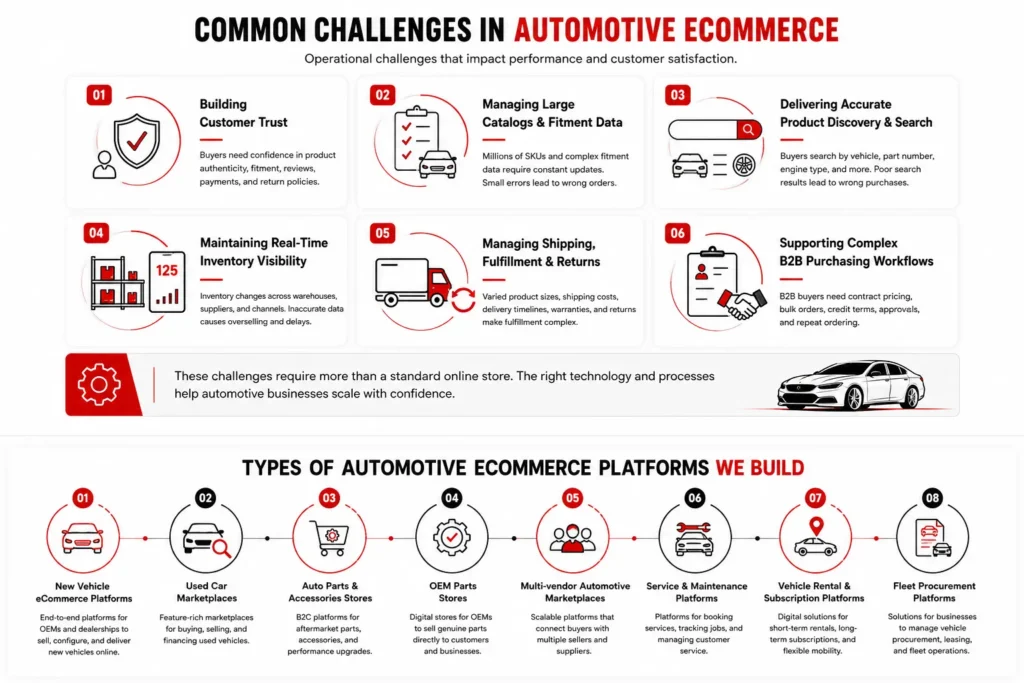
1. Building Customer Trust
Customers want confidence that the product they order is genuine and fits their vehicle. Incorrect product information, poor-quality images, or unclear return policies can quickly reduce buyer confidence.
Accurate product data, verified customer reviews, secure payments, and transparent policies help customers complete purchases with confidence.
2. Managing Large Product Catalogs & Fitment Data
Automotive businesses often manage thousands or even millions of products across different brands, models, and production years.
Keeping vehicle compatibility information accurate requires regular updates. Even a small mistake in fitment data can lead to incorrect orders, higher return rates, and additional support costs.
3. Delivering Accurate Product Discovery & Search
Buyers expect to find the right part without searching through hundreds of products. Standard keyword search is rarely enough because many customers search by vehicle make, model, year, engine type, or part number.
Search tools that use fitment data reduce ordering mistakes and help buyers identify compatible products more quickly.
4. Maintaining Real-Time Inventory Visibility
Inventory levels change constantly as products move between warehouses, suppliers, stores, and online sales channels.
Without current inventory data, businesses can oversell products, delay shipments, or cancel orders. Real-time inventory visibility reduces stock errors and supports better purchasing and replenishment decisions.
5. Managing Shipping, Fulfillment & Returns
Automotive products range from small replacement parts to large components that require special packaging and transportation.
As order volumes increase, shipping costs, delivery timelines, warranty claims, and product returns become more difficult to manage. Efficient fulfillment processes help control costs while maintaining reliable service.
6. Supporting Complex B2B Purchasing Workflows
Many automotive businesses serve repair shops, distributors, fleet operators, and other commercial buyers alongside retail customers.
These accounts often require contract pricing, bulk purchasing, credit terms, approval workflows, and repeat ordering. Standard ecommerce platforms rarely support these requirements without additional customization.
RBMSoft builds custom automotive ecommerce solutions that support complex B2B purchasing workflows, integrating customer-specific pricing, ERP systems, approval processes, and account management into a single platform designed around existing business operations.
Addressing these challenges requires more than a standard online store. The next section looks at the technologies businesses are adopting to improve automotive eCommerce.
Digital Capabilities Shaping Automotive eCommerce
Customers expect more than an online catalogue. They want to confirm compatibility, compare products, and complete purchases with confidence. Automotive businesses are meeting those expectations with digital capabilities that make buying easier while improving day-to-day operations.
1. Product Configurators
Product configurators let buyers customise vehicles or products before placing an order. Customers can choose colours, trim levels, wheels, accessories, or compatible parts while seeing updated pricing and configurations instantly. This helps customers order the right product the first time and reduces avoidable returns.
2. 3D Vehicle & Product Visualization
Some automotive products are difficult to assess from photos alone. Interactive 3D views allow customers to rotate, zoom, and inspect products from different angles before buying. This gives buyers a better understanding of size, design, and fit before they place an order.
3. Visual Merchandising
Product presentation plays a major role in purchase decisions. High-quality images, consistent branding, comparison tables, and well-organized product pages make products easier to evaluate. Clear presentation also builds buyer confidence throughout the shopping experience.
4. Account-Based Buying for B2B Customers
Commercial buyers often have different purchasing requirements from retail customers. Business accounts can include negotiated pricing, purchase orders, approval workflows, credit terms, and repeat ordering.
These capabilities simplify purchasing for repair shops, distributors, and fleet operators while reducing manual administration.
Related read: Ecommerce Replatforming: A Complete Guide for Migration
These capabilities deliver the best results when they work together. The next section explains the platform features that support these capabilities in an automotive eCommerce solution.
Essential Features of an Automotive eCommerce Platform
Automotive buyers expect fast search, accurate fitment, secure payments, and reliable delivery. Behind that experience is a platform that keeps product data, customer accounts, inventory, and business systems working together.
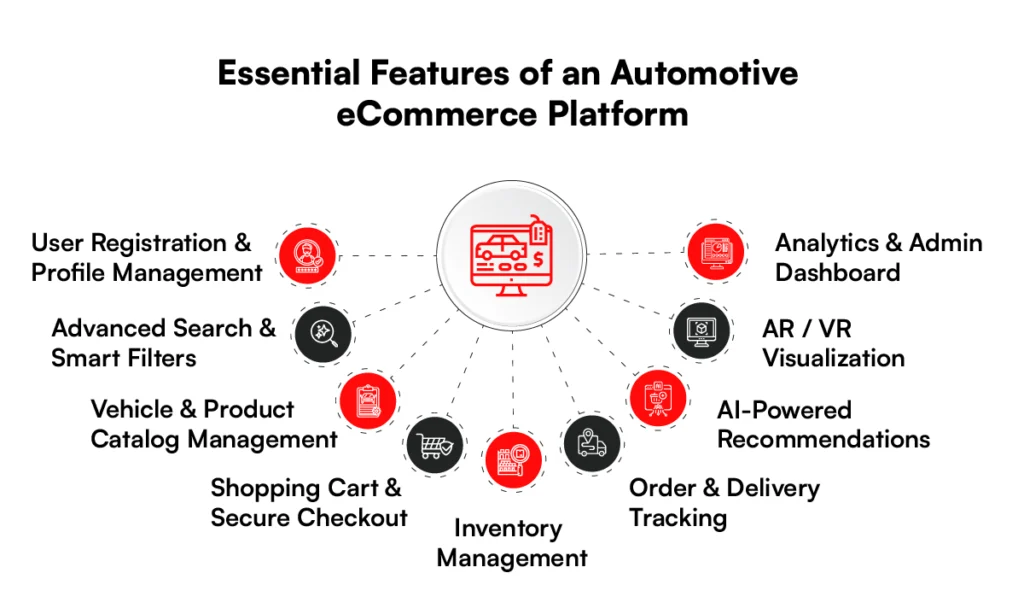
1. User Registration & Profile Management
Customer accounts can store vehicle profiles, saved products, addresses, payment details, and previous purchases for faster repeat orders. Commercial accounts may also include company structures, negotiated pricing, credit limits, user permissions, and purchase approvals.
RBMSoft connects these accounts with ERP, CRM, and identity systems so customer profiles, pricing, and permissions stay aligned.
2. Advanced Search & Smart Filters
Automotive search needs to account for more than product names. Buyers may search by VIN, make, model, year, engine type, SKU, or part number, then filter results by brand, price, stock, or category.
RBMSoft builds search experiences that combine product data, fitment records, VIN lookup, and stock availability to return compatible products across large catalogues.
3. Vehicle & Product Catalogue Management
Specifications, fitment records, prices, images, and technical documents often need to appear across websites, marketplaces, and dealer portals.
A Product Information Management (PIM) system can manage this information from one place and distribute updates across each sales channel. This cuts repeated data entry and keeps product details consistent.
4. Shopping Cart & Secure Checkout
Retail and commercial customers can follow different checkout processes. Consumer orders may require shipping, tax, discounts, and card payments, while B2B orders may include purchase orders, credit terms, or account billing.
RBMSoft builds checkout processes that connect payment services and back-office systems without adding unnecessary steps for buyers.
5. Inventory Management
Stock levels change as products move between suppliers, warehouses, stores, and online channels. Connections with ERP, warehouse, and supplier systems can update availability as products are sold, received, or transferred.
RBMSoft uses these live connections to keep stock information accurate across each sales channel and reduce overselling.
6. Order & Delivery Tracking
Warehouse and shipping systems can send order updates directly to the ecommerce platform. Customers can then follow an order from confirmation through dispatch and delivery without contacting support. This also gives service teams fewer routine tracking requests to handle.
7. AI-Powered Recommendations
Recommendation engines can combine vehicle profiles, browsing activity, fitment data, and past purchases to suggest relevant accessories, replacement parts, or maintenance products.
RBMSoft can add these recommendation engines to an existing ecommerce platform without requiring a full storefront rebuild.
8. AR & 3D Product Visualization
Static photos may not show enough detail for wheels, accessories, body parts, or other high-value products. AR and interactive 3D views let customers inspect products from different angles or preview how an accessory may look on a vehicle before ordering.
9. Analytics & Admin Dashboard
Sales, stock movement, fulfilment, customer activity, and product performance often sit in different systems. RBMSoft builds dashboards that combine data from ecommerce, ERP, CRM, warehouse, and finance software into one view. Managers can track business performance without moving between several applications.
These features work best when the platform also exchanges data with ERP, CRM, payment, warehouse, and shipping systems. The next section covers the software integrations behind those connections.
Need Features Built Around Your Business?
We develop automotive eCommerce platforms with the functionality your business needs, from vehicle fitment and B2B pricing to ERP integrations.
Let’s Discuss Your ProjectEssential Software Integrations for Automotive eCommerce
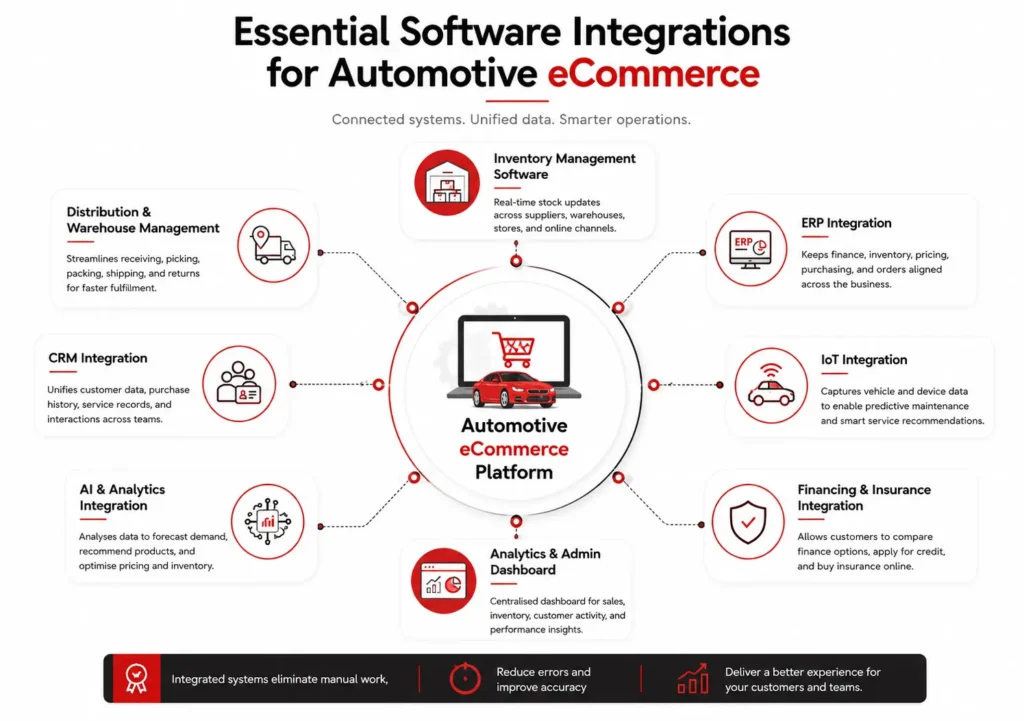
Automotive ecommerce depends on accurate data moving between product, inventory, order, customer, and finance systems. This makes software integration an important part of the platform. Here are the main connections automotive businesses typically need.
1. Inventory Management Software
Inventory software tracks stock across warehouses, stores, suppliers, and online channels. When a product is sold, received, returned, or transferred, the new stock level can be sent directly to the ecommerce platform.
RBMSoft connects ecommerce stores with inventory and warehouse systems so stock information remains current across sales channels. This reduces overselling and prevents customers from ordering products that are no longer available.
2. Distribution & Warehouse Management
Warehouse software manages receiving, storage, picking, packing, dispatch, and returns. Once an online order is confirmed, order details can be sent directly to the warehouse for fulfilment.
After dispatch, the warehouse or carrier can send the tracking number and delivery status back to the ecommerce platform. Teams spend less time copying order information between systems, while customers receive current shipping updates.
3. ERP Integration
ERP systems often manage pricing, purchasing, invoices, inventory, and order records. Linking the ERP with ecommerce keeps these records updated as customers place orders or product information changes.
Some systems can connect directly, while larger setups may need an integration layer to manage data between several applications. RBMSoft plans these connections around the existing ERP, required update frequency, and volume of orders or product data.
4. CRM Integration
CRM software holds customer profiles, enquiries, sales activity, service records, and purchase history. Connecting it with ecommerce gives sales and support teams access to the customer information related to each account and order.
For B2B buyers, CRM records can also supply account pricing, customer groups, assigned sales representatives, and purchase history to the online store.
5. Product Information Management Integration (PIM)
Automotive catalogues can contain thousands or millions of SKUs with fitment records, specifications, images, pricing, and technical documents.
A Product Information Management (PIM) system keeps this information in one location before publishing it to ecommerce websites, marketplaces, and dealer portals.
Parts businesses may also use ACES and PIES data to manage vehicle compatibility and product information. Connecting this data with the online catalogue gives search and fitment tools the information needed to match a part with the correct vehicle.
6. IoT Integration
Connected vehicles can produce mileage, diagnostic, and maintenance data. When this information is available to the ecommerce platform, it can trigger service reminders or point customers toward replacement parts linked to a maintenance need.
The vehicle data must connect with the customer account and product catalogue for this to work accurately. A maintenance alert can then be matched with the correct service or compatible component.
7. AI & Analytics Integration
Connected vehicles can produce mileage, diagnostic, and maintenance data. When this information is available to the ecommerce platform, it can trigger service reminders or point customers toward replacement parts linked to a maintenance need.
The vehicle data must connect with the customer account and product catalogue for this to work accurately. A maintenance alert can then be matched with the correct service or compatible component.
8. Financing & Insurance Integration
Vehicle purchases can involve finance applications, monthly payment calculations, credit checks, and insurance quotes. Connections with lenders and insurers allow customers to complete these steps within the ecommerce purchase process.
Approval status, payment terms, and insurance details can then be passed back to the order system before the transaction is completed.
9. Shipping & Payment Integrations
Payment gateways connect checkout with card processors, digital wallets, and other payment methods. Shipping systems handle carrier rates, delivery choices, labels, tracking numbers, and shipment status.
Automotive shipping can become more complex for items such as wheels, tires, engines, body panels, and other large products. Shipping rules may need to calculate cost based on weight, dimensions, warehouse location, and the carrier that can handle the item.
Good integration starts with clear rules for business data. Teams need to know where product, customer, inventory, and order records are maintained, when those records update, and how failed connections are handled.
RBMSoft addresses these points during integration planning so the ecommerce platform works reliably with the software already used by the business.
Compliance & Security for Automotive eCommerce
Selling automotive products online means handling customer information, payment details, and product data every day. Security and compliance should be built into the platform from the beginning to protect that information, meet legal requirements, and avoid costly issues later.
1. GDPR & CCPA
Any business that collects customer information must comply with privacy regulations such as the General Data Protection Regulation (GDPR) in Europe and the California Consumer Privacy Act (CCPA) in the United States.
Customers must be able to access, update, download, or delete their personal information, while businesses need to explain how that data is collected, stored, and used.
2. PCI DSS
Online payments require compliance with the Payment Card Industry Data Security Standard (PCI DSS). These requirements define how payment information is stored, processed, and transmitted, helping prevent payment fraud and unauthorized access to sensitive data.
3. VIN Traceability
VIN lookup matches parts to a specific vehicle before an order is confirmed. This process lowers compatibility errors, reduces product returns, and provides reliable records for warranty claims and vehicle service history when needed.
4. Warranty Regulations
Customers expect warranty details before completing a purchase. Product pages should clearly explain warranty coverage, eligibility requirements, claim procedures, and coverage periods so buyers know exactly what is included.
5. Right-to-Repair
Right-to-Repair laws give vehicle owners and independent repair shops greater access to repair information, diagnostic tools, and replacement parts.
Automotive eCommerce platforms should make compatible parts and supporting technical information easy to locate wherever these regulations apply.
6. Product Labelling
Every product listing needs accurate specifications, vehicle compatibility details, manufacturer information, safety warnings, and installation guidance where required. Complete product information prevents incompatible purchases and helps customers choose the correct part the first time.
Meeting these requirements early avoids expensive changes after launch. The next section explains how automotive eCommerce platforms help businesses increase sales and improve customer satisfaction.
Automotive eCommerce Website Examples
Successful automotive eCommerce websites solve different customer problems. Some focus on vehicle fitment, while others simplify customization, technical research, or product selection.
The examples below show how businesses have built online stores around their customers’ buying needs.
1. Brocks Performance
Brocks Performance specializes in high-performance motorcycle parts and accessories. Product pages include detailed specifications, installation information, and vehicle-specific categories, making performance parts easier to compare before ordering.
2. OK4WD
OK4WD serves the off-road vehicle market with a large selection of parts, accessories, and recovery equipment. Buyers can browse products by vehicle while using filters to narrow results by brand, category, and product type. Buying guides provide additional support for more technical purchases.
3. Kaiser Willys
Kaiser Willys focuses on replacement parts for vintage Jeep models. Products are organized around specific vehicles and restoration projects, making compatible parts easier to find. Repair guides and technical resources support customers throughout the restoration process.
4. TheBattery.com
TheBattery.com offers batteries for cars, motorcycles, commercial vehicles, and power equipment. Customers can search by battery type, brand, or vehicle application. Detailed specifications and compatibility information help buyers select the correct battery the first time.
5. SKDA
SKDA sells custom graphics kits, seat covers, and accessories for motocross and off-road motorcycles. Buyers can personalize products by selecting their vehicle model, colours, and design options before placing an order. A live customization process allows customers to preview their selections before checkout.
6. BB Wheels
BB Wheels specializes in aftermarket wheels, tyres, suspension components, and automotive accessories. Vehicle fitment tools, financing options, and detailed product information make it easier to select parts that match both the vehicle and the customer’s requirements.
7. JEGS
JEGS supplies performance parts, racing equipment, tools, and automotive accessories for cars and trucks. Product comparisons, customer reviews, and vehicle fitment tools help buyers identify compatible parts before completing a purchase.
8. RevZilla
RevZilla focuses on motorcycle gear, replacement parts, and riding accessories. Product videos, customer reviews, buying guides, and detailed specifications give riders the information they need before placing an order.
Each business serves a different segment of the automotive market, but they all make product selection simpler and compatibility easier to verify. The next section compares custom automotive eCommerce development with ready-made platforms to help you choose the right approach for your business.
Build vs. Buy: Choosing the Right Platform
Every automotive business has different technical and operational needs. A retailer selling a few thousand products has very different requirements from a distributor managing multiple warehouses or a manufacturer supporting B2B customers.
The right platform depends on how much flexibility, customization, and control your business needs over time.
| Factor | SaaS Platform | Open-Source Platform | Custom Development |
| Best for | Small and growing businesses | Businesses that need more flexibility | Enterprises with complex workflows and integrations |
| Setup Time | Fast | Moderate | Long |
| Initial Cost | Low | Medium | High |
| Customization | Limited | High | Complete |
| Scalability | Depends on platform limits | Good | Designed around business requirements |
| Integrations | Supported apps and connectors | Wide range of third-party integrations | Built specifically for existing business systems |
| Maintenance | Managed by the platform provider | Managed by the business or development partner | Managed by the business or development partner |
| Platform Ownership | Platform provider | Business | Business |
1. SaaS Platforms
Hosting, security updates, and software maintenance are included with SaaS platforms, allowing businesses to launch without managing technical infrastructure.
They work well for standard ecommerce requirements, but customization is usually limited to the features and integrations supported by the platform.
2. Open-Source Platforms
Open-source platforms allow developers to modify the source code and build custom functionality where needed.
They suit businesses that need greater flexibility while keeping development costs below those of a fully custom solution. The business remains responsible for hosting, security, software updates, and ongoing maintenance.
3. Custom Development
Custom development starts with the way your business already operates. Product management, approval workflows, pricing rules, integrations, and customer journeys are built around existing processes instead of adapting those processes to fit a pre-built platform.
Development takes more time and investment, but the business retains full ownership of the platform, its features, and its future direction.
Selecting the right platform is only one part of the investment. The next section explains the factors that influence the cost of automotive eCommerce development.
Need the Right Platform Strategy?
We’ll help you choose the best approach based on your products, workflows, and growth plans.
Book a ConsultationCost of Automotive eCommerce Development
Automotive ecommerce development can range from $15,000 for a focused SaaS implementation to $500,000+ for a custom enterprise platform.
Cost rises with catalogue size, vehicle fitment requirements, B2B purchasing rules, integrations, traffic volume, and the amount of custom software the business needs.
Most of the budget is shaped by a small number of technical decisions made early in the project.
Factors That Affect Development Cost
1. Platform Architecture
A SaaS platform includes much of the commerce infrastructure from the start, which reduces initial engineering work.
Open-source platforms provide more control over checkout, catalogue logic, integrations, and hosting but require more development and ongoing maintenance.
Custom platforms are usually considered when standard products cannot support the required business rules or scale.
The storefront, search, catalogue, pricing, order processing, and account services can be separated so individual parts can be changed without rebuilding the entire application.
RBMSoft evaluates expected transaction volume, catalogue growth, integrations, B2B requirements, and future expansion before recommending an architecture. Making those decisions early can prevent expensive platform changes once the business grows.
2. Features & Business Logic
Automotive ecommerce carries more business logic than a standard retail store. VIN lookup, year-make-model search, fitment validation, dealer pricing, quotation tools, fleet approvals, warranty processes, and product recommendations all add development work.
The cost comes from the rules behind these features. A fitment tool, for example, must match product records against vehicle data, handle incomplete or conflicting records, and return results quickly across a large catalogue. B2B pricing may need to check customer groups, contracts, quantities, tax rules, and credit terms before showing the final price.
These rules also require more test cases, since errors can lead directly to incorrect orders, pricing disputes, or returns.
3. Software Integrations
ERP, CRM, PIM, warehouse, inventory, payment, shipping, and finance systems often need to exchange data with the ecommerce platform. Integration cost depends on the quality of the existing APIs, the amount of data being transferred, and how quickly updates need to appear.
Reliable integration work also covers failed requests, duplicate records, API rate limits, data conflicts, and retry handling. Some information can update on a schedule, while stock, pricing, or order events may need near-real-time processing through webhooks or event-based updates.
RBMSoft defines data ownership, update rules, API dependencies, and failure handling before development starts. This reduces the risk of building integrations that work during testing but fail under real order volume.
4. Product Catalogue & Search Complexity
Catalogue size affects much more than storage. Automotive businesses may manage hundreds of thousands of SKUs alongside vehicle compatibility, specifications, manufacturer references, technical documents, and product images.
Large catalogues often need dedicated search indexes, faceted filters, cached results, and carefully structured product data. Fitment search adds another layer because results must be narrowed by make, model, year, engine, or VIN while still returning quickly.
Poor catalogue architecture becomes expensive later. Slow indexing, duplicate product records, and inconsistent fitment data can affect search accuracy, page speed, and marketplace feeds at the same time.
5. Design & Customer Experience
A template storefront costs less because navigation, product pages, cart, and checkout are already defined. Custom automotive interfaces require additional research, design, front-end development, responsive testing, and accessibility work.
Vehicle selectors, saved garages, fitment warnings, product comparison, technical specifications, account dashboards, and B2B ordering tools also need clear interaction rules. These features should be tested against real buying tasks rather than designed as isolated screens.
Front-end performance matters as well. Large product images, 3D assets, complex filters, and third-party scripts can slow the storefront, so image loading, caching, and page rendering need attention during development.
6. Security, Compliance & Performance
Security work increases with the amount of customer, payment, and business data handled by the platform. PCI DSS affects payment processing, while GDPR and CCPA place requirements on personal data collection, access, deletion, and consent.
Enterprise builds may also include multi-factor authentication for administrators, role-based permissions, encrypted data, secure API authentication, audit logs, vulnerability testing, backup procedures, and recovery planning. Security reviews should also account for common web application risks covered by OWASP guidance.
Performance testing belongs in the same planning stage. Search, checkout, inventory updates, and integrations should be tested under expected peak traffic rather than only under normal development conditions.
7. Estimated Development Cost by Platform Type
| Platform Approach | Estimated Cost (USD) | Typical Timeline |
| SaaS Implementation | $15,000–$60,000 | 6–12 weeks |
| Open-Source Platform | $50,000–$150,000 | 3–6 months |
| Custom Automotive eCommerce Platform | $150,000–$500,000+ | 6–12 months |
These figures generally cover design, development, testing, deployment, and initial implementation. The operating budget after launch should account for cloud hosting, software licences, third-party services, monitoring, security work, maintenance, and future releases.
A realistic estimate comes from understanding the catalogue, integrations, business rules, expected order volume, and growth plans before development begins. Those factors usually have a larger effect on the budget than the storefront itself.
Conclusion
Automotive eCommerce requires more than an online storefront. It needs accurate vehicle fitment, reliable inventory data, connected business systems, and a buying experience that reflects how your customers purchase.
RBMSoft provides ecommerce software development services for manufacturers, distributors, retailers, and aftermarket businesses that need software designed for their day-to-day operations.
Our ecommerce IT services cover custom development, platform integrations, B2B commerce, and ongoing platform improvements. If you’re planning a new automotive eCommerce platform or upgrading an existing one, our team can help you define the right solution for your business.
FAQs
1. How do you scale automotive parts ecommerce solutions as the business grows?
Scaling automotive parts ecommerce solutions starts with a platform that can handle larger product catalogues, higher traffic, and increasing order volumes.
As the business expands, companies often add ERP, warehouse management, CRM, and AI-powered search integrations to improve operations. Cloud infrastructure, database optimisation, and performance monitoring also help maintain speed as demand grows.
2. How long does automotive ecommerce software or app development take?
The timeline depends on the scope of the project. A basic automotive ecommerce app development project may take 2 to 4 months, while a fully customised automotive ecommerce software development project with B2B features, vehicle fitment, and third-party integrations typically takes 6 to 12 months. A discovery phase helps define the timeline before development begins.
3. What are the ongoing costs after automotive ecommerce software development?
After launch, businesses should budget for cloud hosting, software licenses, security updates, maintenance, performance monitoring, feature enhancements, and technical support. If the platform connects with ERP, CRM, payment, or shipping systems, integration maintenance should also be included in the long-term operating budget.
4. How do you build a custom automotive ecommerce platform or software?
Building a custom automotive ecommerce platform development project usually begins with business analysis, platform planning, and user experience design. Development then covers product catalogue management, vehicle fitment, search, checkout, integrations, testing, and deployment.
The platform is designed around existing business processes instead of forcing teams to adapt to off-the-shelf software.
5. How do you integrate AI into existing automotive ecommerce solutions or software?
AI can be added to existing automotive ecommerce solutions development projects without replacing the entire platform.
Common use cases include AI-powered product recommendations, intelligent search, personalized merchandising, demand forecasting, customer support chatbots, and inventory planning. The right approach depends on the quality of existing business data and system integrations.
6. How can I sell auto parts online successfully?
Success starts with accurate product information, reliable vehicle fitment data, competitive pricing, and a fast purchasing experience. Businesses should also invest in search, mobile optimization, secure payments, fast delivery, and strong customer support.
Choosing the right automotive ecommerce solutions development approach makes it easier to expand product catalogs and improve customer experience over time.
7. How does fitment data improve sales in automotive eCommerce?
Fitment data matches parts with compatible vehicles before an order is placed. This reduces purchasing mistakes, lowers product returns, and increases customer confidence.
Accurate compatibility information also improves product search, filtering, and conversion rates across an automotive ecommerce platform development project.
8. What payment and shipping options should an automotive eCommerce site offer?
An automotive eCommerce website should support major credit and debit cards, digital wallets, Buy Now Pay Later (BNPL) options where appropriate, and B2B payment terms for commercial buyers.
Shipping options should include standard, express, and freight delivery for oversized items, order tracking, and in-store or warehouse pickup when available. Flexible payment and delivery options improve the buying experience for both retail and automotive B2B ecommerce development projects.