

Key Takeaways:
- B2B ecommerce simplifies complex manufacturing sales by improving customer experiences, automating workflows, and increasing operational efficiency.
- Seamless integrations with ERP, CRM, OMS, WMS, and other systems help eliminate manual processes and keep business data synchronized.
- Features like customer-specific pricing, product configurators, and self-service portals make purchasing faster and more convenient for B2B buyers.
- AI-powered capabilities such as intelligent search, demand forecasting, and predictive maintenance help manufacturers make smarter business decisions.
- A scalable, integration-ready ecommerce solution prepares your manufacturing business for future growth while meeting evolving customer expectations.
Manufacturing has changed, but many buying experiences have not. If your customers still need to call sales representatives, exchange multiple emails, or wait days for quotes and order updates, you’re creating friction that today’s B2B buyers no longer expect.
They want the same speed, convenience, and transparency they experience in their everyday online purchases, even when buying complex industrial products.
At the same time, you’re managing growing product catalogs, customer-specific pricing, inventory across multiple locations, supply chain disruptions, and increasing pressure to deliver faster with fewer manual processes.
Balancing these demands while relying on disconnected systems can slow your business down, increase operational costs, and make it harder to compete in a rapidly evolving market.
B2B ecommerce helps you connect your business systems, simplify complex purchasing journeys, automate routine operations, and deliver the digital experience your customers expect.
Whether you’re planning your first ecommerce initiative or looking to modernize an existing platform, understanding what makes a successful manufacturing ecommerce strategy is the first step.
4 Core Benefits of B2B Ecommerce for Manufacturers
A b2b ecommerce strategy for manufacturers helps simplify sales, improve customer relationships, and create opportunities for long-term growth. It is not just about selling online. It is about making it easier for customers to do business with you while helping your team work more efficiently.
Here are the key benefits you can expect.
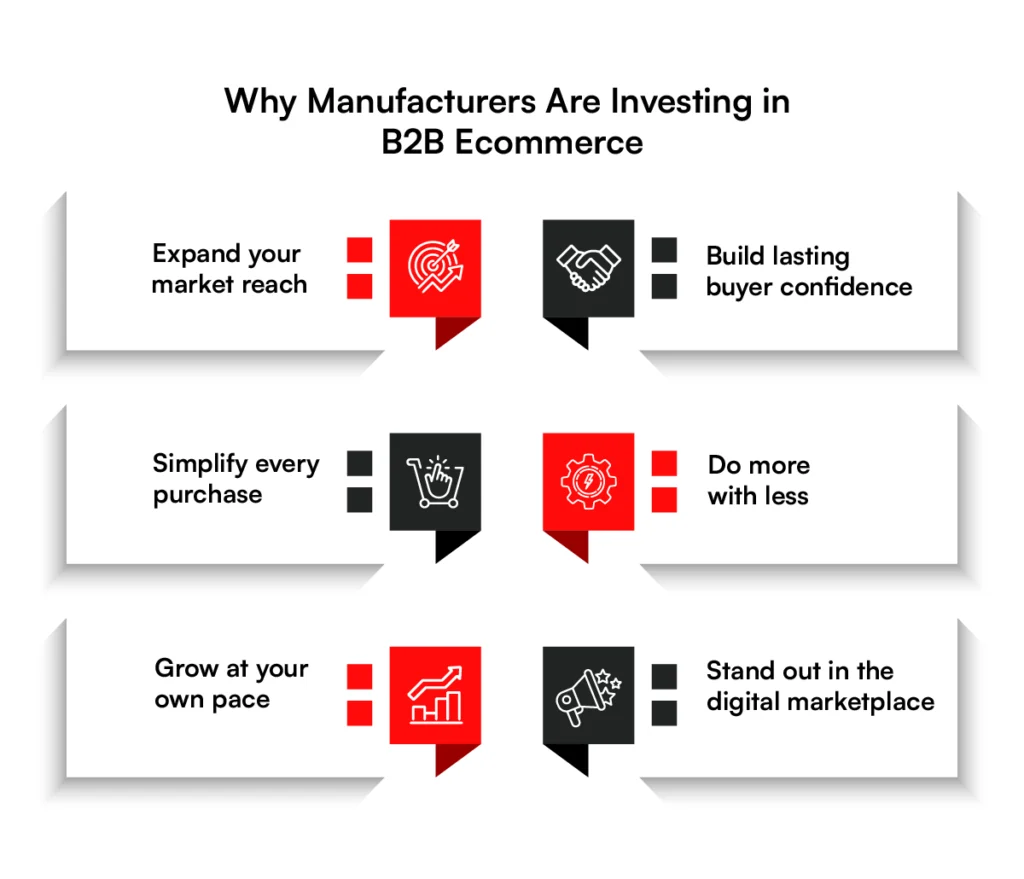
1. Engage New Customers
Your sales team can only reach so many prospects through traditional methods. With a B2B ecommerce platform, your products become accessible to potential buyers around the clock. Customers can browse your catalog, compare products, request quotes, or place orders whenever it suits them.
A well-optimized ecommerce website also helps you reach customers beyond your existing network. You can attract buyers from new industries, regions, and global markets without expanding your sales team at the same pace by improving your online visibility through search engines and digital marketing.
2. Improve Customer Experience
Today’s B2B buyers expect the same convenience they experience when shopping online. They want quick product searches, personalized pricing, simple reordering, and self-service account management.
An ecommerce platform lets you deliver exactly that. Your customers can place orders at any time, check inventory in real time, save frequently purchased products, and reorder with just a few clicks. Instead of waiting for emails or phone calls, they can complete purchases faster and with less effort.
3. Manage Costs
If your team spends hours entering orders manually, correcting errors, or answering routine order status questions, those costs quickly add up.
A b2b ecommerce for manufacturers automates many of these repetitive tasks. When you connect it with your ERP, CRM, inventory management, and warehouse systems, you reduce manual work, improve accuracy, and speed up order processing.
This allows your team to spend more time supporting customers and growing the business instead of handling administrative tasks.
4. Improve Brand Visibility
If your business depends mainly on distributors or sales representatives, many potential customers may never interact directly with your brand.
A B2B ecommerce website allows you to showcase your expertise through detailed product pages, technical resources, case studies, and educational content.
As more buyers discover your website through search engines, you increase brand awareness, generate qualified leads, and create more opportunities to build direct customer relationships.
The benefits of B2B ecommerce go well beyond offering online ordering. It helps you attract more customers, strengthen trust, improve operational efficiency, and prepare your business for future growth.
Build a Smarter Ecommerce Experience
Create a B2B ecommerce solution that simplifies complex purchasing, integrates with your business systems, and grows with your manufacturing business.
Talk to an Expert
Use Cases of Ecommerce for Manufacturers?
If you’re thinking of ecommerce as just another way to sell products online, you’re missing a much bigger opportunity. Today’s manufacturers use ecommerce to simplify complex buying journeys, automate operations, improve customer service, and support multiple sales channels from a single platform.
Whether you sell to distributors, retailers, businesses, or end consumers, here’s how you can use ecommerce to create more value across your organization.
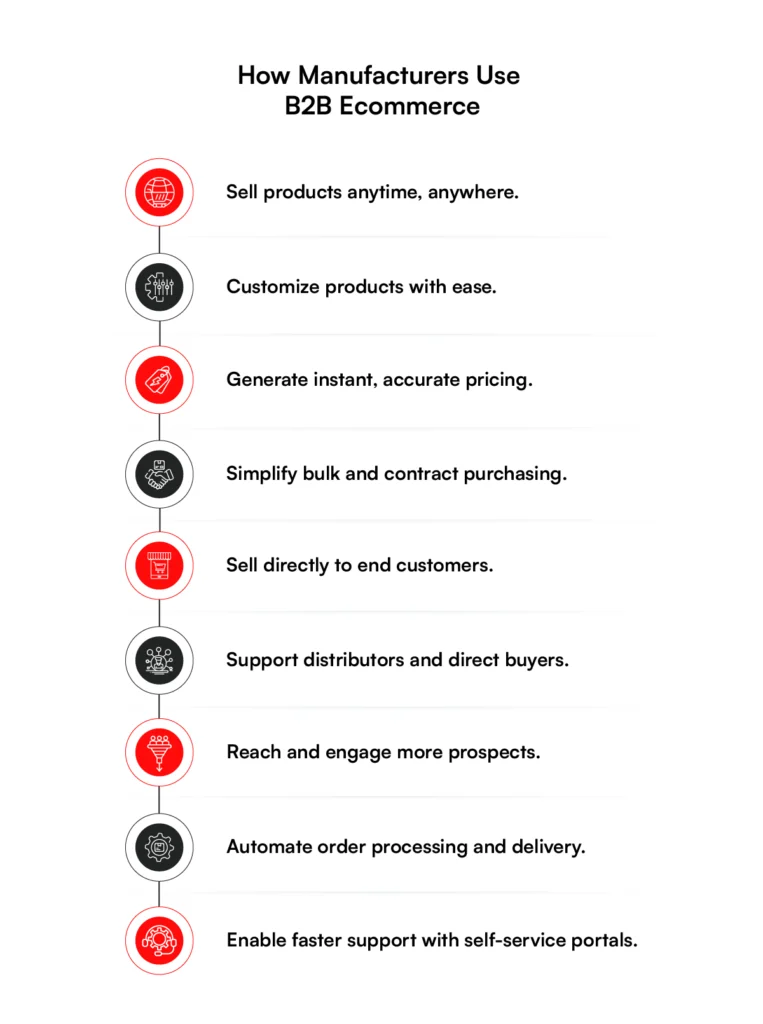
1. Online Storefronts
Your website can be much more than an online catalog. It can become a digital storefront where your customers browse products, compare specifications, request quotes, and place orders whenever it’s convenient for them.
Instead of depending on phone calls or emails, you give customers the freedom to research products and make purchasing decisions on their own. At the same time, you create another sales channel that works for your business around the clock.
2. Product Configurators
If you sell products with multiple sizes, materials, finishes, or custom options, you know how complicated the ordering process can become.
A product configurator lets your customers build exactly what they need by selecting different options online. As they customize a product, they only see compatible choices, which reduces ordering mistakes and speeds up the buying process. Your sales team also spends less time handling back-and-forth discussions about product specifications.
3. Price Calculators
Pricing in manufacturing often depends on several factors, including quantity, customization, materials, or customer agreements. Calculating prices manually for every inquiry slows down your sales process.
By adding a price calculator to your ecommerce platform, you can provide instant estimates or customer-specific pricing. Your buyers get faster answers, and your sales team can focus on more complex opportunities instead of preparing routine quotes.
4. B2B Sales
If you primarily sell to distributors, wholesalers, or other businesses, ecommerce makes it much easier for your customers to purchase.
You can offer customer-specific pricing, negotiated contracts, bulk ordering, payment terms, approval workflows, and personalized product catalogs. Your customers can log in, place orders, reorder previous purchases, and track shipments without contacting your sales team for every transaction.
5. D2C Sales
More manufacturers are choosing to sell directly to consumers alongside their existing distribution network.
A direct-to-consumer channel gives you greater control over your brand, helps you build direct customer relationships, and provides valuable insights into buying behavior. It also creates an additional revenue stream without replacing your traditional sales channels.
6. Business-to-Business-to-Consumer (B2B2C) Sales
You don’t have to choose between selling directly and supporting your partners. Many manufacturers successfully do both.
With a B2B2C model, you can help distributors or retailers sell your products while maintaining consistent product information, inventory visibility, and pricing rules. This allows you to expand your reach while strengthening your relationships with channel partners.
7. Marketing Channel
Your ecommerce website can also become one of your strongest marketing assets. Instead of simply listing products, you can publish buying guides, technical documentation, case studies, videos, and industry insights that help potential customers make informed decisions.
As more buyers discover your content through search engines, you increase brand awareness and generate qualified leads for your business.
Top 8 Essential Integrations for B2B Ecommerce Solutions for Manufacturers
Your ecommerce platform should not work in isolation. Ecommerce integration connects it with the ERP, CRM, inventory, warehouse, and other systems that support manufacturing operations, helping product, pricing, order, and inventory data move between them.
When your business systems are integrated, information flows automatically between departments. This reduces manual data entry, minimizes errors, and gives every team access to the same up-to-date information. The result is greater operational efficiency and a better experience for both your employees and your customers.
Here are the key integrations every b2b ecommerce for manufacturers should include.
1. Enterprise Resource Planning (ERP)
Your ERP system is at the center of your manufacturing operations. It manages inventory, procurement, production planning, finance, and customer orders.
Integrating your ecommerce platform with your ERP ensures that product information, inventory levels, pricing, and customer data stay synchronized across all systems.
This means your customers always see accurate stock availability, while your teams can process orders faster without manually updating multiple platforms.
2. Customer Relationship Management (CRM)
Your CRM helps you manage customer relationships by storing contact information, purchase history, sales opportunities, and ongoing interactions.
When your ecommerce platform connects with your CRM, your sales and customer service teams gain a complete view of every customer.
This allows you to deliver personalized pricing, targeted promotions, faster support, and more meaningful customer interactions throughout the buying journey.
3. Order Management System (OMS)
As your business grows, managing orders manually across multiple sales channels becomes increasingly challenging.
Integrating your ecommerce platform with an Order Management System (OMS) centralizes order processing, routes orders to the appropriate fulfillment location, manages returns, and provides real-time order tracking. This helps you reduce processing delays and ensures every order moves smoothly from purchase to delivery.
At RBMSoft, we build ecommerce solutions that integrate seamlessly with your existing OMS, helping you automate order workflows, eliminate manual processes, and improve order visibility across your entire business.
4. Supply Chain Management (SCM) System
A manufacturing business depends on a well-connected supply chain. Your ecommerce platform should communicate directly with your Supply Chain Management (SCM) system to keep inventory, procurement, suppliers, and logistics aligned.
This integration gives you better visibility into stock levels, improves demand forecasting, and helps you respond quickly to supply chain disruptions before they impact your customers.
At RBMSoft, we develop ecommerce solutions that integrate with your SCM software to create a connected digital ecosystem across your operations. If you’re planning a broader supply chain transformation, you can also explore our guide on Supply Chain Management Software Development to learn how modern SCM solutions improve efficiency and resilience.
5. Manufacturing Execution System (MES)
Your Manufacturing Execution System monitors and manages production activities on the factory floor. Integrating your ecommerce platform with your MES allows production data to flow directly into your sales processes.
This helps you provide accurate production schedules, realistic delivery timelines, and better visibility into product availability, allowing you to meet customer expectations more consistently.
6. Product Lifecycle Management (PLM) and Product Information Management (PIM)
Manufacturers often manage large product catalogs with detailed specifications, certifications, technical documents, images, and configuration options.
A PLM system manages product information throughout its lifecycle, while a PIM system ensures consistent product data across every sales channel.
By integrating these systems with your ecommerce platform, you can keep product information accurate, up to date, and easy for customers to understand, reducing purchasing errors and improving the overall buying experience.
7. Warehouse Management System (WMS)
Accurate inventory and efficient warehouse operations play a major role in customer satisfaction. A Warehouse Management System helps you manage inventory storage, picking, packing, and shipping.
When connected to your ecommerce platform, inventory updates happen automatically, helping prevent overselling while providing customers with accurate stock availability and real-time shipment updates.
8. Accounting Systems
Your finance team should not have to manually transfer sales data between systems. Integrating your ecommerce platform with your accounting software automates invoicing, payment reconciliation, tax calculations, and financial reporting.
This reduces administrative work, improves financial accuracy, and gives you a clearer view of your business performance.
The more connected your business systems are, the more value you’ll get from your ecommerce investment. With the right integrations in place, you can automate workflows, improve operational visibility, and deliver a smoother buying experience from the first click to final delivery.
Build a Connected Commerce Ecosystem
Turn disconnected systems into a unified digital experience that improves efficiency, accuracy, and customer satisfaction.
Build My SolutionBest Practices for Using B2B Ecommerce for Manufacturers
Launching a B2B ecommerce platform for manufacturers is only the first step. To see long-term results, you need a strategy that supports your customers, streamlines operations, and adapts as your business grows.
You can create an ecommerce experience that drives efficiency, builds stronger customer relationships, and delivers measurable business value by following these best practices.
1. Build Detailed and Accurate Product Catalogs
Your customers rely on your product information to make purchasing decisions. If product details are incomplete or outdated, they may delay purchases or look for another supplier.
Create comprehensive product catalogs that include specifications, technical documentation, certifications, images, pricing, compatibility details, and downloadable resources. The easier you make it for customers to find accurate information, the faster they can place orders with confidence.
RBMSoft can integrate your ecommerce platform with PIM and ERP systems to synchronize product data across channels. We can also develop custom catalog structures, advanced search, filtering, and product configuration features to help customers find and select complex products more easily.
2. Provide Customer-Specific Pricing and Ordering Experiences
Not every customer should see the same pricing, payment terms, or product catalog. Configure your ecommerce platform to support contract pricing, customer-specific catalogs, negotiated discounts, payment terms, and personalized ordering workflows.
RBMSoft can implement role-based access, customer-specific pricing rules, personalized catalogs, bulk ordering, and account-level purchasing workflows. These capabilities allow you to deliver a tailored buying experience without requiring your sales team to manage every transaction manually.
3. Maintain Real-Time Inventory Visibility
Nothing frustrates customers more than placing an order for products that are no longer available.
Integrate your ecommerce platform with your ERP, inventory, WMS, or other backend systems so customers always see accurate stock levels and estimated delivery dates. You can develop API-based integrations that synchronize inventory data across systems, helping you reduce backorders, prevent overselling, and improve fulfillment visibility.
4. Support Complex Approval Workflows
Many B2B purchases involve multiple stakeholders before an order is approved. Your ecommerce platform should support approval hierarchies, purchasing roles, spending limits, and multi-step authorization processes.
You can build customized approval workflows based on your customers’ organizational structures and purchasing rules.
You can define different permissions for buyers, managers, and administrators while automating approval notifications and order routing. This allows customers to follow their internal procurement policies without leaving the ecommerce platform.
5. Coordinate with Distributors and Channel Partners
If your business sells through distributors, dealers, or resellers, your ecommerce strategy should strengthen those relationships rather than compete with them.
Support channel-specific pricing, shared product information, inventory visibility, and order management capabilities that help your partners serve customers more effectively while maintaining a consistent brand experience.
RBMSoft can develop partner portals and channel-specific ecommerce experiences that give distributors access to the products, pricing, inventory information, and ordering capabilities relevant to their accounts.
This helps you support different sales channels while maintaining control over your overall ecommerce ecosystem.
6. Invest in Scalable, Integration-Ready Technology
Your ecommerce platform should support your business today and continue growing with you tomorrow.
Choose a solution that integrates easily with your ERP, CRM, warehouse management, manufacturing, and accounting systems. At RBMSoft, we build scalable, API-driven ecommerce solutions that fit into your existing technology ecosystem.
Our integration capabilities help connect your commerce platform with core business applications, automate workflows, and make it easier to introduce new functionality as your requirements evolve.
7. Prioritize Security, Compliance, and Data Privacy
Your ecommerce platform handles sensitive customer information, pricing agreements, payment data, and business transactions. Protecting this information should always be a priority.
You can incorporate security into the ecommerce architecture through role-based access controls, secure APIs, authentication mechanisms, data encryption, and controlled access to customer and business information. You can also design solutions around the regulatory and data privacy requirements relevant to your business and market.
8. Deliver Responsive Customer Support and Self-Service
Your customers expect answers quickly, whether they need technical documents, order updates, or account information.
Provide self-service features such as order tracking, invoice downloads, product documentation, reorder functionality, and support portals. You can develop customer portals and self-service functionality that give buyers direct access to the information and actions they need.
You can also integrate chatbots or AI-powered assistants to help customers find information and resolve routine queries faster.
9. Involve Sales Teams and Customers Throughout the Journey
Your ecommerce platform should complement your sales team, not replace it. Include your sales representatives and key customers during planning, implementation, and testing.
RBMSoft follows a collaborative approach to ecommerce development, using your existing workflows and user requirements to shape the solution. Involving sales teams and customers early helps identify process gaps, validate functionality, and ensure the final platform supports how your business and customers actually work.
10. Continuously Measure Performance and Optimize
Your ecommerce platform should evolve alongside your business. Track metrics such as conversion rates, average order value, repeat purchases, cart abandonment, customer satisfaction, and order fulfillment times.
RBMSoft can help you implement analytics and reporting capabilities that bring ecommerce and operational data together. By monitoring customer behavior, sales performance, and operational metrics, you can identify bottlenecks, improve digital experiences, and make informed decisions about future enhancements.
You can build an ecommerce platform that improves operational efficiency, strengthens customer relationships, and supports long-term business growth. However, the path to success is not always straightforward. Understanding the challenges before implementation can help you avoid costly mistakes and set your business up for long-term success.
Ready to Modernize Your Ecommerce?
Create a future-ready platform that improves customer experiences, automates operations, and scales with your business.
Modernize My PlatformMost Common Challenges of Ecommerce for Manufacturers
While B2B ecommerce offers significant advantages, implementing it is not without challenges. Manufacturing businesses often deal with complex products, legacy systems, multiple sales channels, and unique customer requirements that make digital transformation more demanding than in other industries.
The good news is that these challenges can be addressed with the right strategy, technology, and implementation approach.
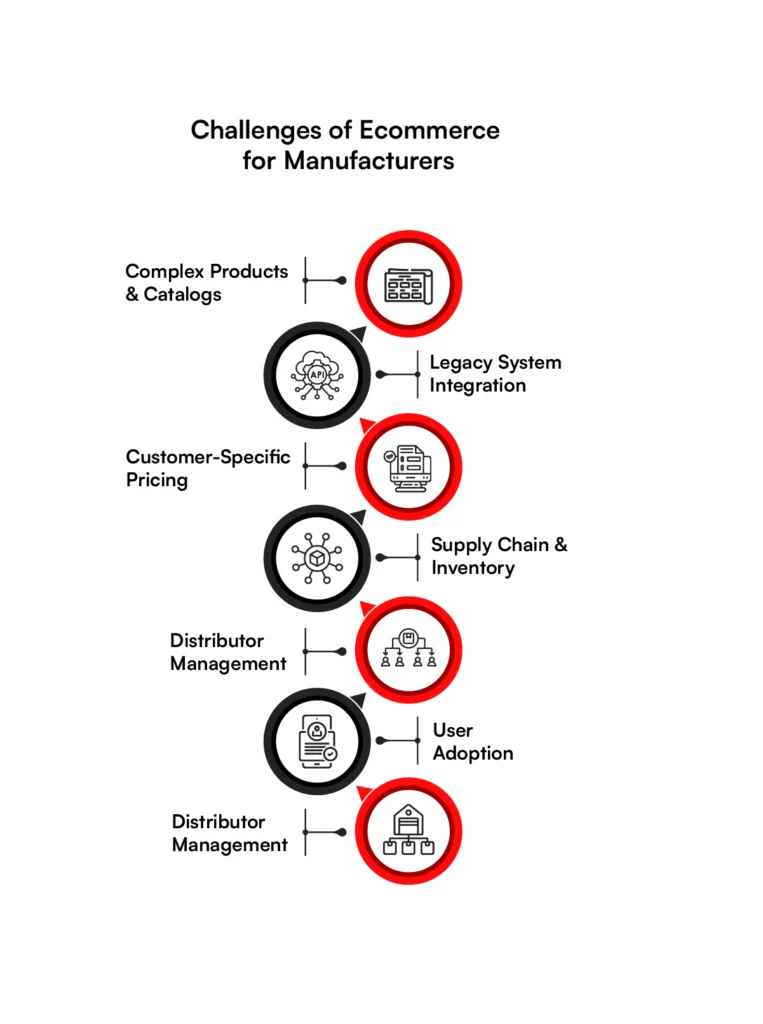
1. Managing Complex Products, Catalogs, and Ordering Workflows
Manufacturers often manage thousands of products with multiple configurations, specifications, variants, certifications, and technical documents. As catalogs grow, keeping product information accurate and consistent across ecommerce and other channels becomes increasingly difficult.
A PIM (Product Information Management) system can centralize product data and synchronize it across ecommerce channels. API integrations can connect PIM platforms with ERP, ecommerce, and other business systems to keep product information consistent.
For manufacturers managing complex product relationships and large SKU volumes, Arvyn can support automated catalog and merchandising workflows.
RBMSoft has built a merchandising engine capable of processing millions of SKU relationships, automating product mappings, validating catalog data, and handling real-time updates through event-driven architecture.
2. Integrating with Legacy Business Systems
Your ERP, ecommerce CRM, inventory, accounting, and manufacturing systems may have been running for years. Replacing them just to launch ecommerce can be expensive and disruptive.
Digital transformation involves modernizing legacy systems, connecting disconnected applications, automating workflows, and creating a scalable technology ecosystem. API-driven integrations and middleware can connect your existing systems with ecommerce without replacing everything at once.
RBMSoft’s digital transformation services can help you modernize legacy applications, integrate business systems, automate processes, and create a connected technology ecosystem that supports your ecommerce and future growth.
3. Managing Customer-Specific Pricing and Contracts
B2B manufacturers rarely follow a single pricing model. Different customers may have negotiated prices, volume discounts, contracts, payment terms, or access to specific products. Implement rule-based pricing engines, customer segmentation, account-level catalogs, and role-based access controls.
These capabilities allow your ecommerce platform to automatically display the right products, prices, discounts, and purchasing options for each customer.
4. Managing Supply Chain, Inventory, and Fulfillment
Customers expect accurate stock information and reliable delivery estimates, but manufacturers often manage inventory across multiple warehouses, production facilities, and suppliers.
Integrate your ecommerce platform with ERP, WMS, OMS, and supply chain systems to synchronize inventory and order data. Real-time inventory APIs, automated order routing, and fulfillment tracking can improve visibility and reduce stockouts, overselling, and fulfillment errors.
5. Preventing Distributor and Channel Conflicts
Selling directly through ecommerce can create tension with distributors and other channel partners if customers receive different pricing, product availability, or purchasing options.
Build partner portals and channel-specific ecommerce experiences with separate pricing, catalogs, permissions, and ordering workflows. This allows you to expand direct digital sales while giving distributors the tools they need to continue serving their customers effectively.
6. Driving Customer Adoption and Organizational Change
Even a technically strong ecommerce platform can struggle if customers and employees continue relying on familiar processes such as phone calls, emails, and manual orders.
Introduce self-service portals, intuitive interfaces, personalized dashboards, guided purchasing, and automated notifications to make digital adoption easier. You can also roll out ecommerce capabilities in phases, gather user feedback, and continuously improve the experience based on actual usage data.
7. Delivering a Consistent B2B Customer Experience
Customers may interact with your business through your ecommerce website, sales representatives, distributors, customer support, and other channels. Inconsistent product information, pricing, or order status across these touchpoints can quickly undermine trust.
Create a connected commerce ecosystem where ecommerce, CRM, ERP, PIM, OMS, and customer service systems share consistent data. A centralized data architecture and API-based integrations help ensure customers receive the same accurate information regardless of how they interact with your business.
Addressing these challenges with the right technology can turn ecommerce from an additional sales channel into a connected part of your manufacturing operation.
As manufacturers continue looking for ways to automate processes and make better decisions, AI is becoming another important layer of the ecommerce technology stack.
AI Ecommerce Solutions Integration for Manufacturers
Artificial intelligence is changing how manufacturers sell, forecast demand, and manage operations. When you connect AI capabilities with your ecommerce platform and existing business systems, you can turn customer, product, inventory, and operational data into actionable insights.
The key is not simply adding AI features. You need the right data pipelines, APIs, machine learning models, and system integrations to make those features work reliably within your existing ecommerce ecosystem.
1. AI-Powered Product Search and Discovery
Finding the right product can be difficult when your catalog contains thousands of SKUs, technical specifications, configurations, and industry-specific terminology.
AI-powered search can use natural language processing (NLP), semantic search, vector databases, and product attributes to understand what a buyer actually means rather than relying only on exact keyword matches. APIs can connect the search engine with your PIM, ERP, and ecommerce platform to keep product information and availability current.
RBMSoft can integrate intelligent search and recommendation capabilities into ecommerce platforms, helping buyers find relevant products faster while making large catalogs easier to navigate.
2. AI in Manufacturing: Predictive Maintenance and Quality Control
AI can extend beyond the ecommerce storefront and improve your manufacturing operations. Equipment failures and quality issues can lead to downtime, waste, and delayed orders.
Machine learning models can analyze IoT sensor data, equipment performance, production records, and historical maintenance data to identify patterns associated with potential failures.
For quality control, computer vision models can analyze images or video from production lines to identify defects and inconsistencies.
These AI capabilities can connect with MES, IoT platforms, ERP systems, and production databases, allowing insights to flow into existing operational workflows.
3. AI Demand Forecasting
Accurately predicting demand becomes difficult when you manage fluctuating customer requirements, seasonal demand, large product catalogs, and complex supply chains.
AI forecasting models can combine historical sales, order patterns, inventory data, seasonal trends, customer behavior, and other relevant data sources to generate more responsive demand forecasts. Integrating these models with ERP, ecommerce, and supply chain systems can help automatically feed forecasts into inventory and production planning.
This gives your teams better visibility into upcoming demand and helps reduce both excess inventory and stock shortages.
4. Product Spotlight and Intelligent Storefront Search
AI can also personalize what each buyer sees on your ecommerce storefront. Instead of showing every customer the same products, you can prioritize products based on their account, purchase history, browsing behavior, product relationships, and business rules.
Recommendation engines and machine learning models can analyze customer and product data to generate relevant product suggestions, complementary items, frequently reordered products, or personalized product spotlights.
These capabilities can integrate with your ecommerce platform through APIs and use real-time behavioral data to continuously refine recommendations.
For manufacturers with large catalogs, this can make product discovery more relevant while creating opportunities for cross-selling and repeat purchases.
With the right architecture, AI becomes an integrated part of your ecommerce and manufacturing ecosystem rather than a standalone feature.
By connecting AI models with your product, customer, operational, and transaction data, you can create smarter digital experiences while improving the efficiency of your underlying processes.
Conclusion
At RBMSoft, we deliver ecommerce software development services that help manufacturers build scalable, secure, and integration-ready ecommerce solutions. We develop platforms that align with your business processes and support long-term growth.
Our capabilities include:
- Custom B2B ecommerce platform development
- ERP, CRM, OMS, WMS, and other enterprise system integrations
- AI-powered ecommerce features and workflow automation
- Platform modernization, maintenance, and optimization
- End-to-end IT services for ecommerce tailored to your business needs
Whether you’re starting from scratch or upgrading your existing platform, RBMSoft can help you build an ecommerce solution that improves efficiency, enhances customer experiences, and supports sustainable business growth.
FAQ’s
1. Why are manufacturers adopting ecommerce strategies?
Manufacturers are adopting ecommerce for manufacturers to simplify complex sales processes, automate order management, and meet evolving customer expectations.
Modern B2B buyers expect self-service ordering, customer-specific pricing, real-time inventory visibility, and faster purchasing experiences.
Investing in b2b ecommerce for manufacturers also helps businesses improve operational efficiency, expand into new markets, and build stronger customer relationships while reducing manual work.
2. What’s the difference between retail ecommerce and manufacturing ecommerce?
Retail ecommerce focuses on selling standardized products directly to consumers, while manufacturing ecommerce supports more complex B2B purchasing processes.
An ecommerce platform for manufacturers typically includes features such as bulk ordering, negotiated pricing, product configurators, approval workflows, and ERP integration.
Unlike traditional retail stores, ecommerce for manufacturers and retailers must support multiple customer types, pricing models, and business-specific purchasing requirements.
3. How does digital transformation impact the manufacturing industry?
Digital transformation enables manufacturers to automate operations, improve productivity, and deliver better customer experiences. By implementing an ecommerce platform for manufacturers, businesses can integrate ERP, CRM, warehouse management, and inventory systems into a single connected ecosystem.
Combined with AI, automation, and data analytics, ecommerce software for manufacturers helps streamline operations, improve decision-making, and support long-term business growth.
4. What is the business impact of ecommerce on the manufacturing industry?
Implementing ecommerce solutions for manufacturers creates measurable business benefits, including faster order processing, reduced operational costs, increased customer satisfaction, and improved sales efficiency.
A modern b2b ecommerce platform for manufacturers also enables businesses to scale more easily, improve inventory visibility, and support multiple sales channels. These capabilities help manufacturers stay competitive in an increasingly digital marketplace.
5. How much does it cost to implement B2B ecommerce solutions for manufacturers?
The cost of implementing ecommerce solutions for manufacturers depends on several factors, including platform selection, custom features, third-party integrations, product catalog complexity, and deployment requirements.
A basic solution may require a smaller investment, while a fully customized b2b ecommerce platform for manufacturers with ERP, CRM, AI capabilities, and advanced workflows will involve a larger budget. The best approach is to define your business goals and request a tailored estimate.
6. How long will it take to build a custom ecommerce solution for manufacturers?
The development timeline depends on your business requirements, platform complexity, integrations, and customization needs. A standard ecommerce platform for manufacturers can typically be implemented within a few months, while a fully customized solution may take longer.
If you’re building ecommerce software for manufacturers with advanced integrations, AI capabilities, and custom workflows, the timeline will increase accordingly.
Whether you’re building ecommerce for manufacturers and retailers or a dedicated B2B solution, careful planning and phased implementation help ensure a successful deployment.