
Quick Summary:
- Custom retail software development builds applications around a retailer’s specific workflows, data, and existing technology stack.
- Custom software becomes useful when packaged platforms cannot support complex integrations, business rules, or growing transaction volumes.
- Common solutions include POS, inventory management, CRM, ERP, omnichannel platforms, analytics, and AI-based retail applications.
- Development requires clear requirements, integration planning, system architecture, testing, deployment, and production monitoring.
- Custom retail software can cost $30,000 to $200,000+, depending on complexity, integrations, infrastructure, and features.
- AI, IoT, AR/VR, blockchain, and conversational AI are expanding what retailers can build into their software.
- The right retail software development company should understand enterprise retail systems, integration requirements, security, and long-term support.
Packaged retail platforms can cover standard commerce requirements, but retailer-specific processes often extend beyond their predefined workflows.
Order routing, inventory allocation, fulfillment logic, or integrations may require repeated configuration and custom workarounds.
As those workarounds accumulate, maintaining the retail stack becomes harder. Teams may end up fixing synchronization problems or adapting operations around platform restrictions instead of letting the software follow established business rules.
Custom software development for the retail industry gives businesses another option for these requirements. This article explains where custom development fits, how retail software is built, what it costs, and how to plan the technical decisions behind it.
What Is Custom Retail Software Development?
Custom retail software development is software built around how a retailer actually runs its business. The requirements come from its pricing rules, inventory structure, fulfillment model, and transaction flows rather than from the fixed capabilities of a packaged platform.
Most retail software development happens within an existing technology stack. A new application may read inventory from an ERP, receive orders from a commerce platform, or send fulfillment requests to an OMS. APIs and event-based integrations keep those exchanges running as records change.
Custom software development for the retail industry is useful when existing platforms cannot support a retailer’s operating logic without extensive workarounds.
Custom services can take responsibility for specific processes while established systems remain the source of record for the data they already manage.
When Custom Software Development for Retail Becomes Necessary
Retailers often consider custom retail software development after gaps appear between the systems they already use. Inventory updates lag, order data stops matching across channels, or teams rely on manual work to keep one system aligned with another.
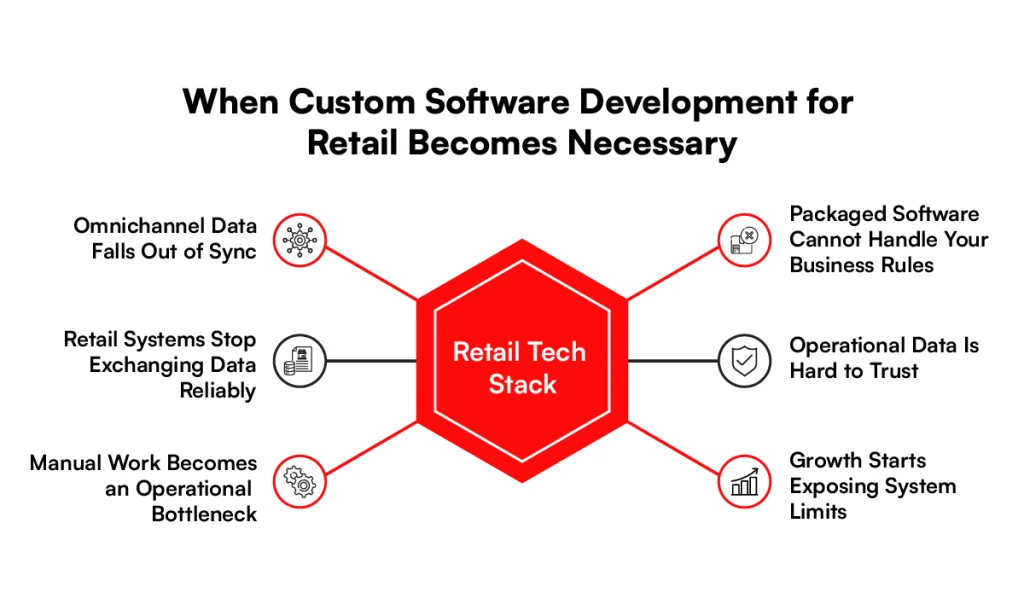
1. Omnichannel Data Falls Out of Sync
Customers may move between the website, app, marketplace, and store during one purchase. If pricing, inventory, loyalty balances, or order status differ between channels, the underlying systems are working from different records rather than shared, current data.
2. Retail Systems Stop Exchanging Data Reliably
Retail systems can lose synchronization as more applications are added to the stack. An OMS, for example, may receive inventory changes from the ERP through delayed batch jobs while the ecommerce platform reads availability from another source. Missing APIs or inconsistent data mappings make those records harder to reconcile.
3. Manual Work Becomes an Operational Bottleneck
Teams should not have to move order data between systems, reconcile inventory in spreadsheets, or update prices in several applications.
Software development for retail can replace these handoffs with APIs, event-based processing, and rules that execute automatically.
4. Packaged Software Cannot Handle Your Business Rules
Standard platforms work around predefined workflows. Problems appear when order routing, inventory allocation, promotions, returns, or fulfillment depend on retailer-specific rules that require repeated workarounds or heavy platform customization.
5. Operational Data Is Hard to Trust
Retail decisions depend on knowing what was sold, what remains available, where inventory sits, and what orders are still open. When those answers differ between systems, custom integration and data pipelines can establish clear ownership for each record.
6. Growth Starts Exposing System Limits
More stores, SKUs, channels, transactions, and fulfillment nodes put different pressure on the architecture.
Custom software development for the retail industry allows specific services and integrations to be redesigned when existing platforms can no longer support the required transaction volume or operating model.
Fix the Gaps Between Your Retail Systems
Build custom integrations and applications that keep data moving reliably across your retail stack.
Discuss Your Retail Software Requirements
Types of Custom Retail Software Solutions
With those gaps identified, the focus shifts to choosing custom retail software solutions that match the specific process or system requirement. Below are the main types used across retail operations.
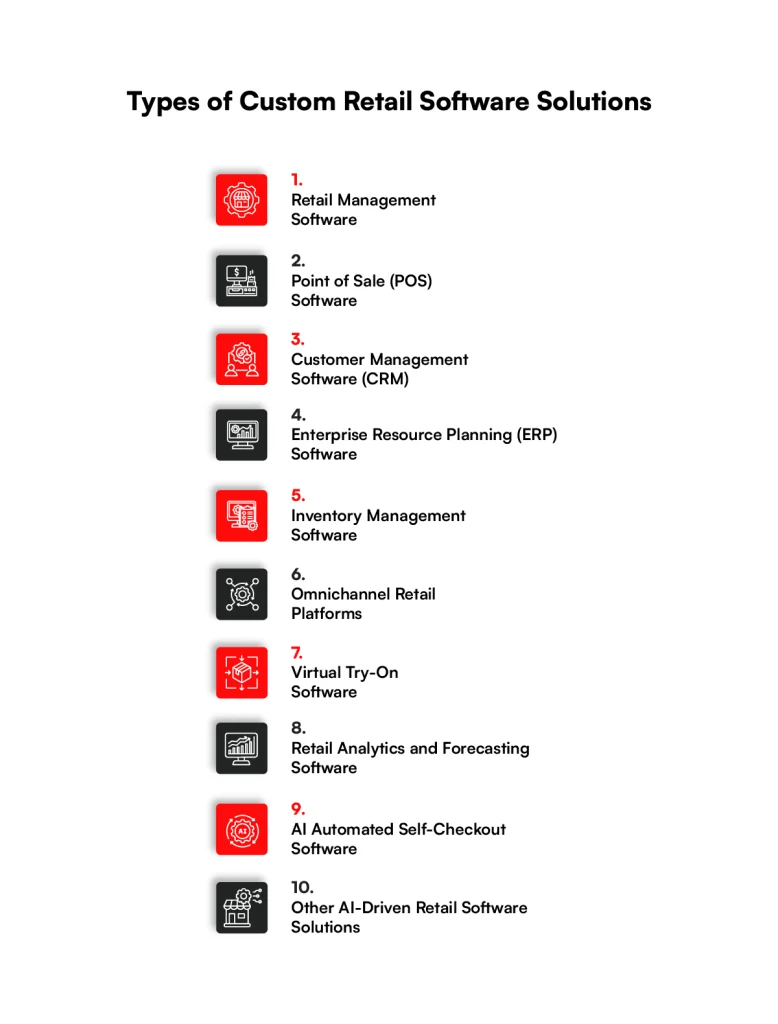
1. Retail Management Software
Retail management software gives operations teams a common layer for running day-to-day retail processes. Instead of moving records manually between separate applications, the system can exchange transaction and operational data with accounting, inventory, ecommerce, and supplier systems through APIs or scheduled integrations.
For larger retail environments, the difficult part is deciding which application owns each record. Product, order, pricing, and inventory data may originate in different systems.
Clear data ownership and integration contracts help prevent duplicate records and conflicting updates as new stores or channels are added.
2. Point of Sale (POS) Software
Custom POS software handles the transaction at the store while exchanging data with the rest of the retail stack. It can support retailer-specific checkout rules and hardware integrations that packaged POS products may not accommodate.
A POS also has to keep working when connectivity becomes unreliable. Local caching and offline transaction queues can allow stores to continue processing sales, then synchronize records after connectivity returns.
Payment terminals, barcode scanners, receipt printers, and other store hardware add another technical requirement. Each device needs tested interfaces, while payment processing must follow the security controls required for cardholder data.
3. Customer Management Software (CRM)
Retail CRM software brings customer activity from digital and physical channels into a usable customer record.
Retail CRM software development services can connect purchase history, loyalty activity, service interactions, and commerce events when a standard CRM data model cannot represent the retailer’s customer relationships properly.
Identity resolution matters here. The same shopper may appear under different emails, loyalty IDs, devices, or store transactions. Matching rules and data validation help prevent duplicate profiles from feeding segmentation, personalization, and campaign systems.
4. Enterprise Resource Planning (ERP) Software
Retail ERP software manages business records that sit behind store and commerce activity. Custom modules or ERP extensions are often required when finance, procurement, warehouse, or supply chain processes follow rules that the existing ERP configuration cannot represent.
Replacing an ERP in one release carries significant operational risk. A phased approach can move individual processes behind APIs while the existing ERP remains the system of record.
That allows teams to modernize specific functions without forcing every dependent application to migrate at once.
5. Inventory Management Software
Inventory software has to answer a harder question than how many units exist: how many units can actually be sold through a particular channel right now? Physical stock may already be reserved for another order, held at a store, in transit, damaged, or unavailable for fulfillment.
Keeping that availability current requires catalog and inventory changes to reach commerce applications quickly. Arvyn by RBMSoft provides a near-real-time read layer for changing product and inventory data, without requiring a full catalog reindex each time records change.
For large or frequently changing catalogs, this architecture shortens the time between an inventory update and the availability presented to the storefront or another consuming application.
6. Omnichannel Retail Platforms
An omnichannel platform coordinates transactions when a customer crosses channel boundaries. An online order collected from a store, for example, requires the commerce application to check location-level availability before the OMS reserves stock and sends the fulfillment request.
That coordination depends on more than connecting APIs. Inventory reservations, order state changes, cancellations, refunds, and loyalty events need defined ownership so one channel does not overwrite a valid change made by another.
7. Virtual Try-On Software
Virtual try-on software combines camera input with AR rendering and, for more complex products, computer vision models. Facial landmarks, body pose estimation, segmentation, or object tracking can determine where a digital product should appear as the user moves.
The technical approach changes with the product. Eyewear can use facial landmark tracking, while apparel may require body segmentation and pose estimation.
Model inference also has to run quickly enough that movement on screen does not lag behind the camera feed.
8. Retail Analytics and Forecasting Software
Retail analytics software becomes useful when operational data can be processed at the level required for a decision. Forecasting may need historical sales combined with current inventory and seasonality, while pricing models may require a different dataset and refresh frequency.
ETL or ELT pipelines can standardize data from retail systems before loading it into a warehouse or lakehouse, while streaming pipelines process inventory and order events that need faster updates.
This gives analytical models a consistent data source instead of relying on records pulled separately from operational applications.
Forecasting models then sit on top of that data foundation. Their output can feed replenishment, allocation, pricing, or planning systems instead of remaining isolated in a reporting dashboard.
9. AI Automated Self-Checkout Software
AI self-checkout can use computer vision to recognize products when a barcode is unavailable or when the system needs another signal to verify what entered the basket.
Camera feeds are processed through detection or classification models before the transaction reaches the payment stage.
The software still has to reconcile the completed transaction with the POS and inventory system. Confidence thresholds can send uncertain detections for manual verification rather than allowing the model to make every checkout decision automatically.
10. Other AI-Driven Retail Software Solutions
AI can also be added to specific retail workflows rather than built as a separate platform. A retailer might develop a recommendation engine that reads catalog and behavioral data, or connect a forecasting model directly to replenishment decisions.
Other requirements may call for a different architecture altogether. RAG can ground customer or associate applications in approved product data, while AI agents can execute defined tasks through existing commerce, CRM, or order-management APIs.
RBMSoft can build these custom retail software development solutions around the systems and data a retailer already has.
The scope can start with one application or integration and expand when the operating requirement calls for additional services, data pipelines, or AI integration components.
Benefits of Custom Retail Software Development
Retail operations gain more room to improve when software reflects the processes, data flows, and transaction rules already used across the business.
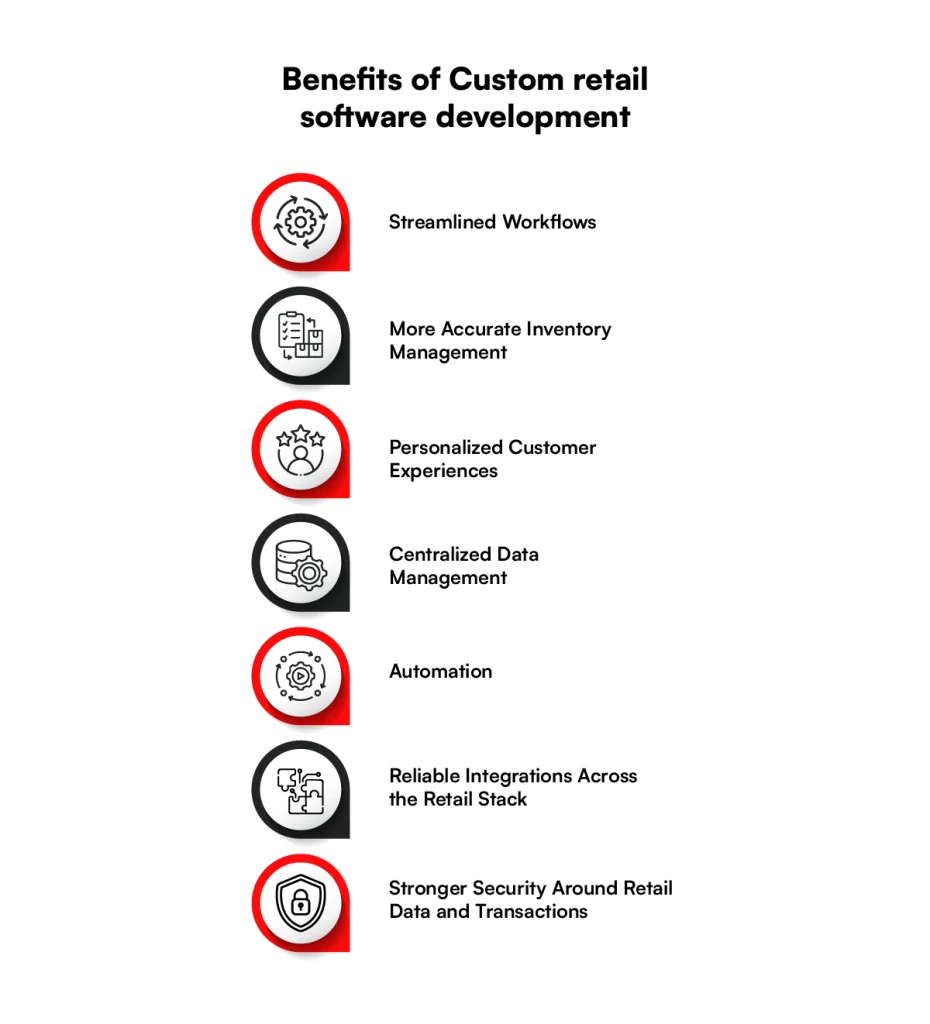
As a result, custom retail software development can improve system connectivity, reduce operational friction, and give retailers greater control over how their technology supports growth.
1. Streamlined Workflows
Custom software can remove unnecessary handoffs between retail applications by carrying the same transaction through each stage of the process.
An order placed online, for example, can trigger inventory reservation and fulfillment without requiring operations teams to enter the same information again.
Because the workflow is built around the retailer’s own rules, exceptions can also be handled within the application. Orders that fail validation can follow a separate path, while successful transactions continue without waiting for manual approval.
2. More Accurate Inventory Management
Inventory accuracy depends on how quickly stock changes move between the systems that sell, reserve, and fulfill products.
Custom inventory software can process these changes through APIs, CDC, or event streams so available-to-promise quantities reflect reservations and completed transactions sooner.
This matters when inventory is shared across stores, warehouses, and ecommerce channels. Allocation rules can determine which location should fulfill an order without letting two channels promise the same unit.
3. Personalized Customer Experiences
Personalization becomes more precise when the application can use customer activity beyond the current browsing session.
A custom customer layer can connect identity and transaction data from CRM or commerce systems, giving recommendation and promotion logic more context about the shopper.
The retailer also controls what information enters the decision. Instead of depending on a vendor-defined profile, business rules can determine how purchase history, loyalty status, product affinity, or current session behavior affects the experience.
4. Centralized Data Management
Retail data often has several sources of record, so centralization should not mean copying everything into one database.
Custom retail software development can define which system owns each domain and create pipelines that make those records available where they are needed.
A PIM might remain responsible for product attributes while the OMS owns order state. Data contracts, schema validation, and change events allow other applications to consume those records without creating competing versions of the same information.
5. Automation
Retail automation works best when software can respond directly to a business event rather than waiting for someone to start the next task. An inventory threshold, order status change, or failed payment can trigger the appropriate processing rule as soon as the event is received.
Custom rules also give teams control over exceptions. Automation can route an unusual transaction for review while allowing routine cases to continue, which prevents a single edge case from stopping the entire workflow.
6. Reliable Integrations Across the Retail Stack
Integrations become harder to maintain when every application connects directly to several others using different schemas and update schedules.
Retail software development can introduce APIs, middleware, or event-based interfaces that define how data moves between existing applications.
Reliability also requires planning for failure. Idempotency can prevent duplicate processing after a retry, while queues and dead-letter handling preserve failed messages for recovery when an ERP, payment service, or other dependent system becomes temporarily unavailable.
7. Stronger Security Around Retail Data and Transactions
Custom applications allow security controls to follow the sensitivity of the workflow instead of inheriting the same access model across every user and service.
OAuth 2.0, SSO, MFA, role-based permissions, encryption, and audit logging can be applied at the appropriate application boundaries.
For payment workflows, architecture can also reduce PCI DSS scope by keeping cardholder data outside systems that do not need it. Tokenization and payment-provider integrations allow applications to reference a transaction without storing raw payment credentials.
RBMSoft applied this custom retail software development approach for Big Lots, addressing load-handling issues and unreliable third-party integrations in its Oracle ATG environment.
The work included a customized ecommerce solution with centralized administration, staged migration, automated release cycles, and integrations supporting supply chain, promotions, and payments, while improving platform reliability during high-traffic periods.
Those benefits depend on how the software is planned, connected, tested, and released. The next step is turning the retail requirement into a working product without creating new gaps across the existing technology stack.
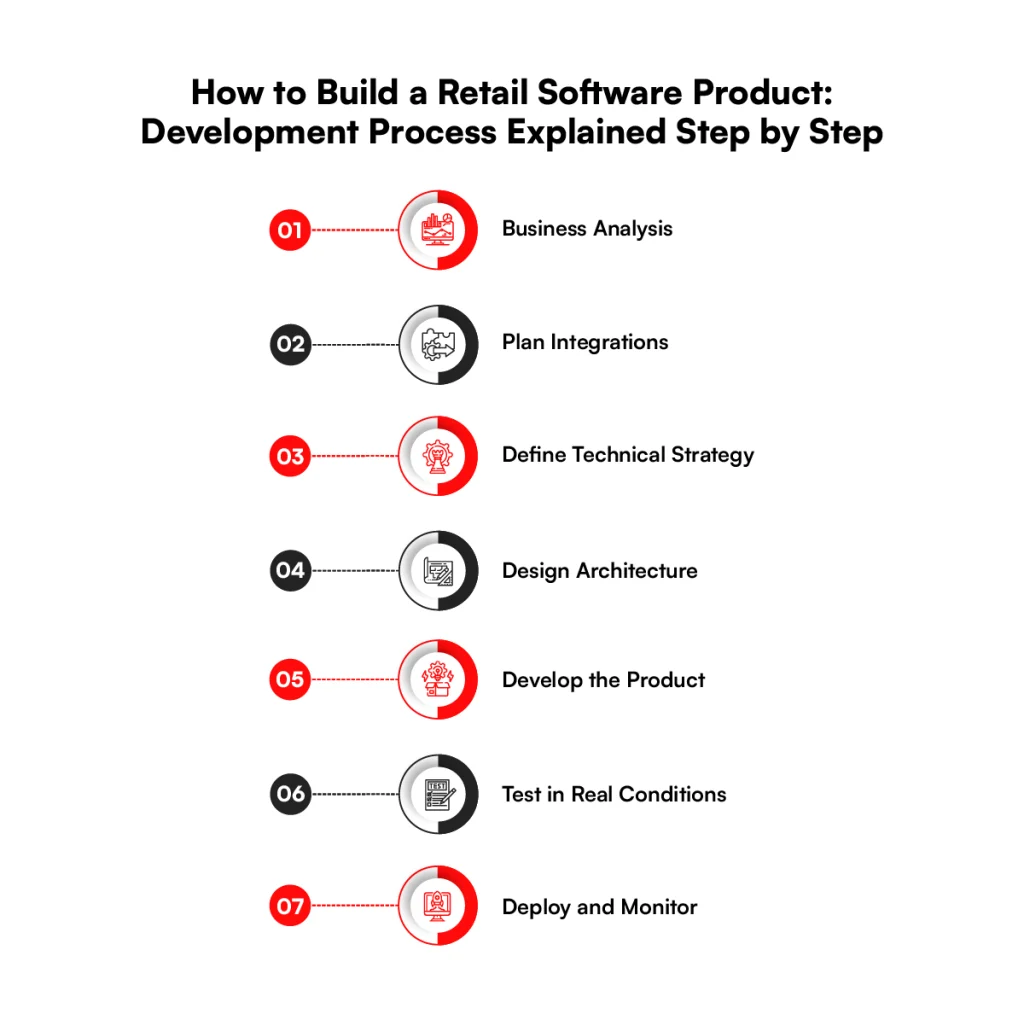
How to Build a Retail Software Product: Development Process Explained Step by Step
Building the right product starts with understanding what it needs to do and how it will fit into the current retail stack. Below are the steps involved in the custom retail software development process, from defining requirements to deploying the product in production.
Step 1. Business Analysis and Requirements Gathering
Start by mapping the retail process the software needs to support, including its users, transaction flow, business rules, data sources, and dependencies on current systems.
Requirements should also define expected order volumes, response times, availability targets, and the operational result the product is expected to improve.
Step 2. Consider Existing and Future Integrations
A retail application may depend on product information from a PIM while inventory availability comes from an ERP or WMS.
Before development begins, teams need to establish the source of record for each data domain and document which applications can create, read, or update that information.
The communication pattern should match the transaction. API-based commerce works well when an application needs an immediate response, while webhooks, message queues, or event streams can process inventory and order changes asynchronously without holding up the original request.
Integration contracts should also define schemas, authentication, timeouts, retry behavior, and error handling. Making these decisions early prevents each application from implementing its own interpretation of the same data exchange.
Step 3. Create the Technical Strategy
The technical strategy translates business and integration requirements into decisions about cloud infrastructure, databases, application services, security, observability, and CI/CD.
Technology choices should account for expected transaction volume and existing engineering capability so the product remains practical to operate after release.
Step 4. Design the System Architecture
System design establishes where business logic runs, which application owns each record, and how components communicate.
A retailer may keep order management within an existing OMS while a custom service handles allocation logic, exposing that capability through an API rather than duplicating the order domain.
Failure paths need to be designed alongside the normal transaction flow. Idempotency can prevent duplicate processing after retries, queues can absorb temporary service interruptions, and reconciliation jobs can identify transactions that did not complete correctly across connected systems.
Step 5. Develop the Retail Software
Once the architecture and contracts are agreed, custom retail software development can move into incremental releases.
Backend services, interfaces, integrations, and data pipelines should be built against defined contracts so changes in one component do not repeatedly break dependent applications.
Automated builds, unit tests, code reviews, versioned APIs, and CI/CD pipelines should be part of development rather than added before launch.
These controls become more valuable as the codebase grows and several teams begin releasing changes to connected services.
Development can also be organized around complete retail workflows instead of isolated features. Completing the order path from checkout through reservation and fulfillment, for example, gives teams something meaningful to validate before expanding into another part of the product.
Step 6. Test Under Real Retail Conditions
Testing should follow complete transactions across system boundaries. An ecommerce order can pass through payment authorization, inventory reservation, OMS processing, and fulfillment, so validating the storefront alone says little about whether the transaction will complete correctly.
Load tests should reproduce expected concurrency and seasonal peaks, while integration tests cover duplicate events, delayed responses, unavailable services, and partial failures.
Security testing should check authentication, authorization, API exposure, and sensitive-data handling before production traffic reaches the application.
Step 7. Deploy and Monitor the Product
Deployment can start with selected stores, regions, users, or a percentage of traffic before wider release. Feature flags and controlled rollouts limit the impact of unexpected behavior, while logs, metrics, traces, and business-event monitoring show how the software performs under production traffic.
Once the development process is defined, attention turns to what the product needs to handle in daily retail operations.
The following core features cover the capabilities required to manage transactions, data, and customer interactions reliably.
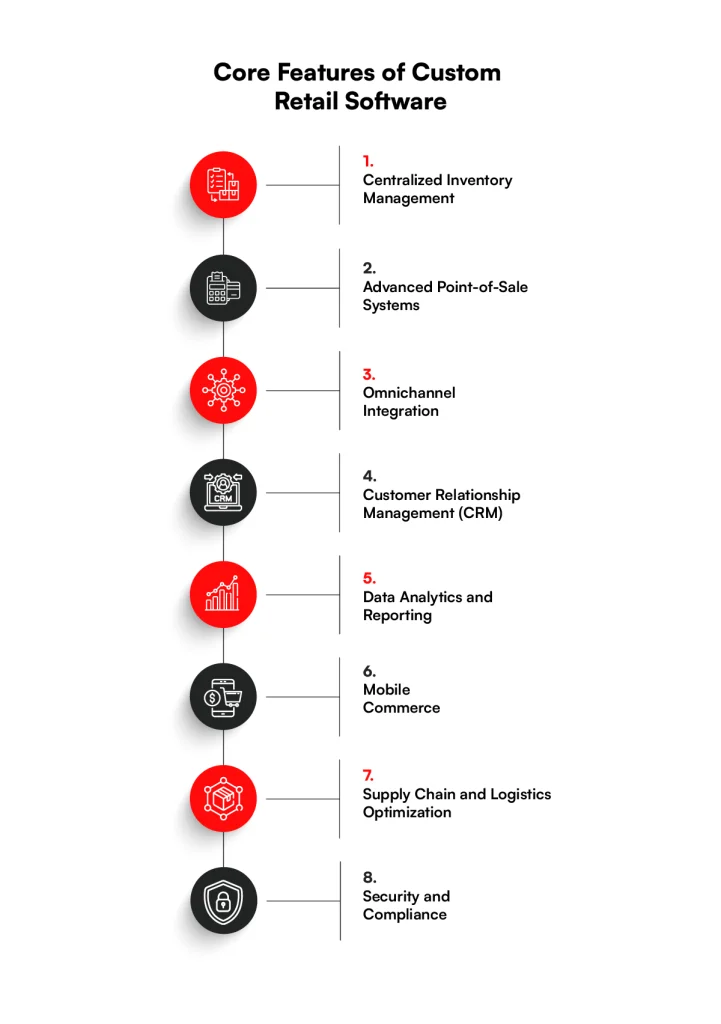
Core Features of Custom Retail Software Development
The feature set should reflect how the software will operate across real retail transactions and connected systems. Below are the core features of custom retail software to consider during product development.
1. Centralized Inventory Management
Centralized inventory management should maintain a consistent view of available stock across stores, warehouses, and digital channels.
Rather than treating physical quantity as sellable inventory, the system can account for reservations, pending orders, transfers, returns, and fulfillment rules before exposing available-to-promise quantities.
For environments where several applications update stock, event streams or CDC can propagate inventory changes without waiting for a full batch synchronization.
Clear source-of-record rules are equally important so an OMS, ERP, WMS, and storefront do not overwrite each other with conflicting inventory states.
2. Advanced Point-of-Sale Systems
An advanced POS should process store transactions while remaining connected to pricing, inventory, loyalty, and order services.
Custom retail software development can support retailer-specific checkout logic, local promotions, returns, associate permissions, and hardware integrations that do not fit a standard POS configuration.
Store connectivity also needs to be considered in the POS architecture. Local caching and offline transaction queues can keep checkout available during a network interruption, with synchronization rules controlling how transactions are reconciled after the connection returns.
3. Omnichannel Integration
Omnichannel integration requires each channel to work against consistent order and inventory states rather than maintaining separate versions of the transaction.
A customer can place an order online and collect it from a store only when the commerce platform and fulfillment systems exchange those state changes reliably.
APIs can handle requests that need an immediate response, while events can distribute inventory reservations, cancellations, returns, and fulfillment updates asynchronously.
Idempotency becomes important here because retrying the same event should never create a second order or reserve the same inventory twice.
A shared customer identity can then carry relevant account and loyalty information between channels without forcing every application to maintain its own customer profile.
4. Customer Relationship Management (CRM)
A retail CRM needs context from transactions occurring outside the CRM itself. Connecting ecommerce CRM with commerce and loyalty data can give sales, service, and marketing applications access to customer activity without relying on periodic spreadsheet imports.
Identity resolution is especially important when one customer appears under different emails, devices, loyalty accounts, or store transactions.
Retail CRM software development services can introduce matching rules and data validation so downstream personalization or segmentation does not operate on duplicate customer profiles.
5. Data Analytics and Reporting
Analytics features should consume governed data from operational systems rather than assembling reports from separate exports.
ETL or ELT pipelines can standardize historical records in a warehouse or lakehouse, while streaming pipelines can feed events that require shorter reporting intervals.
The reporting layer can then expose metrics at the level each role needs, with semantic models keeping calculations consistent between finance, merchandising, operations, and executive reporting.
6. Mobile Commerce
Mobile commerce requires more than resizing the storefront for a smaller screen because application performance, authentication, checkout state, and API latency directly affect the purchase flow.
Native or cross-platform applications can consume commerce services through APIs while keeping business logic in shared backend services.
Session and cart state should also survive interruptions between devices or channels when the retailer supports cross-channel shopping.
Token-based authentication such as OAuth 2.0 and secure local storage can manage customer sessions without placing sensitive credentials directly inside the application.
7. Supply Chain and Logistics Optimization
Supply chain features need visibility into where inventory sits and what must happen before it reaches the customer.
Integration between order, warehouse, carrier, and supplier systems can move fulfillment status through the transaction without operations teams repeatedly reconciling separate applications.
More complex custom retail software development solutions can apply allocation rules before an order reaches fulfillment.
The system might select a node based on available inventory and delivery commitments, while exception workflows handle stock discrepancies or carrier failures without stopping unrelated orders.
8. Security and Compliance
Security should be part of the application architecture because retail software often crosses customer accounts, internal systems, payment services, and third-party APIs.
SSO, MFA, role-based access controls, encryption, secrets management, and audit logging can limit which users and services are allowed to reach sensitive functions.
Payment architecture requires particular care. Tokenization can keep raw card details outside applications that do not need them, while segmentation can reduce the systems falling within PCI DSS scope.
Privacy requirements also affect how customer information is stored, transferred, retained, and deleted. Retail software developers should account for applicable privacy requirements and accessibility standards during system design rather than treating compliance as a final QA check.
Custom Retail Software Development vs. Off-the-Shelf Software: Key Benefits
The choice between packaged and custom retail software comes down to how closely the system needs to match existing processes and technical requirements.
Below, we compare both approaches across customization, integration, scalability, ownership, implementation, and long-term cost.
| Consideration | Custom Retail Software | Off-the-Shelf Software |
| Implementation | Requires discovery, architecture, development, integration, and testing before rollout | Can be deployed faster when standard functionality covers the requirement |
| Initial Cost | Higher upfront engineering investment | Lower initial cost through subscription or licensing models |
| Customization | Business rules, workflows, data models, and interfaces can be built around the retailer | Configuration stays within the options and extension points provided by the vendor |
| Integration | APIs, events, middleware, and data contracts can be designed around existing systems | Integration depends on available APIs, connectors, and vendor restrictions |
| Scalability | Architecture can be designed around expected transaction, catalog, store, and integration loads | Scaling depends on platform limits, pricing tiers, and vendor architecture |
| Data Control | Retailer can define data ownership, storage, access, and synchronization rules | Data handling follows the platform’s architecture and policies |
| AI Integration | Models, RAG, agents, or forecasting services can connect with retailer-owned data and workflows | AI capabilities depend largely on what the platform vendor provides or permits |
| Product Roadmap | Features and releases can follow business priorities | New capabilities depend on the vendor’s release roadmap |
| Maintenance | Requires an internal engineering team or development partner for ongoing support | Core platform maintenance and updates are generally handled by the vendor |
| Long-Term Cost | Engineering costs continue, but the retailer controls where additional development investment goes | Subscription, usage, transaction, storage, API, or add-on costs can increase as usage grows |
Off-the-shelf software makes sense when the process is standardized and the platform already handles it well. A retailer that needs basic functionality may gain little from rebuilding capabilities already available through a mature commercial product.
Custom retail software development becomes the stronger option when the operating model depends on rules the packaged platform cannot represent cleanly.
Custom services can own specific logic for inventory allocation, order routing, fulfillment, pricing, or other processes while exchanging data with the retailer’s existing systems.
The decision does not have to result in a complete build or buy choice. A retailer can retain its ERP, CRM, commerce platform, or POS while developing custom services around the areas that need more control, allowing existing products to remain responsible for functions they already handle well.
How Much Does It Cost to Build Custom Retail Software?
After deciding what to build, cost depends on the scope, integrations, architecture, and data requirements involved in custom retail software development. The table below gives an estimated range based on the type and complexity of the retail software.
| Retail Software Complexity | Estimated Cost | Typical Scope |
| Basic Retail Software | $30,000–$50,000+ | Basic POS, inventory tracking, product management, or a single-store application |
| Mid-Level Retail Software | $50,000–$80,000+ | Multi-store support, third-party integrations, customer management, reporting, and analytics |
| Enterprise Retail Platform | $80,000–$200,000+ | ERP or OMS integrations, omnichannel workflows, large data volumes, advanced automation, and AI capabilities |
These ranges provide a starting point rather than a fixed project price. Two retail applications with similar features can have different engineering requirements once existing systems, transaction volumes, and integration dependencies are considered.
Integration work can have a significant effect on the cost to build custom retail software. Connecting an application with an older ERP may require custom middleware or data transformation, while a modern platform with documented APIs can reduce that work.
Architecture also affects the estimate. Multi-region deployment, high-availability requirements, event-driven processing, observability, security controls, and infrastructure for seasonal traffic peaks require additional engineering beyond the application interface itself.
The final estimate should therefore come after requirements and technical discovery. Defining the expected workflows, integration points, data ownership, performance targets, and deployment environment gives the development team enough information to estimate the project against its actual technical scope.
Get a Clear Estimate for Your Retail Software
Share your requirements with our retail software developers and get a cost estimate based on your integrations, architecture, and project scope.
Discuss Your Retail Software ProjectThe Role of Emerging Technologies in Custom Retail Software Development
As retail applications handle more real-time data and automated decisions, newer technologies are becoming part of custom retail software development. Their value depends on where they connect with existing systems and what retail process they are expected to support.
1. Artificial Intelligence (AI) and Machine Learning
AI and machine learning can process retail data for demand forecasting, recommendations, dynamic pricing, fraud detection, and inventory planning.
Production models may need transaction history from a commerce platform while receiving current inventory or customer signals from other operational systems.
AI integration connects these models with the applications where their output is used. APIs can serve predictions during a request, while event streams support decisions triggered by inventory changes, orders, or other business events.
Model monitoring should track prediction quality alongside application performance. Drift detection, versioning, observability, and human approval rules become especially relevant when model output can change pricing, inventory allocation, or another customer-facing decision.
2. Internet of Things (IoT)
IoT connects physical retail activity with software through RFID readers, shelf sensors, scanners, and other connected devices. Device events can update inventory or store applications when products move through receiving, storage, or sales processes.
Large IoT deployments need an ingestion layer capable of handling frequent device messages without sending every raw event directly into core retail systems.
Message brokers and event-processing services can validate those events before relevant changes reach inventory, WMS, or analytics applications.
3. Augmented Reality (AR) and Virtual Reality (VR)
AR and VR applications connect digital product representations with a shopper’s physical or simulated environment.
The implementation can use facial landmark tracking for eyewear, spatial mapping for furniture placement, or pose estimation when the product needs to follow body movement.
Rendering performance has to work alongside accurate catalog data. Product dimensions, variants, 3D assets, and availability can be retrieved through commerce APIs so the visualization stays connected with the retailer’s current product records.
4. Blockchain
Blockchain has a narrower role in software development for retail, mainly where several independent parties need a shared record that cannot be changed by one participant.
Product provenance or supply-chain events can be recorded across suppliers, logistics providers, and retailers when distributed verification is a genuine requirement.
5. Chatbots and Conversational AI
Conversational AI can connect customer questions with current retail information instead of relying entirely on predefined responses.
An order-status request, for instance, can query the OMS after authentication, while a product question can retrieve current catalog information from an approved source.
RAG can ground responses in product documentation, policies, and other retailer-controlled content. APIs can then provide account-specific information that should not be stored in the model’s general knowledge source.
More advanced implementations can allow AI agents to initiate defined actions inside retail workflows. Authentication, permission boundaries, audit logs, and human approval rules should control which systems an agent can access and what actions it can complete.
Why Build Your Custom Retail Software with RBMSoft
RBMSoft brings retail engineering experience to projects where new software must work with existing commerce platforms and operational systems. Our retail software development services cover the application, its integrations, and the production environment it needs to run in.
1. Retail-Specific Development Experience
RBMSoft has worked with retailers including Big Lots, DSW, Mills Fleet Farm, and PetMeds. Our teams understand the technical requirements behind large catalogs, high transaction volumes, complex fulfillment flows, and connected retail applications.
2. Integration with Your Existing Systems
A new application does not require replacing the rest of your retail stack. RBMSoft builds APIs and integration services that connect custom software with ERP, CRM, OMS, PIM, commerce, and other existing systems.
3. Architecture Built for Enterprise Loads
Our retail software developers design around expected traffic, transaction volume, data flows, and system dependencies. Load testing and phased deployments help validate the software against production conditions before wider rollout.
4. Security and Ongoing Support
RBMSoft addresses security requirements during development, including PCI DSS considerations for applicable payment workflows.
After deployment, monitoring and ongoing engineering support help teams manage performance issues, integration failures, and future software changes.
Conclusion
Retail software works better when it matches the processes, systems, and transaction rules already running the business. Custom retail software development gives retailers the flexibility to build those requirements into the product.
The right architecture also matters beyond launch. Integrations, security controls, and infrastructure should support changing transaction volumes and new business requirements without requiring repeated platform replacements.
RBMSoft builds and integrates retail software around existing enterprise environments. If you are planning a new retail application or improving an existing platform, contact us to discuss your requirements.
Talk to Our Retail Software Team
FAQs
1. How to Choose the Best Retail Software Development Team?
Choose retail software developers with experience in the systems your business already runs, including ERP, CRM, OMS, PIM, POS, and commerce platforms.
The team should understand API integration, data architecture, security, cloud deployment, QA, and production monitoring.
For enterprise projects, prior experience delivering custom software development for the retail industry should carry more weight than a long list of general development services.
2. What Are Real-Life Examples of Enterprises That Implemented Custom Retail Software?
Large retailers use custom retail software development solutions when standard platforms cannot fully support their operating requirements.
RBMSoft, for example, worked with Big Lots on its Oracle ATG ecommerce environment, including platform customization, third-party integrations, automated releases, and improvements designed for high-traffic periods.
Other RBMSoft retail work includes brands such as DSW, Mills Fleet Farm, and PetMeds, covering different parts of commerce and retail technology.
3. How Much Does It Cost to Build Custom Retail Software?
The cost to build custom retail software can range from approximately $30,000 to $200,000+, depending on complexity.
A basic POS or inventory application may sit near the lower end, while enterprise custom retail software development involving ERP integration, omnichannel workflows, large data volumes, or AI capabilities can cost considerably more.
4. How Long Does It Take to Build Custom Retail Software?
A focused retail application may take around 3–6 months, while a larger enterprise platform can require 6–12 months or longer.
The timeline for software development for retail depends on requirements, integration complexity, data migration, testing scope, security requirements, and the number of systems involved.
5. What Future Trends and Market Statistics Should Retailers Consider in Custom Retail Software Development?
AI-driven search, conversational commerce, agent-based workflows, computer vision, real-time inventory intelligence, and predictive models are influencing retail software development.
Retailers should assess these technologies against their own data quality and integration readiness rather than adding them as isolated features.
Many reports highlighted the shift from generative AI experiments toward agentic workflows, edge intelligence, AI governance, and commerce-specific applications such as dynamic pricing, inventory prediction, and one-to-one personalization.
6. Can RBMSoft Integrate AI Into My Existing ERP and CRM Retail Software?
Yes. RBMSoft’s AI integration work can connect models and AI applications with existing ERP, CRM, commerce, and other retail systems without requiring the entire stack to be replaced.
Depending on the use case, APIs, RAG, data pipelines, or event-driven services can provide the model with approved business data and return its output to existing workflows.
This approach allows custom retail software development solutions to add AI capabilities around established systems while keeping the ERP or CRM responsible for the records it already owns.
7. What Compliance Requirements Does RBMSoft Follow While Building Custom Retail Software?
Compliance requirements depend on the software, data, payment flow, and markets involved.
RBMSoft can account for PCI DSS requirements in applicable payment environments, CCPA and GDPR for relevant privacy requirements, accessibility standards for customer-facing applications, and HIPAA where applicable to healthcare retail systems.
Security controls within retail software development services can also include encryption, MFA, role-based access, audit logging, secure API authentication, vulnerability testing, and penetration testing based on project requirements.