
Table of Contents
Key Takeaways:
- Choose an ecommerce app model that fits your business goals and customer journey.
- Prioritize features that improve shopping, payments, orders, and customer retention.
- Build on a scalable tech stack that supports growth, security, and integrations.
- Start with an MVP and expand features based on customer feedback.
- Plan for development costs, compliance, and long-term app maintenance.
- Leverage AI, AR, voice, and social commerce to stay competitive in 2026 and beyond.
Building an ecommerce app sounds straightforward until you start dealing with the realities of running an online business.
Your customers expect a smooth mobile experience, but your team also needs to manage changing inventory, payments, orders, customer data, integrations, and growing transaction volumes behind the scenes.
A basic app may handle initial demand, but it can quickly become difficult to maintain when your business expands or customer expectations change.
You may also be wondering where to start. Should you build a simple MVP or invest in an enterprise-grade application? Which technologies will support future growth?
What features actually matter to your customers, and how much should you budget for development?
A well-planned ecommerce app development can address these challenges while giving you the flexibility to build around your specific business model.
In this article, we’ll explore how to turn your ecommerce idea into a mobile app that works smoothly for your customers today and has the flexibility to grow with your business tomorrow.
Types of Ecommerce Mobile Apps to Create in 2026 for Businesses
Not every ecommerce business needs the same type of mobile app. A wholesale distributor has very different requirements from a D2C fashion brand, while a marketplace needs an entirely different architecture from a subscription-based retailer. The right app model depends on how you sell, who you sell to, and how you plan to scale.
Here are the key ecommerce app types businesses can consider in 2026:
1. B2B (Business-to-Business) Portals
B2B ecommerce apps are built for businesses that sell products or services to other businesses. Unlike consumer shopping apps, they need to support complex purchasing workflows such as bulk ordering, negotiated pricing, customer-specific catalogs, purchase approvals, quotations, and repeat orders.
For example, a manufacturer can give distributors access to personalized pricing and inventory through the app, while a wholesale buyer can place large orders without going through a sales representative for every purchase.
A custom B2B ecommerce app can also integrate with ERP, CRM, inventory, and accounting systems to keep pricing, stock, orders, and customer information synchronized.
2. D2C & B2C Brand Stores
D2C and B2C apps allow brands to sell directly to individual customers through their own mobile storefront. The focus here is on making product discovery, purchasing, payments, and post-purchase engagement as frictionless as possible.
A D2C fashion brand, for instance, can use its app to showcase personalized recommendations, launch exclusive collections, send targeted offers, and build loyalty without relying entirely on third-party marketplaces.
For businesses, the advantage goes beyond selling products. A custom app gives brands greater control over the customer experience, first-party customer interactions, loyalty programs, and brand communication.
3. Multi-Vendor Marketplaces
Planning to bring multiple sellers and buyers onto one platform? A multi-vendor ecommerce app can provide that infrastructure.
Instead of selling your own inventory, you create a digital marketplace where third-party sellers can list products and customers can purchase from different vendors.
The app then needs to manage seller onboarding, product listings, commissions, payments, order management, reviews, returns, and seller dashboards.
This model works particularly well for businesses that want to build a marketplace around a specific product category or customer segment. However, the technology must handle multiple sellers, transactions, and inventory streams without creating operational bottlenecks.
4. Social Commerce Integrations
Social commerce brings product discovery and purchasing closer to where customers already spend their time. Businesses can connect their ecommerce experience with social platforms so customers can discover products through social content, product links, creator recommendations, or shoppable experiences.
For brands, this model can shorten the journey between seeing a product and purchasing it. A customer might discover a product through a social post, explore it through the brand’s ecommerce experience, and complete the purchase without navigating through multiple disconnected channels.
The key is to maintain a consistent product catalog, pricing, inventory, and customer experience across these touchpoints.
5. Subscription Box Apps
Subscription-based ecommerce apps turn one-time purchases into recurring customer relationships. Customers can subscribe to receive products at predefined intervals, while businesses gain a more predictable purchasing cycle.
This model works well for categories such as beauty products, groceries, pet supplies, wellness products, and curated lifestyle boxes.
A custom app can support recurring payments, subscription management, product customization, delivery schedules, skips, upgrades, and personalized recommendations.
The right ecommerce model ultimately depends on your customer journey and business operations. Once you identify the model that fits your business, the next step is to determine the functionality your app needs to deliver that experience.
That brings us to the core ecommerce app development features every modern retail application should include.
Choose the Right Ecommerce Model
Unsure which app model fits your customers and business goals? Get expert guidance to choose the right approach before development begins.
Find My Ideal App Model
Key Ecommerce Mobile App Development Features
A successful ecommerce app needs to make shopping easy for customers and operations manageable for your business.
That means going beyond an attractive interface and building features that support the entire journey, from product discovery and checkout to delivery, engagement, and repeat purchases.
Here are the essential ecommerce app development features to prioritize:
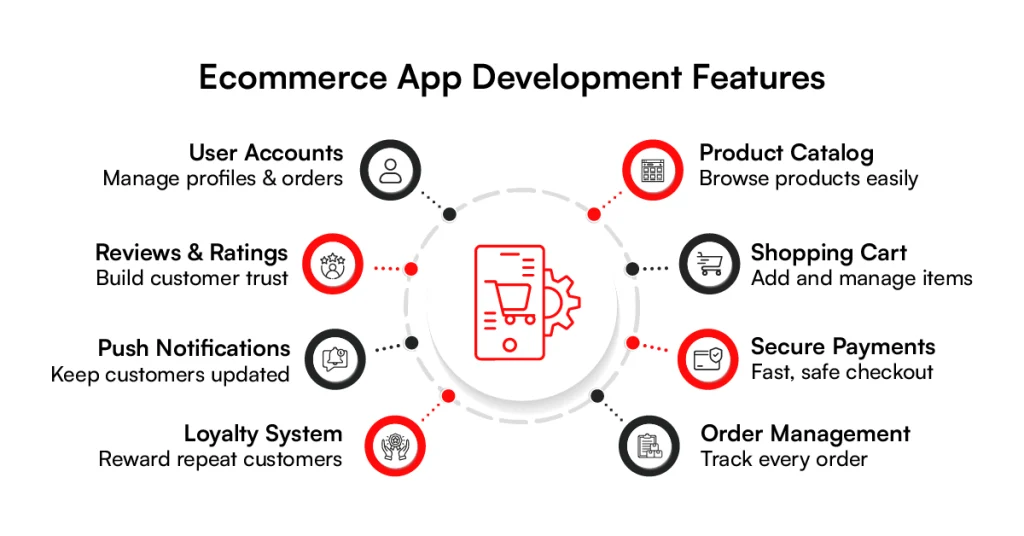
1. Product Catalog
Your product catalog is the foundation of the shopping experience. Give customers a clear way to browse products, explore detailed product pages, and find what they need without endless scrolling.
A well-built catalog should support product images and videos, descriptions, pricing, variants, categories, filters, sorting, and real-time inventory information.
For businesses managing thousands of SKUs, the backend should also make it easy to update product information and inventory in bulk.
2. Shopping Cart
The shopping cart should let customers review and modify their purchases before they check out. Keep the experience simple with options to add or remove products, change quantities, apply coupons, view shipping charges, and see the updated order total.
For mobile ecommerce, a persistent cart can also save items between sessions, allowing customers to return later without rebuilding their order from scratch.
3. Secure Payments
Payment is where convenience and trust need to work together. Your ecommerce app should support secure payment processing and offer the methods your customers actually use, such as credit and debit cards, mobile wallets, and other digital payment options.
You can also integrate multiple payment gateways, tokenized payment information, and additional options such as QR-based payments or buy now, pay later, depending on your target market and business model.
4. Order Management
Once a customer taps “Place Order,” your app needs to keep the entire process moving. An order management system can connect ordering, fulfillment, shipping, returns, and refunds in one workflow.
From the customer’s side, this means clear order confirmations, status updates, delivery tracking, and order history. From the business side, it gives teams better visibility into orders and fulfillment operations.
5. User Accounts
A customer account should make every subsequent purchase easier than the first. Let users securely manage their personal information, saved addresses, preferences, order history, and payment methods.
You can also use account data to create more relevant experiences, such as personalized product recommendations and faster repeat purchases. Just make sure you give customers appropriate control over their personal information and payment details.
6. Product Reviews and Ratings
Customers often want validation before they purchase, particularly when they cannot physically examine a product. Reviews and ratings give shoppers access to experiences from other buyers and help them make more informed decisions.
Consider supporting star ratings, written reviews, product-specific feedback, verified-purchase indicators, and review moderation. These features can also give your business useful insights into customer satisfaction and recurring product issues.
7. Push Notifications
Push notifications can bring customers back to your app, but relevance matters more than volume. Use them for useful updates such as order confirmations, shipping notifications, delivery updates, back-in-stock alerts, personalized offers, and abandoned-cart reminders.
Segment notifications based on customer behavior and preferences rather than sending the same message to everyone. This helps your app stay useful instead of becoming another source of notification fatigue.
8. Loyalty System
If you want customers to keep coming back, build retention into the app from the start. A loyalty system can reward customers through points, exclusive offers, membership tiers, referral rewards, or benefits based on purchase behavior.
You can also connect loyalty data with customer accounts and purchase history to create more personalized rewards. The goal is not simply to give discounts, but to give customers a reason to continue engaging with your brand.
These features create the functional foundation of an ecommerce app, but the technology behind them determines how well the application performs.
Next, let’s look at the advanced tech stack for ecommerce mobile app development and how the right technologies support scalability, security, and performance.
Advanced Tech Stack for Ecommerce Mobile App Development
The right tech stack determines how well your ecommerce app performs, scales, integrates with other systems, and handles growing customer demand. Here’s a practical overview of the technologies commonly used across different layers of ecommerce app development.
| Technology Layer | Common Technologies | What It Handles |
| Mobile App Development | Swift, Kotlin, React Native, Flutter | iOS and Android app development |
| Frontend | React, Angular, Vue.js, HTML, CSS, JavaScript | User interface and shopping experience |
| Backend | Node.js, Python, Java, PHP, Ruby, .NET | Business logic, APIs, authentication, and app operations |
| Frameworks | Node.js, Django, Spring Boot, Laravel, Express.js | Backend application development |
| Databases | PostgreSQL, MySQL, MongoDB, Firebase, DynamoDB | Products, users, orders, inventory, and transaction data |
| APIs | REST, GraphQL | Communication between the app, backend, and third-party systems |
| Cloud Platforms | AWS, Microsoft Azure, Google Cloud | Hosting, storage, scaling, and infrastructure |
| Payment Integration | Stripe, PayPal, Razorpay, Adyen | Secure online payment processing |
| Analytics | Google Analytics, Firebase Analytics, Mixpanel | User behavior, conversions, and app performance |
| Security | OAuth, JWT, SSL/TLS, encryption | Authentication, data protection, and secure communication |
| DevOps & Deployment | Docker, Kubernetes, CI/CD | Automated deployment, monitoring, and application scaling |
You don’t need every technology listed here. Your development team should select the stack based on your app’s functionality, target platforms, expected traffic, integrations, security requirements, and long-term scalability.
Now, let’s move into the complete ecommerce app development process and see how to build an app that can scale with your business.
Not sure which technologies fit your ecommerce app? Get expert guidance to choose a secure, scalable stack built around your business needs.
Plan My Tech StackHow to Build an Ecommerce App to Scale Business: Complete Process
Building an ecommerce app that can support business growth takes more than choosing a framework and starting development.
You need to define what the app should achieve, understand your customers, plan the right features, and build an architecture that can handle increasing users and transactions.
Here’s a practical step-by-step process to follow.
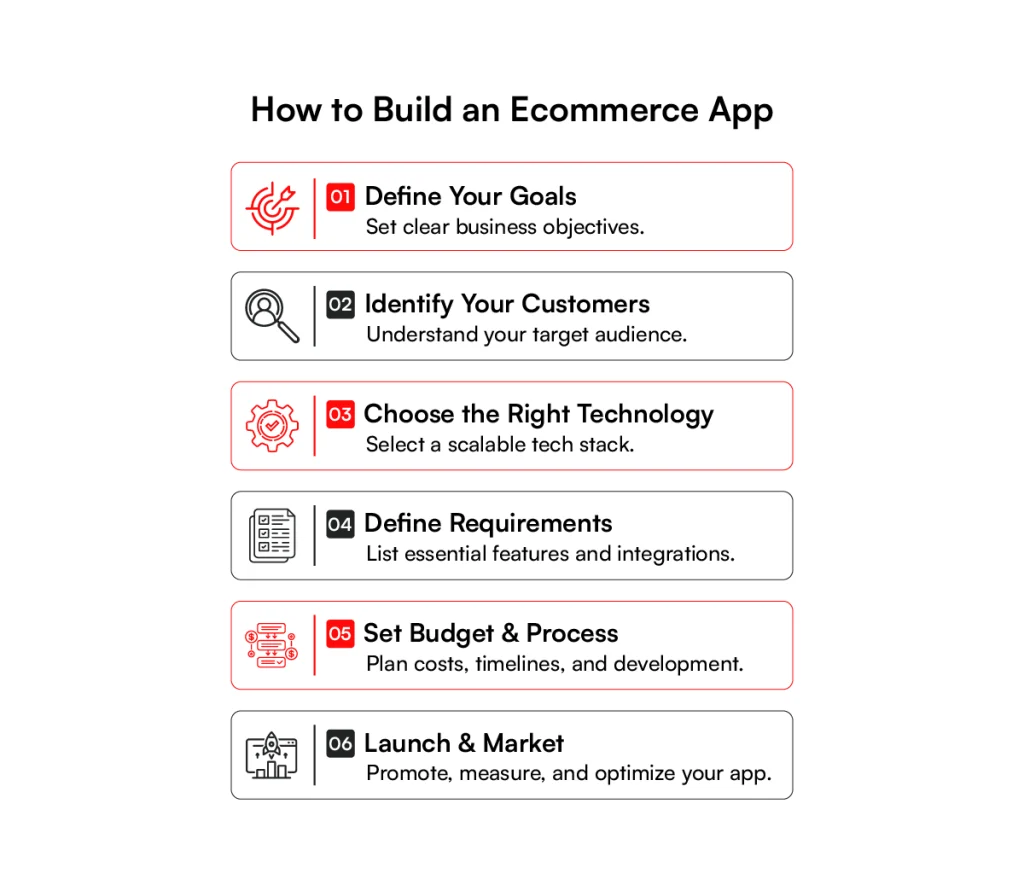
Step 1. Define Your Ecommerce App Goals
Start by deciding what you want the app to accomplish. Are you trying to increase direct sales, enter a new market, improve customer retention, create a mobile-first shopping experience, or streamline B2B ordering?
Set measurable goals around metrics such as app conversions, order volume, repeat purchases, average order value, or customer retention. These goals will influence your features, technology choices, and development priorities.
Step 2. Identify Your Target Customers
Your app should solve problems for a clearly defined audience. Identify who your customers are, what they purchase, how they currently shop, and where they experience friction.
For example, a B2B buyer may need bulk ordering and quick reordering, while a D2C customer may care more about personalized recommendations, loyalty rewards, and a faster checkout experience.
Use customer research, existing purchase data, surveys, and competitor analysis to create clear user profiles before you begin development.
Step 3. Choose the Right Technology
Select your technology stack based on your app’s requirements rather than simply following current trends. Decide whether you need native iOS and Android development or a cross-platform approach such as Flutter or React Native.
Also plan your backend, database, APIs, cloud infrastructure, payment integrations, analytics, and security requirements. If you expect rapid growth, design the architecture for scalability from the beginning instead of rebuilding it when traffic increases.
Step 4. Create a Detailed Requirements List
Turn your business goals and customer needs into a detailed product requirements document. Define the features, user journeys, integrations, technical requirements, and administrative capabilities your app needs.
Your requirements may cover:
- User registration and account management
- Product catalog and search
- Shopping cart and checkout
- Payment processing
- Order and inventory management
- Reviews and ratings
- Push notifications
- Loyalty and rewards
- Personalization and recommendations
- Admin dashboard
- Third-party integrations
At this stage, separate must-have features for the MVP from advanced features you can introduce in later releases. This helps you control the initial scope without limiting future expansion.
Step 5. Set the Budget and Development Process
Once you know what you’re building, estimate the development cost based on the app’s complexity, number of platforms, integrations, design requirements, technology stack, and development team’s location and expertise.
Choose a development approach that supports continuous testing and improvement. An Agile process can help you develop the app in smaller iterations, collect feedback, identify issues early, and prioritize improvements based on actual user behavior.
Don’t forget to budget for post-launch expenses such as cloud infrastructure, maintenance, security updates, third-party services, monitoring, and feature enhancements.
Step 6. Launch, Market, and Optimize Your App
Launching the app is not the end of development. You need a strategy to attract users and encourage existing customers to move to the mobile channel.
Promote the app through your website, email campaigns, social media, paid advertising, app store optimization, loyalty incentives, and personalized offers.
Once users start interacting with the app, monitor metrics such as downloads, activation, conversion rate, retention, cart abandonment, and repeat purchases. Use these insights to identify friction points and continuously improve the experience.
How RBMSoft Can Help
Building and scaling an ecommerce app requires the right combination of product strategy, mobile development, backend engineering, integrations, and ongoing optimization.
RBMSoft can help businesses turn their ecommerce requirements into scalable mobile applications. From MVP development and custom features, AI-powered personalization, payment integration, ERP/CRM connectivity, and post-launch enhancements.
A scalable ecommerce app should evolve alongside customer expectations and business requirements. Once the development roadmap is clear, it’s equally important to prepare for the hurdles that can affect performance, security, scalability, and user experience along the way.
Custom Ecommerce Mobile App Development Cost in 2026
The cost of custom ecommerce app development depends on one major factor: how complex your app is. A basic shopping app with essential features costs significantly less than an enterprise ecommerce platform with AI, multiple vendors, and third-party integrations.
The table below gives you a realistic cost range for different app types in 2026.
| App Complexity | Estimated Cost | Timeline | What’s Included |
| Basic MVP | $15,000–$30,000 | 2–4 months | Product catalog, search, shopping cart, user login, secure checkout, basic payment gateway, and order tracking. |
| Mid-Level Ecommerce App | $40,000–$120,000 | 4–6 months | User profiles, wishlists, push notifications, multiple payment gateways, loyalty program, analytics dashboard, and real-time order tracking. |
| Advanced / Enterprise App | $120,000–$300,000+ | 6–12+ months | Multi-vendor marketplace, AI-powered recommendations, AR product previews, subscription management, ERP/CRM integrations, advanced analytics, and personalized shopping experiences. |
The most cost-effective approach for many businesses is to launch with an MVP, validate the product in the market, and gradually add advanced features as customer demand and business requirements grow.
The next step is understanding where mobile ecommerce is headed and the trends shaping ecommerce app development in 2026 and beyond.
Plan Your Ecommerce App Budget
Unsure how much your app will cost? Get a tailored estimate based on your features, integrations, and scalability requirements.
Get My Cost EstimateEcommerce Mobile Application Development: Future Trends and Market Insights
Mobile ecommerce is evolving faster than ever. Customers expect shopping apps to be faster, smarter, and more personalized with every interaction. Businesses that adopt emerging technologies early can improve customer engagement, increase conversions, and stay competitive in a crowded retail market.
Here are the biggest ecommerce app development trends shaping 2026 and beyond.
1. AI-Powered Personalized Shopping
Personalization has moved beyond product recommendations. Modern ecommerce apps use AI to understand browsing behavior, purchase history, location, and customer preferences to deliver a tailored shopping experience.
This includes personalized product suggestions, targeted offers, dynamic pricing, customized home screens, and relevant push notifications. The result is a shopping journey that feels more relevant to each customer and encourages repeat purchases.
2. Augmented Reality (AR) Shopping Experiences
AR helps customers visualize products before making a purchase, reducing uncertainty and improving buying confidence.
From virtually trying on clothing and accessories to placing furniture inside a room, AR creates a more interactive shopping experience. For retailers, this can improve customer engagement while reducing product returns caused by unmet expectations.
3. Progressive Web Apps (PWAs)
Progressive Web Apps combine the speed of a website with the experience of a mobile app. They load quickly, work on slower networks, support offline browsing, and don’t require users to download an app from an app store.
PWAs are becoming a popular option for businesses that want to offer a mobile-first shopping experience with lower development and maintenance costs.
4. Voice Commerce
Voice-enabled shopping is making ecommerce more convenient, especially for repeat purchases and product searches.
Customers can search for products, add items to their cart, check order status, and reorder previous purchases using voice commands. As voice assistants become more accurate, voice commerce is expected to become a standard feature in many retail applications.
5. Social Commerce Integration
Social media is becoming a shopping channel, not just a marketing platform. Ecommerce apps are increasingly integrating with social platforms to support product discovery, influencer-driven purchases, live shopping, and seamless checkout experiences.
This shortens the path from discovering a product to completing a purchase while helping brands reach customers where they already spend their time.
Conclusion
A custom ecommerce mobile app development services helps you deliver better shopping experiences, streamline operations, and scale your business as customer demand grows. The right app is built around your business goals, not a one-size-fits-all template.
How RBMSoft Can Help
- Custom B2B, B2C, D2C, and marketplace app development.
- AI-powered personalization and smart search experiences.
- Secure payment, inventory, ERP, and CRM integrations.
- Native and cross-platform iOS and Android development.
- Scalable, enterprise-ready ecommerce applications with ongoing support.
At RBMSoft, we build ecommerce mobile applications that are fast, secure, and designed to grow with your business.
FAQ’s
1. How much will it cost to build an ecommerce mobile app?
The ecommerce mobile app development cost typically ranges from $15,000 for a basic MVP to $300,000+ for an advanced enterprise application. The final cost depends on features, platforms, integrations, UI/UX complexity, technology stack, and development team location.
Your ecommerce mobile app development cost can also increase when you add AI, real-time tracking, advanced analytics, or complex third-party integrations.
2. How do you develop an ecommerce mobile application?
Ecommerce mobile app development starts with defining business goals and customer requirements, followed by technology selection, UX/UI design, development, API and third-party integrations, testing, deployment, and continuous optimization.
A structured approach to mobile app development for ecommerce helps ensure the application supports both customer-facing experiences and backend business operations.
3. Should you choose an in-house team, freelancers, or an ecommerce app development company?
The right choice depends on your budget, internal expertise, project complexity, and long-term support requirements. An in-house team offers greater direct control, freelancers can work well for smaller projects, while an experienced development company can provide end-to-end ecommerce app development solutions across strategy, design, development, integrations, testing, and maintenance.
For complex mobile app development for ecommerce, businesses should also consider scalability, security, and ongoing technical support.
4. How long does it take to create an ecommerce app?
A basic ecommerce MVP can take around 2 to 4 months, while a mid-level application may require 4 to 6 months. Advanced ecommerce platforms with complex integrations, AI capabilities, marketplaces, or enterprise workflows can take 6 to 12 months or longer.
The timeline for mobile app development for ecommerce ultimately depends on the application’s scope, number of platforms, integrations, and customization requirements.
5. What compliances should be followed while creating an ecommerce app in 2026?
Ecommerce apps need to address requirements related to data privacy, payment security, consumer protection, accessibility, taxation, and electronic transactions based on the countries and markets they serve.
During ecommerce mobile application development, businesses should identify applicable regulations early and incorporate appropriate consent management, data protection, payment security, terms and conditions, and user rights into the application.
6. What is ecommerce mobile app development, and why is it important for startups and businesses?
Ecommerce mobile app development involves creating mobile applications that allow customers to discover products, make purchases, manage orders, and interact with a brand through smartphones and tablets.
For startups and established businesses, mobile ecommerce app development can create a direct digital channel, support personalized customer experiences, improve convenience, and provide greater control over the mobile shopping journey.
7. How does Agentic AI help with ecommerce app development?
Agentic AI can support ecommerce app development solutions by enabling systems to perform multi-step tasks with limited human intervention.
Depending on the use case, agents can assist with product discovery, personalized recommendations, customer support, inventory workflows, order management, and other operational processes.
When incorporated thoughtfully, Agentic AI can make mobile app development for ecommerce more adaptive and automate repetitive workflows.
8. What core features should an ecommerce mobile app MVP have?
A strong MVP should focus on the features required to complete the core shopping journey. These typically include user registration, product catalog, search and filters, product details, shopping cart, checkout, payment processing, order management, and basic notifications.
Additional features can be introduced as the application gains users and businesses gather real-world feedback.
For businesses pursuing custom ecommerce app development, starting with a focused MVP can help control the initial ecommerce mobile app development cost while creating a foundation for future ecommerce app development solutions.