

Quick Summary:
- Traditional enterprise search finds documents, not answers. Users waste ~1.8 hrs/day hunting for information across disconnected systems.
- Search evolved from keyword matching to semantic search to LLM powered search, which understands intent and replies in plain language.
- RAG for enterprise search combines retrieval with generation, letting a model answer using current, company-specific information it wasn’t trained on.
- It works in four stages: prep/chunk data, retrieve the best matches (often hybrid search), generate a grounded answer, and refresh as sources change.
- Business value includes current answers without retraining, source attribution for trust, faster rollout than fine-tuning, and easier scaling and compliance.
- In ecommerce, RAG enables natural-language product discovery, in-journey support answers, and intent-based recommendations.
- Enterprise deployments need permission-aware retrieval, data masking, system integration, and the right hosting model.
- It breaks down when retrieval is weak. Noise, poor chunking, embedding drift, conflicting sources, and bad source data all cause hallucinations.
- Measure with retrieval metrics (Recall@K, MRR), generation metrics (faithfulness, accuracy), and end-to-end signals (latency, cost, human review).
- What’s next: multimodal RAG, agentic RAG that takes action, unified enterprise retrieval, and citation-driven visibility.
Traditional search systems were built to find documents. Modern users want something different. They want search tools that understand questions and provide direct answers without forcing them to sift through multiple results.
LLM powered search has moved the industry closer to that goal. Yet large language models have limits when they need access to current information, internal business content, or specialized domain knowledge.
RAG for enterprise search fills this gap. By combining retrieval technology with AI-generated responses, a RAG search LLM can answer questions using information retrieved at the time of the request.
This approach has made LLM-search RAG a growing standard for enterprise search applications, digital assistants, and knowledge management systems. The next step is understanding how this process works behind the scenes.
Why Traditional Enterprise Search Fails Users
A search system can return thousands of results and still fail the user. With so much content available, the real challenge is surfacing the specific information someone needs at the moment they need it.
1. Exact-Match Search Misses Reworded Content
A search for “paid time off policy” may not return a document titled “Vacation and Leave of Absence Guidelines.”
HR teams, legal departments, and operations groups often describe the same topic differently. Employees search using words they know. Documents use words chosen by whoever wrote them.
When those terms do not match, relevant information stays buried. This happens even when the answer already exists inside the organization.
2. Slow Searches Cost Hours of Productive Time
Research from McKinsey found that employees spend an average of 1.8 hours per day searching for information. That adds up to 9.3 hours every week.
The impact shows up in delayed approvals, repeated questions, and duplicated work. Teams spend meeting time tracking down information that should have been simple to find.
Your team loses 9.3 hrs/week to search. Let’s fix that.
Book A Discovery Call
3. Siloed Systems Turn Ambiguous Queries Into Wrong Results
In most organizations, this information is scattered. Customer records sit in a CRM, support history in a ticketing system, contracts in a document folder, and financial data in yet another tool. Search “renewal policy” across all of them and the results diverge depending on where the answer happens to live.
A sales manager asking that question wants subscription renewal terms, while a procurement buyer wants vendor contract rules, and traditional search has no way to tell those two intents apart. So the same query serves up everyone’s results at once, leaving each person to sort out which ones actually apply to them.
4. Results Leave Users Without the Answer
Finding a document and finding an answer are two different tasks.
A search engine may return a fifty-page policy manual, a support article, and an internal wiki page. Someone still has to read all three, compare them, and decide which one is correct.
Keyword search still returned matching documents. The trouble was that returning documents and answering questions had quietly become two separate jobs.
That gap pushed search in a new direction. The next step focused less on matching words and more on understanding what users actually meant.
How Enterprise Search Grew From Keywords to RAG
Search technology changed because each generation exposed a different weakness. Finding documents was the first challenge. Understanding intent came next. Producing useful answers became the step after that.
Era 1: Keyword Search Required Exact Term Matches
Early keyword systems matched the words in a query against an index, then ranked whatever came back by fixed rules, often the number of times a term appeared on a page.
None of this involved understanding. The engine counted and compared strings, so a page that repeated a keyword a dozen times could beat a clearer document that mentioned it once.
Frequency-based ranking held up while document libraries stayed small. Scale broke it. As content volumes climbed, counting words pushed too many irrelevant pages to the top, and the method needed rethinking.
Era 2: Semantic Search Connected Related Concepts
Semantic search reduced the need for exact wording. Queries and documents could now be compared based on meaning rather than identical terms. A search for “running shoes for long distance training” could surface content about marathon footwear or endurance racing. The wording changed, but the subject stayed the same.
Finding relevant content became easier. But users still had to open documents, review sources, and build their own answers from the information they found.
Era 3: LLM Powered Search Turned Questions Into Conversations
Search queries started looking less like keywords and more like complete questions. Instead of typing “refund policy international orders,” a customer could ask, “Can I get a refund on an order shipped outside the country?”
A modern LLM powered search engine understands intent across differently worded queries and responds in plain language. The system no longer focused only on finding documents. It could present information in a form that was easier to read and act on.
How RAG Emerged and What Makes It Different
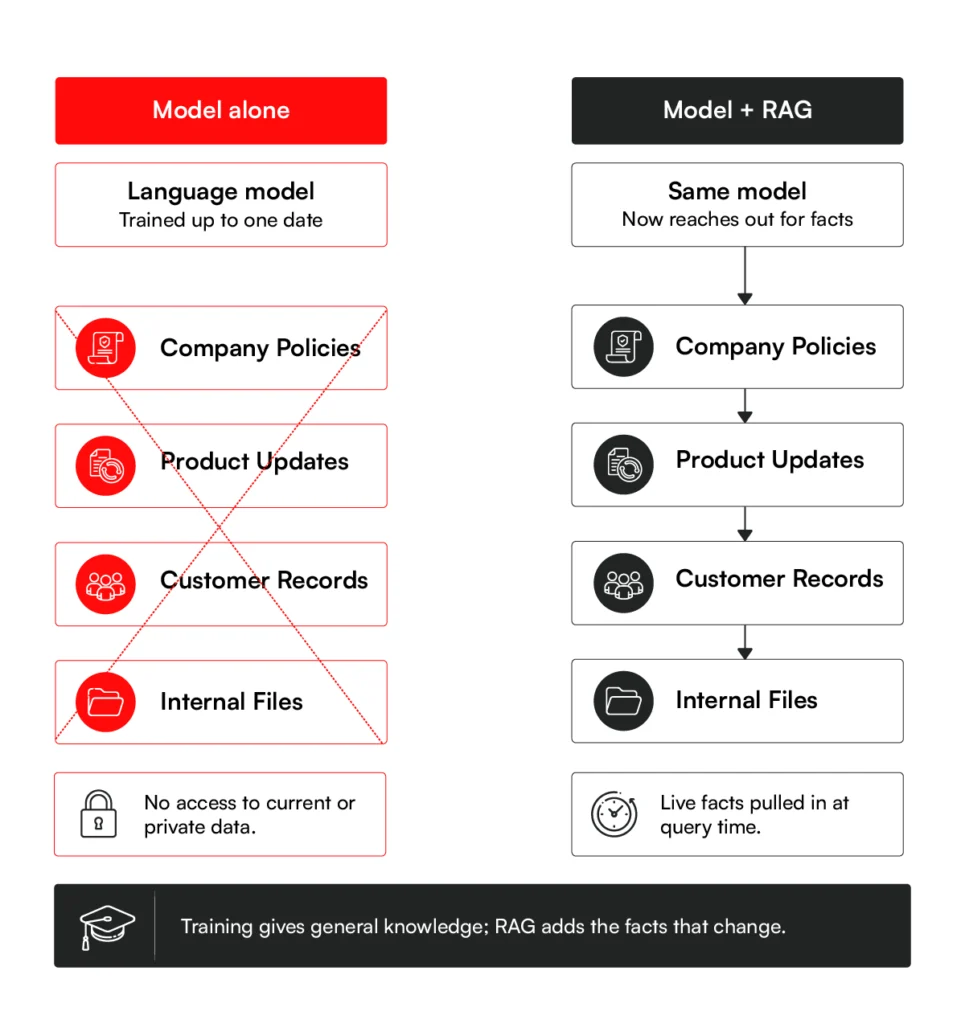
Search and language models each improved on their own, but a gap sat between them. An LLM answering from memory will fill any blank past its training data with a confident, fabricated answer.
RAG closes that gap by retrieving real source material and passing it to the model as context, so responses stay grounded in actual company documents.
1. Retrieval at Query Time
Retrieval-Augmented Generation (RAG) fills that gap by combining retrieval and generation in a single workflow. RAG for enterprise search works by pulling relevant information from knowledge bases, support content, product catalogs, document folders, and business tools first
Because retrieval happens during the query itself, a RAG search LLM can work with information that did not exist when the model was originally trained. Because retrieval happens at query time, a RAG system can answer using information that did not exist when the model was trained.
2. RAG’s Research Origins
In 2020, Meta researchers published a paper titled Retrieval-Augmented Generation for Knowledge-Intensive NLP Tasks. The work focused on a recurring problem in language models. Producing fluent text and producing factually correct answers are not the same task.
Holding all of that inside the model would have meant constant retraining, since product catalogs, customer records, business policies, and operational data change all the time.
Retrieval offered a different path: rather than treating the model as the only source of knowledge, the system pulls in relevant information when needed and uses it as context for the response.
3. The Training-Data Gap
Language models are trained on large collections of data, but that training does not include new information created after it is complete.
Company policies, support content, product catalogs, and operational records change often. RAG provides access to those sources at the time of a query rather than relying only on what the model already knows.
Think of it like a trader who understands markets well but still needs live price data before placing a trade. Training gives a language model general knowledge and reasoning ability.
RAG gives it access to current company documents, product information, and other sources that keep changing long after training ends.
4. RAG vs. Other Approaches
Retrieval is one way to improve response quality. It is not the only option. These four approaches each serve a different purpose.
| Approach | Primary Purpose | Best Used When |
| Pretraining | Build general language capabilities | Creating a foundation model |
| Prompt Engineering | Improve outputs through instructions | Required knowledge already exists inside the model |
| Fine-Tuning | Adapt behavior to a specific task or format | Consistent specialization is required |
| RAG | Access external information at query time | Information changes frequently or exists outside the model |
5. RAG vs. Semantic Search
Semantic search focuses on finding relevant information. The output is usually a ranked set of documents, records, or passages related to a query. RAG uses retrieval as one stage within a larger process.
Retrieved information is passed to the language model and becomes part of the context used to build a response.
In other words, semantic search stops at retrieval. LLM-search RAG adds a generation step that uses retrieved information to produce a direct answer.
That difference matters in production systems because retrieval is only one part of the full pipeline. The next section walks through that complete process from data preparation all the way through to answer generation.
How RAG Works in Four Stages
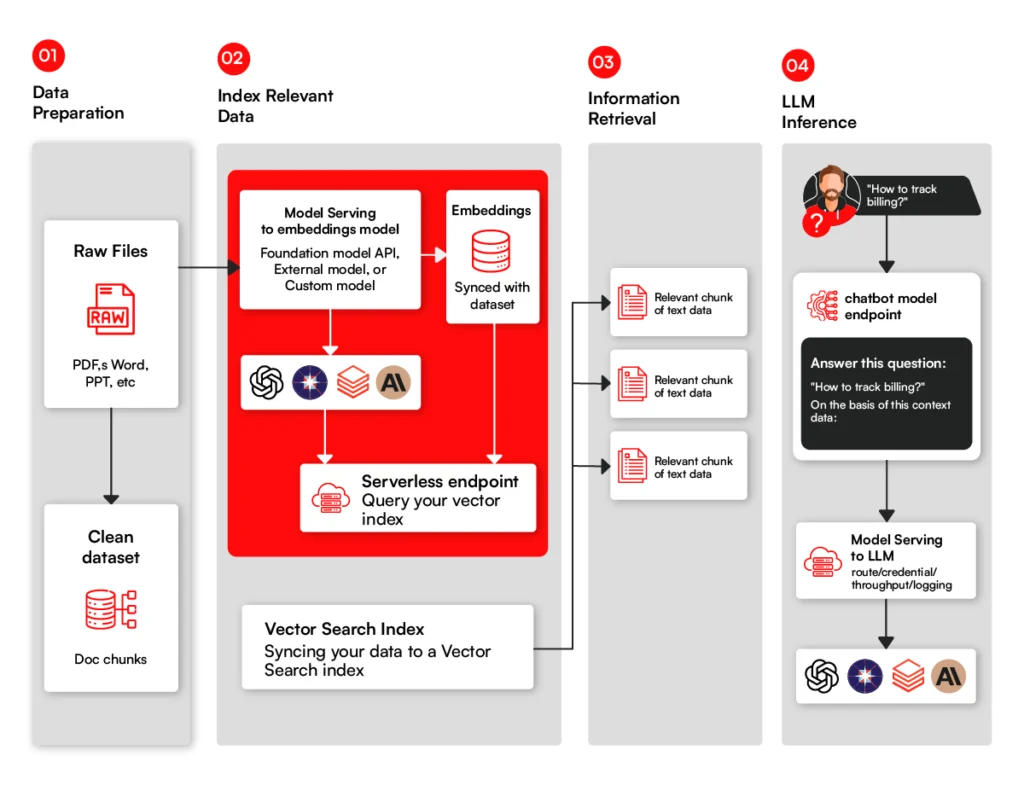
The previous section explained how RAG combines retrieval and language generation. The next step is understanding how information moves through the system. Every response begins with source data, passes through retrieval and ranking, and ends with an answer grounded in retrieved information.
Stage 1: Preparing the Data
Most company information is not ready to search right away. So product catalogs, support articles, contracts, and policies get split into smaller chunks. This helps the system find one exact fact instead of scanning whole files.
Next, each chunk is turned into a string of numbers called an embedding. (An embedding is a way to store meaning as numbers so a computer can compare ideas.) These numbers sit in a vector database, a store built to match them fast.
Extra labels often ride along with each chunk. Things like product IDs, departments, authors, categories, or dates. These labels help the system pull the right chunk. Once everything is sorted and stored, the system can start taking questions.
Stage 2: Retrieving the Matches
When you ask a question, the system turns your words into an embedding too. Then it compares your question against the stored chunks. Many enterprises search for RAG applications, mixing two methods here. They blend meaning-based matching with plain keyword matching, such as BM25.
This blend is called a hybrid search for RAG. In many systems, a web search API for RAG pipelines also runs here to pull in fresh external information.
Together, they catch both the sense of your question and any exact terms. The first pass usually pulls more than the model needs. So re-ranking models score the results and keep only the closest matches before sending them on.
Stage 3: Generating the Answer
The system bundles your question with the chunks it pulled. Then it sends the whole package to the language model. Instead of leaning only on old training data, the model now works with facts picked just for your question.
Companies often add guardrails at this step. Things like source links, set reply formats, and policy checks. These rules keep answers in line with what the business needs.
Stage 4: Updating
Documents, policies, product details, and help content change often. Facts pulled through RAG can show those changes without retraining the model.
As content shifts, teams refresh the indexes, embeddings, and linked data sources. This keeps answers based on the newest facts available.
These stages explain how a RAG system works. Together they form the backbone of any production LLM-search RAG deployment. The next section focuses on the business outcomes that result from faster access to information and more relevant search results.
Benefits of RAG for Enterprise Search
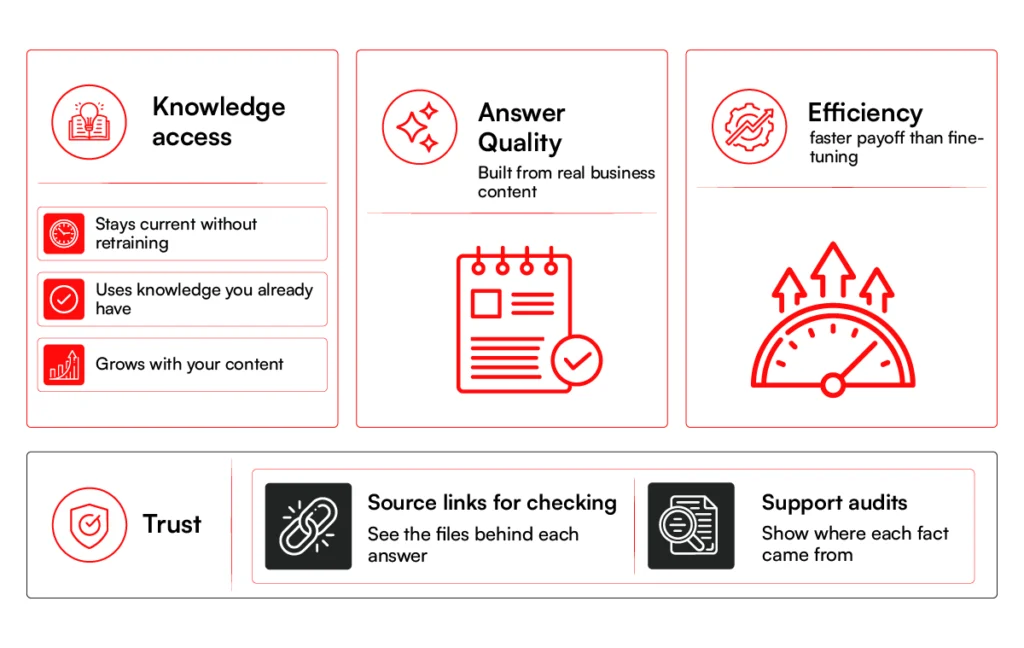
The previous section explained how a RAG pipeline works. For most organizations, the more important question is what RAG for enterprise search delivers in practice. The benefits of LLM-powered search typically appear in knowledge access, answer quality, operational efficiency, and trust.
1. Always-Current Answers, No Retraining
Product teams release new specifications, legal departments revise policies, and support teams publish new documentation throughout the year. In many organizations, information changes far more often than language models do.
RAG allows newly published content to become available through retrieval rather than retraining. As knowledge repositories are updated, the system can use that information in future responses without waiting for a new model version to be trained and deployed.
2. Reuses Existing Knowledge
A support assistant answering technical questions requires different information from a procurement assistant reviewing vendor policies or an HR assistant responding to employee questions.
RAG uses the content organizations already maintain as the foundation for specialized responses. Troubleshooting guides, policy repositories, operating procedures, and internal documentation become part of the knowledge available during retrieval, allowing a single system to support multiple business functions.
3. Verifiable, Source-Linked Answers
Questions involving compliance requirements, contract terms, product specifications, or internal policies often require more than a direct answer. Teams may need to review the documents that support a recommendation, decision, or response.
RAG systems can connect generated responses to the records, articles, contracts, and knowledge sources used during retrieval. This makes it easier to validate information, resolve disagreements, and understand how an answer was produced.
4. Faster to Deploy Than Fine-Tuning
Product documentation, support articles, operating procedures, and policy libraries already exist inside most organizations. In many cases, the knowledge needed for a project is available long before the AI system is implemented.
Connecting those sources to a retrieval layer is often a shorter path than collecting training data, running fine-tuning cycles, validating model behavior, and deploying specialized models. For organizations looking to improve search and knowledge access, this can reduce implementation time.
5. Grounded in Your Own Data
A customer asking about warranty coverage expects information based on the company’s current policies. An employee searching for reimbursement rules expects information based on internal procedures rather than general guidance found elsewhere.
RAG allows responses to be generated from retrieved business content, including support documentation, product catalogs, operational records, and internal knowledge repositories. This helps align answers with the information the organization actually uses to run its business.
6. Scales as Content Grows
Adding a new policy document, support article, or product guide to a repository follows a very different process from retraining and redeploying a language model. As content collections grow, organizations can continue expanding the information available to the system without repeatedly rebuilding the underlying model.
This approach allows an LLM-powered enterprise search platform to support growing volumes of information while keeping ongoing knowledge management costs more predictable.
7. Audit and Compliance Ready
Financial institutions, healthcare providers, insurers, and other regulated organizations are often required to demonstrate where information originated and which records support a decision.
By linking responses back to source documents used during retrieval, RAG provides a clearer record of how information was generated. Access to supporting materials can simplify audits, strengthen internal review processes, and increase confidence in the answers being presented.
These benefits extend beyond internal knowledge systems. The same approach is also used in customer support, product discovery, and digital commerce. The next section examines those applications in more detail.
Ready to turn your data into direct answers?
Talk to our RAG teamHow RAG Changes Ecommerce Search and Product Discovery
Product catalogs are built around categories, attributes, and product data. Product catalogs are built around categories, attributes, and product data, but customers rarely search that way.
They describe needs, compare options, ask questions, and combine multiple requirements into a single query. This gap between how products are organized and how customers search is one reason RAG for ecommerce product search is gaining attention across the industry.
1. Natural-Language Product Discovery
Someone searching for “a quiet blender that won’t wake the baby during early mornings” is describing how they’ll use the product, not naming a catalog category.
Keyword search tries to match the individual words, so it tends to surface anything tagged “quiet” or “blender.” RAG can read the full request, retrieve the relevant product details, and return options that actually fit the use case behind the query.
This approach reduces the need for customers to guess the exact terminology used within a product catalog and helps them discover relevant products more quickly. As search experiences become more conversational, product discovery increasingly depends on understanding customer intent rather than matching exact keywords.
Must Read: Generative AI in the Retail Industry: Everything You Need to Know
2. Support Answers While Shopping
Questions about returns, warranties, shipping policies, compatibility, and product features often interrupt the buying process. Customers leave search results, open support articles, or contact service teams to find answers.
RAG allows product documentation, policy content, FAQs, and support resources to become part of the search experience. Customers can receive answers while browsing products, reducing the need to switch between multiple channels before making a purchase decision.
3. Context-Aware Recommendations
Two customers searching for the same product category may have very different requirements. One may be purchasing equipment for daily professional use, while another may only need it occasionally for personal projects.
When purchase history, browsing behavior, or customer preferences are available, that information can be used alongside retrieved product information to improve product recommendations.
4. Complex Queries in One Search
A customer may be looking for a waterproof hiking jacket under a specific budget, available in a particular color, and suitable for winter conditions. Traditional search systems often force shoppers to apply multiple filters or perform several searches before arriving at a useful result.
RAG can work across multiple requirements simultaneously, helping customers narrow options without repeatedly refining their search.
5. Searchable Product Details
Specifications, compatibility details, materials, dimensions, and usage guidance are often buried inside product descriptions, manuals, and supporting documentation rather than stored as dedicated catalog fields.
RAG can retrieve and compare information from those sources, making it easier for customers to evaluate products based on characteristics that may not exist as structured attributes within the catalog.
6. Filling Catalog Gaps
One product may contain detailed specifications, while a nearly identical product includes only a short description and a handful of attributes. Large catalogs frequently contain these inconsistencies, especially when information comes from multiple suppliers or content sources.
RAG systems can use related manuals, technical documentation, category content, and supporting materials to provide additional information when catalog records are incomplete.
7. Intent-Driven Search
A search for “gifts for a remote worker” and a search for “ergonomic equipment for daily office use” may lead to similar products, yet they represent different shopping goals.
RAG enables search experiences that respond to intent rather than relying exclusively on fixed categories, keyword rules, or predefined merchandising logic. Product rankings can be influenced by what customers are trying to accomplish instead of where products happen to sit within a catalog hierarchy.
8. Lighter Support Load
Returns policies, shipping timelines, compatibility checks, warranty details, and product availability generate a significant share of customer service requests. Much of that information already exists in product documentation, support articles, and knowledge bases.
When customers can receive accurate answers during search and product discovery, fewer routine questions reach support teams. When customers can receive answers during search and product discovery, fewer routine questions may need to be handled by support teams.
9. Adoption Across Commerce Platforms
Retailers and commerce platforms are increasingly introducing conversational shopping assistants, AI-powered recommendations, and context-aware search experiences that allow customers to describe what they need in natural language.
Many commerce platforms are introducing conversational search, product assistants, and natural-language product discovery tools that allow customers to describe what they need instead of relying on keyword searches.
Applying the same approach inside large organizations introduces additional challenges. Information is often distributed across business systems, document repositories, customer records, and operational platforms. The next section examines those challenges in more detail.
What Makes Enterprise RAG Hard to Deploy
A product demo can retrieve documents, answer questions, and generate convincing responses from a limited dataset. Production environments built for enterprise search for RAG applications are different.
Customer information, contracts, invoices, support records, and operational data are spread across multiple systems, each with its own permissions, formats, and governance requirements.
1. Structured vs. Unstructured Data
A customer support article, a PDF contract, and a CRM record may all contain information relevant to the same question. One exists as free-form text, another as a document, and the third as structured data stored in fields and tables.
Enterprise systems rarely treat these sources the same way. Documents, emails, and knowledge-base articles require one retrieval approach, while CRM, ERP, billing, and operational systems often require another. Effective enterprise RAG systems must work across both.
2. Knowledge Trapped in Silos
Customer profiles may exist in a CRM. Orders may live in an ERP platform. Billing records may sit in a finance system, while support history remains inside a ticketing platform.
A question that appears simple to the user often depends on information spread across several repositories. Retrieving a complete answer requires access to systems that were never designed to work together. A broader AI integration architecture can provide those connections, allowing RAG applications to access business data through existing APIs, data pipelines, or custom integration layers.
3. Unified Entity Views
A customer service representative investigating an account may need access to purchases, invoices, support tickets, subscriptions, contracts, and recent interactions.
Enterprise RAG systems increasingly rely on unified entity views that bring related records together before retrieval takes place. Instead of searching each source independently, the retrieval layer can work with a consolidated view of the customer, supplier, employee, or account involved in the query.
4. Permission-Aware Retrieval
Two employees can ask the same question and still require different answers because their access rights are not the same.
If a user is not authorized to view a financial report, customer record, contract, or personnel document, that information should never appear in retrieval results.
Security controls such as document-level permissions, identity management, and data masking are often critical requirements for enterprise search security systems. Permission controls therefore need to operate inside the retrieval layer rather than after information has already been retrieved.
5. Masking Sensitive Data
Customer records, employee information, payment details, healthcare data, and personally identifiable information often sit inside the same systems that support retrieval.
Production deployments commonly apply masking, redaction, and field-level controls before information is passed to the language model. This helps reduce the risk of exposing sensitive data while allowing access to information users are authorized to view
6. Deployment and Compliance Models
A startup operating an online store and a healthcare provider managing regulated records rarely face the same infrastructure requirements.
Some organizations prefer fully managed cloud deployments. Others use hybrid architectures that keep certain systems on-premise. Highly regulated environments may require retrieval systems, models, and data to remain entirely within private infrastructure.
7. Identity and Access Integration
Employees already receive access permissions through corporate identity platforms. Those permissions determine which systems, records, and documents they are allowed to access.
Enterprise RAG deployments often integrate with existing identity and access management systems so that retrieval permissions remain aligned with existing security policies and access controls.
A prototype demonstrates that retrieval and generation can work together. Production deployments introduce additional requirements around security, permissions, data integration, and system performance.
Each requirement adds engineering and infrastructure work, which is why the cost of enterprise search software development can rise considerably when RAG is part of the system. The next section examines the limitations and challenges organizations encounter as RAG systems scale.
Enterprise RAG is hard to get right. We make it simple.
Talk to RBMSoftWhere RAG Breaks Down in Production
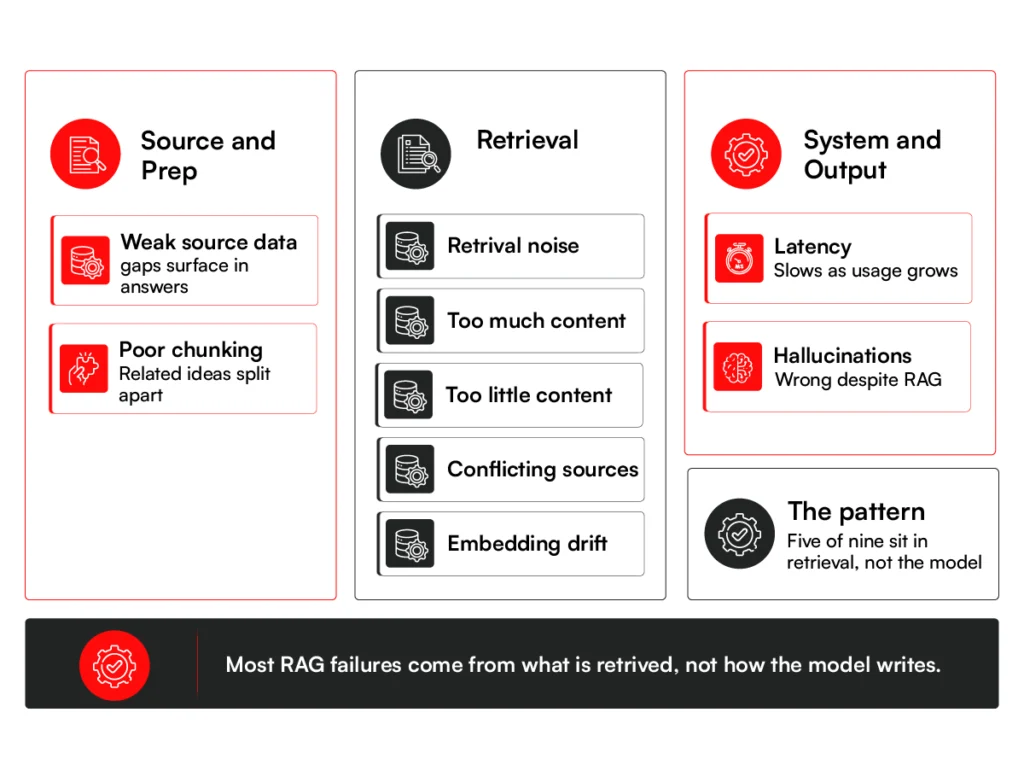
A working RAG system can still produce poor answers. Across most enterprise search for RAG applications, the problem is not the language model itself but the information retrieved before the answer is generated.
1. Retrieval Metrics
A user searching for software licensing terms may receive passages discussing implementation services, pricing models, and support agreements alongside the actual licensing policy.
Once unrelated content enters the retrieval context, the language model may blend useful and irrelevant information into a response that appears credible while drifting away from the original question.
2. Poor Chunking
A policy exception placed in one chunk and the rule it modifies placed in another can create problems before retrieval even begins.
When documents are split at arbitrary points, important relationships between ideas are lost. Content that should be retrieved together becomes disconnected, making it harder for the system to return the information needed to answer a question accurately.
3. Embedding Drift
Organizations regularly upgrade embedding models in search of better performance. Problems emerge when existing content remains indexed using one model while new queries are processed using another.
The system continues operating normally, yet retrieval quality gradually declines because documents and queries no longer occupy the same vector space. Relevant content may rank lower than expected or disappear from retrieval results altogether.
4. Too Much Context
A query that returns dozens of passages may provide more information than the language model can use effectively.
As additional content competes for attention inside the context window, responses often become broader, less focused, and more generic. The system technically retrieves more information, yet answer quality can decline.
5. Too Little Context
A retrieval layer that returns only one or two passages may not provide enough information to answer a complex question.
When supporting evidence is missing, the language model has fewer retrieved facts available and may rely more heavily on generalized training knowledge. The response can appear complete even when important information never reached the model.
6. Conflicting Sources
Many organizations store multiple versions of the same information across different systems. A newer policy may exist in one repository while an outdated version remains available elsewhere.
When contradictory content is retrieved together, the language model may merge details from both sources into a single response instead of recognizing the conflict and surfacing it to the user.
7. Latency at Scale
Every query passes through retrieval, ranking, prompt construction, and answer generation. Each stage adds processing time.
A system that performs well during testing may behave very differently when thousands of users submit requests simultaneously. Delays in one stage can cascade into the next, producing slow responses, timeout issues, and degraded user experience.
8. Residual Hallucinations
Retrieval improves grounding, but incorrect answers can still appear when retrieved content is incomplete, irrelevant, outdated, or contradictory.
The language model generates responses from the information it receives. If the retrieval layer supplies weak evidence, the final answer can remain factually incorrect even though a RAG architecture is in place.
9. Weak Source Data
Outdated support articles, incomplete product records, duplicate documents, and inconsistent knowledge repositories create problems that retrieval alone cannot solve.
The retrieval layer works with the information available to it. When source data contains gaps or inaccuracies, those weaknesses often surface in the final response regardless of how sophisticated the rest of the pipeline may be.
Identifying problems is only part of the process. Organizations also need a way to measure retrieval quality and answer quality. The next section examines the metrics commonly used to evaluate RAG systems.
How to Measure Whether a RAG System Is Working
The previous section examined how RAG systems fail. Determining whether a system is working requires more than checking whether an answer sounds convincing. Evaluation spans retrieval quality, answer quality, system performance, and ongoing operational health.
1. Retrieval Metrics
A customer asking about a warranty policy will never receive a correct answer if the relevant policy document fails to appear in retrieval results.
Before answer quality can be evaluated, retrieval quality must be measured, especially in systems that rely on hybrid search for RAG to combine keyword and meaning-based matching.
Recall@K measures whether the correct document or content chunk appears within the top retrieval results. MRR (Mean Reciprocal Rank) measures how highly relevant content is ranked, while Precision@K evaluates how much of the retrieved content is actually useful to the query.
Teams may also monitor embedding drift after model upgrades to verify that retrieval performance remains stable.
2. Generation Metrics
Retrieval may return the right information and still produce a poor answer if the generated response does not use that information correctly.
Faithfulness measures whether the answer stays within the boundaries of retrieved content. Answer accuracy evaluates whether the response is complete, correct, and relevant to the user’s request.
Coherence focuses on readability, logical flow, and internal consistency, helping identify responses that contain accurate information but present it poorly.
3. End-to-End Metrics
A retrieval layer may perform well in isolation while the overall experience remains disappointing because of latency, grounding issues, or answer quality problems.
End-to-end success rate combines retrieval performance, grounding quality, answer accuracy, and hallucination checks into a broader measure of system effectiveness. Teams also monitor latency to ensure responses remain fast enough for practical use.
Response-time targets vary based on the application, user expectations, and infrastructure. Another common metric is token cost per query, which often increases when retrieval noise, excessive context, or inefficient prompts introduce unnecessary tokens into the workflow.
4. Human Evaluation
Golden question sets, difficult test queries, and real user interactions frequently expose issues that automated metrics fail to capture.
A response may score well across technical measurements while still confusing users, omitting important details, or handling edge cases poorly. Reviewing answers against known questions and real-world scenarios helps teams identify weaknesses before they affect larger groups of users.
5. Ongoing Monitoring
Retrieval quality can change as content repositories grow, indexes are updated, data sources are added, and embedding models evolve.
Organizations track retrieval failure rates, embedding drift, index health, and operational alerts to identify issues before they become visible to users. Monitoring also helps detect problems such as index corruption, missing content, and unexpected retrieval behavior that can gradually reduce system performance over time.
A RAG system that performs well today may not perform the same way six months later. Tracking these metrics helps teams maintain retrieval quality and answer quality as content, models, and user behavior change over time.
Measurement helps organizations improve existing systems. The next section examines emerging developments in RAG and LLM-powered search.
Where RAG and LLM-Powered Search Are Going Next
RAG systems retrieve information and generate answers. New approaches are expanding retrieval beyond documents and text, introducing multimodal search, task execution, and broader access to organizational knowledge.
1. Multimodal RAG
A field technician troubleshooting equipment may need information from maintenance manuals, photographs, inspection videos, and service records at the same time. A customer shopping online may upload an image and ask for similar products instead of typing a search query.
Multimodal RAG aims to retrieve and process information across text, images, audio, video, and other content formats within a single workflow. Instead of relying exclusively on documents, future retrieval systems will increasingly work with whatever information source best fits the question.
2. Agentic RAG
A support assistant may identify that a customer qualifies for a refund, while a procurement assistant may determine that a purchase request meets company policy. In most systems today, the next step still requires a human to take action.
Agentic RAG combines retrieval with task execution. Rather than stopping at an answer when appropriate permissions and controls are in place, or performing other approved actions based on the information it retrieves.
3. Joint Retrieval-Generation Training
A retrieval system can return the right information while the language model still fails to use it effectively. The reverse can also happen, where a capable model receives weak retrieval results and produces a poor answer.
Researchers are increasingly investigating approaches that train retrieval and generation components together. The objective is to improve coordination between the two so that gains in one area contribute directly to gains in the other.
4. A Unified Retrieval Layer
Customer records, invoices, contracts, support tickets, and operational data often exist in separate systems that rarely work together as a single source of knowledge.
One direction being explored is a shared retrieval layer spanning the entire organization. Instead of searching across disconnected repositories, employees could access information through a unified layer that connects systems, departments, and business functions.
5. Citations Over Rankings
A growing number of users receive information from AI-generated responses without visiting a traditional list of search results. In those situations, the source selected by the retrieval system becomes highly influential.
This shift increases the importance of being retrieved and cited within AI-generated responses, where visibility depends not only on ranking well in search engines but also on being retrieved and referenced by AI systems generating answers.
6. The Shift to Direct Answers
Many users now expect a direct response instead of reviewing multiple pages of search results before finding what they need.
Many organizations are monitoring how AI-generated answers affect search behavior, content discovery, and traffic patterns. As that shift continues, content strategies may increasingly focus on answer generation and retrieval visibility rather than clicks alone.
7. Search Embedded Everywhere
Search capabilities are increasingly appearing inside operating systems, productivity software, business applications, voice assistants, and messaging platforms.
As retrieval becomes embedded into everyday tools, users may spend less time opening dedicated search engines and more time accessing information directly from the applications they already use throughout the day.
8. AI as the Default Entry Point
Information requests are no longer handled exclusively by traditional search engines, and an LLM powered search engine increasingly sits at the center of how answers are delivered.
AI assistants, conversational interfaces, and retrieval-powered applications are becoming part of how people find answers.
Information requests are increasingly being handled through AI assistants, conversational interfaces, and retrieval-powered applications in addition to traditional search engines. The future of search with LLMs may be defined less by where people search and more by how quickly relevant information can be retrieved and delivered.
Many of these developments remain early-stage, but they point toward a common theme: retrieval is becoming a central layer between users and information. The next section looks at how RBM Software approaches the design, deployment, and management of RAG solutions.
How RBM Software Builds RAG Solutions
RAG projects often succeed or fail based on factors outside the language model itself. Data quality, system integration, access controls, deployment requirements, and governance decisions usually have a greater impact on long-term performance than model selection alone.
These considerations shape how RBMSoft approaches RAG implementation and delivers some of the best RAG solutions for search technology.
1. A Structured Discovery Process
An enterprise search initiative, a customer-support assistant, and a document-retrieval platform rarely share the same requirements. The users, data sources, security constraints, and success metrics can differ significantly from one project to another.
RBM Software begins by defining business objectives, understanding available data, identifying user needs, and evaluating technical constraints before architectural decisions are made. This process helps ensure that retrieval design, security controls, integrations, and deployment choices support the goals of the project from the start.
2. Industry-Specific Architecture
A software company building a support assistant faces different challenges from a healthcare provider managing sensitive records or a retailer improving product discovery.
Industry-specific requirements often influence retrieval strategies, governance policies, access controls, compliance obligations, and deployment architecture. Experience across multiple sectors helps ensure that technical decisions reflect operational realities rather than generic implementation patterns.
3. Flexible Deployment Models
A public-facing ecommerce platform and a regulated organization handling sensitive business or customer information rarely require the same infrastructure approach.
Some projects are deployed entirely in the cloud, while others use hybrid architectures that keep selected systems within private environments. In highly regulated settings, organizations may require fully private deployments where models, retrieval systems, and data remain under direct organizational control.
RBM Software Builds Security Controls from the Start
Customer records, contracts, operational data, employee information, and internal documentation often become part of the retrieval environment.
RBMSoft incorporates permission-aware retrieval, access controls, sensitive-data protection, and governance requirements as part of the architecture process rather than treating them as post-deployment additions. This approach helps ensure that users can access the information they need without exposing data they are not authorized to view.
Conclusion
Every RAG project starts with a business problem rather than a model selection decision. Whether the goal is enterprise search, customer support, product discovery, or knowledge management, success depends on the quality of the data, retrieval strategy, and operational design behind the system.
As an experienced AI development company, RBMSoft helps organizations design and deploy RAG solutions that align with security requirements, business objectives, and existing technology environments.
If you are evaluating RAG for enterprise search or exploring LLM-powered search, contact RBMSoft to discuss your requirements.
FAQs
1. How to use RAG for better search?
If you want to know how to use RAG for better search, start by connecting a language model to your own knowledge sources—documents, product catalogs, support content, and business records—so answers come from retrieved information rather than training data alone.
To use RAG for better search effectively, follow the core steps: prepare and chunk your content, store it as embeddings in a vector database, retrieve the most relevant chunks at query time, and pass them to the model to produce a grounded response.
The biggest gains in how to use RAG for better search come from improving retrieval quality first—clean source data, sensible chunking, hybrid retrieval, and re-ranking usually matter more than the model itself.
2. How to optimize content for LLM powered search
Learning how to optimize content for LLM powered search means structuring information so it can be retrieved and cited accurately.
To optimize content for LLM powered search, use clear headings, answer questions directly near the top of each section, and keep related facts together so chunking does not separate a rule from its exception.
Maintaining a single up-to-date version of each document is another key part of how to optimize content for LLM powered search, since conflicting sources confuse retrieval. Consistent terminology, descriptive titles, and well-labeled metadata all help LLM powered search surface the right passage for a given query.
3. What is the best search API for RAG pipelines?
There is no single answer to what is the best search API for RAG pipelines—the best search API for RAG pipelines depends on your data, latency targets, and whether you need external web results.
Many production systems decide what is the best search API for RAG pipelines by combining a vector search layer for meaning-based matching with keyword search such as BM25, then adding a web search API for RAG pipelines when queries require current information from outside the organization.
The strongest setups pair hybrid retrieval with a re-ranking step, then evaluate which search API for RAG pipelines performs best against your own metrics for recall, precision, latency, and cost.
4. How much does it cost to implement RAG LLM search?
How much it costs to implement RAG LLM search varies widely based on data volume, the number of systems being integrated, security and compliance requirements, and expected query traffic.
When estimating how much it costs to implement RAG LLM search, account for recurring costs such as embedding and generation token usage, vector database hosting, and ongoing maintenance like re-indexing and monitoring.
Because RAG reuses content an organization already maintains, the cost to implement RAG LLM search is often lower than collecting training data and running fine-tuning cycles. The most reliable way to estimate how much it costs to implement RAG LLM search is to scope a specific use case and measure token cost per query against expected volume.
5. How long does it take to implement RAG LLM search?
How long it takes to implement RAG LLM search depends on data readiness and integration complexity more than on the model.
A focused prototype using a single, clean data source can show how long it takes to implement RAG LLM search at a small scale and come together quickly, while a production deployment that spans multiple systems, enforces access permissions, and meets compliance requirements takes longer.
In many organizations the knowledge needed already exists, which shortens how long it takes to implement RAG LLM search, since connecting existing sources to a retrieval layer is usually faster than building and validating a fine-tuned model.
6. Difference between Vector Search Alone vs LLM-Augmented Search?
The difference between vector search alone vs LLM-augmented search is what happens after retrieval. With vector search alone vs LLM-augmented search, the first returns a ranked set of relevant documents or passages and stops there, leaving the user to read sources and assemble an answer.
When you compare vector search alone vs LLM-augmented search, the second uses retrieval as one stage, then passes the results to a language model that generates a direct, readable answer grounded in the retrieved content.
Put simply, the difference between vector search alone vs LLM-augmented search is this: vector search locates information, while LLM-augmented search explains it.