


Table of Contents
Key Highlights:
- Enterprise search development cost ranges from $50,000 to $700,000+.
- AI-powered search platforms require higher infrastructure and LLM investment.
- Search type, integrations, security, and scalability heavily affect project cost.
- Hidden costs often include AI infrastructure, vector databases, and optimization.
- MVP development helps reduce upfront enterprise search investment.
- Semantic search, RAG, and AI copilots are driving modern enterprise search.
- Custom enterprise search offers better scalability and workflow flexibility.
- Development location and AI expertise significantly impact pricing.
A sales record may be in the CRM, a contract in SharePoint, and the latest project update buried in Slack. For employees, finding one answer can mean searching several systems and still wondering if they have the most recent information.
That gets harder when AI search enters the picture. The system may need to search by meaning, retrieve information for RAG, respect existing user permissions, and connect with several business applications. Each requirement adds development and infrastructure work.
That helps explain why a basic internal search platform may cost around $50,000, while a large AI-powered implementation can exceed $700,000.
So, enterprise search development cost depends heavily on what the business expects the system to handle. The cost of enterprise search software development changes with search requirements, integrations, data volume, security, AI capabilities, and deployment setup.
This guide breaks down those cost areas to help you build a more realistic budget for your project.
What is Enterprise Search Software?
Finding something at work can mean looking in several places. Customer information may be in the CRM. A policy could be sitting in SharePoint, while the latest project discussion happened in Slack.
Enterprise search brings those sources into one search experience, so employees do not have to hunt through each system on their own.
It is not limited to matching the exact words someone types into a search box. Semantic search, for example, can find information based on meaning, even when the wording in the document is different from the search query.
Some enterprise search tools go further by using technologies such as vector databases, machine learning, and Retrieval-Augmented Generation (RAG). Instead of showing only a list of links, they can pull information from company sources and use it to answer the employee’s question.
Build the search foundation AI actually needs.
34% of employees still struggle to find information at work, even as AI assistant adoption grows rapidly.
Explore Enterprise Search Solutions
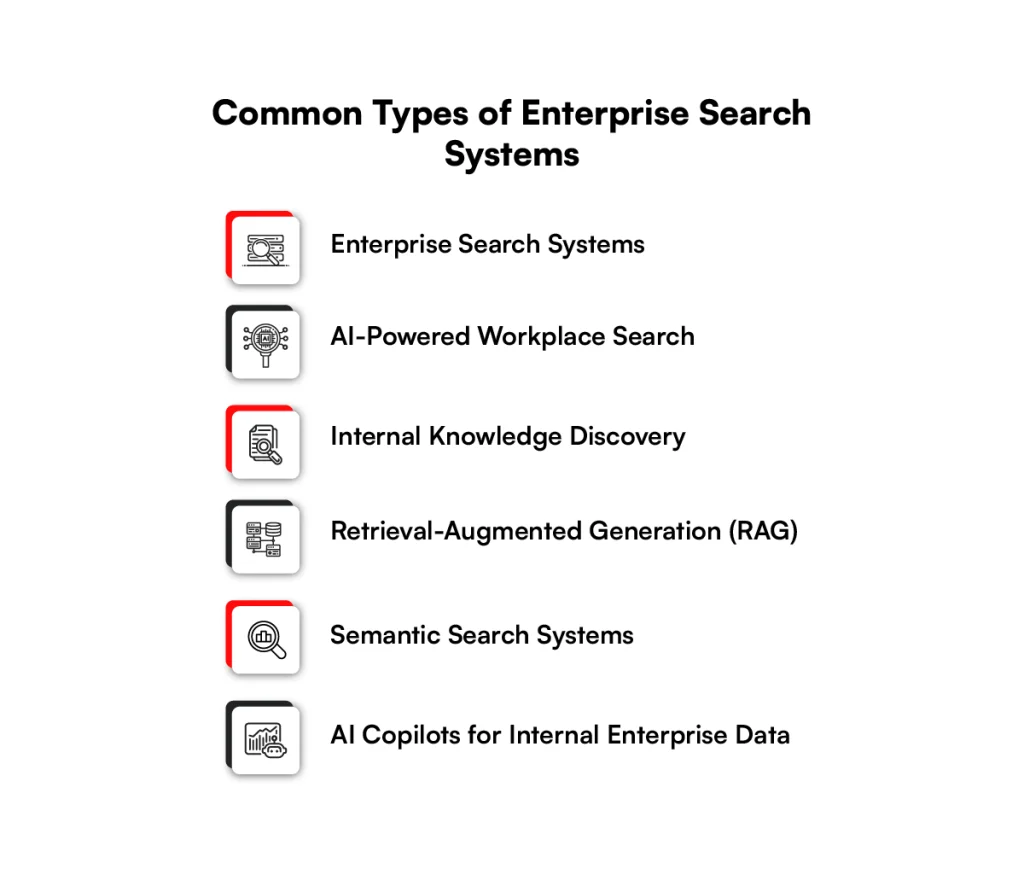
Common Types of Enterprise Search Systems
Some enterprise search platforms focus on basic internal document retrieval, while others are built for AI-powered knowledge discovery, conversational search, compliance workflows, or enterprise-wide automation.
Let’s understand these search models as the enterprise search solutions development cost based on type or industry, can vary significantly depending on infrastructure complexity, AI capabilities, integrations, and scalability requirements.
1. Enterprise Search Systems
Enterprise search systems help index, organize, and retrieve information across multiple internal repositories such as SharePoint, Google Drive, CRMs, ERPs, emails, cloud storage platforms, and document management systems through a unified search experience.
They usually involve lower infrastructure complexity, making them more affordable in terms of overall enterprise search platform development cost.
2. AI-Powered Workplace Search
AI-powered workplace search platforms go beyond document retrieval by understanding user intent, behavior, context, and organizational workflows.
These systems use machine learning, semantic ranking, and natural language processing to deliver more relevant results across enterprise tools.
Modern workplace search solutions are increasingly being integrated into Slack, Microsoft Teams, CRMs, and internal productivity ecosystems to improve operational efficiency and reduce employee search time.
3. Internal Knowledge Discovery
Internal knowledge discovery systems are designed to surface hidden organizational knowledge spread across multiple disconnected platforms.
These systems help employees discover expertise, workflows, project history, compliance documents, research files, and operational insights faster.
Businesses investing in enterprise knowledge discovery often require:
- federated search
- metadata enrichment
- knowledge graphs
- AI-based contextual ranking
- enterprise content intelligence
4. Retrieval-Augmented Generation (RAG)
RAG-based enterprise search systems combine large language models with enterprise retrieval pipelines to generate contextual AI responses grounded in organizational data.
Since these platforms require vector databases, embeddings, LLM orchestration, prompt engineering, and AI guardrails, they significantly increase the average cost of AI enterprise search development.
Instead of simply displaying search results, RAG systems:
- retrieve enterprise documents
- process contextual information
- generate AI-powered answers
- summarize insights
- support conversational enterprise workflows
5. Semantic Search Systems
Semantic enterprise search platforms understand the meaning, relationships, and intent behind search queries rather than relying only on exact keyword matching.
These systems improve contextual relevance, intelligent ranking, synonym understanding, entity recognition, and natural language search experiences.
6. AI Copilots for Internal Enterprise Data
Enterprise AI copilots act as conversational assistants that help employees retrieve information, automate workflows, generate summaries, answer operational questions, and interact with enterprise systems through natural language conversations.
These copilots often integrate with CRMs, ERPs, HRMS platforms, ticketing systems, cloud storage, and enterprise knowledge bases.
Enterprise copilots are among the most advanced and expensive enterprise AI implementations because they require multi-system orchestration, conversational memory, real-time retrieval, enterprise-grade security, AI governance, and workflow automation.
And because of that, they typically represent the highest tier of AI-powered enterprise search development pricing.
Keyword Search vs Semantic AI Search
Earlier enterprise search systems mainly focused on matching exact keywords inside documents and databases. While that worked for basic retrieval, it often failed to understand user intent, context, relationships between information, or natural language queries.
Modern semantic AI search systems work very differently. Instead of simply matching words, they understand meaning, context, behavioral signals, relationships, and conversational intent to deliver more relevant and intelligent answers across enterprise systems.
| Search Type | Traditional Keyword Search | Semantic AI Search |
| Search Logic | Exact keyword matching | Intent and contextual understanding |
| Results | Static document retrieval | Context-aware intelligent answers |
| AI Capabilities | Limited | AI-powered ranking and summarization |
| User Experience | Basic search queries | Conversational AI search |
| Infrastructure Complexity | Lower | High |
| Scalability | Moderate | Enterprise-scale AI architecture |
| Development Cost | Lower upfront investment | Higher AI infrastructure investment |
Related read: Intelligent Search: Use Cases & Real-Life Examples
What Factors Affect Enterprise Search Development Cost?
The cost to create an AI enterprise search solution depends on how much intelligence, automation, scalability, and integration the system is expected to handle.
A platform built mainly for internal file discovery will require far less engineering effort than a system designed to deliver AI-generated answers, contextual enterprise retrieval, conversational search, and real-time knowledge access across multiple business tools.
Things like AI infrastructure, search complexity, enterprise integrations, security requirements, compliance layers, and deployment architecture all directly influence the final cost of enterprise search software development.
Here are the major factors affecting the cost of building enterprise search solutions.
How Does Search Type Affect Enterprise Search Development Cost?
The type of search experience being developed is one of the biggest cost drivers in enterprise search projects. Some platforms are focused on centralized enterprise content retrieval, while others are designed for semantic understanding, conversational AI interactions, enterprise copilots, and AI-powered workflow assistance.
The more intelligent and context-aware the search system becomes, the more infrastructure, AI orchestration, and optimization work it requires behind the scenes.
| Search Type | Estimated Cost Range |
| Basic Internal Enterprise Search | $40,000 – $80,000 |
| Enterprise Knowledge Management Search | $60,000 – $150,000 |
| AI-Powered Enterprise Search Platform | $80,000 – $300,000+ |
| Semantic Search Platform | $100,000 – $350,000+ |
| RAG-Based Enterprise AI Search | $120,000 – $500,000+ |
| Enterprise AI Copilot Platform | $150,000 – $700,000+ |
How Do Features Influence Enterprise Search Development Cost?
Features directly determine how intelligent, scalable, and operationally useful the enterprise search platform becomes after deployment.
Some organizations only require core retrieval capabilities to centralize enterprise content access, while others invest in advanced AI functionality that can understand intent, automate workflows, personalize discovery, and generate conversational responses across enterprise systems.
As feature depth increases, the enterprise application search development cost also rises due to higher backend complexity, AI processing requirements, integration layers, security implementation, and infrastructure scaling.
1. Core Enterprise Search Features
These are the foundational capabilities required to build a functional enterprise search solution that can retrieve, organize, secure, and surface enterprise information across disconnected systems.
| Core Feature | Estimated Cost Range |
| Document Indexing & Crawling | $5,000 – $20,000 |
| Natural Language Search | $8,000 – $30,000 |
| OCR & Document Processing | $5,000 – $20,000 |
| Enterprise Analytics Dashboard | $5,000 – $15,000 |
| Role-Based Access Control | $5,000 – $18,000 |
| Multi-Language Search Support | $5,000 – $18,000 |
| Slack, Jira & CRM Integrations | $10,000 – $50,000 |
A large portion of the enterprise content search development cost at this stage usually comes from:
- enterprise connector development
- indexing pipelines
- metadata normalization
- document processing
- permission-aware access controls
- enterprise data orchestration
An MVP enterprise search platform with core retrieval and indexing capabilities usually ranges between $50,000 – $120,000, depending on integration complexity, enterprise data volume, and deployment architecture.
2. Advanced AI Enterprise Search Features
Modern AI-powered enterprise search platforms are increasingly expected to do far more than retrieve documents. They now support contextual retrieval, conversational interactions, workflow automation, semantic ranking, intelligent summarization, and enterprise-wide knowledge assistance.
These advanced AI layers significantly increase infrastructure complexity and long-term AI operational requirements.
| Advanced Feature | Estimated Cost Range |
| Semantic Search Engine | $15,000 – $50,000 |
| AI Chat Search Assistant | $10,000 – $40,000 |
| Vector Database Integration | $8,000 – $25,000 |
| Enterprise Workflow Automation | $10,000 – $40,000 |
An enterprise-scale AI search platform with semantic search infrastructure, vector retrieval systems, AI assistants, and advanced enterprise orchestration capabilities can range anywhere from $150,000 to $700,000+, depending on scalability requirements, AI complexity, infrastructure size, and enterprise integrations.
How Do AI & LLM Integrations Affect Enterprise Search Development Cost?
AI and large language model integrations are now becoming one of the most expensive layers of modern enterprise search ecosystems.
Unlike basic enterprise site search development, AI-powered enterprise search platforms require semantic retrieval pipelines, prompt orchestration, vector processing, contextual ranking, conversational AI infrastructure, and enterprise-grade governance systems.
| AI & LLM Capability | Estimated Cost Range |
| OpenAI / LLM Integration | $10,000 – $50,000 |
| RAG Pipeline Development | $20,000 – $80,000 |
| AI-Powered Recommendations | $10,000 – $40,000 |
| Knowledge Graph Integration | $10,000 – $40,000 |
| Prompt Engineering & AI Tuning | $5,000 – $25,000 |
| AI Guardrails & Security Layers | $8,000 – $30,000 |
Enterprises operating in regulated industries often require:
- encrypted retrieval pipelines
- AI access governance
- audit logging
- role-based AI permissions
- enterprise AI security frameworks
- data masking and compliance enforcement
These additional requirements increase the custom AI-driven enterprise software development cost because AI security and compliance become deeply integrated into the retrieval architecture itself.
How Do Security & Compliance Requirements Affect Enterprise Search Development Cost?
Enterprise search systems often handle highly sensitive business information, including financial records, healthcare documents, legal contracts, compliance reports, customer data, operational workflows, and intellectual property.
Because of this, enterprise search security architecture plays a major role in overall project cost, especially for businesses operating in regulated industries.
| Security & Compliance Capability | Estimated Cost Range |
| Multi-Factor Authentication (MFA) | $30,000 – $50,000 |
| Role-Based Access Control | $5,000 – $18,000 |
| Data Masking & Tokenization | $20,000 – $40,000 |
| Encryption & Secure Access Layers | $10,000 – $30,000 |
| Audit Logs & Monitoring Systems | $30,000 – $70,000 |
| Compliance & Governance Frameworks | $10,000 – $35,000 |
For enterprises operating under GDPR, HIPAA, ISO 27001, PCI DSS, or financial compliance frameworks, security implementation becomes deeply embedded into both the search infrastructure and AI orchestration architecture.
How Does Deployment Infrastructure Affect Enterprise Search Development Cost?
Some organizations prefer cloud-native enterprise search environments for faster deployment and flexibility, while others require hybrid or fully on-premise infrastructure because of compliance, security, latency, or enterprise governance requirements.
Deployment architecture directly influences infrastructure management, scalability, security, implementation, data residency, maintenance overhead, and enterprise orchestration complexity.
| Deployment Infrastructure Type | Estimated Cost Range | Infrastructure Considerations |
| Cloud-Based Enterprise Search | $50,000 – $200,000 | Reduces infrastructure management complexity, accelerates deployment timelines, and improves scalability and flexibility across enterprise environments |
| Hybrid Search Infrastructure | $100,000 – $400,000+ | Requires additional synchronization layers, enterprise networking configuration, identity management integration, and distributed orchestration systems |
| On-Premise Enterprise Search | $150,000 – $700,000+ | Often involves the highest enterprise AI website search development cost due to infrastructure provisioning, security governance, compliance enforcement, hardware scaling, and long-term maintenance responsibilities |
Building AI copilots on fragmented enterprise data?
RBMSoft builds enterprise search foundations for semantic retrieval, RAG, and connected business systems.
Consult Our ExpertsEnterprise Search Software Development Cost Breakdown by Complexity
Enterprise search platforms can vary significantly in complexity depending on the scale of enterprise data, AI intelligence layers, workflow automation requirements, integration architecture, and user experience expectations.
A lightweight enterprise search portal focused on document retrieval requires far less infrastructure than an enterprise-wide AI knowledge ecosystem capable of semantic retrieval, conversational AI, enterprise copilots, and real-time organizational intelligence.
Here is an enterprise search software development cost breakdown by complexity.
| App Complexity | Estimated Cost Range |
| Basic Enterprise Search Platform | $40,000 – $80,000 |
| Mid-Level AI Search Platform | $80,000 – $200,000 |
| Enterprise AI Search Ecosystem | $200,000 – $700,000+ |
How Does Search Experience Complexity Affect Enterprise Search Platform Development Cost?
The search experience itself also influences the final investment required. Modern enterprises increasingly expect search systems to behave more like intelligent assistants rather than static search bars.
| Search Experience Component | Estimated Cost Range |
| Basic Search Interface | $5,000 – $12,000 |
| Custom AI Search Experience | $15,000 – $40,000 |
| Enterprise Analytics Dashboard | $8,000 – $20,000 |
Custom AI search experiences often involve:
- conversational UI systems
- AI-generated summaries
- contextual recommendations
- enterprise personalization
- semantic interactions
- search analytics
- multi-system conversational workflows
Cost to Develop Custom Enterprise Search: Step-by-Step Breakdown
Behind every intelligent enterprise search platform is a combination of data engineering, AI infrastructure, enterprise integrations, indexing pipelines, semantic retrieval systems, security governance, and continuous optimization frameworks.
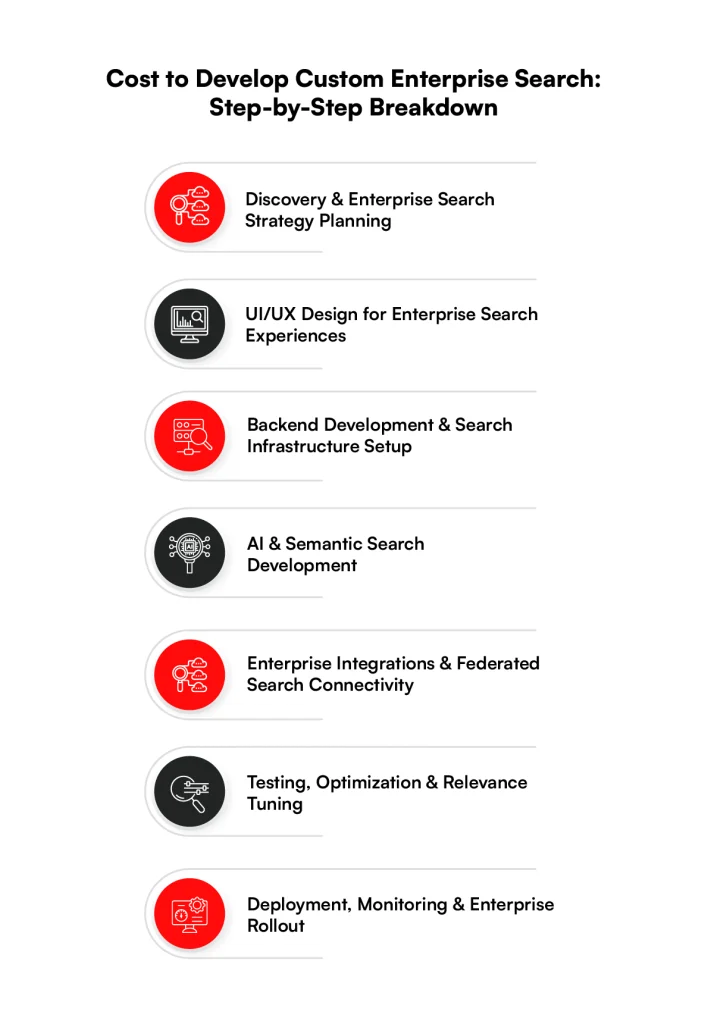
The cost of enterprise search software development is heavily influenced by how the implementation process is planned, architected, and scaled across the organization.
1. Discovery & Enterprise Search Strategy Planning
This phase focuses on understanding how information flows across the organization, where knowledge gaps exist, which systems need to be connected, and how users interact with enterprise content today.
Teams evaluate existing repositories, enterprise workflows, user access models, compliance requirements, search expectations, AI readiness, and indexing requirements.
This stage also helps businesses estimate the overall enterprise search development cost by use cases and examples before large-scale implementation begins.
Estimated Timeline: 2 – 4 Weeks
| Discovery Activity | Estimated Cost Range |
| Enterprise Search Discovery Workshops | $3,000 – $8,000 |
| Data Source & Repository Assessment | $4,000 – $10,000 |
| Search Workflow Mapping | $3,000 – $7,000 |
| AI & Retrieval Strategy Planning | $5,000 – $12,000 |
| Enterprise Architecture Planning | $5,000 – $15,000 |
2. UI/UX Design for Enterprise Search Experiences
This stage focuses on conversational search flows, semantic AI interactions, intelligent dashboards, personalized search experiences, enterprise navigation, contextual recommendations, and AI assistant interfaces.
The complexity of the frontend experience directly impacts the enterprise website search engine platform development cost, especially when organizations require AI copilots, conversational workflows, or cross-platform enterprise accessibility.
Estimated Timeline: 3 – 6 Weeks
| Design Component | Estimated Cost Range |
| Search Experience Wireframing | $3,000 – $7,000 |
| Conversational AI UX Design | $5,000 – $15,000 |
| Enterprise Dashboard Design | $4,000 – $12,000 |
| Responsive Enterprise Search Interfaces | $3,000 – $8,000 |
| AI Search Interaction Prototyping | $5,000 – $12,000 |
3. Backend Development & Search Infrastructure Setup
This is where indexing pipelines, retrieval systems, connectors, orchestration layers, APIs, semantic processing, permissions, and AI infrastructure are built and managed.
A major portion of the investment is usually concentrated in this phase because scalability, indexing speed, semantic retrieval quality, and enterprise security depend heavily on backend architecture quality.
Estimated Timeline: 8 – 16 Weeks
| Backend Infrastructure Component | Estimated Cost Range |
| Search Indexing Infrastructure | $10,000 – $40,000 |
| Enterprise API Development | $8,000 – $30,000 |
| Metadata & Content Processing Pipelines | $5,000 – $20,000 |
| Search Orchestration Systems | $8,000 – $25,000 |
| Cloud Infrastructure Setup | $5,000 – $18,000 |
| Enterprise Authentication Systems | $5,000 – $15,000 |
4. AI & Semantic Search Development
This phase focuses on integrating AI reasoning, semantic retrieval, vector databases, embeddings, conversational AI, and large language models into the enterprise search ecosystem.
This is also where the AI enterprise search development price increases significantly because AI infrastructure requires continuous optimization, testing, retrieval tuning, and operational monitoring.
Estimated Timeline: 6 – 14 Weeks
| AI Development Component | Estimated Cost Range |
| Vector Database Integration | $8,000 – $25,000 |
| Semantic Search Engine Development | $15,000 – $50,000 |
| RAG Pipeline Development | $20,000 – $80,000 |
| LLM Integration & Prompt Engineering | $10,000 – $40,000 |
| AI Relevance Optimization | $8,000 – $25,000 |
| AI Copilot Development | $20,000 – $100,000+ |
5. Enterprise Integrations & Federated Search Connectivity
Enterprise search systems rarely operate in isolation. Most organizations require search connectivity across multiple touchpoints like CRMs, ERPs, SharePoint, Slack, Microsoft Teams, Jira, cloud storage, internal knowledge bases, and document management systems.
This is one of the largest variables affecting enterprise search software development cost based on technologies because integration complexity depends heavily on API maturity, enterprise architecture, data quality, synchronization requirements, and security models.
Estimated Timeline: 4 – 10 Weeks
| Integration Area | Estimated Cost Range |
| CRM & ERP Integrations | $8,000 – $30,000 |
| Slack & Workplace Tool Integrations | $5,000 – $20,000 |
| Federated Search Infrastructure | $10,000 – $35,000 |
| Custom Enterprise Connectors | $8,000 – $40,000 |
| Real-Time Data Synchronization | $5,000 – $18,000 |
6. Testing, Optimization & Relevance Tuning
Enterprise search platforms require extensive testing because even small relevance issues can negatively affect employee productivity, operational workflows, and enterprise-wide knowledge accessibility.
Testing usually includes retrieval accuracy testing, semantic ranking evaluation, load testing, AI hallucination testing, access control testing, conversational AI validation, performance optimization, and indexing accuracy checks.
This phase is especially important for enterprises building copilots or conversational AI search systems.
Estimated Timeline: 3 – 6 Weeks
| QA & Optimization Activity | Estimated Cost Range |
| Retrieval Accuracy Testing | $5,000 – $15,000 |
| AI Relevance Tuning | $5,000 – $18,000 |
| Load & Performance Testing | $5,000 – $20,000 |
| Security & Compliance Testing | $5,000 – $15,000 |
| Conversational AI Validation | $5,000 – $18,000 |
7. Deployment, Monitoring & Enterprise Rollout
Once the platform is validated, the enterprise search ecosystem is deployed across cloud, hybrid, or on-premise enterprise environments.
This stage includes:
- production deployment
- infrastructure scaling
- monitoring setup
- observability
- phased rollout
- user onboarding
- enterprise analytics configuration
Estimated Timeline: 2 – 4 Weeks
| Deployment Activity | Estimated Cost Range |
| Production Deployment Setup | $3,000 – $12,000 |
| Infrastructure Scaling & Optimization | $5,000 – $20,000 |
| Monitoring & Observability Setup | $3,000 – $10,000 |
| Enterprise Rollout & User Onboarding | $5,000 – $15,000 |
| Analytics & Reporting Configuration | $3,000 – $12,000 |
What Is the Enterprise Search Development Cost Per Hour Based on Team Location?
Development location and engineering expertise significantly influence both enterprise search development cost per hour and long-term project quality.
AI search systems require highly specialized expertise in:
- semantic retrieval
- AI orchestration
- distributed search systems
- vector databases
- cloud architecture
- enterprise integrations
- security engineering
- conversational AI
This is why enterprise search developer hourly cost: experience, skills, & location can vary dramatically across projects.
| Region | Average Hourly Rate |
| North America | $120 – $250/hour |
| Western Europe | $90 – $180/hour |
| Eastern Europe | $40 – $90/hour |
| South Asia | $30 – $70/hour |
The total cost of the enterprise search development project based on an hourly pricing model? depends on project complexity, AI requirements, integration scale, infrastructure architecture, enterprise security requirements, deployment scope, and ongoing optimization needs
This is also why the enterprise search development cost by locations (In House Vs Near Shore Vs Offshore) varies significantly depending on communication efficiency, AI expertise, enterprise architecture experience, and long-term support capabilities.
What Are the Hidden Costs of Enterprise Search Development?
Do you also estimate only the visible engineering costs while planning enterprise search initiatives? Because the large-scale enterprise search ecosystems also introduce long-term operational, AI infrastructure, governance, optimization, and scaling expenses that are often overlooked during early budgeting.
These hidden costs become even more significant for businesses building AI-powered retrieval systems, semantic enterprise search, enterprise copilots, or conversational AI search platforms.
1. AI Infrastructure & Model Usage Costs
AI-powered enterprise search systems continuously process embeddings, vector retrieval, semantic ranking, conversational interactions, and LLM inference requests.
As enterprise search usage scales across departments, AI infrastructure consumption can grow rapidly, especially for businesses relying on external LLM APIs or enterprise-scale inference environments.
| AI Infrastructure Expense | Estimated Cost Range |
| LLM API Consumption | $2,000 – $25,000/month |
| Vector Database Scaling | $1,500 – $15,000/month |
| GPU Infrastructure & AI Inference | $3,000 – $30,000/month |
| Embedding Processing Pipelines | $1,000 – $10,000/month |
| AI Monitoring & Observability | $1,000 – $8,000/month |
2. Enterprise Data Cleanup & Content Normalization
One of the biggest hidden problems in enterprise search implementation is poor enterprise data quality. Many organizations operate with duplicate documents, outdated repositories, inconsistent metadata, broken permissions, unstructured content, and legacy systems.
Before semantic retrieval systems can function effectively, enterprise content often requires restructuring, normalization, tagging, enrichment, and governance alignment.
| Data Preparation Activity | Estimated Cost Range |
| Metadata Cleanup & Normalization | $5,000 – $25,000 |
| Legacy Content Structuring | $8,000 – $30,000 |
| Document Classification & Tagging | $5,000 – $20,000 |
| Permission Mapping & Cleanup | $5,000 – $18,000 |
| Knowledge Graph Structuring | $8,000 – $35,000 |
3. Infrastructure Scaling & Performance Optimization
Enterprise search ecosystems continuously expand as organizations add new repositories, departments, AI workflows, copilots, automation layers, and enterprise-wide search usage. Without scalable architecture planning, operational infrastructure costs can rise rapidly after deployment.
This is especially important for enterprise video search platform development cost scenarios where systems process multimedia repositories, OCR pipelines, transcripts, embeddings, and AI-generated summaries at scale
| Infrastructure Scaling Area | Estimated Cost Range |
| Cloud Infrastructure Expansion | $5,000 – $40,000/year |
| Search Performance Optimization | $5,000 – $20,000/year |
| Index Scaling & Storage Expansion | $3,000 – $25,000/year |
| Multi-Region Search Deployment | $10,000 – $50,000+ |
| High-Availability Infrastructure | $8,000 – $35,000/year |
Know Your Exact Cost Before You Commit ?
Enterprise projects fail when costs spiral past projections. Get a precise, scope-based quote from the RBM team, no vague estimates, no surprises.
Get Your Exact QuoteBest Practices to Optimize AI Enterprise Search Development Cost
Building an enterprise search ecosystem does not always require deploying every AI capability at the beginning. Most successful organizations reduce risk and optimize investment by scaling enterprise search capabilities in phases based on operational priorities, adoption patterns, and enterprise workflow maturity.
| Optimization Strategy | How It Helps Reduce Enterprise Search Costs |
| Start with a Focused Enterprise Search MVP | Reduces upfront investment by validating enterprise retrieval, indexing, and adoption before scaling advanced AI capabilities |
| Prioritize High-Value Enterprise Use Cases | Prevents unnecessary development by focusing only on departments and workflows with the highest operational impact |
| Use Modular AI & Search Architectures | Simplifies future scaling, reduces redevelopment costs, and improves integration flexibility across enterprise systems |
| Optimize AI Infrastructure Usage | Minimizes LLM inference, vector processing, and orchestration expenses through caching, retrieval optimization, and efficient AI workflows |
| Continuously Improve Search Relevance | Prevents expensive rebuilds later by improving search quality through analytics, feedback loops, and ongoing optimization |
| Reuse Existing Enterprise Infrastructure | Lowers implementation complexity by leveraging existing cloud environments, IAM systems, and enterprise APIs |
| Implement Phased AI Rollouts | Helps organizations gradually introduce semantic retrieval, copilots, and AI assistants without overwhelming infrastructure costs |
| Use Hybrid Retrieval Models | Balances semantic AI retrieval with traditional indexing to improve performance while reducing infrastructure overhead |
| Automate Metadata & Content Enrichment | Reduces manual enterprise content management effort and improves indexing accuracy at scale |
| Invest in Enterprise Search Governance Early | Prevents future compliance, access control, and enterprise AI governance issues that increase operational costs later |
Why Leading Enterprises Choose RBMSoft for Enterprise Search Development and Integration Services?
Enterprise search has to work across the systems a business already depends on. RBMSoft works with organizations to connect information from CRMs, cloud platforms, internal databases, workplace tools, and other business applications while keeping existing workflows and access requirements in mind.
Our enterprise search solution development work covers the search architecture as well as the systems behind it. Depending on the requirement, this can include:
- Enterprise search architecture: Build search around existing data sources, users, and business workflows.
- Semantic and AI-powered search: Improve retrieval when users search by meaning rather than exact keywords.
- Federated search: Search across multiple repositories without forcing teams to work from a single source.
- Enterprise integrations: Connect search with CRMs, ERPs, workplace tools, cloud platforms, and internal applications.
- Relevance tuning: Refine ranking and retrieval based on the information users actually need.
- Search governance: Apply permissions and access requirements across connected information sources.
- Ongoing optimization: Adjust search performance as content, systems, and usage change.
This gives businesses a practical way to plan search around their existing technology rather than treating it as a separate system.
Conclusion
Enterprise search needs to fit the way information already moves through the business. RBMSoft starts by looking at the systems involved, the information employees need to find, existing access rules, and where search currently falls short. This helps define the scope before development begins.
From there, enterprise search solution development can cover data integration, indexing, semantic search, RAG, AI search, and connections with systems such as CRMs, ERPs, SharePoint, and internal knowledge bases.
Security and permissions are also built around existing business requirements so users only receive information they are allowed to access.
These decisions directly affect the enterprise search development cost, so estimates should reflect the actual systems, data, AI requirements, and deployment model involved. Contact RBMSoft to discuss your enterprise search requirements and get a project estimate based on your scope.
FAQs
1. What are the benefits of enterprise search?
Enterprise search improves how organizations access, organize, and use enterprise knowledge across disconnected systems. It helps employees find information faster, reduces operational inefficiencies, improves collaboration, supports better decision-making, and minimizes time wasted searching across multiple repositories.
Modern AI-powered enterprise search systems also improve workflow automation, semantic retrieval, and contextual knowledge discovery across departments.
2. What does enterprise search do?
Enterprise search centralizes information retrieval across platforms like CRMs, ERPs, SharePoint, cloud storage, emails, internal databases, workplace collaboration tools, and document management systems.
Instead of searching each system individually, employees can access enterprise content through a unified search interface powered by indexing, semantic retrieval, AI ranking, and contextual search capabilities.
3. How much does it cost to build the enterprise search software solution?
The cost of enterprise search software development can range from $40,000 for a basic enterprise retrieval platform to over $700,000+ for enterprise-scale AI search ecosystems with semantic retrieval, enterprise copilots, vector databases, workflow automation, and large language model integrations.
Final pricing depends on AI complexity, integrations, infrastructure scale, enterprise security requirements, deployment architecture, and operational scope.
4. What is enterprise search software, and how is it used?
Enterprise search software helps organizations retrieve and surface information spread across internal systems, repositories, applications, and enterprise databases.
It is commonly used for internal knowledge discovery, enterprise content retrieval, customer support assistance, compliance workflows, enterprise AI copilots, semantic document retrieval, and enterprise workflow automation.
Modern enterprise search systems are increasingly powered by AI, semantic ranking, Retrieval-Augmented Generation (RAG), and conversational search experiences.
5. How long does an enterprise search development project usually take based on budget?
The timeline depends on the project scope, integrations, and AI requirements. A basic enterprise search platform typically takes 2–4 months, while a mid-level AI search platform may take 4–7 months.
Larger enterprise AI search systems can take 7–12+ months because they often include semantic search, AI orchestration, governance, and more complex integrations.
6. What are the ongoing costs of enterprise search development post-launch?
Post-launch costs depend on usage, infrastructure, and how much ongoing work the platform requires.
Platform maintenance can range from 3,000–20,000 per month, while AI relevance work may cost 2,000–12,000. Monitoring, indexing, security updates, and infrastructure scaling can add roughly 1,000–25,000 per month, depending on the requirement.
7. How do enterprise software search development companies calculate project pricing?
Projects involving semantic retrieval, enterprise copilots, RAG pipelines, and AI orchestration usually require higher investment because of infrastructure complexity and long-term optimization requirements.
Most enterprise software search development companies calculate pricing based on:
- AI complexity
- enterprise integrations
- search infrastructure requirements
- security and compliance implementation
- deployment architecture
- data volume
- workflow automation requirements
- custom feature development
- team composition and engineering expertise
8. Which enterprise search development company provides transparent pricing with no hidden costs?
RBMSoft follows a structured enterprise search planning and architecture process designed to help organizations estimate infrastructure requirements, integration complexity, AI implementation scope, and operational scaling costs early in the project lifecycle.
This allows businesses to:
- prioritize high-impact use cases
- avoid unnecessary AI infrastructure costs
- scale implementations in phases
- improve budget predictability
- reduce long-term operational overhead