

Table of Contents
Key Takeaways:
- Streamline your healthcare supply chain by automating procurement, inventory, warehouse management, and order fulfillment.
- Choose the right software approach by evaluating whether an ERP system or a custom-built solution best fits your operational needs.
- Leverage advanced technologies like AI, IoT, RFID, blockchain, and analytics to improve visibility and decision-making.
- Prioritize compliance and security by building software that supports healthcare regulations and protects sensitive data.
- Build for long-term growth with a scalable, integrated healthcare supply chain solution that evolves with your business.
Healthcare organizations operate in an environment where every delay, shortage, or inventory error can directly affect patient care. When critical supplies are difficult to locate or procurement processes become inefficient, operational costs rise while productivity suffers.
As healthcare supply chains become more complex, you need a solution that gives you complete visibility across your supply chain, helps you make faster decisions, and automates repetitive processes. This ensures compliance without adding unnecessary complexity.
Before you invest in a solution, it’s important to understand what healthcare supply chain management software development actually requires and how it supports your day-to-day operations. Let’s start by exploring what healthcare supply chain management software is and why it has become an essential part of modern healthcare organizations.
What is Healthcare Supply Chain Management Software?
Healthcare supply chain management software helps you manage the procurement, inventory, storage, and distribution of medical supplies, pharmaceuticals, and equipment from a single platform.
Instead of juggling multiple systems or manual processes, you get real-time visibility into your inventory, automate purchasing and replenishment, track product movement, and collaborate more effectively with suppliers.
It also helps you stay compliant with healthcare regulations by supporting features such as batch and lot tracking, expiry management, and recall monitoring.
You can reduce operational costs, prevent stock shortages, and minimize waste with better visibility and automation. This will ensure critical medical supplies are available when your teams need them most.
While every supply chain management software for hospitals serves the same core purpose, not all of them offer the same capabilities.
Build Smarter Healthcare Operations
From procurement to inventory management, develop a solution that simplifies complex workflows and supports regulatory compliance.
Book a Free Consultation
Types of Healthcare Supply Chain Management Software
Managing a healthcare supply chain involves much more than purchasing medical supplies. You need to source products, track inventory, manage warehouses, process orders, monitor shipments, and stay compliant with healthcare regulations.
Depending on your operational needs, you may require healthcare supply chain management software designed for specific supply chain functions or a comprehensive end-to-end platform. Let’s explore the most common types of healthcare supply chain management software.
Depending on your requirements, you can implement individual solutions for specific functions or choose an integrated platform that manages your entire supply chain.
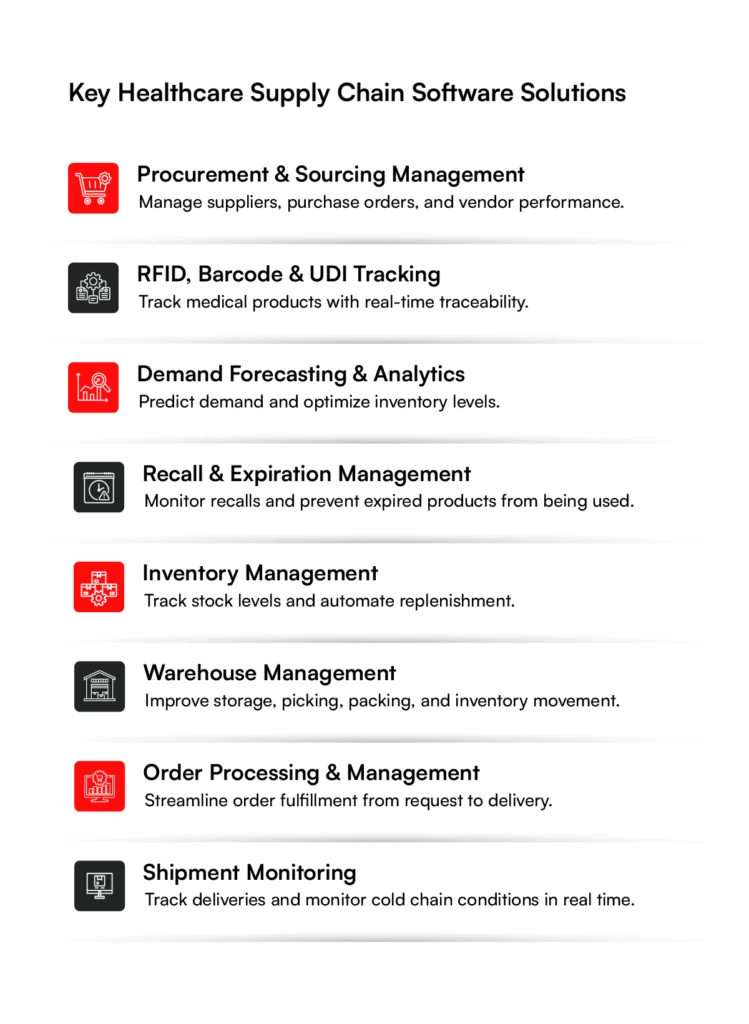
1. Procurement & Sourcing Management
If you’re looking to streamline purchasing, procurement, and sourcing, software can help. It enables you to manage suppliers, compare quotations, create purchase orders, and evaluate vendor performance from a single platform.
This helps you make better purchasing decisions, control costs, and ensure a steady supply of critical medical products.
2. RFID, Barcode & UDI Tracking
Knowing exactly where your inventory is at any given time is essential in healthcare. RFID, barcode, and Unique Device Identification (UDI) tracking allow you to monitor medical devices, pharmaceuticals, and consumables throughout the supply chain. This improves traceability, minimizes manual errors, and helps you meet regulatory requirements.
3. Demand Forecasting & Analytics
Ordering too much inventory increases costs, while ordering too little can disrupt patient care. Demand forecasting software analyzes historical data and purchasing trends to help you predict future demand more accurately. This allows you to optimize inventory levels, improve purchasing decisions, and prepare for demand fluctuations.
4. Recall & Expiration Management
Managing product recalls and expiration dates manually can be both time-consuming and risky. Recall and expiration management software continuously tracks product batches, lot numbers, and expiration dates. This helps you identify affected items quickly and prevent expired products from reaching patients.
5. Inventory Management
Inventory management software gives you real-time visibility into stock levels across hospitals, clinics, pharmacies, and warehouses. You can automate replenishment, monitor inventory movement, reduce stock shortages, and avoid unnecessary overstocking. This ensures the right supplies are always available when they’re needed.
6. Warehouse Management
Efficient warehouse operations play a critical role in healthcare supply chains. Warehouse management software helps you organize inventory, optimize storage space, and improve picking and packing accuracy. It also helps you speed up order fulfillment while maintaining compliance with storage requirements.
7. Order Processing and Management
From the moment an order is placed until it’s delivered, order management software keeps the entire process organized. It coordinates inventory availability, supplier communication, order fulfillment, and delivery tracking, helping you process orders faster and with fewer errors.
8. Shipment Monitoring
Once products leave the warehouse, you need complete visibility until they reach their destination. Shipment monitoring software lets you track deliveries in real time, receive alerts about delays, and monitor transportation conditions for temperature-sensitive products to ensure they arrive safely.
Now that you’ve seen the different types of healthcare supply chain management software available, you might be wondering what impact they can have on your organization. Let’s look at the key benefits these solutions bring to healthcare operations.
Advanced Tech Stack Required for Healthcare Supply Chain Management Software Development with AI Traceability
Healthcare Supply Chain Management Software Development combines cloud infrastructure, integration technologies, intelligent analytics, and operational technologies to create a connected, secure, and scalable platform.
Rather than relying on a single technology, enterprise solutions use multiple layers that work together to automate operations, improve visibility, and support data-driven decision-making.
1. Cloud & Integration Foundation
- Cloud Infrastructure
Cloud platforms such as AWS, Microsoft Azure, and Google Cloud provide the scalability and resilience needed for enterprise healthcare supply chains.
They enable high availability, disaster recovery, secure data storage, and real-time collaboration across hospitals, warehouses, suppliers, and distribution centers.
- Integration Layer
Healthcare organizations use multiple systems, including ERP, EHR, procurement, warehouse, and logistics applications.
An API-first integration layer connects these systems and enables secure data exchange. This eliminates data silos and creates a single, connected supply chain ecosystem.
2. Inventory Visibility & AI Traceability
- RFID, Barcode & UDI Scanning
RFID, barcode, and Unique Device Identification (UDI) technologies provide end-to-end visibility of medical devices, pharmaceuticals, and consumables.
They improve inventory accuracy, simplify recalls, reduce manual errors, and support regulatory compliance through complete product traceability.
- IoT
IoT sensors continuously monitor inventory, medical equipment, warehouse conditions, and shipments. They are especially valuable for temperature-sensitive pharmaceuticals and vaccines, providing real-time alerts when storage or transportation conditions fall outside acceptable limits.
3. Intelligence & Decision Support
- Artificial Intelligence
AI helps healthcare organizations forecast demand, optimize inventory, identify supplier risks, automate procurement recommendations, and detect unusual purchasing patterns. This enables faster and more informed operational decisions.
- Data Science & Business Intelligence
Business intelligence platforms analyze inventory trends, supplier performance, procurement costs, and operational efficiency. Interactive dashboards and predictive analytics help organizations identify bottlenecks, improve forecasting, and monitor KPIs in real time.
- Digital Twin
A digital twin creates a virtual model of the healthcare supply chain. Organizations can simulate different scenarios, evaluate operational changes, and identify bottlenecks before implementing them in live environments, reducing both risk and cost.
4. Trust, Security & Compliance
- Blockchain
Blockchain provides an immutable record of supply chain transactions with traceability. It improves product authenticity, strengthens traceability, reduces counterfeit risks, and increases trust among manufacturers, distributors, suppliers, and healthcare providers.
The technologies you choose will determine how secure, scalable, and future-ready your software becomes. However, even the most advanced technology must comply with healthcare regulations and industry standards.
Benefits of Supply Chain Management Software Development in the Healthcare Industry
An efficient supply chain management software for hospitals does more than move products from one place to another.
It helps you reduce operational costs, improve resource utilization, maintain regulatory compliance, and ensure essential medical supplies are always available when they’re needed most. Here are some of the biggest benefits you can expect.
1. Better Processes, Better Outcomes
If your teams still rely on manual processes, delays and errors are almost inevitable. Healthcare supply chain software automates routine tasks such as procurement, inventory updates, order processing, and replenishment.
This helps you streamline operations, reduce administrative effort, and free up your staff to focus on delivering better patient care.
2. Improved Access to Insights
Making the right decisions starts with having the right information. A centralized supply chain platform gives you real-time visibility into procurement, inventory, suppliers, warehouses, and shipments.
With accurate, up-to-date data, you can identify bottlenecks, improve purchasing decisions, and respond quickly to changing demands.
3. Enhances Transparency
When you can see what’s happening across your supply chain, it’s easier to stay in control. Supply chain software lets you track products from procurement to delivery, monitor supplier performance, and maintain accurate records for audits and compliance. This level of transparency also improves collaboration across teams and external partners.
4. Reduces Inventory Waste
Maintaining the right inventory balance is a constant challenge. Too much stock increases waste, while too little can affect patient care.
You can reduce overstocking, prevent stock shortages, and minimize losses caused by expired products with real-time inventory tracking, automated replenishment, and demand forecasting,
5. Reporting and Analytics
Your supply chain generates valuable data every day. Built-in reporting and analytics tools help you turn that data into actionable insights.
You can monitor key performance indicators, evaluate supplier performance, analyze inventory trends, track procurement costs, and uncover opportunities to improve efficiency across your operations.
To get the most from your investment, you also need the right processes and strategies in place.
This requires you to follow the best practices that can help you build a more efficient, resilient, and cost-effective supply chain management software for hospitals.
Optimize Every Supply Chain Decision
Gain real-time insights, automate critical workflows, and make smarter decisions with a solution built specifically for your healthcare operations.
Build My SolutionTop Hospital Supply Chain Management Software Best Practices for Better Efficiency
Implementing healthcare supply chain software is only part of the equation. To improve efficiency, reduce costs, and ensure uninterrupted patient care, you also need the right processes in place.
The following best practices can help you build a more resilient and efficient hospital supply chain.
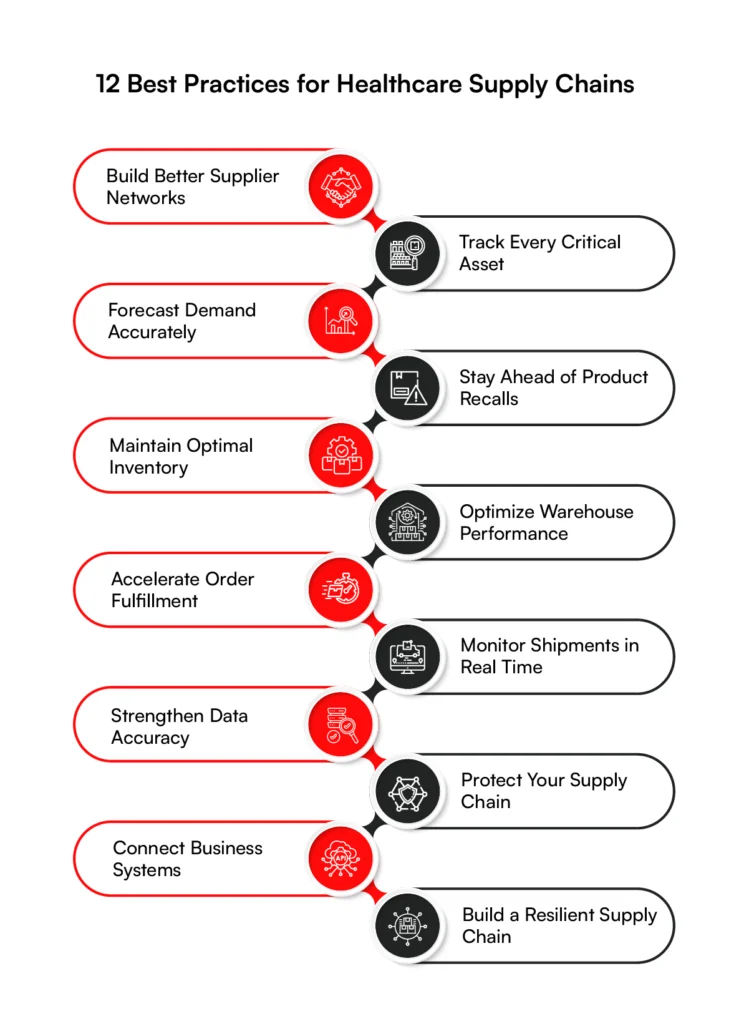
1. Improve Data Quality
Your supply chain is only as reliable as the data behind it. Maintain accurate records for inventory, suppliers, product catalogs, pricing, and purchase orders. Clean, consistent, and up-to-date data improves forecasting, reporting, and day-to-day decision-making.
2. Treat Security as a Product Feature
Healthcare organizations handle sensitive operational and business data that must be protected at every stage. Build security into your systems from the start by implementing role-based access controls, data encryption, regular security audits, and compliance with healthcare regulations.
3. Focus on a Clinician-First User Experience
Supply chain software should simplify work for clinicians and hospital staff, not add complexity. Design intuitive workflows that make it easy to request supplies, check inventory, place orders, and receive notifications with minimal effort. A user-friendly system encourages adoption and reduces training time.
4. Establish Queue-Based Exception Workflows
Not every supply chain issue requires immediate manual intervention. Set up automated workflows that route exceptions, such as delayed shipments, inventory shortages, or approval requests, to the appropriate teams. This helps your staff resolve issues faster while keeping routine operations running smoothly.
5. Diversify and Strengthen Supplier Relationships
Relying on a single supplier increases your risk of supply disruptions. Build relationships with multiple qualified vendors, regularly evaluate supplier performance, and develop contingency plans to maintain a steady supply of critical medical products.
6. Enhance System Integration and Data Sharing
Your ERP, EHR, inventory management system, warehouse software, and procurement platform should work together seamlessly. Integrated systems eliminate duplicate data entry, improve collaboration across departments, and provide a unified view of your supply chain.
7. Increase Supply Chain Visibility
Real-time visibility helps you monitor inventory levels, supplier performance, shipment status, and warehouse operations from a single dashboard. Your teams can identify bottlenecks early and respond to disruptions before they impact patient care with complete visibility.
8. Focus on Demand Forecasting and Inventory Management
Use historical data, seasonal trends, predictive analytics, and ai to forecast demand more accurately. Better forecasting helps you maintain optimal inventory levels, reduce waste, avoid stock shortages, and improve purchasing decisions.
9. Optimize Network Design and Distribution
Review your warehouse locations, distribution routes, and inventory allocation strategies regularly. An optimized distribution network shortens delivery times, reduces transportation costs, and ensures medical supplies reach the right facilities when they are needed.
10. Manage Supply Chain Costs
Look beyond procurement costs and evaluate your entire supply chain. Monitor inventory carrying costs, supplier performance, warehouse operations, transportation expenses, and product waste to identify opportunities for cost optimization without compromising patient care.
11. Apply Lean Principles and Standardize Processes
Standardized workflows reduce unnecessary steps, eliminate inefficiencies, and improve consistency across departments. Applying lean principles helps hospitals streamline procurement, inventory management, and order fulfillment while improving overall operational efficiency.
12. Build Resilience and Agility
Healthcare supply chains must be prepared for unexpected disruptions, whether caused by supplier issues, public health emergencies, or changing market conditions.
Develop contingency plans, maintain strategic inventory reserves, diversify sourcing, and use real-time analytics to respond quickly when disruptions occur.
Following these best practices creates a strong operational foundation, but choosing the right technology is equally important.
Comparing ERP systems and custom-built healthcare supply chain software will help you determine which solution best supports your organization’s long-term goals.
ERP vs. Custom-Built Supply Chain Management Software Development for the Healthcare Industry
Choosing between an ERP system and custom healthcare supply chain software depends on your operational needs. While an ERP helps manage core business functions with standardized processes, it may not address the complex requirements of healthcare supply chains.
Custom software, on the other hand, is designed around your workflows, compliance needs, and long-term business goals.
| ERP Software | Custom Healthcare Supply Chain Software |
| Provides standardized workflows suitable for multiple industries. | Built specifically for your healthcare supply chain processes and requirements. |
| Offers limited customization and often requires additional modules for specialized needs. | Delivers complete flexibility with features tailored to your business. |
| Manages general functions like procurement, finance, and inventory. | Supports healthcare-specific capabilities such as batch tracking, expiry management, cold chain monitoring, and regulatory compliance. |
| May require businesses to adjust their workflows to fit the system. | Adapts to your existing workflows without forcing operational changes. |
| Integrates with common business applications but may have limitations for niche healthcare systems. | Seamlessly integrates with your ERP, EHR, pharmacy, laboratory, warehouse, and other healthcare applications. |
| Upgrades and new features depend on the ERP vendor’s roadmap. | You control future enhancements, feature additions, and system updates. |
| Best suited for organizations with standard operational requirements. | Ideal for healthcare organizations with complex supply chains, strict compliance requirements, and unique business processes. |
Choosing the right software approach is only the beginning. To turn your vision into a reliable solution, you need a structured development process. Here’s how healthcare supply chain software is typically developed.
Healthcare Supply Chain Software Development: Step-by-Step Process
For healthcare supply chain management software development, you need a solution that fits your workflows, integrates with your existing systems, and complies with healthcare regulations. This can help you scale as your organization grows. Here’s what the development process typically looks like.
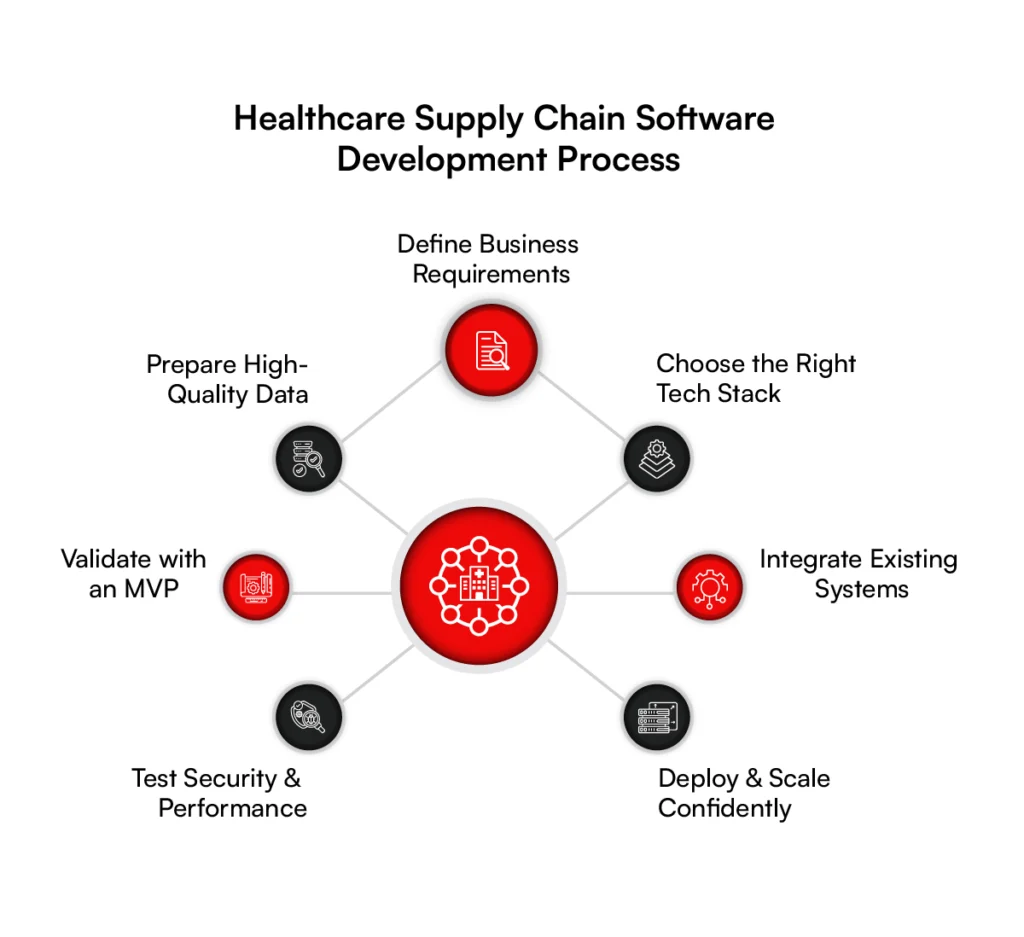
1. Discovery & Scope Definition
Every successful project starts with understanding your business. Before writing a single line of code, the development team analyzes your supply chain workflows, identifies operational challenges, defines project requirements, and prioritizes features. This creates a clear roadmap and ensures the software is built around your business goals.
At RBMSoft, we collaborate with your stakeholders from day one to understand how your supply chain operates and recommend the right technology strategy for your unique requirements.
2. Data Ingestion & Sanitization
Healthcare supply chain data flows from ERP systems, EHRs, warehouse management software, supplier portals, logistics platforms, RFID scanners, and IoT devices.
To create a reliable foundation, this data is collected through automated data pipelines and centralized in a secure data lake or lakehouse. ETL/ELT processes then cleanse, standardize, validate, and enrich the data by removing duplicates, correcting inconsistencies, and normalizing formats.
This ensures high-quality, trusted data that powers accurate reporting, AI-driven forecasting, inventory optimization, and real-time operational insights.
3. Tech Stack Selection
Choosing the right tech stack is about more than selecting a programming language or framework. Your platform should be cloud-native, scalable, and easy to maintain as your business grows.
Many enterprise solutions use a microservices architecture with Docker and Kubernetes to support independent scaling. An API-first approach simplifies integration with ERP, EHR, warehouse, and logistics systems.
Event-driven technologies like Apache Kafka enable real-time inventory updates and order processing. Combined with DevSecOps, CI/CD pipelines, and Infrastructure as Code (IaC), this creates a secure, reliable, and future-ready platform.
4. Prototyping & MVP
Building an enterprise software platform all at once increases cost and risk. Instead, start with a prototype to validate workflows and user experience. Then develop an MVP with core features such as procurement, inventory management, or warehouse operations.
This allows stakeholders to test real business scenarios and provide early feedback. Development teams can refine features before investing in advanced capabilities like AI forecasting or IoT monitoring. Following Agile and DevOps practices also enables faster releases, continuous improvements, and quicker time-to-market.
5. System Synchronization
Enterprise healthcare supply chains depend on multiple business systems working together. Your software should integrate seamlessly with ERP, EHR, warehouse management, procurement, logistics, supplier, and IoT platforms. An API-first architecture and event-driven integrations allow data to flow securely in real time.
Standards such as HL7 FHIR can further simplify interoperability where healthcare data is involved. This approach removes data silos, improves collaboration, and gives teams a unified view of the entire supply chain.
At RBMSoft, we build secure API-driven integrations that connect enterprise systems without disrupting daily operations, creating a truly connected healthcare ecosystem.
6. Model & Security Validation
Before deployment, every component of the platform should undergo comprehensive testing. This includes functional, integration, performance, regression, and security testing. Enterprise healthcare applications should also include vulnerability assessments and penetration testing to identify potential risks early.
Security controls such as encryption, role-based access, audit logs, and identity management must be validated to meet HIPAA, GDPR, and other regulatory requirements. Continuous testing within a DevSecOps pipeline helps maintain security and compliance with every release.
7. Production Deployment
Deployment should be planned to minimize disruption to healthcare operations. Enterprise teams commonly use CI/CD pipelines along with blue-green or canary deployments for safer releases. Automated rollback mechanisms reduce downtime if issues occur.
After launch, observability tools continuously monitor application performance, infrastructure health, and security events. Regular updates, proactive maintenance, cloud scaling, and disaster recovery planning ensure the platform remains secure, reliable, and ready to support future business growth.
Building a reliable healthcare supply chain solution also depends on selecting the right technologies. Let’s explore the advanced tech stack used to develop secure, scalable, and high-performing healthcare supply chain management software.
Need a Development Roadmap?
We’ll help you define the right features, technology stack, and development strategy for your healthcare supply chain platform.
Let’s Get StartedCompliance with Healthcare Supply Chain Management Software Development
Compliance is a critical part of healthcare supply chain software development. Your solution must do more than streamline operations. It should also help you meet industry regulations, protect sensitive data, maintain product traceability, and support audit readiness. Here are some of the key compliance standards to consider.
1. DSCSA & Pharmaceutical Serialization
If your organization operates in the pharmaceutical supply chain, compliance with the Drug Supply Chain Security Act (DSCSA) is essential.
Your software should support product serialization, traceability, verification, and electronic record sharing to help prevent counterfeit drugs from entering the supply chain and enable faster product recalls.
2. GS1 Serialization Standards
GS1 standards provide a common framework for identifying and tracking products across the global supply chain.
By supporting GS1 barcodes and standardized identifiers, your software improves product traceability, simplifies data exchange between trading partners, and enhances supply chain visibility.
3. FDA UDI & EU MDR
Medical device manufacturers and healthcare providers must comply with FDA Unique Device Identification (UDI) requirements and the European Union Medical Device Regulation (EU MDR). Your software should capture and manage UDI information, maintain complete device traceability, and simplify regulatory reporting throughout the product lifecycle.
4. 21 CFR Part 11
If your software manages electronic records or electronic signatures, it should comply with 21 CFR Part 11. This regulation requires secure record management, user authentication, audit trails, and electronic signatures that are trustworthy and legally equivalent to paper records.
5. HIPAA & GDPR
Healthcare supply chain systems often exchange sensitive patient or business information. To protect this data, your software should support compliance with HIPAA for healthcare organizations in the United States and GDPR for organizations operating in or serving customers in the European Union.
Features such as encryption, role-based access, secure data storage, and privacy controls help meet these requirements.
Meeting compliance requirements is an important part of the development process, but it’s also one of the factors that influence your overall investment. Let’s look at the key factors that determine the cost of healthcare supply chain software development.
Healthcare Supply Chain Management Software Development Cost
The cost of Healthcare Supply Chain Management Software Development depends on your feature requirements, compliance obligations, integration complexity, and the scale of your operations.
A solution built for a single healthcare facility will require a much smaller investment than an enterprise platform connecting multiple hospitals, suppliers, distributors, and third-party systems.
| Project Type | Estimated Cost Range | Typical Scope |
| MVP or Single-Facility Solution | $15,000 – $60,000 | Includes core capabilities such as inventory management, procurement, order processing, and basic product serialization. Best suited for organizations looking to launch quickly and expand over time. |
| Mid-Tier Multi-Site Solution | $60,000 – $200,000 | Supports multiple facilities with advanced features such as ERP integration, cold chain monitoring, supplier management, demand forecasting, and regulatory compliance. |
| Enterprise-Grade Platform | $200,000 – $500,000+ | Designed for large healthcare networks with end-to-end interoperability, AI-powered analytics, blockchain-enabled traceability, IoT integration, and support for multiple trading partners. |
Several factors influence the overall development cost, including:
- Compliance requirements: Supporting regulations such as DSCSA, HIPAA, FDA UDI, EU MDR, and 21 CFR Part 11 require additional development, validation, and testing.
- Integration complexity: Connecting the platform with ERP systems, EHRs, warehouse management software, distributors, and third-party applications increases implementation effort.
- Feature complexity: Advanced capabilities such as AI-powered forecasting, IoT monitoring, blockchain, digital twins, and predictive analytics require additional development resources.
- Deployment scale: The number of healthcare facilities, users, suppliers, warehouses, and trading partners directly affects project complexity and cost.
- Security and infrastructure: Building a secure, scalable cloud-based platform with enterprise-grade security and disaster recovery also impacts the overall investment.
At RBMSoft, we help you maximize your technology investment by prioritizing the features that create the most business value and building a scalable solution that grows with your organization without unnecessary development costs.
Conclusion
The right healthcare supply chain software can help you improve visibility, streamline operations, reduce costs, and maintain regulatory compliance. However, achieving these outcomes requires a solution built around your unique workflows and business goals.
At RBMSoft, we deliver end-to-end Healthcare IT services to help you design, develop, integrate, and modernize healthcare supply chain solutions.
Our team combines industry expertise with reliable software development services to build secure, scalable, and future-ready platforms that drive operational efficiency.
How RBMSoft Can Help:
- Custom healthcare supply chain software development
- ERP, EHR, and third-party system integration
- AI, IoT, RFID, and blockchain implementation
- Compliance-ready solutions for HIPAA, DSCSA, FDA UDI, and more
- Ongoing support, maintenance, and scalability for future growth
Whether you’re planning for Healthcare Supply Chain Management Software Development or enhancing an existing one, RBMSoft can help you every step of the way.
We work closely with your team to deliver solutions that improve operational efficiency, strengthen supply chain resilience, and support long-term business growth.
FAQ’s
1. What is supply chain management in healthcare?
Supply chain management in healthcare refers to the process of sourcing, purchasing, storing, tracking, and distributing medical supplies, pharmaceuticals, equipment, and devices across healthcare organizations.
It ensures the right products are available at the right place and time while reducing costs, minimizing waste, and maintaining compliance with healthcare regulations.
Modern supply chain management software and healthcare solutions help automate these processes and provide real-time visibility across the supply chain.
2. What is the importance of supply chain management in healthcare?
An efficient healthcare supply chain directly impacts operational efficiency and patient care. It helps healthcare organizations prevent stock shortages, reduce inventory waste, improve procurement decisions, strengthen supplier collaboration, and maintain regulatory compliance.
Following proven hospital supply chain management best practices also enables organizations to improve supply chain resilience and respond quickly to changing demand.
3. What are the three most common healthcare supply chain management challenges?
Some of the most common challenges include limited inventory visibility, supply chain disruptions, and regulatory compliance. Many organizations also struggle with disconnected systems, inaccurate demand forecasting, and manual procurement processes.
Addressing these challenges requires integrated technology, automation, and real-time data across the supply chain.
4. Buy vs. build custom healthcare supply chain management software?
The right choice depends on your business needs. Off-the-shelf solutions can be implemented quickly and work well for standard workflows.
However, if your organization has complex processes, unique compliance requirements, or specialized integration needs, it is often better to develop healthcare supply chain management software tailored to your operations. A custom solution gives you greater flexibility, scalability, and long-term control over your technology.
5. How do you build a scalable architecture for healthcare supply chain management software?
To develop healthcare supply chain management software that scales with your business, you should adopt a cloud-native architecture, use API-driven integrations, implement modular services, and ensure robust security and compliance.
Integrating AI, IoT, analytics, and real-time monitoring also helps the platform handle increasing users, facilities, and transaction volumes without compromising performance.
6. How do you implement AI in healthcare supply chain management software development?
AI can automate and optimize several supply chain processes, including demand forecasting, inventory optimization, supplier risk analysis, procurement recommendations, and predictive analytics.
To successfully develop healthcare supply chain management software with AI capabilities, organizations need clean, centralized data, scalable infrastructure, and machine learning models that continuously learn from operational data to improve decision-making over time.