- Retail AI
- Services
Looking for a more specific outcome? We’ll build a solution to get you there.
- Industries
Looking for a more specific outcome? We’ll build a solution to get you there.
- About
- Case Studies
- Resources
- Arvyn
Looking for a more specific outcome? We’ll build a solution to get you there.
Looking for a more specific outcome? We’ll build a solution to get you there.
Build AI-powered applications that connect with your existing data and business systems, using LLMs, predictive models, AI agents, and custom APIs.








AI applications can fail when models, business data, and existing systems are treated as separate parts. Our AI app development services cover product planning, model selection, application engineering, integration, testing, and deployment to turn your requirements into software that works in production.
AI software needs more than a model to work as a complete application. Our custom AI app development services cover product architecture, UI development, backend engineering, databases, APIs, AI model integration, authentication, testing, and deployment.
As an AI app development company, RBMSoft builds web and mobile applications around your business requirements and existing software. Our AI app developers handle the application code and AI components together, so models can read the right data, return results inside the app, and connect with the systems your teams already use. We build AI MVPs, customer-facing products, internal applications, and enterprise software ready for production use.
An LLM API can generate a response, but a complete application also needs data access, backend logic, user controls, security, and reliable output handling. Our AI app development services include applications powered by GPT, Claude, Gemini, Llama, and other LLMs selected for the product requirements.
RBMSoft builds RAG applications, document processing tools, AI search, content applications, multimodal features, and custom LLM products. As an AI application development company, we develop the frontend, backend, APIs, databases, retrieval pipelines, and model connections required to ship them as working software. We can connect LLMs with company documents, product data, databases, and business applications while adding access controls and output checks where required.
AI agents need application logic that lets them retrieve data, call APIs, use software tools, and complete defined tasks. RBMSoft builds AI agent applications and copilots that connect models with the systems where the actual work happens.
Our artificial intelligence app development services cover agent development, RAG, API connections, tool calling, user permissions, approval steps, and multi-agent applications. We can connect agents with CRM, ERP, ecommerce, customer support, finance, and custom business software. RBMSoft also builds the interfaces and backend services users need to assign tasks, review results, approve actions, and track agent activity. The AI Summit 2026 Report also identified a move from basic chatbots toward agentic systems that can execute multi-step business tasks.
Prediction models provide little value if their output never reaches the people or software making decisions. Our AI app development solutions put machine learning directly inside web, mobile, and enterprise applications for forecasting, recommendations, classification, anomaly detection, fraud detection, and predictive analytics.
RBMSoft builds the data processing, ML models, backend services, APIs, dashboards, and application features required for each use case. Our AI app developers work with technologies such as Python, TensorFlow, PyTorch, Scikit-learn, and LightGBM where they fit the project. We test model performance before connecting predictions with application functions, giving users a practical way to view results and act on them from the software they already use.
Apps that need to understand images, video, documents, audio, and text require more than a standard application backend. As an artificial intelligence app development company, RBMSoft builds computer vision and multimodal applications for visual search, image recognition, object detection, document processing, image analysis, and mixed text-and-image features.
Our developers work with OpenCV, vision models, multimodal LLMs, OCR, model APIs, and custom backend services based on the application requirements. We build the UI for capturing or uploading inputs, the APIs for processing them, and the backend logic for returning results inside the application. These features can also connect with product catalogs, databases, search systems, or other business software when the app needs additional data to complete a request.
Scripted chatbots often break when a user asks something outside a fixed decision tree or needs information stored in another system. Our AI app development services include conversational applications, virtual assistants, and voice apps that can respond using data from your business software.
As an AI mobile app development company, RBMSoft develops chat and voice features directly into web and mobile applications. We build the chat interface, backend services, LLM connections, RAG search, speech integrations, conversation history, authentication, and API connections needed to support the experience. These applications can handle customer support, product questions, internal knowledge search, appointment booking, and other conversation-based functions without forcing users into fixed menu flows.
You do not always need to rebuild an existing application to add AI. Our AI app development services can add LLMs, machine learning, AI agents, search, and automation features to software that already handles your core business operations.
As an AI app development services provider, RBMSoft works directly with existing application code, APIs, databases, ERP, CRM, ecommerce platforms, and custom backend systems. Our developers can build new AI modules, create APIs, update backend services, replace outdated components, and modify the UI where new functions need to appear. We plan authentication, data access, API behavior, and system permissions as part of the integration so the new features work inside the existing application rather than as a separate tool.
Launching the application does not end the development work. Models can change, APIs can release new versions, application traffic can increase, and inference costs can rise as more users adopt the product. Our AI app development services include ongoing engineering and maintenance for both the application and its AI components.
RBMSoft handles bug fixes, API updates, model changes, application releases, performance checks, CI/CD, model versioning, logging, and infrastructure updates. We can track response times, errors, model output, API consumption, and compute usage to identify problems affecting the application in production. When a model, provider, or application component needs an update, our developers can test the change before releasing it to users.
Tell us what you want the application to do. We’ll map out how to build it.
AI-Powered Digital Healthcare Platform
RAG, LLM & Mobile Application Development
Healthcare MVP Delivered in
Challenges
A digital healthcare provider needed one application for clinics to create physical therapy programs, manage appointments, communicate with patients, and track recovery outside clinical sessions. The product also needed to turn provider documents into usable information inside the application while supporting separate workflows for healthcare professionals and patients.
Solution:
RBMSoft built the platform across a web application and patient-facing iOS app, connecting care plans, appointments, messaging, progress tracking, subscriptions, and guided exercise sessions through a shared backend. We implemented a RAG pipeline with Azure OpenAI to retrieve information from provider documents and added LLM-based exercise descriptions and an AI assistant within the application. Payment processing and subscription management were integrated into the platform, with the functional MVP delivered in roughly seven months.
Large Ecommerce Platform
Customer Review Analytics & NLP
Platform Analyzes Customer Reviews Automatically
Challenges
A large ecommerce platform needed to process thousands of product and service reviews without relying on teams to read and categorize them manually. The existing process made it difficult to classify customer sentiment, identify recurring complaints, compare feedback across products, and detect customers showing signs of churn.
Solution:
RBMSoft built a review analytics application with an NLP pipeline for text preprocessing, feature extraction, and sentiment classification. BERT was used to interpret review context, while classification models including SVM and Logistic Regression categorized customer sentiment. LSTM and GRU models were also tested for sequence-based sentiment analysis. The processed review data is presented through the application so teams can filter feedback by sentiment, identify recurring issues, and track customer satisfaction across the ecommerce platform.
Digital Real Estate Platform
ML-Based Property Valuation & Lead Scoring
Platform Automates Property Valuation
Challenges
A digital real estate platform needed to replace manual property valuation with an application that could calculate prices from property and historical market data. The system had to process variables such as location, property configuration, and amenities while also scoring buyer leads and matching them with available listings.
Solution:
RBMSoft built a property valuation application with a Python-based ML pipeline for data preprocessing, feature encoding, price prediction, and lead scoring. Random Forest Regression processes property attributes, while Statsmodels and ARIMA handle time-series analysis of historical pricing data. A Flask API connects the prediction models with the application backend, allowing property data to be submitted for inference and valuation results to be returned to the user interface. Lead-scoring logic uses buyer and property data to rank inquiries and support property matching.
Every AI application solves a different problem. As an AI app development company, we build across LLM, agentic, predictive, conversational, computer vision, and multimodal applications, selecting the models and application architecture based on what the software needs to do.
A production GenAI app has to manage context, business data, model responses, authentication, and token usage beyond the initial LLM call. Poor retrieval or context handling can return incorrect information even when the underlying model performs well.
We build generative AI applications with GPT, Claude, Gemini, and Llama using RAG pipelines, embeddings, vector databases, prompt management, structured outputs, and LLM APIs. Our developers build the frontend, backend services, database schema, authentication, retrieval logic, and model endpoints for applications such as document analysis, AI search, content tools, and domain-specific assistants.
AI agents execute actions across other software, which requires controlled access to APIs, databases, and business systems. An agent may retrieve a customer record, call an external service, update an order, or send an action for human approval.
Our AI app developers build agent applications with function calling, tool integrations, RAG, memory, workflow logic, role-based access control, and human-in-the-loop approvals. Agents can connect with ERP, CRM, ecommerce, support, finance, and custom software through REST APIs, webhooks, and internal services. We also build dashboards where users can start tasks, review outputs, approve actions, and inspect execution history.
Predictive apps turn historical and live data into forecasts, scores, classifications, or recommendations inside business software. They require reliable data ingestion, feature engineering, model inference, and APIs that can return predictions fast enough for the application using them.
We build predictive applications for demand forecasting, churn prediction, lead scoring, fraud detection, recommendation engines, and risk scoring. Our developers use Python, Scikit-learn, TensorFlow, PyTorch, and LightGBM based on the model requirements. We engineer ETL pipelines, feature processing, model endpoints, batch or real-time inference, and application dashboards so predictions can be used directly within operational workflows.
Conversational apps need to retain session context, retrieve business data, and manage requests that span several messages. Voice apps add speech-to-text, text-to-speech, streaming audio, and response latency requirements.
As an AI powered mobile app development company, RBMSoft builds chat and voice applications with LLM APIs, RAG, vector search, conversation memory, speech APIs, WebSockets, and backend integrations. We develop applications for customer support, product assistance, appointment booking, internal knowledge search, and employee support, with authentication, conversation history, escalation rules, and access controls built into the application.
Computer vision apps need an image-processing pipeline before a prediction can reach the user interface. Image capture, preprocessing, inference, result handling, and database operations all have to run within acceptable response times.
Our AI app development services cover visual search, object detection, image classification, document processing, OCR, and image analysis applications. We work with OpenCV, vision models, multimodal APIs, and cloud vision services, building the upload interfaces, preprocessing services, inference APIs, storage, and backend logic required to process visual data inside web and mobile applications.
Multimodal apps process combinations of text, images, documents, audio, and structured data within the same application. Each input requires its own ingestion and preprocessing logic before the model can interpret it.
RBMSoft builds multimodal applications with file ingestion pipelines, OCR, speech processing, multimodal model APIs, object storage, databases, and backend services. We develop interfaces for camera input, file uploads, voice capture, and text prompts, then route those inputs through the required model endpoints. The application returns structured results that can be stored, searched, displayed, or passed to another system through an API.
Sending every camera frame or sensor reading to the cloud can introduce latency, network dependency, and unnecessary data transfer. Edge inference allows selected models to run closer to the device while cloud services handle storage, management, and heavier processing.
RBMSoft builds AIoT applications that connect sensors, cameras, and connected devices with edge inference, cloud APIs, event queues, and mobile or web dashboards. Our developers handle device-to-cloud communication, telemetry ingestion, local inference, backend APIs, alerts, and data storage. Applications can process events locally and send selected data to cloud services for further processing or reporting.
Running AI inside a mobile product introduces device-specific requirements around memory, compute, battery usage, connectivity, and operating-system permissions. Some features can run on-device, while larger models require cloud inference through secure APIs.
As an AI mobile app development company, RBMSoft builds iOS and Android applications with AI search, recommendations, chat, voice, image recognition, and predictive features. We develop the mobile UI, authentication, local storage, backend APIs, model endpoints, push notifications, and cloud integrations required for the complete application. Where the model supports it, we can also implement on-device inference for functions that need lower latency or offline access.
Building an AI app takes more than connecting a model to an interface. We work through defined stages covering use cases, data, architecture, model engineering, app development, testing, deployment, and monitoring so each release is ready for production.
Before architecture or model selection starts, we work with your team to define what the application needs to do and where AI belongs in the workflow. As an AI app development company, we review users, data sources, existing software, integrations, and expected outputs to set the technical scope before development begins.
We do not select a model based on name or benchmark scores alone. Our engineers test candidate LLMs, ML models, vision models, or multimodal models against the application’s data and expected outputs, then compare accuracy, latency, API limits, infrastructure requirements, and running costs before choosing the model setup.
Once the model setup is validated, we define how the application will move data between users, backend services, models, and external systems. Our team designs the UI alongside database schemas, API contracts, authentication, and model interaction flows so developers have both the interface and technical specification before coding starts.
With the architecture approved, our AI app developers code the frontend, backend, databases, APIs, and model functions. We connect AI directly with application logic and business data, including RAG, vector search, function calling, or enterprise system integrations when those components are part of the product requirements.
Before release, we test the application code and model behavior separately because each can fail in different ways. Our QA and engineering teams test APIs, integrations, authentication, security, load handling, and user flows while evaluating model outputs for accuracy, retrieval performance, latency, and failure cases.
Once the application passes testing, we release it through a controlled CI/CD pipeline and configure the production environment for tracking code and model performance. Our team continues to handle application fixes, model changes, dependency updates, API versions, and infrastructure issues after launch.
Businesses are moving AI into customer and internal applications, and industry data shows growing investment in LLMs, AI agents, predictive models, and production systems that connect AI with existing business software.
AI applications have different technical requirements across healthcare, finance, retail, manufacturing, and other industries. RBMSoft builds applications around your data, user workflows, system integrations, security requirements, and industry regulations rather than adapting the same AI product for every business.’
Fashion apps have to solve product discovery and fit at the same time. Shoppers may know the style they want without knowing the product name, while incorrect sizing can lead to returns. Product images, measurements, order history, and return data give ML models the inputs needed to address both problems.
RBMSoft builds fashion AI apps with visual search, image similarity, size and fit prediction, and returns analysis. Our AI app developers connect computer vision and ML models with product catalogs, customer profiles, order history, and inventory APIs to return product matches and sizing recommendations against current catalog data.

Inventory, demand, and delivery capacity can change between order placement and fulfillment. Grocery applications need current stock, order, location, and delivery data to forecast demand, recommend substitutions, and calculate delivery times accurately.
Our AI app development services cover demand forecasting, replenishment prediction, product substitution, delivery ETA, and route optimization applications. We connect predictive models with POS, WMS, OMS, inventory databases, geolocation services, and delivery APIs, with batch and real-time inference selected according to each forecasting requirement.

Beauty applications often need to match visual characteristics and customer preferences with thousands of product attributes. Skin images, ingredients, purchase history, product metadata, and replenishment cycles create different inputs for search, matching, and repeat-purchase models.
RBMSoft develops beauty apps with computer vision, image classification, product matching, recommendation models, and replenishment prediction. We engineer camera and image-upload flows, preprocessing pipelines, inference APIs, catalog integrations, and customer-profile services that connect model results with products currently available for purchase.

Electronics catalogs contain specifications, compatibility data, reviews, warranties, seller information, and product variants that rarely follow one consistent format. Keyword search alone can struggle when shoppers compare products using technical requirements rather than exact catalog terminology.
As an AI application development company, RBMSoft builds semantic search, specification comparison, review analysis, compatibility matching, and marketplace analytics applications. Our developers use NLP, embeddings, vector search, and classification models to process catalog and review data, with APIs connecting model results to PIM, inventory, seller, and marketplace systems.

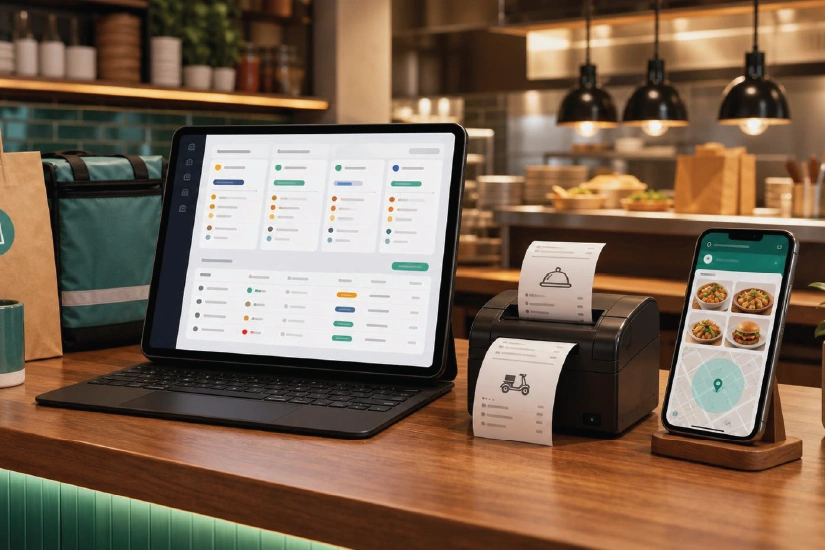
Restaurants generate operational data across reservations, menus, POS transactions, kitchen orders, inventory, and delivery platforms. Demand changes by location, day, time slot, and menu item, making fixed forecasts unreliable for purchasing and kitchen planning.
RBMSoft builds demand forecasting, conversational ordering, menu recommendation, reservation, and kitchen planning apps. LLMs and predictive models connect with POS, reservation systems, menu databases, inventory, and delivery APIs through backend services that handle order data, availability, customer requests, and model inference.
Running the same search or recommendation model across multiple countries can produce poor results when language, terminology, catalogs, inventory, and buying patterns differ by market. International applications need a model and search infrastructure that can account for those regional differences.
RBMSoft develops multilingual search, localized recommendation, demand forecasting, and customer-support apps for global retailers. Our developers work with multilingual LLMs, embeddings, vector indexes, localization services, regional catalogs, inventory APIs, and commerce backends to process queries and product data across markets.

Furniture discovery is highly visual. A shopper may have a room photo, an existing product, or a reference image rather than the keywords needed to describe the style, material, shape, or color they want.
Our custom AI app development services cover visual search, image similarity, room-image analysis, and multimodal product discovery. We connect vision models and multimodal APIs with image preprocessing pipelines, vector indexes, product catalogs, inventory APIs, and search services so visual inputs can be matched against available products.

Wholesale applications handle large catalogs, account-specific products, RFQs, purchase documents, repeat orders, and negotiated pricing. Sales and procurement teams need software that can search technical product data, extract information from documents, and identify purchasing patterns without manually processing every request.
RBMSoft builds B2B applications for semantic catalog search, reorder prediction, demand forecasting, RFQ processing, and procurement assistants. We integrate NLP, OCR, document extraction, predictive models, and LLMs with ERP, PIM, CRM, pricing databases, and procurement APIs to process account, product, document, and transaction data.

Moving an AI app from demo to production exposes problems that early testing may miss. Poor data, inconsistent model outputs, slow inference, integration failures, security gaps, and rising compute costs can all affect how the application performs after launch.
Challenge: AI apps often pull data from CRM, ERP, databases, documents, and legacy systems that store incomplete, duplicated, or outdated records. For RAG applications, poor source data and stale indexes can cause the model to retrieve the wrong context and return incorrect answers.
Solution: We audit data sources before model integration and build ingestion, cleaning, transformation, and retrieval pipelines. For RAG apps, our developers configure document parsing, chunking, embeddings, vector indexes, metadata filters, and index update jobs so retrieval uses current business data.
Challenge: LLM responses can change even when users submit similar requests, making model evaluation different from standard application testing. Incorrect retrieval, hallucinated responses, failed tool calls, and edge cases can reach users when testing covers code but ignores model behavior.
Solution: We create evaluation datasets based on expected user requests and test response accuracy, retrieval precision, tool calls, structured outputs, and failure cases. Output validation, confidence thresholds, fallback responses, and human approval are added where model results affect business actions.
Challenge: AI features often need data or actions from ERP, CRM, databases, SaaS platforms, and legacy software. Weak integration architecture can create duplicate records, failed API calls, and separate workflows that employees have to manage manually.
Solution: As an AI application development company, RBMSoft defines API contracts, authentication, data mappings, and integration flows before implementation. We use REST APIs, webhooks, event queues, and middleware to move data between models and existing business systems while handling retries, errors, and failed requests.
Challenge: Prompts, retrieved documents, model responses, and tool calls can contain customer or company data. Without defined permissions, an AI app may retrieve information a user should not see or execute an action their account is not authorized to perform.
Solution: Our AI app development services include role-based access control (RBAC), authentication, encryption, audit logging, model endpoint permissions, rate limits, and data-access policies. Tool permissions are defined separately so agents and LLM functions can only call APIs and perform actions authorized for that user.
Challenge: Model size, context length, request volume, token usage, and retrieval calls affect both response time and production cost. Real-time mobile and web applications can become slow or expensive when every request is routed through a large cloud model.
Solution: We benchmark inference latency, token consumption, context size, API cost, and compute requirements against expected traffic. Model routing, semantic caching, asynchronous jobs, smaller task-specific models, and on-device inference can be used to reduce unnecessary calls to larger models.
Challenge: Production data changes after launch. New user behavior, products, documents, terminology, and input patterns can reduce model accuracy even when the application code has not changed. Model and API updates can also alter outputs without a frontend or backend release.
Solution: We configure model versioning, tracing, drift detection, error logging, and production evaluation pipelines. New model versions are tested against existing evaluation datasets before release, with rollback controls available when accuracy, latency, or application behavior falls below the defined threshold.
Tell us where the problem starts. We’ll show you how our engineers would address it.
Every AI application has different requirements for data privacy, model access, user permissions, and regulatory compliance. As an AI app development company, RBMSoft builds authentication, encryption, audit logging, access controls, and data handling requirements into the application architecture from the start.
EU AI Act — The EU AI Act sets requirements based on an AI system’s classification and use. We build applicable applications with AI disclosures, model and action logs, human-review controls, output traceability, access permissions, and technical documentation required for the system’s classification.
GDPR — AI apps processing EU personal data must meet requirements for lawful processing, data minimization, user rights, retention, security, and certain automated decisions. We implement consent management, data deletion and export workflows, retention rules, encryption, RBAC, and audit logs across databases, model APIs, and connected systems.
UAE Personal Data Protection Law (PDPL) — AI apps processing personal data in the UAE need controls over how that information is collected, stored, transferred, and accessed. We define data flows across prompts, model APIs, databases, logs, and third-party services, then implement encryption, access permissions, retention rules, and deletion workflows.
ISO/IEC 42001 — ISO/IEC 42001 defines an AI management system for organizations developing or using AI. We support the technical side with model inventories, version records, evaluation logs, access controls, incident records, change tracking, and production monitoring.

"The team absolutely responded to our needs."
"The most impressive part about the company is its people."
"The team delivered on time and was responsive to our needs."
"Their ability to adapt to changes and proactively manage potential roadblocks is commendable."
Every technology in our stack has a defined role, from model inference and data processing to APIs, databases, cloud infrastructure, and frontend development. We select each component based on the application’s architecture, data, latency, security, and deployment requirements.
AI, ML & Data Engineering
Python

Julia

Scala

R
Application & Performance Engineering
Java
C++
Machine Learning
Scikit-learn

LightGBM
Deep Learning
TensorFlow

PyTorch

Keras

MXNet
Computer Vision

OpenCV
AI Regulations
NumPy

Pandas
Data Processing & Streaming
Apache Spark

Apache Kafka
Hadoop

Apache Airflow
Databases & Cloud Data Warehouses

PostgreSQL

MongoDB

BigQuery

Snowflake
LLM & AI APIs

OpenAI API

IBM Watson API
Azure Cognitive Services
Computer Vision APIs

Google Vision API

AWS Rekognition
Conversational & Voice APIs

Twilio
Application Visualization

Plotly
Matplotlib

D3.js
Business Intelligence

Tableau

Power BI

Jira

Trello

Slack

Basecamp
Building an AI app takes more than model integration. RBMSoft brings application engineering, ML development, data pipelines, API integration, testing, and production support into one team, so the model and the software around it are built as one product.
Choosing models or architecture before checking the data can create expensive rework later. Our team reviews the use case, user flows, data quality, model inputs and outputs, security requirements, and AI feasibility to define the application architecture before engineering starts.
AI apps can behave differently when request volume increases, source data changes, or a model API slows down. Our engineers test model outputs and application performance against production-like workloads, measuring retrieval accuracy, inference latency, API response times, concurrency, and failure behavior.
Models need controlled access to the data and functions held in ERP, CRM, databases, SaaS platforms, and internal software. Our integration engineers connect these systems through REST APIs, webhooks, event queues, and data pipelines, with permissions defined for every model and service.
Model behavior can change as data, prompts, APIs, dependencies, and model versions change after release. Our engineers monitor inference latency, retrieval performance, token and API usage, application errors, and infrastructure metrics to identify production issues and manage releases.
Stop leaving a working AI concept stuck at the prototype stage. Our AI app development services cover architecture, model integration, frontend and backend engineering, testing, and deployment to turn your use case into software your business can put into production.


The AI app development cost in 2026 can range from $30,000–$80,000 for an AI MVP, $80,000–$200,000 for a mid-complexity application, and $200,000+ for an enterprise AI application with custom models, multiple integrations, or high-volume inference.
The final cost depends on the LLM or ML model, RAG requirements, data pipelines, frontend and backend scope, third-party APIs, cloud infrastructure, security, and testing. An AI app development company should estimate model/API operating costs separately from the initial engineering budget so you can see both build and production expenses.
Ongoing costs typically include model API calls or GPU compute, cloud hosting, databases, vector storage, observability, data pipelines, security updates, and engineering support. Token volume, model choice, context length, inference frequency, and concurrent users can make model costs vary considerably between applications.
Our AI app development services include production monitoring for API usage, inference latency, errors, infrastructure consumption, and model versions. We can also use caching, model routing, smaller task-specific models, and asynchronous processing to control recurring infrastructure and inference costs.
A focused AI MVP can often take 8–16 weeks, while applications involving custom ML models, complex datasets, enterprise integrations, or regulated data may take longer. The timeline covers use-case validation, architecture, model evaluation, UI/UX, frontend and backend development, integration, testing, and deployment.
Working with an experienced AI application development company helps identify data, model, and integration problems before they appear late in development. RBMSoft can start with a narrow production use case and add functions after the initial model and application architecture have been validated.
Start by proving that AI is necessary for the problem and that you have enough usable data to support it. Define the target users, expected model inputs and outputs, acceptance criteria, failure cases, latency requirements, and expected cost per request before committing to full development.
Our custom AI app development services start with technical discovery and model validation. An AI app developer can benchmark candidate models against representative data, test output quality and inference latency, and build a proof of concept before engineering the complete application.
Put AI where it removes a specific task or decision from the existing user flow rather than adding a separate feature users have to learn. The interface should make model outputs easy to understand, edit, reject, or approve, especially when an incorrect response affects a business action.
Our artificial intelligence app development services combine model engineering with UI/UX, frontend development, analytics, and application testing. We track feature usage, completion rates, failed requests, response latency, and user corrections after release so the product team can see where users accept or abandon the AI function.
Look for an AI app development company that can handle the complete product rather than model integration alone. The team should have experience with frontend and backend engineering, LLM and ML integration, RAG, data pipelines, APIs, databases, security, testing, cloud deployment, and production model monitoring.
When comparing AI app development companies, ask how they evaluate models, test AI outputs, handle your data, integrate existing systems, control inference costs, and support the application after launch. RBMSoft works as an AI app development agency across these engineering layers, from technical discovery through production support.
Requirements depend on the application’s users, data, industry, and markets. An AI powered mobile app development company may need to account for GDPR and the EU AI Act in Europe, CCPA requirements in California, HIPAA for applicable U.S. healthcare applications, UAE PDPL, Australia’s Privacy Act and APPs, plus sector-specific requirements.
RBMSoft builds authentication, RBAC, encryption, audit logs, consent and deletion workflows, data retention controls, and restricted model access into applicable applications. When choosing an artificial intelligence app development company, confirm that its developers can implement these controls across the mobile app, backend APIs, databases, model endpoints, and third-party integrations.
Vision. Expertise. Results.
Our team guarantees exceptional results.
We've streamlined processes to maximize efficiency.
We are the trusted choice for repeat clients worldwide.