





Key Takeaways:
- Composable commerce replaces the traditional all-in-one platform approach by allowing you to build your ecommerce ecosystem using independent, best-of-breed services connected through APIs.
- It offers greater flexibility, scalability, and agility, enabling you to add, replace, or upgrade individual commerce capabilities without disrupting the entire platform.
- MACH architecture serves as the foundation of composable commerce, combining Microservices, API-first, Cloud-native, and Headless principles to support faster innovation and growth.
- Successful implementation requires a strategic approach, including clear business goals, technology assessment, phased migration, strong integrations, and robust security practices.
- Composable commerce is well-positioned for the future of digital commerce. It makes it easier to adopt AI-driven technologies, deliver personalized customer experiences, and respond quickly to changing market demands.
If you’re running an ecommerce business, you’ve likely experienced the challenges that come with growing on a traditional commerce platform. What starts as a solution that meets your needs can gradually become a limitation.
Launching new features takes longer than expected. Integrating third-party tools becomes increasingly complex, and adapting to changing business requirements often requires significant time and resources.
As your business expands across channels, markets, and customer segments, these challenges become even more apparent.
You need the flexibility to introduce new capabilities, improve customer experiences, and adopt emerging technologies without having to rebuild your entire commerce ecosystem. Yet many traditional platforms make this difficult because they rely on tightly connected architectures that can limit agility and innovation.
This is where composable commerce offers a different approach. Instead of forcing you to rely on a single platform for every commerce function, it lets you build a flexible ecosystem with specialized, API-connected services.
But what exactly is composable commerce, how does it work, and why are so many enterprises embracing this modern architecture? To see why more businesses are adopting this approach, it helps to first understand what composable commerce is and how it works.
What is Composable Commerce for B2B?
Composable commerce is a modern approach to ecommerce that gives you the freedom to build your online store using a collection of specialized software solutions instead of relying on a single platform.
You can choose the best tools for product management, search, payments, checkout, content management, and customer accounts. These tools connect through APIs and work together as a unified ecosystem.
At the core of composable commerce are Packaged Business Capabilities (PBCs). Each PBC handles a specific function, such as search, inventory, promotions, or checkout. As your business evolves, you can add, replace, or upgrade these components without disrupting the rest of your commerce environment.
Think of it as building a custom tech stack for your business. Instead of settling for a one-size-fits-all solution, you can select the tools that best align with your goals, operational needs, and the customer experience you want to deliver.
Build Commerce Your Way
Create a commerce ecosystem that adapts to your business, not the other way around.
Let’s Talk
Why Composable Commerce is Important
Composable commerce gives you greater control over your technology stack. Instead of rebuilding your entire platform, you can update, replace, or enhance individual components as your business needs change.
This flexibility helps you respond faster to customer demands, scale more efficiently, reduce vendor lock-in, and adopt new technologies with less disruption. As ecommerce continues to evolve, composable commerce provides a future-ready foundation that helps you innovate and grow with confidence.
Composable Commerce vs Headless Commerce
Composable commerce and headless commerce both offer greater flexibility than traditional ecommerce platforms, but they solve different challenges. Headless commerce development focuses on separating the frontend from the backend, while composable commerce enables businesses to build their entire commerce ecosystem using modular, best-of-breed components.
| Feature | Headless Commerce | Composable Commerce |
| Primary Focus | Frontend and backend separation | Modular architecture across the entire commerce stack |
| Architecture | Decoupled frontend and backend | Collection of independent services connected through APIs |
| Flexibility | High frontend flexibility | High flexibility across both frontend and backend |
| Customization | Primarily focused on customer experiences | Supports customization of every commerce function |
| Technology Approach | Often built around a single backend platform | Uses multiple best-of-breed solutions |
| Scalability | Scales frontend and backend independently | Allows each service to scale independently |
| Vendor Dependency | May still rely on a single commerce vendor | Reduces dependence on any one vendor |
| Innovation Speed | Faster frontend updates | Faster updates and innovation across the entire ecosystem |
| Best For | Businesses focused on customer experience improvements | Businesses seeking long-term agility, flexibility, and scalability |
| Relationship | A standalone architecture approach | Often incorporates headless commerce as one of its components |
While both approaches offer greater flexibility than traditional ecommerce platforms, composable commerce delivers broader business benefits by extending modularity across the entire commerce ecosystem. This allows you to adapt faster, improve customer experiences, and scale individual capabilities as their needs evolve.
Let’s explore the key benefits of composable commerce for B2B and why more retailers are adopting this approach.
What are Composable Commerce Benefits
Composable commerce gives you the freedom to build an ecommerce ecosystem that aligns with your business goals, customer expectations, and growth plans. Let’s look at all the benefits you can drive for your business with composable commerce.
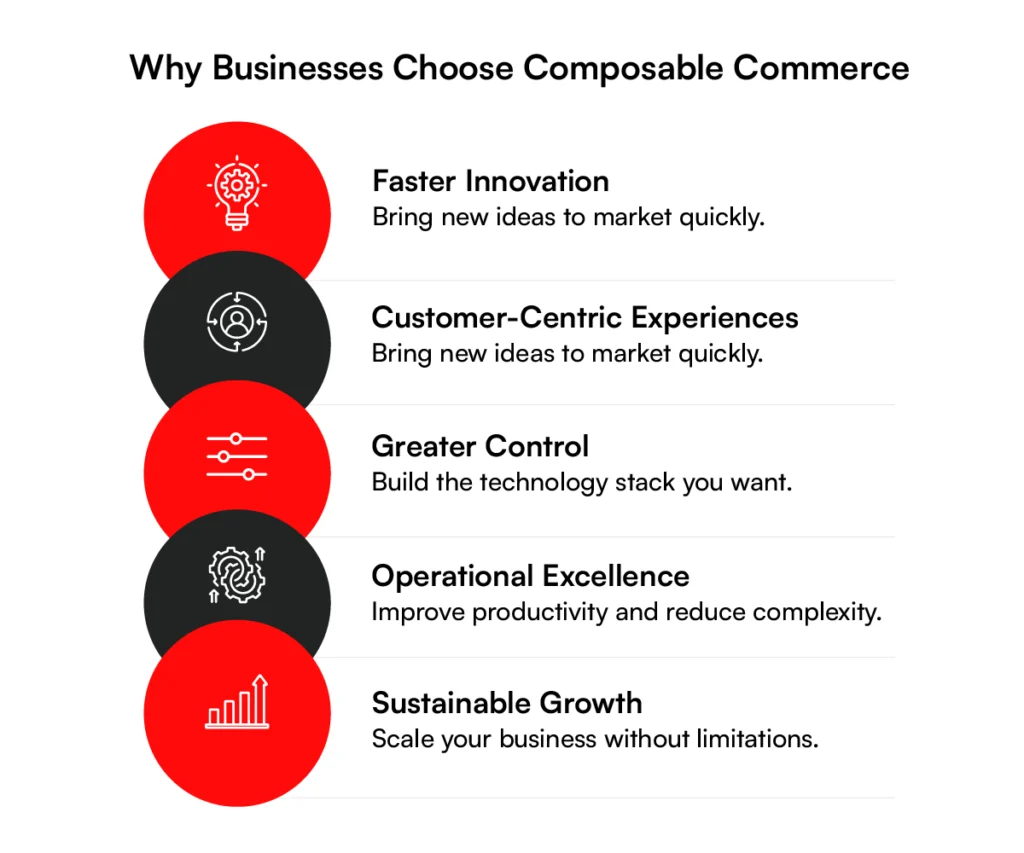
1. Unlimited Flexibility & Agility
One of the biggest advantages of composable commerce is the ability to adapt quickly to changing business needs. Traditional ecommerce platforms often require extensive development work to add new features or make significant changes.
You can update, replace, or enhance individual services without affecting the rest of your ecosystem with composable commerce.
For example, if you want to introduce a new search solution, loyalty program, or payment provider, you can integrate the new service without rebuilding your entire platform. This flexibility helps you respond faster to market trends, customer expectations, and competitive pressures.
2. Personalized Customer Experiences
Modern consumers expect personalized experiences at every stage of their shopping journey. Composable e-commerce allows you to connect specialized solutions for customer data management, content delivery, product recommendations, search, and marketing automation.
By combining these tools, you can create tailored product recommendations, personalized promotions, dynamic content, and seamless omnichannel experiences. This level of personalization helps improve customer engagement, increase conversion rates, and strengthen long-term customer loyalty.
3. Reduced Vendor Lock-In
Many traditional ecommerce platforms require businesses to rely heavily on a single vendor’s ecosystem. While this may simplify implementation initially, it can limit flexibility and make it difficult to adopt new technologies in the future.
Composable commerce gives you greater control over your technology stack. Since each component operates independently, you can select the vendors that best meet your requirements and replace them when needed. This reduces dependency on a single provider and ensures your technology strategy can evolve alongside your business.
4. Increased Efficiency
Composable commerce enables teams to work more efficiently by allowing them to focus on specific business capabilities without impacting the entire platform.
Developers can update individual services independently, while business teams can introduce new functionality without waiting for large-scale platform upgrades.
The modular architecture also simplifies maintenance and reduces the complexity associated with managing a monolithic system. As a result, you can accelerate development cycles, streamline operations, and bring new features to market more quickly.
5. Better Performance & Scalability
As your ecommerce business grows, different parts of your platform may experience varying levels of demand. A composable architecture allows each service to scale independently based on its workload.
For instance, product search, checkout, and inventory services can each scale according to traffic and usage patterns without affecting other components.
This approach improves system performance, supports business growth, and helps maintain a consistent customer experience during peak shopping periods. It also enables businesses to expand into new markets, channels, and customer segments with greater confidence.
Looking for Greater Flexibility?
Choose the technologies that fit your business today while staying prepared for tomorrow’s opportunities.
Get StartedHow Composable Commerce Architecture Works
The strength of composable commerce lies in its architecture. Instead of relying on a single, tightly connected system, it uses multiple layers of specialized services that communicate through APIs. This enables greater flexibility, scalability, and faster innovation.
MACH Architecture: The Framework of Composable Commerce
MACH stands for Microservices, API-first, Cloud-native, and Headless. These four principles enable businesses to create a modular commerce ecosystem where each component can operate, evolve, and scale independently.
- Microservices break complex commerce functions into smaller, independent services.
- API-first ensures that all services communicate seamlessly with each other.
- Cloud-native architecture provides greater scalability, reliability, and performance.
- Headless separates the frontend experience from backend commerce services, giving you greater design and development flexibility.
Together, these principles create a composable commerce architecture that supports rapid innovation, easier integrations, and long-term business growth.
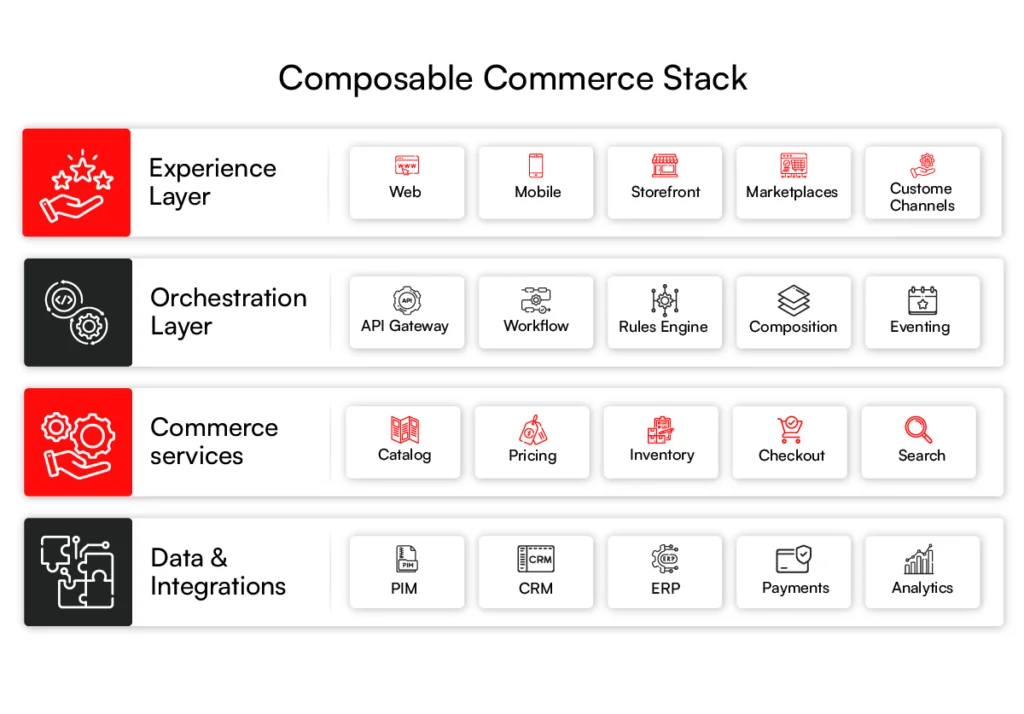
Layer 1: Experience Layer (Frontend)
The experience layer is the customer-facing part of your commerce ecosystem. It includes websites, mobile applications, customer portals, kiosks, and any other digital touchpoints where customers interact with your brand.
Imagine you’re running an online fashion store. A first-time visitor sees trending collections, while a returning customer is greeted with personalized product recommendations, recently viewed items, and exclusive offers based on their shopping history.
At the same time, your mobile app can offer a different experience than your website, even though both use the same product and inventory data.
This layer enables you to create and continuously improve these customer interactions, helping you deliver engaging and consistent shopping experiences across every touchpoint.
Layer 2: Orchestration / Middleware Layer
The orchestration layer acts as the central coordinator that connects all the independent services within your composable architecture. It manages API communication, data exchange, workflows, and business logic between systems.
For example, when a customer places an order, the orchestration layer helps connect the storefront, payment gateway, inventory system, shipping provider, and customer database. This ensures all components work together seamlessly.
Layer 3: Commerce Services (PBCs)
This layer contains the core commerce capabilities that power your online business. These capabilities are often delivered as Packaged Business Capabilities (PBCs).
Examples include product catalog management, search, checkout, cart management, pricing, promotions, payments, inventory management, and customer accounts.
Layer 4: Data & Integration Layer
The data and integration layer connects your commerce platform with internal and external business systems. This may include ERP platforms, CRM systems, marketing tools, analytics platforms, customer data platforms, and third-party applications.
This layer ensures that data flows consistently across your organization, enabling real-time insights, better decision-making, and a unified customer experience. It also helps maintain data accuracy and supports seamless integration between all parts of your technology stack.
By separating commerce capabilities into distinct layers, composable commerce creates a flexible and scalable foundation that can evolve alongside your business. Each layer plays a specific role while working together to deliver a seamless customer experience across every channel.
How to Implement Composable Commerce for B2B
Implementing composable e-commerce requires careful planning, technology evaluation, and cross-functional collaboration. Rather than replacing your entire ecommerce ecosystem overnight, the goal is to gradually build a flexible architecture that supports your business objectives while minimizing disruption.
By following a structured approach, you can create a scalable and future-ready commerce environment that evolves with your business.
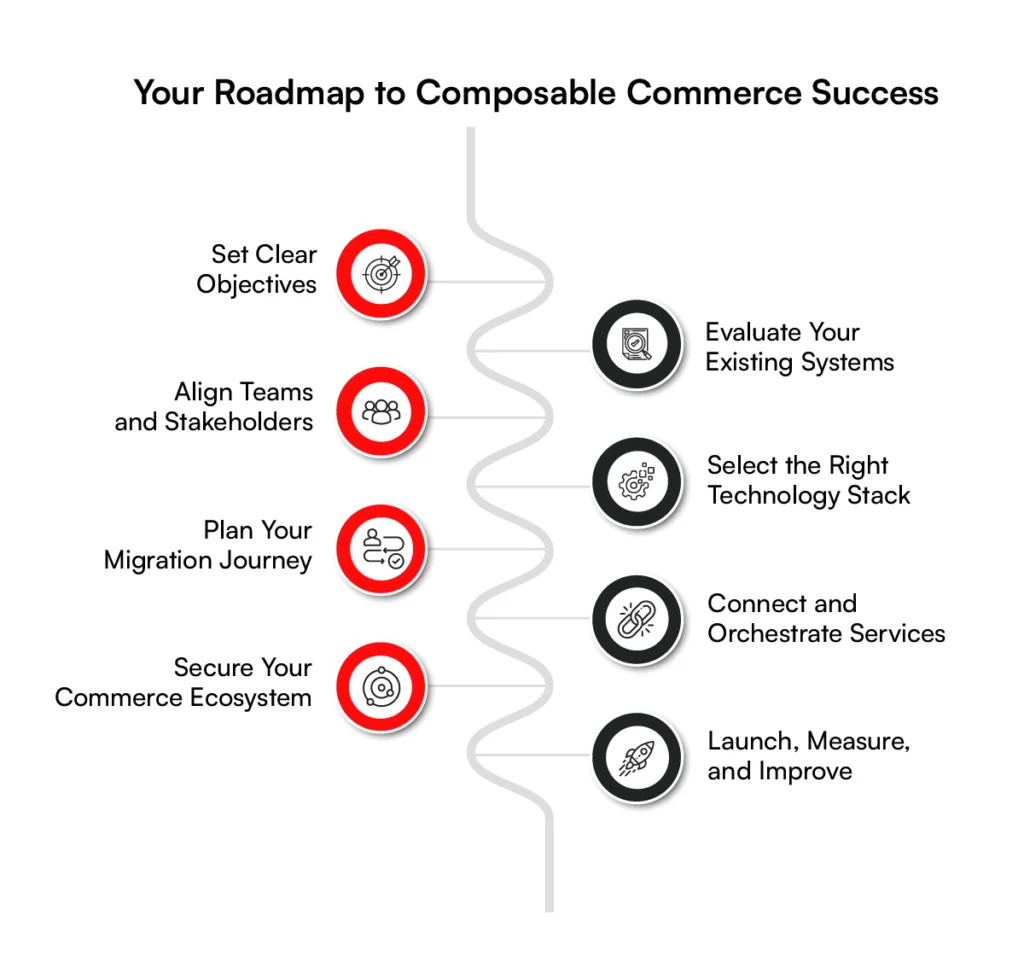
1. Assess Your Current Commerce Ecosystem
Before implementing composable commerce, evaluate your existing ecommerce platform, integrations, workflows, and customer journeys to identify what’s working and where improvements are needed. This assessment will help you determine which systems can be retained, modernized, or replaced as part of your transition.
At the same time, assess potential platforms and technologies based on security, API capabilities, flexibility, scalability, reliability, and vendor support. Choosing solutions that align with your current business needs and future growth plans will help you build a strong foundation for a successful implementation.
2. Build Internal Alignment and Prepare Your Team
Composable commerce is not solely a technology initiative. It impacts multiple teams across the organization, including ecommerce, marketing, IT, operations, customer service, and leadership.
Successful implementation requires clear communication, shared goals, and collaboration between stakeholders.
Ensure all teams understand the benefits of composable commerce, the implementation roadmap, and their role in the transition. Establish governance processes and decision-making frameworks early to reduce confusion and maintain project momentum.
3. Choose the Right Composable Commerce Platform and Technology Stack
Once your requirements are defined, select the technologies that will form your composable ecosystem. This may include solutions for content management, product information management, search, checkout, payments, customer identity, inventory management, analytics, and marketing automation.
Focus on best-of-breed solutions that offer strong API capabilities, flexibility, and seamless integration with other services. Since composable commerce is designed to evolve over time, prioritize technologies that can adapt as your business grows and customer expectations change.
4. Define Your Migration Strategy
Migrating to composable commerce is often most effective when done in phases rather than replacing every system at once. If you’re transitioning from a legacy platform, a well-planned ecommerce replatforming strategy can help minimize risks and ensure business continuity.
Many organizations modernize individual capabilities gradually while keeping critical operations running smoothly.
For example, you may begin by implementing a new content management system or search solution before replacing checkout or customer account services. A phased approach reduces risk, allows teams to learn and adapt, and minimizes disruption to customers and business operations.
5. Build and Integrate Commerce Components
After selecting your technology stack, the next step is to connect the various services into a unified ecosystem. APIs and middleware play a critical role in enabling communication between different applications, ensuring that data flows consistently across systems.
Whether a customer updates their profile, places an order, or redeems a promotion, all relevant systems must work together seamlessly. Effective integration helps create a consistent customer experience while improving operational efficiency behind the scenes.
6. Implement Robust Identity and Security Measures
As the number of connected applications increases, security becomes even more important. A strong identity and access management strategy helps protect customer data while ensuring secure interactions across every touchpoint.
Implement secure authentication methods, role-based access controls, customer identity management, and data protection policies. Regular security assessments and compliance monitoring can further reduce risk and help maintain customer trust.
7. Establish Governance and Observability
As your composable ecosystem grows, it’s important to maintain visibility and control across all connected services. Establish governance policies to define ownership, manage APIs, maintain data consistency, and ensure compliance across your technology stack.
At the same time, implement monitoring and observability tools to track system performance, identify integration issues, and resolve problems before they impact customers.
8. Test, Deploy, and Continuously Optimize
Before launching your composable commerce ecosystem, thoroughly test integrations, workflows, user experiences, and system performance. Validate that all components function correctly across devices, channels, and customer scenarios.
After deployment, continue monitoring performance metrics, customer behavior, and operational efficiency. One of the biggest advantages of composable commerce is the ability to optimize individual components over time.
This continuous improvement approach allows you to introduce new capabilities, refine customer experiences, and respond quickly to changing market demands without overhauling your entire platform.
Struggling With Complex Integrations?
Connect systems, streamline operations, and modernize your commerce ecosystem without disrupting your business.
Talk to an ExpertComposable Commerce and the Agentic Future
Agentic commerce is emerging as businesses look for smarter ways to meet rising customer expectations, manage growing operational complexity, and respond faster to market changes.
AI-powered agents can now analyze data, make decisions, and automate tasks such as product recommendations, inventory management, and customer support. If you’d like to explore this trend in more detail, read our guide on Agentic Commerce in Retail.
To support these intelligent capabilities, you need a flexible technology foundation. Composable commerce makes it easy to integrate AI-powered solutions into your existing ecosystem without replacing your entire platform. This allows you to adopt new technologies faster and continuously improve customer experiences.
As AI continues to reshape digital commerce, businesses that combine composable architecture with agentic technologies will be better positioned to innovate, scale, and adapt to changing customer and market demands.
Conclusion
Composable commerce for B2B is a strategic approach. As AI, automation, and emerging digital commerce technologies continue to evolve, a composable architecture provides the foundation needed to adapt and grow with confidence.
At RBMSoft, we help retailers and ecommerce businesses design, build, and optimize modern commerce ecosystems that support long-term business growth. Our team delivers tailored solutions through our retail software development services and deep commerce expertise.
Our capabilities include:
- Composable e-commerce consulting and implementation
- Custom ecommerce platform development and modernization
- API integration and middleware development
- Data analytics and business intelligence solutions
- AI-powered personalization and customer experience optimization
- End-to-end ecommerce software development services
You can build a commerce ecosystem that not only meets today’s requirements but is also prepared for the future of digital commerce, with the right strategy and technology partner.
FAQs
1. What is an example of composable commerce?
A typical example of composable commerce is an online retailer that combines a headless frontend, a content management system, a product information management platform, a payment gateway, a search engine, and a customer identity solution from different vendors.
These components work together through APIs to create a unified shopping experience. This approach is becoming increasingly common in composable commerce retail environments where businesses need greater flexibility and scalability.
2. What is the best composable commerce platform?
There is no single best platform for every business. The right choice depends on your requirements, budget, scalability needs, and existing technology ecosystem.
Popular providers offer different strengths, but the best composable commerce software is the one that aligns with your business goals and integrates seamlessly with your existing systems.
3. What are the benefits of composable commerce?
Composable commerce provides greater flexibility, faster innovation, improved scalability, reduced vendor lock-in, and better customer experiences. It allows businesses to adopt best-of-breed technologies and update individual capabilities without rebuilding the entire platform.
4. How do you migrate to a composable commerce platform?
A successful migration typically begins with assessing your current ecommerce ecosystem, defining business goals, and identifying the components that need modernization.
Most organizations adopt a phased migration strategy, replacing specific capabilities over time rather than rebuilding everything at once. Working with experienced composable commerce services providers can help reduce complexity and implementation risks.
5. Why are companies moving away from Magento and Salesforce to composable commerce?
Many businesses find that traditional platforms can become restrictive as their requirements grow. While platforms like Magento and Salesforce Commerce Cloud remain powerful solutions, organizations often adopt composable architectures to gain greater flexibility, faster innovation cycles, and more control over their technology stack.
A modern composable commerce solution allows businesses to select and replace technologies based on evolving needs.
6. Is composable commerce only for large enterprises, or can mid-market companies use it?
Composable commerce is no longer limited to large enterprises. Many mid-market companies are adopting composable commerce for B2C initiatives because they want greater agility without committing to large-scale platform replacements. Businesses can start small and expand their architecture as they grow.
7. What problems does composable commerce solve that Shopify and Magento cannot?
Traditional platforms provide strong out-of-the-box functionality, but they may limit flexibility when businesses require extensive customization or specialized capabilities.
Composable commerce enables organizations to select the best technology for each business function and integrate them into a unified ecosystem. This approach often provides more freedom than a single-platform composable commerce solution.
8. How does composable commerce reduce time to market for new features?
Because services operate independently, development teams can update specific capabilities without impacting the entire platform.
This modular architecture reduces dependencies, accelerates testing cycles, and enables faster deployment of new features, integrations, and customer experiences. Many businesses partner with a composable commerce agency to streamline this process and accelerate delivery.
9. What are the composable commerce risks of failure, and what goes wrong in large implementations?
The most common challenges include poor planning, unclear business objectives, integration complexity, inadequate governance, and insufficient stakeholder alignment.
Organizations that underestimate implementation complexity often experience delays and budget overruns. Working with experienced composable commerce services specialists can help mitigate these risks.
10. What are the most important KPIs to track after a composable commerce migration?
Key performance indicators typically include conversion rate, page load speed, average order value, customer retention, cart abandonment rate, customer lifetime value, deployment frequency, and time to market for new features. These metrics help measure both business impact and technical performance after migration.
11. What does a composable commerce tech stack look like?
A typical stack includes:
- Frontend experience layer (website, mobile app, customer portal)
- Content management system (CMS)
- Product information management (PIM)
- Search and discovery platform
- Shopping cart and checkout services
- Payment and tax services
- Customer identity and access management
- Order and inventory management
- Middleware and API orchestration layer
- Analytics and customer data platforms
- ERP, CRM, and third-party business integrations
This modular architecture supports both enterprise deployments and composable commerce for B2C businesses looking to scale efficiently.
12. How long does composable commerce take to deliver ROI?
The timeline varies depending on project scope, migration strategy, and business objectives. Some organizations begin seeing operational improvements within a few months, while larger transformations may take 12 to 24 months to deliver full ROI.
Businesses that leverage experienced composable commerce services and work with a trusted composable commerce agency often achieve value faster through phased implementation approaches.
13. How does composable commerce compare to headless commerce?
The discussion around composable commerce vs headless often creates confusion. Headless commerce focuses on separating the frontend from the backend, while composable commerce takes a broader approach by modularizing the entire commerce ecosystem.
In many cases, headless architecture serves as one component within a larger composable strategy.
14. Is composable commerce a good fit for B2C businesses?
Yes. Composable commerce for B2C organizations offers the flexibility to deliver personalized experiences, launch new features quickly, and scale across multiple channels.
As customer expectations continue to evolve, many B2C brands are adopting modular architectures to remain competitive and future-ready.