
Table of Contents
Quick Summary:
- Headless commerce development separates the frontend from the backend, giving you greater flexibility to build unique digital experiences.
- Businesses invest in headless commerce to deliver faster storefronts, support omnichannel experiences, and scale globally.
- A successful headless architecture relies on key components such as a backend commerce platform, frontend presentation layer, headless CMS, and APIs.
- Implementing a headless commerce solution requires careful planning, including platform selection, migration strategy, testing, and continuous performance monitoring.
- While headless commerce offers significant benefits, businesses must address challenges related to development complexity, costs, security, and ongoing maintenance.
- Choosing an experienced headless commerce development partner can help you reduce implementation risks, accelerate delivery, and maximize long-term business value.
Customers expect fast, personalized, and seamless shopping experiences across every digital channel. If your ecommerce platform struggles with slow development cycles, limited customization, or inconsistent experiences across websites and mobile apps, it may be holding your business back.
Many organizations using traditional commerce platforms find it difficult to innovate quickly or scale efficiently as customer expectations continue to evolve.
Headless commerce development addresses these challenges by separating the frontend experience from backend commerce operations, giving you greater flexibility to build, customize, and scale digital experiences.
In this guide, you’ll learn what headless commerce development is, why businesses are investing in it, the technologies involved, implementation best practices, common challenges, costs, and how to choose the right development partner.
Why Businesses Invest in Headless Commerce Development
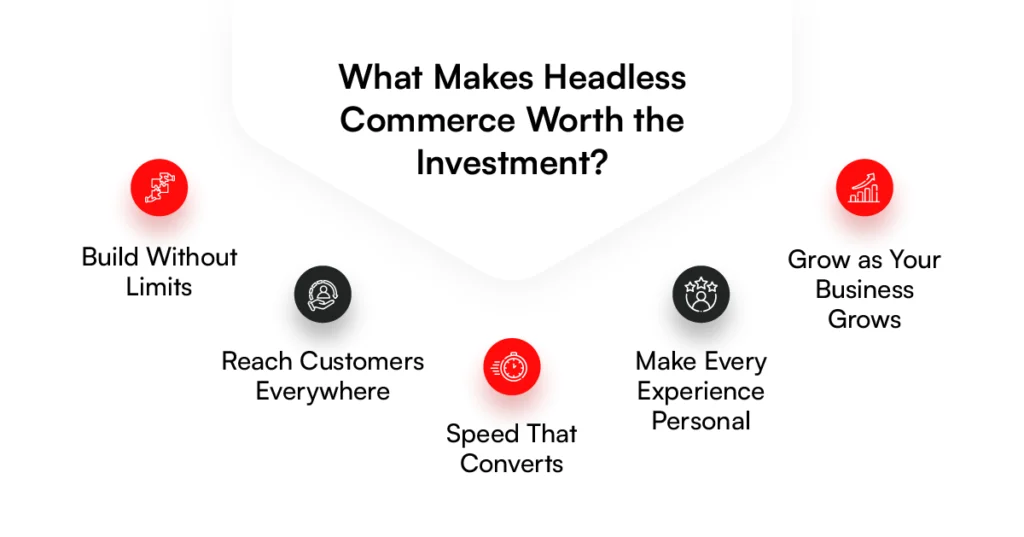
Headless commerce has become a preferred ecommerce architecture for businesses looking to improve customer experiences and accelerate digital growth. Here are the key reasons businesses are investing in headless commerce development.
1. Flexibility and Customization
Every brand wants to deliver a unique customer experience. However, traditional ecommerce platforms often limit what you can customize because the frontend and backend are tightly connected.
With headless commerce development, you are free to design and build storefront experiences that align with your brand vision. You can choose the technologies that best fit your needs.
Experiment with new features and update your customer-facing experiences without disrupting core commerce operations. This flexibility allows you to innovate faster and create experiences that truly differentiate your brand.
2. Omnichannel Experience
Your customers no longer interact with your brand through a single channel. They browse products on websites, shop through mobile apps, discover products on social media, and engage through multiple digital touchpoints. Headless commerce helps you deliver a consistent experience across all these channels.
You can reuse the same backend services across multiple customer touchpoints because commerce capabilities are exposed through APIs,
As a result, your customers receive a seamless experience no matter where they choose to engage with your brand.
3. Enhanced Performance
A slow website can directly impact conversions and customer satisfaction. Even a few extra seconds of loading time can cause shoppers to leave before completing a purchase.
Headless commerce development allows you to use modern frontend frameworks and performance optimization techniques to build faster storefronts. Since the frontend operates independently, you can optimize user experiences without affecting backend systems.
The result is a faster, more responsive shopping experience that keeps customers engaged and supports better conversion rates.
4. Personalization and Engagement
Today’s shoppers expect experiences tailored to their preferences and behavior. Headless commerce makes it easier for you to integrate AI engines, customer data platforms, analytics tools, and marketing solutions.
By connecting these systems through APIs, you can deliver ecommerce personalized recommendations, dynamic content, targeted promotions, and individualized shopping journeys. These personalized experiences help you strengthen customer relationships and encourage repeat purchases.
5. Supporting Global Scalability
If your business plans to expand into new markets, your ecommerce platform must be able to grow with you. Headless commerce development gives you the flexibility to launch region-specific storefronts, support multiple languages, and currencies. It also handles increasing traffic volumes without overhauling your entire system.
You can introduce new channels and market-specific services while maintaining consistent performance across regions. This scalability allows you to expand confidently and support long-term business growth.
As an ecommerce software development company, RBMSoft helps businesses build headless commerce systems around their existing platforms and customer channels. We connect storefronts, commerce services, customer data, and third-party tools through APIs so the architecture can support new experiences and markets as the business grows.
Planning a Headless Migration?
Reduce migration risks with a clear implementation roadmap, the right technology choices, and experienced development support.
Plan My Migration
4 Key Components of Headless Commerce Development
A successful headless commerce implementation relies on several interconnected components working together seamlessly.
Each component plays a distinct role in delivering fast, flexible, and engaging shopping experiences. Understanding these building blocks can help you design an architecture that supports both your current business needs and future growth.
1. Backend Commerce Platform
The backend commerce platform serves as the foundation of your headless commerce ecosystem. It manages core commerce functions such as product catalogs, inventory, pricing, promotions, customer accounts, carts, checkout, and order management.
Since the backend operates independently from the frontend, you can continue running essential business operations while giving your development teams the freedom to create custom customer experiences.
This separation also makes it easier to scale operations, integrate third-party services, and introduce new capabilities without disrupting existing storefronts.
2. Frontend Presentation Layer(s)
The frontend is the customer-facing layer where shoppers browse products, search for items, add products to their carts, and complete purchases. In a headless architecture, you are not restricted to a single storefront.
You can build multiple presentation layers for websites, mobile applications, smart devices, kiosks, and other digital touchpoints while using the same backend commerce engine.
This flexibility allows you to create channel-specific experiences that align with customer expectations and brand requirements. You can also leverage modern frontend frameworks such as React, Vue, or Angular to build highly interactive, fast, and responsive user experiences.
3. Headless CMS (Content Management System)
Content plays a critical role in influencing purchase decisions. Product descriptions, landing pages, blogs, banners, and promotional campaigns all contribute to the customer experience.
A headless CMS integration allows your content and marketing teams to create, manage, and publish content independently of the ecommerce platform. Because content is delivered through APIs, you can reuse and distribute it across multiple channels from a single source.
This approach enables your teams to launch campaigns faster, maintain content consistency, and deliver personalized experiences across every customer touchpoint.
4. APIs
Headless commerce api development is the backbone of any ecommerce business. They enable communication among the frontend, the backend commerce platform, the CMS, payment gateways, ecommerce CRM systems, ERP solutions, and other third-party services. Whenever a customer views a product, updates a cart, or completes a purchase, APIs facilitate real-time information exchange between systems.
Well-designed APIs allow you to integrate new services quickly, support omnichannel experiences, and scale your commerce ecosystem as business requirements evolve. Without APIs, the flexibility and agility that define headless commerce would not be possible.
How to implement a headless commerce solution
Building a headless commerce solution requires careful planning and execution. A structured approach can help you reduce implementation risks and ensure a smooth transition to a headless architecture.
1. Evaluate Your Business Needs
Before touching any technology, audit where your current stack is falling short. Look at your existing tech stack, digital footprint, integration needs, and your team’s technical maturity to define a clear vision for headless commerce that aligns with your business objectives.
This is also the stage to get stakeholder buy-in: headless is a significant shift, and it’s a major business decision requiring the right resources and stringent planning, so alignment across marketing, IT, and leadership matters early. Consider whether a phased rollout makes sense rather than an all-at-once cutover.
2. Choose the Right Headless Commerce Platform
Compare platforms on scalability, API completeness (REST vs GraphQL), flexibility, and how well they fit your existing architecture. It also helps to know that headless isn’t one single architecture but a spectrum:
- Pure Headless: front-end and back-end are decoupled and communicate via APIs. This is the simplest starting point, often a good fit for smaller teams or early-stage D2C brands.
- Composable Commerce goes a step further by combining best-of-breed services (search, payments, CMS, inventory) rather than relying on one all-in-one platform. Suits businesses with complex catalogs or workflows, like B2B.
- MACH Architecture (Microservices, API-first, Cloud-native, Headless): the engineering foundation most composable stacks are built on, favored by larger B2C operations scaling across regions and channels.
You’ll also need to select a back-end commerce platform that supports headless architecture (Shopify, BigCommerce, or Magento are common choices) and a separate and most popular headless CMS to manage content in a decoupled environment.
3. Develop a Migration Plan
With a platform chosen, map out how you’ll move without disrupting the live business. A well-laid migration plan should cover transferring all data, confirming the new system functions as expected, and making sure existing workflows aren’t harmed in the transition.
This is also where you assign ownership: we recommend naming a “captain” from each affected department to oversee their piece of the implementation and its impact on their team.
4. Ecommerce Infrastructure Setup
Set up the underlying environment: hosting, cloud resources, dev/staging/production environments, and a security baseline.
This means setting up the environment, configuring the platform, and developing the necessary integrations your business will rely on going forward. This is also the natural point to budget for ongoing infrastructure costs, not just the initial build.
5. Back-End Development (Platform-Based or Microservices-Based)
Build out the commerce engine itself: catalog, cart, checkout, pricing, promotions, inventory, and order management. You’ll decide here whether to build on a single platform-based backend or a fully composable, microservices-based architecture, where every part of the tech stack functions independently and is combined into a tailored solution.
6. Front-End Development for Different Customer Touchpoints
Build the experience layer: web, mobile app, kiosk, voice assistant, and so on, using a modern framework. Headless lets you build a React Native app, drop in a Next.js kiosk, or run an Alexa skill while proven commerce APIs handle carts, payments, and inventory.
Pay attention to rendering strategy here: fast first paint and crawlable HTML matter, since a headless single-page app that ships a blank shell to search crawlers will quietly hurt organic traffic.
7. Set Up API Connections Between Front-End and Back-End Layers
This is the connective tissue of the whole architecture. Synchronous API calls handle anything the shopper waits on (price, availability, applying a coupon, placing an order), while asynchronous webhooks handle state changes you react to, like an order being created or stock being decremented.
Some guides recommend using semantic versioning to signal risk, enforcing deprecation windows, and toggling new functionality with feature flags instead of hard cuts, so front-end and back-end teams can move independently without breaking each other.
8. Integration with Third-Party Business Systems
Connect the supporting systems that make the storefront fully functional: payment gateways, search providers, ERP, reviews, and analytics. A common composable example pairs a commerce backend with a separate ecommerce CMS for content, a dedicated search provider, and a payments processor, all connected via APIs.
9. Implementing and Testing
Once everything is built and wired together, move into structured QA. This includes functional testing to confirm all commerce features work as expected, performance testing to ensure the site loads quickly and can handle traffic spikes, and security testing to verify protection of customer data and transactions.
10. Going Live and Performance Monitoring
After cutover, the work shifts to observation and iteration. Once the store is live, the focus turns to monitoring performance, confirming everything is functioning correctly, and gathering analytics to guide continuous improvement.
Define your success metrics (adoption, productivity, ROI) and revisit them regularly, since that’s how you demonstrate the migration actually paid off, as Contentstack’s roadmap also emphasizes for the post-launch phase..
Need an Implementation Partner?
Whether you’re migrating from a legacy platform or starting fresh, we’ll help you deliver a scalable headless commerce solution.
Talk to Our ExpertsHeadless eCommerce Best Practices to Boost Security
Headless commerce gives you the flexibility to build exceptional digital experiences, but it also introduces multiple integration points that need to be secured. Following these best practices can help you protect customer data, reduce vulnerabilities, and maintain a resilient commerce ecosystem.
1. Implement Robust API Security
APIs are the backbone of headless commerce, making them a prime target for cyberattacks. Protect your APIs by implementing strong authentication methods, encryption, rate limiting, and continuous monitoring. Regular API audits can also help you identify and address potential vulnerabilities before they become serious threats.
2. Secure CI/CD Pipelines
Your development and deployment pipelines play a critical role in application security. Secure your CI/CD workflows by restricting access, scanning code for vulnerabilities, and securely managing credentials and secrets. This helps prevent security issues from entering your production environment.
3. Enforce Strong Authentication and Access Controls
Not every user needs access to every system or resource. Implement role-based access controls, enforce strong password policies, and enable multi-factor authentication to ensure that only authorized users can access sensitive systems and data.
4. Deploy Web Application Firewalls (WAF) and DDoS Protection
A Web Application Firewall helps protect your storefront from common threats such as SQL injection, cross-site scripting, and malicious bot traffic. Combining WAF with DDoS protection can further safeguard your commerce platform against traffic spikes and large-scale cyberattacks.
5. Maintain Regular Security Updates and Content Security Policies
Outdated software and integrations can expose your business to security risks. Regularly update your commerce platform, third-party services, and dependencies to patch known vulnerabilities. You should also implement Content Security Policies to control how resources are loaded and reduce the risk of client-side attacks.
Common Development Challenges and Solutions
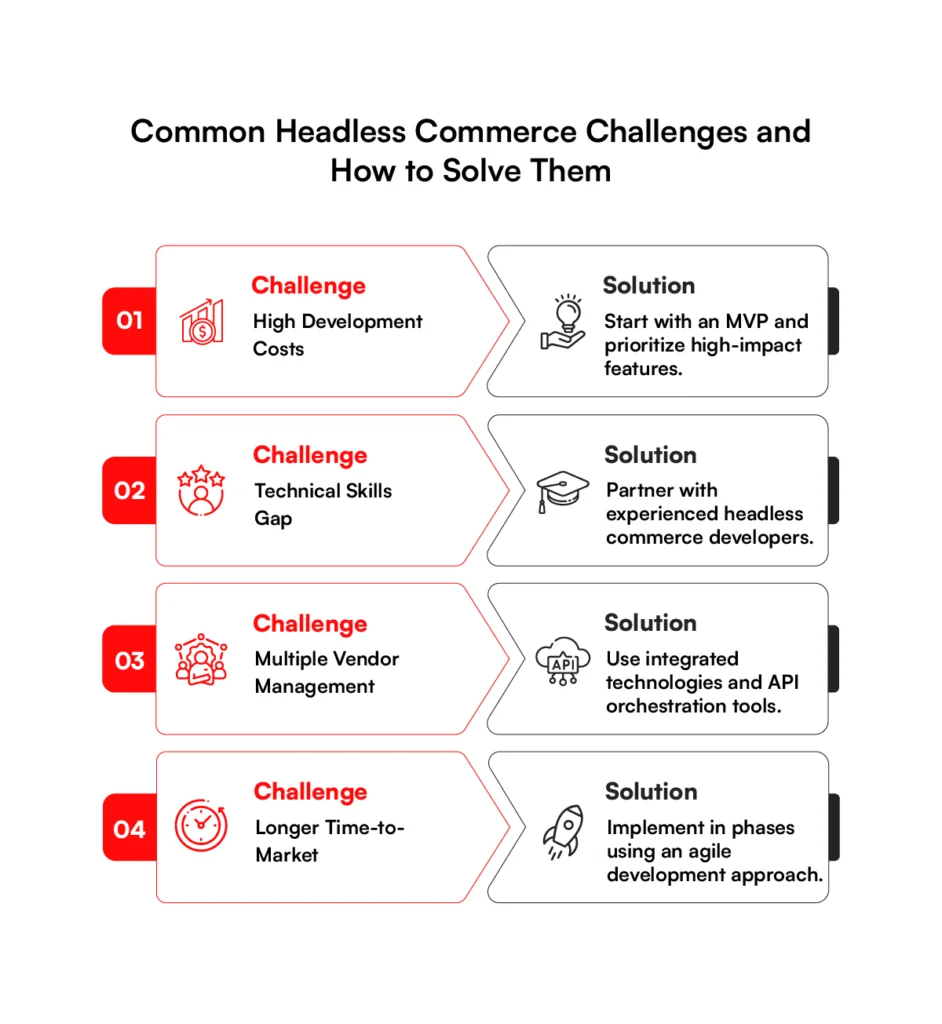
While headless commerce offers significant flexibility and scalability, implementing it is not without challenges. Understanding these obstacles early can help you plan effectively and ensure a smoother implementation journey.
1. Higher Upfront Development Costs and Complexity
Building a headless commerce solution often requires a larger initial investment than traditional ecommerce platforms. Since the frontend, backend, APIs, and integrations need to be developed and managed separately, implementation can become complex.
Solution: Start with a clear roadmap and prioritize business-critical features for your initial launch. Adopting an MVP approach can help you control costs while delivering value faster.
2. Need for Skilled Developers and Ongoing Maintenance
Headless commerce for B2B requires expertise in modern frontend frameworks, APIs, cloud infrastructure, and integrations. In addition, multiple services and applications need ongoing monitoring, updates, and optimization.
Solution: Build a team with the right technical expertise or partner with an experienced headless commerce development company. Establishing ongoing maintenance and support processes will also help ensure long-term stability.
3. Managing Multiple Vendor Relationships
A headless architecture often involves several technology providers, including commerce platforms, CMS vendors, payment gateways, search solutions, and analytics tools. Coordinating multiple vendors can increase operational complexity.
Solution: Choose technologies that integrate well with each other and define clear ownership and communication processes. Using API management and orchestration tools can also simplify integration management.
4. Longer Initial Time-to-Market
Development and integration efforts can take longer compared to deploying a traditional out-of-the-box platform, because headless commerce solutions are highly customizable,
Solution: Break the implementation into phases and launch a minimum viable product first. An agile development approach allows you to release core functionality quickly while continuously adding new features and improvements.
Make Your Migration Seamless
Whether you’re moving from a legacy platform or building from scratch, we’ll help you simplify every step of the transition.
Start My TransformationEnterprise Headless Commerce Implementation Cost
The cost of headless commerce development can vary significantly based on your business requirements and the complexity of the solution.
Factors such as the scope of frontend customization, the number of backend integrations, the technologies selected, and whether you are migrating from an existing platform or building a new composable ecosystem all influence the overall investment.
If you are looking to build a focused headless storefront with essential commerce capabilities, development costs typically start at around $75,000.
However, if your business requires a fully composable architecture with multi-region storefronts, AI-driven ecommerce personalization, ERP integration, and advanced omnichannel order management system capabilities, costs can range from $200,000 to over $1 million.
To avoid unexpected expenses, it is important to begin with detailed architecture planning and clear project scoping. Defining requirements early gives you better visibility into timelines, milestones, and the total investment needed to successfully deliver your headless commerce solution.
Why Choose RBMSoft as Your Headless Commerce Development Partner
At RBMSoft, we combine deep commerce expertise with proven delivery processes to help you modernize faster and with less risk.
1. Architecture Audit
Our headless commerce development services begin with a comprehensive architecture audit to evaluate your existing systems, integrations, and business requirements. This helps us create a roadmap that aligns technology decisions with your business goals.
2. Domain Expertise That Reduces Risk
As a trusted provider of Ecommerce IT services, we bring years of experience in delivering headless and composable commerce solutions across multiple retail industries. Our expertise helps reduce implementation risks and accelerate time-to-value.
3. A Delivery Model Aligned With Your Team
Our engineering teams integrate seamlessly with your internal processes, tools, and release cycles. This collaborative approach ensures faster delivery and complete transparency throughout the project lifecycle.
4. AI-Driven Commerce Experiences
We embed AI capabilities into your headless commerce ecosystem to enable personalization, intelligent automation, and data-driven decision-making. This allows you to deliver engaging customer experiences at scale.
5. Proven Enterprise Commerce Experience
With 50+ recurring global clients and extensive enterprise delivery experience, we have a proven track record of building and scaling modern commerce ecosystems. Our Ecommerce IT services are designed to support your long-term growth and innovation goals.
Looking for reliable Headless Commerce Development Services? RBMSoft can help you design, build, migrate, and optimize your headless commerce ecosystem.
FAQ’s
1. What is headless ecommerce?
Headless ecommerce is an architecture where the frontend is separated from the backend. This allows businesses to build custom customer experiences while managing products, orders, and other commerce functions from a centralized backend.
2. What is headless commerce architecture?
Headless commerce architecture decouples the presentation layer from the commerce engine. APIs connect these independent systems, making it easier to customize storefronts, integrate third-party tools, and scale across multiple digital channels.
3. How does headless commerce work?
Headless commerce uses APIs to exchange data between the frontend and backend. This enables websites, mobile apps, marketplaces, and other touchpoints to access the same commerce services without being tightly connected to the backend.
4. What is the top-rated headless CMS for commerce?
The right headless CMS depends on your business needs. Popular options include Contentful, Strapi, Sanity, and Storyblok. When evaluating solutions for enterprise headless commerce, consider scalability, API capabilities, integration support, and content management requirements.
5. How does headless commerce reduce time to market?
Since the frontend and backend operate independently, development teams can work on different components simultaneously. This allows businesses to launch new features, campaigns, and digital channels much faster than traditional commerce platforms.
6. How do you build a headless commerce storefront?
Building a headless storefront typically involves selecting a commerce platform, choosing a frontend framework, integrating APIs, connecting third-party services, and thoroughly testing the user experience before launch.
7. Is headless commerce worth the investment for a mid-market retailer?
For growing retailers, headless commerce can deliver long-term value through improved flexibility, faster innovation, and easier scalability. The return on investment depends on implementation costs, business goals, and the complexity of your digital commerce ecosystem.
8. What business problems does headless commerce solve?
Headless commerce helps address limited frontend flexibility, slow feature releases, difficult third-party integrations, and inconsistent customer experiences across multiple channels. It is particularly valuable for organizations pursuing enterprise headless commerce initiatives or expanding into headless commerce for B2B.
9. How much should I budget for a headless commerce implementation?
Costs vary depending on platform selection, integrations, custom development, infrastructure, and ongoing support. A phased implementation approach can help manage costs while reducing project risk.
10. What hidden costs should I expect?
Beyond implementation, businesses should budget for API usage, cloud hosting, middleware, third-party integrations, security, monitoring, and ongoing maintenance. Understanding these recurring expenses is essential when planning an enterprise headless commerce strategy.
11. How do I reduce migration risks during re-platforming?
Successful migrations begin with careful planning. Businesses should assess existing systems, migrate in phases, thoroughly test integrations, and monitor performance throughout the transition to minimize operational disruption.
12. Why do some headless commerce projects fail?
Projects often exceed budgets due to unclear requirements, poor integration planning, unrealistic timelines, or inadequate technical expertise. Defining clear objectives and following a phased implementation strategy significantly improve project success.
13. How does headless commerce impact SEO and site performance?
A well-designed headless architecture can improve page speed, Core Web Vitals, and overall user experience. Protecting SEO during migration requires proper URL management, redirects, metadata preservation, and technical optimization.
14. How do I choose the right implementation partner?
Look for a partner with experience in API-first architecture, system integrations, cloud-native development, and successful commerce implementations. They should understand both your technical requirements and long-term business objectives, especially if you’re implementing headless commerce for B2B.