





Quick Summary:
- Search users are 26% of your traffic but drive 49% of revenue, making ecommerce search relevance your highest-ROI optimization target
- Every search failure can be traced to one of three pillars: Retrieval, Ranking, or Merchandising. Fixing the wrong one wastes months
- Zero-result rates between 12 and 20% are common and fixable. Most require no architecture changes, just synonym mapping and query expansion
- Retailers who systematically optimize search see 20 to 40% improvement in search conversion within a single quarter
Search users convert at 12% compared to 4% for non-searchers and spend 2.5x more per session. They account for nearly half of all ecommerce revenue.
Ecommerce search relevance is the system controlling every one of those sessions, and for most retailers, it is also the most neglected revenue lever in their stack.
Zero-result rates range from 12 to 20% in stores without active ecommerce search optimization. At 100,000 monthly search sessions, that is up to 20,000 high-intent visits ending with no products shown.
In most cases, the products exist, but the failure is discoverability, not inventory.
Amazon’s conversion rate moves from 2% to 12% when visitors engage with search, a six-fold increase from a single interaction.
For CEOs and CTOs evaluating where to allocate engineering investment in 2026, the ROI case for ecommerce search relevance optimization is among the clearest in digital commerce. This guide shows you exactly how to capture it.
What is Ecommerce Search Relevance and Optimization?
Ecommerce search relevance is the degree to which your store’s internal search engine surfaces products that precisely match what a shopper intends to buy. Not products that share a keyword with the query. Not products from the same category.
The exact product, or the closest meaningful alternative, ranked in an order that reflects real purchase intent.
When a shopper types “tan leather ankle boot women size 8” into your search bar, full ecommerce search relevance means returning exactly that. Not all boots, not all leather goods, not tan accessories.
Every degree of gap between what a shopper expects and what they actually see is a relevance gap, and every relevance gap costs revenue.
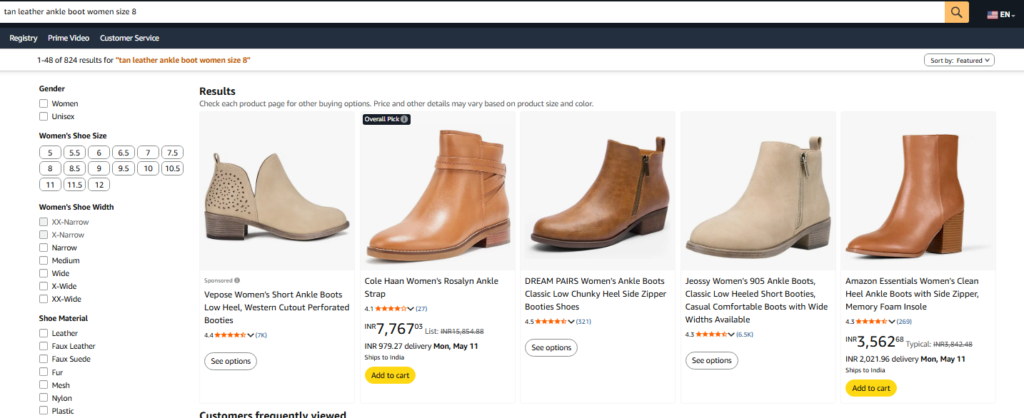
Ecommerce search relevance operates across three dimensions simultaneously. Textual relevance asks whether the result shares vocabulary with the query. Semantic relevance asks whether the result matches the meaning behind the query, even when different words are used.
Contextual relevance asks whether the result fits this specific shopper’s profile, session history, device, and moment in the purchase journey.
Most retail search engines perform reasonably well in terms of textual relevance. Semantic and contextual relevance remain significant competitive gaps for most ecommerce businesses, and closing them is where the real revenue opportunity lies.
Not sure where your search relevance stands?
Get a free Ecommerce Search Relevance Audit from RBMSoft. We will identify your highest-impact gaps in one session.
Schedule Your Free Audit
Ecommerce Search Relevance vs. Ecommerce Search Optimization
These two terms get used interchangeably, but they refer to distinct things. Ecommerce search relevance is the outcome: a qualitative and quantitative measure of how well search results match user intent.
Ecommerce search optimization is the ongoing process of improving that outcome through tuning algorithms, enriching product data, refining ranking logic, and testing changes against real KPIs.
These two terms get used interchangeably, but they refer to distinct things. Ecommerce search relevance is the outcome: a qualitative and quantitative measure of how well search results match user intent.
Ecommerce search optimization is the ongoing process of improving that outcome through tuning algorithms, enriching product data, refining ranking logic, and testing changes against real KPIs.
Retrieval vs. Ranking vs. Merchandising
Many teams treat search relevance as a single system. It is not. Three distinct pillars drive the output of every search query, and diagnosing which one is failing is the most important step before any tuning begins.
| Pillar | What It Does | Who Owns It | Primary Tool |
| Retrieval | Finds candidate products from the catalog that could match the query | Search engineering | Elasticsearch / OpenSearch |
| Ranking | Orders retrieved candidates by predicted purchase probability | Search + ML engineering | LightGBM, XGBoost, neural re-rankers |
| Merchandising | Applies commercial business rules over algorithmic ranking | Merchandising/category managers | Rule engines, search platform UI |
Poor ecommerce search relevance almost always stems from a failure in one of these three pillars. The fix in each case is completely different, which is why accurate diagnosis before tuning matters more than the tuning itself.
How Ecommerce Site Search Actually Works?
Most ecommerce teams interact with search at the surface: add a synonym, adjust a boost, tweak a rule. What sits underneath is a multi-stage pipeline, and knowing where each stage lives is what separates teams that tune effectively from teams that guess.
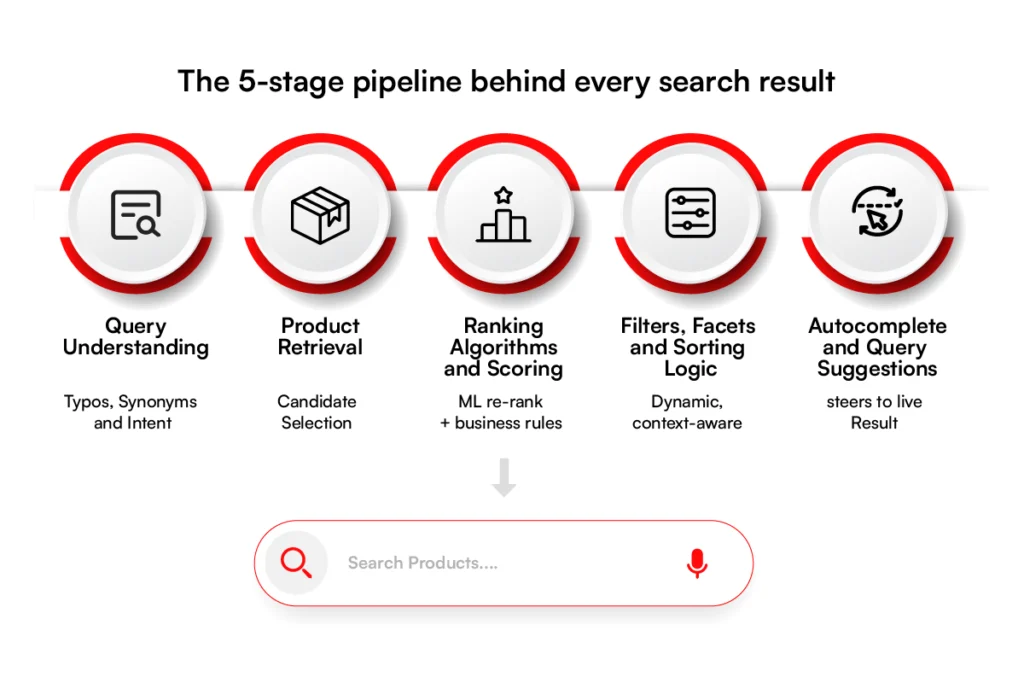
1. Query Understanding: Typos, Synonyms and Intent
Before any product is retrieved, the engine has to figure out what the shopper actually means. Shoppers do not search in catalog language. They search in their own words, with their own spelling and their own shortcuts.
Query understanding handles spell correction, synonym expansion, intent classification, and modifier detection simultaneously. NLP transformer models decompose a query like “comfortable office chair for bad back” not into keywords but into a structured intent cluster: product type, functional attribute, use context.
That structured intent drives everything downstream.
2. Product Retrieval: Candidate Selection
Retrieval pulls a pool of candidate products from the full catalog. Sparse retrieval (BM25) uses keyword matching: fast and precise on exact terms, but it fails the moment vocabulary diverges.
Dense retrieval encodes queries and products as vectors, surfacing a “moisture-wicking performance tee” for a shopper who searched “gym shirt that doesn’t get sweaty.”
Hybrid retrieval runs both in parallel and fuses the scores. For enterprise ecommerce, hybrid is the standard. Pure keywords miss too much. Pure vector over-retrieves. Together, they cover both precision and recall.
3. Ranking Algorithms and Scoring
Retrieval finds what could match. Ranking determines what appears first, and position one receives ten to twenty times as many clicks as position ten for the same query.
Modern pipelines run in stages. BM25 (Best Matching 25) or vector similarity scores are used to order the top 500 to 1,000 candidates.
An ML re-ranking model then applies features such as click-through rate, conversion rate, price position, inventory level, and margin to reorder the top 50 to 100. Personalization and business rules apply on top of that.
4. Filters, Facets and Sorting Logic
Facets accelerate the path to purchase when done well. The most common failures: filters that eliminate all results when combined, static menus that ignore query context, and attribute inconsistencies that make counts unreliable.
Dynamic faceting fixes this by surfacing only filters relevant to the current result set. A search for “running shoes” should lead with size and width. A search for “office chair” should lead with adjustability and material. A static menu treats both identically.
Search indexes can’t compute live facet counts or category-wide math across a real enterprise catalog. Arvyn’s aggregation layer does it in real time, at full scale.
Get Free Demo5. Autocomplete and Query Suggestions
Autocomplete is a relevance intervention before the query is fully formed. Good suggestions steer shoppers toward queries with strong result sets, reducing zero-result rates before they occur.
On mobile, where most ecommerce traffic now originates, it is often the difference between a session that converts and one that never gets started.
Top 5 Types of Search Relevance Algorithms for Ecommerce Businesses
Ecommerce search relevance depends on choosing the right algorithm for the right stage of the search pipeline. Each type solves a different failure. Using the wrong one for your catalog size or team capability is one of the most common gaps in ecommerce search optimization.
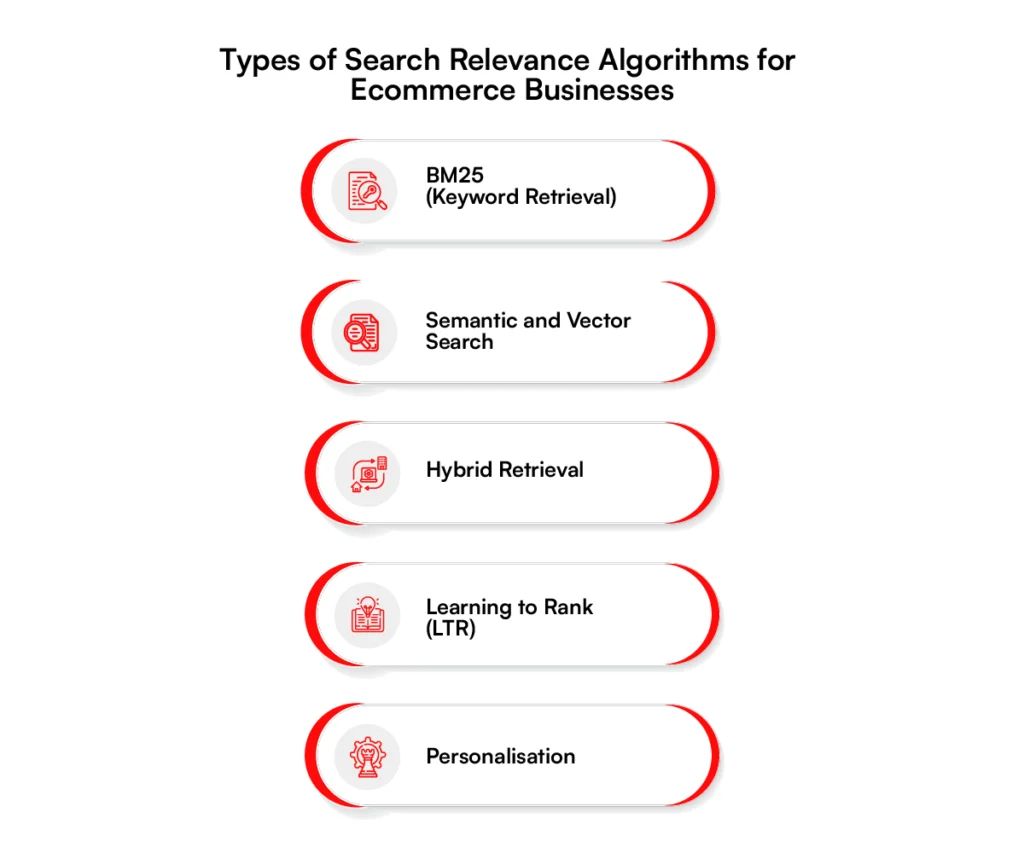
1. BM25 (Keyword Retrieval)
BM25 is the foundation of almost every production search system in ecommerce today, including Elasticsearch and Apache Solr. It ranks products by how frequently a query term appears in titles, descriptions, and attributes, weighted against how rare that term is across the catalog.
Fast, transparent, and precise on exact matches. Its hard limit: it matches tokens, not meaning. A search for “gym shirt that doesn’t get sweaty” returns nothing if no product uses those words. BM25 alone leaves significant demand unmet on any catalog where shoppers search in natural language.
2. Semantic and Vector Search
Semantic search encodes queries and products as dense vectors using transformer models such as Sentence-BERT, then finds matches by mathematical similarity rather than keyword overlap.
A shopper searching for “moisture-wicking performance tee” finds a product described as “breathable athletic top for intense workouts” because both phrases encode to nearby points in vector space.
Strongest on exploratory and long-tail queries: “beach casual outfit,” “gift for a runner,” “Scandinavian living room sofa.”
Best deployed as a complement to keyword retrieval, not a replacement, because pure vector search can over-retrieve conceptually adjacent but commercially irrelevant products.
3. Hybrid Retrieval
Hybrid retrieval runs BM25 and semantic search in parallel, merging candidate sets using Reciprocal Rank Fusion (RRF) before ranking. For enterprise ecommerce, this is the current production standard. BM25 covers precision on exact matches.
Vector search covers recall on intent-based queries. Together, they handle what neither manages alone. This is the retrieval layer most teams should build search relevance for ecommerce enterprise use cases on before adding any re-ranking or personalisation on top.
4. Learning to Rank (LTR)
LTR trains a machine learning model to predict the optimal ordering of results for a given query based on behavioral signals such as clicks, add-to-cart actions, and purchases.
The most widely used architecture is LambdaMART, a gradient boosted decision tree that optimises for NDCG. Features include BM25 score, click-through rate, conversion rate, price position, and inventory level.
LTR is Phase 2 of any serious ecommerce search relevance development roadmap. It requires clean query-level behavioral event tracking before training. Deploying it on unclean signals trains the model on noise rather than intent.
5. Personalization
Personalisation injects individual shopper signals — such as category affinity, brand preference, price sensitivity and purchase history — into the ranking model at query time. Two shoppers searching for the same term see results in a different order based on their profiles.
This layer typically delivers an additional 10 to 20% conversion lift on top of non-personalised relevance improvements
The most expensive mistake in ecommerce search relevance fine-tuning is deploying personalisation before retrieval and ranking are stable. Personalising a broken result set produces a personalised broken experience.
Why Ecommerce Search Relevance Matters for Revenue
Shoppers who use your search bar are not browsing. They have moved past discovery and consideration and straight into intent. They know what they want. They typed it. What happens in the next three seconds determines whether that intent becomes a purchase or a competitor’s sale.
High-Intent Behavior of Search Users
Search users are the highest-value segment on any ecommerce site, and the numbers reflect that clearly. Searchers make up just 26% of ecommerce traffic yet drive 49% of total site revenue and 57% of all add-to-cart activity. Their conversion rate is 12%, triple that of non-searchers at 4%.
Amazon’s own data puts the sharpest point on it. Its conversion rate moves from 2% to 12% when visitors engage with search. That is a six-fold increase from a single interaction type.
Most ecommerce teams know search matters. Very few invest in it proportionally to what it actually produces.
The Real Cost of Poor Ecommerce Search Relevance
Poor search relevance is not a UX problem. It is a revenue problem, and the costs run deeper than the immediate loss of the sale.
Every paid acquisition click that lands where search fails destroys return on ad spend (ROAS) before a product page even loads. Every zero-result query turns away a visitor who just declared purchase intent.
Every misranked result erodes trust in the site, reducing the probability of that session converting and the likelihood of that shopper returning.
Research puts a number on the damage. 69% of shoppers go straight to the search bar when they visit an ecommerce site. But 80% leave when the experience falls short.
According to Google Cloud research, 8 in 10 shoppers say they will buy elsewhere after a failed search, and 8 in 10 say they actively avoid sites where search has let them down before.
Impact on Conversion Rates and Revenue
The financial case for ecommerce search relevance investment is one of the clearest in digital commerce. The relationship is direct: relevant results reduce the time between query and product found, which raises add-to-cart rates and, in turn, conversion.
Optimizing site search delivers measurable returns across every key metric. AI-powered search implementations produce an average 43% increase in conversion rates among search sessions.
Zero-result searches affect 10–20% of all on-site queries at stores that have not actively optimized search. Reducing them can improve sitewide revenue by 5–10%. Top-performing stores maintain a zero-result rate under 2–3%, and anything above 10% signals a broken search experience.
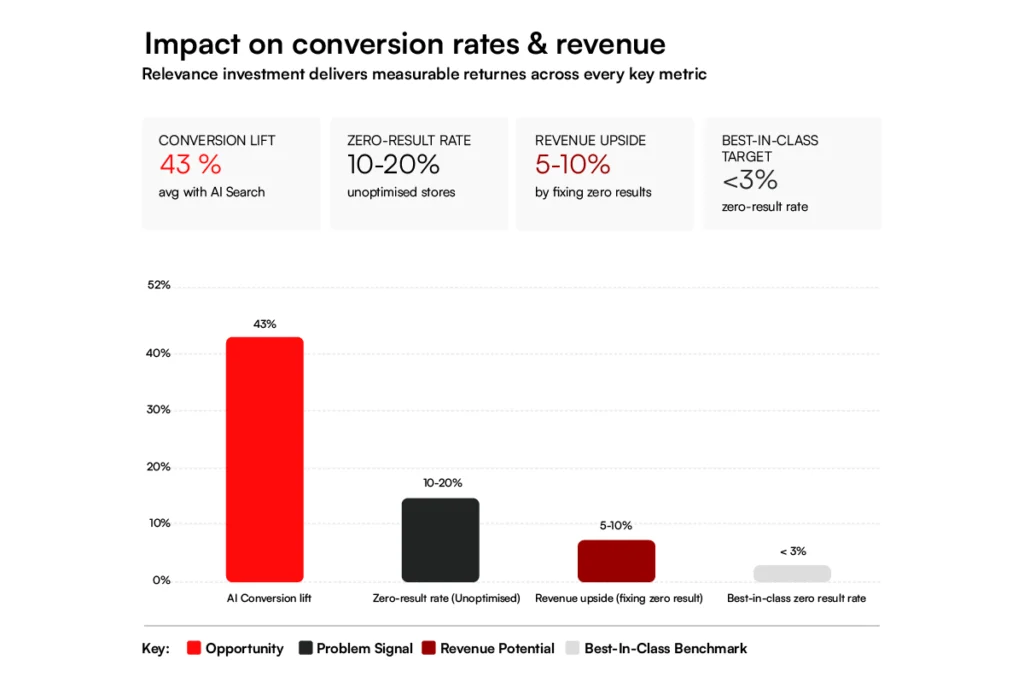
Zero-Results Searches and Lost Demand
A shopper who gets zero results does not refine their search, explore categories, or wait. They leave. Zero-result queries are not a UX inconvenience. They are a direct revenue exit for visitors who arrived with purchase intent already formed.
Most stores that have not actively invested in ecommerce site search optimization run zero-result rates of 10 to 20%. At 100,000 monthly search sessions, that is up to 20,000 high-intent visits ending with no products shown. In most cases, the products exist in the catalog. The failure is discoverability, not inventory.
| Failure Mode | Immediate Impact | Downstream Cost |
| Zero-result queries | Shopper exits immediately | Lost revenue, damaged trust |
| Wrong products surfaced | Shopper scrolls, fails, leaves | High bounce rate |
| Irrelevant top results | Shopper loses confidence | Lower repeat purchase rate |
| Missing synonym coverage | Valid products invisible | Permanently lost demand |
| Out-of-stock items ranking first | Click leads to a dead end | Frustration exits to the competitor |
Measuring Ecommerce Search Relevance
Quantitative metrics tell you whether performance is improving. They do not tell you why. A complete measurement program combines KPIs that surface problems early with quality evaluation that explains what is broken.
3 Key KPIs
Search KPIs are split into two categories. Leading metrics signal problems early, before revenue is visibly affected. Lagging metrics confirm that fixes delivered real commercial value.
1. Leading metrics to review weekly: Zero-result rate, click-through rate from search, query abandonment rate, and search exit rate. A zero-result rate above 10% signals a broken experience. A search exit rate above 25% indicates results do not match intent.
2. Lagging metrics to review monthly: Conversion rate from search, revenue per search session, and add-to-cart rate. These confirm whether recovered shoppers are actually buying. Search relevance is, at best, a means to an end: the real targets are revenue, profit, and conversion rate.
3. The ideal cadence: Leading metrics reviewed weekly, business metrics reviewed monthly and a full qualitative assessment conducted quarterly.
Building a Search Relevance Program
Most search-relevance problems are not technological problems. They are ownership problems. The platform exists, the data exists, but no single team is accountable for the outcome. That is where programs stall.
Who Owns Ecommerce Search Relevance?
In most retail organizations, search ownership is fragmented. Engineering owns the platform. Merchandising owns the rules. Analytics owns the data. Nobody owns the KPIs.
That fragmentation is one of the primary reasons 85% of companies lack dedicated search optimization resources despite search being their highest-converting channel.
The fix is a search product owner: one person accountable for zero-result rate, revenue per search session, and click-through rate from search, coordinating across engineering, merchandising, data science, and analytics. Without that role, improvements are episodic rather than continuous.
Search Optimization Workflows
A sustainable program runs on cadenced workflows rather than reactive fixes.
- Weekly: review the zero-result query report, add high-volume misses to the synonym dictionary, and flag query-level CTR anomalies for investigation.
- Bi-weekly: review A/B test results, deploy winning ranking changes, update query rules for active campaigns.
- Monthly: full KPI review against benchmarks, catalog data quality audit for top-performing categories, re-train the behavioral ranking model with recent click data.
- Quarterly: human judgment relevance evaluation, competitive benchmarking, technology roadmap review.
Ecommerce Search Relevance Audit Checklist
Before investing in new technology or architecture changes, audit what exists. The ten highest-priority checks:
- Measure current zero-result rate, CTR, and revenue per search session against benchmarks
- Pull the top 500 queries by volume and assess the result quality for the top 50 manually
- Identify the top 20 zero-result queries and classify the root cause for each
- Audit the synonym dictionary coverage across the top 10 product categories
- Check attribute completeness for the top 1,000 SKUs
- Test spell correction against the top 20 known misspellings in your category
- Review mobile search performance separately from desktop
- Evaluate facet accuracy and dynamic update behavior
- Test autocomplete suggestions for the top 100 queries
- Assess out-of-stock handling across top search result positions
Your Search Is Costing You Revenue. Let’s Fix That.
Get a Free Search Performance AuditTop 6 Common Challenges in Achieving Ecommerce Search Relevance and Optimization
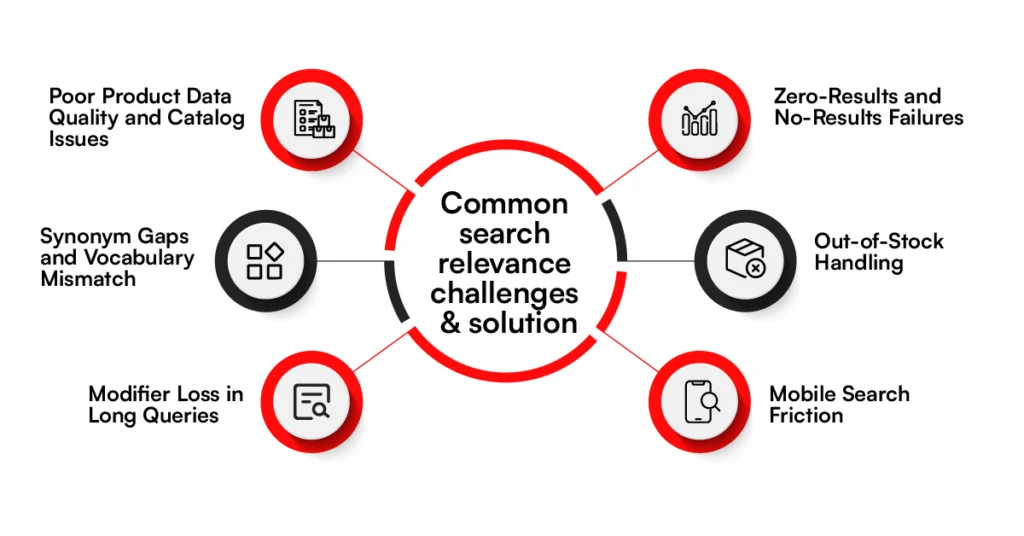
Getting search relevance right is harder than configuring a platform. The challenges span product data, linguistic complexity, system architecture, and day-to-day operations. These are the ones that appear most consistently across enterprise retail engagements.
1. Poor Product Data Quality and Catalog Issues
Search engines can only rank what catalogs describe. When product data is incomplete, inconsistent, or inaccurate, no ranking algorithm compensates for it.
Missing attributes, inconsistent naming conventions across supplier-fed SKUs, and descriptions written in internal jargon rather than shopper language all lead to relevance failures that appear to be search problems but are actually data problems.
2. Synonym Gaps and Vocabulary Mismatch
Shoppers use their own language. Catalogs are organized around buyer and merchandising conventions. That gap between the two is the single largest cause of zero-result queries.
Shoppers search “joggers”, but the catalog says “sweatpants.” They search “comforter”, but the catalog says “duvet.” The product exists. The shopper just cannot find it.
3. Modifier Loss in Long Queries
Traditional keyword engines focus on the primary noun in a query and drop the modifiers. A search for “lightweight waterproof running shoes for flat feet” becomes a search for “running shoes.”
The intent of stability and waterproofing is lost entirely. Proper intent parsing at the query-understanding stage prevents this.
4. Zero-Results and No-Results Failures
Zero-result queries are the most acute form of search failure. In most retail search audits, zero-result rates range from 12 to 20% before any optimization work, and unoptimized stores can reach 15 to 30%.
At 10% on 100,000 monthly search sessions, 10,000 high-intent visits are turned away each month, usually due to a vocabulary mismatch rather than a missing product.
5. Out-of-Stock Handling
Out-of-stock products that continue surfacing in top positions create a compounding problem. The shopper clicks, finds the item unavailable, and leaves.
That interaction also trains the behavioral ranking model to associate that product with clicks that do not convert, quietly degrading future relevance.
6. Mobile Search Friction
Most search relevance programs are designed and tested on a desktop. Mobile queries are shorter, more typo-prone, and far less tolerant of irrelevant results. A single failed search page on mobile drives higher abandonment than the same failure on desktop.
Mobile commerce needs its own configuration: tighter autocomplete, higher spelling tolerance, and result pages built for a smaller viewport.
5 Ecommerce Search Optimization Fundamentals
These are the foundational capabilities every search system needs before advanced techniques deliver any real value. Getting these right first is also the fastest way to improve ecommerce search relevance without rebuilding the entire search engine.
1. Synonym Mapping and Taxonomy Alignment
Build synonym coverage in three tiers. First, manually curate core synonyms for your top product categories. Every merchandising team knows the 50 most common vocabulary mismatches in their catalog. Second, use AI-discovered synonyms from embedding models trained on your product data.
Third, let the system learn behavioral synonyms continuously from click patterns. If shoppers searching for “runners” consistently click products tagged “athletic shoes,” that equivalence gets applied automatically.
Taxonomy alignment ensures your internal category structure maps to how shoppers actually navigate. “Bottoms > Casual” means nothing to a shopper searching for “everyday trousers.”
2. Spell Correction and Typo Tolerance
Effective spell correction in ecommerce requires product-specific dictionaries, not general English ones. Brand names, model numbers, and category-specific terms need explicit handling. Set edit-distance thresholds by query length: one character of tolerance for short queries, two for longer ones.
Tighter thresholds on short queries matter most, since approximate matching on two or three characters produces false positives that hurt precision.
3. Attribute Normalization
Inconsistent attribute values across a catalog create invisible barriers. “Blue,” “blue,” “BLUE,” and “Navy Blue” represent the same value break, faceted search and hurt relevance.
Normalization standardizes these into a consistent taxonomy. Color, size notation, material, fit type, and brand name formatting are the highest-priority targets.
4. Query Rules and Intent-Based Ranking
Query rules are explicit instructions that override algorithmic ranking for specific queries. They are the merchandising team’s primary lever for ecommerce search relevance fine-tuning without touching the underlying algorithm. Surface sale items first for queries containing “cheap” or “discount.”
Promote a specific brand for navigational brand queries. Suppress irrelevant categories when the session context makes them clearly out of place.
5. No-Results Optimization
Teams that implement systematic no-results recovery, including fuzzy matching, synonym expansion, query relaxation, and category fallbacks, typically bring zero-result rates from the 12–20% range down to under 2–3%.
Top-performing ecommerce stores maintain a zero-result search rate below 2–3%, and anything above 10% signals a broken discovery experience.
Advanced Ecommerce Search Relevance Tuning
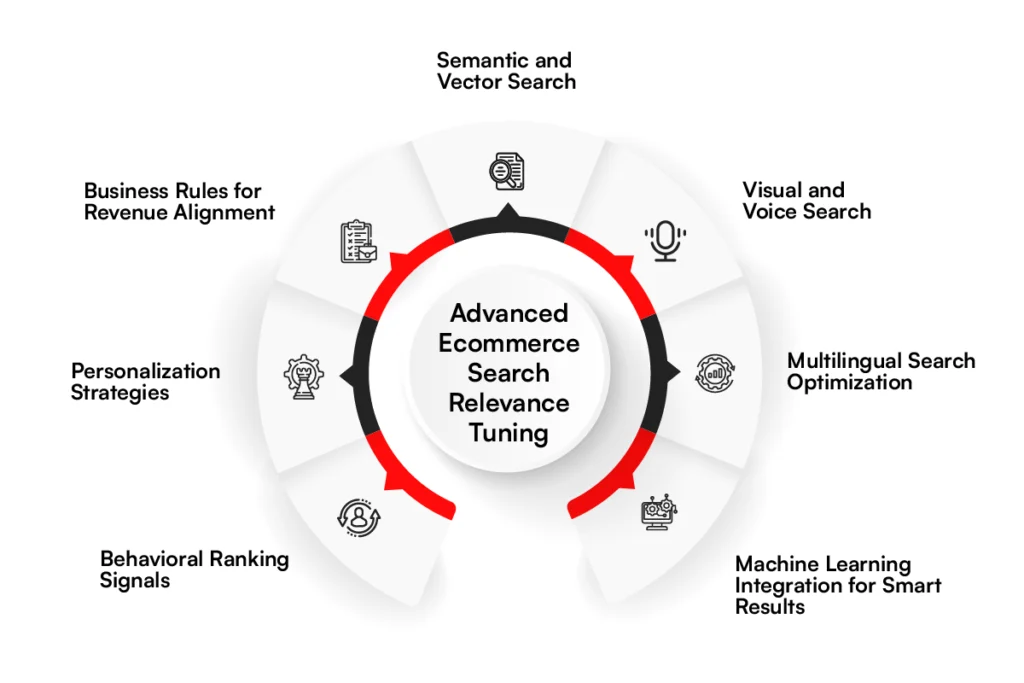
Once the fundamentals are stable, tuning moves into territory that separates good search from genuinely competitive search. These are the techniques that compound over time.
1. Behavioral Ranking Signals
Shoppers generate relevance signals constantly through clicks, add-to-carts, and purchases. Closing the loop from that behavioral data back into ranking is one of the highest-ROI investments in ecommerce search relevance development.
The implementation: capture every search interaction event, stream it via Apache Kafka, process rolling click-through and conversion rates per query-product pair via Apache Flink, and feed those signals as features into the ML re-ranking model.
Products that convert well for specific queries rise. Products that get clicked but not purchased fall. The system improves without anyone having to intervene.
2. Personalization Strategies
Two shoppers searching for the same term should not necessarily see the same results. A returning customer with a history of premium brand purchases should see premium options ranked higher. A price-sensitive shopper should see the opposite.
Feature stores maintain shopper profiles: category affinities, price sensitivity, brand preferences and purchase history. At query time, these profile features are injected into the ranking model alongside query-level signals. The result is relevance that adapts to the individual, not just the query.
3. Business Rules for Revenue Alignment
Algorithmic ranking optimizes for the shopper. Business rules align with commercial priorities: promoting high-margin products within relevant result sets, surfacing clearance items for price-sensitive queries, suppressing products below inventory thresholds, and applying geo-specific availability rules.
These rules sit above the algorithm and apply without adding latency to the search response.
4. Semantic and Vector Search
Where keyword search matches tokens, semantic search matches meaning. A vector representation of the query is compared against vector representations of all products. Items that are conceptually related to the query surface are considered candidates even with zero vocabulary overlap.
Semantic search delivers its strongest results on exploratory queries: “beach casual outfit for vacation,” “gift ideas for runners,” “Scandinavian living room sofa.” These are high-value query types that keyword-only systems consistently underserve.
5. Visual and Voice Search
Visual search lets shoppers upload an image and find similar products. It is particularly valuable in fashion, home decor, and furniture, where shoppers often encounter something they want before knowing what to search for.
Voice queries are structurally different from typed ones: longer, more conversational, and phrased as questions rather than keyword strings. Processing them requires stripping question structure and extracting the underlying product intent before standard retrieval begins.
5. Multilingual Search Optimization
For retailers operating across markets, multilingual search requires more than translation. Each language carries its own synonym landscape, regional vocabulary, and product naming conventions. Multilingual ecommerce search relevance needs language detection at query time, language-specific synonym dictionaries, and ranking models trained on language-specific behavioral data.
6. Machine Learning Integration for Smart Results
Machine learning in Ecommerce enhances search relevance by continuously learning from user interactions and behavior patterns. Production systems require model-serving infrastructure using TensorFlow Serving or similar platforms to handle thousands of predictions per second under strict latency requirements.
Feature engineering pipelines extract behavioral signals from user data, creating input vectors for sophisticated ranking models that adapt in real-time without full retraining cycles through online learning algorithms.
Best Practices For Ecommerce Search Relevance And Optimization
Most ecommerce search optimization projects fail not because the technology is wrong but because the sequence is wrong. Teams jump to personalization before fixing zero-result rates.
They deploy ML re-ranking before behavioral data is clean enough to train on. A phased implementation strategy prevents these expensive missteps.
Strategic Assessment and Planning
Before any configuration change or technology investment, establish an honest baseline. A practical assessment covers five areas: current zero-result rate and root causes, synonym dictionary coverage across top product categories, attribute completeness for top SKUs, mobile search performance measured separately from desktop, and whether click and conversion events are being captured cleanly enough to train a ranking model.
This takes two to four weeks and produces a prioritized gap list. Without it, optimization effort gets distributed evenly across problems of very uneven importance.
Ecommerce Search Relevance Technical Implementation Roadmap
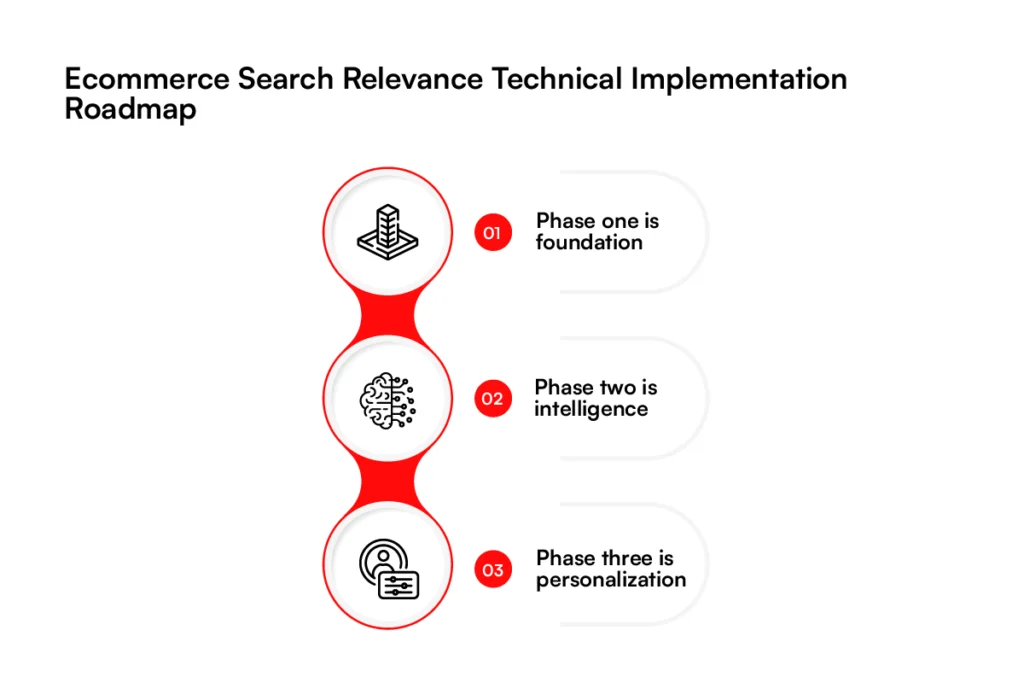
A three-phase approach is standard across enterprise retail engagements.
- Phase one is foundation: fix data problems before adding intelligence. Attribute normalization, synonym coverage for the top 500 query patterns, spell correction calibrated to your catalog, and out-of-stock handling deliver immediate ecommerce search relevance improvement with no ML complexity. Most retailers who stall on ecommerce search relevance implementation do so here, skipping data cleanup in favour of adding new technology on top of a broken foundation.
- Phase two is intelligence: instrument click, add-to-cart, and purchase events at the query level, build the feature pipeline, and deploy a re-ranking model in shadow mode before it takes over live ranking. Use NDCG to assess ranking quality and implement regular retraining to keep the model up to date with changing user preferences.
- Phase three is personalization: with clean signals and a working ranking model, personalization becomes viable. A/B testing different ranking strategies helps identify approaches that work best for specific goals, whether optimizing for relevance, conversion rates, AOV, or margin.
The Mobile-First Imperative
No ecommerce search relevance implementation is complete without treating mobile as a separate configuration problem. When shoppers use a website’s internal search bar on mobile, conversion rates are four times those of visitors who do not use search.
The gap between mobile traffic share and mobile revenue share is a direct measure of mobile search friction, and closing it often delivers the highest short-term ROI available to any ecommerce search team.
Build vs. Buy
Choosing the right search relevance architecture and framework for enterprises is not purely a technology decision. It is a resourcing, timeline, and total-cost-of-ownership decision. The wrong choice at this stage forces an expensive migration 18 months later.
| Approach | Best For | Upside | Downside |
| Elasticsearch / OpenSearch | Large catalogs, strong engineering team | Full control, lowest cost at scale | Requires significant internal expertise |
| Managed SaaS (Algolia, Coveo, Lucidworks) | Mid-market, limited ML capacity | Fast to deploy, pre-built ML models | High cost at volume, vendor dependency |
| Hybrid | Enterprise with complex requirements | Custom where it matters, managed where it does not | Integration complexity |
Retailers that outgrow managed platforms consistently overpay before switching. The migration pays for itself faster than most teams expect.
When to Bring in Search Relevance Experts
Most enterprises attempt to build search relevance for ecommerce enterprise use cases internally before realising the gap between a functional search configuration and a revenue-optimised one. These are the signals that the gap has become too expensive to close without specialist help.
A zero-result rate above 10% with no clear downward trajectory. A search team spends more than half its time on ecommerce search-relevance fine-tuning through manual synonym updates and rule maintenance, rather than on strategic optimization.
No ML re-ranking model in production. No A/B testing framework for search changes. Search infrastructure costs are growing faster than search-driven revenue.
At RBMSoft, our experience providing IT services for retail shows that most retailers underestimate how much revenue is lost in the first 10 seconds of a poor search experience.
The firms that recover fastest are not the ones that hire more merchandisers. They are the ones that invest in ecommerce search relevance development with engineers who have solved the same problem across multiple catalogs and platforms.
RBMSoft’s Case Studies
The designer footwear retailer was running a platform that could not keep pace with fashion retail’s speed. Search behavior, sizing accuracy, and promotional workflows required tuning, and the system had to support rapid updates without disrupting customer journeys.
The search configuration was the bottleneck, not the catalog. RBMSoft restructured the delivery model so that search changes could ship without destabilizing live traffic.
The Midwest multi-category retailer carried farm supply, outdoor, and home products across dozens of stores and channels. The core challenge was centralizing information across various retail touchpoints and enhancing integrations with logistics and ERP vendors to enable quicker and more reliable order handling.
Shoppers searching for in-stock products were routinely shown items unavailable at their location. Fixing search meant fixing inventory unification first.
The pattern is consistent. Search failures in retail are rarely a single cause. They sit at the intersection of data quality, platform configuration, and integration reliability.
Fixing one without the others produces temporary improvement. A specialist engagement that diagnoses all four produces durable results.
Does your catalog have the same problems as DSW and Fleet Farm?
The only difference is whether you fix them first or your competitors do.
Talk to a Search Relevance ExpertHow to Test and Measure Ecommerce Search Relevance?
You cannot improve what you do not measure, and in search relevance, the wrong metrics send teams in the wrong direction. The framework below covers both technical quality and business impact.
| KPI | Target | Warning Threshold |
| Zero-result rate | Below 2% | Above 8% |
| Click-through rate from search | Above 65% | Below 40% |
| Add-to-cart rate from search | Above 18% | Below 10% |
| Revenue per search session | 2.5x site average | Below 1.5x site average |
| Query abandonment rate | Below 20% | Above 35% |
| NDCG (ranking quality score) | Above 0.80 | Below 0.60 |
| Mean Reciprocal Rank | Above 0.70 | Below 0.50 |
1. Search Quality Evaluation Frameworks
Quantitative metrics tell you whether performance is improving. They do not tell you why. Quality evaluation adds the missing layer.
Human judgment evaluation puts trained reviewers on a sample of query-result pairs, rating each on a four-point relevance scale. Results are averaged to produce an NDCG score that benchmarks search quality against industry standards.
Offline testing runs ranking model changes against historical click data before any live deployment. Relevance annotation builds a curated set of 500 to 2,000 query-product judgments specific to your catalog, used as ground truth for evaluating algorithm changes without requiring live traffic.
2. Query-Level Performance Tracking
Aggregate metrics hide the individual query failures that cost the most revenue. Query-level tracking surfaces the specific problems: which queries have the highest zero-result rate, which have high impressions but low click-through rate, and which drive volume but no conversion.
This granular view is what makes optimization work at a targeted level rather than a broad one. Improving an average while leaving the highest-volume failures untouched is a common and expensive mistake.
3. A/B Testing and Experimentation
No search relevance change should go live without a test. Split search sessions randomly into control and treatment groups, measure impact on revenue per session and conversion rate with statistical significance, and run tests for a minimum of two weeks to capture weekly behavioral patterns.
4. Leading vs. Lagging Metrics
Leading metrics (zero-result rate, click-through rate, query abandonment) signal problems early, often before revenue is visibly affected. Lagging metrics (conversion rate, revenue per session) confirm that fixes delivered real commercial value.
The ideal evaluation frequency: leading metrics are reviewed weekly, business metrics are reviewed monthly, and a full qualitative assessment is conducted quarterly.
The Future of Ecommerce Search Optimization
The fundamentals of ecommerce search relevance have not changed. Understand what the shopper wants, return products that match and rank them by likelihood to convert.
What is changing is how each of those steps is executed and how quickly the gap widens between teams that keep up and those that do not.
AI-Driven Search
Keyword matching is giving way to intent understanding, and this shift is already in production at scale. AI-powered ecommerce search optimization now delivers personalized, context-aware results by analyzing browsing history, past purchases, and interaction patterns.
The practical consequence is that maintaining ecommerce search relevance is no longer a matter of rules. It is a data problem.
Models trained on thin or biased behavioral signals produce biased rankings. Clean catalog data and clean click signals are what separate teams running good AI search from teams running AI search that fails in production.
Conversational Commerce
The search bar is beginning to merge with the chat interface, opening a new front in ecommerce search optimization.
A shopper who knows what they want will still type a query and expect a ranked list. But a shopper in the consideration phase is increasingly served by conversational flows that narrow intent through dialogue rather than filters.
The more effective approach integrates conversation into the core of commerce search, allowing shoppers to describe what they need in their own words and receive curated product results grounded in catalog data, while retaining the merchandising control of a traditional search experience
Structured Data
Structured data has moved from a technical nice-to-have to core infrastructure for ecommerce search relevance and external discoverability.
Visibility is now negotiated across Google rich results, AI Overviews, and generative platforms that increasingly summarize, recommend, and cite sources. What is consistent across these surfaces is one requirement: machine-readable meaning.
The catalog hygiene that makes on-site ecommerce search optimization work, consistent naming, complete attributes and accurate availability, is the same hygiene that makes structured data work. They are the same investment, and the return compounds across both channels.
What Remains Constant
Shoppers arrive knowing what they want. Whether they find it depends entirely on how well your search understands them.
Speed, relevance, and recovery from failure have been the three variables that determine ecommerce search relevance since the first search bar was built, and they will remain the three variables regardless of whether the interface is a search bar, a chat window, or a voice command.
The teams that win over the next cycle are not the ones who adopt every new interface first. They are the ones who have invested in clean data, strong behavioral signals, and a disciplined ecommerce search optimization process, because those are the inputs every new interface will depend on. The architecture changes. The data requirements do not.
Partner with RBMSoft for Search Excellence
Achieving retail search excellence requires specialized tools and technical expertise. RBM Software provides advanced solutions for search relevance tuning, enabling retailers to implement BM25-neural integration, contextual ranking, and real-time optimization through cloud-native architectures.
Technical partnerships include implementing modern search architecture with containerized deployments and standardized API integrations with existing e-commerce platforms.
RBM Software’s solutions provide comprehensive analytics and monitoring capabilities essential for ongoing optimization success.
The transformation from basic search to revenue-driving discovery engine isn’t just a technical upgrade—it’s a strategic imperative that determines which businesses thrive in the AI-powered commerce future.
Give RBMSoft a call today for a free consultation. We’ll show you exactly how Search Relevance tuning can speed up your business growth. While your competitors are still figuring things out, you’ll already be ahead.
FAQs
1. What is ecommerce search relevance?
Ecommerce search relevance is the degree to which your store’s internal search engine returns products that match what a shopper actually intends to buy. It combines textual matching, semantic understanding, and contextual signals.
High relevance means the right products appear first for every query. Low relevance means shoppers see results that do not match their intent, and they leave.
2. How to improve ecommerce search relevance?
Start with measurement. Establish your zero-result rate, CTR from search, and revenue per search session as baselines. Fix vocabulary gaps through synonym mapping. Enable fuzzy matching for spelling tolerance.
Suppress out-of-stock products. Implement a no-results recovery cascade. Those five changes alone typically deliver a measurable improvement within 60 days without touching the underlying architecture.
3. What causes poor search results in ecommerce despite well-structured catalogs?
Usually vocabulary mismatch. The product exists, but the words used to describe it in the catalog do not match the words shoppers use to search for it.
Other common causes: missing attribute values that prevent facet matching, overly restrictive query parsing that requires exact phrase matches, and out-of-stock handling that removes matching products without surfacing alternatives.
4. What is semantic search in ecommerce?
Semantic search matches queries to products based on meaning rather than keyword overlap. A query for “moisturizer for sensitive skin” can surface a product described as “gentle hydrating serum for reactive skin” even though none of the exact words match.
It works by encoding both queries and products as vectors and finding the closest matches mathematically.
5. How to measure ecommerce search performance?
Track two sets of metrics. Information retrieval metrics: NDCG above 0.80, Mean Reciprocal Rank above 0.70, zero-result rate below 2%. Business metrics: CTR from search above 65%, add-to-cart rate above 18%, revenue per search session at 2.5 times the site average. Review leading metrics weekly. Review business metrics monthly.
6. What are the best ecommerce search tools and platforms?
For smaller catalogs with limited engineering resources, Algolia and Coveo offer fast time-to-value. For larger catalogs with strong engineering teams, Elasticsearch and OpenSearch provide the best combination of performance, customizability, and cost efficiency.
For enterprises needing pre-built ML ranking, Lucidworks Fusion sits on top of Solr. The right choice depends on catalog scale, engineering capacity, and long-term cost tolerance.
7. Is improving ecommerce search relevance the same as optimizing filters and navigation?
No. Faceted navigation is a browsing paradigm for shoppers who want to explore. Search handles explicit intent queries from shoppers who know what they want.
Both matter, and both affect product discoverability, but they are different systems with distinct failure modes and optimization levers. Improving one does not automatically improve the other.
8. What is the fastest way to improve search relevance without rebuilding the search engine?
Synonym mapping for top zero-result queries, fuzzy matching for spelling tolerance, out-of-stock suppression, a no-results recovery page, and query-level business rules that boost high-converting products for specific queries.
None of these requires architectural changes. Most can be deployed within days. Together, they typically reduce zero-result rates by 40 to 60% within 60 days.
9. How does AI-powered personalization improve ecommerce search relevance and conversions?
Personalization adapts search rankings to individual shoppers based on behavioral signals such as browsing history, past purchases, price sensitivity, and brand preferences. Instead of every shopper seeing the same result order, a shopper with a history of premium purchases sees premium products ranked higher.
A price-sensitive shopper sees budget options prioritized. That personalization layer typically delivers an additional 10 to 20% lift in conversion beyond non-personalized relevance improvements.
10. What is the ideal frequency to evaluate search relevance in ecommerce stores?
Leading metrics weekly. Business metrics monthly. A full qualitative evaluation, including human judgment scoring across a sample query set, quarterly. Ranking models are retrained monthly or whenever the behavioral data volume doubles since the last training cycle.
11. How long does it take to implement ecommerce search relevance in an enterprise?
Quick wins deliver results within 4 to 8 weeks. A full architecture upgrade, covering hybrid retrieval, ML re-ranking, personalization, and behavioral signal integration, takes 3 to 6 months to build and another 2 to 3 months to reach peak performance as behavioral data accumulates.
Most clients see 15 to 25% improvement in revenue per search session within 90 days and 30 to 50% improvement within 12 months.
12. How can RBMSoft help with ecommerce search relevance development and implementation?
RBMSoft covers the full program: audit, implementation, fine-tuning, infrastructure migration, and catalog enrichment. Every engagement starts with a diagnostic audit rather than a solution recommendation, so investment is directed at the actual failure point rather than assumed problems.
For enterprises evaluating where to start, the audit is a two to three-week exercise that produces a prioritized roadmap with specific KPI targets and timelines.