




Table of Contents
Quick Summary:
- An ecommerce recommendation engine uses customer behavior, product data, and shopping patterns to recommend products each shopper is most likely to buy.
- Businesses can choose from collaborative, hybrid, contextual, sequential, or demographic recommendation methods based on their data, catalog size, and personalization goals.
- The biggest business benefits include higher conversions, increased average order value, improved product discovery, reduced manual merchandising, and better inventory decisions.
- A successful implementation requires the right technology, reliable customer data, well-defined business rules, and seamless integration across the ecommerce storefront.
- Long-term performance depends on solving challenges such as cold starts, limited customer data, scalability, privacy compliance, changing customer intent, and algorithmic bias.
Every irrelevant product recommendation is a missed sales opportunity. When shoppers struggle to find products that match their interests, they often leave without buying or purchase fewer items. For ecommerce businesses, this results in lower conversion rates, reduced average order value, and lost revenue.
As online stores grow, solving this problem becomes more difficult. Expanding product catalogs, changing customer behavior, real-time inventory, and multiple sales channels make manual merchandising difficult to manage. Static recommendation rules such as “Best Sellers” or “Customers Also Bought” cannot adapt quickly to changing customer intent.
To overcome these limitations, an ecommerce product recommendation engine analyzes behavioral signals, product attributes, and purchase data to generate more relevant recommendations. Before exploring how these systems work, let’s first understand what an ecommerce product recommendation engine is.
What is an ecommerce product recommendation engine?
An ecommerce product recommendation engine is a software system that identifies products a shopper is most likely to buy and displays them at different stages of the buying journey. Rather than showing identical product suggestions to every visitor, it delivers recommendations based on individual shopping behavior and business rules.
To generate these recommendations, the engine analyses multiple data points, including browsing history, search queries, purchase history, cart activity, product relationships, and customer preferences. It continuously evaluates these signals to determine which products are most relevant for each shopper at that moment.
For example, a customer viewing a DSLR camera may also receive recommendations for compatible lenses, memory cards, and camera bags. The recommendation engine matches customer behavior with product relationships to surface relevant products throughout the shopping journey.
How Does an Ecommerce Product Recommendation Engine Work?
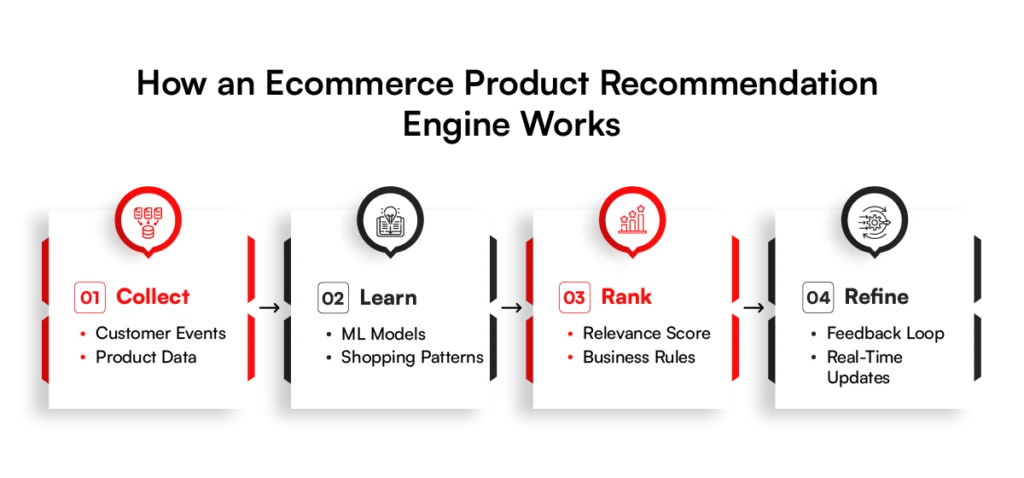
An ecommerce product recommendation engine identifies the products each shopper is most likely to buy by analyzing customer behavior and product data. It follows four steps to generate and continuously improve recommendations in real time.
1. Collect customer and product data
The process starts by capturing customer interactions across the ecommerce platform, including search queries, product views, clicks, cart activity, purchases, and returns. At the same time, it collects product data such as categories, attributes, pricing, availability, inventory, and ratings to create a unified data foundation for recommendations.
This data is consolidated through integration pipelines that connect the ecommerce platform with PIM, CRM, OMS, CDP, and event collection and analytics platforms such as Google Analytics 4 (GA4), Adobe Analytics, and Snowplow.
Before recommendations are generated, the data is validated, standardised, and enriched to ensure the recommendation engine works with accurate and consistent information.
2. Identify shopping patterns
Once sufficient data is available, the recommendation engine analyses customer interactions to discover purchasing and browsing patterns.
It identifies relationships between products and customer segments by evaluating behavioral signals such as co-purchases, repeat purchases, product affinity, browsing sequences, and session history.
Machine learning models use these signals to build customer and product embeddings, group similar shoppers, and detect buying preferences that may not be visible through rule-based analysis alone.
As new interactions are processed, the models continuously retrain to improve pattern recognition and adapt to changing shopping trends.
3. Rank and recommend products
The recommendation engine passes the candidate product set through a ranking layer, where each item receives a relevance score based on ranking features, merchandising rules, inventory availability, pricing, promotional priorities, and business constraints.
Enterprise recommendation engines also apply re-ranking and real-time inference to optimize recommendation accuracy while supporting merchandising strategies and campaign priorities.
The highest-ranked products are then served across product pages, search results, shopping carts, emails, and checkout flows. Ranking scores are continuously refreshed as new customer events are processed, allowing recommendations to adapt in near real time.
4. Continuously refine recommendations
Recommendation engines continuously monitor new customer events, including product views, searches, cart updates, purchases, and abandoned sessions.
These real-time feedback signals are processed through event streams and feedback loops to improve the performance of the selected recommendation model, whether it uses collaborative filtering, content-based filtering, or a hybrid approach.
The recommendation pipeline then refreshes ranking scores or performs incremental model updates using the latest customer interactions. This enables recommendations to remain relevant throughout the shopping journey instead of relying solely on historical data.
The recommendation pipeline remains largely the same across ecommerce platforms. What changes is the recommendation approach used to identify relevant products. The choice depends on the available data, catalogue structure, customer behaviour, and business requirements.
What are the types of ecommerce product recommendation engines?
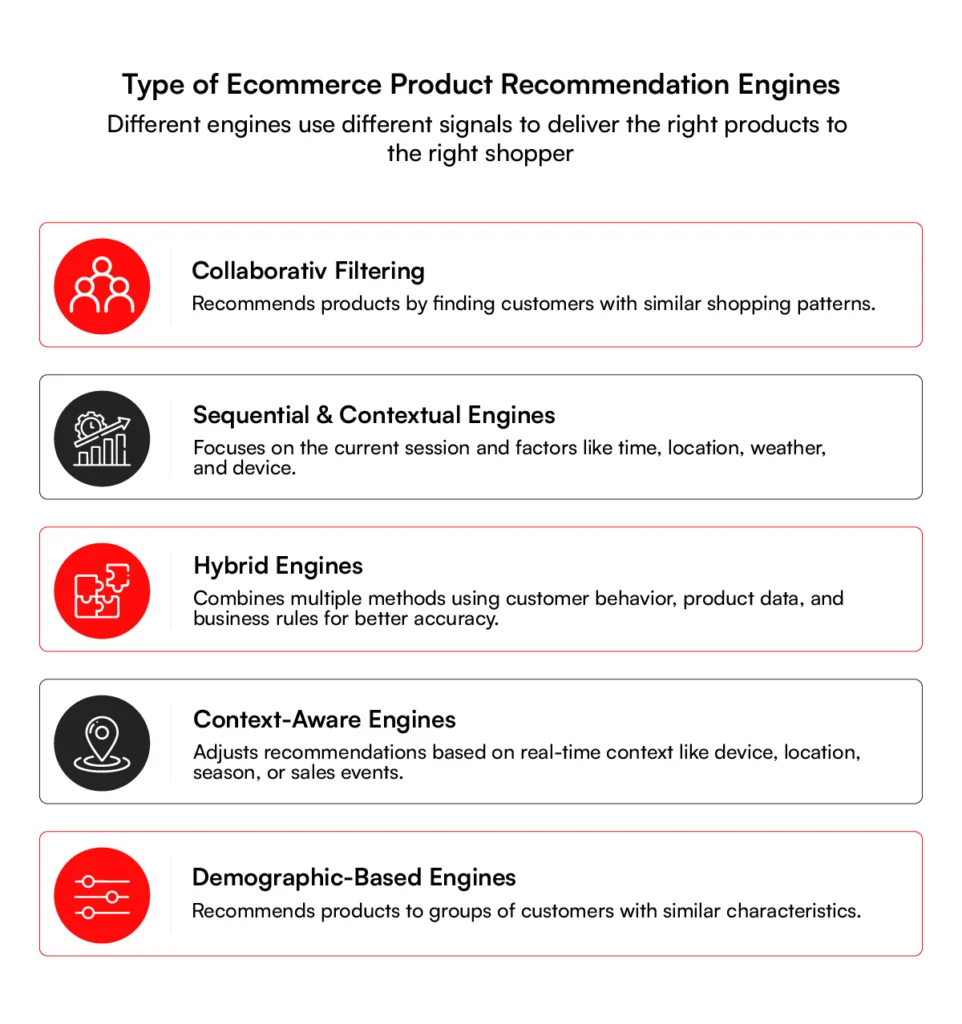
Ecommerce product recommendation engines recommend products in different ways. The right model depends on your data, customer behaviour, and personalization goals. Below are the five most common recommendation engine types.
1. Collaborative Filtering
A collaborative filtering recommendation engine recommends products based on patterns in customer behavior and interactions across an ecommerce platform. It uses behavioral signals such as product views, purchases, ratings, wishlists, and cart activity to identify similar customer profiles or product affinity.
There are two common approaches: user-based collaborative filtering, which identifies customers with similar shopping patterns, and item-based collaborative filtering, which identifies products that are frequently viewed or purchased together.
This recommendation approach performs well for personalization, cross-selling, and upselling because it learns from historical interaction data instead of predefined merchandising rules.
However, it depends on sufficient behavioral data. New customers and newly added products often lack enough interaction history to generate reliable recommendations, a limitation known as the cold-start problem.
2. Content-Based Recommendation Engine
A content-based recommendation engine recommends products by matching customers with items that share similar product attributes. It uses structured product data such as category, brand, price, colour, material, specifications, keywords, and product descriptions to calculate product similarity.
These product attributes are then matched with a customer’s browsing and purchase history to generate personalized recommendations.
Content-based recommendation engines are a good fit for businesses with well-maintained product catalogs because they can recommend newly added products without waiting for customer interaction data to accumulate.
Their effectiveness depends on consistent, high-quality product metadata. Missing or inaccurate attributes reduce product similarity calculations and make recommendations less relevant.
3. Hybrid Recommendation Engines
A hybrid recommendation engine combines multiple recommendation techniques to generate product recommendations. Most hybrid models combine collaborative filtering and content-based filtering while also incorporating business rules, popularity signals, and real-time behavioral data.
The recommendation engine applies weighted scoring to these inputs before ranking products, allowing recommendations to adapt to different customer journeys and shopping scenarios.
Hybrid recommendation engines produce reliable recommendations because they do not rely on a single data source. They also reduce the impact of the cold-start problem by using product metadata when behavioral data is limited and customer interaction data as it grows. This makes hybrid recommendation engines the preferred choice for most enterprise ecommerce platforms.
4. Sequential and Contextual Recommendation Engines
A sequential and contextual recommendation engine recommends products by analyzing the order of customer actions and the current shopping context.
Sequential models learn from searches, product views, clicks, add-to-cart actions, and purchases to predict the next likely interaction, while contextual models use signals such as device type, location, time, weather, and promotions to personalize recommendations.
These recommendation engines use technologies such as Transformer-based architectures, Recurrent Neural Networks (RNNs), and context fusion to analyze behavioral and contextual signals in real time.
They are commonly used in fast-moving retail sectors such as fashion, grocery, travel, and consumer electronics, where customer intent changes quickly.
5. Context-Aware Recommendation Engines
A context-aware recommendation engine recommends products by analyzing the customer’s current shopping context during an active session.
It uses contextual signals such as device type, location, time of day, weather, referral source, active promotions, and inventory availability to rank products for that specific session.
Recommendations change as the customer’s session context changes, even for the same shopper. For example, a customer browsing from a mobile device during a seasonal promotion may receive different recommendations than when visiting the same store from a desktop after the promotion ends.
Retailers commonly use context-aware recommendation engines for localised merchandising, mobile commerce, and event-driven campaigns.
6. Visual AI Recommendation Engine
A visual AI recommendation engine recommends products by analyzing visual characteristics extracted from product images. It uses computer vision, image embeddings, and computer vision models to identify similarities in colour, pattern, texture, shape, and design. Customers can discover visually similar products even when product titles, categories, or descriptions differ.
Visual AI recommendation engines are widely used by fashion, beauty, furniture, and home décor retailers, where visual appearance plays a major role in product selection.
They support image-based search and shop-the-look experiences, helping customers find similar products from a photo or an existing catalogue item. Accurate recommendations depend on high-quality product images and consistent image labeling.
Related read: AI Product Recommendation Engine Development for Scalable eCommerce
Develop a Recommendation Engine That Fits Your Business
RBMSoft builds custom ecommerce recommendation engines that integrate seamlessly with your existing systems and customer data.
Speak With Our Team
What are the Benefits of an Ecommerce Product Recommendation Engine?
An ecommerce recommendation engine helps retailers increase sales, improve conversions, reduce manual merchandising, strengthen merchandising decisions, and deliver more personalized shopping experiences. These benefits improve both business performance and the customer experience.
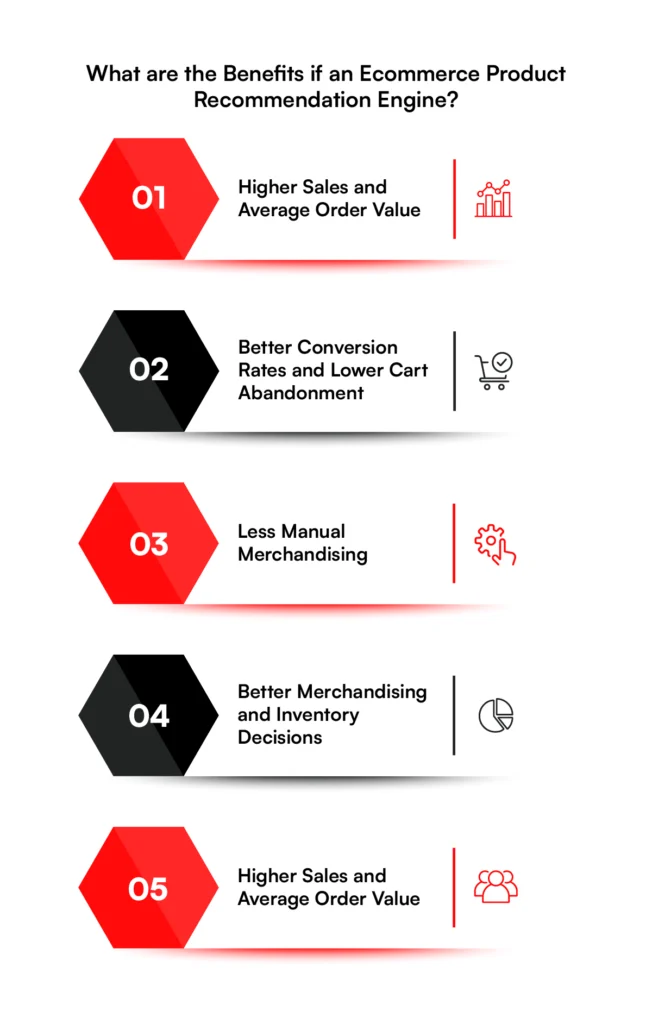
1. Higher Sales and Average Order Value
A product recommendation engine increases sales and average order value by recommending products that match a customer’s current buying intent. It analyzes behavioral data, product affinity, and purchase patterns to identify complementary products, premium alternatives, and frequently bought together items across product pages, the shopping cart, and checkout.
Relevant recommendations increase the likelihood of customers adding more items to their basket or selecting higher-value products without interrupting the purchase flow. Higher recommendation accuracy generates more revenue from existing website traffic without increasing customer acquisition costs.
2. Better Conversion Rates
A product recommendation engine increases conversion rates by presenting relevant products throughout the buying process. It analyzes browsing behavior, search queries, product affinity, and customer preferences to rank products across search results, category pages, and product pages, reducing the number of searches and product comparisons before purchase.
Faster product discovery increases the likelihood of completing a purchase. Recommendation engines integrated with AI-powered search return relevant products earlier in the shopping journey, helping more visitors become customers.
3. Lower Cart Abandonment
A product recommendation engine reduces cart abandonment by keeping relevant products visible after they have been added to the cart. It recommends complementary products, suitable alternatives, or previously viewed items to reinforce purchase decisions before checkout.
Relevant recommendations keep shoppers moving through the checkout process and reduce the likelihood of abandoned carts. They also help returning customers continue from where they left off instead of rebuilding their shopping basket.
4. Less Manual Merchandising
A product recommendation engine reduces manual merchandising by automatically maintaining product relationships across large ecommerce catalogues. It identifies related products using customer behavior, product affinity, and product attributes as products, prices, inventory, and seasonal collections change.
This reduces the need to manually update merchandising rules while keeping recommendations aligned with catalogue changes. Merchandising teams can spend more time on pricing, promotions, and campaign planning instead of maintaining product relationships.
5. Better Merchandising and Inventory Decisions
A product recommendation engine improves merchandising and inventory decisions by identifying product relationships and changing customer demand. It generates data on product affinity, purchase patterns, conversion rates, and category performance to support product placement, inventory planning, and promotional activities.
Recommendation analytics also highlight products with low visibility, changing demand, and missed cross-selling opportunities. These patterns support merchandising and inventory decisions based on customer behavior instead of manual assumptions.
6. A More Personalized Shopping Experience
A product recommendation engine creates a personalized shopping experience by tailoring product recommendations to each customer. It analyzes preferred brands, price ranges, browsing behavior, purchase history, and product affinity to display products that match individual shopping preferences.
Recommendation engines also recommend complementary products and accessories throughout the shopping session, giving customers additional options as they browse. Personalized recommendations reduce repetitive product searches and present products that are more relevant to each customer’s interests.
Challenges of an Ecommerce Product Recommendation Engine
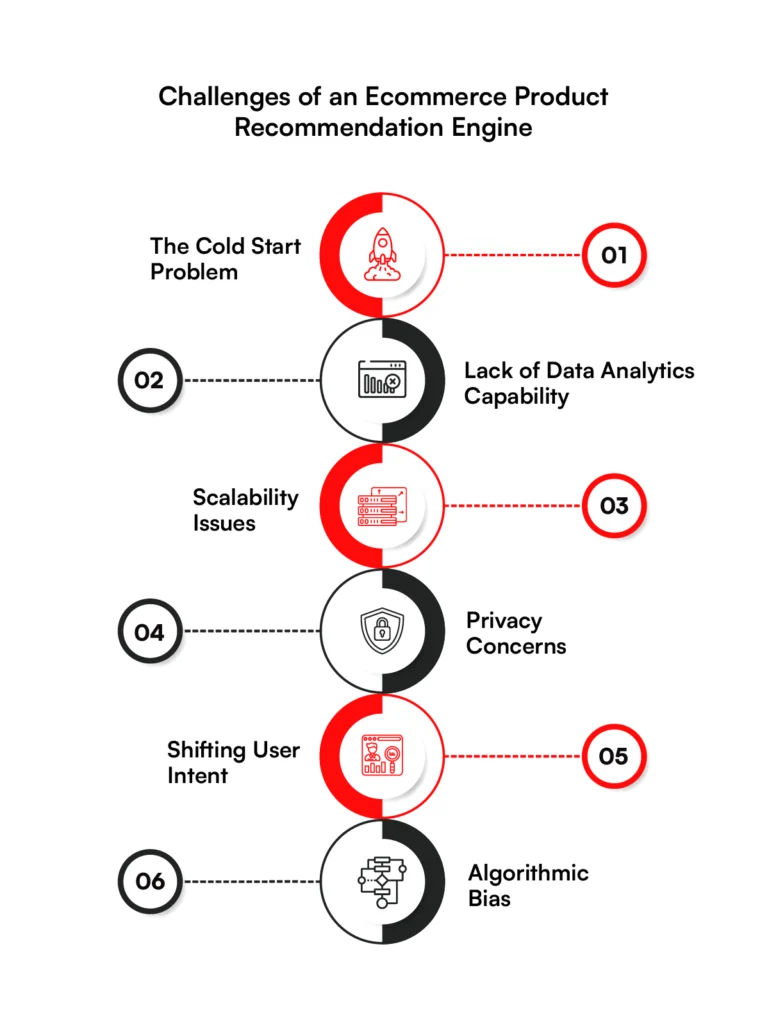
Recommendation quality depends on the availability of customer data, system performance, and continuous model optimization. Common challenges include the cold-start problem, sparse behavioral data, scalability, privacy compliance, changing customer intent, and algorithmic bias.
1. The Cold Start Problem
The cold-start problem occurs when a recommendation engine has insufficient interaction data to generate reliable recommendations for new customers or newly added products. Without browsing history, purchases, ratings, or clickstream data, the engine has limited information for predicting customer preferences.
Retailers reduce this challenge by using product attributes, category trends, popular products, and demographic data until enough behavioral data is available to personalize recommendations.
2. Sparse Behavioral Data
Recommendation engines depend on customer interactions to identify reliable purchasing patterns. When customers interact with only a small portion of a product catalogue, sparse Behavioral data limits recommendation accuracy, particularly for low-visibility or infrequently purchased products.
Additional signals such as search history, browsing activity, wish lists, product views, and purchase events improve behavioral modeling and help recommendation engines generate more relevant recommendations.
3. Scalability Issues
Recommendation engines must process large volumes of customer interactions without affecting page performance or response times. Holiday sales, seasonal campaigns, and product launches can generate millions of recommendation requests within short periods.
Scalable recommendation architectures use distributed processing, caching, and low-latency inference to maintain consistent recommendation performance as traffic and catalogue size increase.
4. Privacy Concerns
Personalized recommendations rely on customer data, requiring businesses to collect, store, and process information in accordance with regulations such as GDPR and India’s Digital Personal Data Protection (DPDP) Act.
Clear consent management, secure data handling, and governance policies help businesses personalize recommendations while meeting regulatory and customer privacy requirements.
5. Changing Customer Intent
Customer interests change over time, and a single purchase does not always represent long-term buying behavior. Recommendation models must distinguish temporary purchase intent from lasting customer preferences to avoid recommending products that are no longer relevant.
Continuous model updates and real-time behavioral signals help recommendation engines respond to changing customer intent and keep recommendations aligned with current shopping behavior.
6. Algorithmic Bias
Recommendation models can favor products that receive the highest number of clicks, purchases, and customer interactions. Over time, this popularity bias reduces the visibility of new, seasonal, or niche products and limits product discovery.
Regular model evaluation, recommendation diversity, and exploration strategies help balance product exposure while maintaining recommendation relevance and business performance.
Off-the-Shelf vs. Custom Ecommerce Recommendation Engine
Off-the-shelf and custom recommendation engines for ecommerce serve different business needs. The comparison below outlines the key differences across performance, customization, security, responsiveness, and cost.
| Factor | Off-the-Shelf Ecommerce Recommendation Engine | Custom Ecommerce Recommendation Engine |
| Performance and Scalability | Designed to support common business requirements. Performance may decline as product catalogs, traffic, or personalization needs grow. | Built around your business requirements and infrastructure, making it easier to support high traffic, large catalogs, and complex recommendation logic. |
| Uniqueness | Offers predefined features and limited customization. Businesses using the same platform often have similar recommendation capabilities. | Recommendation models, business rules, and customer journeys are tailored to your products, customers, and operational goals. |
| Security | Security updates and maintenance are managed by the software provider. Businesses have limited control over security architecture and data handling. | Security controls, data governance, and compliance measures can be designed to meet internal policies and regulatory requirements such as GDPR or DPDP. |
| Responsiveness | New feature requests, integrations, or product changes depend on the vendor’s development roadmap and release schedule. | Features, integrations, and recommendation logic can be updated as business priorities change, giving teams greater flexibility. |
| Cost-effectiveness | Lower upfront investment and faster deployment make it suitable for businesses with standard recommendation requirements. | Higher initial development costs are offset by long-term flexibility, ownership, and the ability to scale without platform limitations. |
Choosing the right solution lays the foundation for long-term success. RBMSoft can help you build a custom ecommerce product recommendation engine that integrates with your ecommerce platform, customer data, and business systems to deliver real-time product recommendations.
Build a Recommendation Engine That Fits Your Business
Develop a custom ecommerce product recommendation engine designed around your catalogue, customer data, and business goals.
Talk to Our ExpertsHow to Implement an Ecommerce Product Recommendation Engine?
Building an ecommerce product recommendation engine involves designing the architecture, preparing data, training recommendation models, integrating with commerce systems, and monitoring performance after deployment.
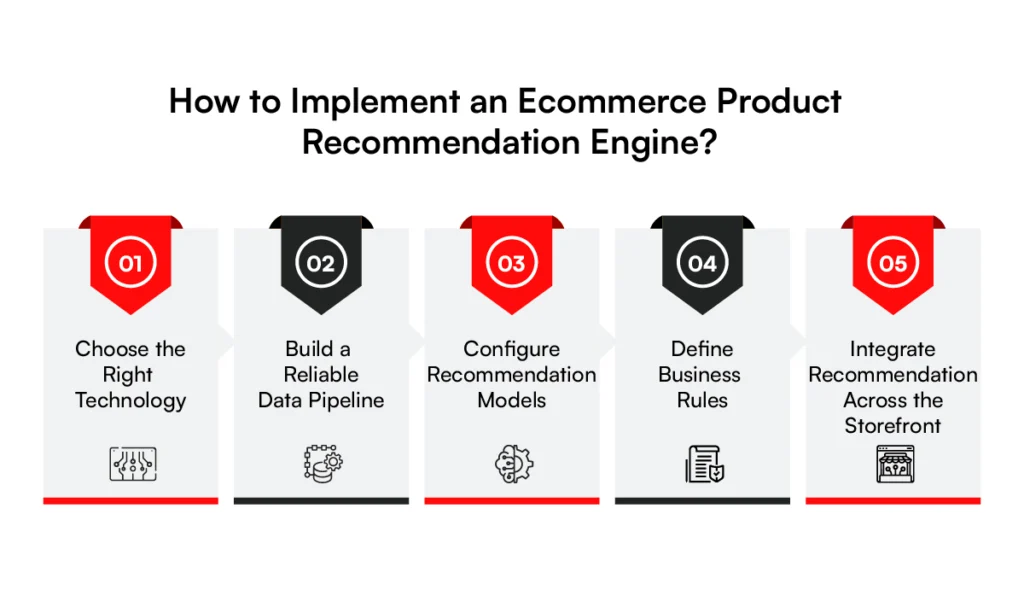
1. Design the Recommendation Architecture
Implementation begins by selecting the recommendation approach that best fits the business. This may include collaborative filtering, content-based filtering, hybrid models, or multiple algorithms working together.
The selected architecture determines the data pipeline, model training process, infrastructure, and system integrations.
The architecture should also define how recommendations are generated. Batch processing precomputes recommendations at scheduled intervals, while real-time inference generates recommendations during customer interactions.
Enterprise ecommerce platforms often combine both methods to balance response times with recommendation freshness.
2. Build a Unified Data Pipeline
Recommendation models rely on complete and consistent behavioral and product data. Customer events such as searches, product views, clicks, cart activity, purchases, ratings, and wish lists should be collected alongside product information, including categories, pricing, inventory, brands, and product attributes.
These datasets are processed through ETL or event-streaming pipelines before being stored in a data warehouse, data lake, or feature store. Clean, synchronized data improves model training, reduces prediction errors, and keeps recommendations aligned with current customer behavior and catalogue updates.
3. Develop and Train Recommendation Models
Model selection depends on recommendation objectives, available data, and catalogue characteristics. Engineering teams develop recommendation models using collaborative filtering, content-based filtering, hybrid models, learning-to-rank algorithms, or deep learning techniques based on the complexity of the recommendation use case.
Model development includes feature engineering, hyperparameter tuning, validation, and offline evaluation before deployment.
Performance is measured using metrics such as Precision@K, Recall@K, Mean Reciprocal Rank (MRR), and Normalized Discounted Cumulative Gain (NDCG) to verify recommendation quality before models reach production.
4. Deploy Recommendation Services and Business Rules
Recommendation models are deployed as scalable APIs or inference services that deliver recommendations across websites, mobile applications, search platforms, shopping carts, and checkout experiences.
Low-latency model serving, caching, and load balancing help maintain consistent response times during peak traffic.
Machine learning models operate alongside merchandising rules that support business objectives. These rules can prioritize seasonal collections, exclude out-of-stock products, promote high-margin items, apply regional restrictions, or highlight campaign-specific products without interrupting the delivery of recommendations.
5. Integrate with the Ecommerce Technology Stack
Recommendation engines rely on integrations with the broader ecommerce technology stack to access customer, product, and operational data.
Common integrations include ecommerce platforms, Product Information Management (PIM), Customer Relationship Management (CRM), Enterprise Resource Planning (ERP), inventory management systems, search platforms, analytics tools, and marketing automation platforms.
A broader enterprise AI integration solutions in business architecture determines how the recommendation model receives data from these systems and how its output reaches the storefront or other applications. APIs, data pipelines, and custom integration layers can support these exchanges based on the existing ecommerce architecture.
During RBMSoft’s ecommerce modernization project for DSW, our team integrated search, promotions, loyalty programs, analytics, and third-party commerce services into a unified storefront.
This integration architecture supported consistent product discovery across customer touchpoints while establishing the technical foundation for future personalization and recommendation capabilities.
6. Monitor Performance and Retrain Models
Recommendation performance should be evaluated continuously after deployment. Customer behavior, product catalogues, and merchandising strategies change over time, making periodic model retraining essential to maintain recommendation quality.
Engineering teams monitor API latency, recommendation accuracy, click-through rates, conversion rates, infrastructure performance, and model drift. A/B testing different recommendation strategies, ranking models, and widget placements identifies configurations that produce stronger engagement and higher conversions.
Cost to Develop and Integrate an Ecommerce Product Recommendation Engine
The cost of developing an ecommerce product recommendation engine depends on the implementation approach, recommendation logic, system integrations, data volume, and infrastructure requirements.
The estimates below represent typical development costs for projects of different sizes and levels of technical complexity.
Estimated Development Cost
| Project Scope | Estimated Cost* | Best Suited For | Typical Capabilities |
| Basic Implementation | $30,000–$70,000 | Startups and small ecommerce businesses | Rule-based recommendations, standard platform integration, basic personalization, and support for smaller product catalogs. |
| Mid-Level Implementation | $70,000–$200,000 | Growing ecommerce businesses | Behavior-based recommendations, hybrid recommendation models, real-time data processing, and integration with existing business systems. |
| Enterprise Implementation | $200,000+ | Large retailers and marketplaces | Custom recommendation models, large-scale data processing, omnichannel personalization, advanced analytics, and enterprise-grade scalability. |
*Estimated costs vary by project scope, technology stack, development location, and implementation requirements.
Factors That Influence Development Cost
| Cost Factor | Why It Affects Cost |
| Implementation Approach | Off-the-shelf platforms require a lower initial investment, while custom development involves higher upfront costs but offers greater flexibility and ownership. |
| Recommendation Features | Real-time recommendations, hybrid models, personalized ranking, and advanced filtering increase development effort. |
| Data Preparation | Customer behavior, product catalog data, and historical transactions often require cleaning, validation, and synchronization before implementation. |
| System Integrations | Connecting the recommendation engine with ecommerce platforms, CRM, ERP, marketing tools, and analytics systems increases implementation complexity. |
| Infrastructure | Large catalogs and high traffic require scalable cloud infrastructure capable of processing recommendation requests with low latency. |
| Maintenance and Optimization | Recommendation models require periodic updates, performance monitoring, and refinement as customer behavior, inventory, and business priorities change. |
Every ecommerce product recommendation engine differs in architecture, recommendation logic, data availability, and integration requirements, making fixed pricing impractical.
RBMSoft begins each project with a technical discovery phase to evaluate your existing systems, data maturity, integration requirements, and business objectives before preparing a detailed development estimate.
How Can You Get Started With an Ecommerce Recommendation Engine?
Building an ecommerce recommendation engine starts with data readiness, a clear deployment strategy, and phased model implementation. Rolling out the engine in stages simplifies deployment, supports continuous testing, and expands recommendation capabilities as customer interaction data grows.
1. Prepare Your Data Infrastructure
Recommendation quality depends on complete, accurate, and synchronized customer and product data. Customer events such as searches, product views, clicks, cart activity, purchases, and wish lists should be instrumented consistently across the storefront.
Product data, including categories, pricing, inventory, brands, and attributes, should remain current across all connected systems.
Before model development begins, data should be validated, normalized, and synchronized across ecommerce platforms, PIM, ERP, CRM, and analytics systems. Consistent data increases model accuracy and reduces prediction errors during training.
2. Validate Recommendation Strategies
Recommendation strategies should be evaluated before they are deployed across the storefront. Different recommendation algorithms, ranking models, and widget placements often produce different conversion patterns depending on where they appear in the customer journey.
A/B testing and performance monitoring measure click-through rate, conversion rate, average order value, and revenue per visitor. The results identify the recommendation strategies that deliver the strongest commercial performance before wider deployment.
3. Plan for the Cold Start Problem
Every recommendation engine encounters situations where interaction data is limited. New customers, recently added products, and seasonal inventory often lack the behavioral history needed for personalized recommendations.
Fallback strategies such as content-based recommendations, category similarity, popularity signals, trending products, and merchandising rules maintain recommendation coverage until sufficient interaction data is collected to support personalized model predictions.
Conclusion
An ecommerce recommendation engine gives retailers a practical way to connect customers with products they are more likely to buy.
Whether the goal is increasing average order value, improving product discovery, or streamlining merchandising, recommendation engines create value across multiple areas of an ecommerce business.
Every business has different requirements. Catalog size, customer behavior, existing systems, and personalization goals all influence the type of recommendation engine that makes the most sense. Taking time to evaluate these factors before implementation reduces technical challenges and supports long-term growth.
If you’re planning to build a recommendation engine for ecommerce, RBMSoft provides ecommerce software development services, ecommerce solutions development, and IT services for ecommerce. Our team designs, develops, and integrates recommendation engines that fit your business processes, technology stack, and growth plans.
FAQs
1. What is an online recommendation engine?
An online recommendation engine analyzes customer activity and product data to suggest products shoppers are most likely to buy. In ecommerce, it uses signals such as browsing history, searches, purchases, and cart activity to display relevant recommendations across product pages, search results, shopping carts, and other key touchpoints.
2. Off-the-shelf vs. custom development: Which ecommerce recommendation engine should you choose?
Off-the-shelf platforms work well for businesses looking for faster deployment and lower upfront costs. They include ready-made features and standard integrations but offer limited flexibility.
A custom ecommerce recommendation engine gives businesses greater control over recommendation logic, integrations, scalability, and personalization, making it a better fit for complex ecommerce operations or long-term growth.
3. How long does it take to develop an ecommerce product recommendation engine?
An off-the-shelf recommendation engine can usually be implemented within a few weeks. A custom ecommerce product recommendation engine requires additional time for data preparation, system integrations, recommendation model configuration, testing, and deployment.
The overall timeline varies with the project’s complexity and technical requirements.
4. How much does it cost to build a product recommendation engine for ecommerce?
Development costs range from basic implementations for smaller ecommerce stores to enterprise-grade solutions with advanced personalization and custom integrations.
Factors such as recommendation complexity, catalog size, data preparation, infrastructure, and third-party integrations all influence the overall investment.
5. How does an ecommerce product recommendation engine help increase sales and revenue?
Relevant product recommendations encourage customers to explore additional products before completing a purchase.
Cross-selling, upselling, personalized product discovery, and timely recommendations contribute to higher conversion rates, larger order values, and improved customer engagement without adding friction to the buying journey.