




Table of Contents
Quick Summary:
- Ecommerce order fulfillment software connects inventory, warehouse operations, order processing, shipping, and returns into a single workflow.
- Core features include real-time inventory visibility, order routing, barcode management, shipping automation, reverse logistics, and operational dashboards.
- Integrating ERP, OMS, WMS, ecommerce platforms, marketplaces, carriers, and EDI systems keeps fulfillment data synchronized across the business.
- AI improves demand forecasting, inventory planning, warehouse productivity, delivery planning, and exception management.
- Development costs typically range from $60,000 to $500,000+, depending on warehouse complexity, integrations, automation, and AI capabilities.
- Businesses with simple fulfillment needs may choose off-the-shelf software, while custom development is better suited to complex operations, multi-warehouse fulfillment, and enterprise integrations.
As ecommerce businesses grow, order fulfillment becomes harder to manage. More warehouses, sales channels, and order volumes increase the risk of inventory mismatches, shipping delays, and manual work, which slow daily operations. Small fulfillment issues can quickly affect operating costs and customer satisfaction.
Adding warehouse staff or separate tools for inventory, shipping, and order management doesn’t always solve the problem. When these systems don’t work together, teams rely on inconsistent data, making it harder to maintain inventory accuracy, order visibility, and on-time deliveries.
This article explains how ecommerce fulfillment software connects inventory, warehouse operations, shipping, and order processing into a single workflow. It also covers fulfillment models, core features, system integrations, AI capabilities, implementation, development costs, and how to choose between an off-the-shelf platform and a custom solution.
What Is Ecommerce Fulfillment Software?
Ecommerce fulfillment software is an order fulfillment system that manages inventory, order processing, warehouse operations, shipping, and returns across a unified fulfillment process.
It maintains inventory records, manages picking and packing activities, generates shipping labels, and tracks every order from purchase through delivery. A single fulfillment workflow reduces manual work, improves order accuracy, and increases warehouse throughput.
Modern ecommerce order fulfillment software integrates with ecommerce platforms, online marketplaces, ERP systems, warehouse management systems (WMS), order management systems (OMS), and shipping carriers through APIs.
Inventory movements, order status, and shipment updates stay synchronized across connected systems. This keeps operational data consistent as warehouses, sales channels, and order volumes grow.
Benefits of Ecommerce Order Fulfillment Software Development
Ecommerce fulfillment software improves operational performance across warehousing, inventory, and shipping. Accurate inventory synchronization, workflow automation, and connected business systems create more efficient fulfillment operations.
Businesses can handle higher order volumes while controlling operating costs and maintaining consistent service levels.
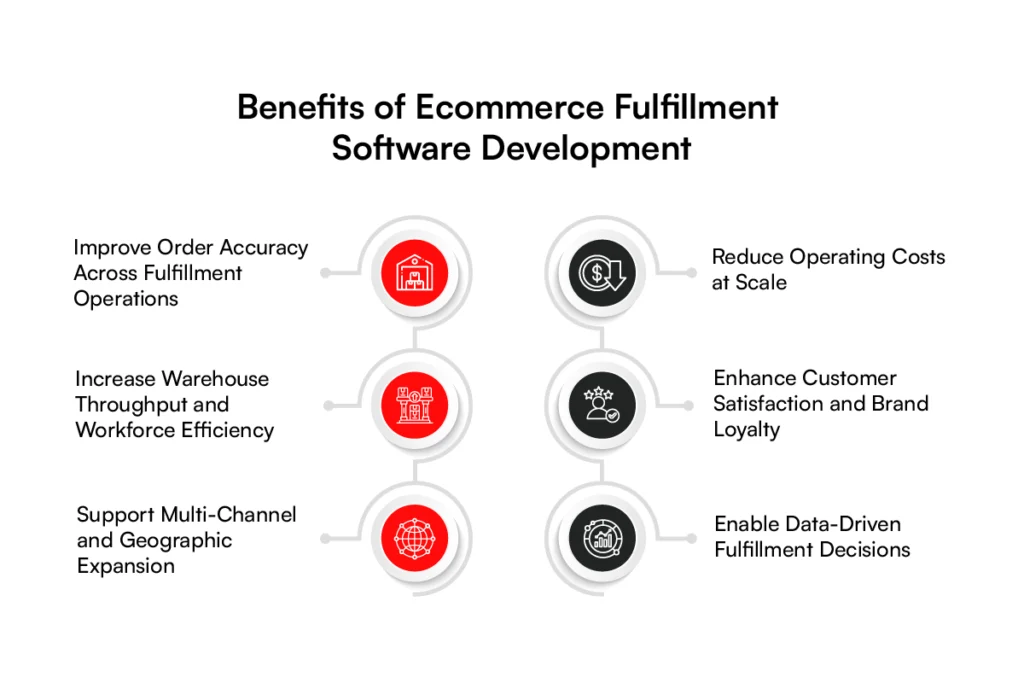
1. Improve Order Accuracy Across Fulfillment Operations
Order accuracy directly affects customer satisfaction and operating costs. Wrong shipments, missing items, and inventory mismatches increase returns and replacement expenses.
Accurate inventory synchronization, barcode validation, and standardized fulfillment workflows reduce fulfillment errors, resulting in more reliable deliveries and lower replacement costs.
2. Reduce Operating Costs at Scale
Operating costs often rise as fulfillment volumes increase. Manual order validation and repetitive warehouse tasks require additional labor and slow daily operations.
Workflow automation and barcode-driven processes increase warehouse productivity, allowing existing teams to process higher order volumes without operating costs increasing at the same pace.
3. Increase Warehouse Throughput and Workforce Efficiency
Warehouse capacity depends on how efficiently orders move through picking, packing, and dispatch. Structured task allocation and optimized warehouse workflows reduce delays throughout the fulfillment process.
Higher throughput increases daily order capacity without expanding warehouse space or significantly increasing headcount.
4. Enhance Customer Satisfaction and Brand Loyalty
Customers expect every order to arrive accurately and on time. Reliable fulfillment reduces service issues, strengthens customer trust, and creates a more consistent buying experience. Positive delivery experiences also encourage repeat purchases and long-term customer loyalty.
5. Support Multi-Channel and Geographic Expansion
Expanding into new marketplaces, regions, or fulfillment centers increases operational complexity. API-based integrations keep inventory, order status, and shipment updates synchronized across ecommerce platforms, ERP systems, warehouse management systems (WMS), and shipping carriers. Businesses maintain operational visibility while expanding fulfillment networks.
6. Enable Data-Driven Fulfillment Decisions
Every fulfillment operation generates operational data across inventory, warehousing, shipping, and order processing.
Dashboards and fulfillment KPIs expose inventory trends, warehouse bottlenecks, and shipping performance. Leadership teams can improve capacity planning, resource allocation, and operational decisions using measurable performance data.
Technology alone does not determine fulfillment performance. Selecting the right fulfillment model is equally important. The next section examines the different ecommerce fulfillment models and how they support different business requirements.
Types of Ecommerce Fulfillment Models
Each fulfillment model differs in how inventory, warehousing, shipping, and order processing are managed. The following models are the ones most commonly used by ecommerce businesses.
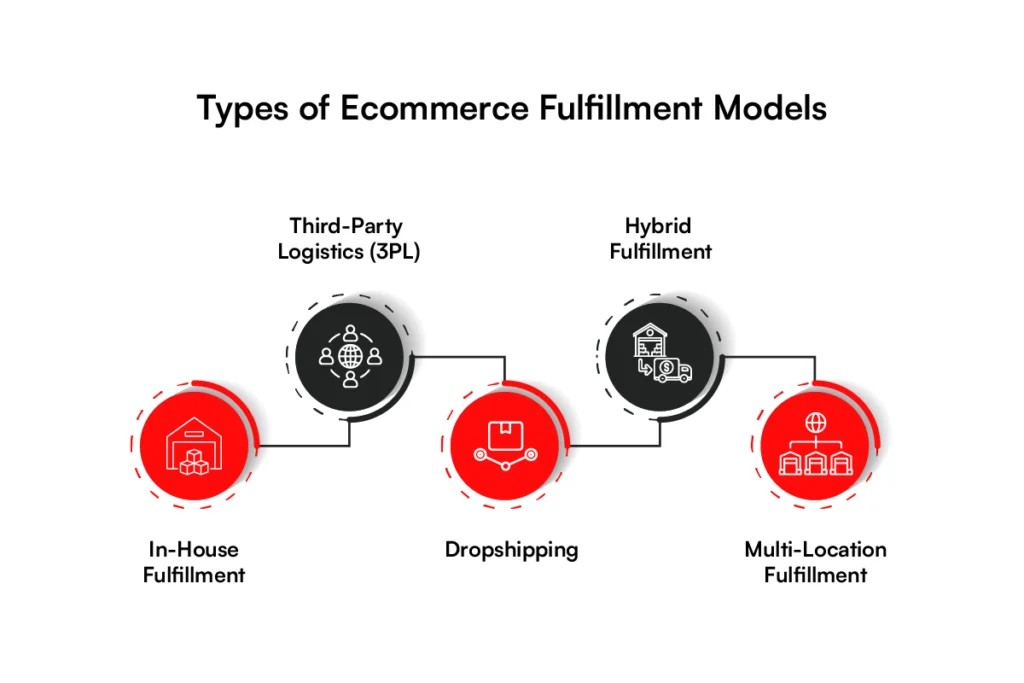
1. In-House Fulfillment
In-house fulfillment places inventory storage, order processing, picking, packing, shipping, and returns under the business’s direct control. Internal warehouse teams manage inventory accuracy, packing standards, shipping service levels, and day-to-day warehouse operations.
Businesses often choose this model when they require strict quality control, predictable fulfillment volumes, or specialized handling processes.
Running an in-house operation also requires ongoing investment in warehouse infrastructure, fulfillment technology, labor, and inventory management.
2. Third-Party Logistics (3PL)
Third-party logistics (3PL) providers handle warehousing, inventory storage, order fulfillment, shipping, and returns for ecommerce businesses.
System integrations route customer orders to fulfillment centers, where inventory is allocated, orders are processed, and shipments are dispatched through carrier networks.
Companies expanding into new markets often choose a 3PL model to scale fulfillment without investing in additional warehouses. Established logistics networks also improve delivery coverage and operational flexibility.
3. Dropshipping
With dropshipping, suppliers or manufacturers store inventory and ship products directly to customers after an order is placed. The ecommerce business manages the storefront, customer orders, payments, and customer support, while suppliers take responsibility for inventory and fulfillment.
Businesses avoid the cost of purchasing inventory upfront or operating warehouse facilities. Fulfillment performance depends on supplier inventory accuracy, shipping reliability, and delivery times.
4. Hybrid Fulfillment
Hybrid fulfillment combines multiple fulfillment models within the same operation. Businesses commonly fulfill high-demand products from their own warehouses while assigning slower-moving, oversized, or specialized products to 3PL providers or dropshipping partners.
Order routing and inventory allocation can shift between fulfillment channels according to stock availability, shipping costs, and delivery commitments. This operating model supports business growth without relying on a single fulfillment strategy.
5. Multi-Location Fulfillment
Multi-location fulfillment distributes inventory across multiple warehouses or fulfillment centers. Intelligent order routing selects the best fulfillment location by evaluating inventory availability, warehouse proximity, shipping zones, and carrier service levels.
Shorter shipping distances reduce transportation costs and improve delivery times. Maintaining consistent performance across multiple locations depends on real-time inventory synchronization, warehouse coordination, and accurate order routing.
A fulfillment model defines the operational strategy, while the software manages daily execution. The next section covers the key features of ecommerce order fulfillment software and how they support efficient fulfillment operations.
Key Features of Ecommerce Order Fulfillment Software
Ecommerce order fulfillment software coordinates inventory, warehouse execution, shipping, and order processing. The technology behind each feature determines how accurately the platform handles data, transactions, and warehouse activity as fulfillment volumes increase.
1. Real-Time Inventory and Order Visibility
Real-time visibility keeps stock levels and order status current as sales, reservations, shipments, returns, and inventory transfers occur. Event-driven architecture, webhooks, APIs, and message queues distribute inventory events between ecommerce platforms, marketplaces, ERP, OMS, and warehouse systems.
Keeping those records synchronized is harder when several systems update the same SKU within seconds. Duplicate events, failed messages, and API latency can produce different stock values across channels. Idempotent event handling, retry logic, and reconciliation processes keep inventory records aligned when individual updates fail.
2. Intelligent Order Routing and Multi-Location Fulfillment
Order routing determines which warehouse should fulfill an order based on available inventory, warehouse location, shipping zones, delivery commitments, and carrier service levels. A configurable rules engine evaluates these conditions before assigning the order to a fulfillment location.
Inventory reservations need particular attention in multi-location environments. Stock can change between checkout and warehouse allocation, creating the risk of routing an order against inventory that is no longer available. Reservation logic and fallback rules account for stock shortages, split shipments, and unavailable fulfillment locations without relying on manual reassignment.
3. Warehouse Picking, Packing, and Barcode Management
Barcode-driven workflows verify products and quantities as orders move through picking, packing, and dispatch. Mobile warehouse applications, handheld scanners, label printers, and identifiers such as UPC, EAN, and GS1 barcodes create a traceable record of inventory movement.
Reliable scanning depends on consistent product and location identifiers across the fulfillment software and warehouse systems. Warehouse Wi-Fi can also affect handheld devices, particularly in large facilities. Offline scan capture with later synchronization can keep warehouse work moving when connectivity drops.
4. Shipping Automation and Carrier Management
Carrier APIs handle rate requests, service selection, label generation, manifests, tracking numbers, and delivery events. Shipping rules select services according to destination, package dimensions, shipping cost, delivery date, and carrier service level.
Implementation becomes more complex when several carriers are involved because API formats, authentication, rate limits, and service codes differ between providers. A carrier abstraction layer separates provider-specific logic from fulfillment workflows. Retry queues and error logging prevent a temporary carrier API failure from stopping shipments across the warehouse.
5. Returns and Reverse Logistics
Returns workflows manage return merchandise authorizations (RMAs), inspection, inventory reconciliation, refunds, exchanges, replacements, and product disposition. Returned inventory moves through defined states before it can be restocked, repaired, written off, or sent to another location.
Inventory and financial records must remain aligned throughout that process. A returned product should not appear as available stock before inspection is complete, while refunds and replacements must remain linked to the original order. Transaction histories and audit logs provide traceability when a return moves between warehouse, finance, and customer service teams.
6. Workflow Automation and Business Rules
A configurable rules engine handles recurring fulfillment decisions such as inventory allocation, warehouse assignment, order holds, shipping method selection, and exception routing. Operations teams can change thresholds or routing policies without rewriting application logic for routine process changes.
Rule management becomes more important as fulfillment logic expands across warehouses and sales channels. Conflicting rules or incorrect priorities can route orders incorrectly. Rule validation, version history, approval controls, and automated tests make changes easier to track before they reach production.
7. Analytics, Reporting, and Operational Dashboards
Fulfillment dashboards track metrics such as inventory accuracy, order cycle time, picking performance, shipping costs, carrier performance, and return rates. ETL or ELT pipelines move transactional data into a data warehouse where reporting workloads can run separately from day-to-day fulfillment transactions.
Reliable reporting starts with consistent data definitions. ERP, WMS, carrier, and commerce systems may record timestamps, SKU identifiers, and order statuses differently. Data validation and normalization within the pipeline prevent those differences from producing conflicting KPIs for operations and leadership teams.
8. Scalability and Configurable Operations
Higher order volumes place pressure on databases, background jobs, APIs, and warehouse processing at the same time. Asynchronous processing, caching, load balancing, and horizontal scaling can distribute workloads when a fulfillment platform begins handling larger transaction volumes.
Peak periods are where architecture problems usually become visible. Database contention, message backlogs, slow API responses, and long-running jobs can delay order processing even when the application performs well under normal traffic. Load testing against expected transaction volumes and application performance monitoring can identify these bottlenecks before production traffic reaches them.
These features depend on the architecture, business logic, data flows, and integrations behind the platform. The next section explains how ecommerce order fulfillment software is designed, developed, tested, and deployed.
Ecommerce Order Fulfillment Software Development Process
Developing ecommerce fulfillment software involves designing the architecture, building fulfillment logic, connecting business systems, testing transaction flows, and preparing the production application. Implementation sits within this process and covers data migration, warehouse configuration, hardware setup, training, and rollout.
1. Define Fulfillment Workflows and Technical Requirements
The first step is mapping how an order moves from checkout through inventory allocation, warehouse processing, shipping, delivery, and returns. Discovery should document fulfillment rules, warehouse locations, transaction volumes, user roles, operational exceptions, and existing applications.
Technical requirements come from those workflows. At RBMSoft, we review existing systems and data flows at this stage so architecture decisions reflect the way the fulfillment operation actually works.
2. Design the Architecture and Fulfillment Data Model
The system architecture defines how orders, inventory, warehouse tasks, and shipment events are processed. Depending on transaction volume and business complexity, separate services can handle inventory, routing, warehouse execution, shipping, returns, and reporting. Event-driven processing is useful where inventory and order updates need to move between services without waiting for synchronous requests.
The data model defines orders, SKUs, inventory reservations, warehouse locations, shipments, and returns across the platform. State management must account for partial fulfillment, backorders, split shipments, cancellations, and returns without creating duplicate transactions or incorrect inventory records.
3. Design Interfaces Around Warehouse Tasks
Warehouse interfaces should reflect how employees receive stock, pick orders, pack shipments, process returns, and handle exceptions. Wireframes and interactive prototypes give warehouse teams a chance to validate those workflows before engineering moves further into development.
Handheld devices introduce their own requirements. Barcode scanner input, touchscreen controls, role-based access, and unreliable warehouse connectivity need to be considered when designing mobile warehouse applications.
4. Build the Core Fulfillment Logic
Backend development converts fulfillment requirements into application logic. Engineers build inventory availability and reservation logic, order allocation, routing rules, picking and packing workflows, shipping processes, returns, notifications, and reporting functions.
Order states need clear transitions throughout the process. For example, cancelling an allocated order must release reserved inventory, while a split shipment must maintain separate fulfillment and shipment states without losing the relationship to the original order.
Frontend development provides warehouse teams and operations managers with task queues, dashboards, alerts, order views, and administrative controls for managing those processes.
5. Engineer Data Exchange With External Systems
External connections need defined API contracts, authentication, data mapping, validation, error handling, and retry behaviour. REST APIs, webhooks, middleware, or event messaging can handle data exchange depending on the capabilities of the systems involved.
Failures also need a recovery path. Retry queues can handle temporary API outages, while reconciliation processes identify transactions that remain inconsistent after automated retries. Integration tests verify that inventory, order, payment, and shipment states remain correct when data moves between applications.
6. Test Fulfillment Logic, Security, and Performance
Testing should reproduce real fulfillment conditions rather than checking individual functions in isolation. QA scenarios can include inventory shortages, concurrent reservations, split shipments, duplicate events, failed carrier requests, cancellations, returns, and interrupted external connections.
Load tests measure API response times, database performance, background processing, and queue behaviour under expected peak volumes. Authentication, access controls, API security, and sensitive data handling also need validation before production deployment.
CI/CD pipelines automate unit tests, integration tests, security checks, and deployment validation as new builds move through development, staging, and production environments.
7. Implement the Software Across Warehouse Operations
Implementation moves the tested application into the operating environment. Teams migrate product, inventory, order, and customer data; configure warehouses and bin structures; set user permissions and business rules; and prepare barcode scanners, mobile devices, and label printers.
Pilot runs should cover receiving, picking, packing, shipping, returns, and exception handling with actual warehouse users. Issues found during the pilot can then be corrected before the platform processes full production volumes.
8. Deploy and Monitor Production Performance
Production monitoring should track the application as closely as warehouse KPIs. API latency, error rates, failed integration events, queue depth, database performance, and infrastructure capacity can expose technical problems before they create order backlogs.
Centralized logging, application metrics, and alerts give engineering teams the information needed to trace failures. Performance data from the first production cycles can also identify routing rules, background jobs, or warehouse workflows that need adjustment.
RBMSoft can work across the development cycle, from fulfillment workflow analysis and architecture design to application development, integration testing, deployment, and production monitoring. The software is developed around existing warehouse processes, business rules, and system dependencies rather than predefined fulfillment logic.
With the development process established, the next section looks at the systems ecommerce fulfillment software needs to connect with and the data exchanged between them.
Essential Integrations for Ecommerce Fulfillment Software
As your ecommerce business grows, keeping orders, inventory, warehouses, payments, and shipping connected becomes harder. A broader ecommerce integration setup keeps data moving between these systems so your teams can process orders without working across disconnected records.
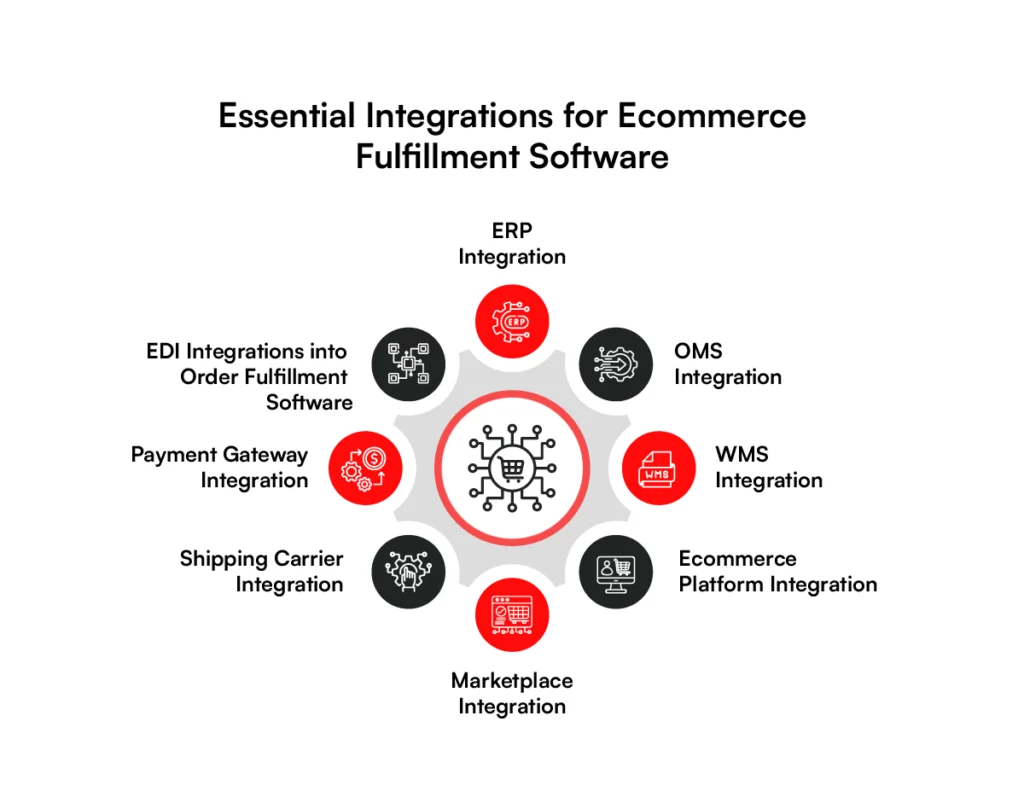
Here are the essential integrations that can support your fulfillment operations as you grow.
1. ERP Integration Keeps Warehouse and Financial Records Aligned
If you use an ERP, you need its inventory records to match what is actually available in your warehouses. Accurate stock data helps you show customers whether a product is available and gives your purchasing team a clearer view of what needs to be reordered. When you connect your ERP with fulfillment software, receipts, shipments, returns, and stock adjustments update your inventory, purchasing, finance, and accounting records.
You also need to account for how each system structures its data. Your fulfillment software may identify a product using an SKU and warehouse location, while your ERP expects an item ID, warehouse code, and accounting entity. Field mapping translates these values between the two systems, and validation checks the transaction data before your ERP processes it.
2. OMS Integration Keeps the Order Lifecycle Connected to Fulfillment
When you connect your Order management software with fulfillment solutions, you give the warehouse the information it needs to start processing an order. Your OMS sends order lines, inventory reservations, fulfillment priorities, and shipping preferences to the fulfillment system once the order is ready for fulfillment.
You also need the connection to work in the other direction. If an order is split, backordered, cancelled, picked, packed, or shipped, the fulfillment system sends that status back to your OMS. Your warehouse and customer service teams can then see the same order status without checking separate systems.
3. WMS Integration Connects Order Decisions With Warehouse Execution
If your ecommerce business already uses a WMS, you do not need your fulfillment software to repeat the warehouse processes it already manages. Your WMS can continue handling picking, replenishment, barcode scanning, packing, stock transfers, and cycle counts, while the fulfillment software manages order routing and other fulfillment decisions.
You need both systems to stay aligned as inventory moves through the warehouse. If your team picks, transfers, damages, or adjusts stock in the WMS, the fulfillment software needs that update before it allocates the same inventory to another order. APIs or event messages can send these inventory changes between the two systems as they occur.
4. Ecommerce Platform Integration Moves Orders From Checkout Into Fulfillment
When you connect your fulfillment software with Shopify, Adobe Commerce (Magento), WooCommerce, BigCommerce, or another ecommerce platform, orders can move directly from checkout into fulfillment. APIs and webhooks send order details, catalog data, and inventory information to the fulfillment system. Shipment status, tracking details, and stock changes then return to your storefront so your customers and internal teams see current information.
This connection becomes harder to manage as your order volume increases. You may encounter duplicate webhooks, API timeouts, rate limits, or failed requests that leave orders and inventory out of sync.
For example, an API request can time out even though the receiving system has already processed the order. Duplicate request protection stops the same order from being processed twice, while retry logic resends updates that failed to reach the other system.
5. Marketplace Integration Keeps Inventory Aligned Across Sales Channels
If you sell through multiple marketplaces such as Amazon, Walmart Marketplace, eBay, and Etsy, you need to keep the same inventory accurate across every channel. When a product sells on one marketplace, the available stock needs to change on the others before another customer orders the same item.
Connecting your marketplaces with fulfillment software helps you manage this from one place. Marketplace APIs send orders to your fulfillment queue and return inventory, shipment, tracking, and order status updates to each channel. API rate limits and synchronization frequency determine how quickly those updates appear. If the inventory update is delayed, another marketplace may still show the product as available and allow a customer to order it even though no stock is left.
6. Shipping Carrier Integration Automates Dispatch and Tracking
If you work with multiple shipping carriers, your warehouse team may otherwise need to switch between different carrier portals to compare rates, create labels, and track shipments. Connecting those carriers with your fulfillment software lets you request rates, select shipping services, generate labels, retrieve tracking numbers, and receive delivery updates from one system.
You also need to account for the technical differences between carriers. Each provider may use different authentication methods, service codes, label formats, API limits, and error responses. Retry queues can resend requests after a temporary API failure, while failure logs help your team identify shipments that still need attention without holding up other orders.
7. Payment Gateway Integration Confirms Orders Before Fulfillment
Payment is one part of fulfillment where you cannot afford incorrect status updates. If a payment fails or remains incomplete, you do not want that order reaching your warehouse for picking and shipping. Payment gateway APIs send authorization and capture status to your fulfillment software, allowing you to hold the order until the required payment is confirmed.
You also need to track what happens to the payment when an order changes. A cancellation may require a void, a return may trigger a refund, and a partial shipment can affect when or how much you capture. Keeping each payment transaction connected to the original order gives your finance team accurate records for reconciliation and helps them handle payment disputes.
8. EDI Connects Fulfillment Software With Enterprise Trading Partners
If you work with large retailers, distributors, suppliers, or logistics providers, APIs may not cover every connection you need. Some trading partners still use Electronic Data Interchange (EDI) to exchange purchase orders, invoices, advance shipping notices (ASNs), inventory updates, and order acknowledgements with your fulfillment system.
Standards such as ANSI X12 and EDIFACT define how these documents are structured, but your partners may have different requirements. One retailer may require fields or transaction rules that another does not. You need to map and validate each partner’s documents, configure acknowledgements and exception handling, and test the connection before sending production transactions.
Determining which connections need custom development can be difficult when your fulfillment environment includes multiple systems and data formats. RBMSoft can assess these dependencies and develop the APIs, middleware, webhooks, or EDI connections required to keep data moving between your systems.
Once these integrations are in place, your order, inventory, warehouse, and delivery data can support demand forecasting, inventory planning, warehouse decisions, and delivery optimization. Next, we look at how AI can use that data within your fulfillment operations.
Need to Integrate Your Fulfillment Software With Existing Business Systems?
RBMSoft develops custom ecommerce fulfillment software that integrates with your existing ERP, OMS, WMS, ecommerce platforms, marketplaces, carriers, and payment systems.
Talk to Our Experts
AI Integration in Ecommerce Order Fulfillment Software
AI fits fulfillment processes that involve prediction, anomaly detection, or optimization based on historical and live operational data. Each use case needs a defined data source, model output, and connection to the fulfillment workflow.
1. Smart Fulfillment Systems Detect Order and Shipment Risks
Anomaly detection and classification models monitor processing times, order events, shipment status, and equipment data to identify transactions likely to miss fulfillment or delivery targets.
The model needs timestamped fulfillment events, defined exception types, and historical outcomes for training. Live order and shipment events generate risk scores during fulfillment, while business rules decide whether to raise an alert, reroute an order, or send the case for human review.
2. Smarter Supply Chains Predict Disruptions
Predictive models combine supplier lead times, purchase orders, inventory levels, transportation data, and external signals such as weather to estimate potential supply delays.
A predicted supplier delay or stock shortage can trigger replenishment or inventory-transfer rules before warehouse availability is affected. Data pipelines keep internal and external model inputs current as supply conditions change.
3. Computer Vision Catches Picking and Packing Errors
Computer vision can inspect products, labels, and packages before dispatch, catching physical mismatches or packaging errors that barcode validation may miss.
A computer vision pipeline needs cameras, labeled image data, an object detection or classification model, and a connection to the WMS or fulfillment application. Confidence thresholds determine whether a package proceeds to shipping or goes to an employee for inspection.
4. Smarter Warehouse Operations Optimize Task Assignment
Optimization models prioritize picking, putaway, replenishment, and packing using order priority, inventory location, worker availability, equipment capacity, and carrier cutoff times.
Current WMS data allows the optimization engine to adjust task priorities as warehouse conditions change. Automated facilities can pass those assignments to a Warehouse Control System (WCS) or robot management software for execution.
5. Real-Time Data Pipelines Support Time-Sensitive AI Decisions
Inventory changes, carrier delays, and warehouse capacity can make earlier predictions or recommendations outdated. Event streams, webhooks, and message queues supply current operational data to models without waiting for scheduled batch updates.
New predictions or risk scores can trigger order-routing, carrier-selection, or exception-handling rules when conditions change. Batch processing remains suitable for AI functions that do not require an immediate response.
6. Machine Learning Forecasts SKU-Level Demand
Forecasting models use historical orders, SKU velocity, stockouts, seasonality, promotions, and supplier lead times to predict demand by product, warehouse, or region.
Data preparation and feature engineering come before model training. Backtesting and forecast-error measurements compare predictions against historical outcomes, while production monitoring tracks accuracy and signals when the model needs retraining.
Nike uses machine learning and predictive analytics across historical sales, regional demand, seasonality, and app engagement data to support demand forecasting and inventory allocation decisions, as covered in RBMSoft’s AI in Ecommerce: Examples and Use Cases article.
For custom fulfillment projects, RBMSoft’s engineering work can cover data pipelines, model development, inference services, and integration with existing OMS, WMS, ERP, and fulfillment workflows. The AI scope is defined around specific prediction, detection, or optimization requirements instead of adding models to processes already handled effectively through business rules.
The AI functionality included in the platform affects development scope and cost. The next section looks at the cost of developing and implementing ecommerce fulfillment software.
Cost to Develop and Implement Ecommerce Fulfillment Software Solutions
Custom ecommerce fulfillment software typically costs $60,000 to $500,000+, depending on warehouse complexity, system integrations, fulfillment workflows, automation, AI requirements, and expected transaction volumes. A single-warehouse application sits closer to the lower end, while multi-warehouse and enterprise platforms require a larger engineering budget.
1. Fulfillment Workflows and Business Rules
Simple order processing requires far less development than a fulfillment platform supporting split shipments, backorders, inventory allocation, returns, warehouse-specific routing, and custom approval workflows. Each workflow introduces additional business logic, configuration, validation, and testing before the system is ready for production.
2. Enterprise System Integrations
Fulfillment software depends on data moving accurately between ERP, OMS, WMS, ecommerce, marketplace, carrier, payment, and EDI systems. APIs, middleware, and EDI connections keep orders, inventory, and shipment records synchronized across these applications.
Each integration includes API configuration, field mapping, authentication, data validation, exception handling, and production testing. The number of connected systems often has a direct impact on implementation effort and overall project cost.
3. Warehouse Operations and Automation
Warehouse complexity extends beyond inventory management. Barcode scanning, mobile warehouse applications, wave picking, replenishment, cycle counting, inventory transfers, and support for multiple warehouse locations all influence software scope.
Additional warehouse workflows require configuration, hardware validation, user acceptance testing, and operational verification before the platform can move into production.
4. AI Capabilities
Adding AI introduces another layer of implementation complexity. Demand forecasting, inventory optimization, warehouse task prioritization, delivery planning, and exception management rely on machine learning models, historical operational data, prediction accuracy, and continuous model monitoring.
The overall investment varies according to the number of AI capabilities included and the quality of operational data available for training and validation.
5. High-Volume Processing, Access Controls, and System Monitoring
Enterprise fulfillment software must continue performing as order volumes, warehouse locations, and connected users increase. High transaction processing, background jobs, API traffic, and concurrent warehouse activity all influence infrastructure planning and system architecture.
Projects at this level commonly include role-based access control, OAuth authentication, audit logging, encrypted APIs, multi-factor authentication, backup strategies, and performance testing before deployment.
6. Estimated Investment by Project Scope
The figures below provide general investment ranges for custom ecommerce fulfillment software development. Actual costs vary according to operational complexity, implementation scope, and integration requirements.
| Project Scope | Estimated Investment (USD) | Typical Timeline |
| Single warehouse solution with core fulfillment capabilities | $60,000–$120,000 | 3–5 months |
| Multi-warehouse platform with enterprise integrations and workflow automation | $120,000–$250,000 | 5–8 months |
| Enterprise fulfillment platform with AI capabilities, advanced automation, and large-scale operations | $250,000–$500,000+ | 8–15 m |
Every fulfillment environment has its own operational processes, warehouse network, and technology stack. At RBMSoft, we begin each ecommerce fulfillment software project by reviewing fulfillment workflows, integration requirements, warehouse operations, automation opportunities, and long-term scalability.
Defining the implementation scope before development begins helps establish realistic budgets, reduce scope changes, and create a delivery roadmap that aligns with business objectives.
Should You Buy or Build Ecommerce Fulfillment Software?
Off-the-shelf fulfillment software works for standard operations, while custom development is better suited to complex workflows, enterprise integrations, and long-term growth. The comparison below outlines where each approach fits best.
1. When Off-the-Shelf Fulfillment Software Is the Right Choice
Off-the-shelf fulfillment software is often suitable for businesses with straightforward fulfillment processes and standard warehouse operations.
Most commercial platforms include inventory tracking, order processing, shipping management, and reporting, with pre-built integrations for common ecommerce platforms and shipping carriers.
A commercial solution is usually appropriate when:
- You operate from a single warehouse or fulfillment center.
- Standard fulfillment processes support your daily operations.
- Pre-built connectors are available for your ERP, ecommerce platform, and shipping carriers.
- Rapid deployment is a higher priority than custom functionality.
- Order volumes and fulfillment activities remain relatively stable.
Commercial platforms are typically quicker to implement, but they may offer limited flexibility as warehouse networks, sales channels, and fulfillment processes become more complex.
2. When Custom Ecommerce Fulfillment Software Delivers Greater Value
Custom ecommerce fulfillment software is often the better choice when standard platforms no longer support the way your business fulfills orders.
Instead of adapting your processes to fit predefined functionality, the software is designed around your warehouse network, business rules, and integration architecture.
Custom development is commonly selected when:
- Multiple warehouses share inventory across different locations.
- Order routing follows warehouse-specific or region-specific business rules.
- ERP, OMS, WMS, marketplaces, shipping carriers, and EDI partners require custom integrations.
- Inventory allocation, shipping, and returns follow specialized fulfillment processes.
- High transaction volumes require workflow automation, demand forecasting, and operational dashboards.
- Business growth includes additional warehouses, sales channels, or changing fulfillment processes.
Although custom development involves a higher upfront investment, it gives businesses control over features, integrations, and future enhancements without relying on a vendor’s product roadmap.
Off-the-Shelf vs. Custom Fulfillment Software: A Comparison
| Evaluation Area | Off-the-Shelf Software | Custom Fulfillment Software |
| Initial Investment | Lower upfront cost | Higher initial investment |
| Deployment Time | Weeks | Several months, depending on scope |
| Business Process Fit | Adapts your processes to the software | Built around your existing processes |
| Integrations | Pre-built connectors and APIs | Custom integrations with ERP, OMS, WMS, marketplaces, carriers, and EDI |
| Workflow Flexibility | Limited configuration options | Configurable business rules, routing logic, and fulfillment workflows |
| Scalability | May require upgrades or platform changes | Supports additional warehouses, order volume, and system integrations |
| Ownership | Vendor controls product roadmap | Full ownership of features and future development |
| AI and Automation | Limited by platform capabilities | AI models and automation tailored to business processes |
Questions to Ask Before Choosing a Fulfillment Solution
Selecting the right fulfillment software starts with understanding your business processes rather than comparing feature lists. Consider these questions before making a decision:
- Will the software support our fulfillment processes without major operational changes?
- Can it integrate with our ERP, OMS, WMS, ecommerce platforms, marketplaces, shipping carriers, and EDI partners?
- Will it support additional warehouse locations, higher transaction volumes, and new sales channels?
- Can business rules, order routing, and inventory allocation be configured as our business evolves?
- Does it provide the operational dashboards, workflow automation, and AI capabilities we expect over the coming years?
- What are the long-term costs for licensing, implementation, customization, maintenance, and support?
Answering these questions early makes it easier to evaluate the total investment and determine whether the platform can support future business growth.
Conclusion
Warehouse efficiency alone is not enough to deliver reliable order fulfillment. As order volumes, warehouse networks, and sales channels expand, fulfillment software must coordinate inventory, order routing, shipping, and connected business systems through a single workflow.
At RBMSoft, we provide ecommerce software development services that align with your fulfillment processes and existing technology stack.
Our engineers design and develop custom fulfillment platforms with ERP, OMS, WMS, ecommerce platform, shipping carrier, and EDI integrations, along with workflow automation and AI capabilities that support future business growth.
If you’re evaluating IT services for ecommerce, our specialists can assess your fulfillment environment, define the right implementation approach, and develop a solution that fits your operational requirements.
FAQs
1. How much does it cost to build custom ecommerce order fulfillment software?
The cost of custom ecommerce order fulfillment software development typically ranges from $60,000 to $500,000+.
The final investment depends on the number of warehouse locations, system integrations, fulfillment workflows, AI capabilities, automation, and reporting requirements. Businesses with multi-warehouse operations, ERP, OMS, WMS, and EDI integrations generally require a larger implementation scope.
2. How does ecommerce order fulfillment software work?
Ecommerce order fulfillment software connects inventory management, order processing, warehouse operations, shipping, and returns into a single workflow.
After a customer places an order, the software validates inventory, routes the order to the appropriate warehouse, supports picking and packing, generates shipping labels, tracks delivery, and updates inventory and order status across connected business systems.
3. How can custom ecommerce fulfillment software improve my operations?
Custom ecommerce fulfillment software development allows the platform to match your warehouse processes, business rules, and technology stack.
It can automate order routing, inventory allocation, barcode validation, shipping, and returns while integrating with ERP, OMS, WMS, ecommerce platforms, marketplaces, and carriers. This improves order accuracy, warehouse productivity, and operational visibility.
4. How does ecommerce order fulfillment software help with inventory management?
Ecommerce order fulfillment software maintains real-time inventory visibility across warehouses, ecommerce platforms, and marketplaces.
It synchronizes stock movements, tracks inventory reservations, supports replenishment, and updates inventory levels after every receiving, picking, shipping, and return transaction. This reduces inventory discrepancies and helps prevent overselling.
5. What is order fulfillment software?
Order fulfillment software is a platform that manages the complete fulfillment lifecycle, including inventory tracking, order processing, warehouse operations, shipping, and returns.
It also integrates with ERP systems, WMS, OMS, ecommerce platforms, marketplaces, and shipping carriers to keep fulfillment data synchronized across the business.
6. How long does it take to implement order fulfillment software?
Implementation timelines depend on the complexity of the project. A standard order fulfillment software implementation can take 3 to 5 months, while enterprise projects involving multiple warehouses, custom integrations, workflow automation, and AI capabilities may require 8 to 15 months, including planning, data migration, testing, and user training.
7. How can custom AI improve last-mile delivery optimization in order fulfillment software?
AI improves last-mile delivery by analyzing carrier performance, delivery routes, traffic conditions, delivery windows, weather, and historical shipment data.
Integrated into ecommerce order fulfillment software, AI can recommend carrier selection, optimize delivery routes, predict ETAs, and identify shipment delays before they affect customers.
8. Can RBMSoft integrate ecommerce order fulfillment solutions with existing ecommerce software?
Yes. RBMSoft develops custom ecommerce fulfillment software and integrates ecommerce order fulfillment solutions with existing ecommerce platforms, ERP, OMS, WMS, marketplaces, payment gateways, shipping carriers, and EDI systems.
Our team reviews your existing technology stack, maps data flows, and builds secure integrations that support your fulfillment processes without disrupting day-to-day operations.