




Table of Contents
Key Takeaways:
- AI agents go beyond traditional automation by understanding context, making decisions, and completing multi-step ecommerce tasks.
- AI agents can impact the entire ecommerce lifecycle, from product discovery and checkout to inventory, fulfillment, fraud detection, and customer support.
- The right use case matters. Businesses should start with a high-impact, measurable problem rather than trying to automate everything at once.
- Successful AI agents require strong foundations, including reliable data, system integrations, clear permissions, security controls, and human escalation.
- AI agent development involves continuous optimization through testing, monitoring, performance measurement, and ongoing improvement.
- RBMSoft can support end-to-end ecommerce AI agent development, from use-case discovery and architecture to integrations, deployment, security, and optimization.
Running an ecommerce business today is more complex than ever. Customers expect instant answers, personalized recommendations, accurate delivery dates, and a seamless shopping experience across every touchpoint.
At the same time, your team is managing inventory updates, pricing changes, customer support, fulfillment, marketing campaigns, and fraud prevention.
As your product catalog and order volume grow, handling these moving parts manually becomes slower, more expensive, and harder to scale.
AI agents for ecommerce automate a single task and can understand customer intent, access business data, and make decisions within defined rules. They can complete multi-step workflows across your ecommerce ecosystem.
Whether it’s helping a shopper find the right product, optimizing inventory before a stockout happens, or routing an order through the most efficient fulfillment center, AI agents bring intelligence to everyday ecommerce operations.
The growing interest in AI agents also creates an important question: are they simply a smarter version of traditional automation, or do they solve ecommerce problems in a fundamentally different way?
Understanding that distinction is the best place to start before exploring where AI agents fit into an ecommerce business.
How are AI agents different from traditional automation?
Traditional ecommerce automation works on predefined rules. You set a condition, and the system performs a specific action. When a customer abandons a cart, an automated workflow can send a reminder email.
It works well for repetitive and predictable tasks, but it cannot go beyond the workflow you have defined.
AI agents take a more flexible, goal-driven approach. Instead of simply following a fixed sequence, they can understand customer intent, evaluate available information, decide what action to take, and complete multiple steps to achieve a goal.
For example, instead of showing predefined product recommendations, an AI shopping agent can understand that a customer is looking for a laptop under a specific budget, compare suitable products, check availability, answer questions about features, and help the customer move toward purchase.
The key difference is how they make decisions and respond to changing situations:
| Traditional Automation | AI Agents |
| Follows predefined rules | Works toward a specific goal |
| Handles predictable tasks | Adapts to changing situations |
| Requires fixed workflows | Can decide the next step |
| Performs predefined actions | Can complete multi-step tasks |
| Responds to specific triggers | Understands context and intent |
The difference is simple: traditional automation follows the path you build, while an AI agent can determine the next best action within the goals and guardrails you provide.
But where can ecommerce businesses actually apply this capability? Let’s look at the different types of AI agents and the use cases they can support across the ecommerce journey.
Ready For Smarter Ecommerce Automation?
Discover how AI agents can handle complex workflows while reducing the limitations of traditional, rule-based automation.
Talk To An AI Expert
Types & Use Cases of AI Agents for Ecommerce
Ecommerce businesses can deploy AI agents across both customer-facing and operational functions. Some agents help shoppers make faster decisions, while others work behind the scenes to manage inventory, pricing, fraud, and marketing.
The most effective implementations focus on a specific business problem rather than adding AI simply for the sake of automation.
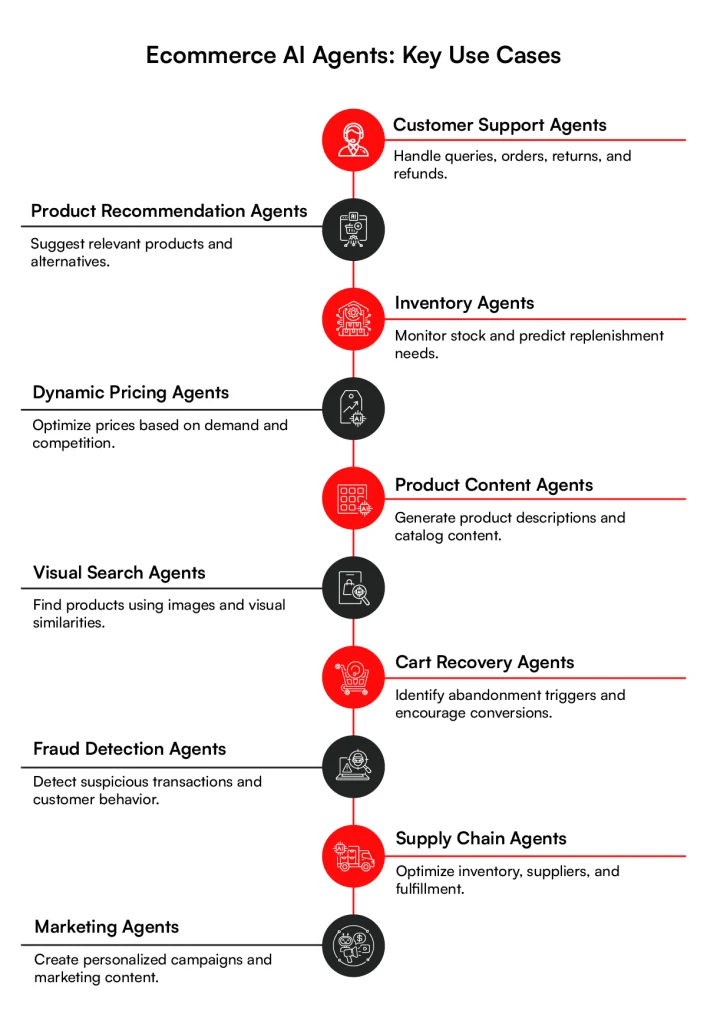
1. Customer Support AI Agents
Customer service teams spend considerable time handling repetitive requests about orders, shipping, returns, refunds, and product information. During peak shopping periods, this volume can quickly stretch support teams and increase response times.
A customer support agent can connect with order management, product, shipping, and customer systems to resolve routine requests.
For example, when a customer asks why an order has not arrived, the agent can check the latest tracking information, explain the delay, and escalate the case if human intervention is required.
Walmart’s AI-powered customer support assistant can verify customer accounts, retrieve order information, and support workflows such as returns. Walmart says the system can make support resolution up to 40% faster.
2. Personalized Product Recommendation Agents
A large product catalog can create a discovery problem of its own. Baymard’s research found that 31% of product-finding tasks failed when users relied on ecommerce search, showing how easily shoppers can struggle to find relevant products.
Recommendation agents can reduce that friction by combining browsing behavior, purchase history, product attributes, inventory, and the shopper’s current intent.
A customer searching for a laptop for video editing, for instance, could receive recommendations based on performance requirements and budget, followed by compatible storage, accessories, or alternatives.
3. Inventory Management AI Agents
For retailers, inventory is a constant balancing act. Stock too little and customers encounter unavailable products. Stock too much and capital remains tied up in inventory that may eventually need markdowns.
An inventory agent can continuously monitor sales velocity, stock levels, supplier lead times, promotions, and demand patterns. If sales of a particular SKU suddenly accelerate, for example, the agent can identify the potential shortage, check inventory across locations, and recommend a transfer or replenishment before the product goes out of stock.
This gives inventory teams earlier visibility into potential shortages and excess stock, allowing them to act before an inventory problem becomes a customer-facing issue.
4. Dynamic Pricing AI Agents
Online pricing can change rapidly as competitors adjust their offers, demand shifts, and inventory levels fluctuate. Manually monitoring these variables becomes increasingly difficult when retailers manage thousands of products.
Dynamic pricing agents can evaluate these signals and recommend price adjustments within predefined margin and pricing rules. Consider a retailer with excess inventory of a seasonal product while competitors begin lowering their prices.
The agent can assess demand, competitive pricing, and remaining stock before recommending whether to adjust the price, launch a promotion, or maintain the current position.
The goal is not simply to lower prices. It is to help pricing teams react faster while balancing conversion, competitiveness, inventory, and profitability.
5. Product Description Generation Agents
Adding hundreds or thousands of SKUs can turn product content into a major production bottleneck. Inconsistent or incomplete information can also make it harder for shoppers to compare products and make purchasing decisions.
A product content agent can work from structured catalog data such as specifications, dimensions, materials, features, and category information.
When a retailer launches a new collection, the agent can generate initial descriptions for each SKU according to predefined brand, tone, formatting, and SEO guidelines.
Content teams can then review and refine high-value products rather than starting every description from scratch. This creates a scalable content workflow while keeping human oversight where accuracy and brand positioning matter most.
6. Visual Search AI Agents
Sometimes the problem is not finding the right keyword. It is knowing what to type in the first place. Amazon’s StyleSnap demonstrates how visual search can address this problem.
Customers can upload a photograph or screenshot of a fashion look and receive recommendations for similar Amazon products. Amazon later expanded StyleSnap to home products, allowing customers to upload an image of furniture or décor and discover visually similar items.
For example, a shopper who sees a chair they like on social media can upload the image instead of trying to describe its shape, material, or style.
The system can identify relevant visual characteristics and return similar products that can then be filtered by price, size, or availability. The impact is a shorter path from visual inspiration to product discovery, particularly for categories where appearance plays a major role in purchase decisions.
7. Cart Abandonment Recovery Agents
Not every abandoned cart has the same cause. One shopper may leave because shipping costs are too high, another may need more product information, while someone else may simply be comparing alternatives. Baymard’s analysis of 50 studies puts the average documented cart abandonment rate at 70.22%.
An AI recovery agent can evaluate the context around an abandoned cart and determine a more relevant response.
If a shopper repeatedly checks delivery information before leaving, the agent can address shipping concerns. If the customer appears to be comparing products, it can suggest an alternative rather than immediately offering a discount.
This makes recovery efforts more targeted and gives retailers an opportunity to address the underlying reason for abandonment rather than treating every abandoned cart identically.
8. Fraud Detection AI Agents
As ecommerce transaction volumes increase, fraud detection teams need to distinguish genuine customers from increasingly sophisticated fraudulent activity.
A fraud detection agent can evaluate transaction history, account activity, payment signals, order velocity, and unusual purchasing patterns in real time. Suppose an account that normally makes small purchases suddenly places several high-value orders using different payment methods and shipping addresses.
The agent can flag the activity, request additional verification, hold the transaction, or route it to a fraud analyst. The objective is not to reject more transactions. It is to identify genuine risk while minimizing false declines that can cost legitimate customers and revenue.
9. Supply Chain Optimization Agents
Supply chain disruptions can quickly affect inventory availability, fulfillment, and delivery promises. AI agents for ecommerce can monitor demand, inventory, supplier performance, and fulfillment capacity to identify potential disruptions and recommend actions.
For example, if a supplier delay coincides with rising demand for a product, the agent can assess inventory across warehouses and recommend a stock transfer or alternative fulfillment option.
10. Content Creation and Marketing Agents
Marketing teams need to create content across product pages, email, social media, and advertising channels, often under tight deadlines. Content agents can use product information, customer segments, and campaign goals to generate and adapt content at scale.
For example, an ecommerce brand launching a seasonal collection can use an agent to create different email and social variations for new customers and repeat buyers.
With appropriate brand guidelines and human review, this can shorten production cycles while supporting more personalized campaigns.
Taken together, these use cases show how AI agents can influence the entire ecommerce operation, from discovery and conversion to inventory, fulfillment, fraud, and marketing.
The next section looks at the broader benefits of adopting AI agents and how these applications can translate into measurable business value.
Key Benefits of AI Agents in Ecommerce
AI agents can create value across the ecommerce lifecycle, not just by automating individual tasks. When connected to the right business systems and given clear guardrails, they can reduce operational costs, improve product discovery, speed up fulfillment, and create more responsive customer experiences.
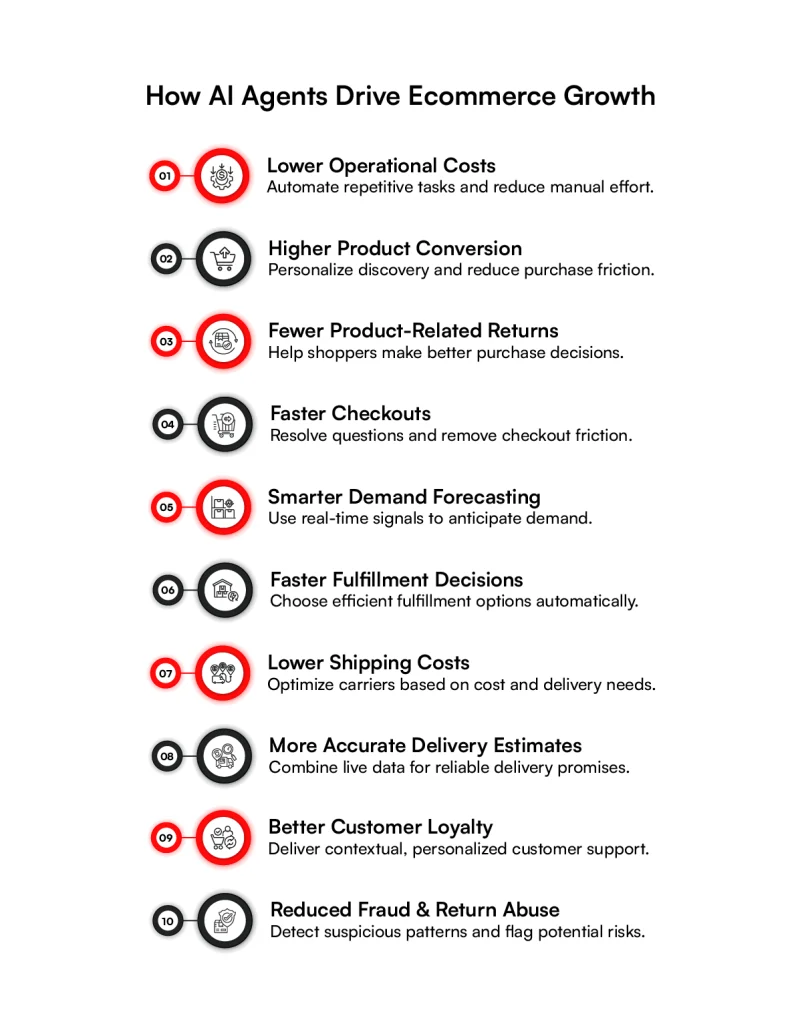
1. Massive Operational Cost Reduction
AI agents for ecommerce can take over repetitive, time-consuming work across customer support, merchandising, order management, and operations.
Instead of requiring employees to manually check systems, compare information, or perform routine actions, agents can handle these workflows continuously.
For example, a support agent can retrieve order details, answer delivery questions, and process routine requests without human intervention. This reduces the volume of repetitive work reaching support teams and allows employees to focus on more complex cases.
2. Higher Product-Page Conversion
Getting shoppers to a product page is only part of the challenge. The product information and recommendations they see next can determine whether they continue toward checkout.
AI agents can personalize product information, recommend relevant alternatives, answer product questions, and surface complementary products based on individual intent.
A shopper comparing two similar products, for instance, can receive a tailored explanation of which option better fits their requirements.
This can reduce decision friction and help more visitors move from product discovery to purchase.
3. Fewer Returns from Wrong Product Choices
Returns often happen because customers choose the wrong size, variant, specification, or product for their needs. An AI agent can intervene before purchase by asking relevant questions and using the answers to narrow down suitable options.
For example, a fashion agent can consider a shopper’s measurements, preferred fit, and previous purchases before recommending a size.
A furniture agent could ask about room dimensions before suggesting a product. Better purchase decisions can reduce avoidable returns while improving customer satisfaction.
4. Faster Checkouts
Checkout friction can turn purchase intent into abandonment. AI agents can simplify the final stages by answering last-minute questions, validating information, recommending appropriate delivery options, and assisting with payment or order-related issues.
For example, when a shopper asks whether an item can arrive before a specific date, the agent can check inventory and delivery information before the customer completes the purchase. Removing these small points of uncertainty can help shoppers move through checkout faster.
5. Demand Forecasting from Real-World Signals
Traditional forecasting often relies heavily on historical sales data. AI agents can incorporate additional signals such as search behavior, browsing patterns, promotions, weather, social trends, and changing customer demand.
If searches for a particular product suddenly increase, an agent can detect the signal and compare it with current inventory and sales velocity.
The business can then adjust replenishment plans before the demand spike becomes a stockout. This gives retailers a more dynamic view of demand and helps them make inventory decisions earlier.
6. Cheaper and Faster Fulfillment Decisions
Fulfillment involves multiple variables, including inventory location, warehouse capacity, delivery commitments, and order characteristics. AI agents can evaluate these factors simultaneously and recommend the most efficient fulfillment option.
For instance, when an order can be shipped from two warehouses, an agent can compare inventory availability, distance, capacity, and delivery requirements before selecting the appropriate location.
The result can be faster fulfillment decisions with less manual coordination between warehouses and operations teams.
7. Lower Shipping Costs Through Dynamic Carrier Optimization
Choosing a shipping carrier manually becomes difficult when businesses work with multiple logistics providers and delivery options.
An AI agent can compare carrier rates, service levels, delivery locations, package characteristics, and current capacity before selecting an appropriate option.
For example, a retailer could route a standard order through a lower-cost carrier while reserving premium services for customers with urgent delivery requirements. Over time, this dynamic approach can reduce unnecessary shipping costs without compromising delivery commitments.
8. More Accurate Delivery Dates
Customers increasingly expect accurate delivery information before completing a purchase. Static estimates can become unreliable when inventory moves between locations, carriers experience delays, or demand changes suddenly.
An AI agent can combine real-time inventory, warehouse processing times, carrier data, location, and historical delivery performance to provide a more precise estimate.
If a shipment encounters a delay, it can also update the customer and recommend alternatives where available. More reliable delivery promises help set realistic expectations and reduce customer frustration.
9. Improved Customer Service and Loyalty
Customers do not simply want quick responses. They expect relevant answers that take their previous interactions and current situation into account.
AI agents can maintain context across conversations, access customer and order information, and provide personalized assistance.
A returning customer asking about a replacement product, for example, can receive recommendations based on their previous purchase rather than starting the conversation from scratch. This creates a more consistent service experience and can strengthen customer trust and loyalty.
10. Reduction of Fraud and Return Abuse
Fraudulent transactions and return abuse can quietly erode ecommerce margins. AI agents can continuously analyze transaction patterns, account behavior, order history, and return activity to identify unusual behavior.
A retailer could, for example, flag an account showing repeated high-value purchases followed by unusually frequent returns. Instead of automatically rejecting the customer, the agent can assign a risk score and route suspicious cases for further review.
This helps businesses identify potential abuse earlier while avoiding unnecessary friction for legitimate customers.
These gains are not automatic. An agent can only make useful decisions when it has a clearly defined role, access to reliable data, the right tools, and guardrails for what it can and cannot do. Getting those foundations right is where effective ai agent development for ecommerce begins.
Build AI That Drives Ecommerce Growth
Don’t invest in AI without a clear business outcome. Identify the workflows where intelligent agents can create measurable operational and customer experience gains.
Build My Ecommerce AI AgentHow to Build & Deploy AI Agents for Ecommerce
Building an ecommerce AI agent starts with turning a business problem into a controlled, measurable system. That requires more than choosing an AI model.
The business needs to define what the agent should accomplish, how it will access ecommerce systems, what data it can use, and how its performance will be tested and monitored.
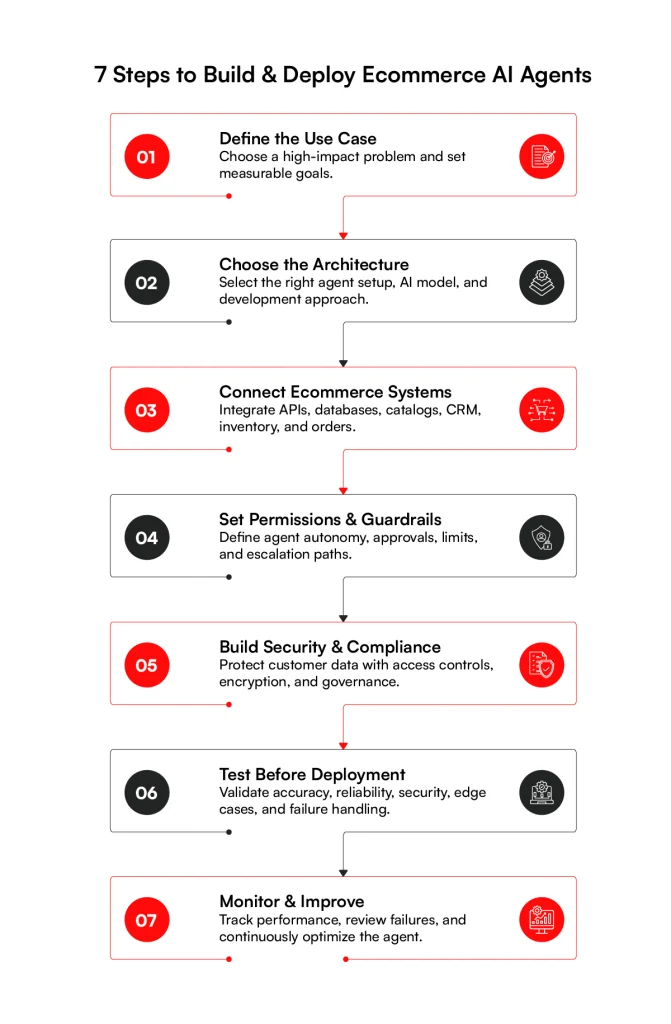
1. Pick One High-Impact Use Case and Define Success
Start with one problem that is frequent enough to matter and narrow enough to measure. Order tracking, product recommendations, return queries, inventory alerts, and cart recovery are practical starting points.
Define the expected outcome at the same time. A customer support agent might target lower response times and higher resolution rates, while an inventory agent could focus on forecast accuracy or fewer stockouts. Establishing a baseline before development makes it possible to determine whether the agent actually improves performance.
2. Choose the Architecture and AI Model
The use case determines how sophisticated the architecture needs to be. A focused product recommendation or support workflow may need only one agent, while a complex process involving inventory, fulfillment, pricing, and customer communication could benefit from multiple specialized agents working together.
Teams also need to decide whether to build, buy, or combine both approaches. An off-the-shelf platform can shorten development time for common use cases, while a custom agent provides greater control over workflows, models, integrations, and data.
Model selection should account for reasoning ability, latency, context requirements, accuracy, and operating cost rather than simply choosing the most powerful model available.
3. Connect the Agent to Ecommerce Systems
An agent cannot accomplish much if it only generates text. It needs access to the systems and data required to complete its task.
An order-support agent, for example, may need information from the ecommerce platform, CRM, order management system, and shipping provider. A recommendation agent will rely more heavily on product catalogs, inventory, customer preferences, and behavioral data.
APIs, webhooks, databases, and middleware provide these connections. Teams should also make sure the agent receives current, consistent data so it does not make decisions using outdated inventory, pricing, or order information.
4. Define Permissions, Approvals, and Escalations
Not every action should carry the same level of autonomy. Create explicit rules for what the agent can do independently, what requires approval, and what must be transferred to a human.
A support agent might answer product questions and check order status autonomously but require approval before issuing a large refund. Similarly, a pricing agent could recommend price changes while leaving unusually large adjustments to the merchandising team.
This authorization layer limits the impact of incorrect decisions and gives businesses a practical way to increase autonomy gradually as confidence in the agent grows.
5. Build Security and Compliance into the Design
Ecommerce agents may interact with names, addresses, purchase histories, payment-related information, and other sensitive customer data. Security therefore needs to be part of the architecture rather than something added after development.
Access controls, encryption, authentication, audit logs, and data minimization help restrict how agents access and use information.
Businesses should also design workflows around applicable requirements such as PCI DSS for payment-card environments and privacy regulations such as GDPR and CCPA.
Where possible, the agent should receive only the data necessary to complete its task. A product recommendation agent, for instance, usually does not need access to payment credentials.
6. Test the Agent Before Production
Before customers interact with the agent, test both its responses and its actions. Start with expected scenarios, then deliberately introduce edge cases such as missing customer data, unavailable products, API failures, conflicting information, unusual requests, and attempts to push the agent beyond its permissions.
Testing should cover accuracy, latency, tool execution, security controls, escalation behavior, and failure recovery. Teams can then run the agent in a sandbox or staging environment before introducing it to a limited portion of real traffic.
A phased rollout makes failures easier to detect and contain than launching the agent across the entire ecommerce operation at once.
7. Monitor Performance and Keep Humans in the Loop
Production is not the end of development. Customer behavior changes, catalogs expand, policies evolve, and new edge cases appear over time.
Monitor the success metrics defined at the outset, as well as failed tasks, incorrect responses, unusual agent behavior, customer feedback, and operating costs.
Human reviewers can use these findings to improve prompts, knowledge sources, workflows, models, and business rules.
As performance becomes more consistent, the agent can gradually handle a larger share of the workload. At that point, the focus moves from building the underlying intelligence to operating it reliably within the live ecommerce environment.
For businesses that need an agent built around their existing operations, RBMSoft’s custom AI agent development for ecommerce takes a system-first approach rather than adapting a generic template.
Each agent is scoped around the business’s requirements, connected to its existing systems and data, and tested against real workflows before reaching production.
This helps ensure the agent fits how the business actually operates, rather than forcing existing processes to fit the technology.
Even with the right architecture, integrations, security controls, and testing process in place, building a reliable ecommerce AI agent comes with practical hurdles.
Data quality, legacy-system integration, unpredictable agent behavior, scalability, and maintaining customer trust can all affect how well the system performs in real-world conditions.
Understanding these challenges early helps teams design agents that are easier to control, improve, and scale.
Key Challenges while Building Ecommerce AI Agents and Their Solutions
Ecommerce AI agents must work with changing data, unpredictable customer requests, and business-critical systems. Keeping them accurate, secure, and reliable requires solving several practical challenges.
1. Defining Clear Agent Objectives and Boundaries
Vague objectives give agents too much room to interpret their roles, increasing the risk of actions that conflict with business rules.
How to solve it: Define exactly what each agent can read, recommend, and execute. Use guardrails, fallback rules, and escalation conditions for exceptions. For example, a returns agent can process standard requests while routing unusual cases for approval.
2. Context and Memory Management
Shopping conversations accumulate details such as budget, size, preferences, and delivery requirements. Keeping too little context creates repetitive interactions, while retaining too much increases token costs and privacy risks.
How to solve it: Maintain short-term memory during the interaction and persist only information with a clear future use.
Store important preferences as structured attributes rather than repeatedly sending complete conversation histories. Apply retention rules to remove unnecessary customer data.
3. Tool Integration and API Orchestration
Agents often depend on catalogs, CRMs, inventory systems, order platforms, payment services, and carrier APIs. One failed integration can disrupt an entire workflow.
How to solve it: Add authentication, schema validation, timeouts, retries, and error handling to every integration. Use an orchestration layer to track completed actions and prevent duplicate orders, refunds, or other transactions during retries. Pull real-time information from the relevant system of record.
4. Reliability, Hallucinations, and Inaccurate Responses
Language models can generate convincing but incorrect information about products, prices, inventory, or policies.
How to solve it: Use retrieval-augmented generation (RAG) to ground responses in approved catalogs, policies, FAQs, and knowledge bases.
Retrieve changing information such as inventory and order status directly from live systems. If reliable information is unavailable, the agent should acknowledge the limitation or escalate rather than guess.
5. Scalability and Infrastructure Costs
Traffic spikes increase model calls, database queries, API requests, latency, and inference costs simultaneously.
How to solve it: Route simple tasks to smaller models and reserve more capable models for complex reasoning. Use caching, shorter context windows, optimized prompts, and asynchronous processing to control costs. Run load testing against expected peak traffic before scaling.
6. Security, Privacy, and Data Governance
Ecommerce agents may access PII, including names, addresses, account information, preferences, and purchase histories. Multiple backend connections increase the potential attack surface.
How to solve it: Enforce least-privilege access, encryption, secure secret management, role-based controls, audit logs, and data-retention policies. Keep sensitive data out of prompts and logs unless necessary.
Data handling should also meet applicable GDPR and CCPA requirements for consent, access, retention, and deletion.
7. Over-Automation and Lack of Human Oversight
High-value refunds, fraud cases, complaints, and policy exceptions often require judgment that an autonomous agent should not make alone.
How to solve it: Build human-in-the-loop escalation around risk, transaction value, confidence levels, and predefined exceptions. Let agents handle low-risk tasks independently while sending sensitive cases to employees with the relevant customer context and conversation history.
8. Continuous Improvement and Success Measurement
Customer behavior, catalogs, policies, and business conditions change over time, which can gradually reduce agent performance.
How to solve it: Track metrics that match the use case, such as conversion and add-to-cart rates for shopping agents or resolution, escalation, response time, and customer satisfaction for support agents.
Review failed conversations, tool errors, escalations, and feedback regularly. Use those findings to improve prompts, RAG sources, workflows, and evaluation datasets.
For businesses that prefer external engineering support, RBMSoft can serve as a development partner for ecommerce AI agents, with security, compliance, and phased rollout considered throughout implementation.
These technical and operational choices directly affect the resources required to build, integrate, test, secure, and maintain an ecommerce AI agent, making them important factors in the overall development cost.
Overcome AI Challenges Before They Scale
From hallucinations to API failures and data privacy, address critical risks early to build agents that remain reliable as your ecommerce business grows.
Talk To Our AI ExpertsCost to Develop AI Agents for Ecommerce
A custom ecommerce AI agent can typically cost $10,000 to $250,000+, depending on complexity, integrations, data requirements, and production scale. A focused MVP sits toward the lower end, while enterprise-grade multi-agent systems can move well into six figures.
| Project scope | Typical development cost |
| Basic ecommerce AI agent or MVP | $10,000–$25,000 |
| Custom single-agent solution | $20,000–$50,000 |
| Agent with RAG and multiple integrations | $40,000–$100,000 |
| Enterprise or multi-agent system | $80,000–$250,000+ |
Agent Complexity
A single agent with a defined workflow requires less engineering than a multi-agent system coordinating several specialized agents. Costs increase with orchestration, state management, inter-agent communication, custom decision logic, and failure handling.
Model Choice and Usage Costs
Commercial LLMs charge based largely on token usage, so operating costs depend on the model, traffic, prompt length, and context size.
Model routing can control spending by assigning simple tasks to smaller models and reserving more capable models for complex reasoning. Self-hosted models reduce dependence on per-call API pricing but add GPU, hosting, DevOps, monitoring, and model-management costs.
Integration and API Work
Standard integrations with ecommerce platforms and common CRMs generally require less development than custom ERP, warehouse, payment, or legacy-system connections.
Custom middleware, authentication, data transformations, failure recovery, and third-party API fees can push both development and recurring costs higher.
Data and Infrastructure
Agents using RAG need infrastructure for document processing, embeddings, vector databases, retrieval pipelines, and storage.
Production environments may also require cloud compute, databases, logging, monitoring, backups, autoscaling, and redundancy, creating recurring infrastructure costs alongside the initial development budget.
Testing and QA
Testing costs depend on the number of workflows and the consequences of an incorrect action. QA should cover response accuracy, tool execution, edge cases, integration failures, security controls, and load testing, while automated evaluation suites add upfront work but make future changes easier to validate.
Ongoing Maintenance and Optimization
Recurring costs include model usage, infrastructure, monitoring, bug fixes, prompt and model optimization, knowledge-base updates, security patches, and API changes.
For accurate budgeting, businesses should therefore separate one-time development costs from ongoing operating costs rather than treating the initial build price as the total investment.
Beyond individual project budgets, market data on adoption, investment, and agentic commerce provides a broader view of where ecommerce AI agents are heading.
Ecommerce AI Agents Industry Trends and Market Statistics
The ecommerce AI agent market is expanding rapidly as retailers invest in more personalized and autonomous shopping experiences.
Technavio estimates that the market will grow by $4.2 billion between 2024 and 2029 at a CAGR of 39.7%, with hyper-personalization and improved customer experience among the major growth drivers.
The market is also moving beyond conventional chatbots toward conversational agents that can understand intent, recommend products, and support customers across multiple stages of the buying journey.
The next phase is likely to bring more multimodal shopping, autonomous workflows, and agent-to-agent commerce. Customers will increasingly interact through combinations of text, voice, and images, while agents take on more complex shopping and operational tasks.
At the same time, wider access to customer and transactional data will put greater pressure on privacy, security, and governance.
As these capabilities mature, the focus will shift from experimenting with AI agents to finding where they can deliver sustainable value across ecommerce.
Conclusion
AI agents can help ecommerce businesses move beyond rule-based automation to smarter, more adaptive customer and operational experiences. But delivering reliable results requires the right AI architecture, integrations, security, and ongoing optimization.
We help businesses build and deploy AI agents for ecommerce tailored to their workflows, technology stack, and business goals.
RBMSoft can help with:
- Custom AI Agent Development: Build agents for support, recommendations, inventory, pricing, fraud, and more.
- Ecommerce Integrations: Connect agents with Shopify, WooCommerce, Magento, CRM, ERP, inventory, and order systems.
- AI & LLM Integration: Implement LLMs, RAG, knowledge bases, and intelligent workflows.
- Agentic Automation: Enable agents to reason, use tools, and complete multi-step tasks within defined guardrails.
- Security & Governance: Protect customer data with access controls, authentication, monitoring, and human oversight.
- Testing & Optimization: Evaluate performance, reliability, accuracy, and cost before and after deployment.
RBMSoft can help turn ecommerce AI opportunities into scalable, production-ready solutions with the right strategy and engineering foundation.
FAQ’s
1. What are ecommerce AI agents, and how are they different from chatbots?
AI agents for ecommerce are autonomous systems that can understand customer intent, make decisions, and take actions such as product discovery, recommendations, order tracking, and returns management.
Unlike chatbots, which primarily respond to predefined or conversational queries, AI agents can use tools, access business systems, and complete multi-step tasks with limited human intervention.
2. How will AI agents change ecommerce?
AI agents in ecommerce can automate customer service, personalize shopping experiences, optimize inventory decisions, streamline order management, and support faster purchasing.
They can analyze real-time data and act across multiple workflows, making ai agents in retail and ecommerce increasingly valuable for improving operational efficiency and customer engagement.
3. How long does it take to build ecommerce AI agents?
The timeline depends on the agent’s complexity, integrations, data requirements, and number of workflows.
A focused agent may take a few weeks, while enterprise-grade ai agent development for ecommerce involving multiple systems, custom workflows, testing, security controls, and deployment can take several months.
4. What compliance requirements does RBMSoft follow while developing ecommerce AI agents?
Compliance requirements depend on the target market, business model, customer data involved, and integrations.
During ecommerce ai agent development, RBMSoft can incorporate appropriate security, privacy, access-control, data-handling, and governance measures based on project requirements and applicable regulations.
Specific compliance standards should be confirmed for each implementation rather than assumed to apply universally.
5. How much does it cost to build an ecommerce AI agent?
The cost varies based on the agent’s capabilities, complexity, integrations, AI model selection, data architecture, security requirements, and ongoing maintenance.
A basic agent costs less than an enterprise solution involving multiple systems and autonomous workflows. A detailed estimate can be provided after defining the scope of ai agent development for ecommerce.
6. Can ecommerce AI agents integrate with Shopify, WooCommerce, and Magento?
Yes. Ecommerce AI agents can integrate with platforms such as Shopify, WooCommerce, and Magento through APIs, webhooks, plugins, and other integration mechanisms.
Ecommerce AI agent development can connect agents with product catalogs, customer data, inventory, orders, payments, and fulfillment systems, depending on the platform and required workflows.
7. What are the most common use cases for AI agents in retail and ecommerce?
Common use cases include AI-powered product discovery, personalized recommendations, customer support, order tracking, returns assistance, inventory monitoring, pricing support, and marketing automation.
AI agents in retail and ecommerce can also coordinate actions across business systems rather than simply generating responses.
8. What does ecommerce AI agent development involve?
Ecommerce AI agent development typically involves defining business objectives, selecting AI models, designing agent workflows, connecting APIs and enterprise systems, establishing data and security controls, testing agent behavior, and monitoring performance after deployment.
The scope varies according to the agent’s intended role and level of autonomy.
9. Why should businesses invest in AI agent development for ecommerce?
AI agent development for ecommerce can help businesses automate repetitive processes, reduce response times, improve personalization, and support employees across operational workflows. When appropriately designed and governed, these systems can help businesses scale customer and operational support without relying entirely on manual intervention.
10. Are AI agents suitable for both B2C and B2B ecommerce?
Yes. AI agents in ecommerce can support both B2C and B2B environments, although their workflows differ. B2C agents may focus on product discovery, recommendations, and customer support, while B2B agents can assist with account-specific pricing, bulk orders, product availability, procurement workflows, and order management.
11. How does RBMSoft approach ecommerce AI agent development?
RBMSoft’s approach can be tailored around the business’s existing ecommerce ecosystem, objectives, data, and workflows.
Ecommerce AI agent development may include integrating the agent with commerce platforms and enterprise systems, defining appropriate levels of autonomy, implementing security controls, and continuously monitoring performance after deployment.