

Table of Contents
Quick Summary
- Custom AI development builds AI around a company’s own data, workflows, business rules, and software systems.
- Custom AI development for B2B fits businesses that need greater control, accuracy, integration, or industry-specific requirements.
- Custom AI development solutions can include custom ML models, NLP, computer vision, predictive AI, and prescriptive AI.
- Project cost and timeline depend on data readiness, model complexity, integrations, security, and the size of the deployment.
- The right custom AI development company should understand data, model architecture, enterprise integration, security, and production monitoring.
- RBMSoft builds and integrates custom AI solutions with CRM, ERP, ecommerce platforms, APIs, and existing enterprise applications.
Businesses can buy AI tools for writing, analysis, automation, and customer support within minutes. The problem starts when those tools need to work with company-specific data, internal rules, existing software, or processes that were never designed around a standard AI product.
That gap becomes harder to ignore as AI moves into day-to-day operations. Limited integrations, generic outputs, data restrictions, and fixed workflows can leave teams changing how they work to fit the tool instead of solving the original business problem.
Custom AI development takes a different route by building around the company’s actual requirements. This article explains custom AI development for B2B, including solution types, benefits, challenges, development steps, costs, use cases, and what to look for in an AI development partner.
What Is Custom AI Development?
When a business needs AI to work around its own processes, data, and operating rules, a ready-made tool may only cover part of the requirement. Custom AI development involves building an AI system for that specific business need, rather than adapting the business around the limits of an existing product.
Depending on what the business is trying to achieve, the solution could involve a machine learning model trained on company data, an application that processes documents, or an AI system connected with existing CRM, ERP, and other business software. Custom AI development solutions can also be built for tasks such as forecasting, recommendations, visual analysis, and process automation.
For companies with more complex operations, custom AI development for B2B can account for internal business rules, approval processes, proprietary data, and dependencies between different systems. The result is an AI solution built around how the company already works and what it needs the system to accomplish.
Difference Between Custom AI Solutions & Off-the-Shelf AI Tools
While off-the-shelf AI tools are built to serve common requirements across many businesses, custom solutions are designed around a company’s own data, processes, and systems. The differences become clearer when you compare how each option performs in day-to-day business use.
| Factor | Custom AI Solutions | Off-the-Shelf AI Tools |
| Flexibility | Built around specific workflows, business rules, and changing requirements. | Works within predefined features and workflows created for a broad user base. |
| Accuracy | Can be trained and tuned using business or domain-specific data for the required use case. | Usually relies on general models and configurations that may need additional tuning for specialized tasks. |
| Integration | Can be designed to work with existing CRM, ERP, databases, APIs, and internal applications. | Integration depends on the APIs, connectors, and configuration options provided by the vendor. |
| Scalability | Architecture, models, and infrastructure can be expanded as data volumes and requirements change. | Scaling depends on the platform’s technical limits, available plans, and supported features. |
| Data Ownership | Gives the business greater control over how its data, models, and related intellectual property are managed. | Data handling, model access, and ownership terms depend on the provider’s policies and agreement. |
Once a business decides that a ready-made tool cannot fully meet its requirements, the next question is what type of AI system it actually needs. Custom AI development solutions can take different forms depending on the data involved, the problem being solved, and how the system will be used within the business.
Need AI Built Around Your Business?
Build a custom AI solution that fits your data, workflows, and existing systems.
Discuss Your AI Requirements
Types of Custom AI Development Solutions for B2B
Based on the problem a business needs to solve, custom AI development for B2B can involve different models and applications. Below are four common types of custom AI development solutions and where they fit into business operations.
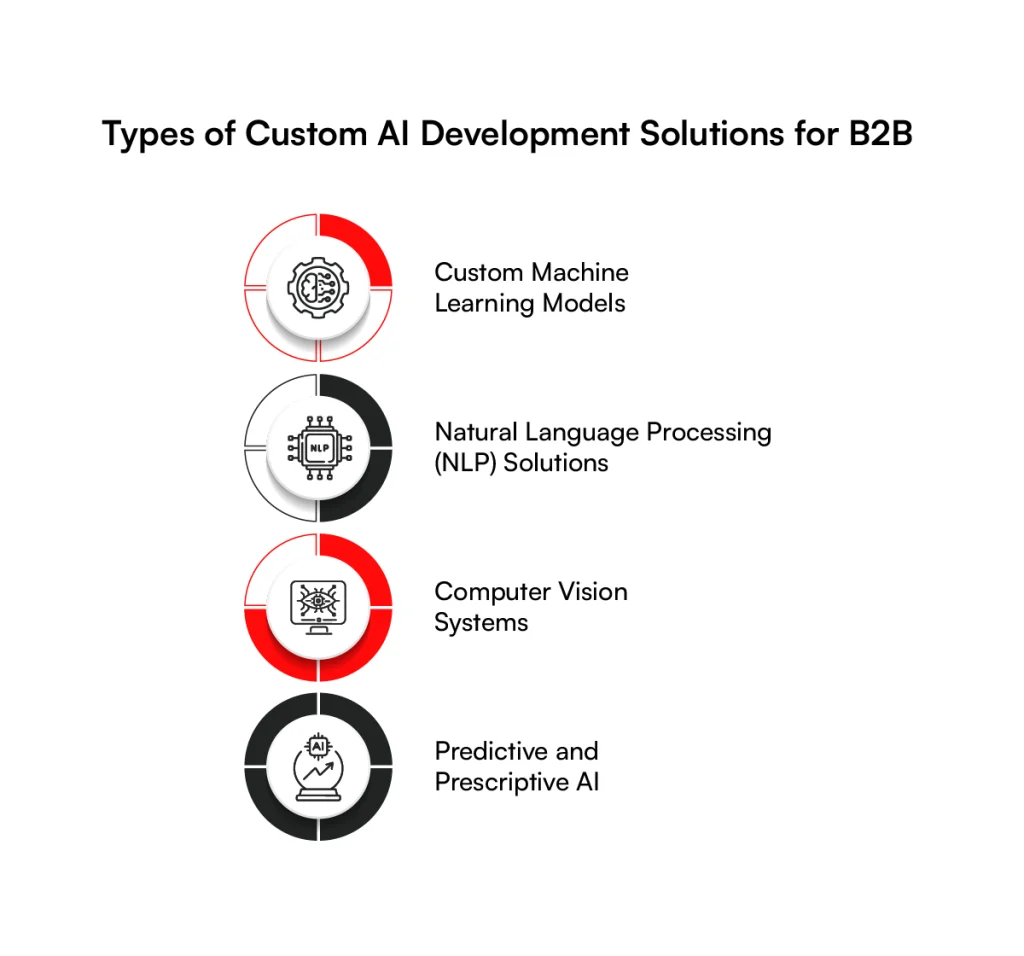
1. Custom Machine Learning Models
Custom machine learning models learn from a company’s historical data to recognize patterns linked to a specific business outcome. A model might study changes in orders, customer behavior, or transactions over time, then use those patterns to forecast what is likely to happen when new data arrives.
A B2B distributor can train a model using order history, product demand, customer accounts, and seasonal changes to forecast demand at the SKU level. The model can then be retrained as purchasing patterns and business conditions change.
2. Natural Language Processing (NLP) Solutions
Companies that work with large volumes of text or conversations can use NLP systems to interpret and process that information. These custom AI solution development projects can cover document classification, data extraction, enterprise search, sentiment analysis, chatbots, and virtual assistants.
An NLP system can read contracts, invoices, support tickets, or other business documents and extract the information teams need. It can also be adapted to company or industry terminology, which is useful when standard language models do not understand specialized terms or document structures.
3. Computer Vision Systems
Computer vision systems use images and video as input, allowing businesses to identify objects, defects, movements, and other visual conditions automatically. Custom models can be trained around the exact visual patterns a business needs to recognize.
Manufacturers can use these systems to identify product defects during inspection, while retailers can apply them to shelf and inventory monitoring. Computer vision can also support equipment inspection, image classification, quality control, and workplace safety checks.
4. Predictive and Prescriptive AI
Predictive AI analyzes historical and current data to estimate what is likely to happen next. Prescriptive AI takes the analysis further by recommending what the business should do based on those expected outcomes. Together, they can support inventory planning, pricing, maintenance, risk management, and demand planning.
This is also where RBMSoft can connect custom AI/ML solutions development with the systems that carry out business decisions. Product, inventory, order, and demand data can feed a predictive model, while its output can flow back into ERP, CRM, commerce, or planning software so teams can act on it within the systems they already use.
Related read: Agentic Commerce in Retail: How AI Agents are Changing Digital Shopping
Benefits of Custom AI Development for Businesses
Once the right AI solution is identified, its value depends on how effectively it improves existing business processes. Custom AI development for B2B addresses specific workflows, decisions, and data needs.
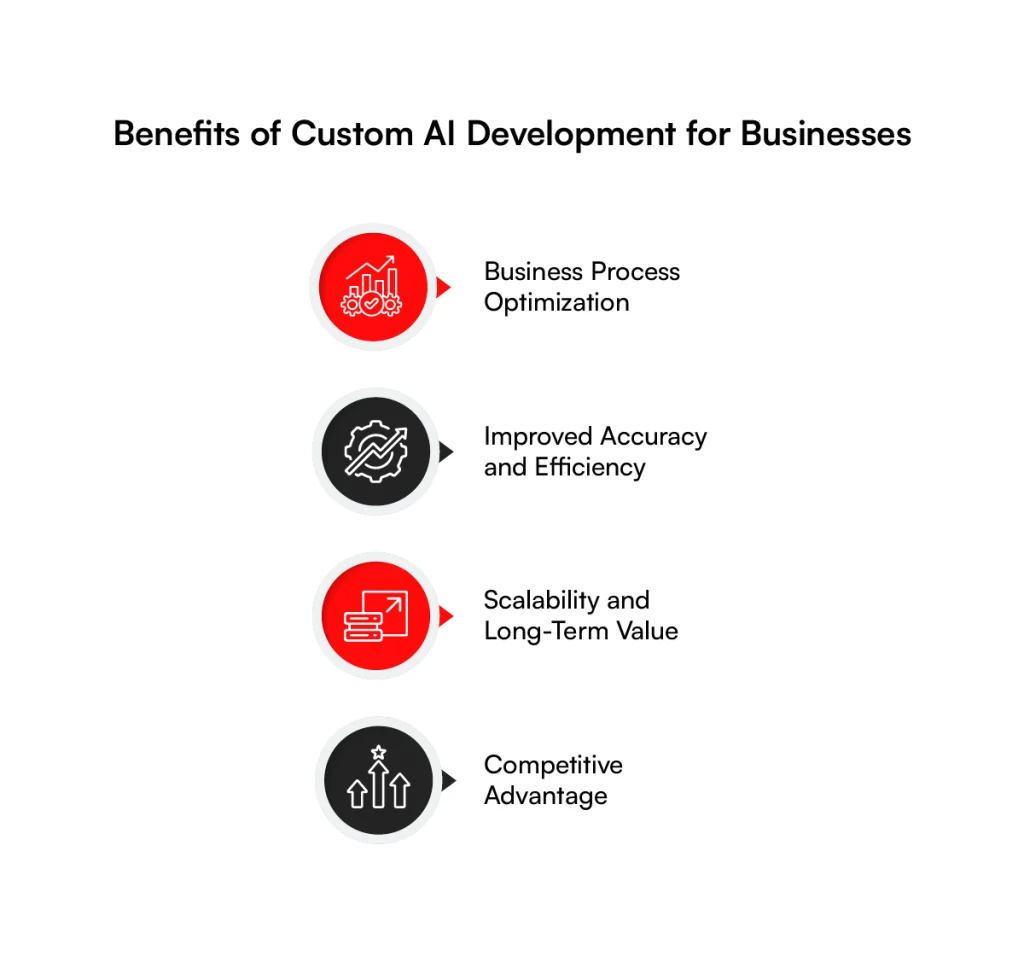
1. Business Process Optimization
Custom AI can take over repetitive work as well as processes that involve several systems, data sources, and decision points. This can include processing documents, routing requests, reviewing transactions, prioritizing leads, or triggering actions based on defined business rules.
Teams spend less time moving information between systems or checking routine tasks manually. The process also becomes more consistent because the same rules can be applied every time the system receives new data.
2. Improved Accuracy and Efficiency
AI models built around relevant business data can produce results that better reflect the conditions in which the company operates. This is particularly useful for forecasting, risk scoring, anomaly detection, customer analysis, and other tasks where generic outputs may provide limited value.
Through custom AI model development, businesses can also set their own performance targets and test results against actual business data. Teams can process larger volumes of information in less time while getting outputs that are better suited to the decisions they need to make.
3. Scalability and Long-Term Value
Business requirements rarely stay fixed, so a custom AI system can be designed to change as data volumes, users, workflows, and use cases increase. Models can be retrained, new data sources can be connected, and additional capabilities can be added without rebuilding the entire system.
This gives custom AI development solutions a longer useful life when AI is expected to become part of core operations rather than solve a single short-term requirement. It also helps businesses adapt the system as priorities change, ensuring the investment continues to support new operational needs and growth opportunities.
4. Competitive Advantage
A company’s proprietary data, operating knowledge, and decision rules can become part of how its AI system works. Competitors may have access to the same commercial AI models, but they do not have access to the same internal data or years of business-specific information.
That difference can support capabilities that are harder to copy, from more precise demand predictions to company-specific decision systems. Over time, the AI system can improve as it receives more relevant business data, giving the company an asset built around its own operations.
Build AI That Can Grow With Your Business
Create a custom AI system that can adapt as your data, workflows, and requirements change.
Start Your AI DevelopmentCommon Challenges in Custom AI Development for B2B Projects
While the business case for custom AI can be strong, getting a system from an idea into production comes with practical hurdles. Custom AI development for B2B often depends on the condition of existing data, available technical skills, budget, and the rules governing how AI can use business information.
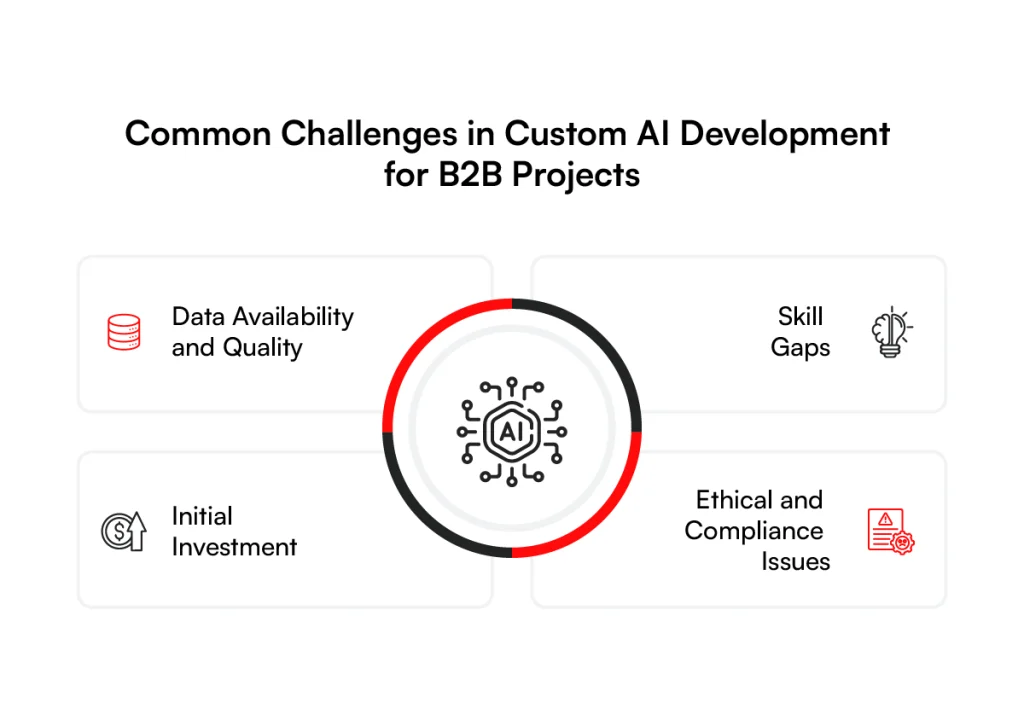
1. Data Availability and Quality
Business data is rarely ready for AI from day one. Customer records may sit in a CRM, transaction data in an ERP, and operational data in separate applications, often with different formats, missing fields, or duplicate records.
Before model training begins, teams may need to clean and organize this information, resolve inconsistencies, and bring data from different sources together. Poor input data can make even a well-built model return unreliable results.
2. Initial Investment
Custom development usually costs more upfront than subscribing to an existing AI tool. The budget may need to cover data preparation, model development, infrastructure, integrations, testing, security, and ongoing monitoring.
The amount depends heavily on what the system needs to do. Automating one document workflow requires far less work than building an enterprise AI system that connects with several applications and handles multiple business processes.
3. Skill Gaps
Building the model is only one part of getting AI into production. A project may also require data engineers, software developers, cloud specialists, security teams, and people who can test and monitor model performance after launch.
Finding all of those skills internally can be difficult, especially when AI is new to the organization. An experienced development partner can fill those gaps while making sure the AI works with the software and data the business already uses.
4. Ethical and Compliance Issues
Once AI starts working with customer, employee, financial, or other sensitive information, businesses need clear rules around who can access the data and how AI decisions are made. Bias, privacy, explainability, auditability, and human oversight may also need to be addressed before the system goes live.
RBMSoft can account for these requirements during custom AI solutions development through access controls, audit trails, model monitoring, governance controls, and human review where needed.
Related read: Retail AI Agent Development: Closing the Gap Between Pilot and Scale
Custom AI Development: Step-by-Step Process
After the business case and possible challenges are clear, the project can move into development. A typical custom AI solutions development process follows six steps, starting with the business requirement and continuing through model monitoring after launch.
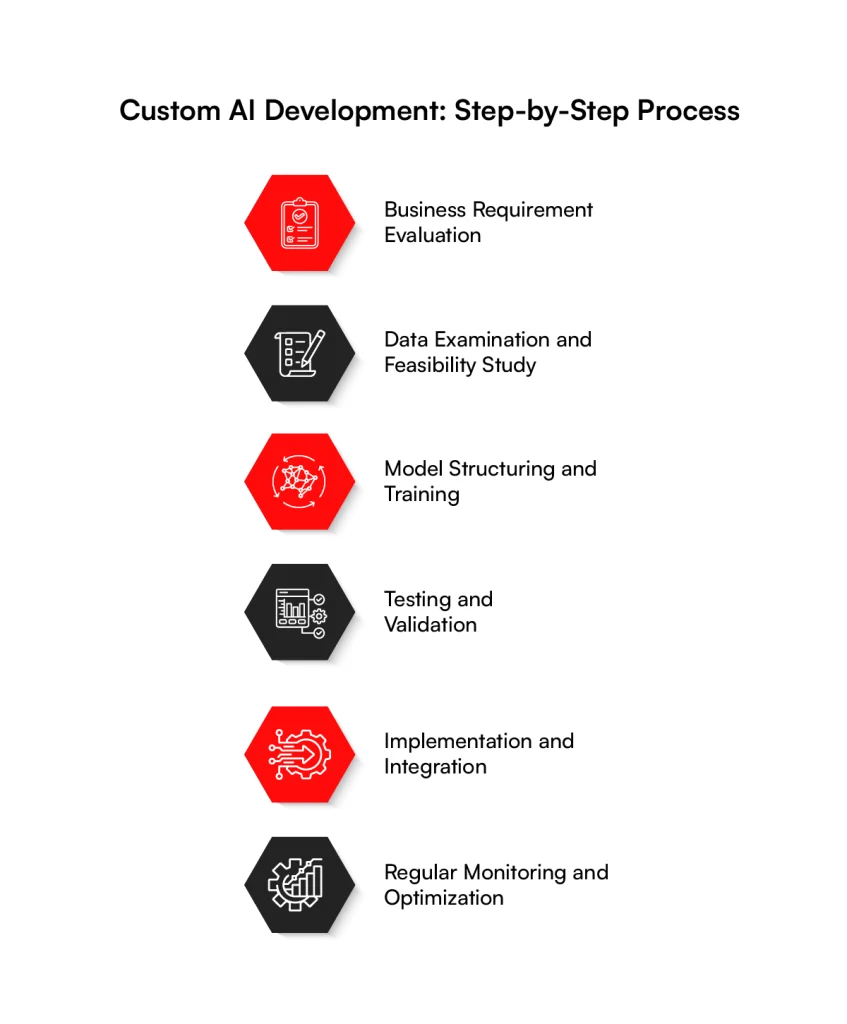
Step 1. Business Requirement Evaluation
The process starts by defining what the AI system needs to solve and how its performance will be measured. Teams identify the current problem, users involved, expected output, business rules, and the systems the AI may need to work with.
This stage should also set measurable targets. A demand forecasting project may track forecast accuracy, while document automation may focus on processing time, extraction accuracy, and the amount of manual review required.
Step 2. Data Examination and Feasibility Study
Once the requirement is defined, the available data needs to be checked before model development begins. Teams review its volume, quality, consistency, format, accessibility, and relevance to determine whether there is enough usable information to support the intended outcome.
The feasibility study also helps determine if AI is the right approach for the problem. Gaps found at this point may require additional data collection, cleaning, labeling, or integration work before the project moves forward.
Step 3. Model Structuring and Training
With usable data in place, developers select the model architecture and training approach that fit the use case. Historical datasets are then used to train the model to identify the patterns and relationships needed to produce the intended output.
Custom AI model development does not always mean creating a model entirely from scratch. Depending on the requirement, teams may train a new machine learning model, fine-tune an existing model, or configure an existing foundation model with company data and supporting components.
Step 4. Testing and Validation
Before an AI system reaches production, its output needs to be tested against data and situations it did not encounter during training. Teams check accuracy, reliability, and how consistently the model performs when inputs change.
Validation criteria should match the original business target rather than relying on technical model scores alone. This helps determine whether the system is ready for actual users and operating conditions.
Step 5. Implementation and Integration
After validation, the AI system moves into the production environment and connects with the applications where it will be used. Depending on the project, that could mean integrating it with CRM, ERP, ecommerce platforms, databases, internal applications, or APIs.
For custom AI development for B2B, this stage often determines how useful the model becomes in practice. RBMSoft can connect the AI with existing business software so inputs reach the model and its outputs return to the systems and workflows where teams need them.
Step 6. Regular Monitoring and Optimization
Production data changes over time, and model performance can change with it. Teams therefore need to track accuracy and other agreed performance measures, identify changes in input patterns, and retrain or adjust the model when its results begin moving away from expected levels.
Monitoring also creates a feedback loop between actual business results and future model updates. Instead of treating deployment as the end of custom AI development, the system can continue to be adjusted as new data and requirements emerge.
Make Custom AI Work With Your Current Tech Stack
Connect AI with the applications, data, and workflows your teams already depend on.
Talk to Our AI TeamHow Much Does Custom AI Development Cost?
The cost of custom AI development can range from a smaller investment for a focused chatbot to a much larger budget for an enterprise AI platform. Project scope, data preparation, model training, integrations, infrastructure, testing, and security all influence where the final cost falls.
Here is a quick cost and timeline comparison for common custom AI development solutions:
| Project Type | Cost Range | Typical Timeline | Typical Use Case |
| AI Chatbot | $5,000–$15,000 | 2–4 weeks | Customer support bot with CRM integration |
| Process Automation | $10,000–$30,000 | 3–6 weeks | Invoice processing and document classification |
| AI Agents | $15,000–$50,000 | 4–8 weeks | Multi-agent systems for sales or operations |
| Enterprise Platform | $50,000–$150,000+ | 8–16 weeks | AI platform with multiple agents and custom models |
These figures can move considerably when a project requires extensive data engineering, specialized model training, strict compliance controls, or integrations with several enterprise systems.
Defining the use case and reviewing the available data first gives businesses a much more realistic estimate than pricing the project around the AI model alone.
When Do Businesses Need Custom AI?
Off-the-shelf AI handles standard tasks well. However, it becomes less suitable when businesses require specific rules, data, integrations, or performance levels. Custom AI development may offer a better solution in the following situations.
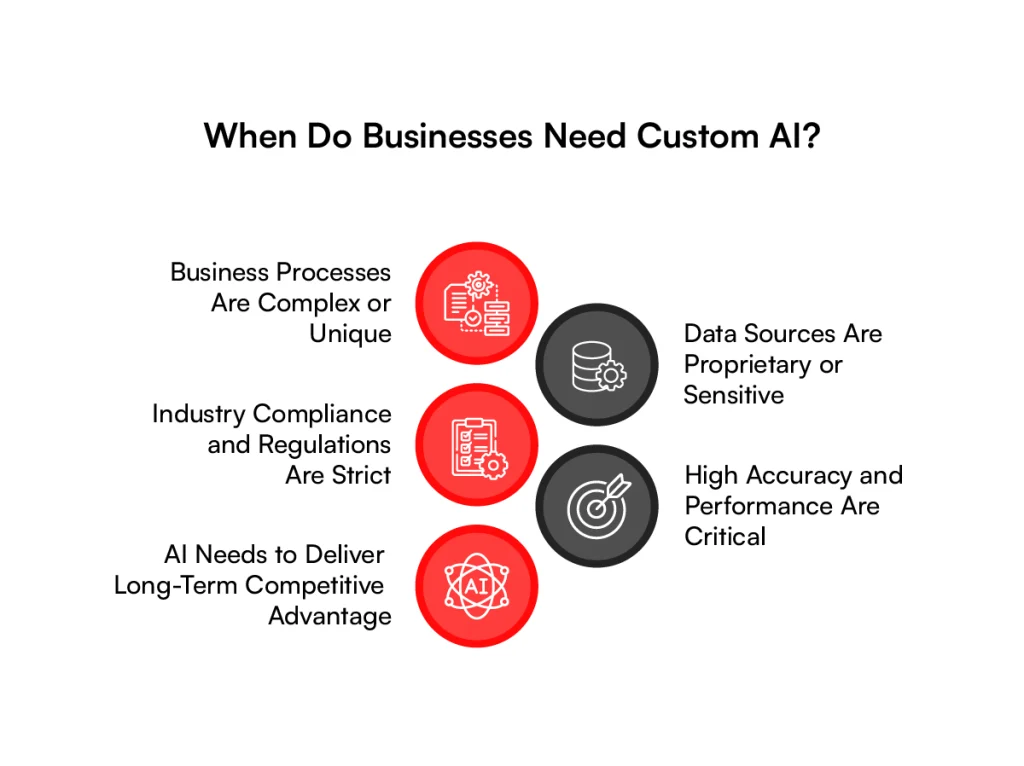
1. Business Processes Are Complex or Unique
Processes involving several systems, approval paths, decision rules, and exceptions may not fit a standard AI product development Services.
Custom AI can combine APIs, workflow orchestration, rules engines, and models so the system follows existing business logic instead of forcing teams into predefined vendor workflows.
2. Data Sources Are Proprietary or Sensitive
Customer records, transactions, contracts, and internal knowledge may contain information that businesses cannot freely share with third-party AI services.
Custom AI development for B2B gives companies more control through private model endpoints, role-based access, encrypted storage, isolated environments, and controlled data pipelines.
3. Industry Compliance and Regulations Are Strict
Healthcare, finance, insurance, and other regulated industries may need clear records of what data entered an AI system, who accessed it, and how decisions were made.
Custom artificial intelligence solutions can include audit logs, model versioning, access policies, traceable outputs, and human-in-the-loop approvals from the start.
4. High Accuracy and Performance Are Critical
Generic models become harder to rely on when incorrect outputs can affect revenue, risk, or operations. Domain-specific datasets, fine-tuning, RAG, validation thresholds, and continuous model evaluation allow businesses to measure performance against their own requirements rather than accepting general-purpose model performance.
5. AI Needs to Deliver Long-Term Competitive Advantage
Using the same AI tools as competitors may improve efficiency, but it rarely creates a lasting advantage. Businesses can gain stronger differentiation by developing AI around their proprietary data, unique processes, and customer needs.
RBMSoft builds custom AI solutions that integrate with CRM, ERP, ecommerce, and operational systems to create capabilities tailored to each company’s goals.
Bring Custom AI Into Your Existing Systems
Connect AI with your CRM, ERP, ecommerce, and operational applications.
Talk to an AI ExpertCustom AI Development for Different Industries
Custom AI development looks different across industries because each works with different data, systems, and business decisions.
1. Healthcare
Healthcare puts strict demands on how AI handles clinical and patient information. A model working with medical images or patient histories may need data from EHR, laboratory, and imaging systems before it can assist with clinical decisions or identify patient risk.
Because this information is sensitive, the architecture also needs controlled access, traceable model outputs, audit logs, and validation before AI becomes part of a clinical workflow.
2. Finance & Banking
Financial services bring AI much closer to real-time decision-making. Banks can combine transaction history with account and behavioral signals to detect unusual activity, assess credit risk, or flag transactions that need further review.
For custom AI development for B2B, accuracy alone may not be enough in this environment. Model versioning, explainability, validation thresholds, and human review can be built into the workflow so financial institutions have a record of how important decisions were reached.
3. Retail & E-commerce
Retail has a different problem: the information AI needs is often scattered across PIM, OMS, CRM, ERP, search, and ecommerce platforms. A demand forecast or product recommendation based on stale inventory or customer data can quickly lose its usefulness.
Custom AI development solutions can bring these signals together and feed them into models for product discovery, demand forecasting, personalization, pricing, and inventory decisions. The output can then return to the commerce systems where customers and retail teams actually use it.
Shopify President Harley Finkelstein’s comments show how quickly AI is moving closer to the commerce transaction itself.
4. Logistics & Real Estate
Logistics AI depends heavily on information that changes throughout the day. GPS feeds, traffic conditions, shipment histories, warehouse activity, and vehicle telemetry can inform ETA predictions, routing decisions, and maintenance planning as operating conditions change.
Real estate deals with a broader mix of property records, transactions, location information, images, and documents. Custom models can connect these sources for property valuation, matching, document analysis, and portfolio forecasting, giving the system the context required for property and investment decisions.
How to Choose the Right AI Solutions Development Partner
Choosing an AI development partner gets harder once you move past portfolios and service lists. The real test is whether the team can understand your use case, work with your existing technology, and explain how the AI will perform once it reaches production.
1. Start With the Problem, Not the Model
A good technical discussion should begin with what the business is trying to change. The development team needs to understand the current process, available data, expected outcome, and how success will be measured before deciding what should be built.
Only then should the conversation move toward RAG, fine-tuning, custom ML models, AI agents, or foundation models. The architecture should follow the requirement rather than starting with whichever AI technology happens to be popular.
2. Past Work Should Show How the Team Handles Difficult Projects
A portfolio is more useful when you look beyond the finished product. Ask what happened when the data was incomplete, an integration failed, model accuracy fell short, or requirements changed during development.
Relevant industry experience helps, but technical similarity matters too. A team that has already worked with comparable data pipelines, APIs, model deployments, or enterprise applications may understand the engineering problems your project will face much earlier.
3. Data Readiness Should Be Discussed Before Development Starts
Custom AI depends heavily on the information available to train, ground, or operate the system. Before estimating the build, the development partner should understand where that data sits, how reliable it is, who can access it, and whether additional cleaning or labeling is required.
This early assessment can also reveal when the original AI idea needs to change. Source Right recommends assessing data readiness and technical feasibility before committing to development.
4. Integration Experience Matters Once AI Leaves the Prototype
A model running successfully in a test environment is only part of the project. Production AI may need to receive information from CRM, ERP, ecommerce platforms, databases, or internal applications and return its output without disrupting the existing workflow.
That requires experience beyond model development. API design, authentication, data pipelines, event-driven architecture, retries, observability, and failure handling can determine how reliably the AI integration company works when real users and systems depend on it.
5. Security and Governance Need to Be Part of the Architecture
Security becomes much harder to add after an AI system has already been designed. Data access, encryption, private model endpoints, audit trails, retention policies, and human approval points should be considered while the architecture is being planned.
The development partner should also be able to explain how model access will be controlled, how sensitive data will move through the system, and how AI decisions can be traced when needed. For regulated businesses, these requirements need to carry through development, testing, deployment, and production monitoring.
6. Business Results Should Decide Whether the Project Worked
Technical metrics tell you how a model performs, but they do not always tell you what changed for the business. The right measurement might be lower forecast error, fewer manually reviewed documents, faster processing, reduced fraud losses, or higher conversion.
Those targets should be agreed on before development. It gives both sides a clearer basis for deciding whether the AI is producing enough value to justify further investment.
RBMSoft Brings AI and Software Engineering Together
RBMSoft works on custom AI development as part of the software environment where the AI will actually run. That means looking at the model alongside APIs, data pipelines, cloud infrastructure, security, and the enterprise applications supplying or consuming its data.
This approach is particularly useful when AI has to connect with CRM, ERP, ecommerce, or operational systems. RBMSoft can take the project from feasibility and architecture through development, integration, deployment, and production monitoring without treating the AI model as an isolated build.
Conclusion
Custom AI development makes the most sense when standard AI tools cannot match a company’s data, processes, or software environment. The starting point should always be a defined business problem and a measurable outcome.
A successful system also needs to work beyond the model itself. Data quality, software integrations, security, testing, and production monitoring all affect how well custom AI development for B2B performs once employees or customers begin using it.
RBMSoft builds custom AI development solutions and connects them with existing CRM, ERP, ecommerce, and enterprise applications. Businesses can work with our team from initial feasibility and architecture through development, integration, deployment, and ongoing model improvement.
FAQs About Custom AI Development
1. Who offers the best custom AI development?
The best custom AI development partner depends on the problem you need to solve. Look for a company with experience in AI engineering, data pipelines, model development, enterprise integration, security, and production monitoring. Relevant project experience matters more than a long list of AI technologies.
RBMSoft provides AI development services and custom business solutions for companies that need AI connected with existing software, data, and business processes.
2. How to measure ROI on custom AI development?
Start with the business metric the AI is expected to change. Depending on the project, that could be processing time, manual workload, forecast accuracy, conversion, fraud losses, support costs, or revenue.
Compare the result against the total cost of custom AI development, including development, infrastructure, integrations, maintenance, and model monitoring. This gives a clearer picture of financial return than model accuracy alone.
3. How does custom AI development work?
Custom AI development starts with a defined business problem and an assessment of the available data. The team then selects the model approach, prepares the data, trains or configures the model, tests its performance, and connects it with the required business systems.
After deployment, model performance needs regular monitoring. New data, changing user behavior, or business rules may require retraining, prompt changes, RAG updates, or adjustments to the surrounding application.
4. How much do custom AI development solutions cost?
Custom AI development solutions can cost around $5,000 for a focused project and exceed $150,000 for a larger enterprise platform. The final budget depends on model complexity, data preparation, integrations, infrastructure, security, testing, and compliance requirements.
A chatbot or document-processing system usually requires less investment than an enterprise platform combining custom models, AI agents, multiple data sources, and business applications.
5. How to find a trusted custom AI development company?
Start by reviewing projects that are technically similar to yours. Ask the custom AI development company how it assesses data quality, chooses models, handles integrations, tests accuracy, protects sensitive information, and monitors the system after deployment.
Pay attention to how the team discusses limitations as well. A trusted partner should be willing to explain when an AI approach is unlikely to work or when the available data is not ready for the proposed use case.
6. How long does it take to build custom AI solutions?
A focused custom AI solution may take two to six weeks, while AI agents and more involved applications can require four to eight weeks. Enterprise AI platforms involving several models, integrations, and data sources may take eight to sixteen weeks or longer.
The timeline can increase when data needs extensive preparation, enterprise APIs need additional work, or the project requires strict security and compliance testing.
7. Can RBMSoft integrate a custom AI solution into my existing software or CRM?
Yes. RBMSoft can connect custom AI development solutions with existing CRM, ERP, ecommerce platforms, databases, APIs, and internal business applications.
The integration can allow AI to receive current business data and return predictions, recommendations, classifications, or automated actions to the software employees and customers already use.
RBMSoft can also handle the supporting APIs, data pipelines, authentication, monitoring, and deployment needed to run the integration in production.