



Quick Summary:
- Store data, including purchase history, seasonal patterns, and browsing behavior, tells you what is likely to happen next. Predictive analytics for ecommerce acts on that before problems occur, not after.
- The seven use cases with the fastest returns are demand forecasting, personalization, marketing targeting, churn prevention, dynamic pricing, fraud detection, and CLV prediction.
- Poor data quality causes more predictive projects to fail than any technical or budget problem.
- Phased implementation works. Build the data foundation first. Add models second.
- The right tool depends on your use case, the cleanliness of your data and what your team can realistically run.
- Real-time decision making and first-party data collection are the two shifts that will matter most in the next few years.
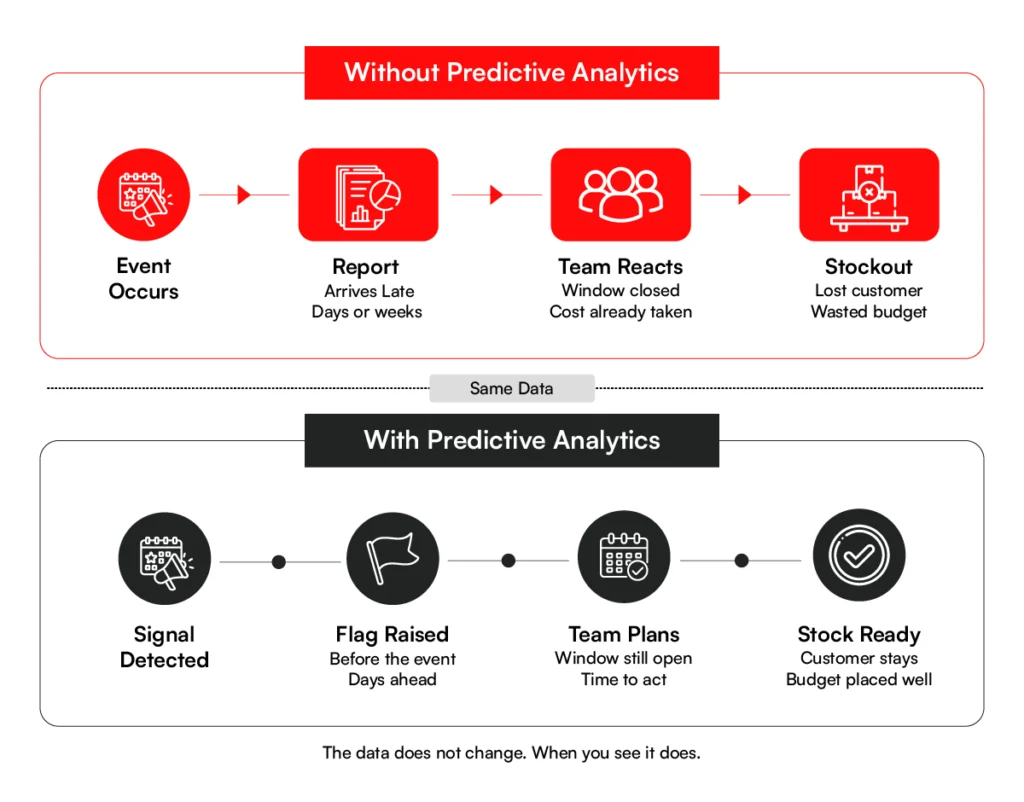
Most ecommerce businesses run on last month’s data. When a report lands on your desk, the stockout has happened, the customer has left, and the budget is gone. That gap costs real money.
Predictive analytics for ecommerce closes this gap. It reads your purchase history, browsing patterns, and buying behavior to show you what is coming before it arrives.
This guide covers how ecommerce predictive analytics works, where it creates the most value, which tools other retailers use today, and how to get started based on your current data.
This level of advanced insight into upcoming trends and customer needs helps eCommerce businesses improve service quality, optimize resource allocation, and most importantly, deliver personalized customer experiences.
What is Predictive Analytics in Ecommerce?
Predictive analytics for ecommerce processes your historical and current data using machine learning and statistical models to predict future trends. These predictions related to future growth, customer pain points, and business outcomes help you make better decisions through accurate anticipation of opportunities as well as challenges.
It processes data from across your infrastructure, such as purchase history, browsing behavior, and seasonal patterns to give your teams a much more accurate picture of what’s about to follow. The team can then modify campaigns, adjust pricing, revamp customer flows, or take other actions to grow revenue.
Automating those actions requires the predictive model to connect with the systems responsible for carrying them out. Enterprise AI integration in business creates that connection, allowing model outputs to move into existing applications and trigger the next step in the process.
How Predictive Analytics Differs from Traditional BI and Reporting
Most ecommerce teams know BI tools well. Dashboards showing last week’s revenue. Reports breaking down which products sold. Summaries of how a campaign performed. These tools describe what already happened, nothing more.
Predictive analytics in ecommerce works from the opposite direction. It reads your sales history, customer behavior, and stock patterns to estimate what is likely to happen next. A product trending toward a stockout, a customer showing early signs of dropping off, or a buyer segment ready for a follow-up offer. Your team sees these signals while there is still time to act on them.
That difference shows up directly in how decisions get made. Traditional BI keeps your team in response mode. Predictive analytics puts your team in planning mode, and the seven benefits below show what that shift produces across your store.
Benefits of Predictive Analytics for eCommerce
Predictive analytics moves ecommerce decisions from reactive to planned. Here is what that produces across seven areas of your store.
1. Stock the Right Products Before Demand Hits
Stocking too much ties up capital in products that sit and eventually need discounting. Stocking too little loses you the sale and often the customer. Predictive analytics reads your historical sales, seasonal trends, and real-time demand signals to tell you what to order, how much, and when, before the gap appears on your shelves. The result is fewer stockouts, less deadstock, and margins that hold rather than erode from poor planning.
2. Price Around Demand, Not Around Habit
Once you know what to stock, the next question is what to charge for it. Most stores set prices and leave them unchanged for weeks. Predictive analytics gives you the data to move prices in response to demand trends, competitor shifts, and customer segments, higher when demand supports it, more competitive when it does not. The outcome is better conversion rates and stronger margins without second-guessing the market every week.
3. Focus Marketing Budget on Shoppers Who Are Ready to Buy
Better pricing only pays off if the right people are seeing your products. Broad campaigns waste budget on audiences that were never going to convert. Predictive analytics segments your customers by purchase likelihood and behavior patterns so your spend reaches people with genuine buying intent. The return is lower cost per acquisition, higher return on ad spend, and campaigns that produce predictable results rather than variable ones.
4. Show Each Customer What They Actually Want
Targeted spend gets people to your store. What keeps them there is relevance. Shoppers respond better when a store reflects their preferences rather than showing the same products to everyone. Predictive analytics draws on purchase history and browsing behaviour to surface relevant products at the right moment, whether on the homepage, in post-purchase suggestions, or through triggered emails. Stores using personalisation built on real behaviour data see higher average order values and more repeat purchases than those using generic merchandising.
5. Recover Carts Before the Window Closes
Showing the right product at the right price does not guarantee a completed purchase. Some shoppers add items and disappear before checking out. Predictive analytics identifies which shoppers are showing high abandonment risk before they leave the session, so your team can step in with a timely reminder or a targeted offer while the purchase is still a live possibility. Acting during the session costs far less than trying to win the customer back days later.
6. Catch Loyal Customers Before They Go Quiet
How does predictive analytics improve customer retention in eCommerce? It reads the signals that standard reporting misses. A drop in purchase frequency, a longer gap between orders, a pattern of smaller basket sizes — these are early signs that a loyal customer is drifting. Predictive analytics flags these accounts before the customer has mentally moved on, giving your team time to reach out with a relevant offer or a loyalty reward while the relationship is still intact. Retaining a customer who already knows your store is significantly cheaper than finding a new one.
7. Forecast Revenue With Enough Lead Time to Act On It
Keeping existing customers stable is one part of the financial picture. Planning around what they will spend is the other. Reliable predictive analytics eCommerce ROI comes from converting historical patterns and real-time signals into revenue projections your team can actually plan against, covering inventory purchasing, staffing levels, campaign timing, and cash flow. The gap between forecasting accurately and forecasting late is often the difference between a well-managed peak season and a reactive one where every decision is made under pressure.
If your team is still making stock, marketing, and retention decisions from last month’s data, there is a faster way to work.
See how RBMsoft can help
Challenges of Predictive Analytics in Ecommerce and How to Get Started
Predictive analytics ecommerce projects stall for predictable reasons. Knowing what they are before you begin saves time and money later.
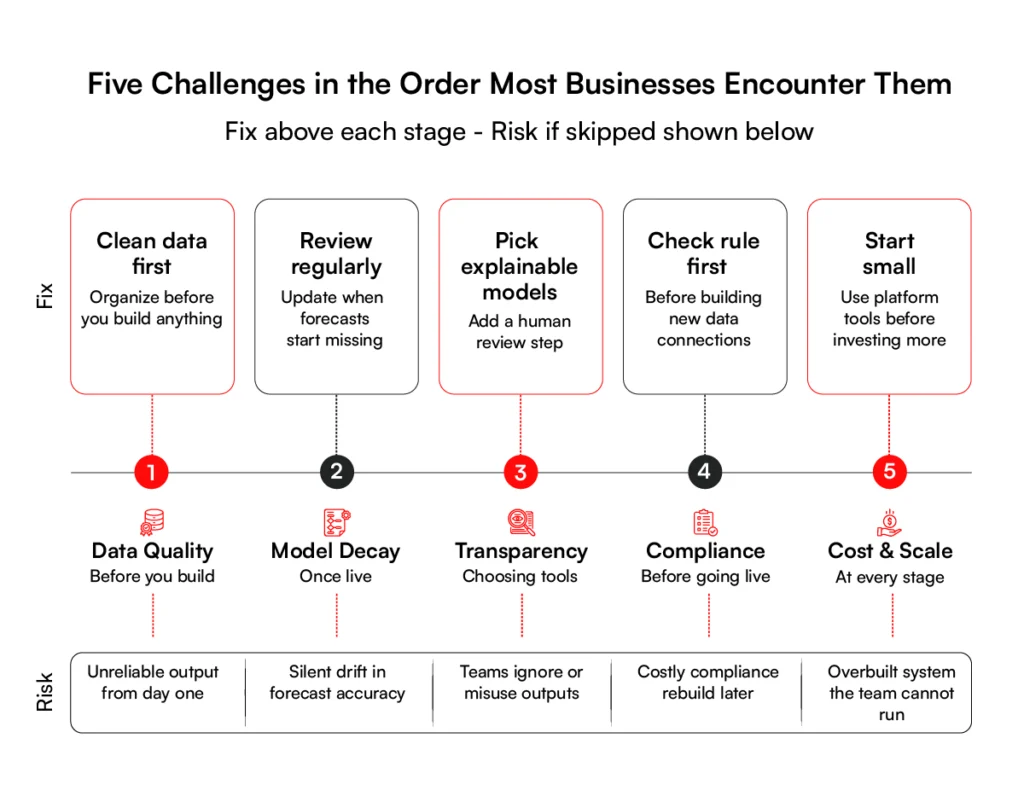
Low-quality and inconsistent data
Picture trying to forecast next month’s sales from a spreadsheet where half the order dates are missing, some customers appear three times under slightly different names, and the stock figures do not match the warehouse system. That is not a hypothetical. It is a common starting point for businesses running across multiple tools for a few years.
No predictive model produces reliable output from unreliable input. Cleaning and organising data before building anything is not optional. It determines whether the forecasts that follow are worth acting on. Businesses that skip it find themselves rebuilding their data foundation six months later at higher cost and under more pressure. Clean data gets a model started. Keeping that model accurate over time is a separate problem.
Degrading model accuracy over time
A predictive model is like a map drawn at a specific point in time. It reflects the roads as they were when it was made. New roads, closed routes, and changed speed limits do not appear unless someone updates the map.
The data a model learned from eventually stops reflecting current customer behavior. New products arrive. Buying patterns shift. Seasonal conditions change. Forecast accuracy needs reviewing on a regular schedule. When predictions start missing more often than they should, the model needs updating with more recent data. Keeping models current solves the accuracy problem. But accurate predictions are only useful if the people reading them know how to act on them.
Lack of transparency in model outputs
A number on a screen that says “this customer has a 74 percent chance of leaving” is only useful if the person reading it knows what to do next. Predictions without any supporting explanation put the full weight of interpretation on whoever is acting on them. Some will act confidently on something they do not fully understand. Others will ignore it entirely.
Model types that produce a readable explanation alongside their output make this easier to manage. So does building a review step for high-stakes predictions before they trigger any automatic action. A tool teams can trust and explain to colleagues is worth more than a technically superior one that nobody uses.
Data Privacy and Regulatory Compliance
Behavioral data is personal data. Using it for predictive modelling means working within rules that govern how data can be collected, stored, and applied.
GDPR covers any business with European customers. India’s Digital Personal Data Protection Act covers businesses handling data from Indian users. Both require clear consent before collecting behavioral data and a process for handling access or deletion requests.
Checking local data rules before building new data connections is straightforward. Restructuring a working system later to meet a requirement that existed from the start is not. Transparency in outputs builds team trust. Compliance in data collection builds customer trust.
High Implementation Cost for Smaller Businesses
Large predictive platforms are built for businesses with large data teams and large budgets. These platforms are not the right starting point for a mid-sized ecommerce operation testing what predictive data can do before committing significant resources.
The practical starting point is the forecasting and segmentation tools already built into most ecommerce platforms. When those tools start showing their limits, that is the right moment to evaluate ecommerce predictive analytics vendors for a more tailored setup. Knowing the obstacles is one thing. Moving through them in the right order is what the next section covers.
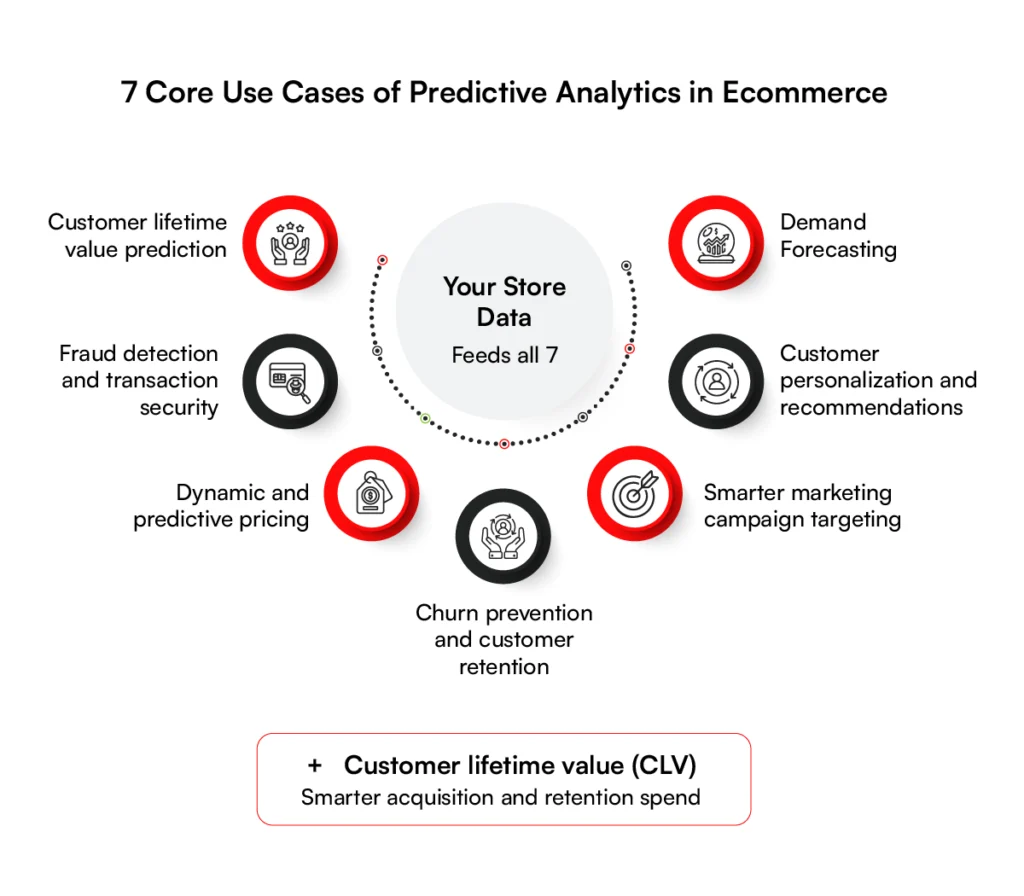
7 Core Use Cases of Predictive Analytics in Ecommerce
Predictive analytics for ecommerce does not live in one part of a business. It runs across stock, marketing, customer relationships, pricing, security, and long-term planning. These seven predictive analytics ecommerce examples show where online retailers are already seeing real returns.
Demand Forecasting
Stock planning is one of the hardest problems ecommerce businesses face. Too much stock ties up cash in slow-moving products. Too little and customers go elsewhere.
IKEA built an internal tool called Demand Sensing that pulls from over 200 data sources, including sales history, weather data, and market trends. The result was better product availability, less excess stock, and lower supply chain costs.
Most businesses start with sales history and seasonal patterns. Time-series models work through that data and produce product-level forecasts that stock planning teams can act on directly.
Customer personalization and recommendations
A customer’s purchase history, product interactions, and on-site behavior tell you what they are likely to buy next. AI-powered predictive analytics in ecommerce uses that information to serve relevant suggestions rather than generic ones.
Sephora built its Color IQ system to match customers with products based on a personal skin tone score. Its Virtual Artist feature lets shoppers preview products before buying. Both tools connect individual customer data to product matching across their full range.
Smaller businesses use recommendation tools that group customers by past purchase behavior and surface products that similar buyers have chosen. Knowing what individual customers want also sharpens how marketing teams decide who to reach in the first place.
Smarter marketing campaign targeting
Broad campaigns sent to large groups with no clear buying intent produce weak results. Predictive analytics ecommerce tools help marketing teams identify which customer groups are showing genuine interest before a campaign goes live.
Zalando analyses platform behavior to build customer groups based on purchase likelihood. Campaigns reach buyers already showing interest in specific categories rather than wide demographic segments.
The result is stronger email performance, more focused paid campaigns, and better return from the same budget. Reaching the right buyers matters, but keeping them once they have purchased is where retention models take over.
Churn prevention and customer retention
Customer churn is hard to spot in real time. A customer buys less frequently, spends less per order, and eventually stops altogether. Monthly reports catch this too late.
Predictive analytics ecommerce systems track these patterns using RFM scoring, a method that measures how recently a customer bought, how often they buy, and how much they spend on average. When those figures drop below normal ranges, the system flags the account. The business then decides whether to send a targeted offer, a follow-up email, or a direct message based on that customer’s value.
Shopify Analytics applies this through its built-in segmentation tools, grouping customers by purchase behavior and surfacing accounts showing reduced activity. Retention keeps existing revenue intact. Pricing is where predictive models help grow it.
Dynamic and predictive pricing
Prices in ecommerce are not static. Competitors move. Stock runs low. Demand shifts with the season or a news cycle. Updating prices manually across a large catalogue is slow, and slow pricing decisions leave money on the table.
Amazon adjusts prices across its catalogue many times each day based on demand data, competitor pricing, and stock positions. Its system also predicts likely purchases and moves inventory closer to buyers before an order is placed.
For smaller businesses, predictive pricing usually starts at the category level rather than the full catalogue. Pricing rules connect to demand forecasts and stock availability. The right predictive analytics vendors for ecommerce to support this depends on catalogue size and how frequently prices need to respond to market conditions. Pricing models protect margin. Fraud detection protects revenue from leaving the business entirely.
Fraud detection and transaction security
Rule-based fraud systems work against known patterns. When fraud methods change, these systems take time to catch up.
Predictive analytics in ecommerce trains models on transaction history to understand what normal purchase behavior looks like for each account. When a transaction sits outside that range, it gets flagged before the order completes. This covers high-value orders from new accounts, delivery addresses that differ from billing details, and unfamiliar payment methods on large purchases.
ClearSale uses predictive models alongside human review to keep false flags on genuine customers low while maintaining strong detection across its client base. With revenue protected from fraud, the final use case is about deciding which customers are worth the most over time.
Customer lifetime value prediction
Not every customer is worth the same amount over time. Some buy once and never return. Others buy regularly for years. CLV prediction estimates which category each customer is likely to fall into, so budgets and retention efforts go where they will have the most impact.
Stitch Fix uses CLV models to determine how much to invest in acquiring new customers based on their predicted long-term value. High-value profiles get more aggressive acquisition spend. Lower-value ones get lighter touchpoints.
For most ecommerce teams this means new customer budgets go toward profiles with the strongest long-term potential. Retention efforts focus on customers with a real history of repeat buying rather than being spread evenly across everyone. These seven use cases show what predictive analytics can do. Getting there requires clearing a few obstacles first.
How Predictive Analytics Works in Ecommerce
Two things determine how accurate your predictions will be: the quality of the data going in and the type of model reading it.
Structured vs. Unstructured Data Sources Used in Ecommerce
Predictive analytics for ecommerce draws on data from across your business, and not all of it looks the same. Structured data, sales records, order history, stock levels, pricing, and return rates, is clean, consistently formatted, and straightforward to feed into a prediction system.
Alongside that sits a second layer that is harder to organize but just as valuable. Customer reviews, browsing patterns, on-site search behavior, and social media activity all carry signals about what buyers are thinking before they act. A spike in searches for a product category. A run of negative reviews around a specific SKU. These signals sharpen forecasts that sales and order data alone would miss.
Getting value from both layers means bringing them into one place. Most businesses already have this data sitting across their systems. The gap is usually not in the data itself but in how it is stored and whether the right tools can reach it. Once the data question is answered, the next decision is which model type does the actual work.
Key Predictive Model Types and What Each One Does
Retail and ecommerce predictive analytics use several model types depending on what question needs answering.
| Model Type | What It Does | Common Use Case |
| Time-Series (ARIMA, Prophet) | Identifies patterns in historical data over time | Demand forecasting, seasonal planning |
| Regression Models | Measures how external factors affect outcomes | Pricing optimization, campaign performance |
| Collaborative Filtering | Matches customer behavior to similar customer profiles | Product recommendations |
| Gradient Boosting (XGBoost) | Scores probability of a customer action | Churn prediction, fraud detection |
| Isolation Forests | Detects unusual patterns that deviate from normal behavior | Fraud detection, anomaly detection |
Ecommerce predictive analytics software development projects rarely rely on one model alone. The right choice depends on the problem being solved and the data available. Knowing which models exist makes it easier to see where each of the seven use cases in the next section actually gets its output from.
How to Get Started with Predictive Analytics: A Phased Adoption Approach
Getting started with predictive analytics for ecommerce works best in stages. Each phase produces results that inform the next one.
| Phase | Focus Area | What to Do |
| Phase 1 | Data foundation | Centralize data, fix quality issues, agree on one source of truth |
| Phase 2 | Demand forecasting | Build forecasts for top 20 SKUs using sales history |
| Phase 3 | Customer analytics | Add churn scoring and basic customer segmentation |
| Phase 4 | Pricing and fraud | Introduce pricing rules and transaction monitoring |
| Phase 5 | Full predictive stack | Connect all data sources and run models across operations |
Start at phase one and move forward in order. Data problems caught early are cheaper to fix than the same problems discovered after a full model build. Once the phases are clear, the next decision is which tools to run them with.
Predictive Analytics Tools and Platforms for ecommerce
No single tool covers every ecommerce predictive analytics need. The right choice depends on the problem you are solving first.
BI and Visualization Tools
These tools turn data and model outputs into reports and dashboards that business teams can read and act on. They work alongside forecasting models rather than replacing them.
| Tool | Best For |
| Power BI | Microsoft ecosystem businesses needing flexible reporting |
| Tableau | Visual data exploration across large datasets |
| Looker | Teams running on Google Cloud infrastructure |
| Qlik | Self-service analytics for business users |
BI tools make model outputs readable. Demand forecasting tools are where those outputs start.
Demand Forecasting Tools
These platforms are built for stock planning and inventory management. They take sales data and produce product-level forecasts based on past performance and seasonal trends.
| Tool | Best For |
| Inventory Planner | Small to mid-sized ecommerce businesses on Shopify or WooCommerce |
| RELEX | Retailers managing large SKU catalogs across multiple locations |
| Google Vertex AI | Businesses building custom forecasting models on Google Cloud |
Demand forecasting protects stock. Fraud detection protects the transactions that move it.
Fraud Detection Tools
These platforms watch transactions as they come in and flag ones that fall outside the normal pattern for each account.
| Tool | Best For |
| Signifyd | High-volume ecommerce businesses needing automated fraud decisions |
| ClearSale | Businesses wanting model-based screening with human review |
| NoFraud | Mid-sized retailers looking for straightforward fraud protection |
Flagging bad transactions is one side of customer data. Understanding good customers over time is the other.
Not sure where to start? RBMsoft’s ecommerce analytics team can help you find the right fit
Talk to our teamFuture Trends in Predictive Analytics for Ecommerce
Predictive analytics tools have changed more in the last three years than in the decade before that. The pace is not slowing down.
Real-time decision making in operations
Most predictive setups today run on a daily or weekly cycle. Data is collected, models run overnight, and teams review outputs the next morning. By then, some of the value in that data has passed.
The shift is toward systems that run continuously and feed directly into operational decisions. Pricing updates, stock reorder triggers, and campaign adjustments that previously required a human to review a report are now happening automatically based on live data.
Faster operational decisions change how businesses respond to data. The next shift changes how businesses see each individual customer.
Hyper-personalisation across all channels
Personalisation in ecommerce has largely meant product recommendations on a website or segmented email campaigns. The next stage connects data from web, mobile, in-store, and social channels into a single view of each customer rather than separate views that never speak to each other.
In practice, a customer who browsed a product on mobile on Tuesday, saw an ad on Wednesday, and visited a physical store on Thursday receives a follow-up that reflects all three interactions. Most businesses today only see the last interaction recorded in whichever system caught it. A complete picture of each customer produces stronger results across every channel.
Agentic AI Moving from Prediction to Action
Current tools surface a recommendation and wait for a human to act on it. Agentic AI, a system that takes action on its own within rules and boundaries the business sets in advance, takes the next step without waiting.
A stock level dropping below a set threshold triggers a reorder automatically. A customer crossing a churn risk score triggers a retention message without a marketer building a campaign manually. The prediction and the response happen in the same step.
This is explored further in our guide to generative AI in ecommerce and the rise of anticipatory commerce. Agentic systems act on data faster. Privacy-first collection makes sure that data is worth acting on.
Privacy-First Data Collection
Third-party cookies are largely gone. The behavioral tracking signals ecommerce businesses relied on have become less reliable as a result. The businesses handling this well are building first-party data collection directly into their customer experience.
Loyalty programs, account registration, post-purchase surveys, and preference centers all generate behavioral data with explicit customer consent. First-party data is more reliable, more compliant, and produces better model inputs than third-party tracking does. These shifts are already underway. The businesses moving now will have a head start on the ones that wait.
Conclusion
Businesses that plan ahead outperform those that react. Predictive analytics for ecommerce gives teams the tools to do that across stock planning, customer retention, pricing, and marketing.
Getting started does not require a large investment or a dedicated data team. Clean data and a clear first use case are enough to begin.
RBMsoft has helped ecommerce businesses across retail and consumer goods build predictive analytics capabilities that fit their current scale. Talk to our team to find out where to begin.
FAQs
How much time does it take to implement ecommerce predictive analytics?
It depends on where you start. A basic demand forecasting setup on clean data can run in four to six weeks. A fuller ecommerce predictive analytics implementation covering churn scoring, pricing, and customer segmentation typically takes three to four months. The biggest variable is data quality. Businesses with clean centralized data move faster than those that need to fix data issues before building anything.
How can predictive analytics help with ecommerce sales and revenue growth?
Predictive analytics for ecommerce improves sales by putting the right products in front of the right customers at the right time. Better demand forecasting reduces stockouts that cost sales. Churn prediction keeps customers from leaving quietly. Smarter campaign targeting improves conversion rates without increasing spend. Each of these contributes directly to revenue growth without requiring a larger budget.
How to choose the right ecommerce predictive analytics vendor?
Start with the problem you are solving rather than the features a vendor offers. The right ecommerce predictive analytics vendor for demand forecasting is not necessarily the right one for fraud detection or CLV modeling. Check whether the tool works with your existing data setup, what technical skills it requires to run, and what the full cost looks like including integration and maintenance. Shortlist two or three predictive analytics vendors for ecommerce and test them against your actual data before committing.
What are the best tools for ecommerce predictive analytics?
The best ecommerce predictive analytics tools vary by use case. For demand forecasting, Inventory Planner and RELEX are widely used. For fraud detection, Signifyd and ClearSale are common choices. For customer analytics and CLV, Life timely and Salesforce Einstein are popular options. For businesses building custom models, AWS Sage Maker, Google Cloud AI, and Azure ML provide the infrastructure. Power BI, Tableau, and Looker sit on top of these to make outputs readable for business teams.
How does an eCommerce predictive analytics pipeline work from raw customer data to revenue forecasts?
Raw customer data from sales records, browsing behavior, and inventory systems is collected and cleaned first. Once the data is standardized it goes into a model that identifies patterns and generates forecasts. These forecasts are then presented through dashboards or reports that operations, marketing, and buying teams use to make decisions. The pipeline runs on a set schedule, daily or weekly for most businesses, and the model is updated periodically to reflect current conditions.
What data sources, data volume, and data quality are required for accurate eCommerce predictive analytics?
Accurate ecommerce predictive analytics needs at least twelve to eighteen months of clean sales history at the product level. Transaction records, inventory data, customer purchase history, and returns data are the core inputs. Behavioral data from browsing and search adds further depth. Data quality matters more than volume. A smaller clean dataset produces more reliable forecasts than a large dataset with gaps, duplicates, and inconsistencies across systems.
What are the industry benchmarks for predictive analytics success in eCommerce across apparel, beauty, electronics, and consumer goods?
Benchmarks vary by category. Apparel forecasting typically runs at fifteen to twenty five percent mean absolute percentage error due to seasonality and high return rates. Beauty sits at ten to eighteen percent with more predictable replenishment cycles. Electronics runs wider at eighteen to thirty percent because of launch volatility and short product life cycles. Consumer goods forecasting is the most stable at eight to fourteen percent. Margin improvements from dynamic pricing range from five to twelve percent depending on catalog size and pricing frequency.
Should your business build, buy, or customize an eCommerce predictive analytics platform?
Most ecommerce businesses are better served buying an existing ecommerce predictive analytics platform than building one from scratch. Building requires a data engineering team, ongoing maintenance, and a long lead time before results appear. Buying an off-the-shelf tool gets a business to results faster at lower cost. Customization makes sense when specific business requirements cannot be met by available tools and the internal team has the capacity to manage a more complex setup. For most businesses under twenty million in revenue, buying is the right starting point.
What does a realistic 4, 8, and 12 week predictive analytics implementation roadmap look like for online retailers?
By week four a business should have its data centralized, quality issues addressed, and a baseline demand forecast running for its top SKUs. By week eight churn scoring and basic customer segmentation should be live and the team should be reviewing model outputs on a regular schedule. By week twelve pricing rules and transaction monitoring can be introduced and the business should have a clear picture of which models are performing and which need adjustment. This timeline assumes clean data at the start. Data issues add four to six weeks to each phase.
Why do most eCommerce predictive analytics projects fail and how can retail leaders avoid common pitfalls?
Most ecommerce predictive analytics projects fail because of data problems that were not addressed before the model was built. Forecasts built on inconsistent or incomplete data produce unreliable outputs and teams stop trusting them quickly. The second most common reason is treating the model as a one-time setup rather than something that needs regular review and updating. Retail leaders can avoid these pitfalls by fixing data quality before selecting a tool, setting a regular schedule for reviewing forecast accuracy, and starting with one focused use case rather than trying to implement everything at once.
How are generative AI and agentic AI transforming predictive analytics in eCommerce?
Generative AI is making predictive outputs easier to interpret by translating model results into plain language that non-technical teams can read and act on. Agentic AI takes this further by connecting predictions to actions directly. Instead of surfacing a churn risk score for a marketer to review, an agentic system can trigger a retention campaign automatically when a customer crosses a defined threshold. AI powered predictive analytics in ecommerce is moving from a reporting function to an operational one where predictions and responses happen in the same step.
How can retailers build accurate predictive models in a privacy-first world without third-party cookies?
Retailers building ecommerce predictive analytics without third party cookies need to shift toward first party data collection. Loyalty programs, account registration, post-purchase surveys, and on-site preference centers all generate behavioral data with customer consent. This data feeds directly into predictive models and produces more reliable inputs than third party tracking because it reflects actual declared preferences rather than inferred behavior. Server-side tracking and data clean rooms are also being used to maintain measurement accuracy while staying within privacy regulations.
What is the expected ROI of predictive analytics for eCommerce and which use cases deliver the fastest business impact?
ROI from predictive analytics for ecommerce varies by use case. Demand forecasting typically delivers the fastest return by reducing overstock and preventing stockouts. McKinsey research puts the sales lift from data driven marketing and forecasting at around fifteen percent for businesses that implement it consistently. Gartner estimates revenue gains from dynamic pricing at ten to fifteen percent when models are fed clean and current data. Churn prevention and personalization follow closely in terms of measurable impact. The use cases with the fastest payback are those where the cost of inaction is most visible, stockouts, lost customers, and wasted ad spend.
How can predictive analytics improve inventory planning, demand forecasting, and supply chain efficiency for retailers?
Retail and ecommerce predictive analytics improves inventory planning by generating product-level forecasts based on sales history, seasonal patterns, and external signals like weather and market trends. This reduces the gap between what is ordered and what is actually needed. Supply chain efficiency improves when reorder points are set by model outputs rather than manual estimates. Businesses using predictive demand forecasting carry less excess stock, experience fewer stockouts, and spend less on emergency restocking and expedited shipping.
What technology stack should businesses choose for scalable eCommerce predictive analytics?
The right ecommerce predictive analytics technology stack depends on current scale and internal capability. For most growing ecommerce businesses a cloud-based data warehouse combined with an off-the-shelf forecasting and customer analytics tool covers the core needs. Businesses with larger data volumes and internal technical teams can add custom model development on platforms like AWS SageMaker or Google Cloud AI. BI tools like Tableau or Power BI sit on top to make outputs accessible to business teams. The priority is getting data into one place before adding model complexity.
How do leading eCommerce brands use predictive analytics to increase conversion rates, customer retention, and average order value?
Leading ecommerce brands use predictive analytics across three areas that directly affect these metrics. Conversion rates improve through better product recommendations and more targeted campaign targeting based on purchase likelihood scoring. Customer retention improves through churn prediction that identifies at-risk accounts before they stop buying. Average order value increases through cross-sell and upsell recommendations built on collaborative filtering models that match customers with products similar buyers have purchased. IKEA, Sephora, and Amazon are among the most cited examples of ecommerce predictive analytics applied at scale across these areas.
What are the key data engineering and integration challenges when deploying predictive analytics across ecommerce platforms?
The main challenge is getting data from multiple systems into one place in a consistent format. Sales data, inventory records, customer purchase history, and behavioral data often sit in separate platforms that were not built to share information easily. SKU naming conventions differ between systems. Currency and time zone handling creates inconsistencies. Return and refund data is frequently missing or not linked back to the original order. Addressing these integration challenges before building any model is the most important step in an ecommerce predictive analytics implementation. Businesses that skip it spend more time fixing data problems later than they would have spent addressing them upfront.
How can AI-powered predictive analytics help retailers anticipate customer behavior before it impacts revenue?
AI powered predictive analytics in ecommerce identifies changes in customer behavior before they show up in revenue figures. A drop in purchase frequency, a shift in the products a customer views, or a change in average order value are all early signals that a customer’s relationship with the business is changing. Predictive models trained on these patterns flag the change early enough for the business to respond. A targeted offer, a product recommendation, or a follow-up communication sent at the right time keeps revenue from being lost to churn or reduced engagement before it appears in a monthly report.
What are the four types of analytics?
- Descriptive Analytics tells you what happened in the past using historical data, reports, and dashboards.
- Diagnostic Analytics explains why something happened by identifying patterns, causes, and correlations in the data.
- Predictive Analytics uses past data and statistical models to forecast what is likely to happen in the future.
- Prescriptive Analytics recommends the best course of action to take based on predictions and business goals.