Table of Contents
Quick Summary:
- Food delivery app development costs range from $20,000 to $500,000+, depending on platform complexity, business model, feature depth, integrations, and scalability requirements.
- Basic MVP food delivery apps with core ordering, payment, and tracking features usually cost between $20,000 and $80,000.
- Mid-market multi-vendor platforms with real-time tracking, loyalty systems, and marketplace workflows typically cost between $80,000 and $200,000.
- Enterprise-grade food delivery ecosystems with AI-powered recommendations, dynamic pricing, multi-city logistics, and compliance systems can exceed $400,000+.
- The business model significantly impacts development cost. Grocery delivery apps and multi-vendor marketplaces are more expensive due to inventory synchronization, dispatch orchestration, and operational complexity.
- Feature scope is one of the largest cost drivers. Real-time GPS tracking, loyalty systems, chat functionality, analytics dashboards, and AI-powered personalization can substantially increase development costs.
- Third-party integrations such as payment gateways, maps, SMS services, and cloud infrastructure create both upfront integration costs and ongoing operational expenses.
- Food delivery platforms also incur recurring post-launch costs. Infrastructure, API usage, maintenance, customer support, security audits, and marketing can collectively exceed the original development cost within the first operational year.
- Cross-platform frameworks like React Native and Flutter can reduce development costs by 30–50% compared to native app development.
- Businesses can optimize food delivery app development costs by starting with an MVP, using scalable architecture, leveraging third-party APIs, and adopting agile development practices.
Food delivery app development costs range from $20,000 to $500,000+. The cost varies based on specific decisions around complexity, business model, platform architecture, team geography, and compliance scope.
Most food delivery app development cost calculations focus only on app components and layers. But they miss out on operating cost, which is an equally important line item. It covers API usage, cloud costs, customer support and more.
In this article, we take you through every consideration and component that affects the cost to create a food delivery application. You’ll also get a phased budget allocation for various development stages along with cost optimization strategies to ensure a ROI-friendly build.
The True Cost of a Food Delivery App Development
Most food delivery app development cost calculations are incomplete by design. They cover what it costs to build the app but often miss out on the operating costs.
The operating cost is recurring, scales with usage, and in the first year alone frequently exceeds what was spent on development. A platform that costs $150,000 to build might require an additional $200,000 to $400,000 in year one alone. That figure covers cloud infrastructure, third-party API usage fees, customer support operations, and user acquisition.
Planning for both budgets upfront changes what decisions you make and when. It affects which city you launch in first, how aggressively you price restaurant commissions, how much runway you actually need, and whether your unit economics hold at the order volumes you are projecting.
We help you deal with this two-budget reality in this guide. The sections on development cost cover what it takes to build a production-grade food delivery platform, broken down by every decision that moves the number.
The sections on post-launch cost cover what it takes to sustain it, with specific figures for infrastructure, APIs, support, and acquisition. This will help you budget realistically, prioritize correctly, and avoid expensive rebuilding decisions later.
The Three Decisions That Determine Your Food Delivery App Development Cost
Once you understand the difference between build cost and total cost of ownership, the next step is understanding what actually determines the size of that initial investment.
In practice, food delivery app development costs are shaped by three major decisions:
- the level of platform complexity you choose
- the business model you operate under
- the number and depth of platform components you build
These decisions are interconnected. A marketplace platform operating across multiple cities requires a very different architecture than a single-restaurant ordering app.
Likewise, a grocery delivery platform handling thousands of SKUs has fundamentally different infrastructure needs than a restaurant chain managing fixed menus.
Let’s examine how these decisions shape the development cost of a food delivery app:
Food Delivery App Development Cost Based on Complexity
The number of features, scale of operational coordination, real-time data handling, and other factors determine the level of complexity in food delivery app development.
A basic platform may process a few hundred orders within a single geography, while an enterprise-grade ecosystem may simultaneously coordinate vendors, delivery fleets, inventory systems, dynamic pricing engines, and AI-driven logistics across multiple cities or countries.
Each increase in complexity changes the engineering requirements behind the platform, from infrastructure scaling and database architecture to dispatch orchestration and operational analytics.
| Food Delivery App Development Cost by Complexity Tier | ||
| Complexity Tier | Estimated Cost | What It Comprises |
| Basic MVP | $20,000 – $80,000 | Single-city deploymentCore ordering + basic trackingSingle restaurant or small cluster Validates concept |
| Mid-Market Platform | $80,000 – $200,000 | Multi-restaurant marketplaceReal-time GPSCross-platform (iOS + Android)Loyalty systems |
| Advanced Platform | $200,000 – $400,000 | Multi-city logisticsDynamic pricingML personalization, Driver SLAsAI-powered recommendations |
| Enterprise Ecosystem | $400,000 – $500,000+ | Multi-country operationsCompliance (GDPR, CCPA)Advanced orchestration systemsLarge-scale operational intelligenceWhite-labeling |
The practical question to ask here is which tier matches your current market, your available runway, and the order volume you can realistically acquire in the first 12 months. A mid-range build serving select cities outperforms an enterprise build that never reaches the scale it was designed for.
Know Your Tier Before You Build
Most businesses overspend on features they don’t need or underbuild and pay twice. Get a complexity assessment tailored to your market and goals.
Get Free Complexity Assessment
Food Delivery App Development Cost Based on Business Model
The business model is the most underestimated cost driver in food delivery development. For example, two different grocery delivery mobile app development costs can differ a lot despite having the same features.
It’s because the underlying data architecture, integration complexity, and operational logic required to support each model differ substantially.
Similarly, if you are building a restaurant aggregator app, it will mostly follow the economics of marketplace app development costs.
Food Delivery App Development Cost by Business Model
| Business Model | Overview | Cost Range | Structural Complexity |
| Restaurant Aggregators | These apps simply list many restaurants in one place where customers browse, compare menus, and order from whichever restaurant they like. These apps earn a commission on each order. | $30,000 – $250,000+ | Multi-vendor coordination, real-time dispatching, marketplace operations, commission management |
| Restaurant-to-Consumer | A single restaurant (or chain) building its own ordering app. The customer orders directly from that brand, and the brand handles its own delivery. | $40,000 – $100,000 | Simpler operational flow, brand-first ordering experience, limited vendor management |
| Grocery Delivery | These apps deliver groceries, not meals. The complexity here is much higher, thousands of products, livestock tracking, short expiry windows, and the need to fulfil orders in minutes. | $150,000 to $400,000+ | High inventory complexity, live stock synchronization, fulfillment orchestration, rapid delivery workflows |
| B2B Food Delivery | This model serves businesses that supply raw ingredients to restaurant chains, office cafeterias, or cloud kitchens in bulk. | $100,000 and $250,000+ | Enterprise authentication, invoicing, approval chains, ERP integrations, procurement workflows |
Food Delivery App Development Cost Based on App Components
Modern food delivery ecosystems are built as a coordinated multi-panel system where different stakeholders interact with different parts of the platform simultaneously.
Most platforms rely on four primary components:
- the customer-facing application
- the courier or driver application
- the restaurant/vendor dashboard
- the administrative operations panel
Each panel has its own workflows, infrastructure requirements, and engineering complexity. Thus, understanding cost per panel is essential for phased rollout planning and vendor negotiation.
| Food Delivery App Cost by Platform Component | ||
| Components | Cost Estimation | Key Functions |
| Customer Panel | $25,000 – $70,000 | Menu browsing, search, cart, real-time tracking, payment gateway, ratings, loyalty program, push notifications. |
| Courier Panel | $20,000 – $70,000 | Live order queue, GPS route optimization, earnings dashboard, in-app navigation, status updates, proof of delivery. |
| Vendor Panel | $20,000 – $50,000 | Menu management, order acceptance, prep time controls, revenue analytics, promotion management. |
| Admin Panel | $10,000 – $50,000 | User management, fraud detection, commission settings, dispute resolution, analytics dashboards and content moderation. |
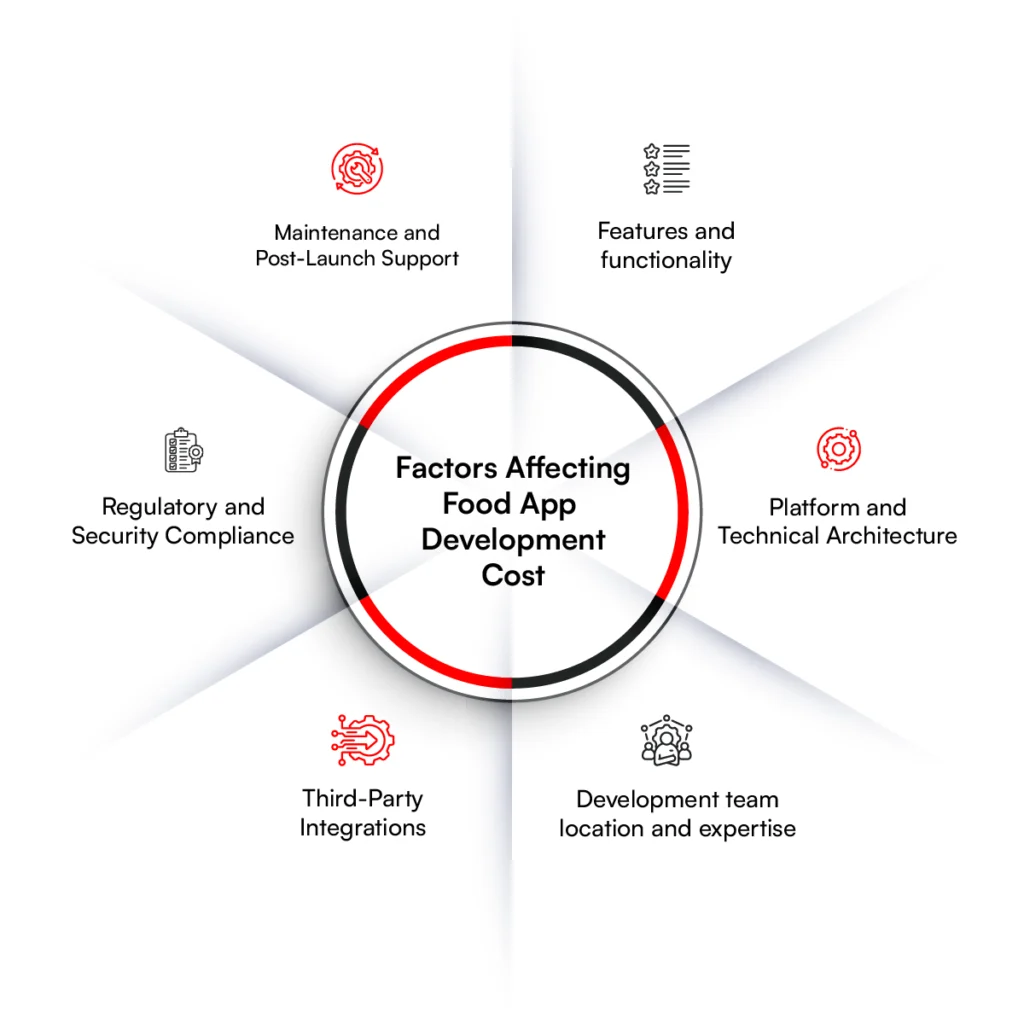
What Factors Affect the Cost of Food Delivery App Development?
Once the foundational decisions around complexity, business model, and platform scope are made, the next layer of cost comes from how those decisions are implemented technically and operationally.
The factors below are what typically move the average cost of food delivery app development significantly higher or lower within the same platform category.
1. Features and Functionalities
Feature scope is the most visible cost driver and, consequently, the one most often mismanaged. The instinct to add features early is understandable. The problem is that every feature added to a food delivery platform carries three costs: the engineering hours to build it, the backend complexity it introduces, and the long-term maintenance burden it creates.
Basic Features
A platform built exclusively on basic features costs between $20,000 to $50,000 and is viable for single-restaurant pilots or early concept validation. The basic food delivery app includes:
- User registration and profile management (email, social login, phone OTP)
- Restaurant/vendor listings with menu browsing and search
- Cart management and single-address checkout
- Payment gateway integration (one provider, standard flows)
- Basic order tracking with manual status updates
- Push notifications for order confirmation and delivery
- Basic admin panel for order monitoring
The key limitation is scalability. The basic architecture rarely handles the load spikes and multi-vendor orchestration that growth demands.
Complex Features
Adding complex features to a basic foundation typically adds $40,000 to $120,000 to the total development cost. The range depends on the depth of implementation and whether features are built custom or via third-party SDKs.
Complex features separate a functional app from a competitive one. This is where most mid-market builds spend the majority of their engineering budget:
- Real-time GPS tracking with live driver position updates
- Dynamic route optimization for multi-stop deliveries
- Multi-restaurant marketplace with vendor management
- In-app chat between customers, couriers, and restaurants
- Ratings, reviews, and social proof systems
- Loyalty programs, promo codes, and referral mechanics
- Advanced admin dashboard with analytics and fraud controls
- Multi-language and multi-currency support
AI-Powered Features
Food delivery platforms with AI features or intelligent search are the new norm. AI integration services adds $20,000 to $80,000 to the initial build, depending on the level of implementation.
The higher cost is ongoing, cloud compute for model inference, data pipeline maintenance, and model retraining adds $5,000 to $10,000 per month at scale. Core AI-powered features in food delivery include:
- Personalized recommendations based on order history and behavioral patterns
- Predictive delivery time estimation using traffic, order volume, and kitchen load data
- Dynamic pricing engines that respond to demand, distance, and time of day
- AI-driven fraud detection on payments and account behavior
- Demand forecasting for inventory and staffing optimization at the restaurant level
- Conversational ordering via chatbot or voice interface
| Feature Category | Estimated Cost Impact | What It Typically Includes |
| Basic Features | $20,000 – $50,000 | User authentication, restaurant listings, checkout, payment integration, notifications, basic admin controls |
| Complex Features | Adds $40,000 – $120,000 | Real-time GPS tracking, route optimization, marketplace workflows, chat systems, loyalty programs, analytics dashboards |
| AI-Powered Features | Adds $20,000 – $80,000 upfront + ongoing operational costs | Personalized recommendations, predictive ETAs, dynamic pricing, fraud detection, demand forecasting |
2. Platform Choice
Platform choice determines how much your frontend development costs and how maintainable the codebase remains as the product scales. It is also the hardest decision to reverse after the build begins.
Migrating from a native codebase to cross-platform, or from cross-platform to native, typically costs 1.5 to 2.5 times the original frontend investment. The decision warrants deliberate evaluation before development starts.
| Native (Swift / Kotlin) | Cross-Platform (React Native / Flutter) | |
| Codebase | Separate builds for iOS and Android | Single codebase for both platforms |
| Frontend Cost | 35–50% higher than cross-platform | Lower than native |
| Development Time | Longer, two parallel workstreams | 30% faster on average |
| Performance | Maximum, full hardware access | Comparable for core delivery workflows |
| Maintenance | Two codebases to update and patch | Single codebase, updates propagate across both |
| Best For | Platforms requiring deep hardware integration at scale | Most food delivery builds at mid-range and advanced tiers |
For the core workflows of a food delivery platform, menu browsing, order placement, delivery tracking, and payment, users perceive no meaningful performance difference between native and cross-platform.
Native becomes the justified choice when the platform requires deep hardware integration or operates at a scale where marginal performance improvements carry direct revenue impact.
3. Third-Party Integrations
No food delivery platform is built entirely from scratch. Payments, mapping, notifications, and authentication are consistently required across every business model and complexity tier, and each one can be delivered faster, more securely, and at lower cost through established third-party services than through custom engineering.
Third-party integrations carry two cost layers. The first is the development cost to implement them, which is incurred once during the build.
The second is the ongoing usage fee, which begins at launch and scales with order volume.
| Dependency | Typical Cost Impact | Purpose |
| Payment Gateways | $5,000 – $15,000+ integration cost + transaction fees | Payment processing |
| Maps & Geolocation APIs | $10,000 – $25,000 integration cost + usage-based billing | Tracking, routing, dispatch |
| SMS & Notification Services | Usage-based recurring cost | OTPs, delivery updates, alerts |
| Cloud Infrastructure | $500 – $10,000+/month depending on scale | Hosting, scaling, databases, real-time operations |
Infrastructure costs increase rapidly as order volume grows because food delivery systems constantly process:
- GPS updates
- dispatch requests
- payment events
- push notifications
- and operational synchronization across multiple panels
This is why scalability planning becomes critical early in the development lifecycle.
Your rivals budgeted APIs. Did you?
Apps built with RBMSoft’s pre-scoped API architecture enter development with locked cost ceilings, no mid-build surprises, no runaway Maps or gateway bills.
Scope My APIs Now4. Development Team Geography and Expertise
Geography is the highest-leverage cost variable in the entire development budget, and it has no effect on what gets built. The same product specification, delivered by a North American team versus a South Asian, can differ by 60 to 75% in total cost.
| Region | Junior Developer | Senior Developer | Average Rate |
| Eastern Europe | $30/h | $58/h | $44/h |
| Latin America | $25/h | $55/h | $40/h |
| Asia | $20/h | $50/h | $35/h |
| Africa | $20/h | $45/h | $32.5/h |
Source: Upwork, Arc.dev, and PayScale (2026)
5. Regulatory and Security Compliance
Compliance is the most consistently underbudgeted cost category in food delivery development. Mostly, enterprises spend money on features and leave compliance for the last minute, which is a costly mistake.
The reality is that, when retrofitted into an existing codebase, compliance architecture costs 3-5x more than building it from the start.
Food delivery platforms collect dense personal data: location history, payment credentials, dietary preferences, behavioral patterns, and identity documents for drivers. That data profile creates material exposure under multiple regulatory frameworks simultaneously.
- Data Protection and Privacy (GDPR / CCPA / CPRA)
Food delivery platforms collect dense personal data, including location history, payment information, dietary preferences, behavioral patterns, and identity documents, for drivers. This creates significant exposure under GDPR (EU), CCPA and CPRA (California).
Total cost range: $20,000 to $100,000+, depending on the number of jurisdictions and existing infrastructure baseline. Ongoing legal counsel and compliance monitoring add $10,000–$40,000 annually for multi-market operators.
- Payment Security (PCI DSS v4.0)
With PCI DSS v4.0, compliance requirements have become more rigorous, mandating continuous monitoring, advanced authentication (MFA), and more frequent penetration testing, rather than merely recommending them.
Cost varies dramatically by compliance level:
- Small merchants (SAQ-based): $5,000 to $20,000 for initial certification
- Mid-size platforms (Level 2–3): $30,000 to $80,000
- Large-scale operators (Level 1, full QSA audit): $50,000 to $200,000
Non-compliance carries a harder price: fines range from $5,000 to $500,000 per breach event. In 2025, the average global cost of a data breach reached $4.4 million.
- Ongoing Security Audits and Penetration Testing
PCI DSS v4.0 mandates annual penetration testing and quarterly vulnerability scans as standing requirements. Beyond compliance obligations, platforms that process financial transactions and location data are high-value targets. Industry benchmark costs for ongoing security:
| Compliance Framework | Typical Penetration Testing Cost | Key Drivers |
| SOC 2 | $5,000 to $20,000 | Evidence collection and control verification. |
| PCI DSS | $12,000 to $25,000 | CDE segmentation and rigorous reporting. |
| HIPAA | $10,000 to $50,000 | Formal risk analysis and ePHI safeguard. |
| ISO 27001 | $5,000 to $50,000 | ISMS maintenance and testing mandates. |
| FedRAMP | $15,000 to $75,000+ | 3PAO authorization and impact-level depth. |
Phase-by-Phase Development Cost of a Food Delivery App
After understanding what determines food delivery app development cost structurally, the next step is understanding where the budget actually gets spent during the development lifecycle.
One of the most common budgeting mistakes businesses make is treating development as a single expense category. In reality, food delivery app development happens across multiple phases, each with its own engineering priorities, operational risks, and cost implications.
Some phases focus on strategy and planning. Others consume the majority of the engineering budget. And some continue long after the product goes live.
Understanding this allocation early helps businesses:
- budget more realistically
- prioritize investments correctly
- and avoid unexpected cost spikes later in the project lifecycle
| Food Delivery App Development Cost by Development Phase | ||
| Development Phase | Estimated Cost Range | What It Typically Includes |
| Phase 1: Discovery & Product Strategy | $5,000 – $15,000 | Market analysisUser journeysFeature prioritizationTechnical planningArchitecture decisions |
| Phase 2: UI/UX Design | $10,000 – $50,000+ | WireframesPrototypesInteraction designVisual systemsUser experience optimization |
| Phase 3: Engineering & Development | $60,000 – $250,000+ | Frontend/backend development APIs IntegrationsBusiness logicPlatform components |
| Phase 4: Deployment & DevOps | $5,000 – $40,000+ | Cloud setup CI/CD pipelinesEnvironment configurationApp deployment |
| Phase 5: Testing & Quality Assurance | $5,000 – $20,000 | Functional testing Load testing Payment validationDevice compatibility testing |
| Phase 6: Post-Launch Maintenance | 15–20% of annual development cost | Updates Security patchesPerformance optimizationOperational support |
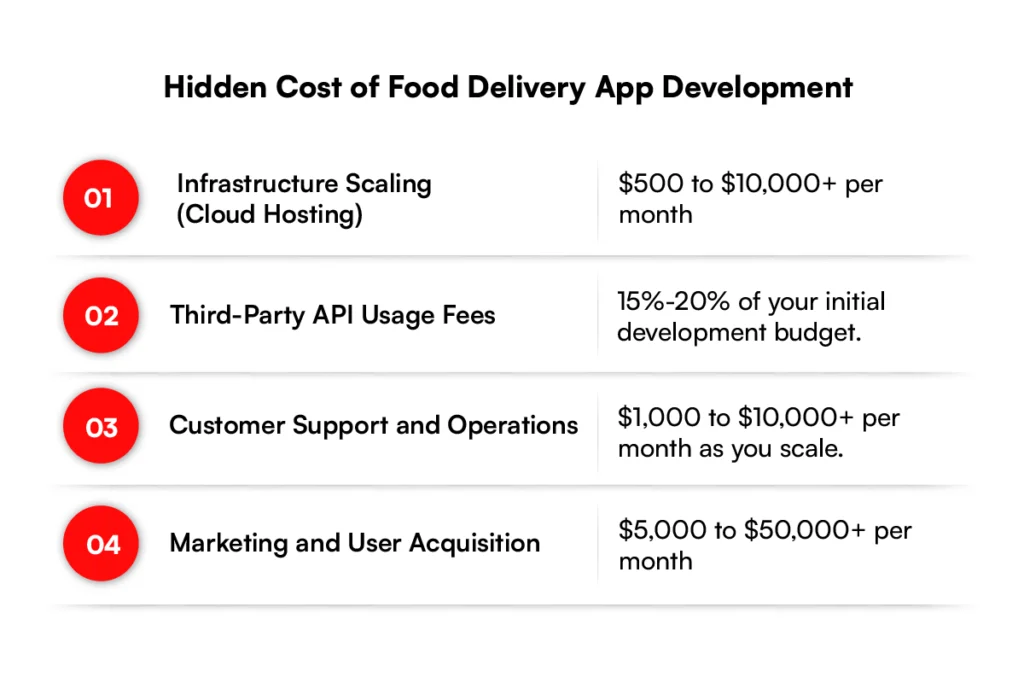
Post-Launch Operational Costs for Food Delivery App
Launching a food delivery platform is only the beginning of the financial lifecycle. Once the platform starts processing real orders, a second layer of recurring operational costs begins to scale alongside user growth.
These are often called the hidden cost of building a custom food delivery app as they do not appear in initial development quotes. However, these costs directly affect platform sustainability and profitability.
| Food Delivery App Post-Launch Operational Costs | ||
| Cost Category | Typical Cost Range | What Drives the Cost |
| App Maintenance | $20,000 – $40,000/year | Updates, bug fixes, performance optimization, OS compatibility |
| Cloud Infrastructure | $500 – $10,000+/month | Order volume, traffic spikes, real-time processing, database scaling |
| Third-Party APIs | $8,000 – $30,000+/year | Maps, payments, SMS, notifications, geolocation services |
| Security Audits & Compliance | $5,000 – $35,000/year | Penetration testing, compliance monitoring, security reviews |
| Customer Support Operations | $1,000 – $10,000+/month | Refund handling, dispute resolution, operational support tooling |
| Marketing & User Acquisition | $5,000 – $50,000+/month | Paid ads, promotions, customer acquisition campaigns |
1. Infrastructure Scaling
Food delivery platforms process continuous streams of:
- GPS updates
- order synchronization
- payment events
- notifications
- and dispatch requests
As order volume increases, infrastructure usage scales rapidly alongside it, and so does the development cost of a food delivery app. Platforms handling high delivery volumes require significantly larger cloud environments, database capacity, and real-time processing infrastructure.
2. API Usage Costs
Most delivery platforms rely heavily on third-party services such as:
- Google Maps
- payment gateways
- SMS providers
- and notification systems
These services charge based on usage, meaning costs increase directly with platform activity. A growing delivery platform may process millions of Ecommerce API calls every month across maps, routing, payments, and communication systems.
3. Customer Support Operations
As delivery volume grows, operational support becomes a major cost center.
Platforms need systems and teams capable of handling:
- refunds
- delayed deliveries
- payment disputes
- vendor issues
- and customer complaints
Operational inefficiencies at this stage directly affect retention and platform reputation.
4. Marketing and Customer Acquisition
Customer acquisition is one of the largest recurring expenses in the food delivery industry. Established players already dominate most markets with aggressive advertising and discounting strategies, making customer acquisition increasingly expensive for new entrants.
In many cases, platforms spend more on acquiring and retaining users during the first year than they spend on the original product build itself.
5. The Real Cost of Ownership
A food delivery platform that costs $150,000 to build can realistically require an additional $200,000–$400,000 during its first operational year once infrastructure, maintenance, APIs, support, and marketing are fully accounted for.
This is why successful food delivery businesses budget beyond launch. The real challenge is sustaining and scaling it efficiently once real operational demand begins.
Best Practices for Optimizing Food Delivery App Development Costs
Most food delivery platforms overspend in one of two ways: either they build too much too early, or they build too cheaply and end up paying to rebuild six months later.
Both failures share the same root cause: decisions on scope, architecture, methodology, and technology made without a clear understanding of the downstream costs of each choice.
The five optimization practices below are structural decisions, on scope, architecture, methodology, and technology, that determine whether a platform deploys capital efficiently or wastes it on rework, redundancy, and premature complexity.
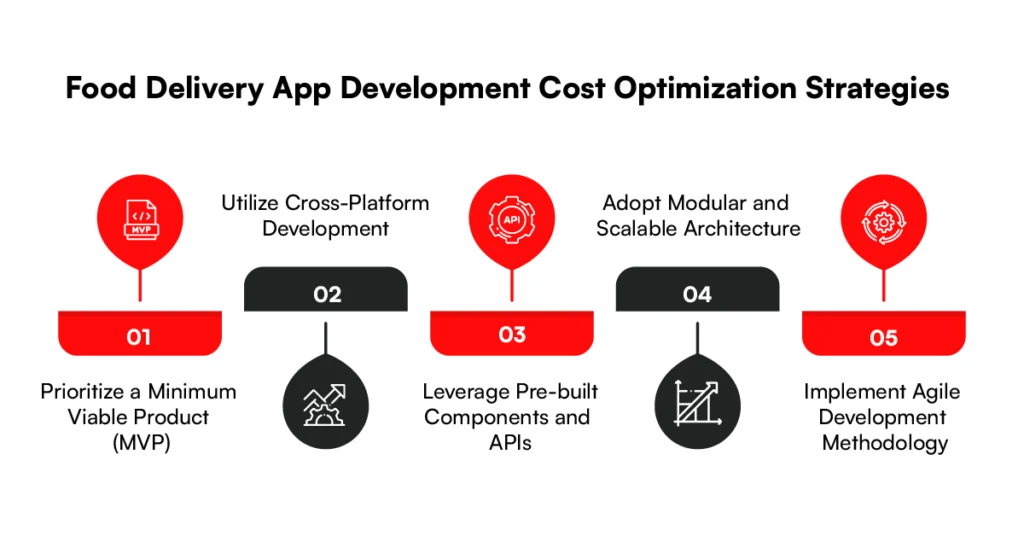
1. Start with a Minimum Viable Product (MVP)
Usually, companies have the myth that building an MVP means building less or in a minimal way. No, MVP is actually a balanced approach that builds the right things first and defers the rest until real user data validates the investment.
Adopting the MVP version while focusing on core features and functionality at launch reduces initial development custom software development costs by 40-50%.
What Does the MVP Phase Cover in Food Delivery?
- User registration and authentication — email, phone OTP, social login
- Restaurant listings with menu browsing and basic search
- Cart management and a single checkout flow with one payment gateway
- Real-time order tracking — the feature most directly tied to first-order satisfaction and return rate
- Basic push notifications for order status updates
- A functional admin panel for order monitoring and basic operations
2. Choose Cross-Platform Development
The platform decision between native vs. cross-platform is the single highest-leverage technical choice in the cost optimization stack.
Industry benchmarks show that cross-platform frameworks like React Native reduce overall costs by 40-50%, with a single codebase reducing development time by 30% compared to building native apps separately.
3. Pre-Built Components and Third-Party APIs
A custom-built food delivery ecosystem consistently requires payments, mapping, notifications, and authentication, which lead to unnecessary cost overruns in food delivery development.
Thus, third-party APIs can reliably deliver every capability you need without requiring you to build engineering, maintenance, or security from scratch. Deploying established services through third-party APIs instead of building custom can reduce development time by up to 40%.
4. Adopt Modular and Scalable Architecture
The investment in good ecommerce architecture pays off exponentially later, and database design significantly impacts query performance at high volumes.
A proper architecture prevents expensive rewrites as you grow; microservices allow scaling individual components independently. Modular architecture in the food delivery ecosystem enables you to:
- Scale independent components without breaking code
- Add features at optimized cost
- Enhance team parallelization and reduce coordination overhead
- Sustain annual maintenance at 15-20% of the initial development cost
5. Implement Agile Development Methodology
Experts often described agile development as a budget-control mechanism that prevents expensive wastage, such as building features users do not want, at a scale that makes them expensive to remove or replace.
Here, agile sprints deliver working features incrementally for early feedback, course corrections happen quickly before significant resources get wasted, and regular reviews prevent these bottlenecks.
How does agile reduce cost in food delivery app development?
- Every sprint delivers working features that real users can test right away. Thus, problems are caught and solved early, before they become expensive fixes.
- Automated testing and deployment pipelines replace slow, error-prone manual processes, and prevent regression costs from growing with every release.
- Agile’s short feedback cycles surface user experience problems early, which requires costly rebuilding of entire sections.
- Every sprint forces a spending decision that keeps scope creep in check and prevents food delivery projects from silently going over budget.
Catch budget leaks before they compound
Waterfall projects discover costly errors at the end. RBMSoft’s agile sprints surface scope and cost issues early, when they’re still cheap to fix.
Start My Agile Cost PlanHow RBMSoft Assists You in Developing a Food Delivery App?
According to Statista, the online food delivery market is expected to earn $1.51 trillion by 2026. That’s a massive number, but it hides a tough reality for anyone trying to build a food delivery app. Most apps fail because of poor engineering and weak product decisions.
We at RBMSoft, a product engineering company, help businesses bridge this gap. We combine industry expertise, AI-powered development, and modern cloud-based systems to take a food delivery app from a solid concept to a live, scalable product.
We take food delivery app development seriously as an engineering challenge, not a copy-paste job. Thus, we follow a four-phase process that matches your business goals with the right technical decisions.
- Phase 1: Strategy & Architecture
We figure out what kind of business you’re running, a marketplace, direct delivery, dark kitchen, or B2B model and design the architecture around it. Our experts make the big decision here: whether to build with microservices or a modular monolith.
Here in this phase, we deliver:
- Competitive analysis
- Feature priority list
- Technical blueprint
- Phase 2: Core App Development
We build the four essential pieces independently that every delivery platform needs:
- Customer app (mobile & web)
- Restaurant portal
- Driver management interface
- Operations & analytics dashboard
We focus on making your food delivery ecosystem more advanced and functional-grade by embedding AI capabilities such as AI-powered menu recommendations (proven to increase order values) and smart driver dispatch that considers proximity, performance history, and vehicle load, not just who’s closest. This cuts delivery times and improves driver efficiency.
- Phase 3: Data & Personalization
Most apps collect valuable user data and do nothing with it, but our AI and data experts put it to work through:
- Demand forecasting: It helps restaurants stock inventory more smartly
- Dynamic pricing: It adjusts automatically during busy periods
- Personalized notifications: It targeted messages instead of mass blasts
- Phase 4: Infrastructure & Security
Security isn’t an afterthought for us; we’ve locked down every platform with tight security from day one, using auto-scaling, CDNs, and database optimization. Our security & compliance specialists bake all necessary compliance requirements into the development process, avoiding expensive fixes later.
Our case studies across retail & ecommerce include Big Lots, PetMeds, BeachBody, North American Apparel Retailer, DSW, Plantronics, etc, demonstrate a pattern of clients who outgrew the limitations of their previous vendors and came to us specifically to build what scales.
Whether you want to build a B2B food delivery app, a restaurant aggregator, or a grocery delivery app, consult our experts and turn your vision into a fully functional, market-ready product. From ideation and design to development and launch, we guide you every step of the way.
FAQs
1) How much does it cost to develop a food delivery app like Uber Eats or DoorDash in the USA?
A. Developing a food delivery app comparable to Uber Eats or DoorDash in the USA typically costs between $80,000 and $300,000+, depending on complexity, features, and the development team.
A basic MVP with core features like ordering, tracking, and payments starts around $80,000–$120,000, while a full-featured platform with advanced AI recommendations, multi-city support, and robust admin panels can exceed $300,000.
2) How much does it cost to build a multi-vendor food delivery app?
A. A multi-vendor food delivery app that supports multiple restaurants and vendors on one platform generally costs between $100,000 and $250,000.
The added complexity of vendor dashboards, commission management, individual restaurant menus, and separate payout systems adds roughly 30–50% more cost compared to a single-vendor solution.
3) What is the cost difference between native and cross-platform food delivery app development?
A. Native app development (separate iOS and Android codebases) typically costs $120,000–$300,000+ since you are essentially building two apps. Cross-platform development using frameworks like Flutter or React Native costs $60,000–$180,000, as a single codebase serves both platforms.
Cross-platform saves 30–40% upfront but may entail performance trade-offs for highly complex, real-time features such as GPS tracking.
4) What is the hourly rate of food delivery app developers in the USA, India, and Europe?
A. In the USA, developers charge $100–$200 per hour. European developers (UK, Germany, Eastern Europe) typically range from $50–$150 per hour, with Eastern European rates closer to $40–$80.
Indian developers are the most cost-effective at $20–$50 per hour, making India a popular choice for cost-sensitive projects without significantly sacrificing quality.
5) What is included in the food delivery app development cost estimate?
A. A typical cost estimate covers UI/UX design, frontend and backend development, database architecture, third-party API integrations (maps, payments, SMS), QA and testing, app store deployment, project management, and initial post-launch support.
Hidden costs like server infrastructure, SSL certificates, third-party service subscriptions, and ongoing maintenance are often excluded from initial quotes and should be budgeted separately.
6) How much does API integration cost in a food delivery application?
A. API integrations collectively add $10,000–$40,000 to development costs. This includes mapping APIs (Google Maps costs roughly $5,000–$15,000 to integrate), SMS/push notification APIs like Twilio or Firebase ($2,000–$5,000), restaurant data aggregator APIs, and social login APIs. The more third-party services involved, the higher the integration and testing overhead.
7) How much does payment gateway integration cost for food delivery apps?
A. Integrating a payment gateway such as Stripe, Braintree, or PayPal typically costs $5,000–$15,000 in development effort, depending on complexity.
Supporting multiple payment methods (credit/debit cards, digital wallets like Apple Pay and Google Pay, and COD), handling refunds, and ensuring PCI-DSS compliance adds to the cost. Multi-currency payment support can push this figure toward the higher end.
8) What is the cost of adding live GPS tracking in a food delivery app?
A. Implementing real-time GPS tracking for delivery agents costs approximately $8,000–$20,000. This includes integrating mapping SDKs (Google Maps or Mapbox), building real-time location-update infrastructure using WebSockets or Firebase, route-optimization logic, and the customer-facing live-tracking screen.
Ongoing Google Maps API usage fees are an additional operational cost based on request volume.
9) How much does it cost to develop separate apps for customers, delivery agents, and restaurants?
A. A full three-panel ecosystem — customer app, delivery agent app, and restaurant management app — plus an admin dashboard costs $80,000–$200,000+ in total.
Each panel is effectively a separate app with its own flows and logic. The customer app is typically the most polished and expensive; the delivery agent app is simpler, focused on navigation and order management; and the restaurant app handles menu management and order acceptance.
10) How much does food delivery app maintenance and support cost annually?
A. Annual maintenance for a food delivery app typically runs 15–20% of the original development cost per year. For a $150,000 app, expect to spend $22,500–$30,000 annually.
This covers bug fixes, OS and security updates, server and infrastructure costs (AWS/GCP hosting typically runs $500–$3,000/month depending on scale), feature enhancements, and technical support.
11) How much does it cost to add loyalty programs and coupon systems to a food delivery app?
A. Building a loyalty points system, referral programs, and dynamic coupon/promo code management adds roughly $10,000–$30,000 to development costs.
The complexity depends on the rules engine required — simple flat discounts are cheap, while tiered loyalty programs with expiry logic, personalized offers, and analytics integration are significantly more involved.
12) Which is more cost-effective: ready-made food delivery software or custom development?
A. Ready-made white-label solutions like Jungleworks! Food costs $500–$15,000 upfront and can be launched in weeks, making them suitable for startups testing the market.
Custom development costs $80,000–$300,000+ but gives full control over features, branding, scalability, and data. For long-term growth and differentiation, custom development is more cost-effective, while ready-made solutions win on speed and initial budget.
13) What tech stack is best for optimising costs in food delivery app development?
A. A cost-effective stack combines React Native or Flutter for cross-platform mobile development, Node.js or Django for the backend, PostgreSQL or MongoDB for the database, Firebase for real-time features, and AWS or Google Cloud for infrastructure.
This stack minimizes team size, reuses code across platforms, and leverages abundant developer talent globally — particularly in India — keeping both development and hiring costs lower without sacrificing scalability.
14) What is the cost of integrating analytics and reporting dashboards in food delivery apps?
A. Adding analytics and reporting dashboards for restaurants, delivery partners, and the admin panel costs $10,000–$25,000.
This includes integrating tools like Google Analytics, Mixpanel, or building custom dashboards using libraries like Chart.js or integrating business intelligence tools like Metabase. Advanced predictive analytics and AI-driven insights can push costs higher, toward $30,000–$50,000.
15) What is the cost of adding multilingual and multi-currency support in food delivery apps?
A. Adding multilingual support (i18n/l10n framework, RTL language support, translation management) costs $5,000–$15,000, depending on the number of languages. Multi-currency support, including real-time exchange rate APIs and locale-based pricing, adds another $5,000–$10,000.
Combined, expect $10,000–$25,000 for a robust international-ready feature set, with ongoing translation and currency maintenance as recurring costs.
16) How Do Food Delivery Apps Make Money?
A. Food delivery platforms generate revenue from multiple stakeholders across the ecosystem, including restaurants, customers, and delivery partners.
The most common monetization models include commission fees on orders, delivery charges, subscription programs, in-app advertising for restaurant visibility, logistics-as-a-service offerings, and value-added services such as analytics and promotional tools.
Most successful platforms combine several of these revenue streams instead of relying on a single monetization model.