


Quick Summary:
- Feature flag driven development separates code deployment from feature release, reducing deployment-related incidents by 89%. The benefits of feature flag driven development run wider than safer releases. They change how product, engineering, and compliance teams coordinate across the entire delivery cycle.
- Enterprise flag systems need five flag types: release, experiment, operational, permission, and kill-switch, each with a defined owner, lifespan, and cleanup trigger
- Architecture decisions matter from day one: local evaluation, control plane separation, and SSE streaming are not optional at scale
- Governance enforced at the platform level, not tracked in a spreadsheet, is what keeps hundreds of flags across dozens of teams from becoming a liability
- Flag debt is silent. Five flags in one service create thirty-two code paths. Most teams test two
- Self-hosted flag evaluation keeps user data, compliance posture, and uptime decisions inside your own infrastructure
- Vexillo delivers a governed, self-hosted feature flag platform on your own AWS infrastructure, compressing months of custom build into weeks of configuration
Shipping software at enterprise scale is harder to coordinate than it is to build. Features move through multiple teams, environments, and approval gates before they reach users. A single bad release can trigger rollbacks, incident calls, and unhappy stakeholders at 2 a.m.
Market trends and stats for the feature flag space show enterprise adoption has more than doubled in recent years, with engineering teams treating flags as core delivery infrastructure rather than an optional add-on.
Feature flag driven development breaks the dependency between deployment and delivery. You ship code to production with new functionality switched off, then turn it on for specific users, regions, or traffic percentages when you are ready. No redeployment. No code freeze. No crossing your fingers on release day.
Compliance requirements, multi-team coordination, and the cost of production incidents make ad hoc release management a liability at enterprise scale.
This guide covers the architecture, governance, and operational patterns that make feature flag driven development work in that environment, and what separates a flag platform that holds up under those demands from one that creates new problems while solving old ones.
What Is Feature Flag Driven Development?
Feature flag driven development is a software delivery practice where code ships to production in a disabled state and activates through configuration. How do feature flags work? The flag evaluates a condition at runtime. When it is off, users get the existing behavior.
When it is on, the new code path runs. Teams that build feature flag driven software decouple deployment from release, so code reaches production on the engineering team’s schedule and features go live on the product team’s schedule without the two ever having to move together.
Martin Fowler documented this pattern in 2010 under the term “feature toggles.” The core idea has remained unchanged but a lot of tooling has been built around it. Modern feature flag framework implementations now handle targeting rules, percentage rollouts, audit trails, and real-time evaluation at scale.
The practical result is that three workflows change at once. Developers merge incomplete features into the main branch behind a flag instead of maintaining long-lived feature branches. QA validates new behavior in production without exposing it to real users. Product managers decide when a feature goes live without raising a deployment request.
The decision of when users see a feature has transformed from an engineering event into a configuration change. The implementation of feature flag driven development begins with that separation. Get it wrong and the tooling creates the same coupling it was supposed to remove.
Build Your Flag Infrastructure With RBMSoft
Vexillo gives your team a governed, self-hosted feature flag platform on your own AWS infrastructure. No months of custom build. No SaaS compliance exposure.
See How Vexillo Works
Why Enterprise Teams Invest in Feature Flag Driven Development
Most enterprise engineering issues stem from scale. Shipping code is no different. Feature flag driven development addresses the coordination gaps that slow release cycles down, but understanding the challenges in feature flag driven development first sets realistic expectations: flag debt, governance gaps, and the cost of scaling across dozens of teams.
Feature flags development at enterprise scale delivers these returns when the governance model is in place:
1. Allows Independent Shipping Without Release Coordination
Traditional release cycles force a hard dependency where every team involved in a feature must be ready at the same time before anything ships.
Feature flags break that dependency. Each team deploys independently behind a flag, tests in production on its own schedule, and the go-live decision belongs to whoever owns the business outcome.
2. Reduces the Risk of Large-Scale Disruptions
The risk with a big-bang release is that it either works for everyone or it breaks for everyone. Organizations using feature flags report an 89% drop in deployment-related incidents, with mean time to recovery improving by up to three times.
Engineering teams can expose a new feature to 5% of users, watch error rates, then expand only when the metrics support it. The blast radius of a bad release shrinks from “everyone” to a cohort you can switch off in seconds.
3. Gives Non-Engineering Teams Control Over Releases
Product managers gain autonomy to ship when the business is ready, not just when the code is. Marketing teams can time a launch to a campaign without raising a deployment ticket. Support teams can enable a feature for one customer account to triage an issue. None of this requires engineering involvement once the flag exists.
4. Enables Compliance Without Slowing Delivery
Regulated industries need every production change documented, reviewed, and auditable. Feature flag platforms enforce a four-eyes principle where changes go into a draft state, require peer approval, and only then apply to production. This delivers the audit trail compliance teams require without pulling the process outside the platform. With feature flag driven development, you no longer need to compromise release velocity for change management.
5. Enables Trunk-Based Development Across Large Teams
Long-lived feature branches are a consistent source of integration pain. Developers drift from the main branch, merge conflicts accumulate, and integration becomes a project of its own.
Feature flags fix this by letting all code merge continuously into the main branch, with incomplete work gated behind a flag rather than isolated in a separate branch. The best practices for feature flag driven development in this area start with a clear naming convention and an assigned owner before the flag ever ships.
Architecture Decisions That Define a Production-Ready Flag System
The decisions that determine how a feature flag system performs in production are architectural. In feature flags software development at enterprise scale, getting evaluation, payload, control plane separation, and environment promotion right determines whether the platform holds up or becomes the bottleneck it was meant to prevent.
Let’s look at what goes into each of these decisions.
1. Server-Side vs. Local Evaluation: Which Model to Choose?
In server-side evaluation, the SDK sends a request to the flag service, which applies targeting rules and returns a variation. Rule changes take effect immediately — save a change and every subsequent request reflects it.
Every flag check depends on a network round-trip, so if the flag service degrades or goes offline, your application’s behavior is entirely determined by how well you’ve handled the fallback.
Local evaluation works differently. The SDK downloads the full ruleset, caches it, and evaluates flags in-process without a network call. Latency drops to microseconds, and a flag service outage has no effect on applications already running against a local cache.
Rule changes only reach clients on the next cache refresh unless you pair local evaluation with a push mechanism like Server-Sent Events.
| Factor | Server-Side Evaluation | Local Evaluation |
| How it works | SDK calls the flag service per request; rules applied centrally | SDK caches the full ruleset and evaluates in-process |
| Latency | Adds a network round-trip to every flag check | Sub-millisecond; no network call involved |
| Rule update speed | Immediate; changes apply the moment they are saved | Depends on cache refresh interval unless paired with SSE push |
| Availability risk | Flag service outage directly affects application behavior | Applications continue evaluating against cached rules |
| Best for | Sensitive business logic that must stay off the client | High-traffic services where latency and resilience matter most |
Most enterprise architectures land on local evaluation paired with Server-Sent Events for real-time rule propagation. You get the latency and resilience benefits of local caching without waiting on a polling interval for flag changes to reach clients.
2. Control SDK Payload Size or Pay for It in Cold-Start Latency
Choosing the best feature flag service for API development means paying close attention to SDK payload size from day one. Every SDK instance downloads flag configurations on initialization.
This is foundational to any mature feature flag solution development. Skipping it in early architecture creates latency problems that get harder to fix as flag count grows.
In a large enterprise deployment with 300 or more active flags, a single SDK payload can exceed several hundred kilobytes. For a serverless function, that adds measurable cold-start latency on every cold invocation. For a mobile client, it can exhaust the memory budget entirely.
Three controls address this directly. Strip evaluation metadata the SDK does not need at runtime. Scope targeting rules tightly so inactive flags are excluded from what each service downloads.
Deliver only the flags relevant to a given service’s context rather than the full organizational ruleset. Each control reduces payload size independently; applying all three compounds the effect.
3. Keep Configuration Infrastructure Off the Evaluation Path
At scale, flag configuration and flag evaluation need to run on separate infrastructure. Coupling them produces a failure mode that only becomes visible under load. How do feature flags work when evaluation and configuration share the same path? They degrade together.
Every production-grade feature flag framework separates these concerns structurally. Convention does not hold at scale.
SDK evaluation traffic can spike into millions of requests per minute. Control plane traffic, covering engineers updating rules, reviewing approvals, and checking audit logs, is occasional and low-volume.
When both share the same infrastructure, an evaluation spike can make the management dashboard unresponsive exactly when your team needs it most, and a bad rule update can degrade evaluation performance across every service hitting the same endpoint.
The mature pattern routes SDK traffic through a dedicated evaluation layer, often CDN-distributed, while keeping the control plane on separate infrastructure with its own scaling characteristics.
Vexillo by RBMSoft, follows this pattern: a PostgreSQL-backed control plane handles configuration and governance while flag evaluation runs through CloudFront, keeping management operations fully isolated from runtime traffic.
4. Move Flags from Staging to Production Without Manual State Changes
Manual flag toggling across environments introduces human error and creates state drift between staging and production. A structured promotion workflow addresses both.
A flag starts in the off state the moment a developer creates it. CI activates it in staging after tests pass. A separate approval gate controls promotion to production.
No engineer manually touches flag state across environments, and every step is logged and tied to the build that triggered it. When something breaks in staging after a flag goes live, the audit trail shows exactly what changed, when, and what triggered it.
5. Prevent the Flag Service from Becoming a Single Point of Failure
An application that cannot reach the flag service should fall back to default behavior without blocking. That requires two things: a well-defined default variation for every flag, and an SDK that serves that default gracefully when the flag service is unreachable.
Beyond SDK-level fallbacks, the flag service itself needs redundancy. Vexillo propagates flag changes to all regions in under few seconds using AWS ECS Fargate and CloudFront.
A us-east-1 outage does not affect the flag state in eu-west-1. For enterprises running services across multiple regions, that propagation guarantee is a reliability requirement, not a feature.
6. Know Within Seconds Whether a Flag Change Caused the Incident
The operational value of feature flags depends on answering one question fast: did a flag change cause this incident?
Flag evaluation events should emit as structured logs or trace spans, timestamped and tagged with the flag key, variation served, and user context. When error rates spike at 14:32 and your APM tool shows a flag change at 14:30, the correlation is immediate.
Teams that wire flag evaluation into Datadog, Grafana, or OpenTelemetry collectors stop asking “what changed?” during an incident. They already know. The kill-switch then takes seconds rather than the ten minutes spent searching a dashboard you rarely open under pressure.
Best Practices for Feature Flag Development at Enterprise Scale
A flag system without formal governance produces a recognizable set of problems: flags with no owners that nobody dares touch, production changes with no approval trail, and a shared namespace where one team’s kill-switch sits three characters away from another team’s release flag. The practices below address each structurally rather than through convention.
1. Assign Individual Owners to Every Flag at Creation
Every feature flag should have a named individual as its owner, and not a team. Teams reorganize, people change roles, and flags outlive the context in which they were created. This is where most feature flags development governance breaks down at scale.
The problem is not the tooling. It is the accountability structure behind it. A flag controlling a payment flow with no named owner has no one accountable for its state, its behavior, or its removal.
Flag creation should require an assigned owner at the platform level. Flags with no active owner should surface automatically in audits rather than waiting for a manual review cycle to catch them. Ownership tied to a role or team rather than a person is ownership in name only.
2. Enforce Naming Conventions by Flag Type
A flag called new_feature_test tells the next engineer nothing about its purpose, its owner, or whether it is still needed. A prefix system makes all three legible at a glance:
- rel_ for release flags
- exp_ for experiment flags
- ops_ for operational flags
- kill_ for kill-switches
The difference between a naming convention that holds and one that erodes within a quarter is enforcement at the platform level. Validating prefixes at creation as a hard requirement keeps the namespace readable as the number of flags and teams grows.
3. Get Every Production Change Behind An Approval Step
A second approver must sign off before any production flag change applies. That approval step is also where intent gets documented and decisions become traceable. Approval workflows need to live inside the flag platform itself. External change management tools create friction that teams route around.
When the approval step is one click inside the same interface where the flag is configured, compliance becomes the default path rather than an obstacle.
4. Make Every Flag Change Queryable, Timestamped, and Immutable
Every flag change needs a timestamped record: who made the change, what the previous state was, what it changed to, and which environment was affected. That record needs to be immutable and queryable.
A compliance team preparing for a SOX audit should be able to pull every production flag change from the last 90 days in under two minutes. If that query requires a support ticket, the audit process has a gap that will show up during the audit itself.
5. Set Flag Expiry Dates at Creation
Short-lived flags without expiry dates are the primary source of flag debt. By the time a flag has outlived its purpose, the engineer who created it has often moved on and the flag’s behavior is poorly understood by anyone currently on the team.
Setting an expiry date at creation forces the lifespan conversation before the flag ships. Automated cleanup surfaces flags past their expiry date and routes them to their owner for a decision.
The goal is to make stale flags visible early enough that the owner can assess them in context rather than six months later when the original intent is gone.
Lifecycle stages made explicit in the platform dashboard — active, ready for cleanup, archived — shift this from a memory exercise into a managed process. Flags that have passed through a formal retirement step carry far less risk than flags that simply stopped being used.
6. Add Namespace and Role Boundaries Before Teams Share the Same Flag System
Governance that works for one team breaks down when fifty teams share the same flag system. Feature flags development at this scale requires structural namespace isolation, not conventions teams are trusted to follow. Namespacing, environment isolation, and role boundaries need to be structural from the start.
One team’s kill-switch shares a prefix with another team’s release flag and disables it in production. Nobody catches it immediately because nobody has a centralized view of who owns what.
A platform that shows every active flag, its owner, its current environment state, and its last modification date makes this class of incident preventable rather than just recoverable.
Role boundaries follow the same logic. Developers work freely in non-production environments but require an explicit approval step for any production change. A separate admin role holds production toggle rights.
Cross-organization configurations sit behind a super-admin boundary that most engineers never need to cross. Those boundaries enforced at the platform level hold regardless of team size or organizational restructuring.
Build Your Flag Infrastructure With RBMSoft
Vexillo gives your team a governed, self-hosted feature flag platform on your own AWS infrastructure. No months of custom build. No SaaS compliance exposure.
See How Vexillo WorksSecurity and Compliance Requirements for Enterprise Flag Systems
Feature flags introduce a class of security risk that infrastructure teams often discover after deployment. A misconfigured flag can expose an unfinished feature to every user in production, disable an active security control, or grant elevated permissions to the wrong audience segment.
The sub-sections below cover the architectural and operational requirements that prevent each of these, along with the specific compliance framework obligations a well-governed flag system needs to satisfy.
1. Treat Your Flag System as an Attack Surface From Day One
Flag configurations contain more sensitive information than most teams account for at setup. Targeting rules can reveal internal user segmentation logic. Kill-switch conditions can expose system vulnerabilities. Permission flags can show which features are restricted in which regions and for which user groups.
Each of these represents an unintended data exposure risk if flag configurations are not adequately protected. Encryption at rest, TLS for all evaluation traffic, and strict API authentication are baseline requirements, applied from initial deployment rather than retrofitted after a security review surfaces the gap.
2. Know Where User Context Data Goes
In a SaaS flag platform, every evaluation call sends user context, targeting attributes, and segment data to the vendor’s infrastructure. For most applications, that is an acceptable trade-off. For enterprises in healthcare, financial services, or any jurisdiction with data residency requirements, it creates a compliance exposure.
Vexillo’s self-hosted architecture keeps all flag configuration and evaluation data within your own cloud, which directly addresses the data residency requirements that regulated industries mandate.
3. Connect Flag Access to Your Existing Identity Provider
A flag platform that maintains its own credential store creates a parallel identity management problem. Access granted inside the flag system exists independently of your organization’s central directory, which means access revocation on employee exit requires a manual step in a system that security teams may not monitor routinely.
SSO integration with an existing identity provider such as Okta or Azure AD resolves this at the infrastructure level. Security teams retain centralized control over flag system access through the same tooling they already govern.
4. Write Audit Logs to an Append-Only Record
The Governance section covers what goes into an audit trail: every flag change, timestamped, with the previous state, the new state, the environment affected, and the identity of the person who made the change.
And that record must be append-only and outside the reach of the flag platform’s administrative interface to ensure security and satisfy compliance control requirements.
5. Match Your Compliance Framework to the Platform Architecture You Need
Different frameworks impose different requirements, and the platform architecture that satisfies one does not automatically satisfy another.
- SOX requires change management controls and audit trails for systems that affect financial reporting.
- SOC 2 Type II evidence requirements around access controls and change management map directly to RBAC and audit trail capabilities.
- HIPAA prohibits sending protected health information to third-party processors without a qualifying business associate agreement.
- GDPR’s data minimization requirements affect how targeting attributes are structured and stored.
Vexillo’s self-hosted architecture keeps all flag configuration and evaluation data within your own cloud. Combined with Okta SSO and role-based access controls, it supports the data residency and identity management requirements that regulated industries mandate.
Feature Flags Across Enterprise Rollout Strategies
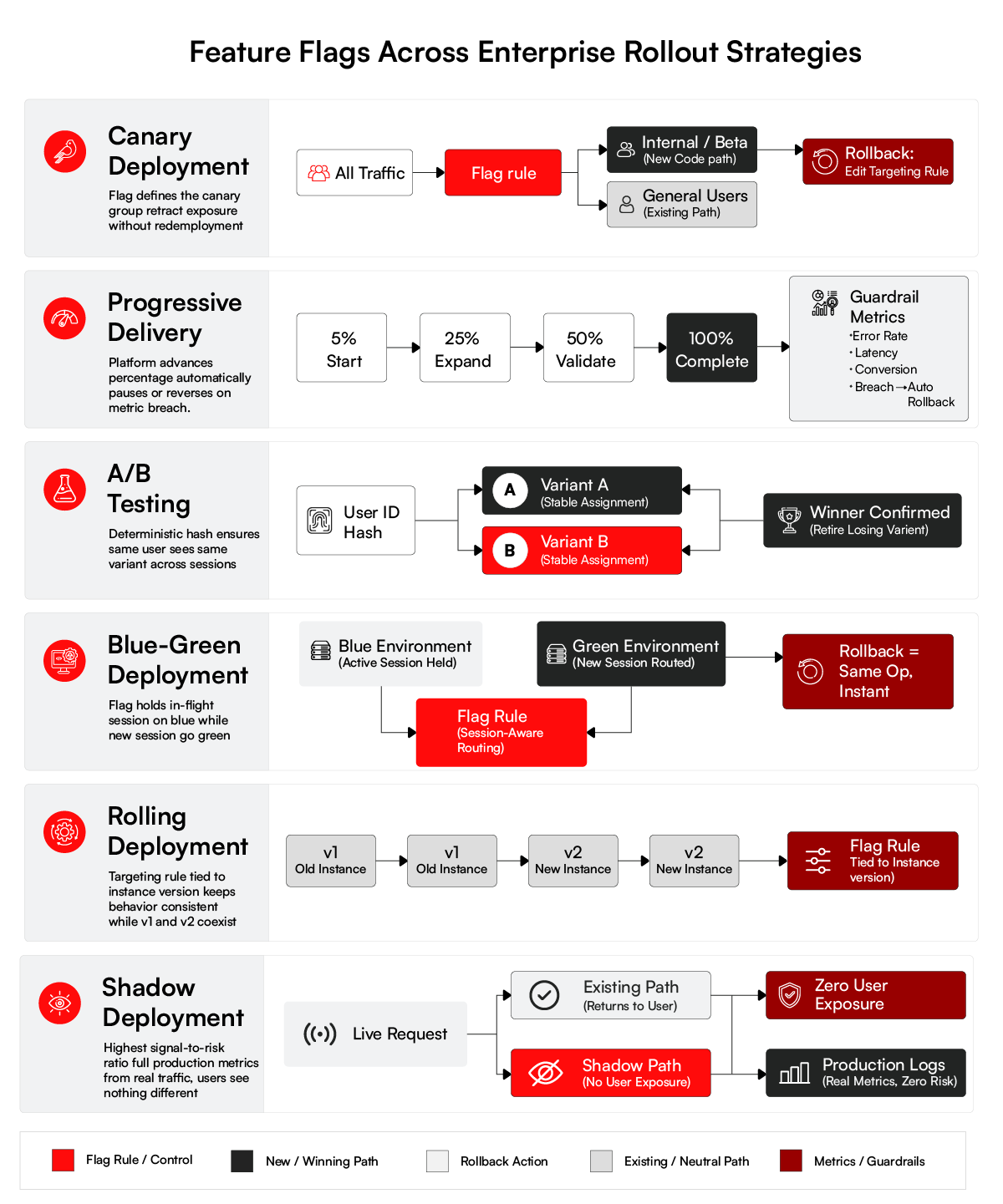
Deployment and release are separate decisions, and feature flags are what make that separation operational. How that works in practice depends on the rollout strategy. The flag mechanics, the targeting rules, the failure modes, and the rollback paths all change depending on which strategy your team is running.
1. Canary Deployment
In a canary release, the flag defines who the canary group is and enforces that definition consistently across every request. Internal users are a named segment in the targeting rule.
Your beta cohort is an attribute match or an explicit list. The percentage ramp is a gradual rollout rule that you advance as confidence builds, with each stage representing a deliberate flag state change rather than a separate deployment artifact.
If the canary group surfaces an error rate spike or a latency regression, you can fix it quickly with a targeting rule change. The deployment stays in place while the exposure retracts. All this happens in the time it takes to save the rule.
2. Progressive Delivery
Progressive delivery is the strategy where flag platforms provide the most direct value in a continuous deployment pipeline. It not only controls visibility but actively manages the rollout’s safety envelope.
The percentage rule advances through defined checkpoints — 5%, 25%, 50%, 100% — while the platform monitors guardrail metrics against thresholds you configure upfront. When a metric breaches its threshold, the platform rolls the exposure back to the previous percentage automatically.
3. A/B Testing
The mechanism that makes flag-managed A/B testing reliable is deterministic cohort assignment. The flag hashes the user ID against the flag key to produce a stable variation assignment without storing per-user state. So a user assigned to variation B on day one sees variation B on day fourteen regardless of which server handles their request.
Once the winning variation is confirmed, the flag gives you a clean retirement patH. You remove the losing variant from the targeting rule, harden the flag to the winning variation or retire it through the standard lifecycle process, and shed the dead code branch.
4. Blue-Green Deployment
Infrastructure-level traffic routing can switch the load balancer from blue to green, but it cannot manage what happens to the sessions already in flight when the switch occurs.
A flag targeting rule can hold active sessions on blue while routing all new sessions to green, giving your users a clean experience through the transition window rather than landing mid-session on a different environment.
When you need to roll back, the operation is identical to the original cutover and executes in the same time.
5. Rolling Deployment
The problem that feature flags solve in a rolling deployment is behavioral consistency across the transition window when old and new instance versions coexist in production. Without flag control, a user’s experience varies depending on which instance handles their request, and those instances are running different code.
A targeting rule tied to instance version ensures your feature’s visibility stays consistent across the transition, so users do not encounter different behavior while the rollout is partially complete.
6. Shadow Deployment
Shadow mode is the flag use case with the highest signal-to-risk ratio for high-stakes backend replacements, because you get full production signal with zero user-facing exposure. A flag activates a parallel code path that processes live requests alongside the existing path but does not return results to users.
The shadow path produces real production logs and latency metrics under actual traffic volumes, giving your team comparison data that staging environments cannot replicate.
Every sprint forces a spending decision that keeps scope creep in check and prevents food delivery projects from silently going over budget. Every sprint forces a spending decision that keeps scope creep in check and prevents food delivery projects from silently going over budget.
Run Every One of These Strategies on Your Own Infrastructure
Vexillo supports canary releases, progressive delivery, A/B testing, blue-green, rolling, and shadow deployments out of the box. Your flag data stays in your own AWS environment throughout.
See How Vexillo Handles RolloutsThe Hidden Cost of Feature Flag Technical Debt
Here’s how flag debt builds up. A flag ships without an expiry date, the engineer who created it moves to another team, and the flag sits in the codebase evaluating to true for every user, wrapping a code path that has been the default behavior for eight months.
Multiply that across fifty flags and the conditional logic in your codebase no longer reflects the actual product. The two costs that follow from that state are worth understanding specifically.
1. Five Flags Produce Thirty-Two Code Paths. Most Teams Test Two.
Five active feature flags in a single service produce 32 possible flag state combinations. The realistic testing coverage for most teams is flag on and flag off. The other 30 combinations are live code paths running in production for real user segments, and none of them have been through QA.
A bug that only manifests when flag A is on and flag B is off will not surface in a test environment. It will surface during a peak traffic window when a specific user segment hits a code path nobody realized was still active. By the time your team traces the errors back to a flag combination, the incident is already underway.
2. The Cleanup Cost Compounds With Every Month a Flag Stays
Engineers onboarding to a service with 200 active flags spend time decoding conditional logic that should have been removed months ago. During an incident, your team cannot quickly determine which flags are active or whether any are relevant to the problem in front of them, which adds investigation time at exactly the moment you can least afford it.
The economics of cleanup make early removal the only rational approach. A flag removed one week after its rollout completes takes roughly 30 minutes. The same flag removed 18 months later, after the engineer who created it has left and the surrounding context has evaporated, can take days of careful archaeology to remove safely.
OpenFeature, Vendor Lock-In, and Enterprise Portability
Every enterprise that adopts a feature flag platform eventually confronts the same question: what happens when you need to switch? The answer depends entirely on how the flag system was built from the start.
1. OpenFeature Removes SDK Coupling From the Migration Equation
OpenFeature is a vendor-neutral standard for feature flag evaluation, maintained by the Cloud Native Computing Foundation. It defines a common API that your application code uses to evaluate flags, with provider plugins handling the vendor-specific evaluation logic underneath.
Your application code calls the OpenFeature SDK. The provider sitting behind it handles the actual flag evaluation, whether that is a managed platform, a self-hosted solution, or a custom implementation. When you need to switch providers, you replace the provider plugin rather than rewriting every flag evaluation call across the codebase.
For a platform team managing flag integrations across twenty services, that is a meaningful reduction in migration cost and a significant reduction in the organizational risk of changing providers.
2. OpenFeature Does Not Cover the Full Migration Problem
SDK coupling is one part of vendor dependency. Targeting rules, flag naming conventions, segment definitions, audit trails, approval workflows, and lifecycle policies all live inside the vendor platform, and moving those to a new provider is a data and process problem that no SDK abstraction resolves.
A team that has used a flag platform for three years and built complex targeting rules across 500 flags will not resolve their migration by switching to the OpenFeature SDK. They solve the easier half of the problem. Porting flag configurations, governance policies, and audit history to a new platform remains the same amount of work regardless of which SDK your application code sits behind.
Understanding that boundary upfront prevents OpenFeature from being adopted as a complete lock-in solution when it is specifically a partial one.
3. OpenFeature Provider Support Varies Across Languages and Platforms
OpenFeature is still maturing, and the gap between its stated portability promise and its current implementation state matters when you are evaluating it as a strategic commitment. Some providers offer full OpenFeature compatibility maintained on the same release cycle as their primary SDK.
Others treat OpenFeature support as a secondary integration path, updated less frequently and covering fewer SDK features.
Before committing to OpenFeature as your portability strategy, verify that your current provider and any candidate replacements maintain active, up-to-date OpenFeature support across every language in your stack.
An SDK abstraction that works for your backend services but not your front-end or mobile clients solves a partial problem while creating an inconsistency you will need to manage indefinitely.
4. Self-Hosted Infrastructure Addresses a Different Form of Lock-In
For teams whose primary concern is data residency, compliance, or operational independence rather than SDK portability, self-hosted flag infrastructure offers a structurally different form of protection.
You own the deployment, the data, and the upgrade cycle. Pricing changes, platform availability decisions, and compliance roadmap delays at a third-party vendor do not affect your flag system’s operation or your ability to meet your own compliance obligations on your own timeline.
The trade-off is operational responsibility your platform team absorbs directly. For teams already running self-hosted infrastructure, that is familiar territory rather than net-new overhead.
5. Open Feature and Self-Hosted Infrastructure Work Better Together
The two approaches solve different parts of the same problem and combine cleanly. A self-hosted platform that implements an OpenFeature-compatible provider gives you infrastructure ownership and SDK-level portability together, which is the more complete answer to vendor dependency for enterprises with both compliance and migration concerns.
Consider a financial services enterprise running forty microservices across three regions with strict data residency requirements and a compliance team that audits flag changes quarterly. OpenFeature alone does not satisfy their constraints.
Self-hosted infrastructure with an OpenFeature-compatible provider keeps flag data in their own cloud, protects them from future provider changes at the SDK layer, and delivers a queryable audit trail to the compliance team without depending on a vendor export feature.
Vexillo operates on this model, running on your own AWS infrastructure with full OpenFeature provider compatibility.
Feature Flag Maturity Model for Enterprise Teams
Most engineering teams do not adopt feature flag for software development all at once. Capability builds incrementally, from a single toggle in a codebase to a fully governed release platform. Here is what each level looks like and where most enterprise teams get stuck.
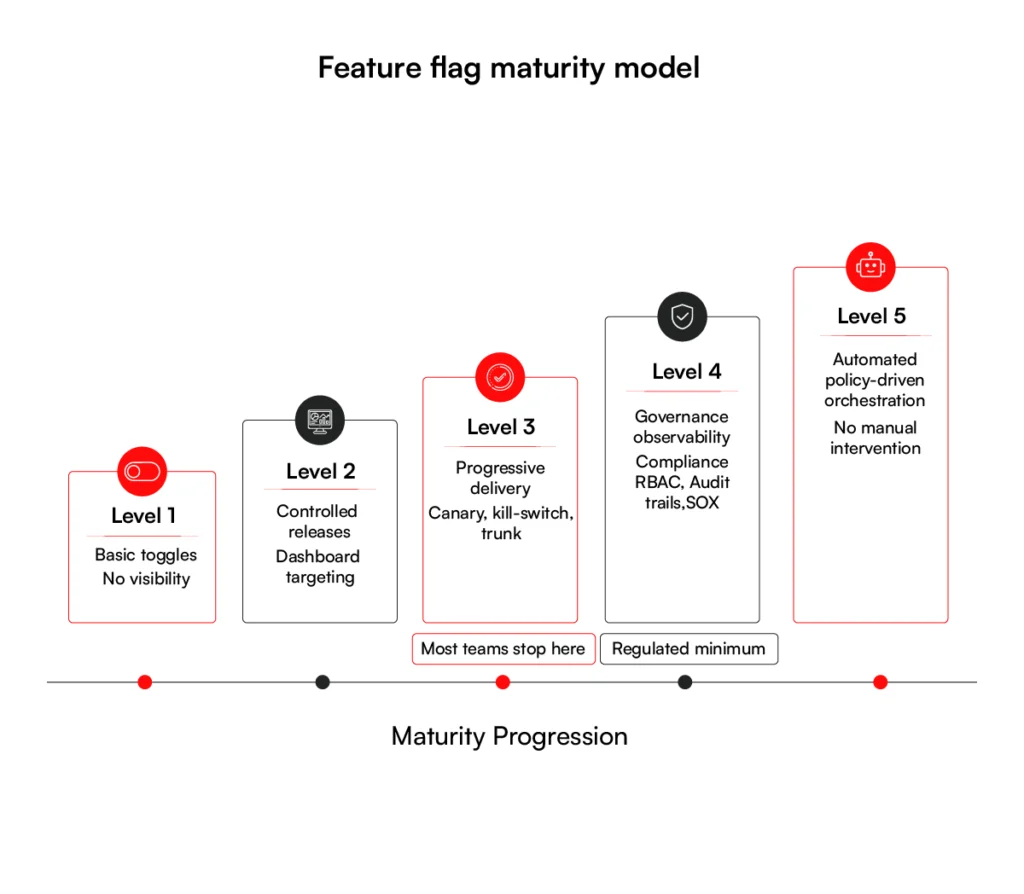
Level 1: Basic Feature Toggles
At this level, feature flags software development is informal. A developer wraps new code in an if/else block, hardcodes a boolean, or reads a value from a config file. There is no dashboard, no targeting, no audit trail. Flags get created when someone needs them and removed, if ever, when someone remembers to clean them up.
This works for a small team shipping infrequently. It breaks down quickly as team size, release cadence, and flag count grow. Nobody knows which flags are active, who owns them, or what turning one off will do to production.
Level 2: Controlled Releases
Teams at this level have moved beyond hardcoded toggles and adopted a structured feature flags platform. Flags live in a central system with a dashboard. Engineers can turn features on or off without a code change or redeployment. Basic targeting by environment, by internal user group, or by a named cohort becomes possible.
Release risk drops measurably here. A flag that goes wrong can be switched off in seconds rather than triggering a rollback and a 2 a.m. incident call. Most teams that reach Level 2 also start defining naming conventions and basic ownership rules, even if enforcement is still informal.
Teams moving from Level 1 to Level 2 will find the flag types and lifecycle guidance in our feature flag management guide useful before building out a full platform.
Level 3: Progressive Delivery
Level 3 is where feature flags based development starts delivering consistent returns. Teams can roll out features to a percentage of users, expand that percentage incrementally, and tie rollout decisions to real production metrics such as error rates, latency, and conversion. A release is no longer a binary event. It is a controlled progression with checkpoints.
Kill-switches become standard practice for any high-risk feature. Canary releases replace big-bang deployments for anything that touches payments, authentication, or core user flows.
This is also where feature flag services trunk-based development practices take hold: all code merges continuously into the main branch, with incomplete work sitting behind a flag rather than isolated in a long-lived branch.
Reaching Level 3 from scratch requires building or configuring an evaluation engine, a streaming layer for real-time flag propagation, environment-level controls, and SDK integrations across the stack. Teams building this independently typically spend several months before the first product team can use any of it reliably.
How long does it take to implement a feature flag solution for enterprise? For most teams building from scratch, the honest answer is longer than expected.
Level 4: Governance, Observability, and Compliance
Level 4 extends the technical capability of Level 3 with the organizational structure to run feature flags software development safely at scale. Role-based access control maps to real team boundaries.
Production flag changes require a second approver. Every change writes to an immutable audit trail that compliance teams can query without raising a support ticket.
Observability is also structural at this level. Flag evaluation events flow into the same monitoring stack as application metrics so the connection between a flag change and a production incident surfaces in seconds. Flag lifecycle management is active: flags have owners, expiry dates, and a defined retirement process.
These are the core elements of feature flag development that separate a governed platform from a collection of unmanaged toggles.
This is the level most regulated enterprises need to reach before feature flag driven development for enterprises can satisfy SOX, SOC 2, or HIPAA audit requirements. Without it, the flag system is a release tool. With it, it becomes a governed release platform.
Level 5: Automated and Policy-Driven Release Orchestration
At this level, release decisions are driven by policy rather than manual judgment. A rollout starts at 5% and progresses automatically as long as error rates, latency, and business metrics stay within defined thresholds.
If a metric breaches its threshold, the rollout pauses or reverses without human intervention. Engineers are notified rather than required to act.
This level is not the right target for every team. The infrastructure investment is significant and the cultural shift of trusting automation to manage production releases requires organizational readiness that takes time to build.
Teams that reach Level 5 have typically been operating at Level 4 long enough that the manual release process has become the bottleneck, not the safety net.
Find Out Where Your Team Sits on the Maturity Model
Share your current setup and we will tell you which level you are at and what it takes to reach the next one.
Book a Free AssessmentCommon Enterprise Mistakes in Feature Flag Adoption
feature flag for software development is easy to start and easy to get wrong. The mistakes creep quietly across teams and codebases until a stale flag triggers the wrong code path, a production change has no audit trail, or a rollback takes longer than it should because nobody wrote down what the flag controls.
- Reused Flag Names: Once a flag is retired, its name should be permanently decommissioned; reusing a name still connected to old code is how a routine deployment activates a code path nobody intended to run.
- Flags as a Security Control: A flag that hides a premium feature on the client side does not protect it, because anyone with basic browser tools can bypass the UI and call your API directly.
- Single-State Testing: Five active flags produce 32 possible state combinations, and a bug that only surfaces when two flags are in a specific configuration will not appear in QA.
- No Naming Conventions: A flag called new_feature_test tells the next engineer nothing about its purpose, its owner, or whether removing it is safe.
- Team-Level Flag Ownership: When a flag is owned by a team rather than a named individual, accountability disappears the moment that team reorganizes or someone moves on.
- Flag Logic Embedded in Business Logic: A function that checks three flags before calculating a price has eight possible states to maintain; flag checks belong behind a clean boundary that the business logic underneath does not need to cross.
- No Fallback Behavior at Creation: Every flag needs a default value set at the point of creation, because a flag service outage with no defined fallback becomes an application outage.
- Flags Without Expiry Dates A flag with no end date accumulates indefinitely as the engineer who created it moves on and the surrounding context evaporates.
- Flag Rollouts Without a Success Metric: A flag change with no connected metric is invisible when something goes wrong, turning a seconds-long correlation into a manual search through deployment logs.
- Production Changes Without Approval: A flag that any engineer can toggle in production without a second approver and a timestamped record gives you a release mechanism with no accountability trail.
How to Choose an Enterprise Feature Management Platform
Most platform decisions look straightforward until the contract renewal arrives or a vendor outage takes down your release process. The criteria below are the ones that determine long-term fit, not just initial capability.
1. Governance Must Be Structurally Enforced
A platform that offers approval workflows engineers can bypass is not a risk control.
Evaluate whether production flag changes require a second approver as a hard gate, whether audit trails are immutable by default, and whether flag ownership is enforced at creation rather than maintained manually.
If any of these are optional configurations rather than platform defaults, treat them as absent for compliance purposes.
2. Evaluate Where Flag Evaluation Runs
SaaS platforms evaluate flags on their own infrastructure, which means user context and targeting attributes leave your environment on every evaluation call. For most organizations this is an acceptable trade-off.
For enterprises in healthcare, financial services, or jurisdictions with data residency requirements, it is a compliance exposure that vendor certifications and contractual terms do not fully resolve.
Self-hosted evaluation keeps all flag data within your own cloud and removes the third-party data processing question from the compliance conversation entirely.
3. Model the Total Cost of Ownership Before Signing
SaaS pricing scales with usage in ways that are not obvious from initial pricing conversations. At enterprise volumes, per-seat fees, evaluation call charges, and environment tiers compound into a number that looks different at renewal than it did at procurement. Get a usage-based projection at your actual evaluation volume before committing.
Self-hosted platforms shift cost to infrastructure and engineering time, both of which are predictable and within your control.
4. Verify OpenFeature Compatibility and SDK Coverage
A feature flags platform development that does not support OpenFeature locks your application code to its proprietary SDK.
As covered earlier in this article, OpenFeature does not solve the full migration problem, but it eliminates the SDK rewrite cost if you ever need to switch providers.
Confirm that the platform maintains active, up-to-date OpenFeature provider support across every language in your stack.
5. Confirm Observability Integration Is Native
A flag platform that does not emit structured evaluation events into your existing monitoring stack requires manual correlation during incidents.
Confirm that flag evaluation events can be routed to your APM and logging infrastructure as a standard integration rather than a custom build.
Vexillo by RBMSoft
Vexillo is RBMSoft‘s self-hosted feature flag platform, built for enterprises that need production-grade flag infrastructure without the months of custom engineering that typically precedes it.
Against the criteria above: Vexillo runs entirely on your own AWS infrastructure using ECS Fargate and CloudFront, so flag evaluation and all user context data stay within your cloud environment.
Flag ownership and naming conventions are enforced at creation. Production changes require approval through a platform-native workflow rather than an external change management tool.
Every change writes to an immutable audit trail queryable by your compliance team without a support request.
Okta SSO integration keeps flag access inside the same identity management system your security team already governs.
On the cost question: Vexillo is built as a reusable engineering accelerator, which means the control plane, SSE streaming layer, multi-region propagation, RBAC model, and audit infrastructure are pre-built rather than custom-scoped. Platform teams get a governed, multi-environment flag platform on their own infrastructure from day one.
OpenFeature provider support and React SDK ship as part of the standard package. Multi-region flag propagation completes in under five seconds via CloudFront.
Checkout Vexillo if you are looking for a feature flag management solution without the SaaS bloat.
FAQs
1. What is feature flag driven development?
Feature flag driven development is a software delivery practice where code ships to production in a disabled state and activates through configuration rather than a new deployment.
Teams use flags to separate the act of deploying code from the decision of releasing a feature, giving product and engineering teams independent control over what users see and when.
2. What is a feature flag in software development?
A feature flag in software development is a conditional gate in your code that controls whether a feature is visible or active for a given user, environment, or traffic segment. Instead of releasing a feature by deploying new code, you release it by changing a configuration value, with no redeployment required.
3. What is a feature flag in CI/CD?
In a CI/CD pipeline, a feature flag allows code to merge and deploy continuously without exposing incomplete or unstable features to users.
The flag keeps new functionality switched off in production until it passes validation, letting teams maintain a fast deployment cadence without tying release decisions to deployment events.
4. What is a feature flag in trunk-based development?
In trunk-based development, feature flags allow all engineers to merge code continuously into the main branch rather than maintaining long-lived feature branches. Incomplete work sits behind a flag rather than in a separate branch, which eliminates merge conflicts and keeps integration continuous.
Feature flag services trunk-based development by making it safe to merge code that is not yet ready for release.
5. How long does it take to implement a feature flag solution for enterprise?
Building best feature flag solutions development for enterprise from scratch typically takes three to six months before the first product team can use it reliably.
That includes the evaluation engine, control plane, streaming layer, RBAC model, and audit trail. Using a pre-built accelerator like Vexillo compresses that timeline to weeks of configuration rather than months of custom build.
6. How much does it cost to develop a feature flag driven solution?
The cost to develop a feature flag driven solution depends on the implementation path. A custom build requires significant engineering investment in infrastructure, governance tooling, and ongoing maintenance. SaaS platforms charge by seat or evaluation volume, which compounds at enterprise scale.
A self-hosted accelerator like Vexillo reduces upfront build cost while keeping infrastructure ownership and data residency inside your own cloud, making it the most cost-effective path for enterprises with compliance requirements.
7. How long does it take to implement a feature flag solution for enterprise?
Building a feature flag solution for enterprise from scratch typically takes three to six months before the first product team can use it reliably. That includes the evaluation engine, control plane, streaming layer, RBAC model, and audit trail. The estimate assumes engineers who have built this before.
Teams starting without that experience run longer. A pre-built accelerator like Vexillo compresses the timeline to weeks of configuration.
8. How much does it cost to develop a feature flag driven solution?
The cost to develop a feature flag driven solution depends on which path you take. A custom build requires engineering investment upfront and ongoing maintenance as the platform scales.
SaaS platforms look cheaper at the start but compound at enterprise evaluation volumes through per-seat fees, environment tiers, and usage charges.
A self-hosted accelerator like Vexillo reduces the build cost, keeps infrastructure inside your own cloud, and removes the data residency exposure SaaS pricing models carry. For enterprises with compliance requirements, the total cost of ownership favours self-hosted from the first renewal cycle.
9. What is feature flag development for ecommerce and why does it matter?
Ecommerce teams run more simultaneous experiments than almost any other engineering environment. Checkout flow changes, pricing tests, product page variants, and promotional features all need to go live independently, roll back instantly if something breaks, and never affect each other mid-test.
Feature flag development for ecommerce handles all of this through deterministic cohort assignment, percentage rollouts, and kill-switches that do not require a redeployment to fire. The cost of a broken checkout at peak traffic makes flags a reliability requirement in ecommerce, not a nice-to-have.
10. How do the best feature flag solutions development teams approach platform selection?
The best feature flag solutions development teams start with governance requirements, not feature lists. They ask whether approval workflows are enforced as hard gates or optional configurations, whether audit trails are immutable by default, and whether flag ownership is required at creation.
A platform that cannot enforce its own controls at the platform level will fail the compliance audit it was meant to support. SDK coverage, OpenFeature compatibility, and observability integrations matter, but none of them compensate for a governance model that engineers can route around.