

Table of Contents
Quick Summary:
- Most projects cost between $50,000 and $300,000. Simple MVPs start at $10,000. Enterprise platforms run $1,000,000+.
- The Clutch 2026 average across verified projects is $132,480 over 13 months.
- Team location moves the number more than almost anything else. US developers bill at $100–$250/hr. Eastern Europe runs $40–$80/hr. India and SE Asia run $20–$50/hr.
- The build cost is only 20–50% of the software’s total cost over its lifetime. Budget 15–20% of the build cost every year for maintenance on top of that.
- Hidden costs most vendors never quote: cloud hosting, legacy integration overruns, scope creep, and compliance audits.
- Compliance is not optional. HIPAA, PCI-DSS, and GDPR each add 20–40% to a base estimate in regulated industries.
- Fixed-price contracts include a 15–30% risk buffer built in. Time and materials often cost less on complex builds.
- ROI is the right metric, not cost. A well-scoped project in the right use case pays for itself in 6–18 months.
- Before signing anything: run a discovery phase, build a 5-year TCO model, and ask every vendor exactly what post-launch support covers.
You ask a vendor for a quote. One comes back at $60,000. Another quotes $180,000. A third wants $400,000. Same project description. Completely different numbers. That gap is not a mistake. It is the result of eight variables most vendors never explain upfront, and most buyers never think to ask about until the invoice arrives.
This guide cuts through that. If you are trying to understand the real cost of custom software development, you will find honest cost ranges by project size, hourly rates by region and role, a phase-by-phase budget breakdown, and the hidden costs that show up after launch but never in the original proposal. By the end, you will have a clear enough picture to evaluate any vendor quote and know whether it is realistic or missing something important.
Industry data consistently shows that most small to mid-sized custom software projects land between $30,000 and $150,000, while enterprise-grade builds routinely exceed $500,000. What moves your number in either direction is what this guide is built to explain.
How Much Does Custom Software Development Cost based on Complexity
Not every software project costs the same. A simple internal tool costs far less than a platform that runs an entire enterprise. The cost factors in custom software development depend almost entirely on what you’re building and who’s building it.
Here’s a fast, honest breakdown.
Small Software Project — $10,000 to $50,000
Timeline: 2 to 4 months
This is the entry-level tier. You’re building one focused tool, not a full platform.
What you get:
- A single module or workflow
- Simple, clean user interface
- Secure single-user access with standard permissions
- Minimal third-party connections
Best for: Startups testing an idea, small businesses automating one process, or teams that need a lightweight internal tool.
Real examples: A basic CRM, a simple appointment booking system, a lightweight admin dashboard, or a basic reporting tool.
Location drives price as much as features at this tier. Offshore and nearshore teams typically deliver the same scope for $10,000 to $15,000. US-based agencies for the same scope start closer to $40,000 to $50,000.
Medium Software Project — $50,000 to $150,000
Timeline: 4 to 9 months
This is the most common tier for growing businesses. Most projects at this level have real moving parts: multiple modules, connected systems, and user roles that need to work together cleanly.
What you get:
- Multi-step workflows
- Analytics dashboards and reporting
- Role-based access for different users
- Integrations with tools you already use
Best For: Growing businesses that are duct-taping five SaaS tools together and want one clean system instead.
Real examples: A SaaS platform, a customer portal, an inventory management tool, or a scheduling and dispatch system.
What adds cost inside this tier:
| Feature | Estimated Cost Addition |
| CRM, ERP, or payment integrations | +$5,000 – $30,000 |
| Analytics dashboards | +$3,000 – $20,000 |
| Automated workflows | +$5,000 – $40,000 |
| Multi-user role system | +$2,000 – $25,000 |
The more connections and user types you add, the more the budget climbs. Get specific about what you actually need before the build starts.
Large Software Project: $150,000 to $300,000
Timeline: 6 to 12+ months
At this level, you are no longer building a tool. You are building a platform that serves multiple teams, user types, or business functions at once.
What you get:
- Advanced features are spread across multiple modules
- Automation that replaces time-consuming manual work
- Machine learning or AI-powered functionality
- Support across web, mobile, and desktop
- Real-time data processing
- Senior engineers, solution architects, and specialized technical roles
Best for: Companies that need a single system to serve multiple departments or customer types.
The price for custom software development at this tier reflects more than just the feature list. You are paying for the engineering depth needed to build something that holds up at scale, handles real traffic, and does not fall apart six months after launch.
Enterprise-Level Project: $300,000 to $1,000,000+
Timeline: 12 to 24+ months
Enterprise software that runs the business, not just supports it. Think of systems that connect finance, HR, operations, and customer data under one roof while serving hundreds or thousands of users at the same time.
What you get:
- ERP-level functionality across departments
- Multi-tenant architecture for multiple divisions or clients on one system
- Deep integrations with legacy systems that the business already relies on
- Advanced security, encryption, and compliance are built into the foundation
- Data governance controls across the entire organization
- Consistent access across web, mobile, and desktop
Best for: Large organizations replacing a patchwork of disconnected tools with one unified system.
The cost of custom enterprise software development is high because the responsibility is high. When something breaks at this scale, it does not slow a user down.
It stops revenue, delays operations, and affects everyone connected to that system. That is why this tier requires the most experienced teams and the most thorough testing before anything goes live.
RBMSoft’s work with Big Lots is a good example of what this tier looks like in practice. Big Lots needed to reinforce its e-commerce foundation and scale operations across its digital channels.
The scope covered multi-channel system stability, high-traffic performance, and consistent customer experience at enterprise scale. That is not a bigger feature list. That is a different category of engineering entirely. And it is priced accordingly.
Cost to Develop Software Solution: Step-by-Step Breakdown:
| Component | Estimated Cost |
| ERP modules (finance, HR, inventory) | $120,000 to $400,000 |
| System integrations | $20,000 to $100,000 |
| Multi-platform access | $50,000 to $200,000 |
| Security and compliance | $30,000 to $150,000 |
One thing to keep in mind: these figures cover the build cost only. They do not include annual maintenance, which typically accounts for 15 to 20% of your build cost each year, cloud hosting fees, or third-party service costs. Those numbers can add up to a significant portion of your total investment over time. We break all of that down in the hidden costs section below.
Not sure what your project needs?
Tell us what you’re building, and we’ll give you a clear, honest cost estimate.
Get Your Free Cost Estimate
Budget Breakdown by Development Phase
Every dollar in a custom software development budget gets allocated across specific phases. Knowing what each phase typically costs helps you spot a vendor quote that is front-loaded, back-loaded, or missing something important.
Here is how a standard software development cost breakdown by complexity looks across the full project lifecycle:
| Development Phase | Typical Budget Share |
| Project Planning | ~10% |
| Architecture and Design | 5% to 10% |
| Engineering and Coding | ~65% |
| QA and Testing | ~20% |
| Deployment and Launch | 1% to 2% |
| Support and Maintenance | 15% to 20% of the build cost per year |
Planning — 10%
This phase covers requirements gathering, feature scoping, user flow design, and the project roadmap. It is the cheapest and most important phase. Decisions made here shape every dollar that gets spent afterward. Rushing it to save time upfront is one of the most reliable ways to blow your budget mid-build.
Architecture and Design — 5% to 10%
This is where the software’s technical structure is defined: how the modules connect, what data structures they use, and what the user interface looks like. Consumer-facing products where experience drives retention should sit closer to the 10% end. Internal tools can usually manage with 5%.
Engineering — 65%
This is where the bulk of the cost of custom software development lives. Backend development accounts for roughly 40% of the total budget, while frontend development accounts for around 25%. This is also the phase where scope changes do the most damage. A feature added during engineering costs significantly more than the same feature scoped during planning.
QA and Testing — 20%
Twenty percent is the industry standard for a reason. Bugs caught during development cost a fraction of what they cost once real users are hitting them in production. This is the phase vendors most often suggest trimming to hit a lower quote, and it is the cut that tends to cost the most in the long run.
Deployment and Launch — 1% to 2%
A small share of the budget, but a phase that still needs proper planning. This covers environment configuration, final testing, and go-live support.
Support and Maintenance — 15% to 20% Per Year
This one sits outside the build budget but needs to be in your financial plan from day one. On a $150,000 project, expect $22,500 to $30,000 per year in ongoing maintenance costs covering security patches, dependency updates, bug fixes, and performance work. New features are scoped and priced separately on top of that.
What this means for you: When you review a vendor quote, map it against these percentages. If QA is under 15% or planning is missing entirely, that is not a deal. That is a budget problem waiting to surface three months into the build.
Software Development Cost Based on Type or Industry
Two projects with identical feature lists can carry very different price tags depending on the industry they are built for. Custom enterprise software development cost in healthcare or fintech can run two to three times higher than the same scope in retail, purely because of compliance and integration requirements.
Compliance requirements, integration complexity, and security standards vary sharply across sectors. Those differences show up directly in the budget. If you want to understand how custom software is applied across these sectors before diving into the numbers, our custom software development breaks down use cases by industry in detail.
| Industry | Estimated Cost Range | Use Cases |
| Healthcare | $75,000 to $250,000+ | Patient portal with appointment booking and HIPAA-compliant medical history access |
| Fintech | $90,000 to $300,000+ | AI-based fraud detection platform with PCI-DSS compliance and real-time transaction monitoring |
| Logistics and Supply Chain | $50,000 to $250,000+ | Custom warehouse management system with real-time inventory tracking and third-party carrier integrations |
| EdTech | $50,000 to $200,000+ | FERPA-compliant LMS with Canvas integration, accessibility support, and student performance tracking |
| Retail and eCommerce | $50,000 to $150,000+ | Custom eCommerce platform with personalized recommendations, inventory management, and ERP integration |
Healthcare — $75,000 to $250,000+
Healthcare software carries one of the highest compliance burdens of any industry. HIPAA requires specific data handling, encryption, audit logging, and access controls built into the architecture from day one. EHR integrations with platforms like Epic or Cerner add significant engineering complexity on top of that.
A mid-sized clinic building a patient portal with appointment booking, medical history access, and HIPAA-compliant data storage typically runs $75,000 to $100,000 at offshore rates. A regional healthcare network connecting a modern intake interface to a legacy EHR system should budget $150,000 to $300,000 and expect to spend a meaningful portion of that timeline on integration work alone.
HIPAA compliance alone adds 20% to 40% to a standard build cost. If your project handles patient data in any form, that percentage is included in the budget from the first line of the estimate.
Fintech — $90,000 to $300,000+
Payment processing, fraud detection, and regulatory compliance make fintech one of the most expensive verticals to build for. PCI-DSS requirements add security protocols, penetration testing, and documented audit trails. AI-based fraud detection layers additional data engineering and model training costs on top of the core platform build.
Fintech developers command a 10% to 20% premium above standard development rates because the domain knowledge required, understanding financial regulations, security standards, and transaction logic, is narrow and in high demand.
Logistics and Supply Chain — $50,000 to $250,000+
Logistics software ranges from straightforward scheduling tools to complex route-optimization and warehouse-management platforms. The wide cost range reflects that gap. A basic scheduling system sits at the lower end. A full warehouse management platform with real-time inventory tracking, fleet management, and API integrations with third-party carriers ranks highly.
A Midwest logistics provider that built a custom warehouse management system at $280,000 eliminated $85,000 in annual licensing fees and avoided $40,000 in planned hardware replacement costs. By year two, the total cost of ownership was 35% lower than the off-the-shelf alternative they had been evaluating.
EdTech — $50,000 to $200,000+
EdTech sits at a unique intersection of user experience, accessibility mandates, and student data privacy. FERPA compliance, COPPA considerations for K-12 products, and WCAG 2.1 AA accessibility standards are non-negotiable for any platform serving educational institutions receiving federal funding.
LMS integrations with Canvas, Blackboard, or PowerSchool add backend complexity. For K-12 platforms, data governance architecture requires careful planning from the start, not as an afterthought. ROI in EdTech is best measured through outcomes, engagement rates, course completion, and learning performance, rather than pure cost savings.
Retail and eCommerce — $50,000 to $150,000+
A standard eCommerce platform with custom logic, inventory management, and ERP integration typically lands at $100,000 to $150,000. Off-the-shelf platforms like Shopify work for straightforward storefronts but break down quickly when businesses need custom pricing rules per customer, complex inventory workflows, or deep integrations with existing systems.
AI-driven recommendation engines and personalization layers push retail builds toward the higher end of the range. The ROI case here is usually direct: a 1% to 2% improvement in conversion rate at meaningful traffic volumes can justify the entire build cost within the first year.
The decisions made at the architecture level before a single line of code gets written determine whether a platform holds up at scale or requires a costly rebuild 18 months after launch. Our ecommerce architecture guide covers how to get those decisions right from the start.
What this means for you: Industry is not just a label on your project. It is a compliance framework, a set of integration requirements, and a security standard that shapes the entire build. Before you compare quotes across vendors, make sure each quote is scoping the same regulatory requirements.
A healthcare quote that omits HIPAA architecture, or a fintech quote that skips penetration testing, is not a cheaper option. It is an incomplete one.
Custom AI Software Development Cost
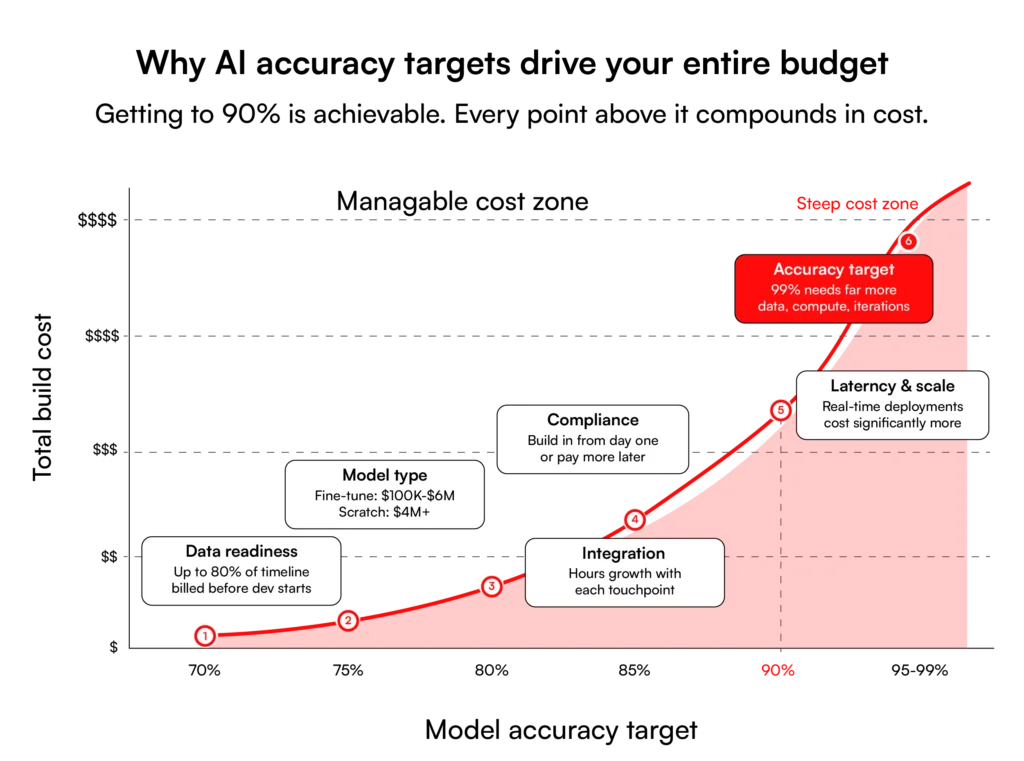
AI features cost more than standard software features. The talent is harder to find, the infrastructure runs heavier, and the data work alone can consume 80% of the project timeline before a single model gets trained. Understanding where those costs come from helps you budget for them accurately, rather than being surprised halfway through the build.
The cost to develop AI software ranges between $50,000 and $200,000,000+, depending on the type of solution you build:
| AI Project Type | Estimated Cost Range |
| AI-powered chatbot | $75,000 to $500,000+ |
| Recommendation engine | $50,000 to $200,000+ |
| Computer vision system | $80,000 to $300,000+ |
| Custom LLM fine-tuning | $100,000 to $6,000,000+ |
| Training a model from scratch | $4,000,000 to $200,000,000+ |
For most businesses, training a model from scratch is not the right starting point. Fine-tuning an existing model on your own data or integrating an off-the-shelf AI solution costs a fraction of the price and often delivers comparable results. The build path you choose drives the budget more than almost any other decision.
AI Specialist Rates in 2026
AI and machine learning engineers sit at the top of the developer rate scale. In the US, senior AI specialists bill at $160 to $250 per hour. Data scientists with production experience run $130 to $200 per hour.
At the offshore level, experienced AI engineers in Eastern Europe and India range from $40 to $90 per hour, depending on the depth of specialization.
These rates are higher than standard software engineers for a reason. The skill set is narrower, demand is growing faster than the talent pool, and mistakes in model design are expensive to undo after training has started.
The 6 Real Drivers of AI Software Development Cost
Before you approve any AI budget, you need to understand what is actually pushing the number up or down. These six factors account for most of the cost variation you will see across AI projects.
1. Data Readiness
Data preparation is where AI projects spend most of their time and money. Collecting, cleaning, labeling, and organizing data before model training begins accounts for up to 80% of the project timeline in many AI builds.
If your data is scattered across systems, incomplete, or unlabeled, that work gets billed before the actual development starts.
2. Model Type: Build, Fine-Tune, or API
Building a model from scratch costs millions. Fine-tuning an existing model on your data costs $100,000 to $6,000,000, depending on scope.
Using an off-the-shelf API like GPT-4o adds per-token usage costs that scale with volume, while keeping upfront development costs low. Choosing the right path for your use case is one of the highest-leverage decisions in AI cost planning.
3. Integration Complexity
Connecting an AI model to existing systems, databases, and workflows adds engineering hours that initial estimates can miss. Search projects have their own cost drivers, including indexing, semantic retrieval, vector databases, permissions, and RAG. Our enterprise search development cost guide breaks those expenses down separately.
4. Latency and Scale Requirements
An AI model that needs to return results in under 200 milliseconds for thousands of concurrent users requires very different infrastructure than one running batch analysis overnight. Real-time, high-scale deployments carry significantly higher infrastructure and engineering costs than async or low-volume implementations.
5. Compliance and Regulatory Requirements
AI systems in healthcare, finance, and legal applications face strict rules around explainability, bias auditing, and data handling. Building compliance into an AI system from the start costs more upfront, but costs far less than retrofitting it after regulators ask questions.
6. Accuracy Requirements
Achieving 90% accuracy with an AI model is relatively achievable. Pushing it to 97% or 99% requires significantly more training data, more compute time, and more iteration cycles. Each percentage point of accuracy above a certain threshold gets progressively more expensive to achieve.
What this means for you: AI development is not a single line item. It is data preparation, model selection, infrastructure, integration, compliance, and ongoing inference costs all running simultaneously. Before committing to a build, get clear on which path fits your use case.
Fine-tuning an existing model almost always delivers better ROI than building from scratch, and make sure your vendor is quoting the total cost of the engagement, not just the development hours.
What Is The Total Cost Of The Software Development Project Based On An Hourly Pricing Model?
Your team’s location is one of the biggest cost levers in any custom software development project. Custom software development cost per hour can range from $20 in India to $250 in the US for the same seniority level, and on a 12-month build, that difference reshapes your entire budget. Over a six- to twelve-month build, that gap compounds into a figure that can reshape your entire budget.
Here is what custom software development rates look like across regions in 2026:
| Region | Typical Hourly Rate |
| USA | $100 to $250/hr |
| Western Europe | $80 to $150/hr |
| Eastern Europe | $40 to $80/hr |
| India and SE Asia | $20 to $50/hr |
Even within the US, rates vary by the team’s location. Agencies in San Francisco and New York run $150 to $250 per hour. Teams in Austin and Denver typically range from $110 to $180. Remote-first US teams generally sit at $100 to $160 and can run 15 to 25% cheaper than teams based in major tech hubs.
Software Developer Hourly Cost: Work Experience, Skills, & Geographical Location
Location is only part of the equation. The role you’re hiring for moves the number just as much. Here’s what different roles cost at the US market rate in 2026:
| Role | US Hourly Rate |
| AI/ML Specialist | $160 to $250/hr |
| Senior Software Engineer | $150 to $220/hr |
| DevOps Engineer | $120 to $180/hr |
| Project Manager | $90 to $160/hr |
| Mid-Level Software Engineer | $100 to $150/hr |
| QA Engineer | $70 to $120/hr |
AI and machine learning specialists sit at the top of the range. Demand for that skill set still outpaces supply by a wide margin in 2026, and the rates reflect it.
Software Development Cost by Locations (In-House vs. Near-Shore vs. Offshore)
Choosing between an in-house team, a fully offshore setup, or a hybrid model is one of the most important decisions in your software development project cost estimation process. The numbers below show why more businesses are moving offshore every year.
| Development Model | Small Project | Medium Project | Large Project |
| Fully US-Based | $80K to $120K | $250K to $400K | $800K to $1.5M |
| Fully Offshore | $30K to $50K | $80K to $150K | $250K to $500K |
| Hybrid Model | $50K to $75K | $150K to $250K | $500K to $900K |
A medium-sized project with a fully offshore team costs $80K to $150K. A US-based team for the same scope runs $250K to $400K. That difference can fund your next product phase or six months of runway.
The risks people associate with offshore are almost always about engagement structure, not location. A vendor with clear contracts, named developer placement, and structured onboarding eliminates most of those problems before the project starts.
Timezone gaps are manageable. Eastern Europe overlaps with US Eastern time for a few hours each day, enough for standups and quick decisions. India and SE Asia run on async, and when the vendor has solid processes, it works well in practice.
What this means for you: The key is not where your team sits. It is whether your vendor has the structure, the communication standards, and the accountability to deliver. Ask the right questions before you sign, and offshore becomes one of the smartest cost decisions you can make.
Want senior engineering talent at 40% to 60% less than US rates?
Our offshore model delivers quality and accountability without the risk of coordination.
See How Our Offshore Model Works8 Factors That Silently Drive Up Your Custom Software Development Cost
Two companies can describe the same project and walk away with quotes that differ by a significant margin, and that gap rarely comes down to chance. It comes down to a specific set of variables that most vendors never fully explain upfront.
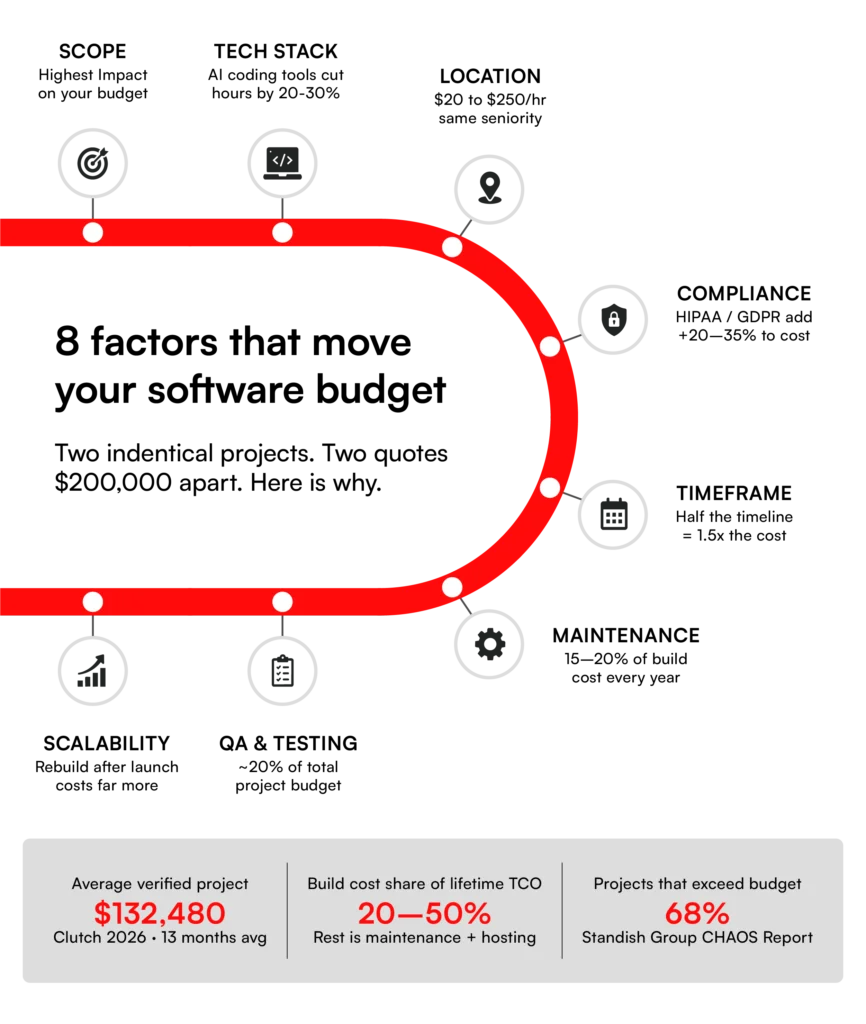
Here are the eight factors that move the needle on custom software development pricing, and what each one actually means for your budget.
1. Project Scope and Complexity
Scope and complexity carry the most weight in determining your final custom software development cost.
Scope covers what you are building: the number of features, user types, screens, and connected systems. Complexity is how difficult those things actually are to build.
A simple reporting tool and a platform that manages inventory, processes orders, integrates with multiple vendors, and supports three user roles can sound similar in the first conversation. Once development starts, they are worlds apart in terms of hours and budget.
Adding features after the build has started makes this worse. That same feature would have cost a fraction of the price if it had been scoped up front.
2. Technology Stack
The tools and programming languages your team builds with affect both what you pay to build the software and what you pay to keep it running afterward.
Technologies with large talent pools, like React, Node.js, and Python, tend to keep rates competitive because there are plenty of developers who know them. Niche or outdated stacks work the other way. Fewer available developers means higher hourly rates and longer hiring timelines.
A few specific things to watch for in 2026:
- Niche enterprise stacks like SAP extensions or legacy Java EE attract fewer developers and command higher rates
- AI and machine learning features built on proprietary models come with API costs that grow as your user volume grows
- Open-source frameworks generally cost less to build on than proprietary licensed platforms
- According to the GoodFirms 2026 survey, 90.6% of development teams now use AI-assisted coding tools like GitHub Copilot, which can reduce development hours on routine tasks by 20 to 30%
3. Development Team Location and Structure
Where your team is located is one of the most controllable cost drivers in your entire software development project cost estimation process.
A senior developer in New York bills at $130 to $210 per hour. The same seniority level in Eastern Europe runs $55 to $95 per hour. In India, $25 to $55 per hour. On a multi-month project with a full team, that rate difference compounds into a number that reshapes your entire budget.
But location is only part of the story. Team structure matters just as much.
| Team Type | What It Means | Cost Impact |
| US-based agency | Highest rates, best time zone alignment | $130 to $250/hr |
| Western Europe | High quality, strong compliance expertise | $90 to $150/hr |
| Eastern Europe | Strong technical base, good English | $40 to $95/hr |
| India / SE Asia | Large talent pool, most cost-competitive | $20 to $55/hr |
| Blended/hybrid team | Mix of onshore leads and offshore developers | 20% to 30% savings vs. fully onshore |
Offshore teams look cheaper on paper, but distributed teams carry hidden coordination costs that most vendors never mention.
Timezone gaps, communication delays, and misunderstood requirements all eat into your timeline. On a 12-month project, plan for 15 to 25% in coordination overhead that will never show up on an invoice but will absolutely show up in your delivery date.
4. Compliance Requirements (HIPAA, GDPR, PCI-DSS)
If your software touches health records, financial data, or personal data from EU users, compliance is not optional. It is a core part of the build, and it carries real cost.
Regulatory compliance requirements like HIPAA, SOC 2, GDPR, and FedRAMP can add 20 to 35% to a base development estimate. Here is what each one actually requires in practice:
- HIPAA for healthcare: specific data handling, encryption, audit logging, and access controls built into the architecture from day one, not bolted on afterward
- PCI-DSS for payment processing: security protocols, penetration testing, and documented audit trails
- GDPR for EU user data: data governance controls, consent management, and right-to-deletion workflows
- SOC 2 for B2B SaaS: a formal audit process that can take 6 to 9 months and cost $30,000 to $100,000 in its first year, before development costs are even counted
HIPAA-compliant software development alone typically costs 20 to 40% more than a standard build.
5. Timeframe
When a client compresses a six-month project into three months, the existing development team does not work faster. More developers are pulled in, which brings more meetings, more code reviews, more coordination, and more room for things to go wrong. As a rough rule, cutting a timeline in half typically increases the total project cost by at least 1.5 times.
Rushing the discovery phase creates a similar problem. Scope misalignment discovered early in development forces rework, wiping out any time saved upfront. Defects that reach production cost 5 to 10 times more to fix than defects caught during development.
6. Maintenance and Support
The industry standard for annual maintenance is 15-20% of your original build cost. On a $200,000 project, that works out to $30,000 to $40,000 every year starting the month after launch. That figure covers bug fixes, security updates, dependency upgrades, and performance improvements. New features are priced separately on top of that.
Software does not stay done on its own. Dependencies become outdated, security patches need to be applied, payment APIs change their behavior, and new operating system versions require updates. None of this is optional. It is simply the ongoing cost of keeping your software functional and secure, and most vendors never bring it up when they quote you the build cost.
7. Testing and Quality Assurance
QA typically accounts for around 20% of the total project budget, and that percentage exists for good reason. A bug caught during development costs a fraction of what it costs to fix once real users are hitting it in production. When set up correctly, automated testing can reduce QA time and costs by up to 20%. Running QA throughout the build rather than only at the end catches problems when they are still cheap to resolve.
8. Customization and Scalability
Scalability means designing the system from the start to handle more traffic, more data, and more users without having to tear out and rebuild the core architecture later. Scalability is partly a design decision. Consumer-facing products where user experience drives retention should allocate 15 to 25% of the total project budget to design from the start. Internal tools can usually get by with 8-15%.
Re-engineering a system for scale after it is already live is one of the most expensive things a business can do. Getting the architecture right at the start costs more upfront but saves significantly over a two to three-year horizon.
Hidden Costs Of Building a Custom Software Solution
Most vendor quotes cover design, engineering, QA, and launch. What they leave out is everything that keeps the software running after it ships. For most businesses, those post-launch costs add up to more than the initial build itself over a three-to-five-year period.
Annual Maintenance — 15% to 20% of Your Build Cost Every Year
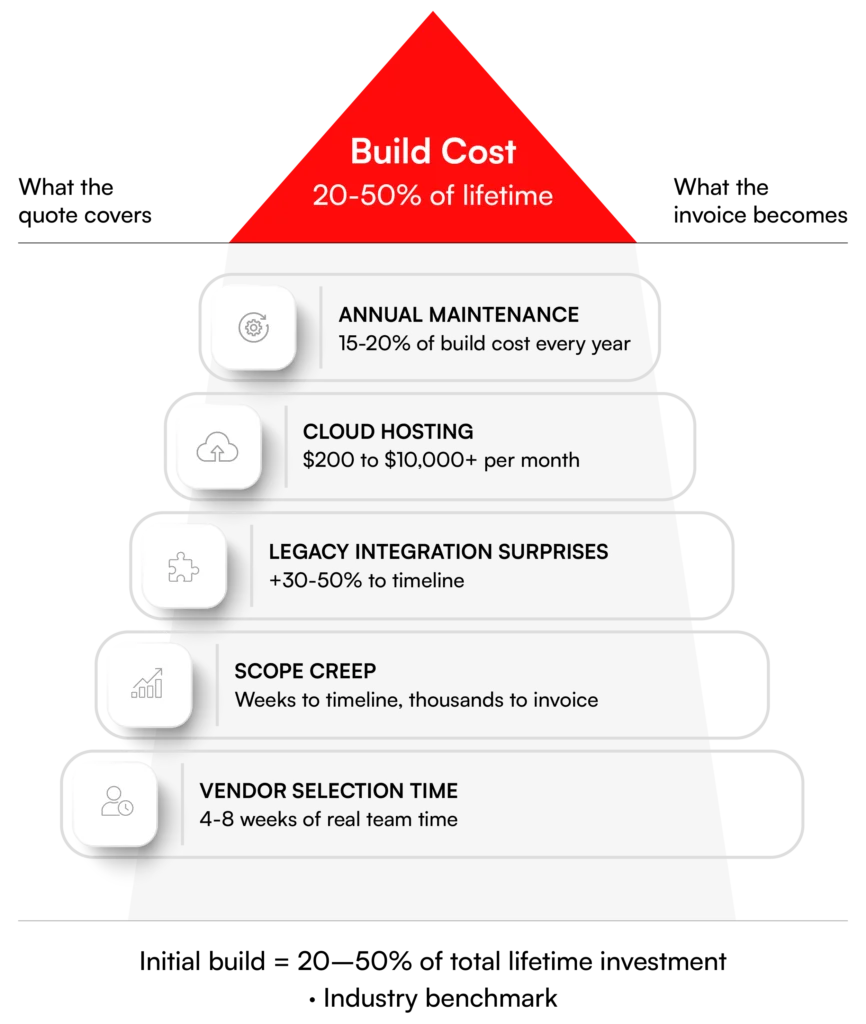
Dependencies go out of date. Security vulnerabilities get discovered. APIs change, and updates break things that worked fine the week before. The industry standard for annual maintenance is 15% to 20% of your original build cost. On a $200,000 project, that is $30,000 to $40,000 every year before a single new feature gets added.
Scope Creep
It starts with one extra report. Then a new user role. Then one more dashboard filter. Each request feels small, but together they add weeks to the timeline and thousands to the invoice. Poorly defined requirements at the start make this worse. Being specific about what ships in version one versus what waits is the cheapest way to stay within your budget.
Cloud Hosting and Server Costs
A small application might run $200 to $500 per month at launch. A platform serving thousands of active users can push $2,000 to $10,000 per month or more. These costs scale with traffic and data, which makes them easy to underestimate early. Budget for them from day one.
Legacy System Integration Surprises
Connecting new software to old databases, ERP platforms, or legacy tools almost always costs more than estimated. Documentation is incomplete. Data formats do not match. Edge cases surface only once development is underway. Integration alone can extend timelines by 30% to 50%. If your project touches anything older than 5 years, build a separate buffer before signing contracts.
RBMSoft’s work with PetMeds shows what this looks like in practice. PetMeds ran their pharmacy platform on Oracle ATG Commerce. Bugs had piled up, prescription fulfillment was slow, and the external veterinary API integrations were breaking the checkout process.
The team could not ship improvements because the foundation could not support them. By the time RBMSoft came in to fix the system, fixing it would have cost significantly more than building it correctly. That is the real price of underestimating integration work. It does not appear in the original quote. It shows up later, when the invoice is far larger than anyone planned.
Third-Party API Usage Fees
Most AI applications rely on external APIs for payments, mapping, data enrichment, or model access, and those costs grow with your user base. What starts as a manageable monthly fee can quietly become a significant recurring expense once the system scales, making it one of the most commonly underestimated line items in any post-launch budget.
Vendor Selection Time
Evaluating vendors, reviewing proposals, checking references, and negotiating contracts takes real time from your internal team. For a mid-sized project, this typically runs four to eight weeks. That time carries a dollar cost even though it never appears on any invoice. Factor it into your total project timeline from the start.
Build Cost vs Lifetime TCO
The build cost gets you to launch. The total cost of ownership covers three to five years of maintenance, hosting, integrations, and new features. Industry data show that the initial build accounts for only 20% to 50% of a software project’s lifetime investment. Judging a vendor purely on build cost is like buying a car based on the sticker price and ignoring five years of running costs.
What this means for you: Add 15% to 20% annually for maintenance, a hosting estimate that scales with growth, and a 20% contingency for scope changes and integration surprises. These are the hidden costs most vendors never put in the proposal. Ask for them specifically before you sign anything.
Calculating ROI Before You Build
Most businesses approve a software budget based solely on the build cost. The smarter approach is to work out what the software needs to return before a single line of code is written. A $200,000 project that saves $80,000 per year pays for itself in 2.5 years and generates pure value thereafter. The same project that generates no measurable return is just an expense.
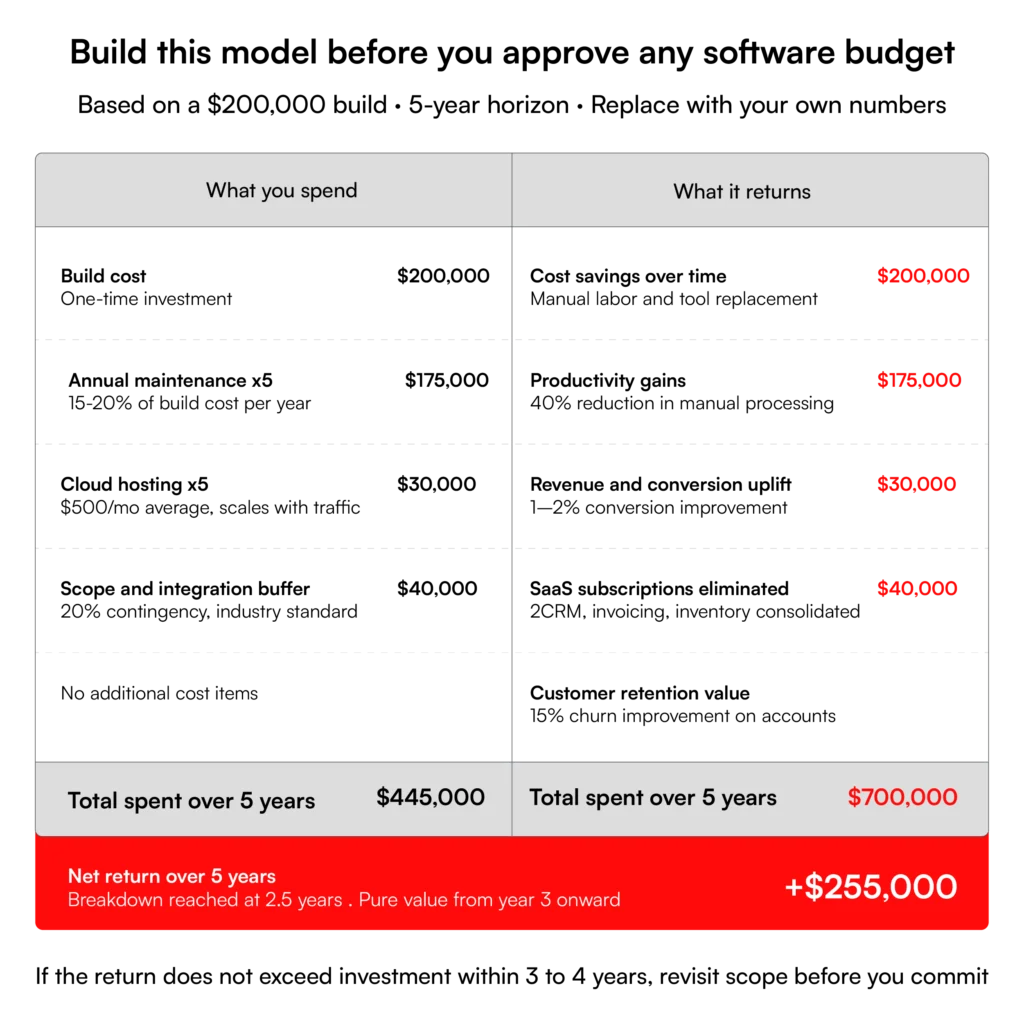
Here is how to think through ROI across the six areas that matter most.
1. Development Cost vs. Savings Over Time
The simplest ROI calculation starts with what the software replaces. Add up the cost of manual labor, inefficient processes, and third-party tools that the new system eliminates. Compare that annual saving against the cost of creating software to find your breakeven point.
A logistics company that replaces multiple outdated tools with a custom tracking system and saves $50,000 per year in software costs and admin labor breaks even on a $150,000 build in three years. Everything after that is margin.
2. Productivity Gains and Operational Efficiency
Custom software built around your actual workflows removes the workarounds your team has learned to live with. Track how much time employees currently spend on the processes the software will handle. Even a 40% reduction in response times or manual processing hours adds up to significant annual savings across a team.
The productivity gains are real, but they need to be measured before and after launch to show up in a credible ROI calculation.
3. Revenue Growth and Customer Acquisition
Better software improves user experience, and better user experience converts more visitors into customers. A retail company that moves to a custom eCommerce platform with personalized recommendations and sees conversion rates climb from 2% to 4% doubles its conversion revenue without spending an extra dollar on traffic.
Map the revenue impact of the features you are building. If better UX, faster checkout, or smarter recommendations are on the roadmap, estimate conservatively what a 1% to 2% conversion improvement is worth at your current traffic volume.
4. Customer Retention and Lifetime Value
Retention improvements tend to generate more long-term value than acquisition gains. A subscription SaaS company that builds a custom dashboard with real-time user insights and improves retention by 15% does not just keep more customers. It increases the lifetime value of every account on the books.
The metrics to track here are churn rate, Net Promoter Score, and average customer lifetime value before and after launch.
5. Reduction in Third-Party Software Costs
Many businesses running on five separate SaaS tools are paying for features they do not use and missing integrations they need. Consolidating a CRM, invoicing system, and inventory tool into a single custom platform, with $30,000 in annual subscription savings, pays back a meaningful portion of the build cost on its own.
List every tool the new software replaces. Add up the annual subscription costs. That number goes directly into your ROI calculation.
6. Maintenance and Scalability Costs
Off-the-shelf software charges you for every seat, every upgrade, and every additional module. Custom software has maintenance costs too, 15% to 20% of the build per year, but it does not charge you per user, and it scales on your terms. As your business grows, a well-architected custom system costs far less to scale than an equivalent SaaS stack.
What this means for you: Before approving any software budget, build a simple five-year model. Put the build cost and annual maintenance on one side. Put annual savings, productivity gains, revenue impact, and subscription eliminations on the other side. If the return does not exceed the investment within three to four years, either the scope needs adjustment, or the business case needs more work before you commit.
Need help defining the scope before you commit?
Let’s talk through your project and build a plan that fits your budget.
Book a Free Discovery CallBest Practices to Optimize Software Development Cost
Most retailers overspend on software development, not because the work is hard, but because the process is broken. Here is how to fix that.
1. Run a proper discovery phase before writing a single line of code
Projects with a defined discovery phase have a 28% higher success rate. Lock your scope, validate feasibility, and document requirements before development starts. Build an MVP first. It gets you to market faster and cuts the cost of rework dramatically.
2. Pick the right engagement model
In-house developers in US tech hubs cost over $200,000 annually. Experienced offshore partners in Eastern Europe run $35 to $75 per hour. In Asia, $15 to $45. The savings are real. But cheap without domain expertise is still expensive. Choose partners who have actually built retail software before.
3. Get your architecture right from day one
The later a bug is found, the more expensive it is to fix. That principle applies to architecture too. A poor architecture decision made in week one can cost ten times more to undo in month six. Go modular. Build for microservices. Address compliance during design, not after launch.
4. Combine Agile, Lean, and DevOps
Agile catches issues early when fixes are cheap. Lean kills features that do not deliver real value. CI/CD pipelines automate builds, reduce deployment errors, and cut rollback costs. Use all three together. None of them work as well on their own.
5. Audit your licenses and cut IT sprawl
Only 47% of SaaS licenses are actively used in any 90-day period according to IBM. The rest is waste. Audit your full technology stack, eliminate redundant systems, and replace proprietary tools with open-source alternatives wherever they meet your security and scalability requirements.
6. Stop wasting cloud budget
More than three quarters of enterprises waste between 21% and 50% of their cloud spend through poor management. Rightsize your instances. Use reserved capacity for predictable workloads. Enable auto-scaling. Set budget alerts. This is not complex. It just requires discipline.
7. Test earlier, not later
A bug that costs $100 to fix during planning can reach $10,000 in production. Involve QA from the requirements stage. Write measurable acceptance criteria before development begins. Automate regression testing from sprint one. Catching issues early is not just good practice. It is the single highest-return cost decision available.
8. Take maintenance seriously
Software maintenance can represent up to 90% of a platform’s total lifecycle costs. Set up monitoring before problems happen. Automate routine tasks. Build self-healing infrastructure. The teams that treat maintenance as an afterthought pay for it later, usually at the worst possible time.
How RBMSoft Assist You in Building Custom Software For Your Business?
What this guide gives you is the context to understand why, and the framework to make better decisions before you commit to anything. Define your scope before talking to vendors. Plan for maintenance, hosting, and integration costs from day one. Match your pricing model to the nature of your project. And evaluate vendors on structure and track record, not just the number at the bottom of the proposal.
At RBMSoft, we bring the expertise and structure to make that process easier:
- End-to-end development ownership across web, mobile, and enterprise platforms so you work with one accountable team from discovery to deployment
- Transparent scoping and estimation that accounts for hidden costs, integration complexity, and long-term maintenance before the project kicks off
- Technology-agnostic approach that matches the right stack to your business needs rather than defaulting to a preferred vendor or framework
- Proven delivery across industries including healthcare, logistics, finance, and SaaS with a track record of on-time, on-budget execution
- Post-launch support and scaling so your software continues to perform as your user base and requirements grow
The build cost is where the investment starts, not where it ends. Custom software development rewards the businesses that planned for the full picture before the first sprint began.
If you are scoping a project and want a realistic cost breakdown, explore our software development services or book a free consultation to help you build that picture before you talk to a single vendor.
FAQs
1. How much does custom software development cost?
The average cost of custom software development ranges from $10,000 for a simple MVP to $1,000,000 or more for a full enterprise platform, with most verified projects landing around $132,480 over 13 months according to Clutch’s 2026 data.
Most growing businesses land between $50,000 and $300,000, depending on scope, team location, compliance requirements, and the number of integrations involved. There is no single number because no two projects have the same requirements.
The fastest way to get a real figure is to define your core features, identify any compliance needs, and get a scoped estimate from a vendor who runs a discovery process before quoting.
2. How long does a software development project usually take based on budget?
Timeline tracks closely with budget because both are driven by the same thing: scope and complexity. Smaller projects in the $10,000 to $50,000 range typically wrap up in two to four months, while mid-range builds between $50,000 and $150,000 generally run four to nine months.
Projects budgeted between $150,000 and $300,000 tend to take six to twelve months, and anything above $300,000 commonly requires twelve to twenty-four months to deliver. These are build timelines only. Discovery, vendor selection, and post-launch stabilization add time on either end.
Rushing a timeline by adding more developers rarely saves calendar time and almost always increases total cost.
3. What are the ongoing costs of custom software development post-launch?
Post-launch costs are where most businesses get surprised. The build cost gets you to go-live. Everything after that is a separate budget line.
The industry standard for annual maintenance runs 15% to 20% of your original build cost per year. On a $200,000 project, that is $30,000 to $40,000 every year covering bug fixes, security patches, dependency updates, and performance work. New features are scoped and priced separately on top of that.
On top of maintenance, plan for cloud hosting ($200 to $10,000 per month depending on traffic), third-party API fees that scale with usage, compliance audit costs if you operate in a regulated industry, and staff training when new features ship. Most vendors quote none of these in the original proposal. Ask for them before you sign anything.
4. Which software development pricing model is best: fixed cost, dedicated team, or time and material?
It depends on how well-defined your requirements are before the build starts.
Fixed price works when scope is stable, requirements are clear, and the project is unlikely to change mid-build. The tradeoff is a 15% to 30% risk buffer baked into the quote and very limited flexibility if priorities shift.
Time and materials works best for mid to large projects where requirements are still evolving or where you are building iteratively. You pay for actual hours worked with no risk premium. The tradeoff is that budget predictability requires strong project management and regular milestone reviews.
Dedicated team works best for long-running products that need continuous development over 12 months or more. You get a full-time team with deep knowledge of your codebase, predictable monthly costs, and the ability to scale headcount up or down based on your roadmap.
For most projects above $100,000, a hybrid approach works well: a fixed-price discovery phase to define scope accurately, followed by time and materials for the build itself.
5. How do software development companies calculate project pricing?
Most vendors start with your feature list and break it into development tasks. Each task gets an hour estimate. Those hours are multiplied by the blended hourly rate of the team, which factors in role types, seniority mix, and location.
Project management overhead adds another 10% to 15% on top of that. Fixed price engagements then add a risk buffer of 15% to 30% to cover scope unknowns.
The formula is straightforward: Total Cost = Development Hours x Hourly Rate + Overhead + Risk Buffer.
What the proposal does not show is how the risk buffer was sized, what assumptions were made about your requirements, or what triggers a change order after signing. Always ask for a task-level breakdown before agreeing to any contract. That is where the real estimate lives.
6. How much does MVP software development cost for startups and enterprises?
For startups, an MVP built to validate one core user journey with an offshore or nearshore team typically runs $15,000 to $75,000 over two to four months.
The goal is the shortest path to a real business outcome, not a scaled-down version of everything you eventually want to build.
For enterprises, an MVP looks different. It usually involves integrating with existing systems, meeting internal security requirements, and supporting a larger user base from day one. Enterprise MVPs commonly run $50,000 to $150,000 and take four to six months, depending on integration complexity.
In both cases, the single biggest cost control lever is scope discipline. Define one primary user journey, ship it, measure adoption, and build from there. Every feature added to an MVP before launch increases cost and delays the feedback that tells you what to build next.
7. Which software development company provides transparent pricing with no hidden costs?
Transparent pricing is about process, not promises. The right vendor runs a paid discovery phase before quoting, provides a task-level cost breakdown in their proposal, uses milestone-based payments tied to delivered work, assigns a dedicated project manager to your account, and includes a clear written policy on what triggers a change order.
When evaluating any vendor, ask these questions directly: What does post-launch maintenance cost and what does it cover? What are the cloud infrastructure costs and who owns them? How are scope changes handled and priced? What is included in QA and what is not? A vendor who cannot answer all four clearly is one whose hidden costs you will find later.
RBMSoft provides scoped estimates based on a structured discovery process, with clear milestone payments and dedicated project management across every engagement.
8. Are fixed-price software development projects really cost-effective?
Less often than they appear. Fixed price contracts include a 15% to 30% contingency buffer that vendors build in to cover scope unknowns. If the project runs smoothly, you have paid for risk that never materialized. If requirements change mid-build, every adjustment triggers a formal change order that adds cost and slows delivery.
Research from the Standish Group found that in many large fixed-price projects, only 42% of originally scoped features were ultimately delivered. The rest of the budget went toward scope that changed, got cut, or was never the right priority in the first place.
Fixed price works well for small, clearly defined projects where scope is stable and the risk of change is low. For anything above $100,000 or with evolving requirements, a time-and-materials or hybrid model almost always delivers better value.
9. What is the average cost of hiring dedicated software developers monthly?
Monthly costs vary significantly by location and seniority level. US-based senior developers typically cost between $15,000 and $25,000 per month, while senior developers in Western Europe run $8,000 to $14,000.
Eastern Europe offers a middle ground at $5,000 to $9,000 per month, and developers in India or Southeast Asia generally range from $2,500 to $5,500. These are fully loaded rates covering salary, benefits, and overhead.
A dedicated team of five developers in Eastern Europe typically runs $20,000 to $45,000 per month, while the same team composition in the US runs $80,000 to $125,000 per month.
Most businesses working with a dedicated team model also factor in a project manager and QA resource, which adds $3,000 to $8,000 per month depending on location.
10. How can I estimate the total software development cost before starting the project?
Start with scope, not with hourly rates. Here is a straightforward process that gives you a reliable estimate before any vendor conversation begins.
First, list every feature you need at launch and separate it from what can wait for version two. Second, identify any compliance requirements such as HIPAA, GDPR, or PCI-DSS, since these add 20% to 35% to a base estimate. Third, decide on your team model: US-based, offshore, or hybrid.
Fourth, invest in a paid discovery engagement with your shortlisted vendor, typically $5,000 to $20,000, which produces a scoped estimate accurate to within 15%.
Fifth, build your five-year TCO: take the build cost, add 15% to 20% per year for maintenance, add your hosting estimate, and add a 20% contingency for scope changes and integration surprises.
The businesses that get the most out of custom software are the ones that did this math before the first sprint began, not after the first invoice arrived.