


Table of Contents
Key Takeaways:
- With 80% of traffic on mobile and customers now shopping via AI agents, ecommerce merchandising is what separates stores that convert from stores that just exist.
- E-commerce merchandising is the art of connecting customers with the right products, simply at the right time.
- It covers every touchpoint, homepage, category pages, product descriptions, search, recommendations, and checkout, working together.
- The three areas where merchandising wins or loses a customer are the homepage, category page, and product detail page. Get these right!
- Good merchandising directly impacts revenue.
- Faster buying journeys, fewer returns, higher order values, smarter inventory movement, and stronger repeat purchase rates are all merchandising outcomes.
- The biggest merchandising challenges are cart abandonment, omnichannel consistency, AI adaptation, and inventory sync.
- When catalog complexity outgrows manual processes, even the best merchandising strategy breaks down.
- RBMSoft’s work with a luxury furniture brand, processing 7 million+ SKUs in under an hour, shows what’s possible when infrastructure finally catches up with ambition.
The ecommerce landscape is no longer shifting; it has fundamentally transformed and moved beyond the screen. In 2025, mobile dominance peaked with 80% of all traffic originating from smartphones.
Now in 2026, consumers are shopping via autonomous AI agents and engaging with brand narratives through virtual avatars on platforms like WhatsApp and TikTok.
With this fundamental transition, technical stability and flawless infrastructure are not enough; you need sophisticated e-commerce merchandising that fuels your engine.
To fix that, you need e-commerce merchandising. And, in this blog, we will talk about it in detail- strategies, best practices, challenges, how to overcome them, future trends, and more. Let’s start from the beginning!
What is E-commerce Merchandising?
Think of e-commerce merchandising as the art of connecting customers with the right products, simply at the right time.
You walk into a store and see products neatly arranged on the shelves, best sellers at eye level, sale signs as soon as you walk in, and everything feels intuitive. That’s e-commerce merchandising, just online instead of a physical store.
At its core, it’s about creating a digital display that attracts customers and making it effortless for them to find what they need, without being salesy, with a completely personalized experience. And e-commerce merchandising solutions help you with exactly that.
This involves everything from how the products are displayed, how they’re described, how they look, and what gets recommended next. The fundamentals include:
- Visually cohesive homepage that instantly reflects your brand
- Smooth navigation with filtering and sorting
- Well-organized product catalog with clear descriptions
- High-quality images and videos that let customers feel the product through a screen
- Checkout process that’s simple, fast, and secure
- Shopping experiences that feel personalized
80% of ecommerce traffic is already on mobile.
Is your merchandising built for it or costing you conversions?
Get a Merchandising Audit
3 Critical Areas to Focus on in E-commerce Merchandising
There are three key spots in your store where merchandising in ecommerce can either win or lose a customer:
- Home Page: Your Shop Window
- Category Page: “Item” Sections in the Store
- Product Page: Item on the Shelf
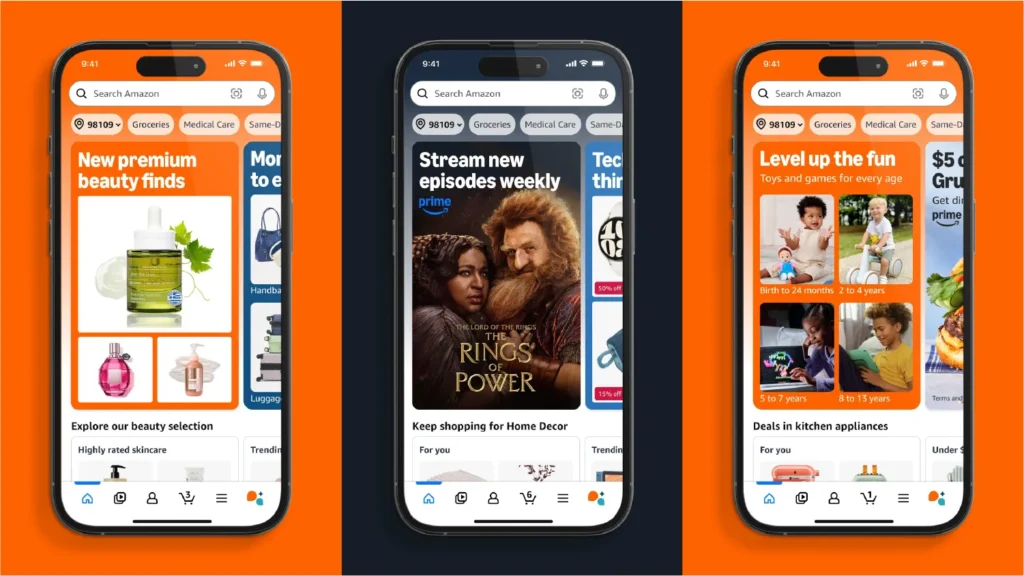
1. Home Page: Your Shop Window
The home page is akin to a physical-store window display, letting people know what types of products you offer, maybe highlighting your latest promotions and trending products, with easy navigation and a prominently placed search box.
2. Category Page: “Item” Sections in the Store
Category pages are like the entrances to the departments in a department store. They’re the place to promote your product lines, point out the best-selling items in a category, and, along with the best sellers, include a menu of filters for attributes such as price, color, and size.

3. Product Page: Item on the Shelf
Product-detail pages are the virtual staging grounds for your individual items, including helpful user-generated content such as product reviews.
Product pages may also be used as landing pages, for instance, if you’ve optimized their site content for search engine optimization (SEO) and someone has found them by searching Google or Bing and clicking straight in.

5 High-Impact Benefits of Ecommerce Merchandising
Merchandising in e-commerce is critical to the success and profitability of an online business. It shows how efficiently your store converts visitors into customers.
Here are some of the high-impact e-commerce merchandising benefits and advantages:
- Faster Buying Process
In a physical store, finding a product takes time, and there’s no guarantee that one will find it in their locality. Online shopping shortens that process and makes it easier.
It allows shoppers to browse through hundreds of products, compare them side-by-side, get offers, make a purchase with just a click, and get home delivery, all without going anywhere.
Product Comparison Table

That’s the speed advantage of digital merchandising in ecommerce. When the products are well-organized, easy to find, and easy to order, the buying process becomes remarkably short, and when buying becomes effortless, people buy frequently.
- Fewer Costly Returns
More than the cost of acquiring customers, the cost of losing them when the shopping experience falls short is the hidden expense most ecommerce businesses don’t see coming.
While running a physical store, the running costs are upfront and visible in rent, repairs, workforce, inventory, etc. But online, the costs show up in returns, wasted ad spend, and slow-moving stocks that never really get sold.
And that’s where e-commerce merchandising directly impacts the bottom line.

When product pages are detailed, with accurate images and clear information, shoppers can easily find what they’re looking for, making confident purchases that lead to fewer returns and lower logistics costs.
- 24/7 Availability
A well-merchandised ecommerce store works 24/7, surfacing the right products, serving up relevant recommendations, and guiding shoppers through the buying process, from anywhere.
Good merchandising goes beyond just being open 24/7; it meets customers exactly where they are, be it on desktop late at night, on mobile during breaks, or on social media mid-scroll.
It adapts to all these entry points, regardless of where or how the customer shows up.

Also, merchandising plays a significant role in building trust, leading to repeat purchases. When the customer reviews and ratings are placed correctly, they do two things simultaneously.
One, they build confidence in first-time buyers, and two, they highlight your best-performing products.
All deals and promotions become even more effective when the merchandising around them is strong, such as a well-placed banner, a relevant recommendation, or a targeted offer.
- No Decision Paralysis
When products are displayed on the website with clear filters and specifications, appealing and well-structured variation displays – different sizes, colors, finishes, price points- customers can evaluate their options easily.

They don’t have to browse through multiple pages; whatever they need is right there, presented clearly. This clarity matters more than most businesses realize.
A well-defined merchandising also gives businesses visibility into this process. Knowing which products are being compared, which variants get clicked most, and where shoppers drop off during browsing gives you the data to refine how products are presented and which ones need to be placed more prominently.
- Smarter Inventory Management
With online trends, a product can go from overlooked to viral overnight. And, your store needs to be set up to respond quickly as the market moves fast.
A well-merchandised ecommerce store is built to adapt to changes, while pushing trending products to the front, updating promotional offers and banners in real time, and surfacing relevant recommendations based on what people are actively looking for right now.
For complex operations, especially in wholesale or enterprise setups, b2b e-commerce merchandising software helps manage large catalogs, demand patterns, and buyer-specific inventory visibility.

When a product goes out of stock, it handles that too. Instead of leaving buyers at a dead end, a “Notify Me” feature keeps them in the loop and signals to the seller exactly where restocking demand exists.
A good merchandising reacts quickly to what’s selling, and also positions your store to capture demand the moment it appears.
Building Your E-commerce Merchandising Strategy
Knowing e-commerce merchandising is one thing. Actually building a strategy around it is another. Here’s where to focus your efforts.
1. Refine Your Product with Brand Integrity
Treat your website as an extension of your brand. From color schemes to fonts, ensure your branding is consistent across all platforms. Inconsistent UI elements create cognitive friction and diminish consumer trust.
From there, focus on the product itself:
- Keep your product catalog organized, with clear and accurate descriptions, high-quality images, and all the relevant information a shopper needs to make a decision
- Optimize your product listing pages for SEO meta titles and descriptions with the right keywords, making your products easier to find, both on your site and through search engines
- Use high-quality photos and videos. 87% of marketers say video marketing has helped them increase sales, and 89% of consumers say watching a video convinced them to buy a product or service
One thing worth noting on video: keep file sizes as small as possible without sacrificing quality. The highest conversion rates happen on pages that load in 0 to 2 seconds; a heavy video file can quietly cost you sales.
2. Prioritize Your Home Page
First impressions matter, and your home page is where they’re made. When a customer lands on your website for the first time, they’re looking to answer a few quick questions: What’s this brand about? Do I trust it? Is this what I need here? Your homepage needs to answer all of that, fast.
Place your most generous offers at the top of the page where they’re most visible. If you offer free shipping, say so upfront; more than half of shoppers are willing to spend between $25 and $50 in a single transaction just to qualify for it.

Don’t overlook navigation and search either. Customers often come in with specific needs. Letting them filter and sort by price, size, color, or brand means they can narrow things down quickly and get to the right product without frustration.
3. Real-Time Inventory Management
Nobody likes adding something to their cart only to find out at checkout that it’s out of stock. It’s one of the most friction-filled moments in the entire shopping experience.
Real-time inventory management removes that frustration entirely. When customers can see what’s actually available as they browse, they make more informed decisions, and you avoid the awkward surprise at the end. It also helps you manage stock levels more effectively behind the scenes.
4. Cross-Selling and Upselling
Cross-selling and upselling are two of the most reliable strategies in ecommerce merchandising, and when done well, they don’t feel like selling at all. They feel like helpful suggestions.
- Cross-selling is about recommending complementary products that naturally go with what a customer is already buying. If someone’s purchasing a smartphone, suggesting a case or a pair of wireless earbuds is a natural fit; it adds value to their purchase rather than pushing something unrelated.

- Upselling is about guiding customers toward a better version of what they’re already considering. If a shopper is looking at a standard laptop, pointing them toward a model with more storage or a faster processor, and helping them see why it’s worth the extra spend, is upselling done right?

- Dynamic bundles take this a step further. If a customer adds a face wash to their cart, a brand might offer a moisturizer and serum as a discounted set, turning a single-item purchase into a complete skincare routine.
Dynamic Bundles
When these techniques are executed well, they increase average order value significantly and make the shopping experience feel more personalized and intuitive.
5. Merchandising During Sales Periods
Sales periods, such as Black Friday and Cyber Monday, are some of the biggest opportunities in the ecommerce calendar. But they only pay off if your merchandising strategy is ready for them.
The goal during these windows is to create a sense of urgency and excitement while making it as easy as possible for customers to find and buy the best deals.
That means prominently featuring discounted products, making sure they’re front and center on category pages and in search results.
It also means removing or demoting out-of-stock items. Nothing kills the momentum of a sales browse faster than hitting a dead end.

One smart approach: curate dedicated shoppable landing pages for your sale items. Organize them by price point “up to 40% off”, for example, or by category. This creates a focused, easy-to-navigate destination that keeps shoppers engaged rather than searching.
Merchandising during sales periods can also help with inventory management. Strategically promoting products with high stock levels helps move stubborn inventory before it becomes a problem.
6. Visual Merchandising
In a physical store, customers can pick up a product, feel its weight, and try it on. Online, you don’t have that luxury, which is exactly why visual merchandising matters so much.
High-quality images are non-negotiable, but the type of imagery matters too. Flat-lay shots provide a clean, detailed product view. On-model images provide context and help shoppers picture how something looks in real life.

For brands selling apparel or beauty products, using on-model images that represent a wide range of body types and ethnicities builds trust and makes more customers feel seen.
User-generated content from social media is another powerful layer, 87% of marketers say UGC is a more authentic way to represent diversity. And authenticity builds trust.
Virtual try-ons are taking this a step further. Allowing customers to see how products look on them digitally, whether it’s clothing, makeup, or accessories can reduce uncertainty and help them make more confident decisions.
Beyond imagery, strategically placed banners, intentional color schemes, and thoughtful page layouts can guide a shopper’s eye toward key products, making the entire browsing experience feel more intentional and less overwhelming.
7. Optimizing for Mobile
Mobile commerce is no longer a secondary channel; it’s the primary one. With m-commerce expected to make up 62% of all retail sales by 2027, how your store performs on a smaller screen isn’t optional.
This starts with a responsive design that adapts cleanly to different screen sizes, clear images, legible text, and navigation that doesn’t require zooming or excessive scrolling.
But mobile optimization goes deeper than layout:
- Simplify the checkout process for mobile users
- Offer mobile-friendly payment options
- Optimize images for faster loading on mobile connections
- Consider a downloadable app and give customers a reason to use it exclusive discounts or free shipping incentives work well
- Offer one-click, no-account checkout to reduce drop-off at the final hurdle
The key is consistency.
Whether a customer shops on desktop, mobile, or through your app, the experience should feel equally smooth and polished.
8. Leveraging Reviews and Returns Data
Customer reviews and returns data are two of the most underused tools in ecommerce merchandising and they can make a real difference to both conversions and return rates. Promote the products that customers love, and quietly move the underperformers to the background. In practice, that looks like:
- Boosting visibility for items above a certain star rating with a solid number of positive reviews
- Demoting products that consistently receive lower ratings or have limited feedback
- Promoting items with a low return rate a strong signal of quality and customer satisfaction
- Pulling back on products with a high return rate to reduce the chance of disappointing new shoppers
When well-reviewed, low-return products are front and center, shoppers are more likely to find something they’ll love, which means fewer returns and higher long-term satisfaction.
9. Product Kits and Collection-Based Products
Grouping products together is one of the oldest tricks in merchandising and it works just as well online as it does in a physical store.
There are two main approaches:
- Featured products are curated based on factors like previous browsing behavior, seasonal relevance, current promotions, or stock levels. If you have a large amount of Christmas-related inventory to move before the holidays, placing those items in a featured section gives them extra visibility without feeling forced.

- Collections go a step further by setting customers in a particular context, one that makes the products feel like a natural part of a lifestyle or moment. Think of a “smart casual” clothing collection with images of office workers wearing the full look, or a cocktail dress collection shot against a festive backdrop.
- The goal isn’t just to show the product. It’s to make the customer want to feel the way the person in the image feels and buy accordingly.
Your catalog is growing; your systems should, too.
We build scalable ecommerce infrastructure that powers modern merchandising.
Explore Ecommerce IT Services
Ecommerce Merchandising Trends To Watch Out For
Strategies that worked two years ago are already being replaced. If you look at the rise of social storefronts to AI agents making purchasing decisions on behalf of shoppers, the forces reshaping merchandising are already here.
So, here are a few new trends in ecommerce merchandising that businesses need to watch out for!
1. Localized and fast delivery options
Localized and fast delivery options are reshaping the logistics field by utilizing distribution centers and advanced strategies so that businesses can:
- Cut shipping times and costs
- Boost sustainability
- Improve operational efficiency
- Enhance customer satisfaction with speedy deliveries

This approach aims to meet the increasing consumer demand for fast delivery, driven by expectations set by industry giants like Amazon.
Technological advancements in logistics software and the growth of e-commerce have further supported this shift, making it easier for businesses to manage local deliveries and tackle last-mile delivery challenges.
When paired with ecommerce merchandising best practices, it benefits both your bottom line and customer loyalty.
2. Social Commerce Expansion
In 2026, social commerce emerged as a defining trend, transforming platforms like Instagram and TikTok into direct sales channels. With a staggering 47% of social media users open to purchasing directly through these platforms, the opportunity for businesses like yours is immense.

Leading brands are successfully setting up storefronts on Instagram, allowing their followers to seamlessly shop their products without leaving the app.
When you embrace social commerce, you can tap into a plethora of audiences actively engaging with your brand. This makes it convenient for your customers to discover, explore, and purchase your products within the social media platforms they frequent daily. This improves customer experience and can boost sales and brand loyalty.
3. AI-Driven Personalization
Gone are the days of broad-spectrum marketing and generic displays. AI-driven personalization enables your business to tailor the following aspects based on each customer’s unique profile:
- Personalized product recommendations: Ensure customers see items they’re most likely to be interested in.
- Messaging: Craft communication that resonates personally with each recipient.
- Special offers: Design deals that appeal directly to individual preferences.

As the e-commerce competition intensifies, personalization technology is essential to differentiate yourself from the competition and build solid customer loyalty.
To achieve this, leverage machine learning through eCommerce personalization software to sift through customer data like:
- Purchase history
- Browsing behavior
- Customer feedback and reviews
- Social media interaction
- Demographic information
- Device and channel preference
[See how AI and Big Data power ecommerce personalization]
4. Virtual influencers

Virtual influencers are staking their claim, with brands like IKEA and Calvin Klein hiring these virtual models for creative ad campaigns.
In the same vein, you’ve got companies like Meta, hoping to push the envelope with AI chatbots, even buying the rights to model AI characters after cultural icons like Tom Brady and Kendall Jenner.
“Once you are digitized, you are immortalized,” says Cameron Wilson, CEO of The Diigitals and the creator of Shudu, the world’s first digital supermodel.
Challenges of E-Commerce Merchandising and How to Overcome Them
With rising customer expectations come new challenges. Even the best merchandising strategy runs into roadblocks. Here are the most common ones and what to do about them.
1. Struggling to Deliver Consistent Omnichannel Buying Experiences
The average customer engages with a brand across 10 different channels. That means your merchandising can’t live in isolation on your website; it needs to be consistent across every touchpoint, whether a customer is shopping on mobile, desktop, in-store, or through a social platform.
Discrepancies in branding, product information, or experience across channels confuse shoppers and quietly erode their trust.
Meanwhile, platforms like TikTok, Instagram, and WhatsApp are becoming storefronts in their own right, and a product can go from a 15-second video to a completed checkout without the customer ever visiting your website.
How to fix it: Ensure that your branding, product presentation, and shopping experience are consistent no matter where a customer interacts with you. Prioritize mobile optimization and ensure your product pages and checkout flows perform just as smoothly on a smaller screen as they do on desktop.
2. High Cart Abandonment Rates
Cart abandonment remains one of the biggest challenges in e-commerce. Customers frequently add items to their cart and then leave, often because of unexpected shipping costs, a complicated checkout process, or simply losing momentum.
Slow-loading pages, compulsory registrations, and repetitive payment requests are among the most common culprits. When any of these friction points appear at the wrong moment, the purchase is lost.
How to fix it: Simplify the checkout process with fewer steps, clear calls to action, and multiple payment options go a long way. Implement exit-intent prompts and personalized retargeting to bring shoppers back, and be upfront about shipping costs early in the journey so there are no surprises at the end.
3. Inventory and Fulfillment Falling Out of Sync
Nobody likes adding something to their cart only to find out at checkout that it’s out of stock. Real-time inventory management is essential not just for the customer experience, but for the operational side of the business too.
Global supply chain disruptions and inventory management issues continue to pose challenges, and maintaining optimal stock levels while avoiding both overstocking and stockouts requires smarter, more connected systems.
When inventory data and fulfillment aren’t in sync, the cracks show up exactly where you don’t want them to, at the point of purchase.
How to fix it: Utilize real-time inventory tracking so customers can see what’s available as they browse. Pair this with AI-powered demand forecasting to better align stock levels with actual customer demand, reducing both costly overstock and frustrating stockouts.
4. Keeping Up with Complex Regulations and Data Security
Ecommerce businesses handle sensitive customer data every day, including payment details, personal information, and browsing history. A single breach can tank customer trust and trigger serious legal consequences.
At the same time, with the introduction of data privacy laws like GDPR and CCPA, keeping up with ever-changing regulations is becoming increasingly complex.
Non-compliance doesn’t just result in fines; it damages the brand credibility you’ve worked hard to build.
How to fix it: Start with the basics: secure hosting, HTTPS, and PCI-compliant payment processing. Be transparent with customers about what data you collect and why, make your privacy policy easy to find, and conduct regular system audits. Staying ahead of regulations is far less costly than reacting to a breach after the fact.
5. Meeting Sustainability Demands
Customers, particularly millennials and Gen Z, are increasingly conscious of how their purchases affect the environment, and they’re making buying decisions accordingly.
Brands that don’t prioritize sustainability risk losing loyal customers who expect more than just a good product.
This isn’t just about offering eco-friendly products; it extends to packaging, sourcing, manufacturing practices, and how transparently a brand communicates all of the above.
How to fix it: Use your product pages and brand storytelling to highlight sustainable materials, fair trade practices, and your company’s environmental commitments.
Complete the circle by giving customers guidance on the responsible disposal or recycling of products. This builds trust and keeps the values-driven relationship alive beyond the point of purchase.
5. Difficulty Adapting to AI Agents
In 2026, customers are shopping through AI agents, handing off purchasing decisions to tools that find, compare, and buy on their behalf. AI influencers and virtual avatars are becoming a new layer of brand storytelling.
At the same time, voice search is growing, and customers expect brands to anticipate their needs, complete search queries automatically, and deliver personalized experiences in real time.
Failure to adapt to these shifts means missing out on entire segments of how modern customers discover and buy products.
How to fix it: Optimize your product listings and site content for natural language and conversational search queries.
Integrate AI-driven product recommendations and automate personalization so that every shopper’s journey from landing page to checkout adapts in real time to their behavior and preferences, with or without a human merchandiser manually driving every decision.
How to Optimize an Ecommerce Store with Merchandising Best Practices
Attracting traffic is okay, but turning that traffic into actual purchases is the real deal. It depends on how well your merchandising is set up.
This set of ecommerce merchandising best practices is for ecommerce businesses looking to improve how their store performs across the entire shopping journey.
1. Use AI To Automate Your Workflow
Today’s businesses are turning to AI automation to alleviate their workload, address their biggest roadblocks, and ensure their success during peak season.
By adhering to the 80/20 principle, businesses can efficiently utilize search and merchandising technology for 80% of their tasks while dedicating the remaining 20% to activities that demand human expertise.
Merging insightful analytics with the invaluable human perspective enables merchandisers to conserve time, budget, and workforce resources. This approach not only leads to remarkable outcomes but also prepares the company for potential economic downturns.
In essence, businesses can concentrate on tasks that require their unique attention and automate the rest with AI, like natural language processing (NLP) and machine learning (ML), to create a balanced and effective strategy.
2. Leverage Helpful Content Where and When You Ca
Leveraging helpful content in your e-commerce merchandising strategy ultimately helps your customers’ decision-making process.
It’s not uncommon to hear stories of customers feeling overwhelmed by the number of choices available to them (perhaps you’ve even been there yourself), so providing relevant, informative, and engaging content on your e-commerce website is essential.
This empowers your prospects (and returning customers) to make a confident purchase decision.
The types of content you offer can take various forms, of course. Think of detailed product descriptions, how-to guides, or blog posts that address common questions and concerns.
When customers feel supported and educated by the content provided, they’re more likely to return to your website for future purchases, recommend your brand to others, and engage with your company through social media and other channels.
This trust in your brand and its credibility will go a long way when it comes to your business’s bottom line.
3. Smart Site Search Functionality
Smart site search functionality is crucial to any e-commerce merchandising strategy as it significantly improves the overall shopping experience and will encourage customers to buy with your brand.
For those who come to your e-commerce site with a specific product in mind, an intelligent, AI-powered search bar allows them to quickly and easily locate their desired items.
By delivering accurate, relevant, and personalized search results, retailers can streamline the shopping process, reduce frustration, and increase the likelihood of customers making a purchase.
Like curated collections, site search can also help shoppers discover other products they might not have initially considered, fostering the idea of exploration and additional purchases.
These shopping experiences are made possible through data-fueled insights into customer behavior and preferences, which e-commerce software like Bloomreach can provide through our customer data engine (CDE).
Customer data ingestion happens on your website and/or mobile app, point of sale (POS), in-store interactions, loyalty program, CRM, and more to create a single marketing view of your customer to personalize and optimize the search experience.
This is crucial if ecommerce retailers hope to cultivate customer loyalty, encourage repeat purchases, and drive short- and long-term business growth.
4. Less searching, more showing with Recommendations
For your customers, the best shopping experiences are easy and enjoyable. They don’t involve too much clicking or scrambling around to find the right products.

Just like how a salesperson might help you find the right shoe size while you’re shopping in stores, you can connect your online shoppers with the right products in various ways. As ideas:
- On your homepage, feature the best-selling, highest-rated, or newest product above the fold.
- On your category pages, prominently display subcategories, filters, and sort bars that help shoppers quickly narrow their options and avoid choice paralysis.
- On your product pages, offer product comparisons or ways to style your product, so buyers don’t have to look elsewhere for inspiration and/or validation. Also, show crucial product details, such as size charts, care instructions, fit details, and more.
- On your checkout pages, recommend add-ons or other products that are frequently purchased with the products in a visitor’s shopping cart.
You can also assist customers through things like autocomplete or auto-suggestions in the search bar, or through pop-up promotions and more.
5. Off-Site Techniques
Your work doesn’t end when a shopper exits your site. Rather, every touchpoint should be optimized for engagement, from the moment customers land on your homepage to the moment they leave.
No matter if a shopper leaves with or without a purchase, follow up with tailored emails, engaging blogs, creative social media posts, retargeting ads, and more. Aim to provide real value as opposed to simply shoving your products in people’s faces.
This can be done by offering thoughtful discounts and promotions. You can even set up a loyalty program, where buyers are incentivized to continue engaging with your brand.
Frequent shoppers can expect special discounts every time they refer another shopper. Or, they can rack up points by ordering a product, following the brand on Instagram, or celebrating their birthday.
How RBMSoft Turned Weeks of Manual Merchandising Work Into Under an Hour
Ecommerce Merchandising often feels like an endless cycle of spreadsheets, manual mappings, and last-minute fixes, which are challenging for a growing retailer to address without leveraging IT services for ecommerce from professional partners like RBMSoft.
80% Less Merchandising Effort for Luxury Brand
A leading luxury furniture company whose merchandising had been built on a legacy platform that worked fine when the catalog was smaller. But as product lines expanded, the cracks became impossible to ignore.
- New collections were consistently launching late because every product required its SKUs to be mapped by hand, a process that took weeks when a seasonal launch involved thousands of new combinations.
- Products were appearing on the storefront with incorrect options and missing swatches.
And the merchandising team?
They were spending the vast majority of their time on manual data entry, leaving almost no time for strategy, product presentation, or promotional planning. The team was trapped doing work that should have been automated years ago.
What RBMSoft Built?
RBMSoft’s approach wasn’t to patch the existing system or layer automation on top of a broken foundation. Our end-to-end ecommerce solutions development expertise facilitate them with a merchandising automation engine, designed specifically for the scale, complexity, and business rules of the client’s catalog.
We have created a customized, stand-alone tool to facilitate the company’s SKU assortment, lowering merchandising efforts.
The results:
- 7 million+ SKU mappings generated per bulk run
- Full catalog processed in under an hour, which previously took weeks
- Zero manual mapping required for routine catalog updates
- Errors caught before deployment, not after customers find them
- Real-time incremental updates so the catalog stays accurate as product data changes throughout the day
The most meaningful shift was in how the merchandising team now operates. Previously consumed by data entry and troubleshooting, they now function as a strategic unit using real-time catalog intelligence to make decisions rather than chasing spreadsheet errors.
Ecommerce merchandising isn’t a one-time setup. It’s an ongoing practice that touches every corner of your store, from your homepage to your checkout flow, from your product descriptions to your inventory strategy.
The brands winning online aren’t usually focusing on bigger catalogs or increasing ad budgets. They are working on making it effortless for the right customer to find the right product at the right moment and then get out of the way.
That’s what great merchandising does. And now you have the roadmap to build it. If you are also looking for merchandising solutions that streamline your ecommerce operations and significantly reduce manual effort, connect with our experts now.
FAQs
1. What is ecommerce merchandising?
Ecommerce merchandising is the art of connecting customers with the right products, simply at the right time. It’s about creating a digital display that attracts customers and making it effortless for them to find what they need, without being salesy, with a completely personalized experience.
This involves everything from how the products are displayed, how they’re described, how they look, and what gets recommended next.
2. What is the role of personalization in merchandising?
Personalization makes merchandising more relevant for each shopper. Instead of showing the same products to everyone, it uses data like browsing behavior, purchase history, and preferences to tailor recommendations, offers, and content.
This reduces decision fatigue, improves engagement, and increases the chances of conversion and repeat purchases.
3. What are the key strategies in ecommerce merchandising?
Some of the most effective ecommerce merchandising strategies include focusing on the areas that directly impact how customers browse and buy.
Optimize your homepage, category pages, and product pages with high-quality visuals and detailed product descriptions, and enable smart search, filters, and sorting so customers can find products quickly.
Also consider implementing cross-selling, upselling, and product bundles to increase order value, leveraging reviews and returns data to promote high-performing products, personalizing recommendations using AI and customer data, and ensuring real-time inventory visibility with a smooth, frictionless checkout experience.
4. How much does it cost to implement ecommerce digital merchandising?
For small to mid-sized businesses, basic setup using existing ecommerce platforms and plugins can range from $5,000 to $25,000.
For larger or enterprise-level businesses with advanced personalization, AI-driven recommendations, and custom integrations, costs can range from $30,000 to $150,000+. Ongoing costs may include tools, maintenance, analytics, and optimization efforts.
5. How long does it take to implement ecommerce digital merchandising?
A basic merchandising setup with standard features can take 2 to 6 weeks.
For more advanced implementations that involve custom design, AI personalization, integrations, and large product catalogs, it can take 2 to 4 months or more.
Continuous optimization and testing are ongoing, as merchandising is not a one-time setup but an evolving process.


