


Quick Summary:
- Retail digital transformation fails when it stays at the level of tools, dashboards, and disconnected pilots instead of changing how the business actually operates.
- Successful programs treat transformation as an operating model shift across cloud, commerce architecture, integration, data platforms, AI, and connected store systems.
- Real impact comes from aligning system speed to decision speed using real time, near real time, intraday, and batch where each makes business sense.
- Enterprise architecture is the foundation. Composable digital platforms scale better than monolithic systems and reduce long term integration risk.
- Real world case studies show measurable gains in revenue growth, margin protection, inventory efficiency, and service levels when transformation is tied to execution, not reporting.
- ROI becomes predictable when leaders model benefits around revenue lift, margin leakage reduction, working capital release, and decision cycle compression.
- Governance and operating ownership matter more than tools. Clear decision rights and outcome ownership determine whether transformation compounds or stalls.
- RBMSoft’s execution approach focuses on building durable digital operating capability that survives vendor changes and scales across channels.
Most retail digital transformation case studies are read like vendor marketing. Meanwhile, transformation programs continue to miss ROI targets by 40% or more. Enterprise retail leaders face a deeper problem.
The gap between strategy and execution gets filled with technical debt, organizational resistance, and platforms that deliver insights too late to change outcomes.
The real challenge is not whether to transform. It is about building digital platforms and operating capabilities that change how retail businesses run day-to-day. Not isolated reporting layers that describe what already happened.
At RBMSoft, we help enterprise retailers modernize their core digital foundation across cloud platforms, commerce architecture, data systems, AI, and connected operations so they can compress decision cycles, protect margins, and reduce inventory risk without ripping and replacing their entire technology stack.
This requires understanding a principle most transformation programs ignore. Right-time data matters more than real-time data. A markdown decision does not need to happen in seconds. It needs to happen at the right moment in the product lifecycle, with the right supporting intelligence.
A store labour schedule does not need real-time updates. It needs an intraday refresh aligned to foot traffic patterns and conversion windows. Confusing speed with value is how transformation budgets get swallowed up by infrastructure that solves the wrong problem.
This blog examines ten retail digital transformation case studies and use cases drawn from enterprise deployments, not pilot programs. It explains the architectural choices, organizational trade-offs, and measured business outcomes that distinguish successful transformations from costly failures.
It also addresses the core challenges that kill transformation momentum, including legacy integration costs, data governance failures, and vendor lock-in.
For CEOs, CTOs, and CDOs evaluating transformation investments, this is a practical decision guide. It explains what works at scale, what the trade-offs look like, and how to estimate ROI based on your current architecture and operating maturity.
Stop Losing 40% of Your ROI
Secure your custom feasibility assessment now to leapfrog competitors still stuck in the pilot phase.
Get in Touch
Why retail digital transformation case studies matter for enterprise decision makers
Executive leaders are usually overwhelmed by success stories and starved for action blueprints. The worth of a case study, as your text indicates, is not what you write on, but how and at what price. The following is an analysis of why these case studies are relevant and how to filter them to have an impact on enterprises.
Vanity Transformation Moving Beyond
The majority of the digital programs are successful on paper but never transform the business. In order to prevent this, seek case studies with the following priorities:
- Revenue Impact: Does the shift really cause a move in the needle on the top line, or is it a shiny new interface?
- Protection of Margin: Does the technology cause a low-margin retail world to lower COGS or labor expenses?
- Less time to make a decision: The end result. When your data is real-time and takes you a week to get your approval, then your transformation has not succeeded.
The Hidden Success Factors
Beneficial case studies should not only be as superficial as the press statement. They should reveal the areas of friction that are being experienced by enterprise leaders:
- Architecture Choices: Was it a monolithic approach to architecture or a composable approach based on micro-services? Why?
- Trade-offs in Data: You can never have it all. Was it the speed of data (latency) that was important to them or the accuracy of data (consistency)?
- Execution Constraints: What did they do about the old systems or employees who were resistant to change?
Identifying Quiet Failure
A program may become operational and remain an unsuccessful one if the subsequent symptoms remain:
- Workarounds: If employees continue to use manual spreadsheets instead of the new 10M platform, the system is broken.
- Embedded Risk: If the new digital service introduces complexity, the core business becomes fragile.
- High Latency: Tools are implemented, but business speed is not improved.
RBMSoft Lens: Reality of the Delivery
It is not to do the homework of another brand but to learn how they do it.
- Context over Content: What was working with a boutique brand is likely to shatter a global enterprise.
- Workflow Integrity: The optimal change does not break the records and processes that turn the lights on.
- Actionable Patterns: Find patterns that can resolve particular bottlenecks in your hierarchy and supply chain.
How RBMSoft Frames Digital Transformation in Retail as an Operating System Decision?
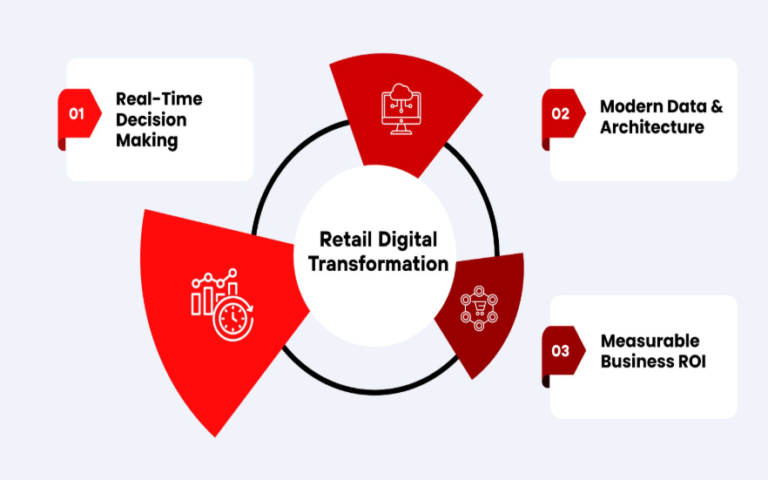
Retail digital transformation fails when it is treated as a technology refresh or a reporting upgrade. Enterprise leaders care about how fast decisions move, how much operating risk is removed, and how reliably teams can execute across channels.
RBMSoft frames digital transformation in retail as an operating-system decision because platforms, data flows, and governance models directly shape how the business runs day-to-day.
Architecture choices are business decisions here. Data freshness is an operating constraint. Integration patterns determine whether frontline teams can act without waiting on analysts.
RBMSoft approaches retail digital transformation case study patterns as operating blueprints that can be adapted to the enterprise context rather than copied as surface-level features.
Aligning digital systems and data flow to real retail decision cycles
Speed without purpose increases cost and fragility across the entire digital operating model, not just in analytics pipelines. Real time means seconds. Near real-time means 1 to 5 minutes. Intraday means 5 to 30 minutes. Batch means daily or weekly.
RBMSoft designs digital operating models so systems, integrations, automation layers, and decision workflows align with the minimum speed required to change outcomes.
Fraud prevention and checkout orchestration require real-time orchestration across commerce platforms, payment systems, and risk engines.
Inventory availability, order promise, and fulfillment routing benefit from near-real-time integration among OMS, WMS, and carrier platforms. Store execution, workforce scheduling, and replenishment coordination often perform best on intraday updates across store systems and cloud services.
Merchandising performance, assortment strategy, and supplier negotiations operate effectively on batch synchronization across planning and supplier platforms.
This framing prevents over-engineering across cloud infrastructure, integration layers, and automation workflows while protecting decision speed where it actually drives business value.
From Digital Visibility Layers to Outcome-Driven Operating Platforms
Most retail transformation efforts stop at surface-level visibility. Dashboards show what happened, but cloud platforms, commerce systems, and store technology continue to operate in silos. What’s missing here is an execution layer, where decisions translate into actions, and that is why AI agents for retail are being deployed.
Read More:
RBMSoft builds operating platforms that integrate cloud infrastructure, headless commerce, data systems, AI services, and connected store operations into a single execution layer tied to measurable outcomes, not isolated reporting views.
This changes platform design. Digital capabilities are built around decisions and actions such as replenish now, reprice now, reroute now, intervene now, or hold. Integration flows, automation services, orchestration logic, and governance models are shaped by decision owners and frontline operators, not by reporting teams alone.
When platforms are designed around decision and execution flows, retail digital transformation moves from passive visibility to active operational control across channels and functions.

Enterprise Architecture Patterns Behind Successful Digital Transformation in Retail
Modern retail leaders are investing in data platforms and architectural frameworks because fragmented systems and siloed data directly slow decisions, inflate costs, and increase operating risk.
According to Gartner, 91% of retail IT leaders plan to adopt artificial intelligence, which cannot be delivered without modern architecture that supports scalable data access and analytics across domains.
Enterprise architecture is the bridge between strategy and execution. It aligns business ambitions with dependable systems, enables coherent integration between channels, and provides a unified framework for ongoing change factors that distinguish successful from stagnated programs.
Modern Retail Digital Platform Reference Architecture
A modern retail digital platform is not a single tool or a data stack. It is an enterprise architecture pattern that integrates cloud infrastructure, commerce platforms, store systems, IoT, integration layers, data services, and AI into a single operating fabric.
The goal is not reporting. The goal is to make execution faster, safer, and more coordinated across channels.
Key architectural layers typically include:
- Digital integration layer connecting POS, e-commerce, OMS, WMS, ERP, supplier systems, store devices, and IoT streams using APIs and event streams.
- Cloud platform layer providing scalable compute, storage, security, and identity for digital services and core retail workloads.
- An operational data and event layer that standardizes customer, product, order, inventory, and event flows for real-time, near-real-time, intraday, and batch decisioning.
- An automation and AI services layer that powers fraud prevention, demand sensing, pricing, fulfillment orchestration, and store execution.
- Experience and execution layer, including headless commerce, mobile apps, store systems, partner portals, and associate tools.
This architecture moves enterprises away from monolithic applications and siloed integrations toward modular platforms that can evolve without breaking core operations. It improves resilience, reduces integration bottlenecks, and enables faster rollout of new digital capabilities across channels.
Real-world implementations of modular digital platforms show improvements in scalability, faster delivery of new capabilities, and lower long-term integration costs because services can evolve independently rather than through large-scale system rewrites.
Composable Architecture Trade-Offs in Retail Digital Transformation
Retail digital transformation is not something enterprises buy as a single platform. It is assembled through architectural choices across cloud infrastructure, commerce systems, integration layers, data services, AI, and store technology.
The real trade-offs leaders face are about how much they build, how much they compose from existing capabilities, and how they govern the whole system.
Enterprise leaders typically face two realistic paths:
Build core digital capabilities in-house:
This provides control over operating models, integrations, and decision logic. It enables differentiation in areas such as pricing, fulfillment orchestration, and customer experience. The trade-off is higher upfront investment, deeper technical talent requirements, and longer time to first value.
Compose from cloud, commerce, and data services with enterprise-owned orchestration
This approach uses existing cloud platforms, commerce engines, integration tools, and AI services, while RBMSoft provides AI integration solutions to design the operating architecture, data contracts, and orchestration layer that connects them. It balances faster implementation with long-term flexibility while reducing fragmentation across systems.
The right choice depends on where differentiation matters most, the maturity of existing platforms, and the enterprise’s ability to operate complex digital systems over time.
Leaders should evaluate the total cost of ownership across people, platforms, integration complexity, and operational risk, not just initial implementation cost.
Comparison table: legacy retail architecture vs modern data platform architecture
| Dimension | Legacy Architecture | Modern Data Platform Architecture |
| Data Integration | Siloed ETL, manual reconciliation | Automated ELT/streaming, unified governance |
| Scalability | Constrained by on-prem hardware | Elastic cloud scaling |
| Data Freshness | Daily batch or manual sync | Real, near real, intraday at scale |
| Analytic Flexibility | Limited to predefined reports | Self-service analytics, AI/ML support |
| Operational Impact | Reports past state | Drives operational decisions |
| Total Cost of Ownership | High due to custom maintenance | Lower marginal cost with shared services |
This comparison illustrates why legacy architectures often fail to deliver on the promise of digital transformation in retail: they were designed to reconstruct history rather than orchestrate future actions. Modern architectures enable operational control, rapid experimentation on use cases, and consistent delivery of value across channels.
For example, retailers adopting modern data platforms report improvements in analytics performance and reduced data operations costs as they centralize governance and streamline integration, a marked improvement over legacy patterns that created fragmentation and redundancy.
RBMSoft provides retail software development services to modernize legacy systems and connect POS, ERP, OMS, WMS, ecommerce, and data platforms. We build the custom software and integrations needed to support digital transformation across retail operations.
10 Successful Case Studies of Digital Transformation in Retail
Digital transformation is no longer a far-off dream for modern retailers but a survival requirement. Whether deploying Agentic AI to forecast the demand of a specific neighborhood or leveraging Augmented Reality (AR) to convert a living room into a virtual fitting room, the industry is being radically reinvented.
With the onset of 2026, it has become more about operational excellence rather than the innovation theatre (glitzy but standalone tech pilots).
The most successful retailers are those that have consolidated their data so that they can offer a frictionless experience to the omniconsumer, in which the switch between a mobile app and a physical aisle does not happen.
The case studies below point out 10 industry leaders, including global companies such as Walmart and IKEA and experience-based ones such as Sephora and Nike, who have succeeded in managing this complexity.
All these illustrations prove that strategic investments in AI, cloud infrastructure, and immersive technology can drive tangible growth, reduce operational drag, and create customer loyalty that endures over time.
Case Study 1: Walmart
How Walmart Rebuilt Its Operating Model Through Digital Transformation
Walmart’s transformation is a practical example of what happens when a legacy retailer treats digital as an operating system rather than a side project. Instead of focusing only on front-end ecommerce features, Walmart invested heavily in the systems that run merchandising, logistics, fulfillment, and customer experience at scale.
The company modernized its supply chain to support faster inventory turns, broader assortment, and more responsive replenishment. This allowed Walmart to expand product availability while protecting margins in a price-sensitive market.
The acquisition of Jet.com accelerated Walmart’s ecommerce capabilities and strengthened its position among urban, mobile-first shoppers who had historically been outside its core customer base.
Key elements of Walmart’s digital transformation included:
Supply chain digitization across sourcing and merchandising
Walmart implemented supplier data platforms to standardize product content, improve catalog accuracy, and shorten the time required to onboard new inventory. This reduced friction between suppliers and merchandising teams while enabling faster online listing and replenishment cycles.
AI-driven logistics and last-mile optimization:
Machine learning models were applied to delivery routing, fulfillment planning, and demand forecasting. These capabilities improved delivery speed and reliability while lowering cost per order across large geographic footprints.
Connected store and digital commerce experiences:
In-store and online data streams were unified to support personalized offers and consistent pricing logic across channels. This allowed Walmart to treat customers as a single audience rather than as separate online and offline segments.
Enterprise data platform and analytics foundation:
Walmart invested in large-scale data platforms that consolidated operational, customer, and supply chain data into shared analytics environments. This enabled faster insight cycles for pricing, inventory allocation, and promotion performance.
Blockchain-enabled supply chain traceability:
Distributed ledger technology was introduced to improve transparency and trust across suppliers and third-party logistics partners. This improved auditability, compliance, and the speed of issue resolution when supply chain discrepancies occurred.
Business impact
By modernizing its core operating systems, Walmart protected its leadership in physical retail while scaling its digital commerce model. The organization did not treat ecommerce growth as a threat to stores. Instead, it designed a hybrid operating model in which physical and digital channels reinforce one another.
This allowed Walmart to remain competitive with digital-native retailers while expanding its relevance among younger, urban customer segments.
Architect Your Foundation for Agentic Commerce/h6>
Real transformation is not in UI skin; it’s a data-ready core. Explore how our Oracle ATG extensions turned Big Lots into a high-velocity, agent-ready ecosystem.
Read Full Case StudyCase Study 2: Nike
How Nike Extended Its Brand Into Digital Experiences While Modernizing Its Supply Chain
Nike has long differentiated itself through brand-led experiences, not just product distribution. As consumer engagement shifted toward digital-first environments, Nike expanded its transformation agenda beyond ecommerce into immersive experiences and operational modernization.
The objective was twofold. Deepen brand connection with younger, digital native consumers while building a faster, more adaptive fulfillment and manufacturing ecosystem.
Nike’s move into virtual environments was not treated as a marketing stunt. It was positioned as an extension of the brand experience layer that sits atop its commerce and supply chain platforms. This allowed Nike to experiment with new engagement models without fragmenting its core operations.
Key components of Nike’s digital transformation included:
Immersive digital brand environments:
Nike launched Nikeland as a virtual experience layer that lets customers explore the brand, interact with digital products, and participate in gamified activities. This environment created a new engagement channel that complements physical retail and ecommerce rather than replacing them.
Automation across fulfillment and warehouse operations:
Nike introduced collaborative robotics across sorting, packaging, and material handling workflows. These systems increased throughput consistency while reducing manual handling constraints during peak demand cycles.
Demand sensing linked to inventory orchestration:
Nike connected near-real-time demand signals with inventory allocation and fulfillment planning systems. This allowed the company to rebalance inventory more quickly during seasonal peaks, materially increasing order processing capacity during high-volume periods, such as holiday sales.
AI-driven personalization across commerce and engagement channels:
Machine learning models were applied to product discovery, recommendation, offer targeting, and delivery planning. This improved conversion rates, reduced friction in the purchase journey, and increased the relevance of promotions for repeat customers.
Business impact
Nike’s transformation strengthened both the emotional and operational sides of the brand. On the customer side, immersive digital experiences created new touchpoints, increasing engagement and time spent with the brand.
On the operational side, automation and demand-driven planning increased fulfillment capacity and improved service levels during peak demand periods.
Together, these changes allowed Nike to scale digital revenue without overloading its physical supply chain, while reinforcing loyalty among high-value customer segments.
Case Study 3: Disney
How Disney Built a Direct-to-Consumer Platform While Experimenting With Immersive Storytelling
Disney’s entry into streaming marked a strategic shift in how the company owns its relationship with customers. Launching Disney+ in a crowded market required more than content. It required rebuilding distribution, identity, data, and monetization layers that had historically been controlled by third-party platforms and broadcasters.
The scale of adoption validated the bet and created a direct feedback loop between audience behavior and content strategy.
In parallel, Disney began exploring how storytelling itself could evolve in immersive digital environments. This was not framed as replacing film or theme parks, but as extending intellectual property into new experience formats that sit atop its existing media and commerce ecosystem.
Key components of Disney’s digital transformation included:
Direct-to-consumer streaming as a core operating platform:
Disney+ became the primary channel for owning subscriber relationships, usage data, and content performance insights. This shifted Disney from a content licensor to a platform operator with direct control over distribution economics and customer experience.
Immersive storytelling using VR and AR:
Virtual and augmented reality experiences were introduced to extend Disney’s franchises into interactive formats. These experiences created new ways for fans to engage with characters and worlds outside traditional screen-based consumption.
Digital collectibles and blockchain-based ownership models:
Disney experimented with limited-edition digital assets tied to its intellectual property. These initiatives explored new monetization and engagement models while testing how scarcity and ownership translate into digital environments.
Business impact
Disney’s transformation repositioned the company as a direct-to-consumer platform rather than only a content studio and theme park operator.
Streaming created recurring revenue streams and direct audience insight at global scale. Immersive and blockchain-based experiments positioned Disney to learn early in emerging experience models without committing core revenue streams to immature technologies.
This balanced approach allowed Disney to protect its core franchises while building optionality for future digital engagement formats.
Case Study 4: Under Armour
How Under Armour Used Fitness Data To Build A Direct Relationship With Athletes
Under Armour’s transformation strategy extended beyond selling apparel and footwear. The company made a deliberate move into digital fitness platforms to build a data-rich relationship with consumers outside traditional retail touchpoints.
Acquiring fitness applications allowed Under Armour to observe real-world training behavior, activity patterns, and lifestyle signals that most apparel brands never see.
This shift reframed Under Armour from a product manufacturer into a data-enabled fitness ecosystem. The objective was not just engagement. It was to create a feedback loop between how people train, what they buy, and how products are designed and marketed.
Key components of Under Armour’s digital transformation included:
Consumer data acquisition through connected fitness platforms:
By acquiring large-scale fitness apps, Under Armour gained access to longitudinal behavioral data across workouts, routines, and health goals. This data was used to identify regional and demographic patterns in activity levels and fitness preferences ahead of competitors.
Community-driven engagement platforms:
Under Armour built digital communities where users could share training plans, progress, and product preferences. These platforms increased retention and created social reinforcement loops that kept users connected to the brand outside purchase moments.
Personalized product and subscription experiences:
Advanced analytics were applied to segment users by behavior and intent, enabling targeted offers and subscription-based product programs. This shifted revenue from one-time purchases toward recurring relationships with high-engagement customers.
Enterprise data infrastructure and privacy controls:
Under Armour invested in centralized data platforms to support large-scale analytics while maintaining governance and privacy standards for consumer data. This created a foundation for cross-channel personalization without exposing sensitive user information.
Agile product development across digital teams:
The organization adopted agile delivery models to shorten release cycles for digital products and iterate faster based on user feedback and performance data. This reduced the time to value for new features and improvements across fitness and commerce platforms.
Business impact
Under Armour increased customer lifetime value by building ongoing engagement loops rather than relying only on transactional retail interactions. The company improved trend detection through behavioral data, enabling faster response to emerging fitness patterns and regional demand shifts.
By connecting product strategy to real usage data, Under Armour strengthened relevance in a crowded athletic apparel market while creating a platform for future digital revenue models.
Case Study 5: Ikea
How IKEA Rebuilt Its Customer Journey and Fulfillment Model for Digital First Retail
IKEA’s business was built around physical discovery. The in-store journey, room sets, and guided pathways were central to how customers explored products and made purchase decisions.
When physical access collapsed during the pandemic, IKEA was forced to accelerate a transformation that had previously moved at a measured pace.
This shift went beyond launching ecommerce features. It required reworking how customers discover products, how orders are fulfilled, and how data flows across the organization.
Rather than abandoning its people-first culture, IKEA reframed digital as a means of extending the in-store experience into the home.
The goal was to preserve the brand’s experiential DNA while modernizing the operating model that supports customer engagement and fulfillment at scale.
Key components of IKEA’s digital transformation included:
Customer analytics as a decision layer:
IKEA expanded its customer data capabilities to better understand browsing behavior, intent signals, and purchase pathways across digital channels. This insight informed merchandising, content design, and service capacity planning.
Spatial visualization through AR and VR experiences:
3D product visualization tools allowed customers to place virtual furniture inside their own living spaces using mobile devices. This reduced uncertainty about large-ticket purchases and improved conversion rates for complex categories such as sofas and storage systems.
Digital first service interactions:
Features such as in-app shopping, self-service checkout, and digital assistance expanded IKEA’s ability to serve customers when stores were closed or operating at limited capacity. This shifted a large share of service demand to scalable digital channels.
Supply chain modernization and fulfillment orchestration:
IKEA invested in modern internal applications to break down legacy data silos across logistics, warehousing, and fulfillment. This enabled more accurate inventory visibility, improved delivery planning, and faster response to demand spikes across regions.
Business impact
IKEA achieved a step change in ecommerce penetration within a short period, shifting a material share of revenue to digital channels. More importantly, the company rebuilt its customer journey to work in both physical and digital environments.
By modernizing internal systems alongside customer-facing experiences, IKEA avoided the common trap of scaling demand without upgrading fulfillment and service capacity. This created a more resilient operating model capable of absorbing future disruptions.
Case Study 6: Home Depot
How Home Depot Unified Digital Commerce With Service-Based Retail
Home Depot’s growth strategy evolved as customer expectations shifted from pure DIY purchasing toward end-to-end project completion. Customers increasingly wanted not just tools and materials, but also professional installation and service coordination.
This required Home Depot to rethink how digital commerce connects with physical stores, field services, and partner networks.
Rather than treating ecommerce as a separate channel, Home Depot reframed digital as the primary orchestration layer for customer journeys that span product discovery, purchase, scheduling, and service fulfillment.
This integration allowed customers to move seamlessly between online planning and in-store execution without fragmenting the experience.
Key components of Home Depot’s digital transformation included:
Replatforming customer-facing digital experiences
Home Depot modernized its web and mobile platforms to support complex purchase journeys that encompass product selection, service selection, scheduling, and order tracking. This reduced friction for customers who prefer to plan and transact digitally before engaging with physical stores or service partners.
Service-enabled e-commerce for project-based purchasing
Digital channels were expanded to support full-service installation for categories such as appliances, flooring, and home improvement projects. This positioned Home Depot to capture demand from customers who value convenience and professional execution over DIY workflows.
Omnichannel operating model and workforce enablement
Store associates and service teams were trained to operate within a unified commerce and service platform. This ensured consistent pricing, availability, and customer context across online and offline interactions, reducing handoff failures between channels.
Business impact
By modernizing before external disruption forced change, Home Depot entered the pandemic with an operating model capable of absorbing rapid shifts in digital demand. The company saw a sharp increase in digital revenue as customers moved online to plan, purchase, and schedule services.
More importantly, Home Depot built a durable omnichannel service model that connects ecommerce growth with store operations and field services rather than creating competing channels.
Case Study 7: Nespresso
How Nespresso Built A Direct To Consumer Experience Through Personalization And Omnichannel Commerce
Nespresso’s brand promise extends beyond selling coffee pods. The company positions itself as a curated coffee experience with ongoing relationships rather than one-time transactions. To support this model at scale, Nespresso invested in digital capabilities that allow it to understand individual preferences, manage recurring demand, and serve customers consistently across channels.
This shift required moving from campaign-based marketing toward data-driven relationship management. Digital channels became the primary interface for ordering, service, and ongoing engagement, while physical boutiques evolved into experience and support touchpoints within a broader omnichannel model.
Key components of Nespresso’s digital transformation included:
Customer data as the foundation for personalization:
Nespresso expanded its data capture across purchase history, preferences, and usage patterns. This enabled targeted communication, replenishment reminders, and tailored offers aligned to individual consumption behavior.
Digitized ordering and supply chain orchestration:
Digital channels were used to streamline ordering, fulfillment, and distribution workflows. This improved order accuracy, delivery speed, and visibility across the end-to-end supply chain.
Unified omnichannel engagement model:
Customers could interact with Nespresso through mobile apps, web platforms, messaging channels, and physical boutiques without losing context. This reduced friction between channels and increased repeat purchase rates by making reordering effortless.
Business impact
By building a data-driven, direct-to-consumer operating model, Nespresso strengthened customer loyalty and increased repeat purchase frequency.
The brand shifted from episodic transactions to ongoing relationships supported by personalized communication and frictionless reordering. This translated into higher customer satisfaction and more predictable revenue flows.
Case Study 8: Tesco
How Tesco Scaled Digital Fulfillment And Supply Chain Intelligence Under Crisis Conditions
Tesco operates at a national infrastructure scale, where disruptions in demand and supply ripple across millions of households. When the pandemic accelerated online grocery adoption and disrupted supplier networks simultaneously, Tesco faced two pressures at once.
Explosive growth in digital orders and reduced predictability across sourcing and logistics. The response required rapid modernization of supply chain intelligence and customer-facing digital platforms, not incremental ecommerce enhancements.
Rather than treating the surge in online orders as a temporary spike, Tesco used the disruption to harden its digital operating model across planning, forecasting, and fulfillment.
Key components of Tesco’s digital transformation included:
Modernized ERP and supply chain visibility:
Tesco upgraded core planning and inventory systems to improve real-time visibility across suppliers, distribution centers, and stores. This enabled faster identification of stockouts, bottlenecks, and replenishment risks during demand surges.
AI-driven demand forecasting with IoT signals:
Predictive models combined historical sales with sensor and operational data to detect shifts in buying patterns earlier. This allowed planners to reallocate inventory and adjust replenishment strategies before shortages became visible to customers.
Customer app and digital experience modernization:
Tesco invested in its digital commerce platforms to support higher order volumes while improving personalization and service reliability. Enhanced data capture improved recommendations, substitutions, and delivery-slot planning under constrained-capacity conditions.
Business impact
Tesco improved supply chain visibility and planning accuracy during a period of extreme volatility. Digital forecasting and operational intelligence allowed the organization to stabilize fulfillment capacity while serving a rapidly expanding online customer base.
By strengthening core planning systems alongside customer-facing channels, Tesco avoided scaling demand on top of brittle infrastructure and emerged with a more resilient digital grocery operating model.
Case Study 9: Woolworths
How Woolworths Built A Marketplace Operating Model On Top Of Its Core Retail Platform
Woolworths’ core strength has historically been first-party retail across grocery, pharmacy, and household essentials. To expand assortment without carrying incremental inventory risk, the company launched a third-party marketplace that extends its product catalog into adjacent categories.
This move required Woolworths to shift from a pure retailer operating model to a platform model that orchestrates third-party sellers, logistics partners, and customer experience within a single digital layer.
Launching a marketplace is not a front-end exercise. It requires deep integration between seller onboarding, catalog management, order orchestration, payments, fulfillment coordination, and customer service workflows. Woolworths treated this as an operating model change rather than a website feature.
Key components of Woolworths’ digital transformation included:
Marketplace orchestration layer integrated with core retail systems
Woolworths deployed a marketplace operator platform that connects third-party sellers to its existing commerce, payments, and customer service systems. This allowed the company to expand its assortment while maintaining a consistent customer experience and brand control.
Modernized commerce applications to support multi-seller workflows
Customer-facing apps and internal tools were upgraded to handle seller-specific product data, delivery timelines, and fulfillment status. Legacy applications were not designed for marketplace complexity and were replaced or rearchitected to support real-time integration.
Unified data layer across first-party and third-party commerce
Woolworths expanded data capture and processing to cover marketplace activity alongside core retail transactions. This created a consolidated view of demand patterns, category performance, and seller service levels across the full digital catalog.
Business impact
The marketplace model enabled rapid expansion of assortment without increasing exposure to owned inventory. Woolworths attracted a new segment of ecommerce customers drawn by broader category coverage, while adjacent categories outperformed initial revenue expectations.
By building a platform operating model rather than bolting on a marketplace front end, Woolworths created a scalable foundation for continued category expansion and third-party growth.
Case Study 10: McCormick & Company
How McCormick Used Consumer Taste Data To Create A New Digital Growth Engine
McCormick’s leadership recognized that category growth in packaged spices had plateaued under traditional marketing and merchandising approaches. To unlock incremental demand, the company invested in a digital experience that understands how people actually cook and which flavor combinations they prefer. This shifted the brand from product-led promotion toward insight-led engagement built on consumer taste data.
The initiative was not positioned as a marketing microsite. It was designed as a data product that connects consumer behavior, content, and commerce into a feedback loop that drives product discovery and repeat purchase.
Key components of McCormick’s digital transformation included:
Predictive taste modeling and flavor profiling
Advanced analytics were applied to consumer inputs and behavioral signals to build individualized flavor profiles. These models enabled McCormick to recommend spices and recipes aligned to personal taste preferences rather than generic category promotions.
Integrated content into commerce workflows
Recipe discovery and product recommendations were embedded into the same digital journey, reducing friction between inspiration and purchase. This connected content engagement directly to demand generation for new and underutilized spice products.
Platformization of flavor intelligence through APIs
The underlying flavor-profiling capability was exposed through APIs and commercialized through a separate data services business. This allowed food service and consumer brands to integrate taste intelligence into their own customer engagement and product design workflows.
Business impact
The digital experience created a measurable lift in consumer engagement and product trial. Early adoption of the platform drove a meaningful increase in website traffic and subscription growth, translating into incremental sales for the core spice portfolio.
More strategically, McCormick converted an internal analytics capability into a standalone data product, creating a new revenue stream and positioning flavor intelligence as a proprietary growth asset rather than a one-time campaign tool.
ROI and Measurable Outcomes from Retail Digital Transformation
Enterprise leaders make transformation decisions based on two criteria: will it move the financial needle, and can we reliably measure it? For retail, the payoff rarely lives in dashboards.
It lives in revenue acceleration, margin protection, inventory efficiency, and faster decisions. Good architecture and execution convert experimentation into predictable outcomes.

Revenue Impact Models for Retail Transformation
Revenue uplift from digital transformation comes from three primary levers:
Improved conversion and customer retention:
McKinsey finds that personalization and seamless commerce experiences can increase revenue by 5 to 10 percent for retailers that execute well. That uplift is real incremental revenue tied to relevance and reduced friction.
Higher average order value and cross-sell:
Unified data platforms enable real-time recommendations and basket optimization. Leading practitioners report mid–single–digit increases in AOV from relevant suggestions tied to first-party data.
New revenue stream – Retail Media Monetization:
Retail media networks are projected to exceed $100 billion globally by 2025, offering a new revenue line for retailers that can activate first-party audiences at scale
To model revenue impact:
- Estimate baseline revenue and sales growth trajectory.
- Insert expected % uplift from personalization, unified commerce, or media monetization based on industry benchmarks.
- Apply conservative adoption curves (example: 5% uplift realized over 12 to 24 months).
- Stress test assumptions with scenarios.
This approach turns qualitative claims into quantifiable revenue forecasts.
Margin protection and cost leakage reduction
Retail digital transformation often looks like a cost story before becoming a revenue story. Shrinkage, manual rework, pricing mismatches, and poor labor alignment bleed margin.
Shrink reduction
The National Retail Federation reports shrink costs U.S. retailers more than $100 billion annually. Intelligent, real-time fraud and loss prevention can reduce false positives and shrink exposure by 40–80 percent versus rule-only models. That protection is straight margin preservation
Dynamic pricing margin lift
Research shows that responsive pricing engines that capture market signals can lift margins by 20–30 percent during competitive peak periods compared with static pricing approaches.
Labor cost containment
AI-assisted workforce planning has delivered 10–15 percent labor cost reductions in early adopters by aligning staff headcount to real demand patterns and reducing unplanned overtime.
To model margin protection:
- Identify key leakage points (shrink, price overruns, overtime).
- Estimate the current annualized cost at risk.
- Apply reduction ratios from benchmarks as conservative scenarios.
- Convert the protected cost into margin-improvement dollars.
The benefits here are predictable because they sit on current cost lines and can be measured before and after implementation.
Inventory and working capital efficiency
Poor inventory visibility and forecasting tie up working capital and erode service levels. Digital transformation that improves forecasting and visibility has measurable effects:
Reduced inventory days
Modern intraday forecasting and replenishment optimization can reduce inventory days and safety stock requirements by automatically aligning supply with demand signals.
Lower emergency freight spend
With improved forecasting and visibility, expedited freight costs decline sharply. For peak events and promotions, this can be 5–15 percent of logistics costs.
To build a working capital ROI model:
- Compute current days’ inventory outstanding (DIO).
- Estimate improved DIO using scenario bands (example: 5–10% improvement).
- Multiply DIO reduction by the cost of capital to convert into working capital savings.
- Layer in freight cost avoidance.
Working capital benefits compound because freed cash can be redeployed into growth initiatives.
Decision latency reduction and speed to market
Decision latency is the time it takes a signal to become an action. Slower decisions cost money. Faster decisions deliver agility.
- A Deloitte survey found that organizations with integrated data platforms make decisions twice as fast as those with siloed systems and manual processes. This means response times shrink from weeks to near real-time or intraday, where required.
- Faster decisions also translate into fewer stockouts, lower markdown risk, and better customer responsiveness.
To measure decision latency ROI:
- Identify key decisions slowed by manual processes (pricing, replenishment, promotions).
- Establish current cycle times (days or weeks).
- Estimate post-transformation cycle times (near-real-time or intraday, where appropriate).
- Map latency impact to lost revenue or cost avoidance (for example, fewer markdowns due to faster repricing).
CIOs often undervalue this part because it is intangible. But when quantified, it directly affects service and margin.
How CXOs should estimate ROI for their enterprise
Good ROI models are not guesses. They are scenario-based and tied to measurable baselines.

Here is a simple executive ROI playbook:
Start with baselines
Establish where you are today on revenue growth, margin leakage, inventory days, and decision latency.
Select benchmark bands
Use referenced industry bands (5–10% revenue lift, 10–15% labor saving, 20–30% margin lift on dynamic pricing, shrink reduction, etc.).
Build scenarios
Create conservative, base, and aggressive versions of each benefit line.
Time phasing
Assume most benefits accrue over 12–36 months, not immediately.
Cost-side discipline
Include implementation, integration, data governance, change management, and operating costs.
Net Present Value (NPV)
Discount future benefits to present value using your cost of capital.
Track and revise
Establish measurement cadences tied to actual operating KPIs and update forecasts quarterly.
What this really means is that transformation ROI must be anchored in observable business processes, not dashboards. When CXOs tie measurable outcomes to decisions rather than tools, the business case becomes credible, comparable, and actionable.
Tie Digital Spend to Operating KPIs
If your transformation doesn’t move the needle, align your quarterly forecasts with observable business processes today.
Get Service AssistanceChallenge & Solution in Retail Digital Transformation
Key challenging factor: Architecture Debt Cost
Enterprise retailers are facing a compounding crisis in which technical debt saps every dollar of revenue. This debt is realized in three major forms:
The Integration Tax: Retailers use 45- to 65-percent of their transformation funds merely to wrap old systems. A project estimated to last four months usually lasts twice as long because engineers must develop custom connectors to connect 8 to 12 old systems (such as AS/400 or COBOL mainframes).
Decision Latency (The Opportunity Cost): Old information results in old decisions. In retailing, where inventory or competitor pricing information requires 24 48 hours to be processed, retailers lose important markdowns and reallocations. This lag is estimated at 2 to 4-percent of gross margin per year.
The Drain of the Talent: High-end data engineers would prefer to use modern cloud architectures, rather than maintain flat-file Python code and ancient batch jobs. Therefore, retailers with high debt turnover increase their technical positions by 40-60 percent.
The Fallacy of Rip and Replace: A lot of companies have the idea that they have to either give in to a complete system overhaul (which is risky and slow to pay off), or leave it alone. Zero value is common in the initial 24 months of total replacements, and their returns on investment often fall short of ROI requirements by half.
Solution: Modernization at the Strategy Level
Rather than a binary decision between old and new, the answer to this can be found in a staged, behavior-based system that places more emphasis on ability than migration.
Don’t Replace Strategy: For central transaction systems (ERP/Order Management), the risk of a complete shutdown should be avoided. Rather, construct API layers and event streams to query data in almost real-time, without accessing the business logic. This provides outcomes within 6 to 9 months for medium-risk cases.
Incremental Analytical Migration: Migrate legacy data warehouses and BI tools to cloud native. As these systems do not require processing transactions but only data, they can be migrated in low-risk, small-use-case (3-6 months) blocks.
Transforming the Connective Tissue: Reengineer legacy ESB platforms and point-to-point relationships with cloud-based integration solutions. This is aimed at the region that results in the highest technical debt/dollar expended.
Risk Distribution: The retailers will be able to achieve 60 to 80 percent of the benefits targets within the first 18 months by changing the 36-month all-or-nothing programs into 90-day measurable checkpoints.
Maintaining Alternative: Before replacing a core system at a later point, it is important to modernize either the data or integration layers so that, if a core system switch is needed, there is an underlying layer that can support it.
Here is the decision rubric RBMSoft uses with enterprise clients:
| System Type | Recommended Approach | Typical Timeline | Risk Level |
| Core ERP and order management | Wrap with APIs and event streams | 6 to 9 months | Medium |
| Legacy data warehouses | Replace with a cloud data platform | 9 to 14 months | Low to Medium |
| Custom integration middleware | Modernize with cloud native tools | 4 to 8 months | Medium |
| Reporting and BI tools | Replace incrementally by use case | 3 to 6 months per use case | Low |
How RBMSoft Partners with Retail Enterprises to Execute Digital Transformation
RBMSoft partners with retail enterprises as an execution partner, not as a tool vendor, to provide top-notch IT Services for Retail. The focus is on building an operating capability that survives leadership changes, vendor churn, and shifting market conditions. The partnership model is designed to protect business continuity while compounding value from each delivered use case.
Delivery model and governance approach
RBMSoft structures delivery around accountable decision ownership, not around project milestones. Every workstream has a named business owner tied to a measurable outcome such as revenue lift, margin protection, or inventory efficiency. Governance is light on ceremony and heavy on clarity.
Key elements of the RBMSoft delivery model include:
- A joint business and technology steering group that meets on a fixed cadence with authority to resolve trade-offs fast
- A product ownership model where each data product has a business owner and a technical owner
- Clear decision rights on data models, integration priorities, and data freshness choices
- Measurable success criteria agreed before build starts, not after dashboards ship
This governance model prevents platform teams from drifting into internal feature factories. It forces every build decision to tie back to an operating outcome that matters to P and L owners.
Architecture first execution with use case velocity
RBMSoft sequences its transformation by first locking in a minimal yet durable architecture, then delivering use cases quickly on top of it. This avoids the common failure mode where teams build high-value pilots that cannot scale or be governed later.
RBMSoft’s execution sequence follows three principles:
- Establish a shared data foundation early, including identity resolution, core entities, and event standards
- Design for right-time data from the start, so pipelines align to decision cadence and cost discipline
- Deliver use cases in short cycles that move one operating metric at a time
Architecture is treated as a business constraint rather than a technical preference. Use cases are selected based on their ability to prove value quickly without creating long-term platform debt. This balance allows enterprises to see momentum early while avoiding rework later.
Change management and adoption at enterprise scale
Digital transformation fails when operating teams do not change how they work. RBMSoft treats adoption as a design problem rather than a training problem. Tools do not create change. Decision flows do.
RBMSoft drives adoption through:
- Redesigning decision workflows so insights are embedded in the systems people already use
- Limiting the number of new interfaces introduced to frontline teams
- Aligning incentives and KPIs to the new decision cadence so teams benefit from using the platform
- Running controlled pilots with measurable outcomes before scaling across regions or banners
What this really means is that RBMSoft focuses on changing how decisions get made, not just on improving visibility. When operating teams feel faster and more confident in their decisions, adoption follows naturally, and transformation sustains itself. Connect with us to see how we can empower your teams to move quickly and precisely.
FAQs
1. What maturity level is required before starting digital transformation in retail?
You do not need a perfect data estate to start. You need two things: clarity on which decisions hurt the business today, and executive alignment to fix them. Even low-maturity retailers can begin with a narrow set of high-impact use cases if core data sources such as POS, inventory, and customer records are accessible.
RBMSoft typically starts where decision latency or margin leakage is highest, then builds foundational data capabilities in parallel so early wins do not become long-term constraints.
2. How long does a retail digital transformation program take to show ROI?
Leaders should expect to see measurable ROI from the first use cases within 90 to 180 days if scope is disciplined and outcomes are defined upfront. Platform-level ROI compounds over 12 to 24 months as additional use cases are layered on the same architecture.
The mistake is expecting enterprise-wide impact from the first release. Early ROI should be scoped to one decision flow, one region, or one channel, then scaled.
3. What is the typical investment range for enterprise retail transformation?
Investment varies widely by scale, architecture maturity, and scope of change. Typical enterprise programs span from the low seven figures to the low eight figures in US dollars over 12 to 24 months, including platform build, integration, governance, and change management.
Leaders should evaluate the total cost of ownership over three years, not just year one build costs, and compare this against projected revenue lift, margin protection, and working capital release.
4. How should data security and privacy be handled in retail platforms?
Security and privacy must be designed into the platform, not layered on later. This includes role-based access control, data minimization, encryption at rest and in transit, consent and preference management, and audit trails for the use of sensitive data.
RBMSoft treats privacy and security as operating requirements tied to business risk. Platforms should be designed so that customer and transaction data can be used for decisioning without exposing raw identifiers to every downstream system. This protects regulatory compliance while still enabling value creation.
5. How do we avoid vendor lock-in while modernizing retail data platforms?
Avoiding vendor lock-in is about controlling your data and decision logic, not avoiding vendors entirely.
Keep it simple:
- Own your core data models for customer, product, order, and inventory
- Use open formats and standard APIs so tools can be swapped later
- Separate storage, compute, and orchestration so no single vendor owns the full stack
- Keep business rules and transformation logic in systems you control
- Define an exit plan for major platform choices before you commit
This keeps your platform flexible as scale, cost, and regulatory needs change.