
Quick Summary:
- Traditional outsourcing gives you deliverables. Build-operate-transfer services give you ownership.
- A partner builds and runs your offshore team under the build operate transfer model, then hands it over completely, people, IP, and processes included.
- BOT clients hold beneficial ownership from day one. BOOT partners hold legal ownership until transfer, making it more capital-light upfront.
- Engagements run 18 to 48 months depending on the model chosen.
- Cost savings range from 40% to 60% versus equivalent onshore hiring.
- At transfer, you receive a mature, functioning offshore team that already knows your business.
- Best for companies serious about long-term offshore ownership, not short-term capacity relief.
The first wave of offshore outsourcing was built on one idea: move the work to a cheaper location. Keep the vendor at arm’s length, save on headcount, and call it a win. It worked for a while. Then, companies looked back after ten years and realized they had been paying for a capability they would never own.
Thus, the Build Operate Transfer model is the correction to that.
You still get the offshore cost advantage and tap into global tech talent. But when the engagement ends, the team, processes, IP, and infrastructure belong entirely to you. BOT and BOOT are how ecommerce brands, SaaS companies, and enterprise IT teams are building offshore capability today, not just renting it.
This guide covers everything: definitions, implementation phases, the difference between BOT and BOOT, model variants, real examples, build operate-transfer pricing models, and a framework for deciding whether this model fits your situation.
What is a BOT?
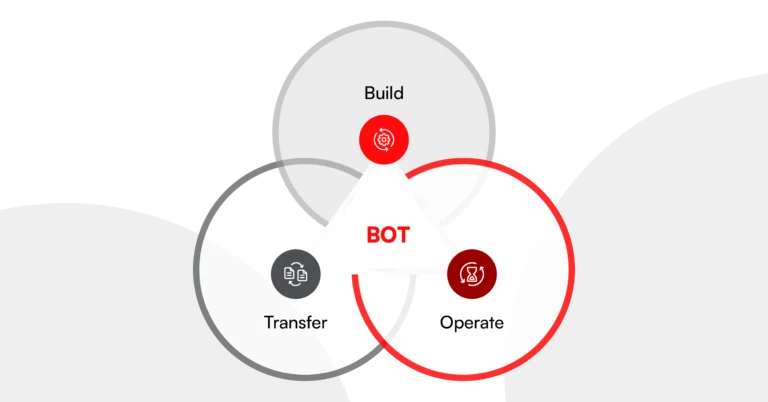
BOT stands for Build-Operate-Transfer. A private entity designs, builds, and runs the infrastructure for a defined period. Ownership then transfers back to the client at the end of that term.
There are three stages:
Build. The partner designs and constructs the infrastructure, whether that is an ecommerce platform, a software engineering team, or a logistics operation, according to agreed specifications.
Operate. The partner runs and maintains it. Offshore talent handles functions like customer support, IT development, and data operations during this phase.
Transfer. Ownership of the infrastructure, the team, and all accumulated knowledge reverts to the client upon the end of the concession period.
What is a BOOT?
BOOT stands for Build Own Operate Transfer model. It follows the same structure as BOT with one important difference: the partner retains ownership of the infrastructure throughout the concession period, not just during the build phase. That ownership gives the partner more control over operations and strategic decisions throughout the engagement.
There are four stages:
Build. The partner finances and constructs the infrastructure and holds ownership from day one.
Own. The partner maintains ownership through the full concession period. This allows for tighter operational control and faster decision-making.
Operate. Offshore talent runs and optimizes the infrastructure, contributing across software development, digital marketing, and supply chain functions.
Transfer. At the end of the term, ownership moves to the client, along with all the capability, knowledge, and operational maturity built during the engagement.
Myth Buster: Is PPP and Build-Operate-Transfer the Same?
Most people use PPP and BOT interchangeably. They are not the same thing.
Public-Private Partnerships are broad collaborative frameworks. They cover management contracts, concession agreements, and joint ventures between governments and private entities. BOT is one specific structure within that category, not a synonym for the whole thing.
PPP is a governance approach. Build-Operate-Transfer is a precise ownership structure with a fixed lifecycle. In technology and ecommerce contexts, it operates entirely in the private sector. The client company receiving the transferred asset plays the same role that a government body plays in the traditional infrastructure version.
Your code. Your team. Zero ambiguity on ownership.
Most businesses stumble on offshore engineering because of blurry IP rights, murky contracts, and misaligned teams. RBMSoft’s BOT advisory team helps you structure offshore ownership the right way, from day one.
Talk to the BOT Advisory Team
Why BOT and BOOT Are Growing in IT Outsourcing
BOT and BOOT have moved from niche contract structures into mainstream IT sourcing strategy. Three forces are driving this shift, and none of them is easing up.
The talent shortage is not going away
ManpowerGroup’s 2026 Talent Shortage Survey, covering 39,000 employers across 41 countries, found that 72% report difficulty filling roles. AI skills topped the hardest-to-find list for the first time, ahead of traditional engineering and IT. Markets like the US, Germany, France, and the UK face the tightest constraints. Offshore talent pools in India, Eastern Europe, and Southeast Asia carry significantly more supply. Companies already using the Build Operate Transfer Services are not waiting for local markets to correct. They are building now.
The cost difference is too large to ignore
A fully-loaded senior engineer in the US runs between $180,000 and $220,000 a year. A comparable profile through an offshore BOT engagement in India costs $40,000 to $60,000. At the team scale, that gap does not just reduce spend. It unlocks investment decisions that would otherwise not be possible.
Boards are asking what the company actually owns
Permanent outsourcing produces deliverables. It builds no organizational equity, no retained knowledge and no offshore assets. The build-to-operate-transfer model takes the same spend and converts it into ownership by the client at the end. That conversation is now happening at the CFO and board level, not just inside engineering teams.
BOT vs. BOOT — Key Differences Explained
The two models share the same destination. Who carries the weight? Getting there is where they split.
Build Own Operate Transfer model takes the BOT structure and changes one thing: the partner doesn’t just manage the offshore entity during the operational phase. They legally own it.
In a standard Build Operate Transfer services arrangement, the client holds beneficial ownership from day one while the partner handles operations. Under BOOT, the partner owns the legal entity, the infrastructure, and the employment contracts until the agreed transfer milestone. That changes the accountability dynamic entirely. The provider’s financial stake in the operation’s success is real, not contractual, and when the transfer occurs, it’s a full legal transfer of ownership, not a management transition.
BOOT has become the preferred entry point for mid-market and enterprise companies that want offshore capability without the upfront capital commitment, and need their partner to have genuine skin in the game before handover.
| Dimension | BOT (Build-Operate-Transfer) | BOOT (Build-Own-Operate-Transfer) |
| Legal Ownership | Client holds beneficial ownership from day one. | Provider holds legal ownership until transfer. |
| Client CapEx | Moderate; shared setup costs. | Very low; provider funds the build. |
| Provider Accountability | High; SLA-contractual. | Very high; owner-level. |
| Client Involvement | Governance and strategic direction. | Strategic direction only. |
| Risk Distribution | Shared from day one. | Provider bears early-stage operational risk. |
| Transfer Complexity | Moderate; management handover. | Higher, full legal ownership transfer. |
| Typical Duration | 18 to 30 months. | 24 to 48 months. |
| Best For | Businesses are ready to co-invest in an offshore setup. | Companies wanting a capital-light offshore entry. |
When to Choose BOT vs. BOOT for Your Business?
Neither model is universally better. The right choice depends on your business’s financial position and the level of operational involvement you want during the engagement.
- Choose BOT if your business can absorb some setup investment alongside the partner, you want closer involvement during the build phase, you’re targeting ownership within 24 months, or you already have some offshore presence or legal entity to work from.
- Choose BOOT if capital preservation is the priority and upfront CapEx isn’t an option, you want the provider to carry full legal and financial responsibility through the operating phase, you’re entering an offshore market for the first time, or you’re comfortable with a longer timeline in exchange for lower early-stage exposure.
For most companies evaluating BOOT for the first time, if budget is the sticking point, BOOT removes the friction. If you want tighter control from the start and can fund the setup, BOT gets you to ownership faster.
Types of Build-Operate-Transfer Model Variants
BOT and BOOT get most of the attention, but the framework has expanded into a broader family of models. Knowing the variants helps you pick the structure that actually fits your financial position, risk appetite, and what you want to own at the end.
Build Operate Transfer (BOT)
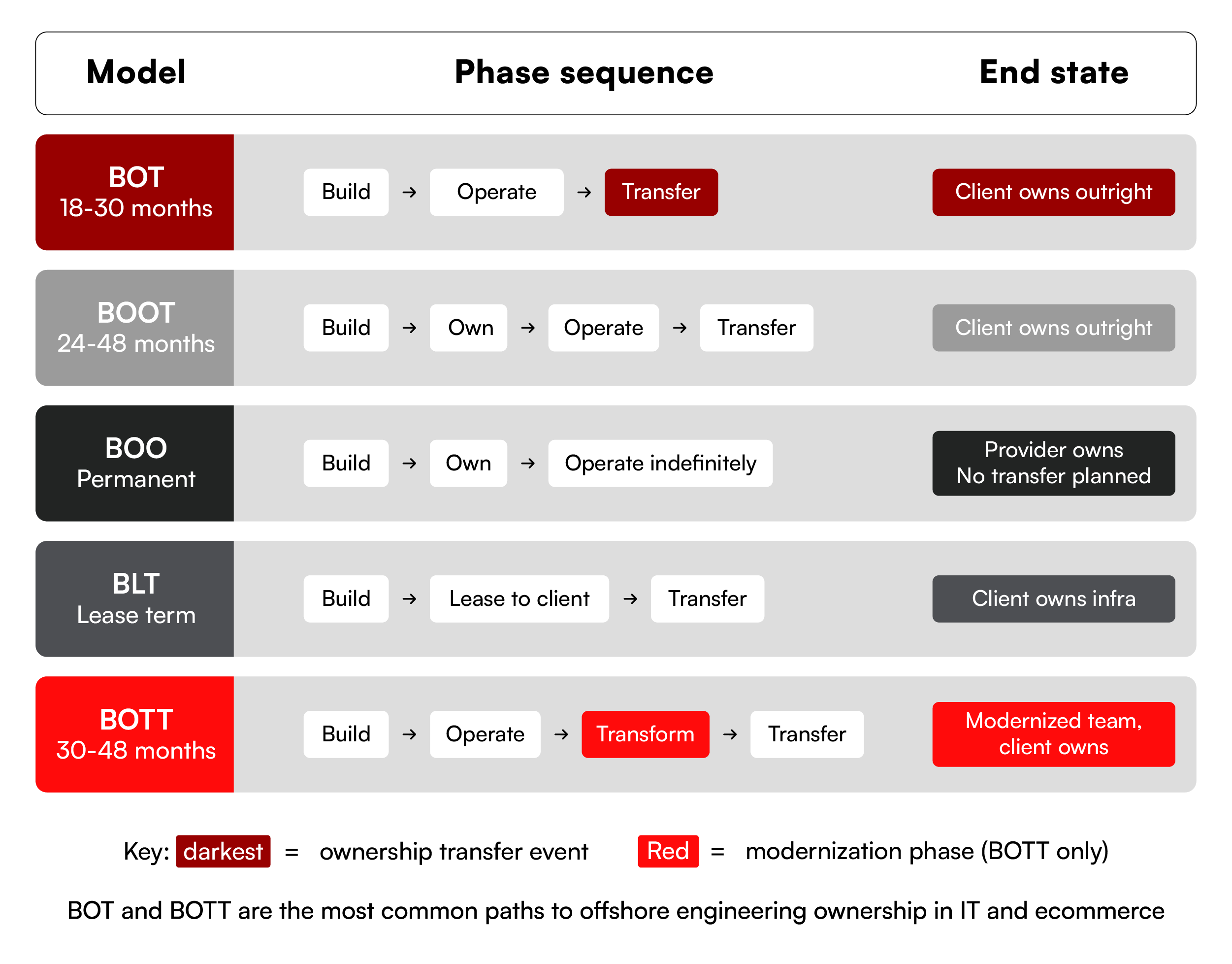
The standard model. A partner builds and operates the offshore unit while the client holds beneficial ownership from day one. At the end of the agreed term, everything transfers formally to the client. The most common entry point for IT and ecommerce companies building offshore engineering capability. Typical engagement runs 18 to 30 months.
Build Own Operate Transfer (BOOT)
The partner holds legal ownership of the offshore entity throughout the operational phase, bearing the financial risk before transferring full ownership to the client. Capital-light for the client upfront. The provider’s ownership stake creates stronger accountability than a contractual SLA alone delivers. Typical engagement runs 24 to 48 months.
Build Own Operate (BOO)
BOO removes the transfer entirely. The provider builds and operates the offshore unit indefinitely on the client’s behalf, retaining permanent ownership throughout. No handover is planned.
Companies choose BOO when bringing the operation in-house was never the goal. It functions closer to a permanent managed service, but the provider’s ownership stake drives stronger accountability than traditional outsourcing typically delivers. In IT and ecommerce, it’s less common than BOT or BOOT, but it suits businesses that want the operational benefits of an offshore team without the complexity of an ownership transfer.
Build Lease Transfer (BLT)
In a BLT model, the provider builds the facility or infrastructure, leases it to the client through the operational phase, and transfers ownership at the end of the lease term. It’s common in infrastructure for hospitals, government buildings, and transport hubs.
In technology, BLT structures occasionally appear for dedicated offshore development centers where the client wants to lease physical workspace and operational infrastructure before assuming ownership. For software-first teams where the real assets are people and process rather than real estate, BLT is rarely the right fit.
Build Operate Transform Transfer (BOTT)
BOTT inserts a Transform phase between Operate and Transfer. Deloitte and other tier-one advisors have been applying this variant to enterprise digital transformation engagements where simply handing over a functioning team isn’t enough.
The logic is straightforward. By the time a long Build Operate Transfer IT outsourcing reaches the transfer stage, the technology landscape has often changed. BOTT builds in a formal modernization phase before ownership changes hands, ensuring the client receives a transformed capability rather than a snapshot of what existed 18 months earlier.
Key Considerations for the BOTT Model
Before choosing BOTT, a few things need to be defined upfront, or the added complexity creates more problems than it solves.
The transformation scope has to be locked down at the contract stage. What does “transformed” actually mean at the point of transfer? Which technology modernization milestones need to be hit? What capability uplift is required? Without clear answers, the transform phase becomes a moving target.
Budget and timeline both expand. Adding a genuine transformation phase typically extends the overall engagement by 6 to 12 months and requires additional investment in training, process redesign, and change management. Companies that go in expecting BOTT to cost the same as BOT are usually wrong.
The payoff is real when it’s executed well. Ecommerce enterprises undergoing platform modernization, ecommerce replatforming, AI capability building, or major architectural transitions during the offshore engagement period are natural candidates for this model.
Which Variant Is Right for Your Business?
| If you want… | Consider… |
| Offshore ownership within 18 to 30 months, shared setup cost | BOT (Build-Operate-Transfer) |
| Offshore ownership within 30 to 48 months, zero upfront CapEx | BOOT (Build-Own-Operate-Transfer) |
| A permanent managed offshore operation with no transfer intent | BOO (Build-Own-Operate) |
| Physical offshore infrastructure on a lease-to-own basis | BLT (Build-Lease-Transfer) |
| Offshore capability that is modernized before transfer | BOTT (Build-Operate-Transfer-Transform) |
Advantages of the Build-Operate-Transfer Model
The case for the Build Operate Transfer services isn’t just financial, though the numbers are hard to argue with. Here’s what companies actually gain across the full engagement.
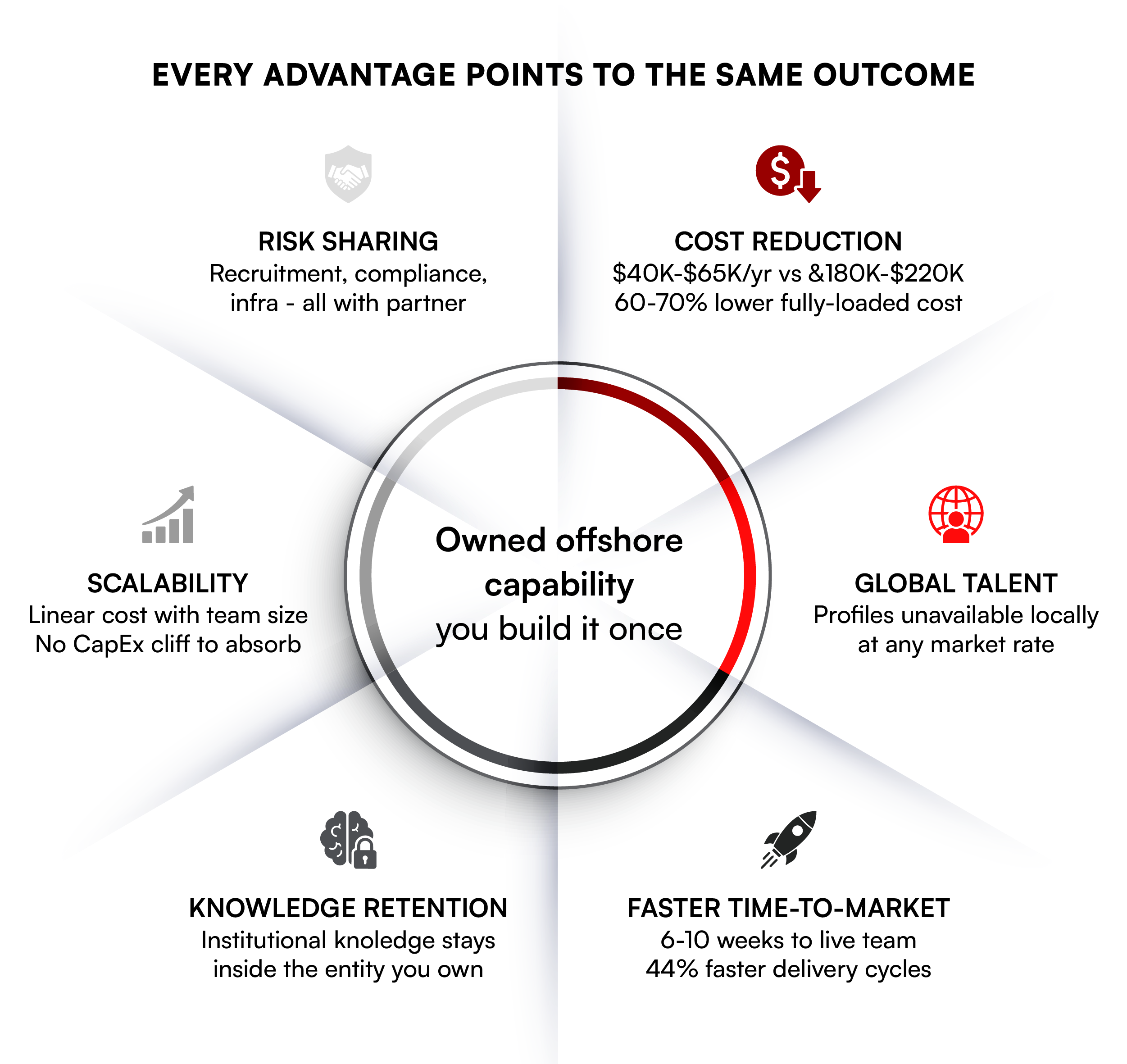
Cost Reduction and Value Arbitrage
A fully-loaded senior software engineer in the US costs $180,000 to $220,000 per year once you factor in salary, benefits, employer taxes, office, and tooling. The same caliber of engineer through a Build Operate Transfer services engagement in India runs $40,000 to $65,000. At the team scale, that gap doesn’t just save money. It changes what’s financially possible.
A 20-person engineering team built through build-operate-transfer IT outsourcing in India over 24 months typically costs $2.0M to $2.8M all-in. An equivalent US-based team over the same period runs $7.5M to $10M. That $5M to $7M difference is capital that goes back into product development, marketing, or market expansion instead of payroll.
What companies consistently underestimate are the setup costs the BOT partner absorbs entirely: legal entity registration, recruitment agency fees, HR infrastructure, office buildout, and compliance implementation. None of that lands on the client during the build phase.
Access to Global Tech Talent
Local hiring markets in the US and Western Europe won’t solve a structural talent shortage. BOT partners in established offshore markets maintain active talent pipelines, employer brand recognition, and deep networks inside local technology communities that most clients couldn’t build independently in under two years.
RBMSoft draws from one of the deepest pools of ecommerce and enterprise technology talent globally, with direct pipelines into tier-1 engineering institutions. From Salesforce Commerce Cloud architects and headless commerce engineers to AI and ML specialists and cloud-native platform engineers, these are the profiles that power RBMSoft’s enterprise software development services and aren’t available in meaningful quantity at US market rates. Through BOT, they are.
Faster Time-to-Market
Speed is the most underappreciated advantage of the build-operate-transfer model. A BOT partner with established talent pipelines, HR infrastructure, and compliance systems already in place can stand up a 10 to 15-person offshore engineering team in 6 to 10 weeks. A company doing direct offshore hiring for the first time, navigating local labor laws, registering a legal entity, and running recruitment cycles from scratch, is looking at a 4 to 8 month timeline before the first engineer starts.
For ecommerce businesses with hard deadlines on platform launches, seasonal campaigns, and competitive product releases, that gap translates directly into revenue.
Risk Sharing and Mitigation
Because the build operate transfer IT outsourcing services are accountable for building and operating a functional offshore team, not just supplying contractors, they absorb a much wider range of operational risk than traditional outsourcing ever does.
Recruitment risk sits with the partner. If a hire doesn’t work out, they replace them. Compliance risk stays with the partner through the operation phase: labor law violations, statutory benefit miscalculations, and regulatory breaches are their problem to solve. Infrastructure risk, office lease, hardware failure and utility disruptions are managed by the partner. Attrition risk is managed through the partner’s HR programs and team culture. In staff augmentation or traditional outsourcing, most of these risks quietly migrate back to the client over time. In BOT, they don’t.
Scalability Without CapEx
Growing a BOT team from 15 to 30 engineers to support a platform migration doesn’t require the client to absorb a capital expenditure cliff first. The partner handles recruitment, onboarding, workspace expansion, and HR infrastructure. Cost scales linearly with team size.
For ecommerce businesses managing seasonality, Black Friday ramp-ups, new market launches, or accelerated catalog expansions, that elasticity isn’t a nice-to-have. It’s operationally critical.
Knowledge Retention at Transfer
Traditional outsourcing quietly and continuously drains organizational knowledge. Every deliverable a vendor produces stays in the vendor’s operational context. The client gets the output. The institutional knowledge stays with the vendor.
The Build Operate Transfer Model inverts that. From the first day of the operation phase, the partner is building documentation, process standards, architectural decisions, and team expertise inside an entity the client will eventually own. By the time transfer happens, the client doesn’t just receive a team. They receive years of accumulated knowledge embedded in people who already understand the business, the technology stack, and how the operation runs.
How to Implement the Build Operate Transfer Model (5 Phases)?
Most BOT engagements don’t fail because the model is flawed. They fail because companies skip steps, rush phases, or underestimate what a clean transfer actually requires. Here’s how it works when it’s done right.
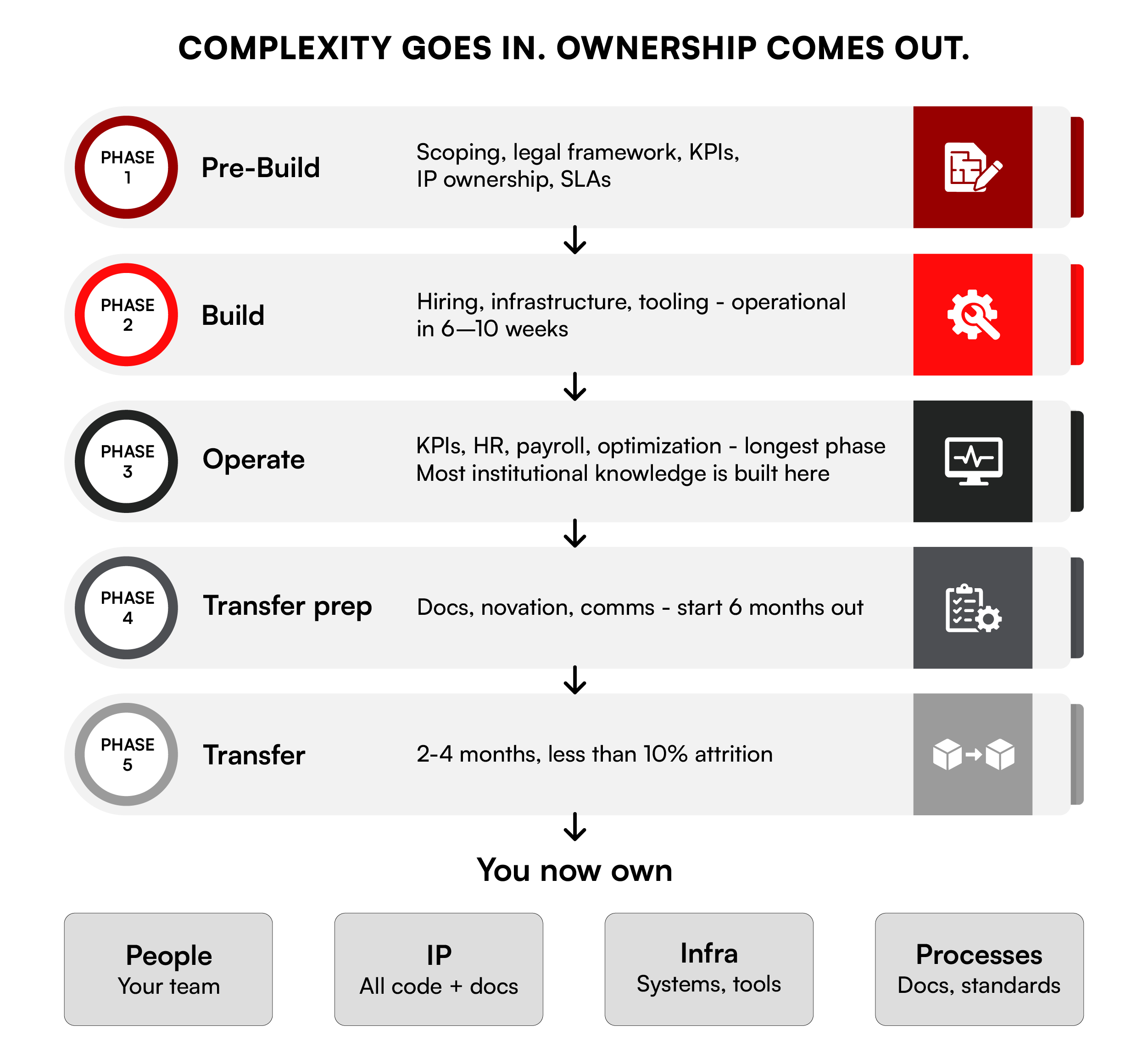
Phase 1: Pre-Build (Scoping, Legal, Alignment)
Before a single hire is made, the client and BOT partner need to align on objectives, finalize the legal framework and define how existing resources will be handled. Scope the offshore unit’s purpose, team composition, and KPIs first. Then structure the contract to cover IP ownership, SLAs, and exit provisions, and map compliance requirements in the target offshore market. Every decision made here determines how smoothly the following phases will run. Skipping this work doesn’t save time. It creates problems that compound.
Phase 2: Build (Hiring, Infrastructure, Stack)
Talent acquisition, office setup, tooling, security frameworks, and process design all land with the Build Operate Transfer Model partner in this phase. The client carries none of that operational overhead. For e-commerce-focused build-operate-transfer engagements, recruitment typically covers Salesforce Commerce Cloud developers, DevOps engineers, frontend specialists, and QA leads. A 10 to 20-person team is usually operational within 6 to 10 weeks.
Phase 3: Operate (KPIs, Management, Optimization)
The operate phase is the longest part of the engagement and where most of the value gets built. HR, payroll, compliance, and performance management stay with the Build Operate Transfer IT outsourcing partner. The client sets product strategy and delivery priorities through weekly reviews and monthly steering committees, without getting pulled into day-to-day operational details. Over time, the team matures, KPIs stabilize, and institutional knowledge accumulates inside an entity that the client will eventually own outright.
Phase 4: Transfer Preparation (Docs, Handover Plans)
Preparation needs to start six months before the handover date, not six weeks out. Process documentation, employment contract novation, payroll transition, and communication with the offshore team must be executed in sequence. What gets skipped here shows up as attrition spikes and knowledge gaps on the other side of the transfer. The offshore team needs to hear directly what the handover means for their employment terms and career paths, before uncertainty fills that space.
Phase 5: Transfer (Ownership, People, IP Handover)
At transfer, everything moves to the client: the people, the IP, the infrastructure, the processes. Employment contracts are novated, code and documentation are formally assigned, and the client becomes the offshore team’s direct employer. When done well, the handover takes 2 to 4 months and results in less than 10% attrition. Most BOT partners remain available in an advisory capacity for 3 to 6 months after transfer to ensure the transition holds.
Ready to build a custom BOT model for your business?
Stop adapting generic tools to your workflows. Our BOT experts help you design, train, and deploy a bot built around your exact processes in weeks, not months.
Get your Implementation RoadmapKey Considerations Before Choosing a Model
Choosing the right build-operate-transfer model is only half the decision. The other half is knowing whether your business is actually ready to run one. Five things determine whether a BOT engagement succeeds or drifts before it reaches transfer.
Strategic intent
BOT is a long-term ownership play. If the underlying goal is short-term capacity, staff augmentation is a faster, cheaper option. BOT requires genuine commitment to owning what gets built.
Leadership bandwidth
Someone in the organization needs to actively govern the engagement: attend steering committees, make architectural decisions, and prepare the business for eventual ownership. Engagements without a clear internal owner on the client side consistently underperform.
Financial runway
A BOT engagement runs 18 to 36 months. Financial visibility across that entire horizon isn’t optional. Committing to the model without it creates pressure that usually shows up at the worst possible point in the lifecycle.
IP clarity
Vague IP ownership policies don’t get clearer during a Build Operate Transfer Model engagement. They create disputes. If the client’s IP framework doesn’t clearly extend to offshore deliverables, that gets fixed before the contract is signed, not after.
Change management capacity
The offshore team’s existence changes how the onshore team works. Cross-timezone collaboration, documentation disciplines, and governance rhythms all require real organizational adjustment. Companies that treat this as a minor inconvenience usually find out otherwise by month six.
How to Evaluate BOT Companies?
Not all build-operate-transfer consulting firms and service providers are the same. These are the factors that actually separate good partners from risky ones.
1# Full-cycle track record
References from clients who have completed the full lifecycle, build through transfer, are worth ten times more than references from clients who are mid-engagement and still optimistic. Ask specifically for post-transfer contacts and what the operation looked like six months after handover.
2# Offshore market depth
Established talent pipelines, employer brand recognition, and compliance infrastructure in the target market take years to build. A provider entering a new offshore market alongside a client is carrying risk that the client usually doesn’t know they’re absorbing.
3# Industry and technology specialization
A generalist BOT provider won’t meet an ecommerce-specific technology need the same way a provider with proven depth in ecommerce engineering will. The talent profiles are different, the platform knowledge is different, and the delivery risks are different.
4# Financial stability
The engagement runs two to three years. Provider financial instability mid-engagement is one of the most disruptive things that can happen to an offshore operation that hasn’t transferred yet. It’s worth asking for.
5# Contract transparency
Providers who get vague about transfer mechanics, exit provisions, or IP ownership terms during commercial conversations will be vaguer still once the contract is signed. The best partners actively welcome contract scrutiny.
Build Operate Transfer Pricing Model: What to Expect
Build operate transfer pricing model follows a three-component structure, and the numbers vary significantly based on team size, offshore location, and engagement complexity.
Set up and mobilization fee
A one-time charge covering talent acquisition, legal setup, infrastructure provisioning, and onboarding. Typically ranges from $15,000 to $75,000, depending on team size and complexity.
Monthly management fee
The ongoing fee through the operating phase covers HR management, payroll administration, facilities, compliance, and provider margin. Most providers structure this as either a per-seat monthly fee, ranging from $800 to $2,500 per person depending on location and seniority, or a percentage of total team cost, typically 15 to 25%.
Transfer fee
A one-time fee at legal and operational handover, often including three to six months of post-transfer advisory support. Generally ranges from $10,000 to $50,000, depending on team size and transfer complexity.
For a 20-person team over a 24-month BOT engagement, the total all-in cost typically runs $1.5M to $2.5M. The equivalent US-based team over the same period costs $8M to $11M.
What Should a BOT Contract Include?
A BOT contract that doesn’t cover these points isn’t a BOT contract. It’s a managed services agreement with a transfer clause tacked on at the end.
- Scope of services: Exact functions the BOT partner delivers across all phases
- Team composition guarantees: Minimum seniority levels, specializations, and replacement timelines for key roles
- SLA definitions and remedies: Performance metrics, measurement methodology, and consequences of underperformance
- IP ownership: All work product assigned to the client from the point of creation, not at transfer
- Data security obligations: Specific frameworks, audit rights, and breach notification requirements
- Knowledge transfer obligations: Documentation standards, handover milestones, and readiness criteria
- Transfer conditions: Specific milestones that must be met before transfer can proceed
- Exit provisions: What happens if either party needs to exit before the planned transfer date
When BOT Beats Traditional Outsourcing?
Traditional outsourcing answers one question: how do we get work done without hiring people? The build-operate-transfer model answers a different question: how do we build something we own?
No matter how well a traditional outsourcing vendor performs, the capability stays theirs. They hire. They manage performance. They own the processes and the institutional knowledge that accumulates inside their team. The client gets deliverables. That’s the ceiling.
BOT turns the vendor relationship into a temporary arrangement on the way to ownership. Every month of the operating phase is a month of team maturation, process refinement, and institutional knowledge building that ultimately transfers to the client. Traditional outsourcing months produce deliverables. BOT months produce deliverables and organizational equity. That difference compounds significantly over a 24 to 36-month engagement.
Is the BOT Model Right for Your Business?
The model fits when the goal is ownership, the timeline is realistic, and the internal commitment is genuine.
It’s the right choice if:
- You need to build a specialized offshore engineering capability at scale and want to own it
- Long-term ownership is the actual goal, not just near-term capacity relief
- Your technology functions are complex enough to justify a structured, knowledge-preserving engagement
- A cold-start direct offshore hiring program carries more risk than your business can absorb right now
- Someone in your leadership team is ready to govern the engagement actively, not just receive status updates
- You have financial visibility across an 18 to 36-month horizon
It’s the wrong choice if:
- The need is 3 to 6 months of additional engineering capacity, nothing more
- Long-term offshore ownership isn’t actually on the roadmap
- Leadership bandwidth for active engagement governance isn’t there
- You need a team operational within 6 to 8 weeks, in which case staff augmentation is the faster answer
The honest question to ask before starting a BOT engagement isn’t whether the model makes sense in theory. It’s whether the business is ready to run one.
What are the Challenges Associated with the Build-Operate-Transfer Model?
Every model has trade-offs. The companies that navigate the Build Operate Transfer Model well are not the ones that avoid problems. They are the ones who saw them coming.
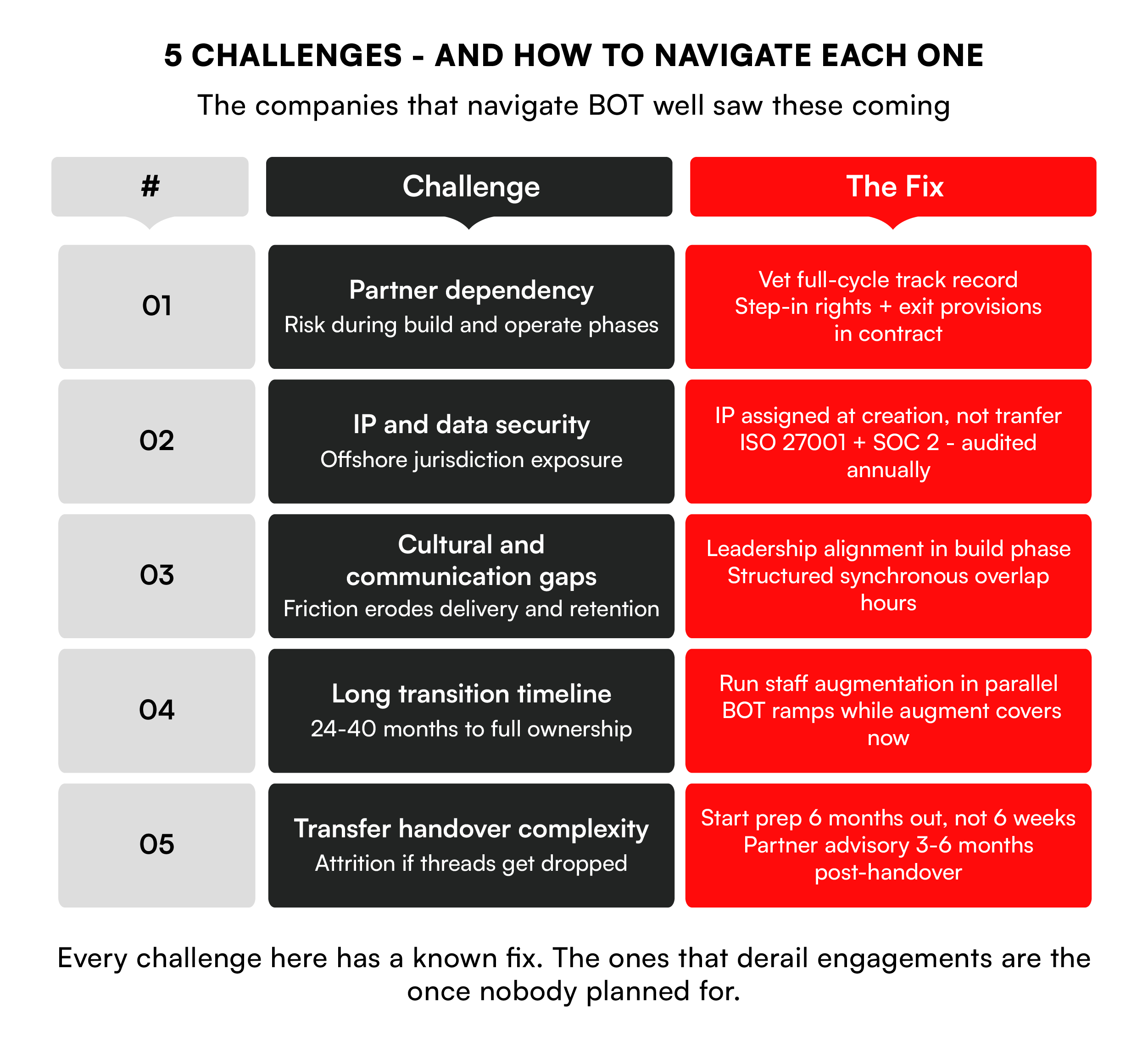
Partner Dependency Risk
During the build and operate phases, the client is dependent on their BOT partner. A partner that underperforms, loses key staff, runs into financial trouble, or shifts strategic focus can leave an offshore operation exposed at exactly the wrong moment.
Vet partners on their full-cycle track record, not their pitch materials. Ask for references from clients who have completed the entire lifecycle, build through transfer, not clients who are mid-engagement and still optimistic. The contract should include performance remedies, step-in rights, and exit provisions that give the client real options if the partner falls short.
IP and Data Security Risks
Sharing sensitive technology, customer data, and proprietary processes with a third party in a foreign jurisdiction creates exposure that does not manage itself. Without the right contract structure and ongoing governance, IP and data security risks accumulate quietly throughout the operational phase.
All work product, code, documentation, and data created during the engagement should be assigned to the client from the point of creation, not at transfer. Security frameworks appropriate to the data being handled, ISO 27001, SOC 2, and GDPR compliance, where applicable, need to be contractually required and audited annually. Assuming they are in place is not enough.
Cultural and Communication Gaps
Time zones, language differences, cultural norms around hierarchy and feedback, and different communication styles all create friction between onshore and offshore teams. Left unmanaged, those gaps erode delivery quality, slow decisions, and drive attrition on the offshore side.
Getting leadership from both sides together during the build phase matters more than most clients expect. Structured overlap hours for synchronous collaboration, a BOT partner with real cultural bridging experience, and leadership that operates across both markets are not soft considerations. They directly affect retention and delivery.
Long Transition Timelines
The full BOT lifecycle, from pre-build through transfer, typically runs 24 to 40 months. For a business that needs offshore capacity within six months, the model is not the right fit.
The answer is not to rush the engagement. Staff augmentation can run alongside a BOT engagement to cover immediate capacity needs while the offshore unit ramps properly. Both can coexist. For companies with near-term delivery pressure and a genuine long-term offshore ownership goal, running them in parallel is often the right structure.
Complexity of the Transfer Handover
Even well-run Build Operate Transfer Model hit friction at handover. Employment contract novation, payroll migration, HR policy alignment, and team communication all need to happen within a compressed window while the offshore team keeps delivering. When any of those threads gets dropped, attrition follows.
Transfer preparation should start six months out, not six weeks. Treat it as a standalone workstream with its own project management, stakeholder communication plan, and risk register. It is not a checklist item. Keeping the BOT partner in an advisory capacity for three to six months after transfer provides a buffer that consistently makes the difference between a clean handover and a difficult one.
BOT for Global Capability Centers
A Global Capability Center is a captive offshore subsidiary that a company owns and operates directly. For most companies running a BOT engagement, a GCC is exactly where they are headed. BOT is the most structured path to get there without betting on a cold start.
Building a GCC from scratch means absorbing the full complexity of legal entity registration, local HR infrastructure, talent acquisition in an unfamiliar market, compliance setup, and office infrastructure, all before the first engineer starts work. The Build Operate Transfer Model removes that burden. The partner builds and operates the center as a managed operation. Over 24 to 36 months the team matures, processes standardize, and institutional knowledge builds. At transfer, the client takes ownership of what is, in effect, a ready-made GCC.
For ecommerce and IT companies targeting India as their GCC location, which the majority of mid-to-large enterprises now do, the build-operate-transfer model is the most capital-efficient and risk-managed entry path available for scaling ecommerce platform engineering capability.
What BOT and BOOT Engagements Look Like in Practice
The model works differently depending on team size, timeline, and what the client ultimately wants to own. Rather than individual case studies, the numbers below reflect what companies are actually seeing across BOT and BOOT engagements in IT and ecommerce today.
Cost savings: 40% to 60% versus onshore hiring
Companies using the Build Operate Transfer Model in India report cost savings of 40% to 60% compared to equivalent onshore hiring in the US. That range accounts for the full managed cost of the offshore engagement, including partner overhead, HR, compliance, and infrastructure, not just salary. The gap is widest for senior engineering profiles where US total compensation runs highest.
Time to operational team: 6 to 10 weeks
A BOT partner with established local recruiting networks and infrastructure can put an operational team on the ground in 6 to 8 weeks. Building the same team through direct hiring in an unfamiliar offshore market typically takes 12 to 18 months for the operation to be fully functional.
Faster delivery: 44% improvement in time to market
Companies using BOT engagements in 2025 reported a 44% improvement in time to market and 45% shorter development cycles compared to building in-house teams at overseas facilities directly.
The GCC destination of choice: India, with 1,800+ centers already operating
India is the dominant destination for offshore capability center builds. According to NASSCOM’s 2024 GCC Annual Report, India hosts over 1,800 Global Capability Centers generating $64.6 billion in revenue, employing more than 1.9 million professionals. Over 170 new GCC setups were recorded in 2025 alone. For ecommerce and IT companies using a BOT to reach a GCC outcome, India is where the majority of those engagements land.
Adoption is accelerating
The clearest signal of how quickly this model is growing is the GCC data. According to NASSCOM’s 2024 GCC Annual Report, India recorded over 170 new GCC setups in 2025 alone, with the total number of centers crossing 1,800. The majority of those centers were established through BOT or BOOT arrangements rather than cold-start builds. The overall GCC ecosystem in India is projected to reach 2,100 to 2,200 centers by 2030, generating $99 to $105 billion in revenue.
What a typical engagement delivers at transfer
A well-run BOT engagement over 24 to 36 months typically produces a team of 15 to 40 engineers, a legally registered offshore entity, all developed IP formally assigned to the client, and documented processes ready for the client to operate independently. Partners with track records in managed transfers consistently cite attrition below 11% at handover as the benchmark for a clean transfer.
The BOT Model in IT Outsourcing and Ecommerce
The model works across industries, but software development and ecommerce are where it has gained the most traction. Here is why, and what it looks like in practice.
BOT for Software Development Teams
Build, operate, transfer IT outsourcing for software development is the most common application of the model in tech today. Companies use it to establish offshore engineering teams that eventually become in-house captive capabilities. The functions covered typically include full-stack web development, mobile applications, DevSecOps, cloud infrastructure, QA automation, data engineering, and AI and machine learning.
Software development is particularly well-suited to BOT because of the nature of the asset being built. Human capital and institutional knowledge transfer cleanly at the end of an engagement in a way that physical infrastructure never does. A software team that has spent 24 months building on your stack and within your processes already knows your business. The handover is not a disruption. It is a formality.
BOT for Ecommerce Operations
Ecommerce has pushed the BOT model outsourcing further than almost any other sector. The functions that now drive competitive differentiation, platform engineering, personalization, customer experience technology, and order management require exactly the kind of specialized offshore talent that BOT is built to access.
- Platform engineering: Salesforce Commerce Cloud, SAP Commerce, Magento, Shopify Plus, and commercetools all require specialized engineering talent for implementation, customization, and ongoing optimization. BOT lets ecommerce brands build dedicated platform engineering teams at offshore cost structures without absorbing a 6- to 12-month US hiring timeline before a single sprint begins, whether that means a greenfield build or ecommerce replatforming.
- Digital marketing technology: Marketing automation, personalization engine development, A/B testing infrastructure, and analytics platform management are functions that ecommerce companies regularly offshore through BOT engagements. The talent exists offshore. The cost makes the decision straightforward.
- Customer experience technology: Chatbot development, customer service platform integration, loyalty program technology, and omnichannel experience engineering are areas where offshore BOT teams with ecommerce specialization consistently deliver at a level that matches or exceeds what onshore teams produce at three times the cost.
- Order management and supply chain technology: OMS integration, inventory optimization, and logistics technology development round out the ecommerce functions, where offshore BOT teams add measurable value quickly.
RBMSoft’s ecommerce BOT engagements have supported platform work for enterprise retailers, including BigLots, DSW, PetMeds, Fleet Farm, and BeachBody, building offshore engineering capability that transfers cleanly into the client’s own technology organization at the end of the engagement.
The Engineers You Need. The Ownership You Deserve.
Our BOT model is designed with a single exit condition – a fully transferred, deeply embedded engineering team that belongs to you, not us.
Claim Your Offshore TeamConclusion
Talent scarcity, cost pressure, and the compounding cost of building nothing you own: these aren’t temporary problems. They’re the operating conditions every ecommerce and IT business is navigating right now. The build-operate-transfer model exists as a direct response to all three.
Whether BOT fits because you want balanced ownership from day one, BOOT fits because capital-light entry is the priority, or BOTT fits because the operation needs to be transformed before it transfers, the destination is the same: a single, unified ownership structure.
A mature, high-performing offshore team that belongs entirely to your business, built with expert support rather than assembled through years of trial and error on your own.
RBMSoft has delivered 3,000+ digital engagements across 15+ industries, with deep specialization in ecommerce engineering, Salesforce Commerce Cloud, and offshore delivery. Every BOT and BOOT engagement we run is built around one outcome: a clean transfer, a stable team, and an operation that performs better after handover than it did the day before it.
If your platform engineering is locked inside a vendor relationship — and your roadmap moves at their pace, not yours, it’s time to restructure. Schedule a consultation with RBMSoft’s BOT advisory team and tell us your stack, timeline, and growth targets, we’ll map out exactly what your offshore team would look like.
FAQs
1. What is the build operate transfer model?
The build operate transfer model is a contractual framework where a specialist partner builds, operates, and eventually transfers full ownership of an offshore technology unit to the client company. The client directs strategy throughout. The partner manages operational complexity during the build and operate phases. At transfer, the client receives a mature, functioning operation: the people, the IP, and the processes, all of it.
2. How does a BOT model work?
A BOT engagement runs through five phases: pre-build covering scoping, legal setup, and alignment; build covering talent acquisition, infrastructure, and process design; operate covering KPI management, delivery, and optimization; transfer preparation covering documentation, legal transition, and team communication; and transfer, which is the full ownership handover. The full lifecycle typically runs 18 to 36 months.
3. What is the difference between BOT and BOOT?
In the Build Operate Transfer Model, the client holds beneficial ownership from day one while the partner manages operations. In BOOT, the partner holds legal ownership of the offshore entity throughout the operational phase, bearing greater financial risk before transferring ownership to the client. BOOT offers lower client CapEx upfront but requires a longer engagement timeline and a more complex transfer event at the end.
4. What are the main advantages of BOT?
The primary advantages are a 60 to 70% cost reduction versus equivalent onshore hiring, access to specialized global talent markets that local hiring can’t reach, faster team formation compared to direct offshore hiring, risk distribution across both client and partner, elastic scalability without upfront capital expenditure, and the eventual ownership of a mature offshore capability rather than a permanent vendor dependency.
5. What are the challenges associated with the BOT model?
The main build operate transfer disadvantages are partner dependency during the operate phase, IP and data security risks in offshore jurisdictions, cultural and communication gaps between onshore and offshore teams, a 24 to 40 month timeline to full ownership, and the legal and operational complexity of executing a clean transfer at engagement conclusion. None of these are insurmountable, but all of them need to be planned for, not discovered mid-engagement.
6. Which industries are best suited for BOT and BOOT?
Both models work best in industries where technology is a core competitive differentiator and offshore talent markets provide meaningful cost and scale advantages. Ecommerce and retail, IT and SaaS, banking and financial services, healthcare and life sciences, and travel and logistics are the primary sectors. In each of these, the combination of talent access, cost efficiency, and structured ownership transfer produces outcomes that traditional outsourcing can’t match.
7. What are the benefits of the BOT and BOOT model?
Both models deliver lower talent costs, faster offshore team formation, risk distribution, compliance management by a specialist partner, scalability without upfront capital expenditure, and a structured path to owning an offshore capability rather than renting one indefinitely. BOOT adds one further benefit: the provider funds the build phase as a legal owner, which means the client’s capital stays where it belongs during the highest-risk period of the engagement.
8. How do BOT and BOOT help reduce cost and increase ROI?
Cost reduction comes through three channels: offshore labor arbitrage delivering 60 to 70% reduction in fully-loaded talent cost, elimination of cold-start setup expenses including legal entity registration, recruitment, and HR infrastructure, and conversion of outsourcing spend into owned organizational equity rather than perpetual vendor margin. ROI compounds through faster time-to-market, continuous development cycles made possible by time zone distribution, and the fact that every dollar spent during the operate phase builds toward an asset the client owns, not a vendor relationship they’re locked into.