




Table of Contents
Key Takeaways:
- Generative AI helps retailers reduce operational costs by automating tasks such as customer support, content creation, and inventory planning.
- Personalized recommendations, targeted marketing campaigns, and intelligent shopping assistants enable retailers to improve customer engagement and drive revenue growth.
- Retailers are using generative AI across multiple functions, including product design, content generation, inventory management, supply chain optimization, and customer service.
- Leading brands such as Amazon, Walmart, and Sephora are already leveraging generative AI to enhance customer experiences and improve business efficiency.
- Successful implementation requires addressing challenges related to data quality, legacy systems, governance, talent, and ROI measurement through a well-defined AI strategy.
If you’re a retailer, you’re likely under constant pressure to do more with less. You need to meet rising customer expectations, deliver personalized shopping experiences, manage inventory efficiently, and keep operating costs under control, all while staying ahead of the competition.
Traditional retail processes often struggle to keep pace with these demands. That’s where generative AI comes in. It helps you automate repetitive tasks, create personalized customer experiences, optimize operations, and make faster, data-driven decisions.
In this article, we’ll explore how generative AI is transforming the retail industry and the challenges you should prepare for before implementation.
What are the Key Benefits of Generative AI in the Retail Industry?
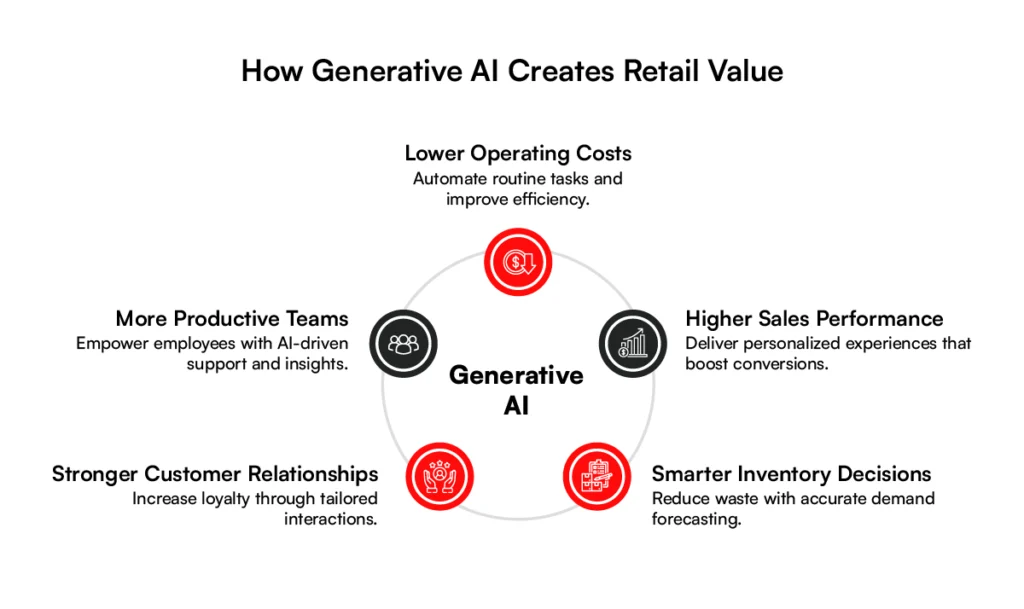
The real value of generative AI in the retail industry goes beyond automation. It gives you the ability to reduce costs, increase revenue, and improve operational efficiency across your business. You can also use it to deliver more personalized shopping experiences that keep customers engaged and coming back.
As competition becomes more intense, meeting rising customer expectations can be challenging. Gen AI in retail helps you address both challenges by streamlining operations and creating better customer experiences at scale.
1. Cost Reduction
Running a retail business requires significant investment in customer service, content creation, inventory management, and day-to-day operations. Generative AI helps you reduce these costs by automating repetitive and time-consuming tasks.
For example, AI-powered virtual assistants can handle common customer inquiries around the clock, reducing the need for large support teams. Your marketing team can use Gen AI in retail to create product descriptions, email campaigns, social media content, and promotional materials in a fraction of the time required for manual creation.
You can also use AI-generated insights to optimize inventory planning, improve demand forecasting, and reduce costly overstocking or stockouts. As a result, your business can operate more efficiently while lowering operational expenses.
2. Revenue Growth
Generative AI helps you create highly personalized shopping experiences that encourage customers to buy more and return more often.
By analyzing customer behavior, browsing patterns, purchase history, and preferences, AI can generate tailored product recommendations, personalized offers, and customized marketing messages. These personalized interactions help you increase conversion rates and average order values. Generative AI can also help you identify emerging trends and customer demands faster. This allows you to launch relevant products, promotions, and campaigns that resonate with your target audience and create new revenue opportunities.
3. Waste Reduction
Managing inventory efficiently is one of the biggest challenges in retail. Excess inventory often leads to markdowns, disposal costs, and unnecessary waste, while insufficient inventory can result in lost sales and disappointed customers.
Generative AI helps you make more accurate demand predictions by analyzing large volumes of historical, seasonal, and real-time data. Better forecasting allows you to stock the right products in the right quantities.
You can also use AI-generated insights to optimize supply chain operations, improve replenishment strategies, and reduce product spoilage in categories such as grocery and food retail. These improvements help lower waste while supporting your sustainability goals.
4. Enhanced Brand Loyalty
Today’s customers expect personalized and seamless experiences throughout their shopping journey. Gen AI in retail helps you meet these expectations by delivering relevant interactions across multiple touchpoints.
AI-powered shopping assistants can provide personalized product guidance, answer questions instantly, and help customers find products that match their preferences. Generative AI can also create customized loyalty rewards, targeted promotions, and individualized communications that make customers feel valued.
When customers consistently receive relevant recommendations and positive experiences, they are more likely to trust your brand, make repeat purchases, and become long-term advocates.
5. Increased Workforce Productivity
Your employees often spend valuable time on administrative work, content creation, reporting, and repetitive customer interactions. Generative AI can automate many of these tasks, allowing your teams to focus on higher-value activities.
Store associates can access AI-generated product information and customer insights to provide better in-store assistance. Marketing teams can accelerate campaign creation and testing. Customer service teams can use AI-generated response suggestions to resolve issues faster.
RBMSoft provides IT services for retail that connect generative AI with your ecommerce platforms, customer data, inventory systems, and business workflows. We help turn Gen AI use cases into working retail solutions tied to measurable business outcomes.
Reduce Costs, Increase Revenue
Struggling to balance customer expectations with rising operational costs? Discover how AI can help you streamline operations while driving measurable growth.
Get Started Now
7 Important Generative AI Use Cases in Retail
Generative AI can help you improve far more than customer-facing experiences. You can use it to design products, personalize customer interactions, optimize inventory, and automate repetitive tasks across your retail operations. Let’s look at some of the most impactful ways retailers are using generative AI today.
1. Product and Display Design
Creating new products and designing effective in-store displays often requires extensive research, multiple revisions, and significant creative effort. Generative AI can help you speed up this process by generating design concepts based on customer preferences, market trends, and historical sales data.
You can use AI to visualize product variations, packaging designs, store layouts, and merchandising displays before investing in production. This allows you to test ideas faster, shorten design cycles, and create products and displays that better match customer expectations.
2. Automated Content Generation
As a retailer, you create large volumes of content every day, from product descriptions and marketing emails to social media posts and promotional campaigns. Generative AI can help you automate much of this work while maintaining consistency across channels.
Instead of manually writing thousands of product descriptions, you can generate accurate and engaging content at scale. Your marketing team can also use AI to create campaign copy, promotional messages, and customer communications more efficiently. This saves time and allows your team to focus on strategy, creativity, and campaign optimization.
3. Personalized Marketing
Today’s customers expect brands to understand their preferences and deliver relevant experiences. Generative AI helps you meet those expectations by analyzing customer behavior, purchase history, browsing activity, and preferences.
Using these insights, you can create personalized emails, targeted promotions, and customized product offers for individual shoppers. Rather than sending the same message to everyone, you can deliver highly relevant content that increases engagement, conversions, and customer satisfaction.
4. Product Recommendations
Product recommendations play an important role in influencing purchase decisions. Gen AI in retail takes recommendations beyond basic “customers also bought” suggestions by understanding customer intent and shopping context. By analyzing customer interactions in real time, AI can recommend products that align with individual preferences, budgets, and buying goals.
This helps your customers discover relevant products faster while increasing average order value and creating more cross-selling opportunities.
5. Inventory Management and Supply Chain Optimization
Managing inventory effectively is one of the biggest challenges in retail. Excess inventory can tie up capital and increase storage costs, while stock shortages can result in lost sales and frustrated customers.
Generative AI helps you improve demand forecasting by analyzing historical sales data, seasonal trends, customer behavior, and external market factors. More accurate forecasts allow you to maintain optimal inventory levels and make smarter purchasing decisions.
You can also use AI-generated insights to improve supplier coordination, warehouse management, and replenishment planning. This helps create a more efficient supply chain that can respond quickly to changing customer demand.
6. Visual Search and Virtual Try-On
Customers increasingly expect shopping experiences that are convenient, interactive, and personalized. Generative AI helps deliver these experiences through visual search and virtual try-on capabilities.
Visual search allows your customers to upload an image and instantly find similar products within your catalog. Virtual try-on tools enable shoppers to see how clothing, accessories, cosmetics, or even furniture may look before making a purchase. These experiences help customers shop with greater confidence, improve engagement, and reduce the likelihood of product returns.
7. Customer Service Automation
Customer service teams often spend a significant amount of time handling repetitive inquiries about orders, returns, products, and store policies. Generative AI helps automate these interactions through intelligent chatbots and virtual assistants.
Unlike traditional rule-based bots, AI-powered assistants can understand natural language, provide contextual responses, and guide customers throughout their shopping journey. They can answer questions, recommend products, track orders, and resolve common issues at any time.
This allows you to provide faster support, reduce service costs, and free up human agents to focus on more complex customer requests.
Ready to Modernize Retail?
From personalized marketing to inventory optimization, implement Gen AI solutions that solve real business challenges.
Let’s Build ItReal-World Generative AI in Retail Examples
1. Amazon
Amazon uses generative AI across multiple areas of its retail business to improve customer experiences and streamline operations. The company leverages AI to create product descriptions, generate personalized advertising content, and deliver more relevant shopping recommendations.
Amazon also integrates AI into technologies such as Amazon One for contactless payments and Just Walk Out for frictionless in-store checkout experiences. In addition, generative AI helps Alexa deliver more natural and context-aware conversations.
It also helps Amazon Pharmacy accurately interpret complex prescription instructions. This helps improve operational efficiency and customer service.
2. Walmart
Walmart is using generative AI to create more intuitive and personalized shopping experiences for both customers and store associates. Its AI-powered search capabilities understand the intent behind customer queries rather than relying solely on keywords.
This allows Walmart to deliver more relevant product suggestions based on specific shopping needs. For example, a customer searching for Valentine’s Day gift ideas may receive curated recommendations that include chocolates, flowers, jewelry, and other related products in a single experience.
The company is also using generative AI to support store associates by providing quick access to product information and customer assistance tools. This enables employees to answer detailed questions, locate products more efficiently, and deliver a better in-store shopping experience.
3. Sephora
Sephora is using generative AI to enhance the online beauty shopping experience through its Virtual Artist app, developed in collaboration with ModiFace. The app allows customers to virtually try on different makeup products before making a purchase, helping them make more confident buying decisions.
By combining generative AI with augmented reality technology, the platform can realistically render makeup shades on a user’s face in real time.
Facial recognition technology maps individual facial features to create a seamless and personalized experience. This approach has driven significant customer engagement, with millions of users experimenting with products virtually and hundreds of millions of shades tried on through the platform.
Sephora continues to explore new generative AI capabilities, including personalized product recommendations based on skin tone, preferences, and beauty goals. The technology also has the potential to support future product development by uncovering customer trends and insights from large volumes of consumer data.
Challenges for Implementing Generative AI in the Retail Industry and Their Solutions
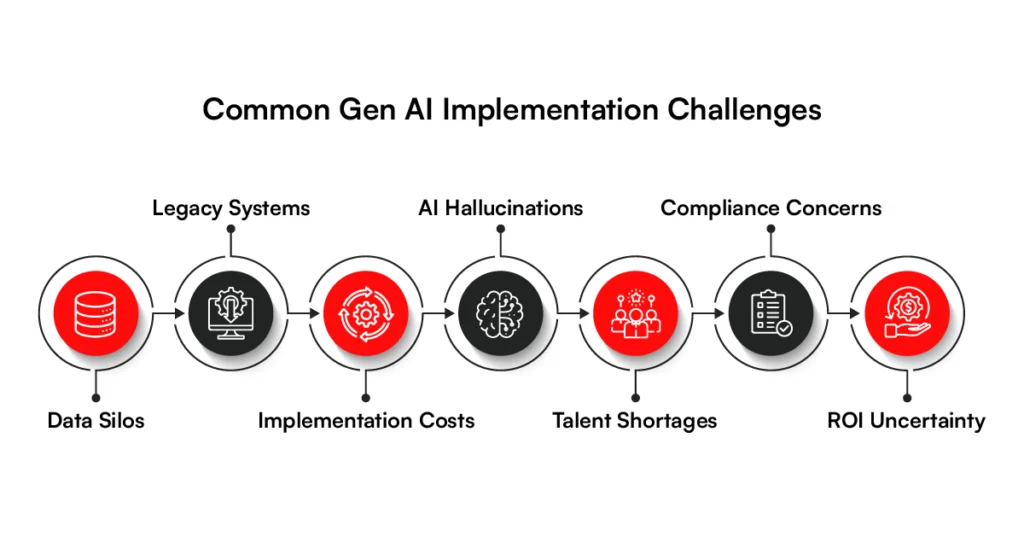
While generative AI can help you transform retail operations, implementing it successfully is not always easy. Many retailers face challenges related to data, technology, talent, and governance that can slow adoption and limit results.
The key is to identify these challenges early and address them strategically. Doing so can help you maximize the value of your generative AI investments and scale initiatives more effectively.
1. Data Quality and Fragmentation
Generative AI in the retail industry is only as good as the data it learns from. However, if your customer, inventory, sales, supply chain, and marketing data are spread across multiple disconnected systems, it becomes difficult for AI to generate reliable insights.
Inconsistent data formats, duplicate records, and missing information can lead to inaccurate recommendations, poor forecasting, and ineffective personalization efforts. For example, if customer data is fragmented across different channels, your AI models may struggle to understand customer preferences accurately.
Solution: You should focus on creating a unified data ecosystem by integrating data from critical business systems. Regular data cleansing, standardization, and governance practices can improve data quality and ensure your AI models have access to accurate and reliable information.
2. Integration with Legacy Systems
Many retailers still depend on legacy software and infrastructure that were not built to support modern AI technologies. Integrating generative AI with older ERP, CRM, inventory management, and point-of-sale systems can be both complex and time-consuming.
Without proper integration, you may continue to deal with data silos, limited visibility, and operational inefficiencies that prevent AI from delivering its full value.
Solution: Rather than replacing existing systems all at once, you can take a phased approach to modernization. APIs, middleware solutions, and cloud integration platforms can help connect legacy systems with AI applications while minimizing disruption to your daily operations.
3. High Implementation Costs
Implementing generative AI often requires investments in infrastructure, cloud services, data management, model customization, and employee training.
For many retailers, especially small and mid-sized businesses, these costs can create uncertainty around adoption. It can also be difficult to justify the investment when the business benefits are not immediately visible.
Solution: Start with use cases that can deliver measurable results quickly. Applications such as customer service automation, content generation, and personalized product recommendations often provide fast and visible returns. Early wins can help you build internal confidence and secure support for larger AI initiatives.
4. Model Accuracy and Hallucinations
One of the biggest concerns with generative AI is that it can sometimes generate inaccurate, misleading, or completely fabricated information. In retail, this could result in incorrect product details, pricing errors, or inaccurate responses to customer inquiries.
These issues can damage customer trust and negatively affect your brand reputation, especially when AI is used in customer-facing applications.
Solution: You should establish strong validation processes and maintain human oversight for critical workflows. Using techniques such as Retrieval-Augmented Generation (RAG) allows AI models to generate responses based on verified business data, improving reliability and reducing hallucinations. Continuous monitoring and regular model updates can further enhance accuracy.
5. Skills and Talent Gap
Successfully implementing generative AI requires expertise in areas such as machine learning, data science, AI governance, system integration, and change management.
However, many retail organizations do not have access to these specialized skills internally. Without the right talent, you may struggle to build effective AI strategies, deploy solutions efficiently, and maintain long-term performance.
Solution: Investing in employee training and upskilling programs can help bridge the skills gap. You can also partner with experienced AI consultants and technology providers to accelerate implementation while building internal expertise. Creating cross-functional teams that combine business and technical knowledge can further improve project outcomes.
6. Governance, Privacy, and Compliance
As a retailer, you manage large volumes of customer information, including purchase histories, payment details, and personal data. When generative AI systems process this information, concerns around privacy, security, transparency, and regulatory compliance become increasingly important.
Failing to address these concerns can expose your business to legal risks, financial penalties, and reputational damage.
Solution: Establish clear AI governance policies that define how data is collected, stored, accessed, and used. You should also implement strong security controls, conduct regular compliance audits, and ensure adherence to applicable data protection regulations. Responsible AI practices can help build trust with both customers and stakeholders.
7. Unclear ROI and Business Alignment
Many businesses adopt generative AI because of industry hype rather than a clearly defined business objective. As a result, projects may fail to deliver meaningful outcomes or gain support from leadership teams.
Without measurable goals, it becomes difficult to determine whether your AI initiatives are creating real business value.
Solution: Before implementing any AI solution, clearly define the business problem you want to solve and establish success metrics.
Whether your goal is increasing conversion rates, reducing support costs, or enhancing customer satisfaction, you should start by defining clear business objectives. Aligning AI initiatives with those goals makes it easier to measure performance and achieve sustainable ROI.
Overcome AI Adoption Barriers
Struggling with data silos, legacy systems, or unclear ROI? We help retailers implement AI with a clear roadmap and measurable outcomes.
Book a Free ConsultationConclusion
Generative AI is rapidly becoming a competitive advantage for retailers looking to improve customer experiences, streamline operations, and drive business growth. Generative AI helps retailers improve customer experiences, streamline operations, and drive growth through intelligent automation and personalization.
However, realizing the full potential of AI requires more than implementing the right technology. You need access to reliable data, scalable infrastructure, and a clear strategy that aligns AI initiatives with business objectives.
At RBMSoft, we help retailers unlock the value of their data and transform it into actionable business intelligence. As a provider of comprehensive retail software development services, we build data-driven solutions that help businesses improve decision-making, enhance customer engagement, and optimize retail operations.
Our capabilities include:
- Ecommerce data analytics and reporting
- Customer behavior and purchase pattern analysis
- Demand forecasting and inventory optimization
- Personalized recommendation solutions
- Predictive analytics and AI-powered insights
- Custom AI development services for retail and ecommerce
Whether you’re starting your AI journey or scaling existing initiatives, RBM Soft can help you build the data foundation and AI solutions needed to stay competitive.
FAQ’s
1. How does GenAI improve business?
GenAI improves business by automating repetitive tasks, enhancing decision-making, and delivering personalized customer experiences. It can help organizations reduce operational costs, increase productivity, improve customer engagement, and uncover new revenue opportunities through data-driven insights.
2. How is GenAI used in retail?
The use of gen AI in retail spans a wide range of applications, including product recommendations, customer service automation, personalized marketing, inventory management, content generation, and demand forecasting. Retailers use GenAI to improve efficiency while creating more relevant and engaging shopping experiences.
3. What is the role of GenAI in online retail?
In online retail, generative AI in retail helps businesses personalize customer interactions, generate product descriptions, automate marketing campaigns, improve product discovery, and provide intelligent customer support. These capabilities help ecommerce brands increase conversions and improve customer satisfaction.
4. How can AI be used for order tracking in retail?
AI can improve order tracking by providing real-time shipment updates, predicting delivery delays, and automatically responding to customer inquiries about order status. Combined with gen AI automation in retail, AI-powered virtual assistants can proactively notify customers about shipment progress and resolve common order-related questions without human intervention.
5. What is generative AI in retail and ecommerce?
Generative AI in retail and ecommerce refers to the use of advanced AI models that can create content, generate insights, and automate interactions based on business and customer data. Retailers use it for personalized recommendations, customer service, marketing content creation, and inventory optimization to improve both customer experiences and operational efficiency.
6. How can AI enhance customer engagement in retail?
AI helps retailers deliver personalized recommendations, targeted promotions, conversational shopping assistants, and customized customer experiences. These capabilities enable businesses to engage customers more effectively and build stronger relationships. Many modern gen AI solutions in retail are specifically designed to improve customer engagement and increase loyalty.
7. How much does it cost to implement GenAI in the retail industry?
The cost of implementing generative AI in the retail industry varies depending on the complexity of the solution, integration requirements, data readiness, and business objectives. Small-scale implementations may cost a few thousand dollars, while enterprise-wide deployments can require significantly larger investments. Starting with a focused use case often helps retailers achieve faster ROI.
8. How long does it take to implement GenAI in retail?
Implementation timelines depend on project scope, infrastructure readiness, and integration complexity. Simple applications such as AI chatbots or content generation tools can often be deployed within a few weeks, while larger generative AI in retail initiatives involving personalization, analytics, and supply chain optimization may take several months.
9. How does AI improve retail supply chain operations?
AI improves forecasting, inventory planning, supplier coordination, and logistics management. By analyzing historical and real-time data, gen AI in retail supply chain operations helps retailers reduce stockouts, prevent overstocking, and improve overall efficiency.
10. Can AI help reduce supply chain disruptions in retail?
Yes. Gen AI in retail supply chain management can identify potential disruptions early, predict demand fluctuations, and recommend corrective actions. This enables retailers to respond faster to changing market conditions and maintain smoother operations across the supply chain.