
Table of Contents
Key Takeaways:
- API-first architecture enables seamless communication between independent systems, making headless commerce possible.
- Headless commerce APIs give you the flexibility to build and deliver consistent experiences across multiple digital channels.
- APIs such as Catalog, Cart, Checkout, and Customer APIs power core ecommerce functions and simplify integrations.
- An API-first approach helps you innovate faster, integrate best-of-breed tools, and scale your commerce ecosystem efficiently.
- While headless commerce offers significant benefits, careful planning is essential to address challenges such as complexity, higher costs, and replatforming.
Customers expect consistent shopping experiences across websites, mobile apps, marketplaces, and other digital channels. However, traditional ecommerce platforms often make it difficult to deliver these experiences.
Launching new features, integrating third-party tools, or expanding to new channels can take significant time and effort.
API-first headless commerce addresses these challenges by separating the frontend from the backend and connecting systems through APIs. This approach gives you the flexibility to build experiences faster, integrate specialized tools, and scale across channels without disrupting core commerce operations.
This article covers the fundamentals of headless commerce APIs development. But before exploring how headless commerce APIs work, it’s important to understand why APIs are the backbone of a headless architecture and the key to delivering flexible, scalable commerce experiences.
Why API is Important in Headless Commerce
APIs are the backbone of headless commerce. In a headless architecture, the front end that customers interact with is separated from the back-end commerce engine. APIs act as messengers between these independent systems, enabling them to exchange data and perform actions in real time.
Whether a customer browses products, adds items to the cart, or completes a purchase, APIs ensure that information flows seamlessly between all connected applications.
APIs are important in headless commerce because they enable flexibility, scalability, and omnichannel experiences. Businesses can create unique customer experiences across websites, mobile apps, marketplaces, and other digital touchpoints without changing the core commerce system.
APIs also make it easier to integrate third-party tools, launch new features faster, and adapt to changing customer expectations.
Types of APIs in Headless Commerce
Headless commerce relies on multiple APIs to connect the frontend experience with backend services. Each API handles a specific function, ensuring that different components of the commerce ecosystem work together seamlessly.
| API Type | Purpose | Example |
| Catalog API | Delivers product information across all sales channels. | Updates product prices and inventory in real time. |
| Login API | Authenticates users and manages secure access. | Enables SSO, MFA, and social logins. |
| Cart API | Manages shopping cart operations and syncs carts across devices. | Customers continue shopping seamlessly across mobile and desktop. |
| Checkout API | Handles payments, taxes, shipping, and order creation. | Supports express checkout and multiple payment methods. |
| Marketing API | Connects commerce data with marketing and personalization tools. | Triggers abandoned cart emails and personalized offers. |
| Customer API | Manages customer profiles, preferences, and order history. | Keeps customer information consistent across all channels. |
1. Catalog API
A Catalog API manages and delivers product information to customer-facing channels. It serves as the primary source of product data, including product names, descriptions, images, pricing, specifications, categories, availability, and inventory status.
When a customer browses a website or mobile app, the frontend requests product information through the Catalog API, which retrieves the required data from the backend commerce system.
APIs distribute product information across multiple touchpoints, ensuring consistent experiences across websites, mobile apps, marketplaces, kiosks, and social commerce channels.
For example, if a retailer updates a product’s price or inventory level, the Catalog API automatically reflects those changes across all connected sales channels.
2. Login API
A Login API manages user authentication and authorization processes. It enables customers to create accounts, sign in securely, reset passwords, and access personalized shopping experiences.
In a headless environment, customers often interact with a brand through multiple channels. The Login API ensures that users can authenticate seamlessly across websites, mobile applications, and other digital touchpoints while maintaining a consistent identity.
Beyond basic authentication, Login APIs often support advanced security capabilities such as single sign-on (SSO), multi-factor authentication (MFA), social logins, and token-based authentication. These capabilities help businesses strengthen security while reducing friction during the login process.
3. Cart API
A Cart API handles all shopping cart-related operations throughout the customer journey. It allows customers to add products to their cart, update quantities, remove items, save products for later, and retrieve cart details across sessions.
One of the key advantages of a Cart API is its ability to maintain cart consistency across devices. For instance, a customer may add products to a cart using a mobile app and later complete the purchase on a desktop website.
The Cart API synchronizes this information in real time, ensuring a seamless omnichannel experience. Cart APIs can also support promotional rules, discounts, coupon applications, and dynamic pricing, allowing businesses to create personalized shopping experiences.
4. Checkout API
A Checkout API orchestrates the final stages of the purchase process. It connects multiple backend services, including payment gateways, shipping providers, tax engines, fraud detection tools, and order management systems.
When customers proceed to checkout, the API validates cart information, calculates taxes and shipping charges, processes payments, and creates orders within the commerce platform.
Businesses can customize and optimize the checkout experience without affecting other parts of the application because these processes occur through APIs.
For example, retailers can introduce express checkout options, buy now pay later services, or region-specific payment methods by integrating additional APIs into the checkout flow.
5. Marketing API
A Marketing API enables seamless integration between ecommerce platforms and marketing technologies. It allows businesses to connect customer and commerce data with email marketing platforms, customer data platforms, analytics tools, personalization engines, and advertising systems.
Marketing APIs help organizations deliver personalized promotions, targeted campaigns, product recommendations, and automated customer journeys by sharing customer behavior and transaction data across systems.
For example, if a shopper abandons a cart, the Marketing API can trigger an automated email reminder or personalized promotional offer to encourage conversion.
6. Customer API
A Customer API manages customer-related information across the entire commerce ecosystem. It stores and retrieves customer profiles, addresses, preferences, order history, loyalty points, and account settings.
Centralizing customer information through APIs enables businesses to create unified customer experiences across channels. Whether a customer interacts through a website, mobile app, customer support portal, or physical store, the same profile information remains accessible and up to date.
Customer APIs also support personalization initiatives by allowing businesses to tailor content, product recommendations, and promotions based on customer behavior, preferences, and purchase history.
Ready for API-First Commerce?
Create seamless customer experiences across every channel with a robust API-first commerce architecture.
Start My Transformation
How Do Headless Ecommerce APIs Work?
Headless commerce separates the customer-facing experience from the backend commerce engine. Instead of operating as a single, tightly connected system, the frontend and backend function independently and communicate through APIs.
This architecture gives businesses the flexibility to create unique customer experiences while maintaining a robust commerce foundation.
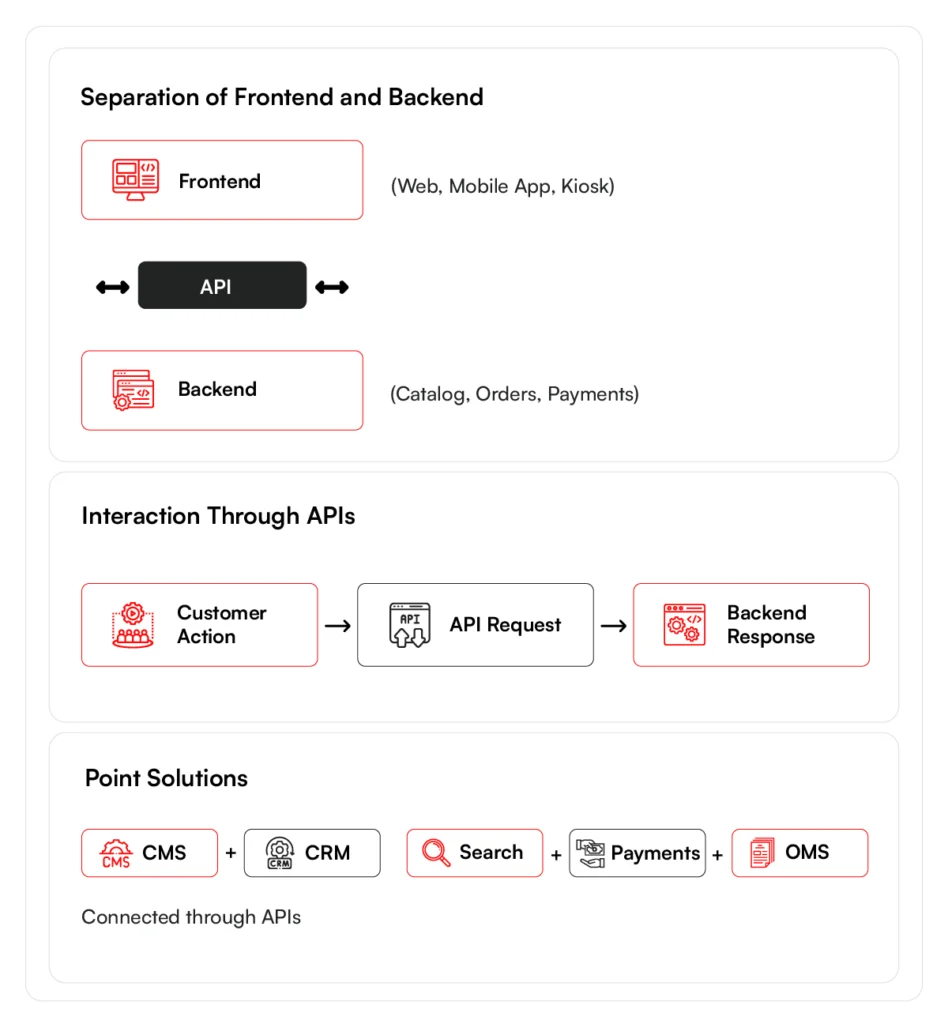
1. Separation of Frontend and Backend
In a traditional ecommerce platform, the frontend and backend are tightly coupled. Any changes to the customer interface often require modifications to the backend as well. Headless commerce removes this dependency by decoupling the presentation layer from the commerce engine.
The frontend includes customer touchpoints such as websites, mobile apps, kiosks, smart devices, and other digital interfaces. The backend manages core commerce functions such as product catalogs, inventory, pricing, customer accounts, and order processing.
Since both layers operate independently, development teams can update the user experience, redesign storefronts, or launch new digital channels without disrupting backend operations.
2. Interaction is Done Through APIs
APIs serve as the communication bridge between the frontend and backend systems. Whenever a customer acts, the frontend sends an API request to the backend, which processes the request and returns the necessary information.
For example, when a customer searches for a product on a mobile app, the app sends a request to the product catalog API. The backend retrieves the relevant product details and sends them back to the app, which then displays the information to the customer.
This API-driven communication occurs continuously throughout the shopping journey, from browsing products and managing carts to processing payments and completing orders.
3. Point Solutions
Headless commerce allows businesses to integrate specialized point solutions instead of relying on a single all-in-one platform. A point solution is a dedicated application designed to perform a specific business function.
For instance, a retailer may use one solution for content management, another for search and personalization, a separate payment gateway, and a different order management system. APIs connect these applications and enable them to exchange information seamlessly.
This modular approach allows businesses to choose best-of-breed technologies, replace individual components when needed, and scale specific services without affecting the entire commerce ecosystem.
What are the Different API Protocols?
API protocols define the rules and standards that applications use to communicate with each other. In headless commerce, these protocols determine how data is exchanged between the frontend, backend, and third-party services.
Choosing the right protocol can significantly impact performance, scalability, flexibility, and developer productivity.
1. REST
Representational State Transfer (REST) is the most widely used API protocol in headless commerce. REST APIs use standard HTTP methods such as GET, POST, PUT, and DELETE to exchange data between systems.
REST is popular because it is simple, lightweight, and easy to implement. Most ecommerce platforms, content management systems, and third-party applications support REST APIs, making integrations relatively straightforward.
Ecommerce businesses often use REST APIs to retrieve product information, manage customer accounts, process orders, and synchronize inventory across channels.
2. SOAP
Simple Object Access Protocol (SOAP) is a protocol that enables applications to exchange structured information using XML messages.
Unlike REST, SOAP follows strict communication standards and includes built-in security, reliability, and error-handling capabilities.
Although modern headless commerce primarily relies on REST, many enterprises still use SOAP APIs to integrate legacy systems, ERP platforms, payment systems, and other critical business applications.
Organizations that require high levels of security and transactional reliability often continue to rely on SOAP-based services.
3. gRPC
gRPC is a high-performance API protocol developed by Google for fast and efficient communication between services. It uses Protocol Buffers instead of traditional JSON or XML formats, which reduces data size and improves processing speed.
Headless commerce architectures that rely on microservices often use gRPC to enable rapid communication between backend services.
Since gRPC supports low-latency communication and efficient data transfer, it is particularly well-suited to high-traffic ecommerce environments where speed and scalability are essential.
4. WebSockets
WebSockets provide a persistent, two-way communication channel between applications. Unlike traditional request-response protocols, WebSockets enable systems to exchange data continuously in real time without repeatedly opening new connections.
In headless commerce, WebSockets support use cases that require instant updates, such as live inventory availability, real-time order tracking, dynamic pricing updates, live chat, and personalized customer interactions.
WebSockets help businesses deliver more responsive and engaging shopping experiences by enabling continuous communication.
Optimize Your API Performance
The wrong API protocol can impact speed, scalability, and user experience. Our experts help you build high-performing commerce architectures.
Talk to our experts5 Key Benefits of API-First Headless Commerce
API-first headless commerce gives you the flexibility to build and scale digital experiences without being tied to a rigid, all-in-one platform. Since APIs connect independent systems, you can choose the tools that best fit your business and adapt quickly as customer expectations evolve.
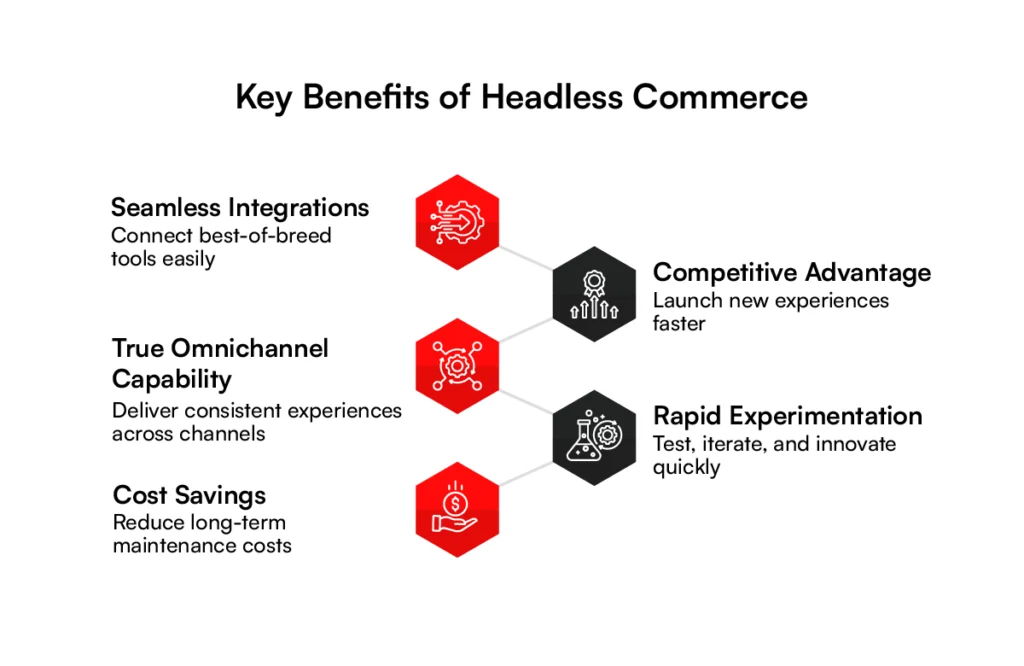
1. Seamless Integrations
Modern ecommerce businesses rely on a variety of tools, from content management systems and payment gateways to CRM platforms and analytics solutions.
With an API-first approach, you can connect these applications seamlessly and create a unified commerce ecosystem.
Instead of depending on a single platform for every capability, you can integrate best-of-breed solutions that meet your specific business needs. If you decide to replace or upgrade a particular tool in the future, you can do so without disrupting the rest of your technology stack.
2. True Omnichannel Capability
Today’s customers expect a consistent experience wherever they interact with your brand, whether through a website, mobile app, social media platform, online marketplace, or in-store kiosk.
API-first headless commerce makes this possible by enabling all customer touchpoints to access the same backend services and data.
For example, when you update product information, pricing, or inventory in the backend, those changes automatically become available across every connected channel.
This ensures that your customers receive a seamless and consistent experience regardless of where they choose to shop.
3. Lower Long-Term Costs
While transitioning to a headless architecture may require an upfront investment, it can significantly reduce long-term operational costs.
Since individual components operate independently, you only need to update or replace the specific service that requires improvement instead of replatforming your entire commerce system.
This modular approach also reduces maintenance complexity and allows your development teams to work on different services simultaneously. This improves efficiency and lowers ongoing development costs.
4. Stronger Competitive Advantage
Customer expectations and market trends change rapidly. API-first headless commerce gives you the agility to respond quickly to these changes.
You can launch new digital channels, introduce innovative customer experiences, or integrate emerging technologies without waiting for major platform upgrades.
This flexibility enables you to stay ahead of competitors and continuously deliver differentiated experiences that strengthen your brand.
5. Faster Experimentation and Innovation
Innovation becomes much easier when your frontend and backend are decoupled. Your teams can experiment with new storefront designs, personalized experiences, checkout flows, or promotional campaigns without affecting core commerce operations.
As a result, you can test ideas, gather customer feedback, and roll out successful initiatives much faster. This ability to iterate quickly helps you continuously improve the customer experience and accelerate time to market.
Top 3 Use Cases of Headless Commerce APIs
Headless commerce API development enables you to deliver flexible and highly personalized shopping experiences across multiple channels.
APIs allow you to create customer experiences that go far beyond a traditional ecommerce website by decoupling the frontend from the backend. Here are some common use cases:
1. Content-Driven Commerce
Content plays a critical role in influencing purchasing decisions. Headless commerce APIs enable you to combine engaging content with commerce functionality to create immersive shopping experiences.
For instance, you can embed shoppable products within blog posts, buying guides, videos, or editorial content. A fashion retailer can showcase an entire outfit in a style guide and allow customers to purchase featured items directly from the article without leaving the page.
2. Custom Frontend Development
Many businesses want to create unique digital experiences that differentiate their brand. Headless commerce API development gives you the freedom to design and develop fully customized storefronts without being restricted by predefined templates.
You can build highly interactive websites, progressive web applications, mobile apps, or even commerce experiences for smart devices while continuing to use the same backend commerce engine.
This flexibility allows you to deliver distinctive customer experiences while maintaining consistent business operations behind the scenes.
3. Personalized Shopping Experiences
Personalization has become a key differentiator in ecommerce. Headless commerce APIs allow you to integrate recommendation engines, customer data platforms, and analytics tools to deliver tailored experiences.
You can deliver personalized product recommendations, targeted promotions, and dynamic content based on customer preferences, browsing behavior, and purchase history. This improves engagement and conversions.
Common Challenges in Headless Commerce API Development and Their Solutions
While API-first headless commerce offers tremendous flexibility, it also comes with a few challenges. Before you adopt this architecture, it is important to understand the potential hurdles and plan accordingly. With the right strategy, you can overcome these challenges and maximize the value of your investment.
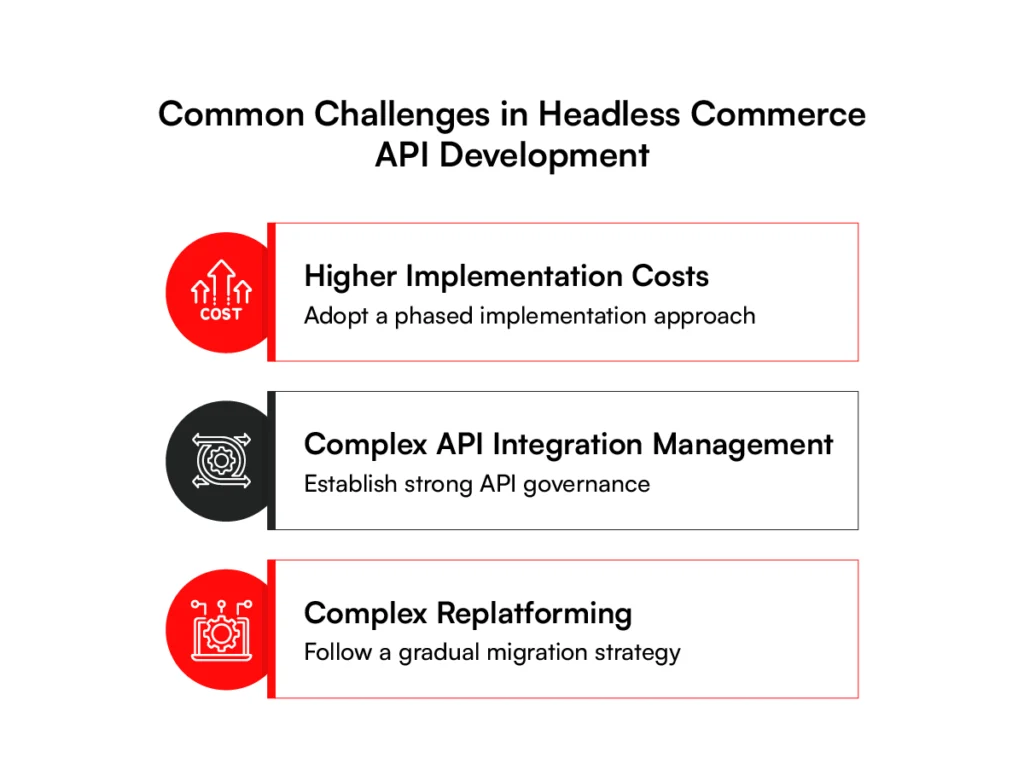
1. Higher Implementation Costs
Implementing a headless commerce architecture often requires you to invest in multiple specialized solutions. You may also need experienced developers to build and maintain integrations between these systems.
As a result, the initial investment can be higher than that of traditional ecommerce platforms.
Solution: To manage costs effectively, you should begin by identifying your core business requirements. You should also prioritize the capabilities that deliver the most value.
Instead of deploying multiple solutions simultaneously, you can adopt a phased implementation approach. This will help scale your technology stack as your business grows.
2. Complex API Integration Management
One of the biggest advantages of headless commerce is flexibility. However, greater flexibility also means greater complexity.
Managing integrations and ensuring seamless communication across systems can become challenging, since multiple independent services communicate through APIs.
Solution: You can reduce complexity by establishing clear API governance practices, maintaining comprehensive API documentation, and using centralized API management and monitoring tools.
A defined ecommerce integration approach can also establish how ERP, CRM, inventory, payment, fulfillment, and other commerce systems exchange data across the technology stack. Standardizing these connections can make ongoing maintenance and troubleshooting easier.
3. Complex Replatforming
Moving from a traditional ecommerce platform to a headless architecture isn’t a simple switch. You’ll need to migrate product catalogs, customer data, order history, and business workflows while keeping your store running smoothly.
Solution: Instead of replacing everything at once, adopt a phased re-platforming approach. Start by modernizing high-impact components, such as your storefront or checkout, while keeping your existing systems operational. This minimizes risk, reduces business disruption, and gives your team time to adapt.
If you’re planning a migration, our eCommerce Replatforming Guide walks you through the process, common challenges, and best practices for a successful transition.
Struggling With Replatforming?
Migrating to headless commerce does not have to disrupt your business. Our experts help you plan and execute seamless migrations with minimal risk.
Plan My MigrationHeadless API Architecture vs Traditional Architecture
The table below highlights the key differences between headless API architecture and traditional architecture.
| Feature | Headless API Architecture | Traditional Architecture |
| Architecture | Frontend and backend operate independently and communicate through APIs. | Frontend and backend are tightly coupled within a single platform. |
| Content Structure | Content is created once and delivered across multiple channels through APIs. | Content is usually designed for a single website or storefront and is closely tied to the presentation layer. |
| Frontend Flexibility | You can build fully customized experiences using any frontend framework or technology. | Frontend customization is often limited by the platform’s templates and predefined capabilities. |
| Performance | Independent services allow teams to optimize frontend performance and deliver faster user experiences. | Changes to one part of the system can affect overall performance, making optimization more challenging. |
| Scalability | Individual components can scale independently based on business needs and traffic demands. | Scaling typically requires expanding the entire platform, which can increase costs and complexity. |
The right choice ultimately depends on your business goals, existing technology landscape, and long-term growth plans.
If you’re evaluating whether headless commerce is the right fit for your business, RBMSoft can help. Our experts assess your current ecosystem, define the right architecture strategy, and build scalable API-first commerce solutions tailored to your unique requirements.
Conclusion
API-first architecture has become a key enabler of modern headless commerce. You can deliver seamless customer experiences and respond quickly to changing business needs by connecting systems through API.
While implementing a headless architecture comes with challenges, the long-term benefits in terms of flexibility, scalability, and innovation often outweigh the initial complexity.
At RBMSoft, we help businesses design, build, and optimize API-driven commerce ecosystems through our Ecommerce software development services. Our team combines deep commerce expertise with strong data and integration capabilities to help you create connected, high-performing digital experiences.
We also offer specialized headless commerce development services to help you modernize legacy platforms and accelerate digital growth.
Our capabilities include:
- API-first headless commerce architecture design and implementation
- Custom storefront and frontend development
- Third-party API integration with CMS, CRM, ERP, payment, and marketing platforms
- Ecommerce data analytics and reporting solutions
- Customer behavior analysis and personalization strategies
- Real-time dashboards for sales, inventory, and customer insights
- Commerce platform modernization and replatforming support
- Ongoing optimization, performance monitoring, and maintenance
Partner with RBMSoft to build a future-ready, API-driven commerce ecosystem that scales with your business and delivers exceptional customer experiences.
FAQs
1. What is a Headless Commerce API, and how does it work?
A headless commerce API acts as a communication layer between the frontend and backend of an ecommerce platform. It enables independent systems to exchange data in real time, allowing businesses to deliver seamless shopping experiences across websites, mobile apps, and other digital channels.
2. What does an API-first approach mean in headless commerce?
An API-first approach means designing and developing APIs before building customer-facing applications. This approach ensures that all components within the commerce ecosystem can communicate efficiently, making integrations, scalability, and future enhancements easier.
3. How is an API-first approach different from headless commerce, and are they the same thing?
No, they are not the same. Headless commerce refers to separating the frontend from the backend, while an API-first approach focuses on designing APIs as the foundation of the architecture.
Most modern headless commerce implementations adopt an API-first strategy to improve flexibility and interoperability.
4. What is MACH architecture, and is it the right approach for a $20M ecommerce brand?
MACH stands for Microservices, API-first, Cloud-native, and Headless. For fast-growing ecommerce businesses, MACH architecture can provide the scalability, agility, and flexibility needed to support expansion across channels and markets.
However, organizations should assess their business goals, existing systems, and technical capabilities before adopting MACH.
5. Which Headless Commerce API development companies have built solutions for enterprise retail in the UK?
Several technology providers specialize in enterprise-grade Headless Commerce API development for retailers in the UK. When evaluating partners, look for proven experience in API-first architecture, enterprise integrations, omnichannel commerce, replatforming, and large-scale digital transformation projects.
6. How do I choose between REST and GraphQL APIs for a headless commerce build?
REST APIs are simple, widely supported, and suitable for most ecommerce integrations. GraphQL offers greater flexibility by allowing applications to request only the data they need.
The choice depends on factors such as application complexity, performance requirements, and frontend customization needs.
7. What is the best API integration strategy for connecting ERP, PIM, and a headless commerce frontend?
The most effective strategy is to adopt an API-first integration approach with clearly defined data flows, centralized API management, and standardized integration patterns. This approach ensures consistent product, inventory, and customer data across all systems.
8. What security vulnerabilities should I watch for in a headless API-first commerce architecture?
Common security risks include broken authentication, unauthorized access, API abuse, data exposure, and insecure third-party integrations.
Implementing authentication protocols, encryption, rate limiting, continuous monitoring, and regular security audits can help mitigate these risks.
9. What payment API integrations are essential for a headless ecommerce store selling across Germany, France, and the UK?
A headless ecommerce API strategy for European markets should support region-specific payment methods alongside major global providers.
Businesses typically integrate payment gateways that support credit cards, digital wallets, Buy Now Pay Later options, and local payment methods to improve customer experience and maximize conversions.