



Table of Contents
Quick Summary:
- AI software development costs can range from $10,000 to $1,000,000+. The final cost depends on complexity, integrations, infrastructure, and scalability needs.
- Simple AI tools such as chatbots and automation systems usually cost between $10,000 and $75,000.
- Advanced enterprise AI platforms and generative AI systems can exceed $500,000+.
- Data preparation is one of the biggest cost drivers. Data collection, cleaning, labeling, and management can cost between $10,000 and $200,000+.
- AI infrastructure creates recurring monthly expenses after deployment. GPU training, cloud hosting, API usage, monitoring, and storage can cost anywhere from a few hundred dollars to $100,000+ per month at enterprise scale.
- Industry requirements strongly affect the cost of AI development. Healthcare, finance, and manufacturing projects are more expensive due to the complexity of compliance, security, and integration.
- Businesses can reduce AI software development costs by starting with an MVP. Using pre-trained models, improving data quality early, and planning for long-term maintenance also help control costs.
You are planning to build an AI software solution for your business. You have a use case in mind, maybe a chatbot, a recommendation engine, or a predictive tool. You start researching costs, and the numbers are all over the place.
One source says it can cost a few thousand dollars, while another says it can cost hundreds of thousands. This gap creates confusion and makes it hard to plan your budget with confidence. Many businesses face this exact problem. They underestimate the role of data, ignore integration challenges, or overlook long-term expenses like maintenance and scaling.
As a result, projects go over budget or fail to deliver expected results. AI involves data, experimentation, and continuous improvement, which makes cost estimation more complex. In this article, you will get a clear breakdown of what actually drives AI software development cost. From complexity and data requirements to team structure and long-term expenses, this blog will help you understand where your money goes and how to plan smarter.
Cost to Develop AI Software Solution: Complete Breakdown by Complexity
AI development costs vary based on the solution’s complexity and the degree of integration into business operations.
For enterprises, this difference becomes even more pronounced because systems must scale, handle large datasets, and meet strict performance and security requirements. Below is a clear breakdown of costs by complexity level.
| Complexity Level | Typical Enterprise Use Cases | Cost Range (USD) | Timeline | What Drives the Cost |
| Simple AI Solutions | Chatbots, basic automation, API-based AI features | $10,000 – $75,000 | 4–8 weeks | Uses pre-trained models, minimal data prep, and limited customization |
| Intermediate AI Solutions | Recommendation engines, predictive analytics, and NLP tools | $75,000 – $300,000 | 3–6 months | Requires custom model training, structured data pipelines, and more integrations |
| Advanced AI Solutions | Enterprise AI platforms, real-time systems, and multi-agent AI | $300,000 – $1,000,000+ | 6–18 months | Large datasets, high infrastructure cost, complex architecture, and scalability needs |
Simple AI solutions are usually the starting point for many businesses. These systems rely on existing models or APIs, which reduces development effort. Enterprises often use them for quick automation or customer support.
Since they require less data preparation and minimal customization, costs stay relatively low. However, these solutions may not deliver deep insights or handle complex workflows at scale.
Intermediate AI solutions involve more customization and business logic. Enterprises use them for predictive analytics, product recommendation engines, or intelligent search systems.
These projects need structured data pipelines, model training, and tighter system integration. As a result, both development time and cost increase. At this level, companies also start investing in accuracy, performance, and scalability.
Advanced AI solutions are built for enterprise-wide impact. These include large-scale AI platforms, real-time decision systems, and multi-agent architectures. They require massive datasets, strong infrastructure, and continuous monitoring.
Costs increase significantly due to custom model development, cross-system integration, and long-term maintenance. In many enterprise cases, the total investment can go beyond initial build costs due to ongoing optimization and scaling needs.
Know Your True AI Spend
Over 60% of AI costs are driven by data and infrastructure. Understand where your budget will go.
Get Cost Insights
AI Software Development Cost Based on Type or Industry
AI software development cost depends heavily on what type of solution you are building and the industry you operate in. Not all AI technologies require the same level of effort, data, or infrastructure.
Similarly, industry-specific requirements, such as compliance, accuracy, and integration needs, can significantly affect the final budget. Let’s break this down so you can see where your project might fit.
AI Software Development Costs by Type
| AI Type | Typical Use Cases | Cost Range (USD) |
| Machine Learning Models | Forecasting, classification, automation | $50,000 – $200,000 |
| Natural Language Processing | Chatbots, search, summarization, copilots | $60,000 – $300,000+ |
| Computer Vision Applications | Image recognition, surveillance, quality checks | $80,000 – $250,000+ |
| Predictive Analytics & Recommendation Engines | Product recommendations, demand forecasting | $30,000 – $200,000 |
| Chatbots & Virtual Assistants | Customer support, automation, voice assistants | $5,000 – $150,000+ |
| Generative AI & AI Agents | Content generation, automation workflows | $100,000 – $1,000,000+ |
- Machine Learning Models
Machine learning models form the base of most AI systems. Costs usually depend on the amount of data you have and the complexity of the model.
Simple models with structured data are more affordable, while custom or deep learning models require more training time and computing power. This increases both development and infrastructure costs.
- Natural Language Processing
Natural language processing solutions handle text and language-based tasks such as search, summarization, and AI assistants. These systems require large language datasets and fine-tuning to improve accuracy and fluency. Costs increase further if you need multilingual support or domain-specific understanding.
- Computer Vision Applications
Computer vision systems work with images and videos. These include facial recognition, object detection, and quality inspection tools. Development costs rise due to the need for labeled image data and high-performance infrastructure for training and processing visual inputs.
- Predictive Analytics and Recommendation Engines
These systems analyze historical data to predict future outcomes or suggest products and content. Costs depend on data quality, model complexity, and the degree to which the system integrates with existing platforms. Real-time recommendations and personalization features can further increase the budget.
- Chatbots and Virtual Assistants
Chatbots are often the entry point for AI adoption. Basic bots using predefined flows are relatively affordable. However, advanced virtual assistants with contextual understanding, voice capabilities, and system integrations can become much more expensive due to added complexity and training needs.
- Generative AI & AI Agents
Newer AI types, such as generative AI tools, AI agents, and automation platforms, can significantly increase costs. These systems often involve multiple models, continuous learning, and real-time decision making. This adds to both development effort and ongoing operational expenses.
AI Software Development Pricing by Industry
The cost of developing custom AI software varies across industries because each sector has different requirements for accuracy, compliance, data sensitivity, and system integration. Some industries can tolerate small errors, while others cannot.
Some deal with open data, while others handle highly sensitive information. These differences directly impact development time, testing effort, infrastructure, and overall cost.
| Industry | What Affects the Cost | Cost Range (USD) |
| Healthcare | Compliance, accuracy, sensitive data, system integration | $80,000 – $600,000+ |
| Retail & eCommerce | Personalization, real-time processing, scalability | $50,000 – $400,000+ |
| Manufacturing & Industrial | IoT integration, real-time data, and hardware dependency | $60,000 – $500,000+ |
| Finance & Insurance | Security, compliance, high accuracy, risk management | $100,000 – $800,000+ |
1. AI in Healthcare
Healthcare AI solutions are expensive because they require very high accuracy and strict compliance with data privacy regulations. Systems often handle sensitive patient data, increasing the need for robust security and governance.
Integration with hospital systems and electronic health records also adds complexity. Even small errors can have serious consequences, so teams spend more time on validation and testing, which increases cost.
2. AI for Retail and Ecommerce
Retail and ecommerce AI focuses on personalization, product recommendations, and customer engagement. These systems need to handle large volumes of customer data and deliver results in real time.
While compliance requirements are lower than healthcare or finance, scalability and performance become key cost drivers. Businesses also invest in continuous optimization to improve customer experience, which adds to long-term costs.
3. Manufacturing and Industrial AI Applications
Manufacturing AI solutions often involve predictive maintenance, supply chain optimization, and quality inspection. These systems need to process data from machines, sensors, and IoT devices.
Integration with hardware and real-time processing requirements increases development and infrastructure costs. Reliability is also critical, as system failures can affect production, leading to greater investment in testing and monitoring.
4. AI for Finance and Insurance
Finance and insurance AI solutions are among the most costly due to strict regulations and high accuracy requirements. Use cases like fraud detection, risk assessment, and automated decision-making demand reliable and explainable models.
Strong security, audit trails, and compliance frameworks are essential. These requirements increase both development effort and ongoing maintenance costs.
AI Software Solution Cost Breakdown by Project Stages
AI software development costs are spread across multiple stages, and each stage contributes differently to the total budget. Some phases require deep technical effort, while others focus more on planning or long-term support.
Understanding how costs are distributed across these stages helps you plan more accurately and avoid unexpected expenses.
| Project Stage | Typical Cost Range | What Influences the Cost |
| Discovery & Strategy | $5,000 – $25,000 | Use case validation, feasibility analysis, data audits and architecture planning |
| Data Acquisition & Preparation | $10,000 – $200,000+ | Data sourcing, labeling, cleaning, preprocessing, storage infrastructure |
| Model Development & Training | $20,000 – $250,000+ | Model complexity, training iterations, compute usage and accuracy requirements |
| Software Development & UI/UX | $15,000 – $150,000 | Frontend/backend development, APIs, dashboards, workflow customization |
| Integration & Testing | $5,000 – $50,000+ | Third-party integrations, QA testing, security checks, compliance validation |
| Deployment & Maintenance | $500 – $50,000+ per month | Cloud hosting, monitoring, retraining, scaling infrastructure |
Stage 1: Discovery & Planning
This stage defines the foundation of your AI project. Teams identify the problem, map out use cases, assess data readiness, and choose the right approach. It also includes feasibility checks and early cost estimation.
Although this phase takes up a smaller share of the budget, it has a significant impact on overall costs. Poor planning often leads to scope changes, delays, and expensive rework later.
Stage 2: Data Collection
Data collection is one of the most resource-intensive stages in AI development. Teams gather data from multiple sources, clean it, remove inconsistencies, and structure it for training. If the project requires labeled data, manual annotation adds both time and cost.
In many cases, businesses also need to invest in data storage, pipelines, and governance. As data volume grows, so do infrastructure and management costs, making this stage a major contributor to the overall budget.
Stage 3: Model Training
This is where the AI system is built and refined. Teams train models on prepared data, test different approaches, and improve performance through iterative refinement. The cost depends on model complexity, data size, and the level of accuracy expected.
Custom models require more experimentation and computing power, which increases cost. Even with pre-trained models, fine-tuning and validation take time and skilled effort.
Stage 4: UI/UX & Development
Once the model is ready, development teams build the application layer around it. This includes frontend interfaces, backend systems, and APIs that connect everything.
The cost here depends on the product’s level of advancement. Simple interfaces are quicker to develop, while enterprise-level systems with custom workflows and dashboards require more time and resources. A well-designed interface also improves usability, which is important for adoption.
Stage 5: Integration & Testing
AI systems need to work smoothly with existing business tools. Integration involves connecting to platforms such as CRMs, ERPs, and databases, which can be complex due to system compatibility.
Testing ensures the system performs well in real-world conditions. Teams validate accuracy, reliability, and security. As the number of integrations and features increases, testing effort and cost also grow.
Stage 6: Deployment & Maintenance
Deployment marks the transition from development to real-world use. Once live, the AI system needs continuous monitoring to ensure stable performance. Maintenance includes updating models, managing infrastructure, and improving performance over time.
AI systems often require retraining as data evolves, making this an ongoing cost rather than a one-time expense.
How much does it cost to maintain AI software post-launch?
Most AI proposals focus heavily on development cost, but the real financial commitment starts after deployment. AI systems evolve with data, user behavior, and business needs. This makes maintenance a continuous expense rather than a one-time activity.
For mid- to large-sized enterprises, ongoing maintenance can account for a significant portion of the total cost of ownership. If you do not plan for it early, it can strain budgets and reduce the long-term value of your AI investment.
| Cost Component | Estimated Cost Range (USD) | Frequency |
| Model Monitoring & Performance Tracking | $2,000 – $15,000/month | Recurring |
| Model Retraining & Updates | $10,000 – $100,000/year | Recurring |
| Cloud Infrastructure (Compute & Storage) | $5,000 – $120,000+/month | Recurring |
| API & Third-Party Services | $2,000 – $60,000+/month | Recurring |
| Security & Compliance | $10,000 – $80,000/year | Recurring |
| Maintenance & Bug Fixes | $3,000 – $25,000/month | Recurring |
| Feature Enhancements & Upgrades | $10,000 – $150,000/year | Periodic |
AI Software Development Cost by Regions (In-House vs. Nearshore vs. Offshore)
Where your development team is located has a major impact on the total cost of AI software. It is not just about hourly rates.
You also need to consider hiring time, communication efficiency, management overhead, and long-term scalability. In 2026, companies are choosing between in-house, nearshore, and offshore models based on a mix of cost, control, and delivery speed.
| Model | Hourly Rate (USD) | Annual / Monthly Cost | Key Cost Drivers | Best Use Case |
| In-House | $100 – $250+ | $150,000 – $250,000+ per year | Salaries, hiring, infrastructure, retention | Core AI systems, sensitive data |
| Nearshore | $40 – $90 | $6,000 – $15,000 per month | Collaboration efficiency, reduced overhead | Complex AI projects needing real-time communication |
| Offshore | $20 – $60 | $3,000 – $12,000 per month | Lower salaries, higher coordination effort | Scalable, well-defined tasks |
1. In-House Cost Structure
In-house development is the most expensive option. You hire full-time employees and build your own team internally. This gives you full control over the project, better collaboration, and stronger product ownership.
However, the cost goes far beyond salaries. You also pay for hiring, onboarding, training, infrastructure, and employee benefits. A senior developer in regions like the US can cost between $120,000 and $180,000+ per year, and the total cost, including overhead, can reach $150,000 to $250,000+ per engineer.
This model works best for core AI systems or highly sensitive projects. But it requires a large upfront investment and long-term commitment.
2. Nearshore Cost Structure
Nearshore development offers a middle ground between cost and collaboration. You work with teams in nearby countries with similar time zones, which makes communication easier and faster. Nearshore developers typically cost around $40 to $90 per hour, or about $6,000 to $15,000 per month per engineer.
The main advantage is efficiency. Teams can collaborate in real time, reducing delays and improving productivity. While it is more expensive than offshore, it often delivers better overall value for complex AI projects that require frequent communication.
3. Offshore Cost Structure
Offshore development is the most cost-effective option in terms of hourly rates. Companies hire teams from regions such as India, Southeast Asia, and Eastern Europe to reduce costs.
Offshore rates typically range from $20 to $60 per hour, or about $3,000 to $12,000 per month per developer. This model is ideal for scaling teams quickly and handling well-defined tasks. However, lower costs can come at the cost of trade-offs.
Time zone differences, communication gaps, and additional management effort can increase the total cost over time if not handled properly.
AI Software Developer Hourly Cost: Work Experience, Technology Skills, & Geographical Location (Per Hour, In USD)
AI developer pricing is not fixed. Rates vary based on where the developer is located, their experience, and the skills they bring to the table. In 2026, businesses are seeing a wide price gap because demand for AI talent is high and supply remains limited in many regions.
If you are planning your budget, you need to consider all three factors together rather than focusing solely on the hourly rate.
Hourly Cost by Geographic Location
Location is one of the biggest factors that affects developer rates. Developers in North America and Western Europe charge the most due to higher demand and living costs. In contrast, regions like Asia and Eastern Europe offer more competitive pricing.
| Region | Hourly Rate (USD) |
| North America (US, Canada) | $100 – $250+ |
| Western Europe (UK, Germany, France) | $80 – $180 |
| Eastern Europe (Poland, Ukraine) | $40 – $100 |
| Latin America | $30 – $80 |
| Asia (India, Southeast Asia) | $20 – $60 |
Lower rates do not always mean lower quality, but communication, time zone differences, and project management effort can affect overall cost.
Hourly Cost by Work Experience (Global Average)
Experience level plays a major role in pricing. Senior developers charge more because they can handle complex tasks, make better architectural decisions, and reduce project risks.
| Experience Level | Hourly Rate (USD) |
| Junior Developer (0–2 years) | $20 – $50 |
| Mid-Level Developer (2–5 years) | $40 – $100 |
| Senior Developer (5+ years) | $80 – $200+ |
| AI Specialist / Architect | $120 – $300+ |
While junior developers are more affordable, they often need guidance. Senior experts may cost more per hour but can deliver faster and with fewer mistakes.
Technology Skills & Specialized Costs
Not all AI skills are priced the same. Developers with expertise in advanced technologies or niche areas usually charge higher rates. For example, machine learning engineers and data scientists typically cost more than general software developers.
| Skill Type | Hourly Rate (USD) |
| General Software Developer | $30 – $100 |
| Machine Learning Engineer | $60 – $180 |
| NLP Specialist | $80 – $200+ |
| Computer Vision Engineer | $90 – $220+ |
| AI Architect / MLOps Engineer | $120 – $300+ |
Specialized roles are expensive because they require deep expertise and hands-on experience with complex systems.
Factors Impacting Work Experience, Technology Skills & Geographical Location-Based Cost
Several factors influence the final hourly rate beyond location and experience. Project complexity, required tools, and urgency can all affect pricing. Developers working on real-time systems or large-scale AI platforms often charge higher rates due to the technical challenges involved.
Demand for specific skills also plays a role. Technologies like generative AI, large language models, and AI agents are currently in high demand, which pushes rates higher.
Contract type, project duration, and level of involvement can also change pricing. For example, long-term projects may offer slightly lower hourly rates, while short-term or urgent work often costs more.
Key Factors and Market Trends Influencing the AI Software Development Cost
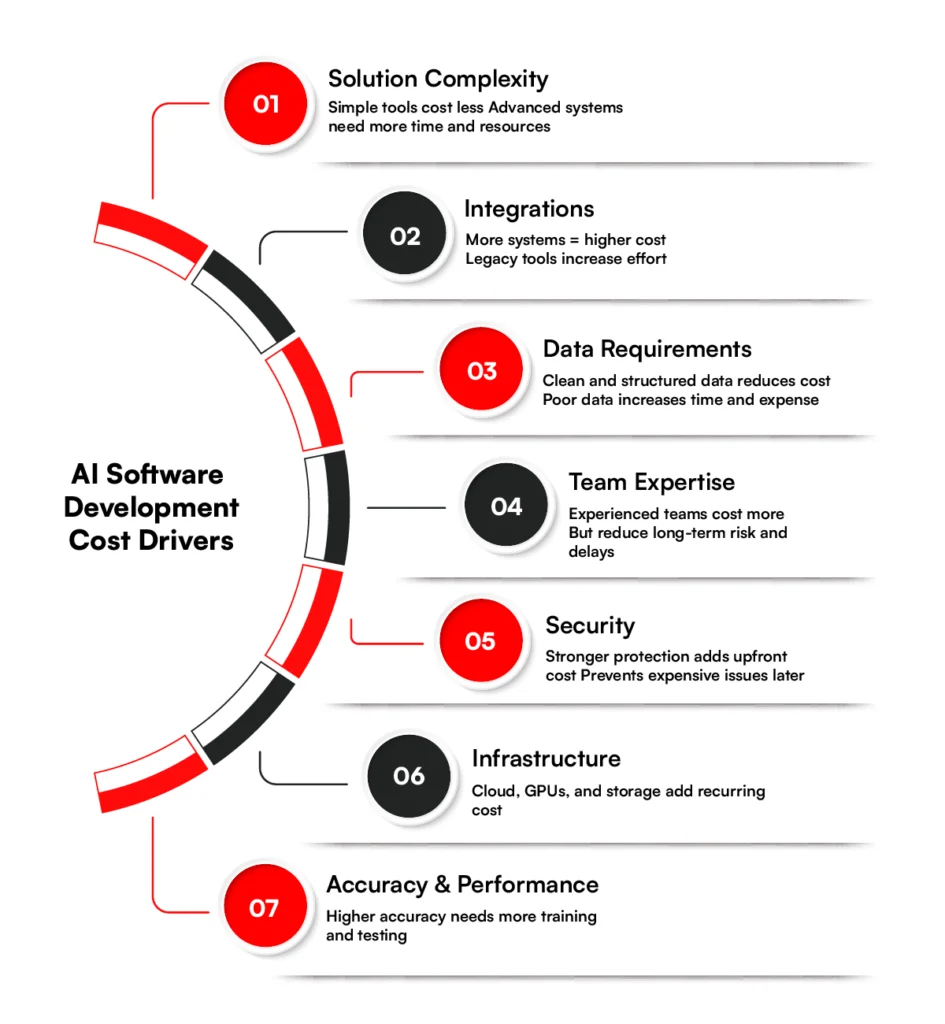
The cost to develop AI software is never fixed. Two projects may use similar technology but still have very different budgets. The final cost depends on project scope, data quality, security needs, integrations, and future scaling plans.
In 2026, tools like pre-trained models and AI coding assistants are also changing how businesses plan their investments.
To build a realistic budget, you need to understand the factors that shape the total cost. Below are the features that influence the cost of custom AI software development.
1. Complexity of the Solution
Project complexity is one of the biggest factors affecting the cost of AI software development. Simple AI applications are much cheaper than enterprise-grade systems. This is because they use pre-trained models, limited workflows, and fewer integrations.
For example, a basic AI chatbot or FAQ assistant typically costs between $10,000 and $50,000. These solutions rely on existing NLP models. They also need very little customization.
More advanced AI systems cost significantly more. Fraud detection platforms, risk management tools, and computer vision applications usually range from $50,000 to $150,000. These projects require custom model training. They also involve large-scale data processing and deeper integrations.
At the higher end, fully custom AI solutions can exceed $100,000 to $500,000+. Examples include predictive maintenance systems, advanced trading platforms, and medical diagnosis tools.
These applications often need proprietary algorithms and large training datasets. They also require specialized infrastructure and longer development timelines.
Complexity also increases infrastructure and engineering requirements. Features such as multilingual AI, voice processing, and real-time analytics require additional development effort.
Integrations with ERP and CRM systems can further increase cost and implementation time. Enterprise-grade AI platforms in industries such as finance and manufacturing can even reach $300,000 to $800,000+.
Compliance requirements, security standards, and integration complexity are major reasons for these higher costs.
2. Third-Party Integrations
Most AI solutions do not operate as standalone systems. They usually need to connect with the tools a business already uses every day. These can include CRM platforms, ERP systems, ecommerce stores, payment gateways, helpdesk software, analytics dashboards, and cloud databases.
For example, an AI sales assistant may need customer data from a CRM, inventory data from an ERP, and order history from an ecommerce platform. Each connection requires planning, technical mapping, and secure data exchange, which adds to the total development cost.
API integration costs can range from $5,000 to $25,000+, depending on the number of systems involved and the complexity of the connection. Simple integrations with modern APIs are faster and cheaper to implement.
However, enterprise systems with multiple platforms and custom workflows require significantly more development effort.
Integration costs also rise when businesses use multiple platforms with different data formats or outdated APIs. Developers often need to build custom connectors to ensure systems communicate properly. In some cases, legacy software may not support modern integrations at all, which creates extra workarounds and delays.
Teams must also test every connection carefully to ensure data flows correctly and does not disrupt existing operations. The more systems involved, the more time is needed for setup and quality checks.
Ongoing maintenance is another hidden cost many businesses overlook. Third-party platforms regularly update their APIs, security rules, or features.
When that happens, the AI system may need adjustments to keep everything running smoothly. This is why integration-heavy AI projects often cost more than expected, both during development and after launch.
3. Data Requirements
AI systems rely on data, and data preparation often becomes a major expense. If business data is incomplete, outdated, or unstructured, teams must spend time cleaning and organizing it. Some projects also require labeled datasets or industry-specific information. The larger the data volume and the higher the quality standards, the higher the cost increases.
Many businesses also need to combine data from multiple sources, such as CRMs, websites, mobile apps, and internal databases. This process can be slow and technically complex. Ongoing data updates, storage management, and governance also add recurring costs after development is complete.
4. Development Team Expertise
The experience level of your development team directly affects the cost of AI software development. Skilled AI engineers, data scientists, architects, and senior developers usually charge higher rates because they bring specialized knowledge.
They can select the right models, build scalable systems, and solve technical challenges faster. Although the upfront investment is higher, experienced teams often save money by reducing delays, avoiding poor decisions, and minimizing rework.
Less experienced or lower-cost teams may seem budget-friendly at first, but they can increase long-term costs. AI projects involve complex tasks such as data preparation, model tuning, infrastructure setup, and performance testing.
Mistakes in these areas can lead to weak results, missed deadlines, and expensive rebuilds later. In many cases, investing in the right expertise early leads to better outcomes and lower total ownership costs.
| Role | US Rates ($/hr) |
| Data Scientist | $100 – $150 |
| ML Engineer | $100 – $140 |
| Backend Developer | $80 – $120 |
| PM / BA | $70 – $100 |
| QA Engineer | $50 – $90 |
5. Security Measures
Security is a key part of AI development. Many AI platforms handle customer records, internal files, or payment data. Businesses often need encryption, user access controls, audit logs, and secure APIs. Strong security measures increase upfront cost, but they help prevent expensive breaches and compliance issues later.
6. Infrastructure & Tooling for AI Software Development
AI software needs the right technical foundation. This may include cloud hosting, GPU resources, storage systems, databases, and monitoring tools. Training custom models can be expensive, especially when large amounts of computing power are required.
Some businesses focus only on the cost of developing custom AI software and forget that infrastructure can become a recurring monthly expense.
| Infrastructure Component | Typical Monthly Cost | What the Cost Covers |
| Cloud ML Training (GPU) | $500 – $15,000/month | GPU compute for model training, fine-tuning, and retraining workloads |
| Model Serving Endpoint | $450 – $5,000/month | Hosting live AI models in production environments with scalable uptime |
| LLM API Inference | $1,000 – $50,000/month | Usage-based API calls for generative AI and large language model responses |
| Feature Store Infrastructure | $200 – $1,500/month | Real-time feature serving, offline training data storage, Redis, managed databases |
| MLOps Platform (Managed) | $0 – $5,000/month | Model deployment, versioning, orchestration, and experiment tracking tools |
| Data Storage & Pipelines | $100 – $3,000/month | Cloud storage, ETL pipelines, orchestration tools, and data transfer costs |
| Monitoring & Observability | $200 – $2,000/month | Model drift monitoring, reliability tracking, and performance observability |
7. Algorithm Accuracy & Fluency
Higher performance expectations usually lead to higher development costs. When an AI model needs to deliver strong accuracy, natural conversations, or multilingual support, the team must invest more time in training and testing.
This often requires larger and more diverse datasets, as well as multiple evaluation cycles to improve results. Achieving consistent performance across different scenarios is not simple and adds to both time and cost.
Improving accuracy also involves fine-tuning models, running experiments, and validating outputs with human review. For conversational AI, fluency and context understanding require additional optimization to make responses sound natural and relevant.
Each improvement cycle increases resource usage and development effort. Businesses need to define acceptable performance levels early to control the cost of developing custom AI software while still meeting user expectations.
AI Software Development Cost by Use Cases and Examples
AI software development cost varies significantly depending on the use case, level of customization, data requirements, and infrastructure complexity.
Simple automation tools are usually more affordable, while enterprise-grade AI systems with real-time processing and custom models require much larger investments.
1. AI Chatbots and Virtual Assistants
Estimated Cost: $6,000 – $30,000
AI chatbots are commonly used for customer support, lead generation, appointment booking, and internal helpdesk automation. Costs are generally lower because many businesses use pre-trained NLP models and standard conversational workflows.
A good example is H&M Virtual Shopping Assistant, which uses AI to answer customer queries and recommend products in real time. The system reportedly resolves a large percentage of customer requests without human intervention while also improving conversions.
2. Recommendation Systems
Estimated Cost: $24,000 – $120,000+
Recommendation engines help businesses personalize content, products, and user experiences. Costs increase when systems need to process large datasets and generate recommendations in real time.
One of the best-known examples is the Netflix Recommendation Engine. Netflix uses machine learning models to analyze viewing behavior and recommend personalized content. AI-driven recommendations are estimated to influence the majority of user viewing activity on the platform.
3. Computer Vision Solutions
Estimated Cost: $36,000 – $180,000+
Computer vision systems are widely used in healthcare, manufacturing, retail, and security. These solutions require image datasets, model training, GPU infrastructure, and high accuracy levels, which significantly increase development costs.
In manufacturing, companies such as Siemens Senseye use AI-powered predictive maintenance systems to detect equipment issues before failures occur. These systems help reduce downtime and maintenance costs through continuous monitoring and real-time analysis.
4. Fraud Detection and Risk Management Systems
Estimated Cost: $60,000 – $240,000+
AI fraud detection systems analyze large volumes of transactions and user behavior to identify suspicious activities in real time. These platforms require advanced machine learning models, continuous retraining, and strong security infrastructure.
Large enterprises in banking, fintech, and ecommerce often invest heavily in these systems because even small improvements in fraud prevention can lead to major financial savings.
5. Generative AI Applications and AI Copilots
Estimated Cost: $60,000 – $360,000+
Generative AI applications include AI copilots, enterprise search assistants, content generation tools, and workflow automation platforms. These projects often involve LLM integration, vector databases, fine-tuning, and high inference costs.
Development costs rise further when businesses need private AI deployments, custom training data, multilingual support, or integration across multiple enterprise systems.
6. AI Supply Chain and Inventory Management
Estimated Cost: $48,000 – $240,000+
AI is increasingly used to optimize inventory planning, supplier management, and logistics operations. These systems rely on predictive analytics, automation, and real-time operational data.
For example, Walmart AI Supply Chain Systems uses AI to improve inventory management and supplier operations. The company has applied AI across forecasting, automation, and supplier negotiations to reduce operational costs and improve product availability.
Not Sure Where AI Fits Your Business?
RBMSoft works alongside your team to identify the highest-ROI use case for your industry, then builds it to production standard. Pinpoint your single highest-impact AI opportunity Get a realistic timeline and cost range Walk away with a clear build roadmap
Book Your Free Quote
Traditional Software vs AI Software Development: Cost Comparison
When you compare traditional software development with AI-driven development, the difference is in how that cost is structured. Traditional software relies on predefined logic and predictable workflows.
AI software depends on data, experimentation, and continuous improvement. This shift changes how businesses spend money across the entire lifecycle.
AI can reduce development time and team size, but it introduces new cost layers, including data preparation, model training, and ongoing optimization.
In many cases, traditional software has lower upfront costs, while AI systems require higher initial investment but offer more long-term value through automation and intelligence.
The cost difference becomes clear when you compare similar project types. AI-assisted development can significantly reduce time and cost for standard applications, especially where automation is possible.
| Project Type | Traditional Cost (USD) | AI Software Cost (USD) | Savings |
| Landing Page | $15,000 – $30,000 | $3,000 – $6,000 | Up to 80% |
| MVP Web App | $80,000 – $150,000 | $24,000 – $45,000 | ~70% |
| E-commerce Platform | $150,000 – $300,000 | $45,000 – $90,000 | ~70% |
| SaaS Application | $200,000 – $500,000 | $60,000 – $150,000 | ~70% |
| Mobile App | $100,000 – $250,000 | $30,000 – $75,000 | ~70% |
| API Development | $40,000 – $80,000 | $8,000 – $16,000 | Up to 80% |
AI reduces cost mainly by speeding up development and automating repetitive tasks. However, these savings are more visible in early-stage builds or standardized applications.
Hidden Cost to Develop AI Software
Most AI projects do not exceed budgets because of development alone. The real challenge comes from hidden costs that appear after the initial planning phase.
These software development costs are often underestimated or overlooked, especially when businesses focus solely on model development. In reality, a large part of AI spending happens around the system.

1. Data Preparation and Management
Data is one of the most underestimated cost areas in AI projects. Even if your business already collects data, it is rarely in a usable format.
Teams must clean, organize, remove duplicates, and standardize them before training can begin. If labeled data is required, manual annotation can further increase cost and timelines.
In large-scale systems, data management does not stop after preparation. You also need pipelines to continuously update data, storage systems to handle growing volumes, and governance policies to maintain quality.
These ongoing efforts make data one of the most expensive hidden components of AI development.
2. Integration with Existing Systems
AI solutions must work with your existing technology stack. This includes CRMs, ERPs, internal tools, and third-party platforms. Integration is rarely simple, especially when systems use different formats or outdated technologies.
Developers often need to build custom connectors, handle data transformation, and ensure secure data exchange. Each integration point increases development effort and testing complexity. Over time, maintaining these integrations also adds to operational cost, especially when external systems update their APIs or workflows.
3. Usage-Based and API Costs
Many modern AI solutions rely on cloud-based services or external APIs. These services typically follow a usage-based pricing model, where you pay based on the number of requests, tokens, or processing volume.
At the early stage, these costs may seem small. However, as your user base grows, usage increases significantly. High-traffic applications can see monthly costs rise quickly, making this one of the most important hidden expenses to plan for.
4. Model Retraining and Optimization
AI models require continuous improvement to stay effective. As business data changes over time, model accuracy can drop. This makes retraining necessary to maintain performance.
Retraining involves collecting new data, running training cycles, testing outputs, and deploying updated models.
Each cycle consumes compute resources and developer time. In many cases, businesses need to repeat this process regularly, making it a recurring cost rather than a one-time effort.
5. Infrastructure and Cloud Expenses
AI systems depend heavily on infrastructure. This includes cloud storage, computing power, networking, and deployment tools. Training models often require GPUs or high-performance environments, which can be expensive.
Operational costs also grow as the system scales. Running real-time predictions, storing large datasets, and managing data pipelines all contribute to monthly expenses. Additional charges, such as data transfer and backup storage, can further increase costs beyond initial estimates.
6. Monitoring, Compliance, and Governance
Once deployed, AI systems need constant monitoring to ensure they are working correctly. This includes tracking model accuracy, detecting errors, and ensuring stable performance. Without monitoring, issues can go unnoticed and impact business outcomes.
In regulated industries, compliance adds another layer of cost. Businesses must comply with strict data privacy rules, maintain audit logs, and ensure transparency in AI decision-making. These requirements involve additional tools, processes, and ongoing audits, which increase both time and expense.
7. Organizational and Operational Costs
AI adoption also brings internal changes. Teams need training to understand and use AI systems effectively. Existing workflows may need to be redesigned to integrate AI into daily operations.
There can also be resistance to change, which slows down adoption and reduces productivity in the short term. Managing this transition requires time, effort, and sometimes external support, adding indirect costs that are often overlooked.
| Cost Component | Estimated Cost Range (USD) | Frequency |
| Data Preparation & Labeling | $20,000 – $150,000+ | One-time + ongoing updates |
| Data Storage & Management | $1,000 – $10,000/month | Recurring |
| System Integration | $15,000 – $100,000+ | One-time + maintenance |
| API & Usage Costs | $2,000 – $50,000+/month | Recurring |
| Model Retraining & Optimization | $10,000 – $80,000/year | Recurring |
| Cloud Infrastructure (Compute & Storage) | $5,000 – $100,000+/month | Recurring |
| Monitoring & Maintenance Tools | $1,000 – $15,000/month | Recurring |
| Compliance & Security | $10,000 – $70,000+/year | Recurring |
| Training & Change Management | $5,000 – $30,000 | One-time/periodic |
AI Software Monetization Strategies
Building an AI solution is only half the equation. The real value comes from how you monetise it. AI gives you multiple ways to generate revenue, but not every model fits every product. The right approach depends on your users, your use case, and how often your AI is used.
1. Subscription-Based Pricing
This is the most common model. You charge users a monthly or annual fee to access your AI features. It works well for SaaS products, AI tools, and platforms that require continuous access.
Subscription pricing creates predictable revenue. You can also offer tiered plans based on usage, features, or performance. For example, basic plans may include limited usage, while premium plans offer advanced capabilities.
2. Usage-Based Pricing
In this model, users pay based on their usage of the AI system. This could be per API call, per request, per token, or per processed dataset. This approach is popular for AI APIs and platforms.
It aligns cost with value, especially for businesses with variable usage. However, pricing needs to be clear, or users may hesitate due to unpredictable costs.
3. Freemium Model
Freemium allows users to access basic features for free while charging for advanced functionality. This helps attract a large user base quickly. Once users see value, they are more likely to upgrade.
The challenge is balancing free and paid features so that the free version is useful but still encourages conversion.
4. Pay-Per-Result or Outcome-Based Pricing
In this model, users pay based on results delivered by the AI. This could be cost per lead generated, per fraud detected, or per successful recommendation. This approach is powerful because it directly ties pricing to business value. However, it requires clear measurement and trust in the system’s performance.
5. Licensing AI Models
Businesses can license their AI models to other companies. This is common when the model is highly specialized or trained on unique data. Licensing can be structured as a one-time fee or recurring payment. It allows companies to generate revenue without directly managing end users.
5. API as a Product
You can expose your AI capabilities through APIs and charge developers or businesses to use them. This model works well for companies that want to scale usage across multiple clients. It is often combined with usage-based pricing. The more the API is used, the more revenue it generates.
6. Embedded AI in Existing Products
Instead of selling AI separately, you can embed it into your existing product and increase pricing. For example, adding AI-driven insights, automation, or personalization to a SaaS platform.
This approach improves product value and justifies higher pricing tiers. It also makes AI a competitive differentiator rather than a standalone product.
7. Enterprise Custom Solutions
Some businesses monetise AI by building custom solutions for enterprise clients. These projects are usually high-value and tailored to specific needs. Pricing can include development fees, licensing, and ongoing support. This model works well for companies with strong domain expertise.
8. Data Monetization
AI systems generate insights from data. In some cases, businesses can monetize these insights by offering analytics, reports, or benchmarks. This works best when the data is unique and valuable. However, privacy and compliance must be handled carefully.
Best Practices to Optimize AI Software Development Cost
AI development can get expensive quickly, but most cost overruns stem from poor planning, unclear scope, or unnecessary complexity.
If you approach the project strategically, you can control both upfront and long-term costs without affecting quality. These best practices help you make smarter decisions at every stage of development.

1. Start with MVP
Instead of building a full-scale AI solution from the beginning, start with a minimum viable product. Focus on solving one clear problem or delivering one high-impact feature. This allows you to test whether the solution actually works for your business before investing heavily.
An MVP also helps you gather real user feedback early. You can identify what needs improvement and what features are not required.
This avoids spending time and money on unnecessary functionality. Many companies reduce initial costs significantly by limiting scope and expanding only after validation.
2. Use Pre-Trained Models
Building models from scratch is expensive and time-consuming. In many cases, pre-trained models can deliver strong results with minimal customization.
These models are already trained on large datasets and can handle common use cases like text processing, image recognition, and recommendations.
Using pre-trained models saves on data collection, training time, and infrastructure costs. You only need to fine-tune them for your specific use case. This approach is especially useful for businesses seeking a faster time to market without a heavy investment in research and development.
3. Invest in Data Quality Early
Data quality directly impacts both cost and performance. If your data is messy, incomplete, or inconsistent, your team will spend a lot of time fixing it during development. This leads to delays and higher costs.
Investing in clean, structured, and well-labeled data early reduces the need for rework later. It also improves model accuracy, which reduces the need for repeated training cycles.
In many AI projects, data preparation takes a large share of the budget, so improving data quality upfront is one of the most effective ways to control cost.
4. Choose the Right Pricing / Engagement Model
The pricing model you choose can significantly affect your total cost. Fixed-price models work well when the scope is clearly defined and unlikely to change. However, AI projects often evolve, which makes rigid pricing risky.
Time-and-material models offer greater flexibility for AI development. They allow you to adjust scope, experiment with models, and refine features as the project progresses. Choosing the right engagement model ensures better cost control and prevents unexpected budget overruns.
5. Adopt Incremental Development and Scaling
AI systems do not need to be built at full scale immediately. A better approach is to develop in phases. Start with a smaller version, test performance, and gradually expand based on results.
This helps you avoid high infrastructure costs in the early stages.
It also reduces the risk of building a large system that may not perform as expected. Incremental scaling allows you to invest only when you see proven value.
6. Partner with Experts or Outsource Strategically
Building an in-house AI team can be expensive and time-consuming. Hiring skilled professionals, setting up infrastructure, and managing teams all increase costs.
In many cases, working with experienced vendors or outsourcing specific components is more efficient.
Experts bring domain knowledge, proven processes, and faster execution. They help you avoid common mistakes and reduce development time. Strategic outsourcing also allows you to scale resources up or down as needed for projects.
7. Use Modular Architecture
A modular architecture helps you build your AI system in smaller, independent components. Instead of creating one large system, you break it into manageable parts that can be developed and updated separately.
This reduces complexity and makes maintenance easier. If one component needs improvement, you can update it without affecting the entire system. Over time, this approach lowers both development and maintenance costs.
8. Plan for Hidden and Ongoing Costs
Many businesses underestimate the hidden costs of AI. These include cloud usage, API calls, data storage, monitoring tools, and model retraining. These costs continue even after deployment.
Planning for these expenses early helps you avoid budget shocks later. It also allows you to choose cost-efficient tools and infrastructure. AI is not a one-time investment, so ongoing cost planning is essential for long-term success.
9. Invest in Knowledge Transfer When Outsourcing
When you outsource AI development, it is important to ensure your internal team understands the system. Without proper knowledge transfer, you may become fully dependent on external vendors for updates and maintenance.
Documenting processes, training internal teams, and sharing technical knowledge reduces this dependency. It gives you more control over your system and helps lower long-term costs. Over time, this approach makes your AI investment more sustainable.
Build Lean. Ship Fast. Outspend Nobody.
Most AI projects bleed budget, not because the technology is expensive, but because the architecture decisions are made too late. RBMSoft engineers your solution cost-first, so you get production-ready AI without the six-figure surprises.
See How We Price AI Projects
Why Choose RBMSoft as Your AI Software Development Partner?
AI software development is about making the right decisions across data, infrastructure, talent, and long-term scaling. Costs can vary widely, but with the right strategy, you can control them and still build high-impact solutions.
The key is to focus on business value, start with clear use cases, and plan beyond the initial development phase. This is where working with the right partner makes a real difference.
At RBMSoft, we help businesses turn AI ideas into practical, scalable solutions, especially in the ecommerce space where data plays a critical role.
As an experienced AI development company, we understand how to balance cost, performance, and speed to deliver measurable results.
Our capabilities include:
- Building data-driven ecommerce analytics solutions for customer behavior, sales trends, and demand forecasting
- Developing AI-powered recommendation engines to improve conversions and average order value
- Implementing fraud detection and risk analysis systems for secure transactions
- Integrating AI with existing ecommerce platforms, CRMs, and analytics tools
- Designing scalable data pipelines for real-time insights and reporting
- Optimizing AI models for performance, accuracy, and cost efficiency
- Providing ongoing support, monitoring, and continuous improvement for long-term success
Our approach combines strong data analytics with tailored software development services to help you get the most value from your investment. With the right strategy and the right team, AI becomes a growth driver.
FAQ’s
1. How much does it cost to build an AI software solution?
The cost to build custom AI software depends on complexity, data, and integrations. Simple solutions may start at around $10,000, while advanced enterprise platforms can exceed $500,000.
Accurate AI software development cost estimation requires understanding your use case, data readiness, and scalability needs.
The cost to create an AI software solution also increases with real-time features, security, and compliance requirements. Planning early helps control the overall cost of developing AI software.
2. How long does it take to create a custom AI software?
Timelines vary based on scope and complexity. A basic solution can take 4 to 8 weeks, while mid-level projects may need 3 to 6 months. Advanced systems can take up to a year or more.
The AI-based software development cost often increases with longer timelines due to testing and model training cycles. Faster delivery is possible with pre-trained models, which also helps reduce AI-powered software development costs.
3. How much does it cost to maintain AI software post-launch?
Maintenance is a recurring expense that many businesses underestimate. It usually ranges from 15% to 25% of the initial development cost per year. This includes model retraining, infrastructure, monitoring, and updates.
The cost of developing AI software does not end at launch, as ongoing improvements are required. Proper AI software development cost estimation should always include long-term maintenance to avoid budget gaps later.
4. What are the latest technologies driving AI software development costs in 2026?
Technologies like generative AI, large language models, AI agents, and MLOps platforms are shaping costs in 2026. These tools improve capabilities but increase infrastructure and training expenses.
The cost to build custom AI software rises when businesses adopt advanced models that require high computing power. At the same time, pre-trained APIs can reduce the cost to create an AI software solution for common use cases, offering a balance between performance and cost.
5. What are the most effective ways to calculate ROI in AI software development projects?
To measure ROI, you need to compare development cost with business impact. This includes revenue growth, cost savings, and efficiency gains. A strong AI software development cost estimation also considers long-term value, not just upfront investment.
Businesses often track metrics like automation savings, conversion improvements, and reduced manual effort. Understanding the cost of AI-powered software development alongside measurable outcomes helps justify investment and guide future decisions.
6. Which advanced tools and frameworks are popular in AI software development today?
Popular tools include TensorFlow, PyTorch, OpenAI APIs, and cloud AI platforms like AWS and Azure. These frameworks speed up development but can influence the cost of AI-based software development, depending on usage and scale.
Choosing the right tools helps optimize the cost of developing AI software while maintaining performance. Many teams also use pre-built models to reduce effort and control the cost of building custom AI software efficiently.


