





Quick Summary:
- ~90% of AI pilots stall before production, not because of weak models, but because the data feeding them was never properly prepared
- AI-ready data must meet five non-negotiable standards: accurate, complete, consistent, labeled, and secure. Missing even one breaks the model built on top of it
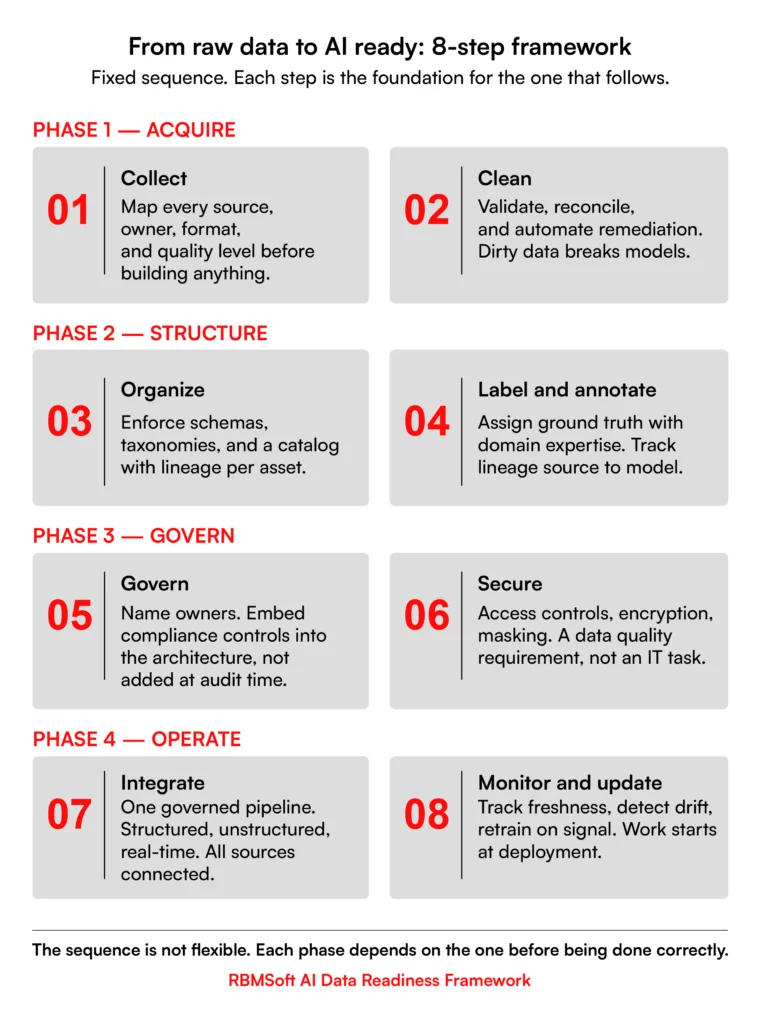
- The 8-step framework (Collect, Clean, Organize, Label, Govern, Secure, Integrate, Monitor) is the only sequence that holds under real enterprise conditions
- Unstructured data makes up 90% of enterprise knowledge but less than 1% is in a format AI can directly consume. Ignoring it means ignoring most of what your organization knows
- Governance is not a policy document. It is named ownership, embedded stewards, and compliance controls built into the pipeline before audit time, not after
- Deployment is where the real work begins. Data drift and freshness failures silently degrade production models while they keep producing confident, wrong outputs
- Enterprises that build the data foundation first see measurably higher AI project success rates. Those that skip it keep recycling pilot failures
Making yourself or your enterprise AI-ready doesn’t mean investing heavily in building sophisticated algorithms. But what about data? Even the best AI algorithms fail during optimization and fall short on AI workloads without having high-quality data.
The successful AI implementation is like a cooking machine; unless you feed it fresh, clean, and well-organized data, it cannot make good food at all.
Simple equation:
Bad data = bad AI results
Good data = good AI results
What’s the Real Cost of Bad Data?
The global market is expected to grow by $2 trillion by 2030, but initiatives have not yet reached that level. Approximately 90% of AI projects are stalled in the pilot phase due to insufficient data readiness.
Having AI-ready data takes you beyond experimental models to enterprise-scale impact.
This guide covers the eight steps that take raw, scattered data and make it clean, governed, secure, and ready to perform.
What Is AI-Ready Data?
AI-ready data is clean, labeled, and governed information that an organization can directly use to train, fine-tune, or deploy AI systems reliably and at scale.
Most enterprises don’t have a data shortage. They have an AI data readiness problem. Data sits in silos, arrives inconsistently, lacks context, and carries bias from years of incomplete collection. The result: AI systems that produce confident, authoritative, and wrong outputs.
For data to be AI-ready, it must be:
- Clean and accurate: Data must be validated, consistent, and free from duplicates or gaps, as any of these flaws directly corrupt model training and degrade output quality.
- Real-time and scalable: Use cases like fraud detection, AI-driven demand forecasting, and personalization are time-sensitive by nature and simply cannot function on data refreshed in weekly cycles.
- Unbiased and ethically sourced: Models inherit every pattern embedded in their training data, including instances of historical discrimination in hiring, lending, and healthcare, making the source and integrity of that data a critical ethical responsibility.
Why Enterprises Need AI-Ready Data?
The numbers make a sobering case. The IBM Institute for Business Value found that only 29% of technology leaders believe their enterprise data meets the standards needed to scale generative AI. PwC’s 2026 Global CEO Survey found that 56% of CEOs saw zero financial return from their AI investments.
The problem runs deeper than leadership confidence. Nearly 90% of AI pilots never reach production, and more than half stall specifically because of a lack of data readiness.Data issues rank as the second most common reason for AI project failure, with over 80% falling short of delivering meaningful business value.
AI data readiness is not a technical problem to delegate. It is the strategic foundation for every AI initiative, and enterprises that treat it as an afterthought are already paying the price.
Real-World Examples of AI-Ready Data in Action
Microsoft Digital, the company’s internal IT organization, made AI-ready data a foundational imperative, built around four core areas: data quality, governance, compliance, and infrastructure.
Using Microsoft Fabric and Purview, the team moved away from siloed, inconsistently governed data. Fabric connected data sources across platforms through a unified data lake, while Purview handled sensitivity labeling, data loss protection, and maintaining a reliable chain of custody for digital assets.
The operational impact was immediate. Copilot for Sales took over data hygiene tasks in their sales pipeline, eliminating the need for sellers to manually update or deduplicate records.
Legal teams gained confidence in the accuracy of filing data, and facilities teams began using AI-ready data to forecast occupancy and inform real estate decisions.
When data is accurate, governed, and consistently available across the enterprise, AI delivers real operational value rather than staying stuck in the pilot phase.
Is Your Data Truly AI-Ready?
Most enterprises assume their data is ready for AI. The reality tells a different story. Find out where your data stands and what it takes to move from pilot to production.
Assess Your AI Data Readiness
The 5 Pillars of AI Data Quality
AI-ready data is not built on a single standard. It is built on five properties that work together. Remove any one of them, and the AI system built on top will reflect that weakness in its outputs, decisions, and compliance posture.
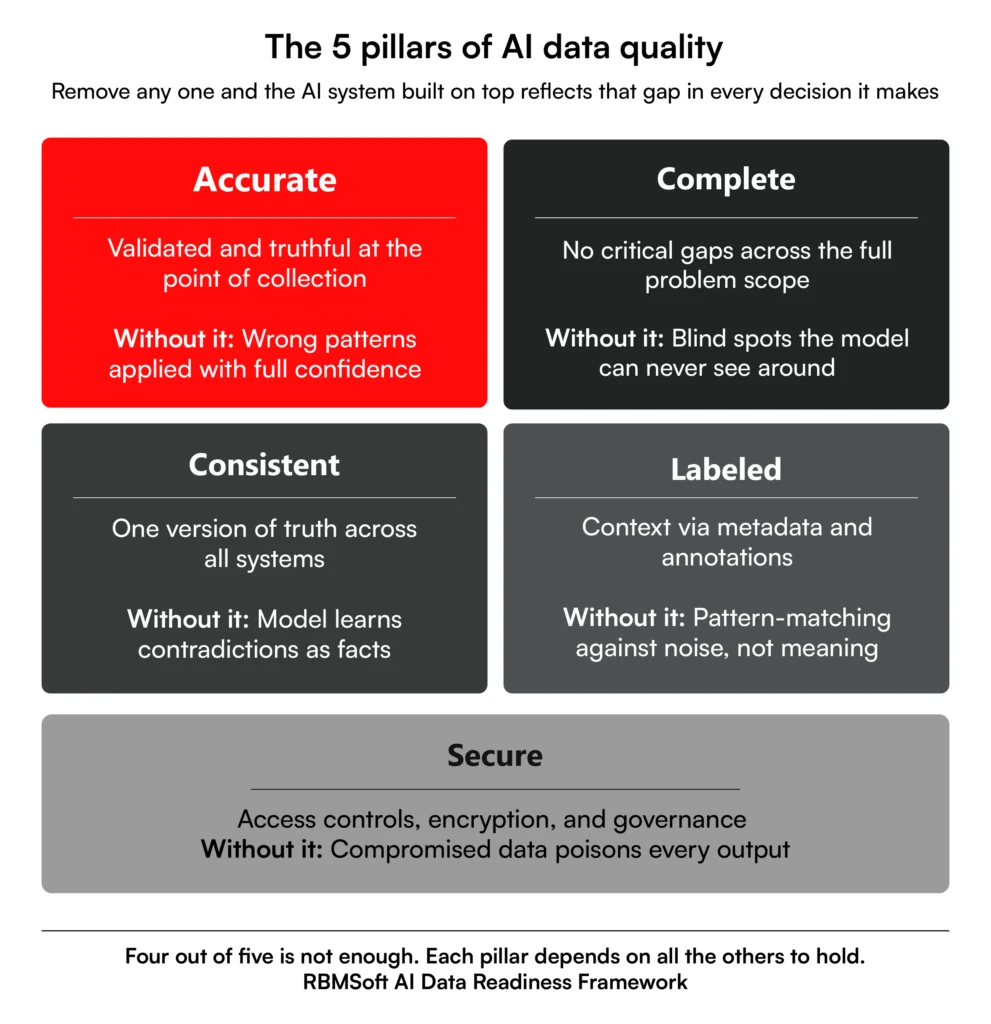
- Accurate: Validated, truthful, and reflecting reality at the point of collection. A model trained on inaccurate data does not just underperform. It learns the wrong patterns and applies them confidently across every decision it makes.
- Complete: Incomplete data creates blind spots. If a customer dataset is missing three years of transaction history, the model will never be able to understand long-term buying behavior. No critical gaps across the full scope of the problem.
- Consistent: Effective AI-ready data management demands a single version of truth. The same customer under three different IDs, revenue figures that don’t reconcile, product categories labeled differently by region. These are not minor issues. They are model-breaking contradictions.
- Labeled: Raw data has no meaning to a model without context. Labeling assigns that context through metadata, annotations, and classifications. The quality of labeling directly determines the quality of what the model learns.
- Secure: Data exposed to unauthorized access or manipulation is no longer trustworthy. Strict access controls, encryption, and governance policies are what keep enterprise data fit for AI use. Security is not an IT requirement. It is a data quality requirement.
Why These 5 Pillars Must Work Together
Meeting four out of five is not enough. Accurate and complete data that is poorly labeled produces a confused model. Well-labeled data with weak security becomes a liability the moment it is compromised.
Databricks and Qlik both converge on the same conclusion: the benefits of AI data readiness are only fully realized when all five pillars are in place simultaneously.
From Raw Data to AI Ready: An 8-Step Process
Data is scattered across CRMs, ERPs, cloud platforms, legacy systems, and departmental spreadsheets that were never meant to feed an AI pipeline. The first step in implementing AI data readiness in businesses is not collection. It is knowing what you already have.
Step 1 – Collect: Establish a Unified Data Acquisition Strategy
Start with a data estate audit
Before building anything, map every data source, format, owner, update frequency, and quality level across the enterprise. This is not a one-time exercise. It is the baseline against which all subsequent readiness decisions are made.
Four questions the audit must answer:
- What data exists, and where is it stored?
- Who owns it and who has access?
- How frequently is it updated?
- What is its current quality level?
Organizations that skip this step build AI-ready data pipelines for technology on top of foundations they have never fully mapped. The pipelines work. The strategy doesn’t.
Know what you have in terms of Structured and Unstructured
Structured data lives in databases and spreadsheets with defined schemas and consistent formats. Transaction records, customer profiles and financial data. Relatively straightforward to ingest.
Unstructured data is everything else. Emails, contracts, PDFs, call recordings, support transcripts. This is where most enterprise knowledge lives. According to IBM, 90% of enterprise data is unstructured, and less than 1% is currently in a format AI can directly consume.
Unstructured data and AI-readiness is one of the most underestimated challenges enterprises face. Solving it requires purpose-built ingestion pipelines equipped with NLP and computer vision to extract, structure, and prepare that data for AI use. Storage alone is not enough.
Step 2 – Clean: Enforce Enterprise Data Integrity
Collecting data is the easy part. What most enterprises discover when they look closely is that what they have is inconsistent, incomplete, duplicated, and in many cases simply wrong. Dirty data is not a minor inconvenience. It is an active threat to every AI system built on top of it.
Making your data AI-ready starts here. Cleaning is where raw enterprise data becomes something a model can actually learn from.
Automated validation works across three levels:
- Schema validation. Every incoming record is checked against the expected structure. Missing fields, wrong data types, and out-of-range values are flagged before they enter the pipeline.
- Business rule validation. A transaction dated three years in the future, a customer age of 400, and a negative product price. Rules that reflect business reality filter out records that are technically formatted but factually impossible.
- Cross-system reconciliation. The same customer under three different IDs, the same product at two different price points across two databases. Identified and resolved into a single consistent record.
Remediation must be equally automated. Flagged records trigger workflows routed to the appropriate data owner, with full lineage tracking so every correction is documented and auditable.
Structured data has validation rules. Unstructured data needs parsing.
Emails, contracts, PDFs, and call transcripts cannot be cleaned with a schema check. They must be parsed, interpreted, and converted into structured representations before entering the pipeline.
NLP extracts entities, relationships, and meaning from text. Computer vision does the same for images and scanned documents.
AI-ready data pipelines for technology that handle only structured inputs are leaving the majority of enterprise knowledge on the table.
Case Study: Regional Hospital Diagnostic Support Tool
A diagnostic support tool for a regional hospital network performed well in testing but fell short in production.
The audit found the cause: medical images from three different systems had been ingested without standardization against DICOM, the clinical format standard. Fields varied, the clinical context was missing, and no consistent image resolution was applied.
NLP was deployed to standardize clinical notes. Automated validation enforced DICOM-compliant metadata across all three systems. Images failing quality thresholds were flagged before entering the training set.
After retraining on cleaned, standardized data, diagnostic accuracy met clinical deployment standards. Nothing about the model had changed, but everything it had learned.
Step 3 – Organize: Architect for AI Compatibility and Discoverability
Collected and cleaned data still has a problem. It is not findable, not consistently structured, and not interpretable across systems. The organization closes that gap. It is where clean data becomes an asset, and a pipeline can actually be used.
The most common reason clean data breaks pipelines is inconsistency below the surface.
“Sale,” “order,” and “purchase” mean the same thing across three systems. Revenue figures using different currency conventions by division. Vibration sensors logged in millimeters per second in one facility and g-force units in another.
Each dataset looks clean in isolation. Together, they produce a model that learns contradictions.
Standardization enforces a single organizational logic across the estate. Format governance locks every asset to consistent schemas and encoding standards at the infrastructure level. Apache Iceberg and Delta Lake make this enforceable rather than advisory.
Taxonomy enforcement builds a shared business vocabulary so the model sees one concept where three names previously existed.
For unstructured data, NLP extraction pipelines convert variable-format documents and transcripts into consistently structured representations before they reach the pipeline.
Standardized data that cannot be found is not useful.
A data catalog is the enterprise index. Every asset is tagged, classified, and searchable across systems and cloud environments. For AI data readiness specifically, it serves three functions:
- Discoverability: Data teams find the right datasets without spending most of their time searching.
- Contextual metadata: Every asset carries provenance, transformation history, ownership, and quality certification.
- Trust signaling: Databricks Unity Catalog provides column-level lineage across every table. Qlik’s AI Trust Score aggregates accuracy, timeliness, governance, and consumability into a composite readiness score per asset.
Without this layer, trust collapses. A BARC report found that 42% of companies do not trust their AI model outputs, even though 58% already have observability programs in place. In most cases, the data is not the problem. The organizational infrastructure around it is.
Case Study: Manufacturing Predictive Maintenance
A global manufacturer had sensor networks across fourteen facilities on three continents. The data existed. The cleaning pipelines worked. The predictive maintenance model was sound. It could not perform.
The audit found the failure at the organizational layer. Equipment identifiers used seventeen different ID formats. Vibration readings were stored in different units with no conversion logic. Failure codes had no shared taxonomy.
The fix was architectural. A unified equipment taxonomy was enforced across all fourteen facilities. Sensor data was standardized at the ingestion layer. A centralized catalog was deployed with asset-level metadata per telemetry stream. Ongoing validation was built into the catch format drift before it reached the model.
Fault prediction accuracy reached the deployment threshold after retraining. The model was the same. The organizational discipline around the data was not.
Step 4 – Label and Annotate: Establish Ground Truth and Full Data Lineage
Clean, organized data still has no meaning to a model. It knows what the data looks like. It does not know what it means.
Labeling assigns that meaning. It is where the model learns the difference between a fraudulent transaction and a legitimate one, a healthy tissue scan and a malignant one, a satisfied customer and one about to churn.
Without it, a model is pattern-matching against noise.
Not all labeling is equal.
A medical image tagged “abnormal” without specifying type, location, or severity gives the model a signal too vague to act on. A transaction flagged “suspicious” without capturing the pattern that triggered it teaches the model to recognize a label, not a behavior.
Labeling requires domain expertise at the annotation stage, not just technical tooling. It requires guidelines specific to the problem, applied consistently across everyone working on the dataset, with review processes that catch annotation drift before it comes across thousands of records.
For unstructured data, this is harder and more consequential. Models trained on poorly annotated text learn the annotator’s inconsistencies as facts.
Data lineage: the complete history of every record.
Every dataset has a history. Where it was sourced. How was it cleaned? Which records were excluded and why? Which version of the annotation guidelines was applied? Lineage is the documentation of that history, tracked automatically from origin through every transformation to the model it fed.
It serves three purposes that nothing else can replace:
- Regulatory compliance: GDPR, HIPAA, and the EU AI Act require organizations to show how data was collected, processed, and used.
- Explainability: When a model produces an unexpected output, lineage is what makes root cause analysis possible.
- Reproducibility: Without a complete record, a model’s behavior cannot be audited or reliably recreated.
Databricks Unity Catalog automates column-level lineage across all tables, notebooks, and models.
Gartner predicts that by 2027, organizations that actively leverage metadata analytics across their data management environment will reduce the time to deliver new data assets by up to 80%.
When real-world data is not enough, synthetic data fills the gap.
Some scenarios cannot be covered by real-world data alone. Rare equipment failures. Fraud patterns are too infrequent to build a valid sample. Medical conditions with small patient populations.
Synthetic data fills these gaps by generating records that preserve the statistical patterns of real data without exposing the underlying sensitive information.
It is not a shortcut. It is a precision instrument for the corners of the problem that reality has not yet supplied enough examples to cover.
Case Study: Autonomous Vehicle Development
A vehicle developer was training models to detect pedestrians in low-visibility conditions. Daylight and moderate weather were well covered. Night driving, heavy rain, and fog were not.
The fix had two parts. First, the existing dataset was re-annotated with richer labels: visibility condition, lighting type, pedestrian distance, and occlusion level per frame. Prior labels had recorded only object presence.
Second, synthetic data was generated to cover underrepresented conditions at scale, each record carrying full lineage back to its generation parameters and the real-world distributions it was modeled on.
Low-visibility detection improved materially after retraining. Real-world validation confirmed the gains transferred to on-road performance. The detection capability was always there. The data quality to surface it was not.
Getting Governance and Lineage Right Is Harder Than It Looks
Most enterprises know they need better data governance and lineage tracking. Few have the infrastructure to execute it at scale. Our data engineers work with you to build the foundation your AI initiatives actually need.
Talk to a Data EngineerStep 5 – Govern: Institutionalize Accountability Across the Data Lifecycle
Governance is what separates an AI data strategy from an AI data experiment. Collection, cleaning, organization, and labeling can all be done well in isolation. Without governance, none of it holds. Data drifts back into inconsistency.
Ownership disputes stall remediation. Compliance gaps appear at audit time rather than before it.
Governance is not a policy document. It is an operating discipline built into every stage of the data lifecycle.
Every data asset needs an owner, not a department.
Without named accountability, issues get escalated into committees and resolved by nobody. In practice, effective AI data readiness management requires three things:
- A Chief Data Officer with executive mandate and board visibility
- Data stewards embedded in each business function who can make quality judgments, not just technical ones
- A governance council that resolves cross-functional conflicts before they reach the pipeline as contradictions
Organizations with formal data ownership structures identify and resolve quality issues faster, and their AI initiatives are significantly more likely to reach production.
Regulatory compliance is not a pre-launch checklist. It is an ongoing obligation.
GDPR Article 25 requires privacy by design. Data minimization, purpose limitation, and access controls must be built into the pipeline architecture, not added at audit time. HIPAA mandates complete audit trails and strict access controls for any system processing patient data.
The EU AI Act introduces data quality documentation and bias testing requirements for high-risk applications covering credit scoring, hiring, and law enforcement.
Non-compliance is an operational risk. Fines under GDPR reach 4% of global annual turnover. Reputational damage from a governance failure compounds far beyond the regulatory penalty.
Structured and unstructured data require different governance approaches.
Structured data can be governed through schema enforcement, access controls, and automated quality rules. A contract PDF, a call transcript, an email chain cannot.
Governing unstructured data means classifying it at ingestion, tagging it with ownership and sensitivity metadata, and applying access controls at the document level. NLP-based classification pipelines can automate this at scale, but the policies that determine what gets classified how must be defined by people with domain and legal context.
Treating both data types under the same governance framework is one of the most common and most costly mistakes enterprises make.
Case Study: Banking Compliance and Regulatory Clearance
A regional bank deploying a system to assist compliance officers with AML transaction review had a model that performed well in testing. Regulators asked a straightforward question: where did the training data come from, who approved it, and how was sensitive customer information protected?
The bank could not answer. Data ownership had never been formally assigned. Training data had been pulled from three source systems without documented authorization. Masking had been applied inconsistently with no audit trail.
Deployment was paused. Formal ownership was assigned across every source system. A data stewardship function was established within the compliance team.
Masking rules were standardized and enforced at the pipeline level with complete lineage documentation. When deployment resumed, the regulator got answers. The model was never the problem.
Step 6 – Secure: Protect the Organization’s Most Strategic Asset
Data security is not an IT workstream running parallel to AI development. It is a data quality requirement. Data exposed to unauthorized access, manipulation, or theft is no longer trustworthy data. Every system built on compromised data inherits that compromise in its outputs.
Security must be designed into the pipeline. Not bolted on after deployment.
Know who can see what and under what conditions.
Role-based access controls limit data exposure to people and systems with a verified need for it. Attribute-based controls go further, applying restrictions dynamically based on data sensitivity, user context, and regulatory jurisdiction.
The same controls become especially important for enterprise search and information security when employees can retrieve information from several company sources through one search experience.
Encryption protects data at rest and in transit. Masking and tokenization protect it in use. A customer’s account number replaced with a non-reversible token can still train a fraud detection model on behavioral patterns without exposing the underlying identity.
GDPR Article 25 requires these controls by design across any system processing personal data.
The most common failure is inconsistency. Masking is applied in one system and not another. Access controls are enforced in production but not in the development environment, where models are trained. That gap is where exposure happens.
When real data carries too much risk, synthetic data is the governed alternative.
Records generated to match the statistical properties of real data without containing any of the actual sensitive information.
For healthcare and financial services this is increasingly standard practice. A synthetic patient dataset that preserves clinical distributions can train a diagnostic model without touching a single HIPAA-governed record.
Synthetic data used for security purposes still requires lineage documentation. The generation methodology, source distributions, and the validation process which confirm it cannot be reverse-engineered, all need to be documented and auditable.
Two threat vectors specific to AI pipelines require explicit security design.
Traditional cybersecurity frameworks were not built with AI in mind.
Model poisoning occurs when manipulated records are introduced into a training dataset, corrupting the patterns the model learns. A fraud detection model poisoned to treat a specific transaction pattern as legitimate.
A content moderation model trained to ignore a specific category of violation. The attack happens at the data layer, which means security controls at the data layer are the only defense.
Data exfiltration through model outputs is the second vector. A model trained on sensitive data can reproduce that data in its responses if not properly isolated. Isolation controls, output monitoring, and differential privacy techniques are the countermeasures.
Case Study: Healthcare AI Security and HIPAA Compliance
A hospital system building a clinical documentation tool had a legitimate use case and an unsecured pipeline.
An internal review found that the development environment was pulling directly from production patient records, with no masking, no audit logging, no separation of environments, and no Business Associate Agreements with third-party vendors.
The model had not been assessed for whether it had retained patient-identifiable content during training. It was retired.
Development restarted on a secured pipeline with masking applied across all 18 HIPAA-defined identifiers, role-based access controls separating dev, test, and production, audit logging enabled, BAAs executed, and output monitoring deployed to catch PHI patterns in responses.
Clinical performance matched the prior baseline. The risk profile was in a different category entirely.
Step 7 – Integrate: Connect Intelligence Across the Enterprise Ecosystem
Secure, governed, labeled data sitting in an isolated pipeline is not enterprise AI. It is a proof of concept. Integration is what makes AI operational at scale, connecting data with the systems where decisions and business processes already happen.
This is where enterprise AI integration in business becomes part of the architecture. Models need reliable connections with existing applications so prepared data can reach them and their outputs can move back into operational workflows.
Most enterprises underestimate this step. The data work is done and the model works. Then it meets the real environment.
A production system draws from multiple sources simultaneously.
CRM records, transaction histories, contract documents, support transcripts, inventory feeds. Each source has its own format, update frequency, and access control requirements. The integration layer reconciles all of it into a coherent, continuous input the pipeline can consume.
The majority of enterprise knowledge sits in unstructured form. Emails, contracts, call archives, and internal documents that structured pipelines were never built to handle. Emails, contracts, call archives, and internal documents that structured pipelines were never built to handle.
Closing that gap requires AI-ready data pipelines for technology that ingest, parse, and normalize unstructured sources alongside structured ones within the same governed architecture.
The integration layer must also handle velocity. Fraud detection cannot run on data that is hours old. Personalization engines cannot wait for a nightly batch.
Apache Kafka and Confluent stream live operational events directly into workflows, with governance and quality controls applied in motion.
IBM’s acquisition of Confluent in March 2026 reflects how central real-time streaming has become to enterprise AI infrastructure.
RAG: the enterprise knowledge layer.
Retrieval-Augmented Generation connects language models to an organization’s own knowledge. Rather than relying on what a model learned during training, RAG retrieves relevant documents and records at the moment a query is made and grounds the response in that retrieved evidence.
Internal policy documents, compliance guidance, product specifications, historical case records. Knowledge that exists in the organization but was never accessible at speed.
RAG makes it accessible without exposing it to external model providers or requiring expensive retraining every time the knowledge base changes.
For RAG to work in production, the underlying data needs to be prepared for retrieval. Document structure, metadata, access controls, indexing, and data quality all add work before the search experience is ready. These requirements also affect the average cost of AI enterprise search development.
Stale content generates confident answers that are factually out of date. RAG does not fix data problems. It surfaces them in every response.
One version of every data asset, accessible everywhere, governed consistently.
Enterprise data does not live in one place. On-premises databases, cloud object stores, SaaS platforms, and legacy systems all hold data that pipelines need. Integration architecture must federate across all of them without creating duplicate copies that immediately diverge in quality.
Apache Iceberg and Delta Lake provide a single governed copy of data accessible to multiple workloads regardless of where it physically lives.
Databricks Unity Catalog extends unified access controls and lineage tracking across every environment in the federation.
Case Study: Financial Services Compliance AI
A multinational bank needed to draw from three sources for its compliance review system: structured transaction records, unstructured email and chat archives, and a library of regulatory guidance documents updated quarterly. None had been integrated before.
The transaction database used a proprietary schema. The communications archive was incompatible with the bank’s data lakehouse. The regulatory documents lived in SharePoint with no metadata tagging and no pipeline connection.
Three ingestion connectors were built and normalized into a single lakehouse layer. The communications archive was processed through NLP pipelines to extract structured representations of flagged content.
The regulatory document library was chunked, embedded, and loaded into a vector database to power RAG retrieval at query time. A quarterly refresh process kept the index current as guidance changed.
When the system went live, compliance officers could query a client’s full communication history against current regulatory requirements and receive responses grounded in specific retrieved documents with full source attribution.
Human review remained a necessary step before acting on any finding. Review time per case dropped significantly. The model was the same one tested in isolation. The integration was what made it useful.
Step 8 – Monitor and Update: Sustain AI Performance as an Operational Discipline
Deployment is not the finish line. It is where the real work starts. Data changes. Business conditions shift. The patterns a model learned six months ago may no longer reflect the reality it is making decisions about today.
A system without active monitoring is one quietly degrading while producing confident outputs.
Most enterprises discover this problem after it has already cost them something.
Production pipelines break in ways that testing never anticipates.
A source system changes its schema without notifying the data team. A third-party feed starts arriving with a four-hour delay.
A labeling error introduced upstream compounds through downstream records. None of these failures announces itself. They surface gradually in outputs that drift from acceptable to wrong.
Continuous monitoring catches these failures at the pipeline level before they reach the model. Monte Carlo’s data observability platform applies anomaly detection across incoming data without requiring manual rule definition for every possible failure mode.
When a distribution shifts, a volume drops, or a field populates outside its historical range, the system flags it and traces it to the source.
The standard for production AI is not periodic quality checks. It is always-on visibility across every layer of the pipeline.
Two failure modes account for most performance degradation in production. Neither involves the model.
Data freshness failures occur when the pipeline is functioning but the data it delivers is stale. A fraud detection model receiving transaction data on a four-hour lag in an environment where fraud patterns evolve in minutes. The pipeline looks healthy. The inputs are outdated. The outputs are wrong.
Data drift is slower and harder to detect. The statistical properties of incoming data shift gradually away from the distributions the model was trained on. Customer behavior changes after a market event. Sensor calibration drifts in an industrial environment.
The model was built for a world that no longer quite exists, and its performance erodes without any single failure to point to.
Catching drift requires baselining statistical properties at training time and running continuous comparison against production inputs. When divergence crosses a defined threshold, retraining triggers as a response to a measured signal, not a scheduled calendar event.
When a model underperforms, lineage tells you why.
Without lineage, that question takes weeks to answer. With it, the answer is traceable in hours. A drop in fraud detection accuracy traced to a schema change three weeks prior.
A RAG system returning irrelevant responses traced to documents ingested without proper chunking. A forecasting model degrading traced to a promotional feed that stopped updating after a vendor migration.
The fix in each case is at the data layer, not the model layer. Lineage makes that visible. Without it, teams rebuild models to solve problems the data created.
Case Study: Real-Time Fraud Detection in Banking
A retail bank’s fraud detection system performed well through its first two quarters. In the third, false negative rates began climbing. Fraudulent transactions were clearing at a rate the system’s initial performance had not suggested was possible.
The investigation traced the degradation to two compounding failures. A payment processing partner had migrated to a new system and the transaction feed was now arriving with a ninety-minute delay.
Separately, a new category of card-not-present fraud had emerged over the prior four months, absent from the original training data and from any subsequent update.
Neither failure had been caught. Latency thresholds had never been configured. Distribution monitoring had not been implemented at deployment.
Both were corrected. Latency alerting was configured across every upstream feed tied to the detection window each use case required. Distribution monitoring was implemented with automated retraining triggers keyed to drift thresholds defined during the original model validation.
Fraud detection performance recovered after remediation. The model had not fundamentally changed. The operational discipline around it had.
How RBMSoft Helps Enterprises Make Data AI Ready?
The eight steps in this guide are not a checklist to hand to an internal team already running at capacity. They are an engineering discipline that requires the right ai-ready data architecture, the right sequence, and execution that holds under the pressure of live enterprise environments.
Being a bespoke AI Development Company, RBMSoft builds AI-ready data foundations in production.
Pipeline architecture across structured and unstructured sources, data quality frameworks, governance with compliance controls built into the architecture, real-time streaming, and lakehouse implementations that give AI workloads a single governed copy of enterprise data. Observability runs throughout, so pipelines do not quietly degrade after deployment.
At RBMSoft, AI data readiness is not a project with an end date, it is the operational foundation every AI initiative is built on. Our AI experts focus on extracting measurable value from AI have one thing in common: they got the data right first.
If your AI initiatives are stalling at the data layer, that is where the conversation with RBMSoft starts. Schedule a consultation now.
FAQs
1. What is AI ready data?
AI ready data is clean, labeled, consistent, and governed information that an organization can directly use to train, fine-tune, or deploy AI systems reliably and at scale. It is not just data that exists. It is data that has been validated, organized, and made fit for purpose across every stage of the pipeline.
2. How to make your data AI-ready and why does it matter?
Start with a data estate audit to understand what you have, where it lives, and what condition it is in. Then work through cleaning, standardization, labeling, governance, and security before building anything on top of it.
It matters because without AI-ready data, models produce confident and wrong outputs. The data foundation is where most AI initiatives succeed or fail.
3. How do I get my enterprise data ready for AI?
Follow a structured process: audit your data estate, clean and validate at the pipeline level, organize for consistency and discoverability, label with domain expertise, govern with named ownership and compliance controls, secure at every layer, integrate across structured and unstructured sources, and monitor continuously after deployment. There is no shortcut through these steps.
4. How to build an AI-ready data pipeline?
An AI-ready data pipeline ingests from all relevant sources, structured and unstructured, applies automated validation and cleaning in motion, enforces consistent schemas and taxonomies, and delivers governed, traceable data to the model layer.
Tools like Apache Kafka handle real-time streaming. Apache Iceberg and Delta Lake enforce format governance. Databricks Unity Catalog manages lineage and access controls across the full pipeline.
5. How much AI-ready data does a company need to get started with AI?
There is no universal threshold. It depends on the use case, the model type, and the complexity of the problem. A narrow classification task can perform well on thousands of clean, well-labeled records. A large language model fine-tuned on enterprise knowledge needs significantly more.
The more important question is not how much data you have. It is how fit that data is for the specific problem you are solving. Quality drives outcomes far more than volume.