






Quick Summary:
- AI-powered product recommendation engines use behavioral data, contextual signals, and continuous learning and help you elevate the personalized experience across your eCommerce platform.
- Modern recommendation systems combine collaborative filtering, content-based models, hybrid logic, and GenAI layers to improve relevance, presentation and intent understanding.
- Direct use cases such as real-time personalization, search re-ranking, generative bundles, and AI-driven notifications directly improve CTR, AOV, and customer retention.
- The cost to develop an AI product recommendation engine ranges from $30,000 for basic setups to $500,000+ for advanced, enterprise-grade, real-time platforms.
- System performance and ROI depend heavily on data quality, infrastructure scalability, real-time processing capabilities, and continuous model monitoring.
- Successful implementation follows a structured approach: enabling the GenAI layer, connecting data, deploying across channels, learning from interactions, and refining placements.
- Businesses that invest in long-term optimization, intelligent operations, and cross-channel consistency turn recommendation engines into sustainable growth drivers rather than standalone features.
If you are also thinking that more options attract more customers, you are missing the second part of the story: more options paralyze decision-making and kill sales.
Here is the evidence: 74% of consumers abandoned their shopping baskets in the last three months simply because they were overwhelmed by choice and frustrated by the time and effort required to make decisions. (Source: Accenture)
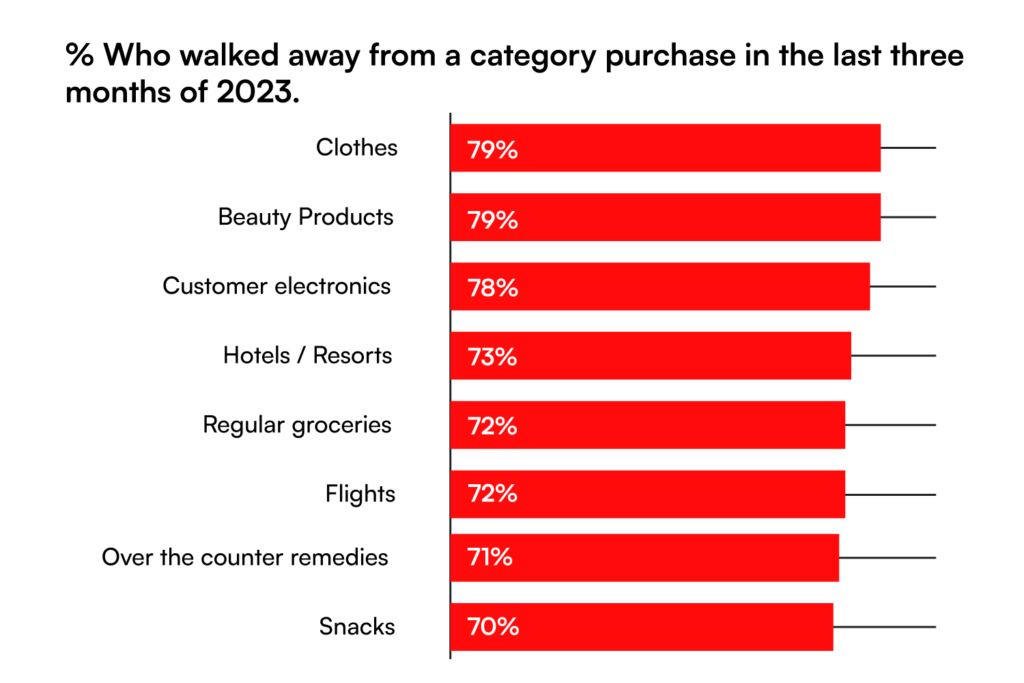
Consumers do not need an extensive product catalog with endless options. They simply need personalized shopping experiences. This is where you need advanced tools like AI product recommendations that show your customers the right products at the right time, based on what they are most likely to need.
By developing an AI product recommendation engine, you can elevate the personalized experience across your eCommerce platform. This will drive your sales straight up while increasing return on investment (ROI).
Let’s explore what an AI product recommendation engine is, how it works, its real-life use cases, and what benefits you’ll see as a business owner. On top of that, you will also explore architectural blueprints, MLOps pipeline design, cost-benefit analysis, and a clear-eyed evaluation framework.
This comprehensive guide will equip your leadership team to make a high-confidence build-vs-buy-vs-partner decision and execute it at enterprise scale.
What is an AI Product Recommendation?
AI-powered product recommendations are intelligent suggestions displayed to customers based on their behavior, preferences, and purchase history. These recommendations are generated using a product recommendation system AI framework powered by machine learning algorithms that analyze large volumes of customer data in real time.
Unlike static rule-based suggestions, an AI product recommendation engine learns and evolves continuously. It adjusts the recommendations based on new inputs, interactions, and broader buying patterns across different user segments, making it a core part of modern AI product recommendation system development.
These AI-based product recommendations can be integrated throughout the customer journey, including:
- Homepage: Personalized trending products or bestsellers
- Product Pages: Related items or complementary products
- Cart and Checkout: Frequently bought together, last-minute add-ons
- Emails & SMS: Dynamic product suggestions based on recent activity
- Push Notifications: Timely nudges for repeat purchases or new arrivals
Types of Product Recommendation Engines

AI product recommendation systems build on traditional recommendation approaches by adding generative capabilities to the decision-making process. While traditional engines act as a sophisticated filing cabinet, GenAI acts as a digital concierge.
These systems do not replace existing recommendation logic but enhance how recommendations are created, adapted, and presented in a more deeply contextualized and user-intent-driven way.
Depending on data availability and implementation goals, the different types of GenAI recommendation engines generally fall into the following categories.
1. Personalized Recommendation Engines
These engines generate recommendations based on individual user behavior, such as browsing history, purchase patterns, and recent interactions. Along with identifying relevant products, generative models help tailor how recommendations are framed, making them more aligned with a user’s preferences and current intent.
The 2026 Reality: In 2026, the system doesn’t just show you a movie; it might show you a personalized trailer or thumbnail image tailored to your unique aesthetic tastes.
2. Collaborative Filtering-Based Recommendation Engines
These engines use collaborative filtering to identify products based on similarities among users. GenAI enhances recommendation outputs by adding contextual interpretation and explanatory elements. While the core recommendation logic remains behavior-driven, generative capabilities help improve relevance and presentation.
The 2026 Reality: This is now considered basic. Its big flaw is the “cold-start problem”—if a user or product is brand new, there is no data to work with, and the system fails.
3. Content-Based Recommendation Engines
These engines analyze product attributes, such as category, brand, or specifications, to suggest similar items. Generative AI supports this process by interpreting product information more flexibly and adapting recommendations when user interaction data is limited.
The 2026 Reality: This has become much smarter. AI can now “read” product descriptions and “see” product photos to understand exactly what an item is, helping new products get noticed immediately.
4. Hybrid Recommendation Engines
These engines combine collaborative filtering, content-based approaches, and generative AI. Traditional models determine which products are relevant, while GenAI refines how recommendations are adjusted or delivered based on context. This approach helps improve accuracy and reduces limitations such as cold-start scenarios.
The 2026 Reality: Today, the goal isn’t just mixing methods, but mixing them in real time. These systems now use “dynamic weighting”—adjusting their logic on the fly. For example, in the morning, the app might suggest your usual routine based on your history; by the afternoon, it ignores your past and focuses entirely on what you are clicking right now.
5. Context-Aware Recommendation Engines:
These recommendation engines generate recommendations using real-time signals such as session behavior, location, or timing. These engines dynamically adjust recommendations, ensuring product suggestions remain relevant to the user’s current situation rather than relying solely on historical data.
The 2026 Reality: This is the fastest-growing area. Because of new privacy laws and more people browsing anonymously, companies need systems that work perfectly even if they don’t know the user’s name or history.
Is your platform optimized to deliver personalized shopping experiences?
73% of customers expect personalized recommendations
Consult Our AI Experts
How Do AI-Powered Product Recommendations Work?
AI-powered product recommendations work by learning what shoppers are interested in and using that information to suggest relevant products. The goal is simple: to show each customer items they are most likely to engage with or buy.
To do this, recommendation systems follow a few core steps.

Step 1: Collecting shopper data
The process starts with collecting data from different points across the shopping journey. This includes how customers browse, search, and interact with products on the website or app. This data serves as the foundation for an AI product recommendation engine integration and enabling personalization.
Here are a few common data points:
- Products viewed or clicked
- Search activity
- Items added to cart or wishlists
- Purchase history
- Time spent on product or category pages
Each action here adds more insight into what a shopper is interested in.
Step 2: Building user and product profiles
Once the data is collected, AI systems group it together to form profiles.
- User profiles reflect browsing habits, preferences, and buying behavior.
- Product profiles include information such as categories, descriptions, pricing, and availability.
And then, AI models use this information to understand how users and products relate to one another. This profiling layer is essential when organizations build enterprise AI product recommendation engines or build AI-powered ecommerce product recommendation engines that can scale across large catalogs.
Step 3: Applying AI product recommendation techniques
At this stage, the system applies various AI-based product recommendation techniques to generate suggestions.
- Collaborative filtering looks at patterns across users and recommends products based on what similar shoppers have liked or purchased.
- Content-based filtering focuses on the products a user has interacted with and suggests similar items based on shared features.
- Hybrid techniques combine both approaches to improve accuracy and reduce limitations such as limited data or new users.
These techniques enable the system to predict which products are most relevant to each shopper and are widely used in AI-powered B2B product recommendation systems and consumer-facing platforms. It enables both vertical- and horizontal-level AI product recommendation development.
Step 4: Using context to refine recommendations
Modern recommendation systems also consider context when generating suggestions. Factors such as time of day, device type, location, and season are likely to influence which products are shown.
These systems combine behavioral data with contextual signals and support an AI platform’s real-time integration with a product recommendations feature store, ensuring recommendations remain relevant to the shopper’s current situation.
Step 5: Learning and improving over time
AI-powered recommendation systems continue to learn as users interact with them. Every click, view, or purchase feeds new data back into the system. Machine learning models use this feedback to refine recommendations, adapt to changing preferences, and improve accuracy over time.
This continuous learning cycle is what differentiates advanced AI product recommendation engine development from traditional systems and directly impacts long-term performance, ROI, and scalability.
Use Cases of AI Product Recommendation Systems
AI product recommendation systems actively direct users to relevant products and content based on interaction data, preferences, and behavioral indicators. These systems assist in discovery and decision-making by adjusting recommendations across various touchpoints and industries.
The following are typical applications of AI-based recommendation systems.
Real-Time and Dynamic Recommendations
Recommendation systems powered by AI constantly update their products based on user interactions. Recommendations change as user behavior evolves during a session to capture up-to-date intent and interest.
- How AI Recommendation Works: It is an application of Session-based clickstream data through a Sequential Neural Network (RNNs or Transformers). The product and user high-dimensional vector embeddings in the system are computed in real time, enabling detection of intent changes within a single session and avoiding the use of stale historical information.
- Outcome: CTR (Click-Through Rate) and Conversion rate (CVR) may increase dramatically by acquiring immediate buying intent.
Search Re-Ranking (Learning-to-Rank)
This use case contrasts with the regular product carousels, which use AI in the search bar. It relies on Learning-to-Rank (LTR) models to ensure that two users who search for the same query (e.g., running shoes) see different results based on their style preferences or past price ranges.
- How AI Recommendation Works: The systems use Learning-to-Rank (LTR) algorithms such as XGBoost or LightGBM. The model is fed a typical BM25 search result set and re-ranks items using a multi-objective scoring model that accounts for user profile characteristics, past preferences, and business constraints (e.g., stock levels).
- Outcome: Search-to-Cart Addition Rate was improved, and the number of Null Search Results was reduced.
Also Read: AI-Powered Search Optimization: A Complete Guide to NLP, Machine Learning, and Semantic Search Implementation
Creation of Generative Bundle and Kit
An advanced application in which AI not only recommends items already available but also creates new packages. It maximizes the user’s preferences and the business’s profitability by producing custom product arrangements on the fly (typical of the furniture or professional tool industries).
- How AI Recommendation Works: It is based on Association Rule Mining (ARM) and Graph Neural Networks (GNNs) and derives latent associations between disparate SKUs. The AI does not use the same logic as the frequently bought together, but instead creates context-oriented bundles. For example, the complete summer skincare kit is based on co-occurrence matrices and compatible feature bundles.
- Outcome: Radical increase in AOV (Average Order Value) and UPO (Units Per Order).
Next-Best-Action Customer Service/B2B
This shifts the recommendation engine away from consumers and into the hands of account managers. It models account-wide information to identify proactive reorder opportunities or cross-sell opportunities, enabling sales teams to reduce churn and grow share of wallet.
- How AI Recommendation Works: It uses Reinforcement Learning (RL) to suggest the best sequence of interactions. Through long-term value (LTV) analysis of historical curves, the system will suggest actions, such as offering a discount, placing a replenishment order, or providing a technical white paper, to move the account through the funnel.
- Outcome: Decreased Churn rate and quantifiable Customer Lifetime Value (CLV).
Email and Push Notifications driven by AI
This is not just about cart abandonment notifications. The engine uses embeddings computed offline to surface complementary items in outbound communication, which is much more effective at motivating clicks than any static, rule-based trigger.
- How AI Recommendation Works: Multi-Armed Bandits (MAB) are used to optimize send time and content. The engine is personalized to the payload using a dynamic content pool, indexed by Collaborative Filtering scores, so that the notification appears within the window of high engagement predicted by the user.
- Outcome: An Increase in Open Rates and a drop in Unsubscribe Rates.
New Prospective Clients of Cold-Start
It uses aggregated engagement patterns and trending data to provide value, switching to this data before the system has enough personal data to build a specific user profile.
- How AI Recommendation Works: Adopts Content-Based Filtering and Hybrid Filtering designs. Users having a zero transaction history have their features (metadata: geospatial data, referral source, device type) extracted and mapped to clusters formed as Lookalike to give them instant relevance until enough behavioral data has been collected.
- Outcome: Reduction in the Bounce Rate of the first-time visitors and Time-to-First-Purchase.
More than Inter-industry Domain Applications
This points to the flexibility of non-retail engines, i.e., the customization of recommendations to Healthcare (treatment plans), Education (learning paths) and Financial Services (investment or insurance products).
- How AI Recommendation Works: Deploys knowledge graphs to enforce strict domain constraints on recommendations (e.g., risk profiles in Finance or clinical compatibility in Healthcare). Knowledge Tracing models, applied in Education, suggest the most appropriate next-best learning module based on a student’s mastery of prerequisite concepts.
- Result: Improved Compliance/Safety Measures and User Success/Outcome Rates.
Real-World Examples of AI Recommendations in Action
Hypersonalization as a trend has moved the AI recommendation engine from simple back-end tools into the central system of global commerce. Various industries deploy AI recommendation engines for more than just recommending products.
Below are the real-world examples of AI product recommendation systems in action, detailing how the world’s most influential brands deploy these engines and the tangible results they achieve.
Amazon
Amazon’s recommendation engine accounts for more than 35% of its income. It applies collaborative filtering, purchase history, and even voice assistant behaviour (Alexa) to make smart suggestions. Let’s explore in detail:
- How Amazon Deploys the AI Recommendation Engine:
- Collaborative Filtering: Amazon uses Item-to-Item filtering, which aligns a user’s interests with those of others, forming a storefront for them.
- Omnichannel Signals: The platform combines voice behavior information, Kindle reading history, and Prime Video history to create a comprehensive consumer profile.
- Anticipatory Logic: It is an item-tracking system for carts and commonly purchased-together packages to deliver consistent, real-time recommendations across every aspect of the journey.
- Outcome: In 2025, Amazon achieved incredible net sales of 716.9 billion, driven by the effectiveness of its automated cross-selling and upselling strategies.
Netflix & Spotify
Both are not typical eCommerce platform but relies on AI to deliver personalized content suggestions. User interaction and retention have been redefined by these systems, and eCommerce brands can learn from this.
- How They Deploy the AI Recommendation Engine:
- Netflix: With deep learning, Netflix not only knows what you are watching, but how you watch, pausing, rewinding and even the time of the day. Another AI application by Netflix is the automatic creation of show thumbnails based on the images a particular user is most likely to tap.
- Spotify: It uses Reinforcement Learning and acoustic analysis to power features like Discover Weekly. It blends the idea of exploitation (playing what you like) with exploration (introducing new artists) to avoid listener fatigue.
- Outcome:
- Increased Engagement: Spotify has seen a 30% increase in engagement, particularly with its spot-on AI-generated playlists.
- Churn Reduction: The two platforms have one of the lowest subscription cancellation rates in the digital media sector by ensuring that relevant content is accessible to users in a few seconds.
Nike
Nike uses AI to offer suggestions on shoes a shopper should buy based on activity (running, walking, gym), foot type, past purchases, and the local climate. Nike has managed to bridge the digital information to the physical performance apparel.
- How Nike Deploys the AI Recommendation Engine:
- Based Intelligence: The AI will recommend shoes to a shopper based on the individual’s specific athletic objectives (e.g., marathon training vs. HIIT), after connecting to the Nike Run Club and Nike Training Club apps.
- Environmental Context: The engine uses local climatic and weather information. When it rains in your zip code, the Nike app could focus on displaying you water-repellent Shield apparel.
- Nike Fit: The app uses a smartphone camera to scan a user, then reads the foot and suggests the specific size and style to wear based on the user’s anatomy.
- Tangible Results: This will enable Nike to increase its annual earnings, making 39.12 billion. (Source: HData Systems)
Myntra & Flipkart (India)
These applications apply machine learning and visual search to recommend clothing style and accessories based on fashion trends, events, physique, and price.
- How They Deploy the AI Recommendation Engine:
- Visual Recognition: Myntra uses AI to read pictures. If a user prefers a specific floral pattern, the engine suggests complementary accessories or similar styles from other brands.
- Demographic Filtering: The results are narrowed by body type, occasion (e.g., wedding vs. office), and budget, and each user receives a tailored Style Cast.
- Generative AI Stylists: The two websites rely on AI-selected outfits presented as online personal stylists, combining footwear, jewelry, and other clothing into a single outfit.
- Tangible Results: AI-personalization has positively impacted their Search-to-Cart conversion rate by 24%.
Ready to boost conversions and AOV with AI?
Talk to our specialists and see how personalization can become your strongest growth engine.
Get Service Assistance
Where to Display AI-Powered Product Recommendations
Here are the best locations to integrate AI-powered product recommendations across your site and funnel:
| Platform Area | Example Recommendation |
| Homepage | Personalized trending items |
| Category Pages | Bestsellers in that category |
| Product Detail Page | Customers also viewed similar products |
| Cart Page | Frequently bought together, accessories |
| Checkout Page | Add-ons or upgrades |
| Post-Purchase Page | Related products to the next purchase |
| Email Campaigns | “We thought you’d like these.” |
| SMS & Notifications | Flash deals based on preferences |
Benefits of AI-Powered Product Recommendations

Let’s break down the benefits of AI for personalized product recommendations in e-commerce and how that can be a game-changer for your business:
1. Boosts Conversion Rates: AI-powered product recommendations reduce decision fatigue and improve product discoverability. By helping users find the right product quickly, businesses can see conversion lifts of 25–35%.
2. Increases Average Order Value (AOV): “Complete the Look” or “Buy It With” suggestions encourage customers to add more items to their cart. When used effectively, these cross-sell and upsell strategies can increase AOV by 10-50%.
3. Improves Retention and Loyalty: Customers are more likely to return to a platform that ‘gets them’. Personalized shopping experiences encourage repeat visits, better engagement, and long-term loyalty.
4. Decreases Bounce Rate: If users land on a page and don’t find what they want immediately, AI recommendations can show relevant alternatives, keeping them on-site and reducing bounce rates.
5. Enhances Inventory Efficiency: By analyzing which products are trending and which are stagnating, AI systems can guide inventory decisions, helping avoid overstock or stockouts.
6. Drives Revenue from Abandoned Carts: AI systems can personalize follow-up emails for cart abandoners with tailored product suggestions, limited-time offers, or bundles, dramatically improving cart recovery rates.
Future Trends in AI Product Recommendations
AI product recommendation is quickly becoming a core capability across eCommerce platforms. As we see online catalogs growing and customers’ attention spans shrinking, brands are increasingly relying on AI to simplify product discovery and personalize shopping journeys at scale.
The future and market trends of AI product recommendation engine adoption clearly point toward deeper personalization to increase conversions, retain customers and boost average order value.
Below are the key trends shaping the future of AI product recommendation in eCommerce.
1. AI Product Recommendation Becoming a Standard eCommerce Capability
According to Salesforce’s report, 73% of customers expect companies to understand their unique needs and expectations, prompting brands to invest in AI-driven personalization across digital channels. This demand is accelerating the development of AI product recommendation systems across eCommerce platforms.
2. Shift Toward Real-Time and Intent-Based Recommendations
Instead of relying solely on past purchases, modern systems analyze live browsing behavior, clicks, and session activity to adapt recommendations in real time and keep them relevant throughout the shopping journey.
3. AI Product Recommendation Tied Directly to Revenue Outcomes
Businesses are increasingly using recommendation engines to improve conversions, increase average order value, and recover abandoned carts. This shift reflects a broader trend where AI product recommendation system development is closely aligned with measurable revenue and growth goals.
4. Gradual Adoption of GenAI-Enhanced Recommendations
Another emerging trend is the integration of generative AI into recommendation systems. While still evolving, GenAI is being used to enhance how recommendations are presented, such as generating personalized product explanations or contextual recommendation messages based on user intent.
How to Integrate a Gen AI Product Recommendation Solution: Step-by-Step Process
Getting started with a Gen AI product recommendation solution does not require a complex setup. The process focuses on connecting your data, enabling recommendation touchpoints, and allowing the system to learn over time.
Here is a simple step-by-step process for developing an AI product recommendation system.
Step 1: Enable the Gen AI Recommendation Layer
Start by activating the Gen AI recommendation capability on your eCommerce platform. This allows the system to begin generating recommendations through on-site experiences, such as product pages or assisted shopping interactions.
Bonus Read: Generative AI in the Retail Industry: Everything You Need to Know
Step 2: Connect Your Product and Customer Data
Ensure your product catalog and customer data are properly connected. The recommendation engine needs access to up-to-date product information, availability, and basic customer interaction data to generate relevant suggestions. This step is essential when working with an AI product recommendation system, as data accuracy directly affects the quality of recommendations.
Step 3: Add Recommendations Across Customer Channels
Once data is connected, recommendations can be added across different channels. This includes product pages, cart experiences, and communication channels such as email campaigns or automated messages. Placing recommendations across multiple touchpoints improves visibility and engagement.
Step 4: Allow the System to Learn and Adapt
After deployment, the Gen AI recommendation solution continuously learns from user interactions. As more data is collected, recommendation relevance improves automatically without manual intervention. Over time, the system adapts to changing user behavior and product trends.
Step 5: Monitor Performance and Refine Placement
Track how recommendations perform across different pages and channels. Observe engagement, conversion behavior, and product interactions to understand which placements deliver the best results. Minor adjustments in positioning or formats can further improve effectiveness.
Challenges of Implementing AI Product Recommendation Systems
Building and deploying AI product recommendation systems involves multiple technical and operational challenges. These challenges typically emerge from data limitations, system complexity, and the need to balance performance with personalization.
Understanding these issues early helps teams design more resilient and scalable recommendation engines.
1. Limited Initial Data
AI recommendation systems rely heavily on user interaction data to function effectively. When users are new to a platform or when a recommendation engine is newly deployed, there is often insufficient data to accurately infer preferences.
In such scenarios, recommendation systems must operate with minimal signals, which can limit early personalization.
2. Incomplete Interaction Signals
In large eCommerce environments, most users interact with only a small subset of available products. This results in fragmented interaction data, making it difficult for models to identify strong relationships between users and items.
Recommendation engines must address this imbalance by incorporating additional signals, such as product attributes, browsing patterns, and aggregated behavioral trends, to improve coverage and relevance.
3. Maintaining Recommendation Quality
User preferences are not static. They change due to seasonality, trends, pricing shifts, and personal circumstances. Recommendation models that are not updated regularly can quickly become outdated, leading to irrelevant or repetitive suggestions.
Maintaining recommendation quality requires continuous model retraining, performance monitoring, and adjustment of weighting across different data sources.
4. System Scalability
As user traffic and catalog size grow, recommendation systems must handle increasing volumes of data without latency issues. Some algorithms may perform well during testing but struggle under real-world load.
Scaling AI recommendation systems requires efficient data pipelines, optimized model inference, and infrastructure capable of supporting real-time personalization across high-traffic environments.
5. Balancing Relevance and Discovery
Highly personalized recommendation systems tend to focus on items closely aligned with a user’s past behavior. While this improves relevance, it can limit product discovery and reduce exposure to new or diverse items.
Effective recommendation systems introduce controlled exploration strategies to surface a broader range of products while maintaining personalization accuracy.
Tech Stack Required for AI Product Recommendation Engine Development
To build AI-powered ecommerce product recommendation engines, you need a clear set of technologies working together behind the scenes.
These technologies handle everything from collecting user data to generating and delivering recommendations in real time.
| Tech Stack | Purpose | Technologies |
| Data Collection & Ingestion | Gather user interaction data, including clicks, searches, views, add-to-cart events, and purchases. | Apache Kafka, AWS Kinesis, Snowplow, Segment |
| Data Storage & Management | Stores structured and unstructured interaction data, user profiles, and product information. | PostgreSQL, MongoDB, Amazon S3, Snowflake |
| Model Training & Machine Learning | Builds models that learn patterns from data and generate personalised recommendations. | TensorFlow, PyTorch, Scikit-learn, XGBoost, CatBoost |
| Real-Time Serving & Inference | Provides low-latency delivery of recommendations based on active user sessions. | Redis, TensorFlow Serving, TorchServe, REST APIs |
| Integration & Delivery | Embeds recommendation outputs into websites, apps, emails, and other channels. | REST/GraphQL APIs, Webhooks, Frontend frameworks |
| Monitoring & Feedback | Tracks model performance, system health, and user engagement to refine recommendations over time. | Prometheus, Grafana, ELK Stack |
Cost to Develop and Integrate an AI Product Recommendation Engine
The cost to develop and integrate an AI product recommendation engine isn’t fixed, and it shouldn’t be. Much like personalization itself, pricing depends on how deep you want to go, how much data you’re working with, and how intelligently the system needs to adapt over time. At a high level, most businesses fall into one of three implementation tiers: basic, mid-level, or advanced.
| Basic AI Product Recommendation Engine | Medium AI Product Recommendation Engine | Advanced AI Product Recommendation Engine |
| $30,000 – $70,000 | $100,000 – $200,000 | $300,000 – $500,000+ |
| • Foundational AI-based product recommendation setup • Popular and trending product suggestions • Limited personalization using basic user signals • Batch-based recommendations updated periodically • Suitable for small catalogs and early-stage platforms | • Behavior-driven recommendations using browsing and purchase data • Combination of collaborative and content-based logic • Personalization across product, category, and cart pages • Near real-time updates during user sessions • Designed for growing eCommerce platforms | • Advanced, real-time AI product recommendation engine development • Deep personalization using live intent and contextual signals • Large-scale data processing across multiple channels • Continuous model learning and optimization • Built for enterprises with high traffic and complex catalogs |
Factors Affecting the Cost of an AI product recommendation system development
While ranges provide direction, final pricing is shaped by a few practical considerations that directly influence build effort and long-term upkeep.
| Cost Factor | How it Affects | Cost Impact (Approx.) |
| Data Quality & Volume | More data requires additional preparation and validation | $20k – $70k |
| Recommendation Complexity | Advanced models take longer to design and fine-tune | $30k – $100k |
| Team Location | Regional engineering rates vary significantly | $25k – $150k |
| Real-Time Requirements | Live recommendations need faster infrastructure | $40k – $90k |
| Ongoing Maintenance | Models must be monitored and retrained over time | $15k – $50k per year |
Get a clear path to 3.5x ROI
Connect with our experts and get the 2026 pricing blueprint to see the $300k+ investment logic, conversion lift data, and the full Kafka-to-Ranker timeline.
Get Your Custom Quote
Best Practices for AI-Driven Product Recommendations in e-commerce
Once you have an AI product recommendation solution in place, the next step is making sure it is used effectively. Even the most advanced recommendation models can underperform if they are not implemented, tested, and optimized correctly.
Following these AI product recommendation techniques helps businesses deliver consistent experiences, reduce manual effort, and understand the real impact of AI recommendations on conversions and revenue.
1. Build a Consistent Cross-Channel Experience
AI-based product recommendations should remain consistent across all customer touchpoints. Whether recommendations appear on the website, mobile app, email campaigns, or messaging channels, they should reflect the same user preferences and recent interactions.
2. Optimize Recommendations for Mobile Users
A large portion of eCommerce traffic now comes from mobile devices. Recommendation widgets must be optimized for smaller screens, fast loading, and simple interaction.
Mobile users should be able to browse, explore, and purchase recommended products without friction.
Mobile optimization is especially important when scaling AI product recommendation system development across multiple devices.
3. Reduce Manual Work With Automation
AI-driven recommendation solutions should reduce operational effort, not increase it. Tasks such as customer segmentation, updates to recommendation logic, and campaign adjustments should be handled automatically by the system.
4. Test Different Recommendation Formats and Placement
Recommendation performance can vary based on format and placement. Showing bestsellers, trending products, recently viewed items, and frequently bought together recommendations helps guide users across different stages of the shopping journey. This approach improves product discovery while maintaining relevance.
Running controlled A/B tests helps measure the true impact of recommendations and supports informed decisions during the integration of an AI based product recommendation engine
5. Use Multiple Recommendation Categories
Effective recommendation strategies include multiple types of suggestions. Showing bestsellers, trending products, recently viewed items, and frequently bought together recommendations helps guide users across different stages of the shopping journey.
This approach improves product discovery while maintaining relevance.
6. Monitor Key KPIs
Track performance using metrics like:
- Click-through rate (CTR) on recommendations
- Conversion rate uplift
- Average order value (AOV)
- Bounce rate
- Customer lifetime value (CLV)
How RBMSoft Can Assist in Implementing AI Product Recommendations?
At RBMSoft, we implement intelligent, data-driven AI product recommendation systems for eCommerce businesses through our bespoke IT Services for Retail, enabling them to transition from basic product listings to revenue-generating personalization engines without the overhead of assembling an internal ML team from scratch. Our implementation approach is built around four core pillars:
Building Enterprise Platforms from Scratch
For companies starting without an established recommendation framework, we deliver complete, production-ready platforms.
- Full-Stack Recommendation Engineering: Covering ingestion, modeling, experimentation, and deployment.
- Cloud-First Architecture: Designed for AWS, GCP, or Azure environments.
- Scalability: Built to support traffic spikes, catalog expansion, and scalability.
- Development Cycles: Platform accelerators significantly reduce time-to-market.
Auditing Your Existing Recommendation System
For businesses with existing recommendation capabilities, we begin with a structured evaluation of current systems.
- Architecture Review: Analysis of data pipelines, model pipelines, and serving infrastructure.
- Performance Diagnostics: Evaluation of recommendation accuracy, latency, and conversion impact.
- Cost Optimization Assessment: Identification of infrastructure inefficiencies and optimization opportunities.
- Upgrade Roadmap: A prioritized action plan with estimated revenue impact for each initiative.
Enhancing Personalization with Generative AI
For mature platforms seeking deeper intelligence, we introduce advanced generative and foundation model capabilities.
- Context-Rich Product Representations: Creation of semantic embeddings for better understanding of user intent.
- AI Shopping Assistants: Conversational agents that guide customers through discovery.
- Cross-Modal Intelligence: Unified analysis of text, images, and behavioral data.
- Improved Long-Tail Discovery: Better visibility for niche and complex products.
Sustaining Performance Through Intelligent Operations
Long-term success depends on how well models are monitored, maintained, and improved. We implement robust operational frameworks to ensure consistent performance.
- Centralized Feature Management: Standardized, reusable feature repositories.
- Continuous Learning Pipelines: Automated retraining using fresh interaction data.
- Proactive Model Monitoring: Early detection of accuracy and relevance drift.
- Controlled Experimentation: Systematic A/B testing for optimization.
- Automated Deployment Workflows: Reliable CI/CD pipelines for ML systems.
Willing to turn product recommendations into a consistent growth engine, contact us today at RBMSoft to connect with our experts.
FAQs
1. How to boost ctr conversion from AI product recommendations engine for ecommerce?
An AI product recommendation engine boosts CTR and conversions by showing users products that closely match their interests and intent. It analyzes browsing behavior, purchase history, and real-time interactions to predict what a user is most likely to click or buy.
By reducing exposure to irrelevant products and improving personalization, AI-driven recommendations help users discover products faster and convert more efficiently.
2. Can RBM Software develop AI-powered solutions for product recommendation based on data trends and historical data?
Yes. RBM Software builds AI-powered product recommendation solutions using historical data, real-time behavioral data, and data trends. These systems analyze customer interactions, product performance, and user segments to generate personalized recommendations. The solution can be customized based on business goals, data maturity, and integration requirements.
3. What’s the difference between rule-based and AI-powered product recommendations?
Rule-based product recommendations rely on predefined rules, such as recommending related products or bestsellers. These rules do not adapt to individual user behavior.
AI-powered product recommendations use machine learning models to learn from user interactions, identify patterns, and personalize recommendations in real time. Unlike rule-based systems, AI-powered recommendations continuously improve as more data is collected.
4. How long does it take to develop an AI product recommendations engine?
The development timeline depends on system complexity, data availability, and integration scope. A basic AI product recommendation engine can be developed within a few weeks. More advanced or enterprise-grade systems, including real-time and GenAI-based capabilities, typically take several months to build and deploy.
5. How to measure ROI after AI product recommendations engine development and integration?
ROI is measured by tracking metrics such as click-through rate, conversion rate, average order value, revenue per visitor, and customer retention. Performance is compared before and after implementation. As the AI model continues to learn from user data, ROI generally improves over time.
6. How much does it cost to build an AI product recommendation engine for ecommerce?
The cost depends on factors such as the depth of personalization, data volume, model complexity, real-time processing requirements, and system integrations. Basic implementations cost less, while enterprise-scale and GenAI-enabled recommendation engines require higher investment. Ongoing optimization and infrastructure costs also affect the total cost.
7. What is a GenAI recommendation engine?
A GenAI recommendation engine generates context-aware and personalized recommendations using generative AI models. Unlike traditional systems that match users with existing products, GenAI systems can generate personalized product descriptions, bundles, or recommendation narratives based on user intent and context.
8. How do GenAI recommendation engines differ from traditional ones?
Traditional recommendation engines predict user preferences based on historical data and interaction patterns. GenAI recommendation engines add a generative layer that understands context and creates personalized content around recommendations. Many implementations use a hybrid approach, combining traditional recommendation models for prediction with GenAI for content generation and presentation.


