



Quick Summary:
- Retail AI agent development is shifting AI from insight generation to real-time execution. The real challenge is scaling pilots into systems that drive measurable ROI.
- 88% of retailers use AI, but only 39% see meaningful business impact. The gap comes from weak integration, poor data quality, and a lack of operational alignment.
- Retail AI agents act as autonomous systems that connect inventory, pricing, customer experience, and supply chain decisions into a single execution layer.
- Core components include unified data foundations, NLP, machine learning, system integrations, and orchestration layers that enable continuous decision-making and action.
- Development costs range from $40,000 to $250,000+, depending on features, integrations, and system complexity. Ongoing costs like APIs, retraining, and compliance also determine long-term ROI.
- High-impact use cases include product discovery, inventory management, dynamic pricing, demand forecasting, fraud detection, and supplier coordination.
- 71% of retailers report limited impact due to poor workflow redesign and lack of internal capabilities.
- Security, compliance, and autonomous decision risks increase as AI agents gain more control. Governance frameworks and human-in-the-loop systems are critical.
- Agentic commerce is expected to reach $300-$500 billion by 2030, with AI increasingly influencing or completing purchase decisions.
Perplexity launched an AI shopping agent for U.S. subscribers in November 2024. By 2025, OpenAI had signed deals with Target, Instacart, and DoorDash to let shoppers buy directly inside ChatGPT. Ralph Lauren launched its own AI-powered shopping assistant.
New shopping agents have been sprouting left, right, and center. 88% of retailers have now integrated AI into their operations, but here’s the catch – only 39% can point to a significant impact on their bottom line.
The gap between pilot and scale is the real deal!
As Doug Herrington, CEO of Worldwide Amazon Stores, put it at the National Retail Federation 2025, “AI in retail is becoming transformative, and we really haven’t had a technology revolution as large as this since the start of the internet.”
And he’s not wrong. But big shifts don’t automatically lead to business outcomes. The retailers winning the ROI game are investing in AI agents development for retail, a technological framework that not only generates insights but also takes action.
Let’s talk about what AI agents for retail are, how they are delivering results, the cost of retail AI agent development, how you can build them, and what’s coming next!
What are AI Agents for Retail?
Retail AI agents are intelligent systems powered by machine learning and LLM designed to assist retailers and customers by increasing back-office efficiency, automating various operations, and enhancing shopping experiences.
They use text or voice to understand a customer’s or employee’s needs, pull real-time data from Inventory Management Systems (IMS), CRMs, ERPs, POS systems, warehouse databases, and logistics providers.
Analyze this data, learn about customer behavior, provide personalized experiences, and use the insights to create highly targeted marketing strategies.
These agents are task-specific; a customer-facing agent is not the same as a replenishment agent. Yet, AI agents may be combined into a larger, orchestrated agentic AI workflow to expand their capabilities.
In practical terms, AI agents function as digital team members in modern retail environments. Through retail AI agent development, businesses can deploy systems that take action where needed without constant manual follow-ups and continuously adapt as market dynamics or supply chain conditions change.
40% of enterprise applications include AI agents
Every moment you delay, someone else is automating faster, selling smarter, and capturing the customers you’re still chasing.
Secure Your AI Advantage
Key Components of Retail AI Agents
To deliver effective and efficient AI agent solutions, the foundational components need to be in place. These elements ensure that retail AI agents can process data, make decisions, and continuously improve while operating seamlessly across retail ecosystems.
1. Unified Data Platform
You need a comprehensive data platform to balance structured and unstructured data from multiple sources.
A unified data layer brings structured data, such as inventory levels and transaction records, together with unstructured data, such as customer reviews and service interactions, into a single accessible layer.
This data helps retail AI agents to connect a drop in product ratings to a spike in returns, or flag a demand shift before it shows up in a weekly report, while generating accurate insights and recommendations. This is a critical layer when you build retail AI agent systems.
Building this platform correctly requires more than consolidation. Data must be validated, consistently structured, labeled, and governed before agents can act on it reliably. See the 8-step process for building ai ready data that gets this foundation production-ready. This is a critical layer when you build retail AI agent systems.
2. Natural Language Understanding Capabilities
Natural language processing (NLP) enables retail AI agent to understand and respond to human language in a conversational manner. This allows seamless communication with customers across channels, making interactions more intuitive and effective.
With NLP at the core, agents can interpret queries, provide relevant responses, and enhance overall customer engagement.
For example, customers are usually searching “where’s my order” without the order number in sight. NLP enables AI Agents to identify customers’ intent and extract identifiers such as email addresses and phone numbers from chat metadata.
Further, it deploys semantic search to scan retailers’ account histories, identifies the most-purchased items that haven’t been delivered yet, and automatically connects the dots. It’s essentially autofilling the order number without digging into the inbox.
3. Machine Learning and Predictive Intelligence
Machine learning algorithms power the analytical capabilities of AI agents by processing large volumes of data, identifying patterns, and making accurate predictions.
These systems continuously learn from past interactions, customer behavior, and market trends to improve accuracy over time.
Predictive analytics further strengthens this capability by helping retailers anticipate demand, optimize inventory, and make informed business decisions.
4. Seamless System Integration
Integration with CRM systems and e-commerce platforms ensures AI agents have real-time access to essential business and customer data.
Agents can execute tasks efficiently by connecting with APIs, databases, and retail systems such as order management and logistics platforms.
This omnichannel integration should also be a key consideration when you develop retail AI agent solutions, as it enables consistent interactions across websites, mobile apps, and in-store systems, ensuring a unified retail experience.
5. Memory, Learning, and Orchestration
AI agents rely on memory for context. One of the most important features to keep in mind when developing AI agents for the retail industry is the ability to retain customer preferences and past interactions to deliver personalized, consistent experiences.
Continual learning mechanisms enable agents to refine their strategies as data evolves, resulting in increased effectiveness over time.
Orchestration capabilities help manage complex retail workflows, such as order processing, supplier coordination, and real-time decision-making, while observability ensures transparency, monitoring, and ongoing optimization of agent performance.
All these capabilities form the base for a scalable retail AI agent implementation.
Different Types of Retail AI Agents
Retail AI agents come in different forms, each designed to handle specific tasks across customer experience and retail operations. Businesses can combine these agents to streamline workflows, enhance personalization, and improve overall efficiency.
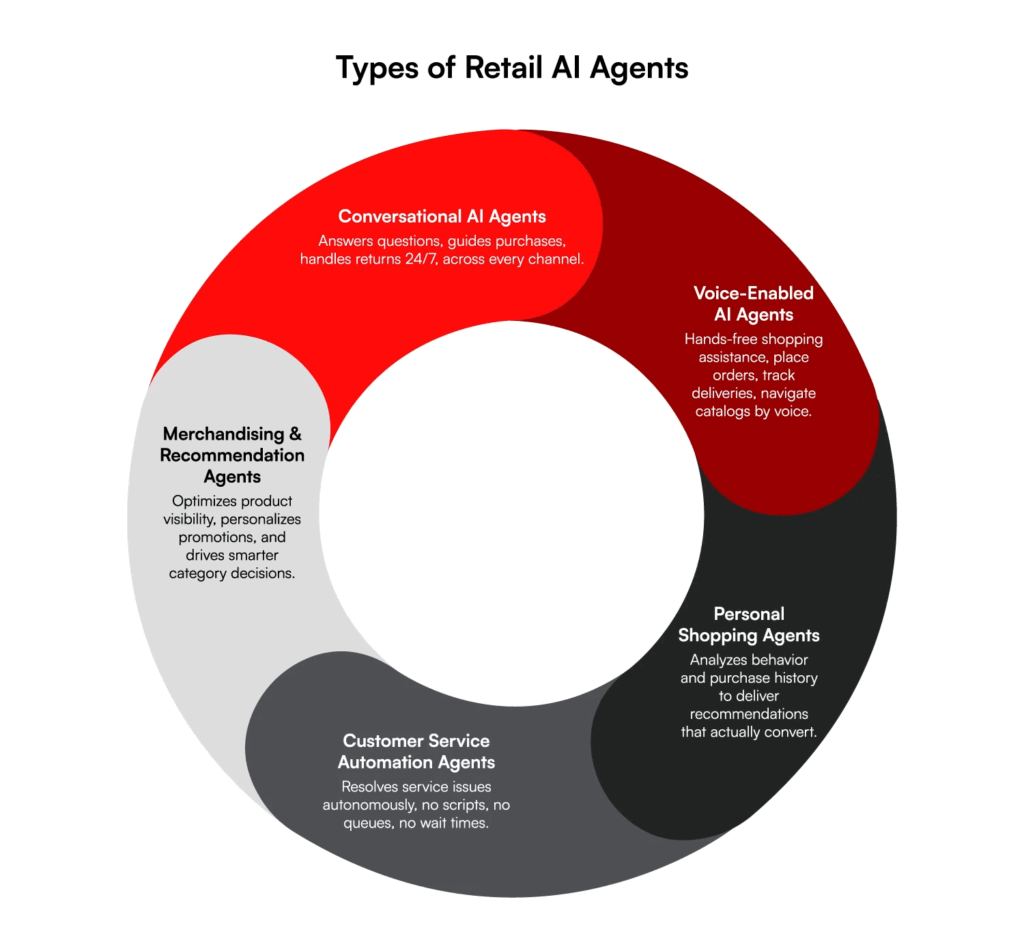
1. Conversational AI Agents
Chatbots and virtual assistants are AI-powered conversational agents that interact with customers in natural language.
They provide information, answer questions, guide users through product catalogs, assist with purchases, and help with order tracking or returns, ensuring fast, engaging, and 24/7 customer support.
2. Voice-Enabled AI Agents
Voice-enabled AI agents use voice recognition technology to interact with customers, offering hands-free assistance.
These agents allow users to navigate platforms, place orders, and manage shopping tasks through voice commands, making the shopping experience more convenient and accessible.
3. AI-Powered Personal Shopping Agents
These agents act as virtual personal shoppers by analyzing customer preferences, past behavior, and purchase history. They provide personalized product recommendations, helping create a tailored shopping journey and improving product discovery.
4. Customer Service Automation Agents
Customer service agents provide proactive, autonomous support by handling a wide range of service issues without relying on preprogrammed scenarios. They ensure efficient and accurate resolution of customer inquiries while maintaining continuous availability.
5. Merchandising and Recommendation Agents
Merchandising agents support retail teams with site setup, goal setting, personalized promotions, and product content creation. They also generate data-driven insights for better merchandising decisions.
These agents help optimize product visibility, improve conversions, and align offerings with customer demand.
How Retail AI Agents Work?
Retail AI agents operate through a structured architecture that enables continuous sensing, reasoning, decision-making, and execution with minimal human intervention.
Unlike traditional AI systems that focus on predictions, these systems are designed to take action based on real-time data and predefined goals.
1. Data Ingestion and Context Awareness
AI agents gather data from multiple internal and external sources, including transaction systems, inventory databases, customer interactions across online and offline channels, and external signals such as market trends, social media, weather, and competitor pricing. This creates a real-time, contextual view of the retail environment.
2. Reasoning and Decision Processing
The system applies business rules, machine learning models such as demand forecasting and customer segmentation, and optimization frameworks to evaluate different outcomes.
Instead of only generating insights, it analyzes trade-offs and selects the most suitable action based on defined objectives.
3. Memory and Continuous Learning
AI agents store past interactions, decisions, and performance outcomes. This enables them to learn from previous actions and improve over time, making future decisions more accurate and context-aware.
4. Autonomous Execution
Once a decision is made, AI agents execute actions such as adjusting prices, triggering inventory replenishment, launching promotions, or sending customer communications. These actions are carried out through integrations with systems such as ERP, CRM, and eCommerce platforms.
5. Governance and Control Mechanisms
AI agents operate within predefined constraints to ensure compliance with business rules and ethical standards. This includes enforcing pricing limits, protecting data privacy, and adhering to vendor agreements. Escalation mechanisms are in place for decisions that exceed defined thresholds.
6. Human Oversight and Feedback
AI agents include monitoring and feedback mechanisms that allow business users to review decisions, adjust goals, and intervene when required. This ensures that while agents operate autonomously, they remain aligned with business objectives and policies.
How Retail AI Agents Add Benefits With?
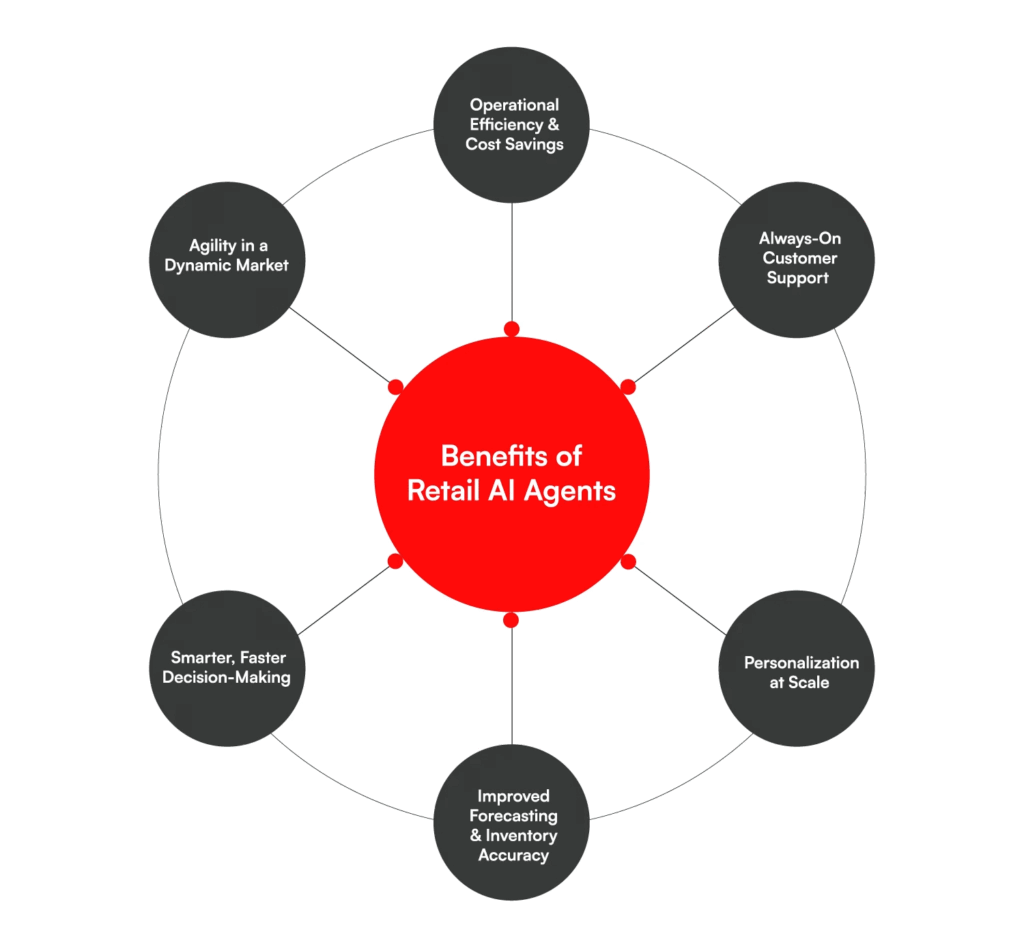
Retail AI agents offer significant value across operations, marketing, and customer service. One of the biggest benefits of retail AI agents development is their ability to act autonomously and intelligently at scale, handling tasks that would otherwise require large teams, extensive hours, or expensive systems. Here are the core benefits:
1. Ensure Operational Efficiency and Cost Optimization
Effective AI agents development for retail starts here, automating repetitive, time-consuming tasks like demand forecasting, stock reordering, and customer support ticket routing.
This reduces reliance on manual labor, cuts operational overhead, and improves consistency.
2. Ensure 24/7 Customer Support
AI agents, especially those using natural language processing, can handle thousands of customer interactions simultaneously, 24/7. This reduces wait times, ensures consistent service, and allows human agents to focus on complex cases.
3. Ensure Personalization at Scale
Recommendation agents analyze user behavior in real time and deliver individualized suggestions across web, mobile, and in-store experiences. This drives higher engagement, greater customer loyalty, and increased average order values.
4. Ensure Improved Forecasting and Inventory Accuracy
By continuously analyzing historical trends, external factors (such as seasonality and weather), and live sales data, AI agents improve forecast accuracy and reduce surplus inventory and markdown costs.
5. Ensure Smarter and Faster Decision-Making
AI agents can analyze millions of data points across sales, operations, customer feedback, and marketing to deliver real-time insights that would take teams hours or days to compile manually.
6. Ensure Agility in a Dynamic Market
AI agents can detect shifts in consumer behavior, competitor pricing, or supply chain status and act accordingly. This gives retailers the ability to respond in near real time, something traditional reporting tools can’t support.
Use Cases of Retail AI Agents With Real World Examples:
In retail, very few workflows follow a straight line. From shifting consumer demand to supply chain disruptions, the “ground truth” is constantly changing. And that’s where AI agents stand out.
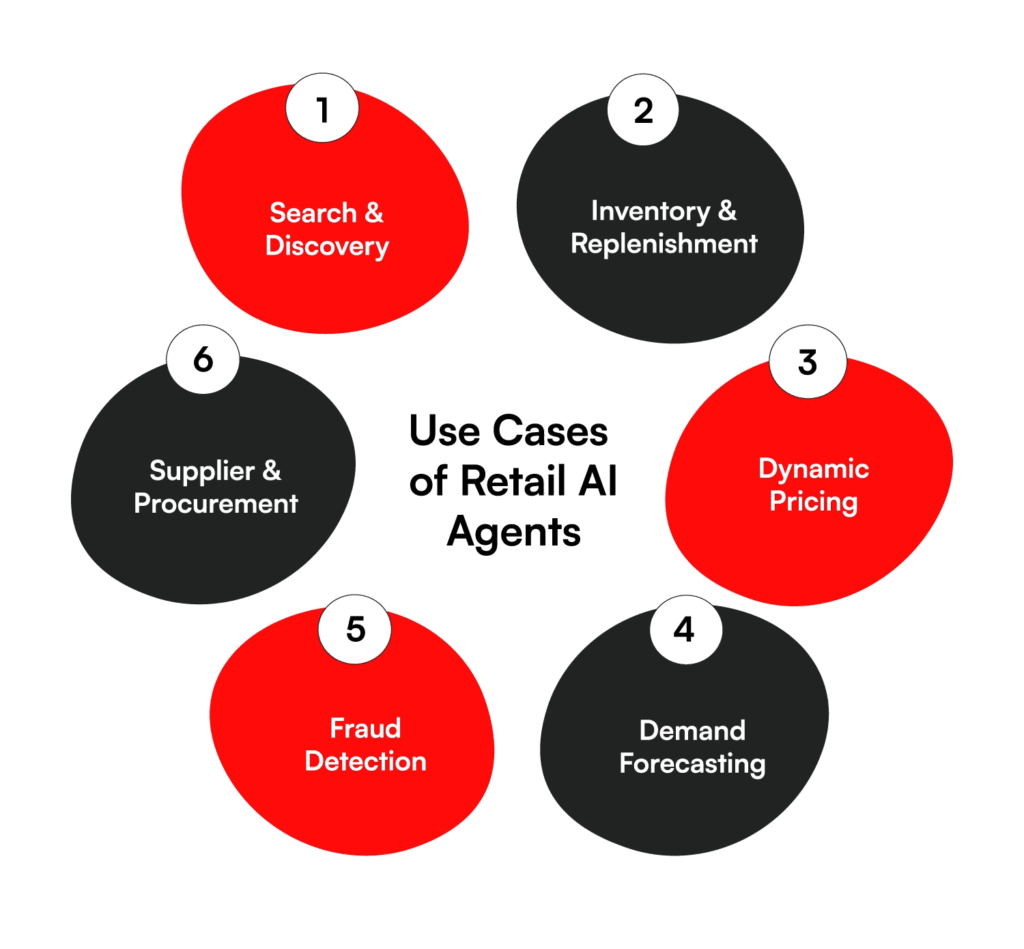
Retailers are increasingly deploying AI agents across customer experience, core operations, and internal workflows to reduce friction, improve decision-making, and drive measurable business outcomes. Let’s have a closer look at retail AI agent use cases and real-world examples.
1. Use Case: AI-Powered Product Search & Discovery
Traditional retail search often fails to surface relevant products, leading to lost conversions and poor customer experiences.
The series of AI agents transforms search into a guided discovery experience. The first AI agent interprets natural language queries, another scans product catalogs and real-time inventory, while a third applies personalization based on customer behavior and preferences.
Instead of returning generic results, the system delivers curated, context-aware recommendations.
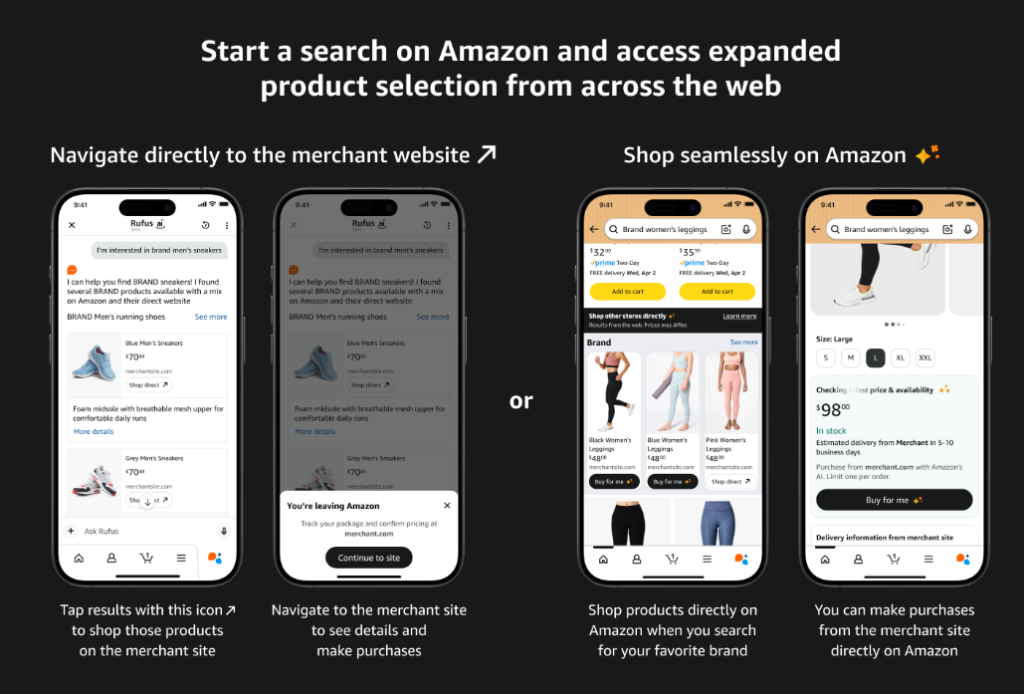
Real Word Example: Amazon: Buy For Me
Amazon’s Buy For Me is an agentic feature that helps customers search using full sentences or casual phrases and even purchase products from external brand sites.
Built on Amazon Bedrock and powered by Amazon Nova and Anthropic’s Claude models, it uses agentic AI to interpret intent, discover relevant items, and complete purchases seamlessly within the app.
It is one of the few publicly documented cases of a major retailer deploying an AI agent that completes a financial transaction autonomously.
2. Use Case: Inventory Management & Replenishment Intelligence
Inventory distortion is a $1.7 trillion global problem, with average retail inventory accuracy hovering around 70%. This forces teams to spend time manually reconciling stock levels instead of making strategic decisions.
AI agents shift inventory management from reactive reporting to proactive execution. One agent continuously monitors POS data to detect demand spikes.
Another evaluates stock levels across warehouses, transit, and stores, while a third determines the most efficient action, whether to reorder from a supplier or trigger a store-to-store transfer.
At the same time, agents update digital storefronts to reflect real-time availability, preventing mismatches between online and physical inventory.
This results in significantly improved inventory accuracy, reduced stockouts for high-demand products, and better capital efficiency by minimizing excess or dead stock.
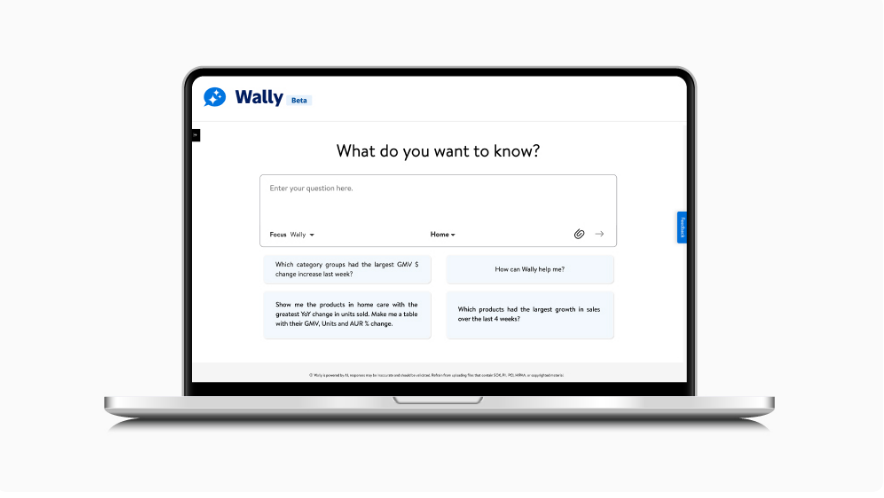
Real World Example: Walmart: Wally
Wally is Walmart’s internal AI tool that serves as a productivity enhancer for retailers, automating tasks such as generating insights from data piles, diagnosing product performance, pricing, and predicting future trends.
It uses advanced algorithms and a high-performance processing infrastructure t0 manage and process a large quantity of data. This removes the friction of manual reporting and provides actionable insights in seconds.
Walmart has also signaled where Wally is heading: it will move from a productivity multiplier for merchants to a fully autonomous agent, one that executes tactical decisions within configurable guardrails.
3. Use Case: Dynamic Pricing
Retailers relying on static pricing strategies often lose margins during demand fluctuations. Markdown losses alone can reduce margins by 20-25% when pricing is not aligned with real-time conditions.
AI agents enable continuous, data-driven pricing decisions. One agent monitors demand elasticity, competitor pricing, and inventory levels in real time. Another applies predefined business rules such as margin thresholds and brand positioning. A third executes price updates across eCommerce platforms, POS systems, and digital shelf labels.
This ensures pricing remains competitive during peak demand while minimizing unnecessary markdowns during slower periods. Retailers benefit from increased profitability, improved sales during demand spikes, and faster inventory turnover.
4. Use Case: Demand Forecasting & Allocation Optimization
Traditional forecasting relies heavily on historical data, leading to misaligned inventory and a 4-5% loss in total gross sales. Products often end up in the wrong locations, forcing markdowns and missed opportunities.
AI agents enable continuous forecasting by combining historical data with real-time signals such as weather patterns, social trends, and regional demand shifts. One agent monitors these signals and identifies deviations from expected patterns.
Another validates the recommended changes against operational constraints like warehouse capacity and labor availability. If within defined guardrails, the system automatically adjusts purchase orders and distribution plans.
This transforms forecasting from periodic planning into a continuous, execution-driven process, improving accuracy, reducing waste, and enabling faster response to market changes.
5. Use Case: Fraud Detection in Payments & Returns
With $890 billion in annual returns, retailers face significant exposure to fraud, particularly in refund abuse. Traditional systems either fail to detect fraud or incorrectly block legitimate customers, impacting trust and loyalty.
AI agents enable real-time fraud detection by analyzing transaction metadata, device signals, and customer behavior. One agent evaluates the transaction context, while another cross-references historical patterns such as return frequency and purchase consistency.
Based on this, a risk score is generated, allowing the system to either approve the request instantly or route it for further verification.
This approach reduces fraud losses, lowers operational costs associated with reverse logistics, and ensures a better balance between security and customer experience.
5. Use Case: Supplier Coordination & Procurement Intelligence
Retail supply chains are highly vulnerable to disruptions, which are often identified too late, after inventory shortages impact sales.
AI agents provide continuous visibility into supplier performance and logistics signals. One agent monitors potential disruptions, another calculates current inventory levels and identifies at-risk locations, while a third evaluates alternative suppliers based on pricing and lead times.
The system then prepares procurement actions, such as ready-to-send purchase orders, for quick approval.
This reduces disruption risk, accelerates procurement cycles, improves supplier performance tracking, and optimizes working capital usage.
6. Use Case: Customer Experience Enhancement (Virtual Try-On & Assistance)
Customers often hesitate to purchase products online due to uncertainty, particularly in categories like beauty and fashion, where physical trials are important.
AI agents enhance the shopping experience through interactive and personalized engagement. Using technologies such as computer vision and real-time processing, they enable customers to visualize products, explore variations, and make informed decisions without visiting a store.
This reduces purchase hesitation, increases engagement, and improves conversion rates by making the experience more immersive and personalized.
We have spent over a decade building inside the systems retail runs on, Oracle ATG, Salesforce Commerce Cloud, Shopify, and beyond.
Go from use cases to deployment now!
Explore Retail IT ServicesWhat is the Step-by-Step Process to Build AI Agents for the Retail Sector?
Starting with AI agents may sound ambiguous, but it doesn’t have to be. The key is to begin small with a specific use case that has clear business value, and approach scaling agentic AI from there. By focusing on one high-impact workflow, you can test, learn, and refine without investing in a full rebuild.
Once proven, the same architecture and logic can be applied to other parts of your business. With the right planning and a modular approach, AI agents can move from pilot to enterprise-ready at remarkable speed.
Step 1:Define Goals and Use Cases
At this point, you should decide the focus area of your business to improve.
- Improve in-house operations like warehouse management, financial or tax operations, or personnel scheduling
- Define clear objectives tied to business needs
- Focus on specific use cases before expanding
Step 2: Assemble the Right Team
Building AI agents requires multiple layers of expertise across infrastructure, platforms, and models.
- Infrastructure: on-premises, hybrid, or cloud compute, storage, and networking
- Platform: model management, monitoring, and deployment pipeline tools
- Frameworks: LangChain agents or AgentMesh for coordinating reasoning, context, and tools
- Models and data pipelines require specialized capabilities
Step 3: Plan Your MVP and Roadmap
Every custom AI agent is based on its architecture. Businesses should operate in modular layers instead of a monolithic system.
- Infrastructure, platform, frameworks, models, data pipelines, and service layers
- APIs, microservices, and business-facing applications
- Layered design enables scalability, flexibility, and easier upgrades
Step 4: Design for Seamless User Experience
To build AI agent components that feel intelligent, natural language understanding and dialogue management are required.
- Extract intents, entities, and sentiment from user input
- Use transformer-based NLP models (BERT, GPT, mT5)
- Use embeddings to map queries to knowledge bases and APIs
- Dialogue management through rule-based flows and reinforcement learning
- Memory modules preserve session context for multi-turn interactions
Step 5: Develop and Train AI Models
The model is the intelligence core that powers reasoning, planning, and execution.
- General-purpose LLMs (GPT-4, Claude, Gemini)
- Domain-specific fine-tuned models
- Hybrid stacks combining classical ML models with LLMs
- Retrieval Augmented Generation (RAG) with vector databases
- Multimodal models for text, vision, voice, and IoT data
Step 6: Integrate Across Retail Systems
The execution layer enables the agent to interact with enterprise systems.
- API and microservice orchestration
- Integration with ERP, CRM, and RPA systems
- Plugin and tool integration with databases and third-party systems
Step 7: Monitor, Optimize, and Scale
AI agent deployment requires continuous monitoring and scaling.
- CI/CD pipelines for building, training, testing, and deployment
- Containerization (Docker, Kubernetes)
- Monitoring dashboards for uptime, latency, and performance
- Version control and rollback
- Adversarial testing, prompt injection guards, and data privacy
- Multi-agent orchestration and shared memory layers
- Scale across operations after successful implementation
Implement Agentic AI in Retail Systems with the Right Approach
Bringing AI agents into your retail business isn’t a one-size-fits-all process. Retailers can choose from several implementation models, each with its own pros and cons.
1. In-House Development
Best suited for large retailers with strong technical teams. This approach provides full control over development, customization, and integration with existing systems.
- Full control and customization
- High investment and requirement for specialized talent
2. Outsourcing
Retailers rely on external vendors or experts to design and implement AI agents. This approach helps accelerate deployment and address skill gaps.
- Speeds up development and fills skill gaps
- Less control and ongoing vendor dependence
3. Hybrid Approach
Combines in-house strategy with external development resources, balancing speed, flexibility, and control.
- Balances speed, flexibility, and control
- Requires coordination between internal and external teams
4. Pre-Built Solutions
Quick to deploy and cost-effective, but less customizable. Great for retailers wanting to test AI agents before a bigger commitment.
- Quick to deploy, cost-effective
- Less customizable, limited flexibility
5. AI as a Service (AIaaS)
Cloud-based solutions from providers such as AWS and Azure offer scalable, plug-and-play AI agents for common retail tasks.
- Scalable, plug-and-play, easy to deploy
- Less customization, reliance on third-party services
Challenges for Implementing AI Agent in Retail Industry
Unlike traditional software, AI agents for retail operate autonomously, thinking, acting, and deciding without merely following rules. But with all the benefits they offer retailers, they also add a new layer of complexity that creates certain challenges.
So, here we discuss the challenges of implementing retail AI agents and how to overcome them.
- Autonomous Decision-Making Risks
The very characteristics that make AI agents powerful also make them hard to govern. Unlike traditional custom retail software development that does exactly what it’s programmed to do, AI agents analyze data, assess probabilities, and make decisions on their own, in real time.
Their ability to make decisions independently also means there’s no built-in checkpoint for a human to review the decision before it executes.
And in environments such as financial trading, healthcare, or autonomous vehicles, a single wrong decision can have severe consequences. This requires stronger oversight to ensure the AI agents operate ethically.
How to fix: Human-in-the-loop frameworks and explainability tools that define clear boundaries for autonomous action, flag high-risk decisions for human review, and log every agent decision with traceable reasoning.
- Security and Compliance Risks
Since AI agents connect to APIs, pull data from external sources, and communicate with users in real time, they also create a wide attack surface, making them vulnerable to security threats, just like any other AI system.
They can be manipulated through adversarial attacks, in which manipulated input data tricks an agent into making incorrect decisions.
LLM-powered agents can also be exploited to generate harmful outputs if not properly governed. This decentralized nature of agentic systems makes them harder to manage.
On top of security, there’s the compliance layer. Regulations around AI are still catching up to where the technology actually is.
Requirements are often ambiguous, vary across regions, and in many cases weren’t written with autonomous agents in mind. This may create real legal and reputational exposure for organizations operating at scale.
How to fix: End-to-end security protocols that include API access controls, authentication mechanisms, and continuous monitoring for adversarial activity, alongside a compliance framework that’s built to adapt as regulations evolve.
- Implementation and Adoption Gaps
McKinsey’s research reveals that 71% of merchants say AI retail tools have had limited to no effect on their business so far, because the organizational conditions to support them do not exist.
Dropping agentic AI into workflows and teams without rethinking roles, responsibilities, and operating rhythm creates friction instead of accelerating the operations.
AI agents can surface recommendations, flag anomalies, and execute decisions, but someone still needs to set the guardrails, interpret the outputs, and know how to control the system.
That requires a different kind of capability than most teams currently have, and most organizations aren’t building it fast enough.
How to fix: A phased implementation approach that redesigns workflows and redefines roles before scaling, with structured upskilling programs that build the data fluency, agent oversight, and decision-making capabilities teams need to actually work with agentic AI.
How Much Does it Cost to Build a Retail AI Agent?
Let’s be clear about one thing: the cost of building retail AI agents isn’t just a number but the reflection of how deeply you want intelligence embedded into your operations.
The typical investment ranges from $40,000 to $250,000+, but that range exists for a reason. A basic automation layer is very different from a fully orchestrated, multi-agent system that connects inventory, pricing, customer experience, and supply chain decisions in real time.
Let’s take a closer look at the cost breakdown of AI agent development for retail.
Feature-Wise Cost Breakdown
Every feature you add is another layer of decision-making your system can handle without human intervention.
1. Automated Inventory Management ($8,000 – $30,000)
Real-time stock tracking across locations. Reduces overstocking, prevents stockouts, and aligns digital availability with physical inventory.
2. Retail AI Sales Automation Agent ($10,000 – $35,000)
Drives upselling and cross-selling by analyzing behavior, preferences, and purchase history. Moves beyond static recommendations to contextual selling.
3. Customer Service AI Agents ($7,000 – $25,000)
Handles queries, returns, and support workflows 24/7. Reduces dependence on human agents while maintaining consistent responses.
4. Predictive Analytics ($5,000 – $20,000)
Forecasts demand using historical and real-time data. Shifts planning from reactive reporting to forward-looking decision-making.
5. Multi-Platform Integration ($6,000 – $25,000)
Connects POS, ERP, CRM, and eCommerce systems into a single operational layer. Without this, AI remains fragmented.
6. Advanced Capabilities: Vision, Voice, Generative AI ($15,000 – $50,000+)
Enables conversational interfaces, visual recognition, and generative workflows that enhance both automation and customer engagement.
Factors Affecting the Cost
Two retailers can allocate the same budget to AI and achieve completely different outcomes. The difference comes down to what sits underneath the system.
1. Scope of Features: More capabilities mean more decision layers, more complexity, and higher cost.
2. Integration Complexity: Legacy systems don’t integrate cleanly. Custom connectors and data mapping increase effort
3. Data Availability and Quality: Clean, structured data reduces training cost. Poor data increases both time and risk.
4. Customization Level: Fully bespoke systems require significantly more engineering than semi-custom implementations.
5. Technology Stack Choice: Cloud platforms, AI frameworks, and APIs influence both upfront and recurring costs.
6. Development Team Location: Costs vary globally, along with collaboration speed and domain expertise.
Hidden Costs That Impact ROI
This is where most AI projects go wrong. The initial build is approved, but the ongoing costs of running and evolving the system are underestimated.
1. Ongoing Maintenance and Model Retraining: AI agents don’t stay accurate on their own. They require continuous tuning as data and market conditions change.
2. Third-Party API Costs: NLP, computer vision, and analytics services often operate on usage-based pricing, which scales with adoption
3. Security and Compliance Audits: Regulatory requirements and data protection standards add additional layers of cost
4. Change Management and Training: Teams need to adapt. Without proper training, even the best AI systems fail to deliver value
The range is wide because every retail environment is different.
Get a scoped estimate based on your systems, use cases and integration requirements.
Get a Free Cost EstimateFuture and Market Trends of Retail AI Agents
According to Stanford’s AI Index, 78% of organizations reported using AI in 2024, up from 55% the year before. At the same time, Adobe reports a 1,950% year-over-year increase in retail site traffic from chat interactions during Cyber Monday, indicating that consumers are ready to embrace more advanced AI agents.
Additionally, investments in AI continue to grow as the need for real-time decision-making, hyper-personalization, and intelligent automation platform development like n8n increases.
2026 is expected to mark the shift from experimentation to execution, integration, and measurable return on investment.
Agentic Commerce
Bain estimates that the US agentic commerce market could reach $300 to $500 billion by 2030, making up roughly 15% to 25% of overall e-commerce.
Agentic commerce refers to purchases that are initiated, influenced, or completed by AI agents. Already, 30% to 45% of US consumers use generative AI for product research and comparison, and AI influenced $3 billion in US Black Friday sales.
Fully Autonomous Retail Ecosystems
Retail automation is moving toward creating smarter stores and supply chains. Technologies such as cashierless stores, smart shelves, and automated fulfillment systems are becoming more common.
By 2026, fully autonomous retail environments are expected to be viable for large-scale deployment. Smart shelves powered by sensors and computer vision enable real-time stock visibility, proactive replenishment, and improved inventory accuracy.
Multi-Agent Ecosystems for Operations
AI agents are increasingly being used across multiple functions within retail operations, including pricing, inventory management, supply chain optimization, and customer engagement.
These agents operate across workflows, analyzing data from various sources such as historical sales, weather patterns, local events, and social signals to improve forecasting, allocation, and operational efficiency.
Phygital Retail and Smart Stores
By 2026, the line between online and offline retail will continue to blur, with “phygital” retail becoming the standard.
Smart store infrastructure, mobile-enabled shopping, and AI-powered personalization are enabling seamless experiences across digital and physical touchpoints. Stores are also evolving into experience centers, fulfillment hubs, and key components of omnichannel strategies.
Why Choose RBMSoft For AI Agents Development For Retail?
As a digital transformation company with over a decade of hands-on enterprise delivery, RBMSoft designs, builds, and deploys custom retail AI agents for enterprises from the ground up, engineered for their commerce infrastructure.
Inventory systems, pricing engines, customer data, and order management don’t live in one place. And getting AI agents to operate effectively across that environment requires deep engineering. Our retail IT services are designed for exactly this!
- Purpose-Built Agentic AI
Our AI development services span the full stack from MLOps and LLMOps foundations to agentic systems built on LangChain, LangGraph, and RAG-based architectures. All our retail AI agents for enterprises are designed to reason, execute, and improve continuously.
- Connected Commerce Infrastructure
At RBMSoft, we have spent years building inside the systems that retail runs on: Oracle ATG, Salesforce Commerce Cloud, Shopify, and Adobe Commerce. That means agents aren’t operating on clean demo data.
They’re connected to live inventory positions, real pricing logic, and actual customer records, the operational context that makes autonomous decisions reliable in production.
FAQs
1. How to make an AI agent for a retail store?
Building an AI agent for retail is about creating a system that can connect data, understand context, and execute decisions across workflows.
The process typically starts with defining where the impact is needed most: inventory, customer service, pricing, or operations. From there, it moves on to building data pipelines, selecting models, and integrating with systems such as POS, CRM, ERP, and eCommerce platforms.
What separates a working prototype from a production-ready system is what happens next:
- Designing reasoning layers that evaluate decisions instead of just triggering actions
- Connecting agents to real-time data sources
- Enabling execution through APIs and system integrations
- Deploying with monitoring, guardrails, and continuous optimization
2. How are retail AI agents different from traditional automation systems?
Traditional automation was designed for predictability. Fixed rules. Predefined workflows. Limited scope. Retail doesn’t operate that way anymore.
AI agents are built for variability. They don’t just execute instructions; they interpret intent, evaluate context, and decide what action makes the most sense.
Instead of isolated systems:
- Inventory, pricing, and customer service operate together
- Decisions are made in real time, not in scheduled batches
- Systems adapt as demand, behavior, and supply conditions change
3. How long does it take to build AI agents for retail stores?
Timelines vary because the system you build defines the effort required.
- A focused implementation, like customer service or search, can be deployed in a few weeks to a couple of months
- Systems that involve inventory, forecasting, and integrations can take 3-6 months
- Multi-agent environments that coordinate across operations can take 6-12 months or more
4. How much does it cost to build retail AI agents?
The cost usually falls between $40,000 and $250,000+. But the range exists for a reason.
The cost is not driven by “AI” alone. It’s driven by what the system is expected to handle:
- The number of features and workflows involved
- The complexity of integrating with existing systems
- The quality and availability of data
- The level of customization required
- The technology stack and infrastructure choices
And then there’s the part most teams underestimate: ongoing costs. Maintenance, model retraining, API usage, compliance, and team enablement all add to the total investment over time.
5. How do AI agents improve the retail customer experience?
Customers move across channels, devices, and touchpoints within minutes. AI agents bring consistency to that experience by
- Understanding customer intent using natural language
- Surfacing relevant products based on behavior, preferences, and context
- Ensuring inventory visibility reflects actual availability
- Responding instantly across chat, voice, and digital channels
- Personalizing interactions across web, mobile, and in-store experiences
Inventory problems are usually where you first notice that your systems aren’t talking to each other, creating the most visible failures, and where AI agents deliver the most immediate value.
Most businesses rely on periodic checks and manual processes to keep inventory accurate. AI agents replace that with something continuous, constantly reconciling what’s in the system with what’s actually happening in the real world.
They catch discrepancies early, automate the predictable decisions, and surface the unpredictable ones to the right person before they become a crisis. They:
- Monitor stock levels across stores, warehouses, and in transit
- Detect demand shifts using real-time sales and behavioral signals
- Trigger replenishment or redistribution decisions automatically
- Keep digital storefronts aligned with physical inventory