Table of Contents
Quick Summary:
- AI demand forecasting replaces guesswork with data-driven decisions. It helps you predict demand more accurately using real-time and historical data.
- Inventory, staffing, and menu planning become more efficient. You reduce waste, avoid stockouts, and align staffing with actual demand.
- Even small forecasting improvements can significantly impact margins. Better planning directly reduces costs and improves profitability.
- A structured implementation approach is critical for success. From data audit to continuous improvement, each step ensures long-term value.
- AI requires continuous optimization. Regular updates, feedback, and performance tracking keep forecasts accurate.
- AI demand forecasting creates a scalable and future-ready operation. It helps restaurants handle growth, changing demand patterns, and operational issues.
You walk into your restaurant expecting a steady day. One hour later, you are short on ingredients because demand suddenly spikes. By the close, you are throwing away unused stock because the footfall did not match expectations. Your team struggled to keep up during rush hours, while you paid for idle staff during the slow ones.
Most restaurants deal with constant uncertainty across inventory, staffing, menu planning, and promotions. Traditional methods rely heavily on past averages or intuition, which simply cannot keep up with how quickly demand changes today.
AI demand forecasting in restaurants helps you move from reactive decisions to proactive planning by using data you already have. Instead of relying on guesswork, you begin to see patterns in your sales, customer behavior, and operations that were not visible before.
What is AI Demand Forecasting in Restaurants
AI demand forecasting in restaurants uses machine learning models to predict future demand at a granular level, such as item-wise sales, hourly orders, or location-specific trends.
It processes historical POS data along with external variables like weather, local events, seasonality, and customer behavior to generate accurate demand forecasts.
These models continuously learn from new data, detect patterns, and adjust predictions in real time. Instead of static reports or rule-based planning, you get dynamic forecasts that adapt to changing conditions.
This enables better decision-making across inventory, staffing, and operations. Now let’s see how it actually impacts your day-to-day operations.
Benefits of AI Demand Forecasting for Restaurants: Explained with Use Cases and Examples
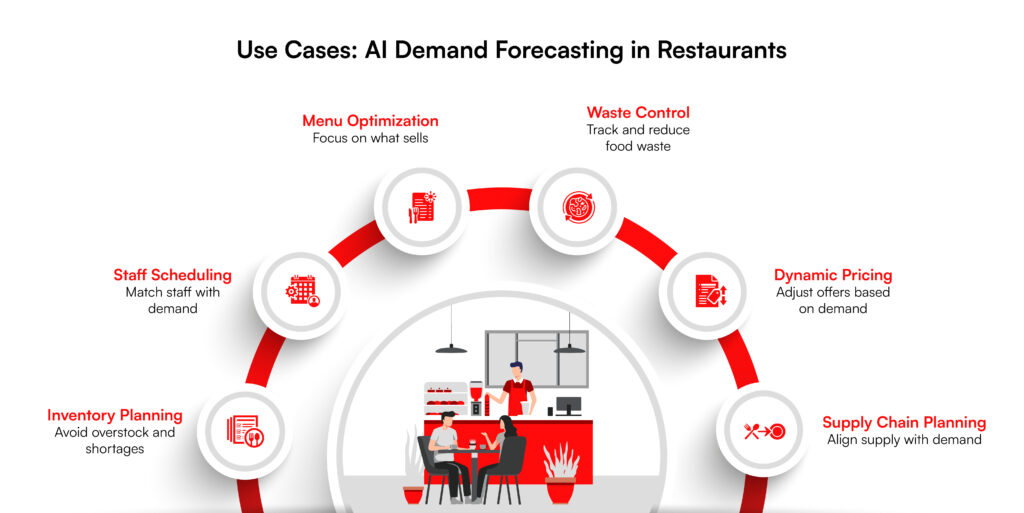
AI demand forecasting in restaurants directly impacts every business decision. From what you stock to how you staff and what you promote, it helps you make smarter decisions.
1. Use Case: Smarter Inventory Management
Restaurants typically lose around 4% to 10% of food purchases due to waste, and a big part of that comes from poor demand planning. AI demand forecasting looks at your past sales, day-wise trends, weather patterns, and local events.
It then predicts how much of each inventory you will actually need. Instead of guessing, you plan based on data. Over time, this reduces waste and minimizes stockouts.
Real Life Example: McDonald’s moved from reactive to proactive inventory management with AI demand forecasting:
McDonald’s has a complex and highly dynamic supply chain. With thousands of outlets globally, demand keeps changing based on location, weather, events, and even supply disruptions. With traditional methods, they often reacted after demands fluctuated, which increased the risk of stock imbalances, higher costs, and potential shortages.
To overcome this, McDonald’s shifted to AI-driven demand forecasting. Their systems now analyze large volumes of data, including historical sales, real-time POS data, supplier performance, weather patterns, and market conditions.
The predictive models forecast demand in advance and identify potential risks early, such as supply shortages or demand spikes.
This allows McDonald’s to act before problems occur. Suppliers and distribution centers receive demand signals in advance and adjust production and deliveries accordingly.
At the same time, smart inventory systems monitor stock in real time and trigger replenishment based on predicted demand. This helped them reduce waste, prevent stockouts, and improve supply chain coordination.
2. Use Case: Optimized Staff Schedules
Labor is one of the biggest expenses in restaurant and food delivery app development costs, often making up 25% to 35% of total revenue, so even small inefficiencies can impact profitability.
AI demand forecasting in restaurants helps you plan staffing more accurately. It analyzes past sales, hourly demand patterns, local events, and other relevant data to predict the daily and hourly footfall accurately. You can then schedule shifts based on this data.
Over time, this helps balance workload, reduce unnecessary labor costs, and maintain service quality during peak hours.
Real life Example: Starbucks deployed AI to automate workforce scheduling:
Starbucks operates across thousands of stores, housing diverse staff globally. For them, traditional scheduling methods proved inefficient when it came to employee schedule management.
They often found stores understaffed during peak hours, and also instances when the store was overstaffed for the relatively low footfall. These situations led to poor customer experiences and high operational costs, respectively.
To solve this, Starbucks introduced an AI platform for workforce scheduling optimization. The system uses AI-powered predictive analytics and historical data to predict the busiest and slowest hours for each store. It then creates optimized staff schedules to match demand more accurately.
It uses the data to generate work schedules. As a result, Starbucks not only improved staffing balance across stores but also reduced employee burnout with optimized scheduling.
Stop Losing Revenue to Guesswork
Restaurants using AI demand forecasting see up to 40% less waste and significant cost savings.
Speak to an expert
3. Use Case: Better Menu Optimization
AI demand forecasting shows you understand what customers actually prefer. It analyzes order data, seasonal trends, time of day, and even customer behavior patterns. It identifies which items sell the most, which ones are profitable, and which ones are rarely ordered.
Based on this, you can redesign your menu. You can promote high-margin dishes, remove low-performing ones, and introduce new items based on predicted demand.
Real Life Example: Yum! Brands uses AI for menu innovations
Yum! Brands leverages AI to analyze large volumes of customer data, including past orders, location-specific preferences, and digital interactions. Based on this, it predicts what customers are more likely to order and adjust menus, pricing, and promotions accordingly.
This allows brands like Taco Bell and Pizza Hut to highlight high-demand items, personalize offers, and even test new menu combinations more effectively.
4. Use Case: Efficient Waste Tracking & Analytics
Food waste is one of the highest hidden costs in a restaurant. You may not see it clearly, but it affects your margins every day. Ingredients expire. Food gets over-prepared. Some dishes consistently go unsold. This usually happens because you do not have visibility into what is being wasted and why.
Restaurants can lose around 2% to 6% of their revenue due to food waste, and most of it comes from poor demand planning.
AI demand forecasting in restaurants, combined with waste tracking, helps fix this. It connects sales data with kitchen operations. It shows which items are consistently over-prepared and which ingredients are frequently wasted. It also predicts future demand more accurately.
This allows the kitchen to adjust prep quantities and purchasing decisions. Over time, waste reduces, and inventory becomes more aligned with actual demand.
5. Use Case: Dynamic Pricing and Promotions
Pricing and promotions often run on fixed plans. You decide on offers in advance and stick to them. But demand does not follow a fixed pattern. Some hours are slow, others are packed. This creates a gap. You either give discounts when you do not need to, or miss chances to attract customers when business is slow. This directly impacts revenue.
AI demand forecasting studies past sales, time-based patterns, customer behavior, and external factors. It predicts the rise and drop in demand.
Based on this, the restaurant can run promotions only when needed. For example, it can introduce limited-time offers during slow hours to increase footfall. During peak periods, it can reduce discounts and focus on full-price sales. This keeps demand steady and protects margins.
6. Use Case: Improved Supply Chain Operations
AI demand forecasting helps you connect demand signals across your entire supply chain. It analyzes sales data from each location, along with external factors like weather, local events, and regional trends..
It predicts demand at a granular level and shares these insights with suppliers and distribution centers in advance. This allows better planning of production, inventory allocation, and deliveries.
Real Life Example: McDonald’s uses demand forecasting for global supply chain optimization
McDonald’s has one of the most complex supply chains in the world. It operates across thousands of restaurants, multiple countries, and a vast network of suppliers and distributors.
McDonald’s uses AI-driven demand forecasting to run supply chain operations smoothly. The system ingests POS sales data, supplier performance, inventory flows, weather forecasts, satellite crop imagery, and commodity trends. It then generates demand signals across the entire supply chain every four hours.
It flags potential ingredient shortages, weather disruptions, or supplier delays weeks before they impact operations. McDonald’s can then reroute shipments, adjust sourcing, or onboard alternative suppliers proactively
Now that we have seen how AI demand forecasting delivers value across operations, the next step is implementation. The impact only comes when these insights are applied correctly in your day-to-day workflows.
10 Hours Saved Every Week
AI-driven planning reduces manual effort and frees up your team for higher-value work. See how much time you can save.
Get in touch with usStep-by-Step Process to Implement AI Demand Forecasting for Restaurants
Implementing AI demand forecasting in restaurants is a structured process that starts with understanding your operations. It gradually builds into a system that supports everyday decisions. When done right, each step helps you move from guesswork to data-driven planning without disrupting your existing workflows.
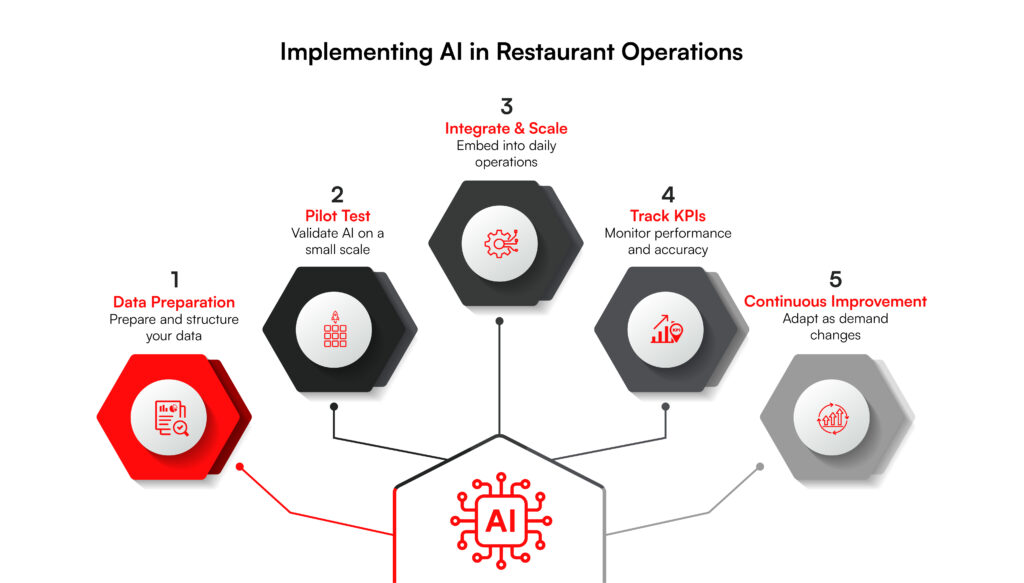
1. Collect and Prepare Data
Start by collecting structured internal data from POS systems, inventory logs, recipe-level consumption, waste tracking, and staff schedules. This forms your core demand signal. Then, integrate external datasets such as weather APIs, local events, holidays, and regional trends that influence demand variability.
Next, clean the data by removing duplicates, handling missing values through imputation, and correcting inconsistencies. Standardize formats, align timestamps, and normalize units across systems. Create a unified data schema and build pipelines to merge sources into a centralized dataset.
You can also engineer features like day-of-week trends, seasonality, and demand spikes to improve model accuracy. This step is critical because AI models rely on high-quality, structured, and consistent data to generate reliable forecasts.
At RBMSoft, we build automated data pipelines, apply advanced preprocessing techniques, and engineer features to ensure your data is accurate, unified, and ready for AI forecasting models.
2. Test AI with a Pilot Use Case
This is where you test AI demand forecasting in a controlled setup before rolling it out across your restaurant or chain. Start small by selecting a specific use case, such as inventory planning or staff scheduling.
Choose a few locations or a single outlet for the pilot. Prepare and feed relevant data into the model, including sales, inventory, and external factors. The AI runs alongside your existing system. Compare its predictions with current decisions to see the difference.
Then track results, focusing on accuracy and operational impact. Based on this, you decide whether to scale, refine, or adjust your approach.
A common mistake is trying to do too much too soon. Many restaurants attempt to apply AI across multiple areas at once. This creates confusion and makes it harder to measure success. Start small and stay focused.
Key focus areas
- Identify Low-Risk, High-Impact AI Use Cases
Start with a use case that is simple to implement but shows clear results. Focus on areas like inventory planning or demand prediction for top-selling items. This helps you prove value quickly without disrupting operations.
- Select Pilot Locations Strategically
Choose locations that reflect your typical business patterns. Avoid extreme cases like your highest or lowest performing outlets. The idea is to test in an environment that represents your overall operations.
- Prepare and Feed Data into the AI Model
Use clean and structured data from your audit phase. Ensure consistency in formats and timelines. Good input data directly impacts the quality of forecasts.
- Run AI in Parallel with Existing System
Do not replace your current process immediately. Run AI alongside it and compare outputs. This builds trust within your team and helps you understand how decisions differ.
- Measure and Evaluate Pilot Outcomes
Track metrics like forecast accuracy, waste reduction, stockouts, or labor efficiency. Focus on real business impact, not just model performance.
- Plan for Scaling or Iteration
Based on the results, decide your next move. If the pilot works, plan to expand. If not, refine the model or adjust the use case before scaling.
After this step, you have a working pilot with measurable results. You can clearly see improvements in accuracy or efficiency. Your team understands and trusts the outputs and also knows what needs to be improved before scaling. At this point, you are ready to expand AI across more locations or use cases.
3. Integrate and Scale Across Operations
Move from a successful pilot to making AI demand forecasting part of your everyday operations. Connect your AI model with the systems you already use. This includes your POS, inventory, and staffing tools. You ensure data flows smoothly so forecasts are always based on real-time information.
Then start using these predictions in daily decisions. This could mean adjusting inventory orders, planning prep quantities, or scheduling staff based on forecasted demand. Gradually reduce manual guesswork.
As you gain confidence, expand the solution across more locations and use cases. At the same time, define clear processes so every outlet uses forecasts in a consistent way. Also, train your teams to understand and act on AI outputs.
Key focus areas
- Automate Decision Workflows
Start automating routine actions like inventory reordering, prep planning, and basic staffing adjustments. Keep human oversight in place, but reduce dependency on manual decisions. This improves speed and consistency in daily operations.
- Standardize Basic Processes
Define clear guidelines on how forecasts should be used across locations. For example, how much buffer stock to maintain, or how staffing changes are approved. Standardization ensures every outlet follows the same approach, which is critical for scaling.
- Set Governance & Control Mechanisms
Define ownership and accountability. Decide who monitors performance, who approves decisions, and how exceptions are handled. This prevents misuse and ensures AI supports decision-making rather than replacing it blindly.
As a result, AI forecasts become part of your daily operations. Systems stay connected, and data flows smoothly across functions. Your teams start relying on forecasts for everyday decisions with confidence.
4. Track Performance with Key KPIs
In this step, you define a small set of KPIs that directly reflect operational impact. Start tracking these metrics regularly using your existing systems or simple dashboards.
Compare current performance with your baseline from the audit phase. Also track how AI predictions perform against actual outcomes on a daily or weekly basis.
Involve your operations team in reviewing these metrics. Store managers and kitchen staff provide context behind the numbers. This helps you identify gaps that data alone cannot explain. Based on these insights, you refine how forecasts are used in daily decisions.
Teams often create complex dashboards with too much data, which makes it hard to understand what actually matters. As a result, managers stop using the data in daily decisions. Another issue is treating KPI tracking as a reporting activity instead of an action-driven process.
Numbers get reviewed, but no changes are made on the ground. In some cases, teams only look at overall performance and ignore where forecasts are going wrong at a detailed level.
5. Continuously Improve and Optimize
Keep improving your AI forecasting so it stays accurate and useful as your business changes. In this step, you treat AI as an ongoing process, not a one-time setup. Keep feeding new data into the system so it stays updated with recent trends. Review where forecasts go wrong and understand why. Adjust the model and how you use it in daily decisions.
Update your approach as your business evolves. This could include new menu items, pricing changes, or expansion to new locations. At the same time, you keep your teams involved so they continue to trust and use the system. Review performance regularly and make small improvements instead of waiting for major issues.
Many restaurants stop updating data or reviewing performance after initial success. Over time, forecasts become less accurate because demand patterns change. Without continuous updates and feedback, the system loses its value.
With this, your forecasting system keeps improving over time. It adapts to changes in demand, menu, and operations. Teams continue to trust and use it in daily decisions. You see steady improvements in accuracy, efficiency, and overall performance.
Cost to Develop and Integrate AI Demand Forecasting and ROI
Implementing AI demand forecasting in your restaurant is an investment, but it directly impacts your bottom line. Most restaurants spend between $25,000 to $50,000 in the first year. This covers setup, system integration with POS or ERP, and team onboarding.
Ongoing costs typically range from $500 to $2,000 per location per month. If you go for a custom or enterprise-level solution, costs can exceed $100,000. However, the returns often justify the spend, with many businesses seeing 120% to 280% ROI through better efficiency and cost control.
Cost Overview:
| Component | Estimated Cost |
| Initial Setup & Integration | $25,000 – $50,000 (Year 1) |
| Enterprise/Custom Solution | $50,000 – $100,000+ |
| Ongoing Monthly Cost | $500 – $2,000 per location |
Areas of ROI:
| Area | Impact |
| Food Waste Reduction | Reduces waste by 30% to 40% by improving demand accuracy |
| Labor Optimization | Cuts overtime and overstaffing costs by 10% to 15% |
| Inventory Efficiency | Lowers food costs by reducing overstocking and stockouts |
| Operational Efficiency | Saves 8 to 10 hours per week in scheduling and planning |
| Increased Revenue | Prevents lost sales by ensuring item availability |
Know Your ROI Before You Invest
Get a tailored quote and see the projected cost and ROI for your specific operations.
Show Me My QuoteWhy Choose RBMSoft as Your AI Forecasting Partner
AI-powered demand forecasting in restaurants helps you reduce waste, control costs, and make better decisions every day. But the real impact depends on how well the system is implemented and aligned with your operations.
At RBMSoft, we bring deep experience in delivering travel and hospitality IT solutions, which helps us understand the real challenges restaurants face on the ground.
We design solutions that fit into your day-to-day workflows and deliver measurable results. From the first audit to continuous improvement, we stay involved to ensure the system works in real conditions.
- End-to-end implementation support
From data audit to scaling, we guide you through every stage of the journey. - Seamless system integration
We connect AI with your POS, inventory, and staffing systems for real-time insights. - Custom AI models built for your business
No generic solutions. We design models based on your menu, demand patterns, and operations. - Operational-first approach
We focus on solving real problems like waste, stockouts, and staffing inefficiencies. - Scalable architecture
Our solutions grow with your business, whether you run one outlet or a global chain. - Ongoing optimization and support
We continuously refine models and processes to keep improving accuracy and performance.
RBMSoft provides AI development services that are designed to turn data into daily decisions. You gain better control over demand, reduce waste, and improve efficiency. This is how you build a restaurant that is ready for what comes next.
FAQ’s
1. How do restaurants use AI for demand forecasting?
Restaurants use AI to analyze past sales, customer patterns, weather, and local events. It predicts future demand at the item, hour, or location level. This helps plan inventory, staffing, and promotions more accurately, reducing guesswork and improving daily operations.
2. How does AI demand forecasting help for restaurant growth and success?
AI reduces waste, improves staffing efficiency, and ensures better product availability. It helps restaurants make data-driven decisions instead of relying on guesswork. This leads to cost savings, better customer experience, and more consistent revenue growth over time.
3. Is demand forecasting limited to restaurant menu planning, or does it also extend to staffing and other operational aspects?
Demand forecasting goes beyond menu planning. It supports inventory management, staff scheduling, pricing strategies, and supply chain decisions. It connects multiple parts of operations, helping restaurants run more efficiently and respond better to changing demand.
4. Is demand forecasting only beneficial for large restaurant chains, or can it also deliver measurable value for small and independent restaurants?
It benefits both large chains and small restaurants. While large businesses gain scale efficiency, smaller restaurants can reduce waste, control costs, and improve planning. Even simple forecasting models can deliver strong value with the right data.
5. How is AI-powered demand forecasting in restaurants different from traditional forecasting or ERP systems?
Traditional methods rely on past averages and static rules. AI uses real-time data, learns patterns, and adapts to changes like weather or demand shifts. Unlike ERP systems, which track data, AI actively predicts future demand and supports better decision-making.