


Quick Summary
- Why AI in ecommerce personalization has shifted from broad segmentation to hyper individualization and the segment of one
- How unified big data architecture connects behavioral, transactional, contextual, and preference data to power real time decisions
- The measurable impact of AI personalization including higher conversion rates, increased AOV, stronger retention, and long term customer loyalty
- How AI technologies such as machine learning, recommendation engines, dynamic pricing, and personalized search drive revenue growth
- Real ecommerce examples showing how leading brands use AI to scale personalization successfully
- The biggest implementation challenges including data silos, model drift, algorithm bias, privacy regulations, and over automation
- A phased deployment roadmap covering strategy, data integration, AI model development, testing, launch, optimization, cost expectations, and ROI timelines
In 2026, AI in ecommerce has witnessed a paradigm shift from Hyper-personalization to Hyper-Individualization i.e moving from a broad customer segment to the segment of one. It is no longer useful for enterprises to predict what thousands want rather than predict what one person wants.
And this is the most expensive mistake an enterprise can commit when it treats a $10,000 loyalist like a first-time browser. Consequently, your consumer will simply penalize your brand for failing to recognize them in real time.
According to McKinsey, 71% of consumers expect personalized interactions, and 76% get frustrated when they don’t receive them.
Achieving this level of hyper-individualization at scale requires more than just a recommendation engine; it requires a sophisticated orchestration of AI models fed by a unified Big Data architecture.
This serves as connective tissue, turning your simple infrastructure into a predictive force that delivers an algorithmically generated version of your brand to every visitor.
This guide walks through exactly how AI ecommerce personalization powers that transformation and what it takes to implement it at scale.
Why Personalization in Ecommerce Matters?
AI personalization in ecommerce is about tailoring the user experience using each user’s data patterns. It’s pretty simple. If you don’t personalize the shopping experience, your customers are already looking for the exit. They won’t wait around for you to get it right.
Most brands just wing it. It never works. According to Epsilon, about 80% of shoppers are more likely to buy when a brand actually uses personal details to help them.
This shift isn’t some fancy trend. It is a massive change in how people act. Modern shoppers feel overwhelmed by too many choices. They have zero patience for stuff that doesn’t matter to them.
AI for ecommerce fixes this headache. It cuts through the noise and shows exactly what a person needs. It does this at the right time. No more wasted time.
Key benefits of AI-driven personalization in ecommerce include:
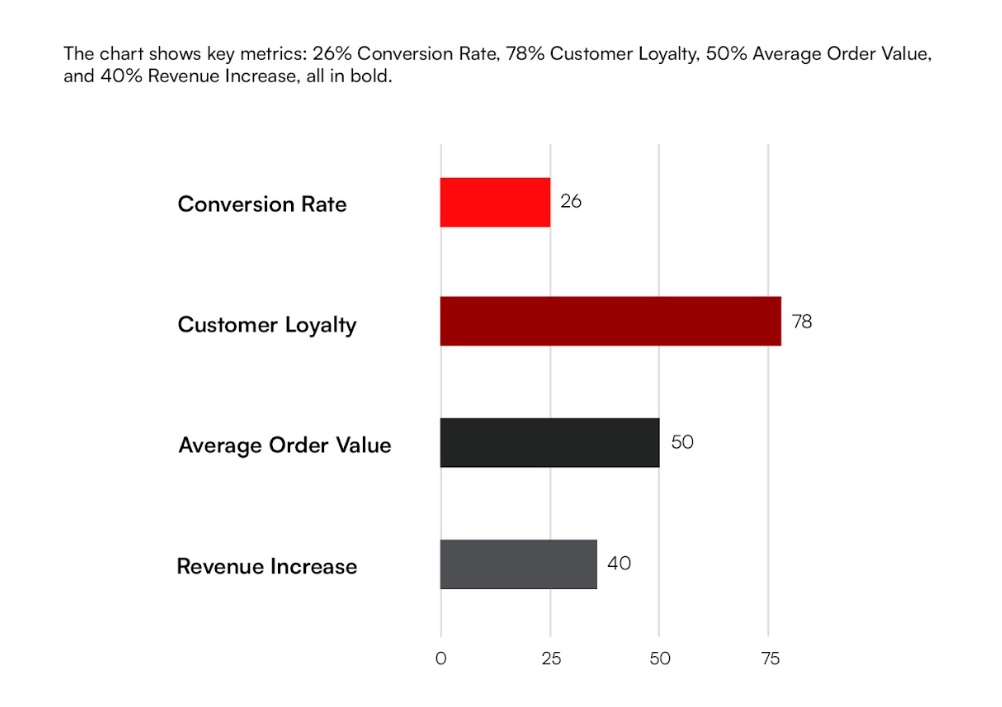
- Conversion Rate Optimization: Targeted product suggestions, a noticeable growth in conversions by 26%, according to Salesforce.
- Increased Customer Loyalty: 78% of targeted consumers make repeat purchases.
- Increased Average Order Value (AOV): Personalized cross-selling and upselling strategies increased AOV by 50%.
The Data Foundation: Beyond Basic Recommendations
Advanced personalization requires a data architecture that processes information in real time at a massive scale. Most ecommerce businesses fail here. Their customer data is trapped in silos: CRM systems, email tools, and inventory logs all live in separate worlds.
Without a unified view, AI efforts fall flat. You end up with fragmented experiences where loyal customers are treated like strangers. The mobile app doesn’t know what they bought on a desktop. It is a major gap.
Properly integrating these sources allows AI to build a complete picture. Each data point alone has limited value, but together they enable experiences that feel intuitive rather than intrusive.
Types of Data That Drive Personalization
- Behavioral Data: Browsing history, click patterns, session duration, and cart abandonment signals reveal customer intent and interest.
- Transactional Data: Purchase history, average order value, and buying frequency provide concrete records of customer preferences for predictive recommendations.
- Contextual Data: Location, device type, time of day, and weather conditions add crucial context. A mobile shopper at lunch requires different personalization than a desktop user researching at midnight.
- Preference Data: Explicitly stated preferences through surveys, wish lists, and saved items give direct insight into customer desires, increasingly valuable in privacy-conscious environments.
- Social Data: Social media engagement, shared interests, and community participation reveal lifestyle elements that inform personalization beyond transactional behavior.
Each data point individually has limited value. When integrated, they create a multidimensional customer profile that enables AI algorithms to deliver personalization that feels intuitive rather than intrusive.
How AI and Big Data Power Personalization
Raw data is useless without the intelligence to act on it. AI and Big Data don’t just collect information; they transform billions of fragmented signals into precise, real-time decisions that make every customer feel like your only customer. Here’s how it works.
Customer Data Collection and Analysis
AI and Big Data changed everything about how we understand customers. We used to guess based on demographics or last quarter’s sales reports. Now? We pull in browsing history, purchase patterns, clickstreams, location data, age, gender…all of it. The difference is night and day.
But here’s the thing: AI-powered personalization in ecommerce isn’t about hoarding data. It’s about making sense of the chaos. AI algorithms find patterns buried in millions of data points.
Patterns you’d never spot manually. Add natural language processing and deep learning to the mix, and you’re not just tracking behavior. You’re predicting it. Sometimes, before customers know what they want themselves.
Real-Time Personalization
Postgres and MySQL are great databases and reliable. But they can’t handle the speed modern shoppers expect because they are not designed for it.
NoSQL databases like MongoDB and search tools like Elasticsearch changed the game completely. AI-driven personalization in ecommerce becomes make-or-break during Black Friday. Or Cyber Monday. Or any flash sale, really.
RBM Soft’s microservice solution enables ecommerce clients to deliver personalized content to users in real time. This is critical for businesses with enormous transaction volumes and those that need to update inventories instantly.
Personalized Product Recommendations
Personalization is achieved by AI recommendation engines using collaborative filtering and content-based filtering to propose a unique set of products to each client.
According to McKinsey, companies like Amazon generate 35% of their revenue from AI personalized recommendations.
RBM Software takes a different approach. We combine machine learning with generative AI to create recommendations that feel helpful instead of invasive.
The system learns from every interaction. What you bought, when you bought it, and what you browsed but didn’t buy. It gets smarter. Not creepier. There’s a difference.
Dynamic Pricing Optimization
Static pricing is dead. AI-powered pricing adjusts constantly based on real-time conditions. Competitor prices. Inventory levels. Demand spikes. Sometimes even weather patterns.
Deloitte’s research backs this up: businesses using AI-driven pricing see revenue increases of 10% to 20%. That’s not marginal. That’s transformative.
RBMSoft’s smart pricing algorithms handle the complexity automatically. No spreadsheet monitoring at 2 AM. No manual price adjustments. The system protects your margins while keeping you competitive. Set it and forget it? Not quite. But close.
Personalized Marketing Campaigns
“Dear Valued Customer” emails belong in the trash. AI transforms marketing by figuring out who wants to hear from you. When they want to hear from you. What message will resonate? Personalized campaigns consistently crush generic blasts. The data doesn’t lie.
We worked with a global clothing retailer struggling with its international campaigns. Different languages. Different cultures. Different buying patterns. AI-powered segmentation solved it.
Each region got tailored messages at optimal times. Engagement rates jumped. ROI improved across every market. The secret? Stop treating all customers the same. They’re not.
Join the Industry Leaders Scaling Smarter
Get your custom feasibility roadmap and see how we can slash your overhead by 60% without missing a beat.
Schedule Free Consultation
Platforms with AI Personalization Capabilities: Real-life Examples
1. Amazon
Amazon has long been the gold standard for AI-driven personalization. According to McKinsey, their recommendation engine processes over 35% of total ecommerce sales through personalized product suggestions as “RECOMMENDED FOR YOU.”
They use machine learning algorithms to analyze every browse, every click, and every purchase. The system builds real-time recommendations that feel almost psychic. “Recommended for you” isn’t marketing speak. It’s predictive analytics working at a massive scale.
Customer retention jumped 56% after implementing their AI personalization system. These are AI personalization ecommerce examples that actually move the needle.
2. Netflix
While primarily a streaming platform, Netflix’s personalization strategies offer crucial insights for ecommerce. Around 75% of content watched on Netflix comes from the personalized recommendation system, which means the AI algorithms guide the viewers toward their next favorite movie or TV show.
Netflix’s personalization approach consists of:
- An AI-powered recommendation system analyzing viewing patterns
- Personalized thumbnails based on individual user preferences
- Content clustering using machine learning
Netflix has more than 1,300 “recommendation clusters,” built using viewers’ preferences through personalization. In 2024, Netflix generated $39 billion in revenue, a 15.7% year-on-year increase.
3. Alibaba
Alibaba uses AI to personalize product recommendations across its ecommerce platforms, Tmall and Taobao. According to a 2021 case study published by Alibaba, the use of AI recommendation systems resulted in a 20% increase in sales during the last quarter of 2020 on their ecommerce platforms.
4. Sephora
Sephora took a different approach. They combined AI with augmented reality to completely reimagine the customer experience. Virtual Artist launched in 2016, letting customers try products virtually before buying. Smart move. Really smart.
That initiative increased Sephora’s e-commerce net sales from $580 million in 2016 to over $3 billion in 2022. More than four times the growth in six years. The AI doesn’t just recommend products. It shows you how they’ll look on your actual face. That’s personalization that removes all buying friction.
Major Advantages of AI and Big Data in E-commerce Personalization
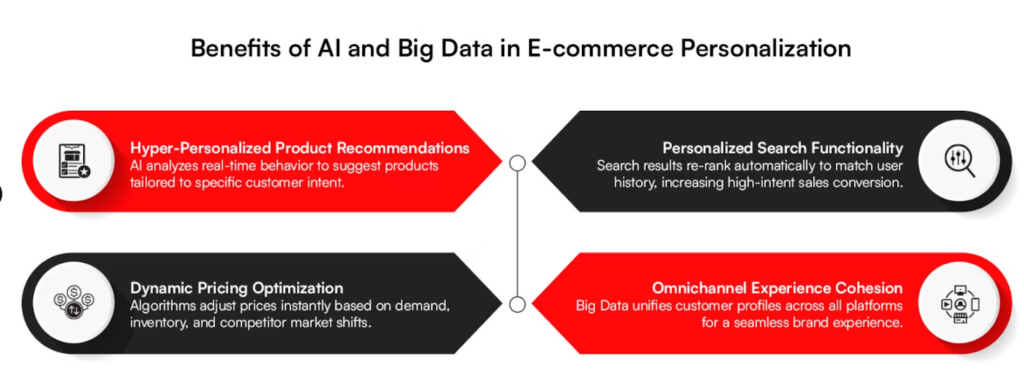
The competitive gap between brands that personalize and brands that don’t is no longer small. It is existential. AI and Big Data give ecommerce businesses the power to stop guessing and start delivering exactly what each customer wants at exactly the right moment. Here are the advantages that make the difference.
1. Hyper-Personalized Product Recommendations
AI algorithms analyze millions of data points to make product recommendations that dramatically outperform traditional customer-based suggestions. These systems learn from each interaction, getting smarter with every click and purchase.
Large Language Models (LLMs) can generate comprehensive customer categories by analyzing past transaction data, creating segments based on frequency, preferences, and purchase patterns that human analysts would miss.
2. Dynamic Pricing Optimization
AI-powered pricing systems adjust prices in real time based on competitor prices, demand patterns, and individual customer willingness to pay. McKinsey’s study found that retailers implementing AI-driven dynamic pricing saw revenue increases of 5-10% within the first year. The algorithm optimizes for both volume and profitability simultaneously.
3. Personalized Search Functionality
Most search bars are broken because they treat every customer like a stranger. Search remains the most critical function of an e-commerce site, yet many retailers still offer one-size-fits-all experiences. AI-enhanced search changes that by doing the following:
- Re-rank results based on individual preferences
- Understand natural language queries
- Predict search intent based on past behavior
- Adapt to regional and cultural linguistic differences
The benefits of AI personalization in ecommerce are obvious when looking at the numbers. Delivering these complex, personalized search experiences usually brings 15-25% additional sales and revenue from search terms. If your search bar doesn’t recognize who is typing, you’re just leaving money on the table.
4. Omnichannel Experience Cohesion
Customers interact across multiple touchpoints before making purchases. AI and big data enable seamless personalization across websites, mobile apps, email, social media, and in-store experiences.
This connected approach not only improves customer experience but also provides complete visibility into customer journeys, informing better decisions about marketing spend and inventory allocation.
Develop the bespoke AI and Big Data architecture required to outpace your ecommerce business and own the future. Don’t just watch the shift, engineer it.
Get Service AssistanceChallenges of Implementing AI-Driven Personalization
AI-driven personalization delivers serious competitive advantages, but implementation is rarely straightforward. From fragmented data infrastructure to ethical algorithm governance, enterprise teams face real obstacles that can stall ROI and erode customer trust.
Here are the five most critical challenges and how to overcome them.
1. AI Model Maintenance and Upgrades
Challenge: AI models are not set and forget technology. After deployment, they need constant attention to maintain performance.
Over time, models experience model drift, where accuracy degrades as customer behavior patterns shift. What worked brilliantly six months ago might miss the mark today. Skip maintenance, and personalization accuracy declines while your team wonders why conversions are dropping.
Solution: Build a continuous monitoring framework from day one. Schedule quarterly model retraining cycles and set performance thresholds that trigger automatic alerts when accuracy drops. Treat AI model health like any other critical business infrastructure, not an afterthought.
2. Data Silos and Integration Issues
Challenge: Most enterprise retailers have customer data scattered across disconnected systems. CRM platforms sit separate from inventory management. Marketing automation tools do not talk to payment processing. Customer service platforms operate in their own world.
This fragmentation kills personalization before it starts. The AI cannot build complete customer profiles when critical data lives in isolated silos.
Solution: Implement a Customer Data Platform as your single source of truth. A CDP pulls data from every disconnected system into one unified layer, giving your AI the complete customer picture it needs to deliver personalization that actually works at scale.
3. Algorithm Transparency and Bias
Challenge: AI systems amplify the biases present in their training data. A recommendation algorithm might reinforce gender stereotypes in product suggestions.
Certain customer segments could face inadvertent discrimination if you are not monitoring how the system makes decisions. This is not theoretical. It happens, and it carries both reputational and compliance consequences.
Solution: Implement ethical AI governance from the start. Assign diverse teams to regularly audit algorithm outputs, challenge assumptions, and flag discriminatory patterns. Explainability tools that surface why the AI made a specific recommendation are no longer optional. They are a business requirement.
4. Inaccurate and Intrusive Recommendations
Challenge: Customers get chased by ads for products they already bought. Retargeting that feels creepy instead of helpful. These failures drive customers away.
They unsubscribe from emails, bounce from your site, and move to competitors who have not annoyed them yet. The line between helpful and invasive is thin, and crossing it damages trust that takes months to rebuild.
Solution: Build suppression logic into your recommendation engine from day one. Exclude recently purchased items, set frequency caps on retargeting, and use purchase and browsing signals together to keep suggestions feeling relevant. Regularly audit recommendation quality using real customer feedback, not just click data.
5. Balancing Automation with Human Connection
Challenge: Over-automate, and customers feel like they are interacting with a system instead of a brand. Every touchpoint becomes transactional.
Some retailers automate everything, chatbots, email sequences, product recommendations, and then wonder why brand affinity drops. Customers want personalization that feels human, not algorithmic.
Solution: Define which touchpoints benefit from automation and which require a human voice. High-value customer interactions, complaint resolution, and loyalty milestones should always carry a human element.
Use AI to handle scale and efficiency, but design the experience so customers feel a brand behind the algorithm, not just a machine.
Privacy Concerns and Regulatory Compliance
Personalization inherently involves collecting and analyzing consumer data, raising significant privacy concerns. Companies have an obligation to their consumers to fully comply with current data protection laws and to be transparent about how they use consumer data.
Navigating Regulatory Landscapes
There is an escalating transformation in the global regulatory environment, with GDPR in Europe and the CCPA in California, and so much similar legislation cropping up elsewhere.
These regulations:
- Data collection should not happen without the explicit consent of any person.
- Grant consumers the right to access and delete their data.
- Data practices are transparent.
- Impose significant penalties for non-compliance.
Advanced personalization must operate within these constraints while still delivering value.
Balancing Personalization and Privacy
Finding the balance between customization and privacy requires discipline:
- Be transparent: Communicate what data you collect and why. No fine print tricks.
- Provide value: Offer tangible benefits for data sharing. Better recommendations, faster checkout, exclusive offers.
- Offer control: Let customers manage their personalization preferences. Some want maximum personalization, others prefer minimal data sharing.
- Practice data minimization: Collect only what you need. Every piece of customer data creates privacy risk and compliance overhead.
Getting this right builds trust. Get it wrong, and customers become critics. The choice matters more than most executives realize.
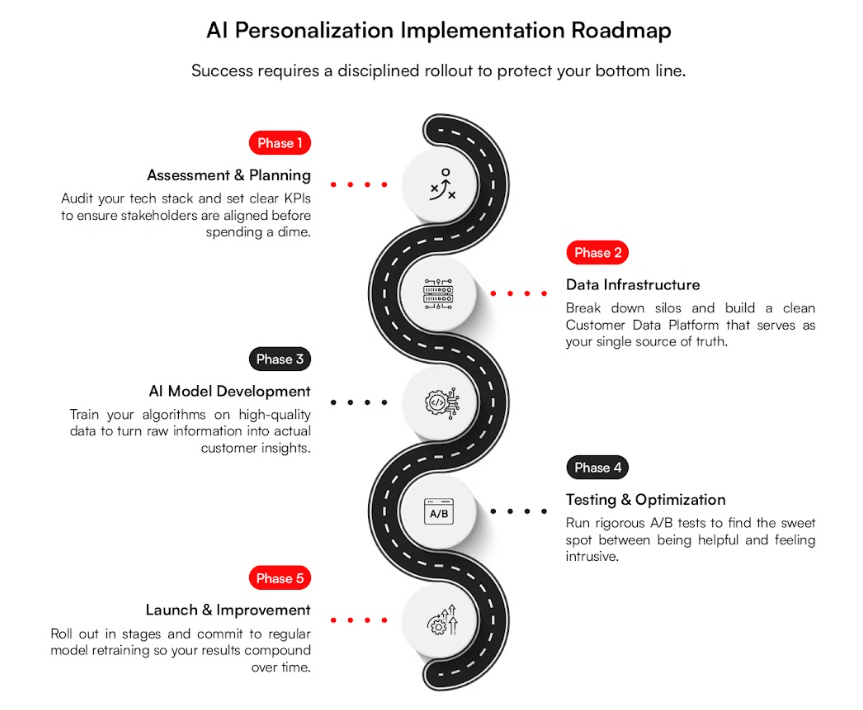
Strategic Roadmap for High-Conversion AI Deployment
Phase 1: Assessment & Planning (Weeks 1-4)
Start with a current state analysis. Audit your existing technology stack, evaluate the quality of your data infrastructure, and assess your team’s capabilities honestly.
Define clear goals and KPIs. What does success look like? 10% conversion increase? 20% higher AOV? Get stakeholder alignment early. Finalize budgets. Select vendors if you’re buying rather than building.
Phase 2: Data Infrastructure (Weeks 5-12)
Implement your Customer Data Platform. Build data pipelines that actually work. Clean and integrate data from all those siloed systems we talked about earlier. Establish data governance frameworks and privacy compliance from day one. This phase determines everything that comes after. Rush it, and you’ll pay later.
Phase 3: AI Model Development (Weeks 13-20)
Select algorithms based on your specific use cases. Prepare training data carefully. Bias in, bias out. Train and validate models rigorously. Integrate with your ecommerce platform.
Deploy initial recommendation engines. AI Ecommerce personlization Implementation Roadmap success hinges on getting this phase right technically while avoiding the common pitfalls around creepy personalization.
Phase 4: Testing & Optimization (Weeks 21-26)
Run A/B tests extensively. User acceptance testing catches issues before customers see them. Build performance monitoring dashboards. Fine-tune models based on real results. Test for that balance between helpful and intrusive we discussed. Quality assurance here prevents trust-damaging mistakes later.
Phase 5: Launch & Continuous Improvement (Week 27+)
Phased rollout beats big bang launches. Train your team thoroughly. Deploy to production with monitoring in place. Then the real work begins. Monthly performance reviews. Quarterly model retraining. Continuous feature expansion. AI in ecommerce personalization isn’t a project. It’s an ongoing capability that compounds returns over time.
Top AI Personalization Vendors for Ecommerce
Choosing the right vendor determines whether your personalization initiative succeeds or stalls. Here are the top AI personalization vendors for ecommerce based on business size and needs.
Enterprise Solutions (For businesses $100M+ revenue)
- Salesforce Marketing Cloud: Einstein AI drives cross-channel orchestration. Best for existing Salesforce customers. Pricing runs custom, typically $50K-$500K+ annually. Complex implementation, but proven at scale.
- Adobe Target: AI-powered testing and automated personalization. Strong for content-heavy sites. Expect $100K+ annually. Steep learning curve, but advanced capabilities justify the investment.
- Dynamic Yield (by Mastercard): Omnichannel personalization with quick time-to-value. $2K-$10K monthly based on traffic. Fast implementation, strong ROI, excellent support.
Mid-Market Solutions (For businesses $10M-$100M revenue)
- Monetate: Personalized search, testing, social proof. Strong for fashion and lifestyle brands. $3K-$15K monthly. An intuitive interface makes it accessible to marketing teams without deep technical expertise.
- Nosto: Product recommendations, content personalization, pop-ups. Growing ecommerce brands love it. $1K-$5K monthly. Quick setup, user-friendly, solid mid-market choice.
Custom Development & Integration
RBMSoft: Custom AI personalization development and ecommerce personalization AI solutions for businesses needing tailored approaches. Best for companies where off-the-shelf platforms fall short. Combines ML and generative AI ecommerce personalization for unique recommendation engines.
Offshore model delivers enterprise-grade capability at 50-70% cost savings. Flexible engagement models from full custom development to platform integration and optimization.
Selecting vendors requires matching your business size, technical capabilities, and customization needs. Enterprise solutions offer comprehensive features but demand significant investment. Mid-market platforms balance capability with accessibility.
Custom development through partners like RBMSoft provides maximum flexibility when your requirements exceed standard platform capabilities.
The top AI personalization vendors for ecommerce share one trait: they turn customer data into revenue. Choose based on your current state and growth trajectory, not just features.
Cost to Implement AI in Ecommerce Personalization
The cost to implement AI in ecommece personalization varies dramatically by business size and approach. Here’s what budgets actually look like.
| Business Tier | Total Investment (Year 1) | Cost Breakdown | ROI Timeline |
| Small Ecommerce ($1M–$10M revenue) | $50K – $150K | Platform subscriptions: $15K–$40KImplementation services: $15K–$45KInfrastructure: $8K–$20K | 6–12 months |
| Mid-Market ($10M–$100M revenue) | $150K – $500K | Platform + CDP: $60K–$180KCustom dev & integration: $40K–$150KScalable infrastructure: $25K–$75K | 9–18 months |
| Enterprise ($100M+ revenue) | **$500K – $2M+** | Enterprise platforms: $200K–$800KComplex integration & custom dev: $150K–$700KInfrastructure & compliance: $150K+ | 12–24 months |
Hidden Costs
Data quality improvement often requires an upfront investment of $20K-$100K. Change management consumes 15-20% of internal team time. Testing and optimization add 10-15% to platform costs annually. Factor these in early.
Offshore Development Advantage
US implementation: $150-$250/hour. Ecommerce it Services through offshore partners: $50-$80/hour. That’s 50-70% savings. A $300K project becomes $120K. Same quality, dramatically different investment.
Research shows 78% of customers receiving personalized experiences become repeat buyers. The ROI isn’t just in the first sale. It’s in lifetime value that compounds over the years.
Stop overpaying for inefficiency
Consult our AI experts to discover your custom cost to develop & integrate a personalized AI solution that eliminates waste and streamlines ops.
Book Your Quote NowWhy Choose RBM Software for AI-Powered Personalization?
RBM Software delivers cutting-edge AI and big data solutions tailored for modern ecommerce challenges. Our expertise includes evaluating your existing technology stack, creating custom modernization roadmaps, implementing scalable, future-proof solutions, and leveraging offshore development for cost-efficient innovation.
We’ve worked with global retailers like Big Lots, DSW, and PetMeds to transform their personalization capabilities. Our ecommerce solutions development approach combines technical excellence with business pragmatism. We don’t just build platforms. We engineer outcomes.
Gen AI ecommerce personalization requires partners who understand both the technology and the business impact. Our offshore model delivers enterprise-grade capability at 50-70% cost savings without compromising quality. Fixed-price projects, flexible engagement models, transparent pricing. No surprises.
Ready to transform your e-commerce business with AI in ecommerce personalization? Schedule a free consultation to assess your personalization capabilities and discover how our expertise can accelerate your results.
For a deeper breakdown of platforms, costs, and implementation phases, refer to our complete guide to ecommerce personalization for 2026.
FAQs
How does AI personalization work and change the ecommerce industry?
The impact of big data in ecommerce personalization is the real engine here. By processing massive datasets, systems can predict shopper needs in real time.
This shift moves the industry away from static storefronts toward AI-driven personalization in ecommerce. Instead of a generic home page, the store morphs to fit each individual, turning a simple transaction into a tailored service.
How does AI-powered personalization enhance customer experience?
It removes the friction of endless scrolling. By filtering out irrelevant noise and highlighting items that match a shopper’s specific taste, AI-powered personalization in ecommerce reduces decision fatigue. Customers feel understood by the brand, which makes the shopping process faster and far more satisfying.
What role does a Customer Data Platform (CDP) play in AI personalization?
A CDP acts as the single source of truth. It pulls data from silos into one place. Without a CDP, your AI personalization ecommerce strategy is essentially flying blind. It provides the unified data needed to build accurate profiles. This is a critical part of the tech stack for AI in ecommerce personalization.
How does AI personalize ecommerce shopping experiences?
It happens through several touchpoints. Common use cases of AI personalization in ecommerce include re-ranking search results, sending emails at optimal times, and dynamic website content. Newer gen AI ecommerce personalization tools even create custom product descriptions for specific users.
AI personalization ecommerce examples like Amazon’s recommendation engine show how this drives massive engagement.
How long does it take to implement AI in ecommerce personalization?
A standard AI ecommerce personalization implementation roadmap usually spans three to six months. The timeline depends on your current data quality and integration needs.
While the challenges for implementing AI personalization in ecommerce involve high technical hurdles, working with experts in AI ecommerce personalization development can help you overcome these gaps quickly.
What ROI can ecommerce businesses expect from AI personalization?
The benefits of AI personalization in ecommerce are measurable. Most businesses see a 10% to 30% lift in revenue. You can also expect a 26% jump in conversion rates.
While the cost to implement AI in ecommerce personalization varies based on scale, the long-term ROI comes from higher retention and lower acquisition costs.