

Quick Summary:
- Ecommerce personalization uses AI and customer data to deliver unique shopping experiences for each visitor in real time.
- The benefits of personalization in ecommerce include 18–35% higher conversion rates and 12–28% higher average order value.
- Customer personalization in ecommerce fails 23% of the time due to insufficient traffic, limited catalogs, or wrong platform choice.
- The cost to implement ecommerce personalization for enterprises ranges from $3,000 to $8,000 per month for mid-to-large retailers.
- Ecommerce personalization solutions require clean first-party data, compliance with CCPA and GDPR, and a phased rollout.
- B2B and B2C personalization in ecommerce require fundamentally different approaches, data models, and algorithms.
If you are showing the same homepage, the same recommendations, and the same promotions to every visitor, you are not just leaving revenue on the table. You are ceding ground to competitors who are not. According to McKinsey, 71% of consumers expect personalized experiences when they shop online. Yet many mid-size retailers still treat high-intent buyers and first-time visitors exactly the same way.
AI-driven ecommerce personalization, powered by big data, allows retailers to tailor experiences automatically and at scale. Modern systems adjust in real time based on Live shopper behavior. This eliminates guesswork, reduces operational friction, and lifts both conversion rates and average order value.
This guide explains how ecommerce personalization works in 2026. It covers realistic cost expectations, common failure points, and how to implement it without a six-figure budget. You will find practical numbers, real-world risks, and a phased roadmap designed to scale with your growth stage.
What Is Ecommerce Personalization?
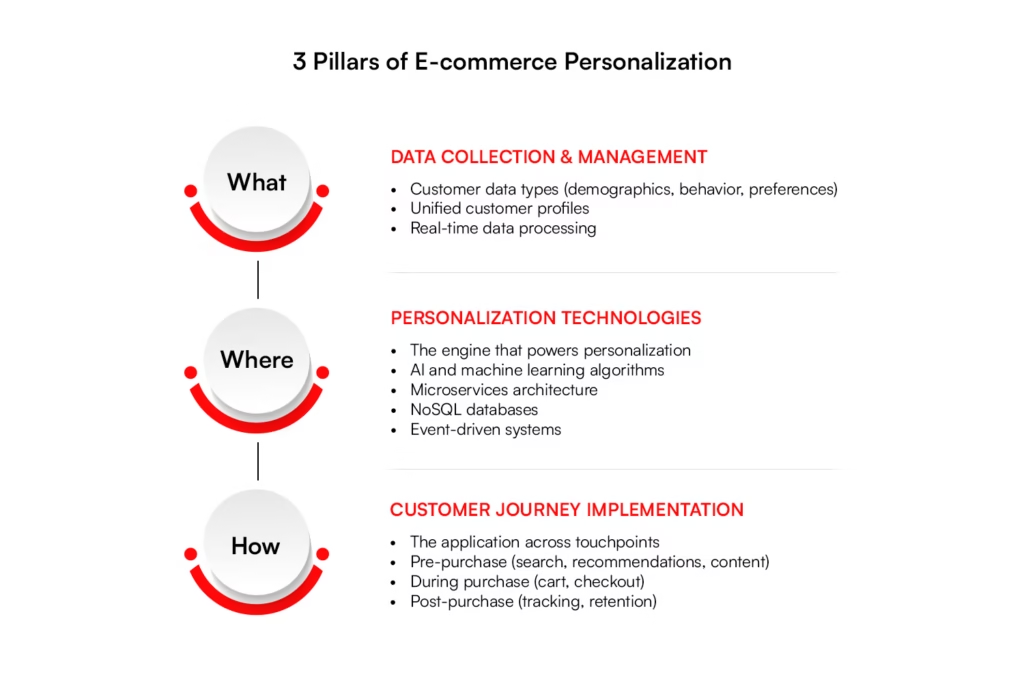
Ecommerce personalization uses AI and customer data to deliver unique shopping experiences for each visitor in real time. Instead of showing the same homepage to everyone, it adjusts product recommendations, pricing, content, and offers based on browsing behavior, purchase history, location, and device type.
Consider two quick examples. When a customer from Phoenix searches for “winter coats” in December, personalization for ecommerce surfaces lightweight options rather than heavy parkas. When a returning customer who bought running shoes three months ago visits your site, the engine shows new arrival sneakers, not the pair they already own.
Today, ecommerce personalization is fully accessible to mid-market retailers, not just enterprise brands. Platforms that once required $50,000 or more in custom ecommerce personalization development now start at $150 per month. Product recommendations, dynamic pricing, and personalized content are all within reach for stores doing $1M or more in annual revenue.
Benefits of Personalization in E-Commerce
How does ecommerce personalization enhance customer experience management and drive revenue? The benefits of personalization in ecommerce are measurable and consistent across retail categories.
Increased Conversion Rates
The most direct benefit of ecommerce personalization is higher conversion. When customers see relevant products instead of scrolling through 200 unrelated items, decision fatigue drops and purchase intent rises. Platform data from leading personalization vendors shows average lifts by type:
- Product recommendations: Sophisticated engines increase conversion rates by 150%
- Personalized homepages lift conversion by 27.6% through behavior-focused personalization
- Dynamic email content delivers 6x higher transaction rates compared to generic sends (HubSpot)
- Personalized search: 70% of consumers complete purchases when results match their history
Higher Average Order Value
Ecommerce personalization surfaces complementary items at exactly the right moment. According to Monetate, companies increase average order value by up to 12% through personalized recommendations. A customer buying running shoes sees socks, insoles, and shorts. A customer buying a camera sees lenses, bags, and memory cards. The logic is simple: show people what they actually need next.
Improved Customer Retention
Customer personalization in ecommerce builds loyalty by making shoppers feel recognized rather than anonymous. According to Instapage, 80% of consumers are more likely to purchase from brands that offer personalized experiences, and 91% prefer shopping with brands that recognize them and provide relevant recommendations. Customers return to stores that remember them.
Reduced Cart Abandonment
Ecommerce site personalization directly addresses the 70% average cart abandonment rate through behavior-triggered emails and dynamic cart reminders. Cart recovery emails that show the exact abandoned items alongside real-time inventory alerts such as “Only 2 left” convert 3–5% of abandoners into buyers.
For stores doing $2M or more annually, that 3–5% recovery rate represents a material revenue line that compounds over time.
Use Cases of Personalization in E-Commerce
The use cases of personalization in ecommerce touch every stage of the customer journey. Below are the highest-impact applications for U.S. retailers, along with real-world context on what each one delivers.
Homepage Personalization
Homepage personalization is the most visible form of ecommerce site personalization. Returning visitors see a homepage tailored to their browsing history and purchase behavior. New visitors from California see different featured products than new visitors from Minnesota. It is often the first place retailers see a measurable lift after implementation.
RBMSoft Case Study:
RBMSoft helped a U.S. luxury home furnishings retailer eliminate fragmented SKU mapping across multiple legacy systems. The result was a 40% reduction in time spent on SKU management and a centralized product data layer that made accurate personalization possible at scale. Read the full case study.
Product Recommendation Engines
Product recommendation engines are the most widely deployed use case in ecommerce personalization. Collaborative filtering algorithms analyze purchase patterns across thousands of customers to surface “frequently bought together” combinations with remarkable accuracy.
Personalized Search Results
Search result ordering adjusts based on each visitor’s individual browsing history. Two customers searching “running shoes” can see entirely different results: a trail runner sees trail-specific options first, while a road runner sees pavement-optimized shoes at the top. Small reordering decisions like this consistently move conversion rates.
Email Personalization
Dynamic email content updates at open time, surfacing real-time inventory, personalized product blocks, and pricing relevant to each recipient. Platforms like Klaviyo and Mailchimp both support this capability, with pricing ranging from $30 to $600 per month, depending on list size and feature depth.
Ecommerce Content Personalization
Ecommerce content personalization is one of the most underused levers in ecommerce. Blog posts, buying guides, and educational material can all surface based on a customer’s category interests. A customer who buys outdoor gear sees camping guides.
A customer who buys kitchen tools sees cooking content. Retailers using ecommerce content personalization consistently report higher engagement rates and longer average session duration, both of which signal stronger purchase intent.
Ecommerce Product Personalization
Ecommerce product personalization goes beyond recommendation widgets. It adjusts which products appear, in what order, and with what level of detail based on individual visitor profiles.
This includes personalized product photography cropped for mobile versus full-length for desktop, dynamic pricing for loyalty tiers, and custom bundle suggestions.
These ecommerce personalization examples show the full range of what is possible today. At the entry level, a simple “recently viewed” widget at around $150 per month reminds visitors of products they already showed interest in, nudging them back toward purchase.
At the advanced end, a fully dynamic storefront at $3,500 or more per month changes every element for every visitor in real time: the homepage layout, featured products, pricing, banners, and search results all adjust automatically based on who is browsing. The right starting point depends on your store size, traffic volume, and revenue stage.
Dynamic Pricing
Dynamic pricing extends ecommerce product personalization into the pricing layer, applying differentiated rates for returning customers, loyalty members, and location-based segments.
One Texas retailer that implemented 8% weekend price increases saw a 6.2% revenue lift but also a 3% drop in mobile conversion, a reminder that pricing personalization requires careful segmented testing before a full rollout.
Drive more conversion, higher AOV with real-time personalization!
Talk to our Experts
AI-led Personalization Examples: Amazon, Sephora, and Netflix
The best way to understand what ecommerce personalization looks like at scale is to look at the retailers who have invested the most in getting it right. These three are the most frequently cited ecommerce personalization examples in U.S. retail.
Here is what their approaches actually involve, what the numbers show, and what mid-market retailers can realistically apply without a $200M technology budget.
Amazon: The Personalization Leader
Amazon generates 35% of its revenue from personalized recommendations, using collaborative filtering and purchase history analysis. Their approach combines “customers who bought X also bought Y” logic with time-based triggers and category-specific algorithms that improve with every transaction.
Key Metrics:
- 35% of Amazon revenue driven by ecommerce personalization
- 56% of buyers are more likely to become repeat purchasers after a personalized experience
- Platform: Proprietary, built in-house at a $200M+ investment
What Would This Cost Your Business?
Mid-market retailers do not need a $200M budget to get results. See the full cost breakdown
What U.S. Mid-Market Retailers Can Learn: Start with purchase history recommendations before attempting complex browsing behavior algorithms.
Amazon’s “frequently bought together” engine is the highest-ROI ecommerce personalization example available to study. Build that foundation first, and the more sophisticated layers become much easier to justify and implement.
Sephora: Omnichannel Excellence
Sephora’s ecommerce personalization drives 80% of transactions through the Beauty Insider loyalty program. Store associates can access a customer’s online browsing history in real time. The mobile app functions as a full personalization hub, combining virtual try-on with trait-based product recommendations.
Key Metrics:
- 25 million Beauty Insider members
- 80% of Sephora transactions from program members
- Platform: Salesforce Commerce Cloud with custom integrations
What U.S. Mid-Market Retailers Can Learn: Start with loyalty program integration. Email and online integration together deliver roughly 60% of Sephora’s omnichannel benefits at around 20% of the cost.
Netflix: Content Personalization Pioneer
Netflix keeps 80% of watched content coming from its recommendation engine, using hybrid algorithms that combine viewing history, time-of-day patterns, and content attributes. Even thumbnail personalization is dynamic, showing different images for the same title depending on a user’s viewing profile.
Key Metrics:
- 80% of content discovered through personalization
- Estimated annual value: $1 billion saved in customer retention
- Platform: Proprietary, with $200M or more invested annually
What U.S. Mid-Market Retailers Can Learn:
Do not try to replicate Netflix’s technology scale. Instead, borrow their core philosophy: surface different content to different people based on who they are and what they respond to.
One San Francisco retailer applied this thinking to ecommerce content personalization, showing cropped images to California mobile users and full-length images to Texas desktop users, and saw a 43% lift in mobile conversion as a result.
What is the Difference Between E-Commerce Personalization and Customization?
Personalization and customization in ecommerce are two terms that get used interchangeably, but they represent fundamentally different approaches. Understanding the distinction matters because choosing the wrong one for the wrong context will cost you conversions.
The core difference comes down to who is driving the experience.
Ecommerce Personalization is automatic. The AI decides what to show each visitor based on behavioral signals, purchase history, and predictive modeling. The retailer sets the rules and algorithms, and the system executes without any input from the customer. When Amazon surfaces a product recommendation before you knew you wanted it, that is personalization at work.
E-Commerce Customization is manual. The customer actively selects preferences, builds a configuration, or modifies a product to their own specifications. Nike allowing customers to design their own shoes is customization. Spotify’s “Liked Songs” playlist is customization. The customer is in the driver’s seat.
Both approaches create differentiated experiences, which is why the confusion is understandable. But they serve different moments in the buying journey, as the table below illustrates.
Key Differences: Personalization vs. Customization in Ecommerce
| Factor | Ecommerce Personalization | Ecommerce Customization |
| Who drives it | AI and algorithms | The customer |
| Effort required | Zero (automatic) | Active customer input |
| Scale | Millions of users | Requires customer action |
| Data needed | Behavioral + purchase data | Customer preferences input |
| Best for | Product discovery | High-involvement purchases |
| Examples | Amazon recommendations | Nike By You, Converse Custom |
The table above makes the strategic choice clearer. Here is when to use each approach:
When to use personalization:
- Product discovery, email campaigns, homepage optimization, and search results
- Works best when customers do not yet know what they want and need the experience to guide them there
- Asking a customer to configure their experience during discovery mode adds friction and kills conversion
When to use customization:
- High-involvement purchases above $100, and categories like fashion, furniture, and gifts
- Works best when customers arrive with specific requirements already formed
- Most effective when giving customers control measurably increases satisfaction and reduces returns
For most U.S. retailers, personalization and customization in ecommerce serve very different purposes. Personalization is the right default. It works across your entire catalog, runs automatically, and drives day-to-day revenue without requiring anything from the customer.
Customization is a worthwhile investment only in the specific product categories where handing the customer control directly improves outcomes.
B2B vs B2C E-Commerce Personalization
B2B and B2C personalization in ecommerce share the same underlying goal of delivering relevant experiences, but they require completely different data models, algorithms, and technology stacks. Understanding where they diverge is essential before choosing a platform or scoping an implementation.
B2C E-Commerce Personalization
B2C customer personalization in ecommerce focuses on the individual shopper. Data sources include browsing behavior, past purchases, geographic location, and device type, and the algorithms are built to optimize for immediate purchase conversion.
Typical B2C signals:
- Products viewed in the last 30 days
- Cart abandonment patterns
- Purchase frequency and value
- Category preferences
- Geographic location
Typical B2C outcomes include increased conversion rates, higher average order value, lower cart abandonment, and stronger email engagement.
B2B Ecommerce Personalization
B2B personalization for ecommerce focuses on organizations rather than individuals. Purchasing decisions typically involve procurement teams and longer approval cycles.
Rather than behavioral tracking, B2B personalization prioritizes account recognition, role-based catalogs, and contract pricing, allowing buyers to reorder instantly without contacting a sales representative.
Typical B2B signals:
- Company size and industry
- Account history and contract terms
- Role-based permissions such as buyer, approver, and requester
- Negotiated pricing agreements
- Compliance and regulatory requirements
Typical B2B outcomes include faster reordering, higher contract compliance, reduced off-contract purchasing, and improved account retention.
Best platforms for B2B: Salesforce Commerce Cloud, SAP Commerce Cloud, and Elastic Path.
Key B2B vs B2C Differences
| Factor | B2C Personalization | B2B Personalization |
| Decision Maker | Individual shopper | Committee (3–7 people) |
| Purchase Cycle | Minutes to days | Weeks to months |
| Pricing Model | Uniform for all users | Negotiated per account |
| Algorithm Focus | Discovery + impulse | Reorder + compliance |
| Data Source | Behavioral tracking | Account + ERP data |
| Key Metric | Conversion rate | Contract compliance |
| Platform Cost | $800 – $3,000/month | $5,000 – $20,000/month |
B2B ecommerce personalization requires deep integration with ERP systems such as SAP and Oracle, CRM platforms like Salesforce, and procurement tools.
That integration layer significantly increases both implementation complexity and total cost compared to a B2C deployment, which is why platform selection and scoping should happen before any development work begins.
How E-Commerce Personalization Increases Sales and Revenue
The mechanism behind ecommerce personalization is simpler than it sounds: less friction, more relevance, faster decisions. Understanding how it translates into measurable revenue starts with the core problem it solves.
The Core Problem
Generic storefronts force customers to manually filter through hundreds of irrelevant products. Most give up and leave before finding what they need. Average ecommerce conversion rates sit at 2.5% to 3.5% nationally, meaning 96% to 97% of visitors leave without buying. That is not a traffic problem. It is a relevance problem.
How Personalization Fixes It
Ecommerce personalization solutions automatically filter out irrelevant products and surface the 8 to 12 items each customer is most likely to buy. The customer spends less time searching and more time evaluating purchase decisions, which is where conversion actually happens.
Revenue Impact by Personalization Type
- Email personalization: 18–25% email revenue increase within 30 days, making it the lowest cost and fastest ROI entry point
- Homepage personalization: 18% average conversion lift for returning visitors
- Product recommendations: 22% average conversion lift, responsible for 26% of ecommerce revenue
- Cart personalization: 3–5% cart abandonment recovery rate through behavior-triggered sequences
- Personalized search: 26% higher conversion compared to generic search results
What ROI Can Ecommerce Businesses Expect From Personalization?
Based on McKinsey’s research on personalization ROI and platform benchmarks, typical returns break down as follows:
- Email segmentation: 8–12x ROI with the fastest payback period of 2 to 3 months
- Basic on-site personalization: 5–8x ROI with a 4 to 5 month payback
- AI recommendation engines: 6–11x ROI with a 4 to 7 month payback
- Enterprise solutions: 3–6x ROI with an 8 to 12 month payback
The 23% of implementations that fail typically share three root causes: insufficient traffic below 5,000 monthly visitors, a platform mismatched to store size, or a lack of ongoing optimization after launch. Proper platform selection and a structured rollout plan eliminate most of that risk before it becomes a problem.
Real-time personalization connected to your retail systems drives measurable ROI.
Explore our Ecommerce Solutions DevelopmentTechnologies Driving E-Commerce Personalization
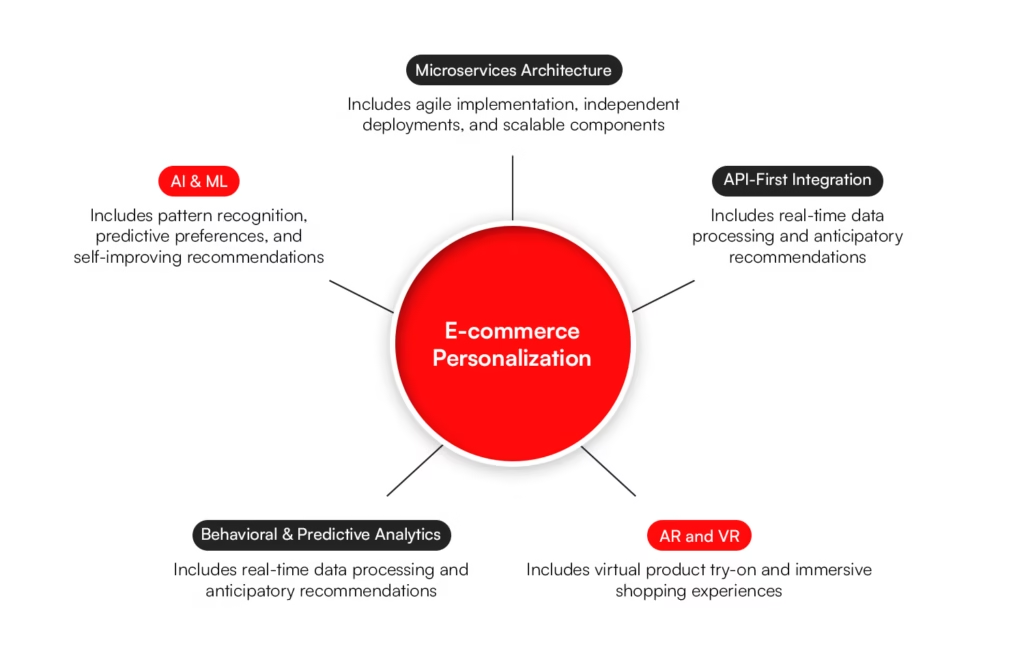
The tech stack for ecommerce personalization runs on five core technologies. Each layer handles a distinct job, from predicting what customers want to delivering that experience in real time across web, mobile, and email.
Artificial Intelligence and Machine Learning (AI & ML)
AI and machine learning form the backbone of modern ecommerce personalization. These technologies detect patterns in customer data, forecast needs, and refine recommendations automatically through behavioral feedback loops.
Recommendation systems have evolved well beyond basic collaborative filtering. Today, neural networks understand the relationships between products, customers, and context, enabling product personalization at scale without manual merchandising rules for every segment.
RBMSoft implements these AI-driven systems for businesses at any stage of digital transformation, from first-time deployments to replacing legacy recommendation engines.
Microservices Architecture
Microservices architecture makes ecommerce personalization more scalable and easier to maintain by breaking capabilities into independently deployable services rather than one monolithic system.
In practice, this means retailers can test new personalization features on a limited traffic slice, scale high-demand components during peak hours, and upgrade individual capabilities without disrupting the rest of the stack. For enterprise retailers running multiple storefronts, it is the only architecture that realistically supports personalization at scale.
Behavioral Targeting and Predictive Analytics
Behavioral targeting moves ecommerce personalization from reactive to proactive. Real-time signals such as clicks, scrolls, search queries, and time on page feed predictive models that surface relevant products before customers actively search for them.
This is the technology behind weather-triggered campaigns, reorder prompts, and browse abandonment emails. It transforms personalization from a display feature into a revenue-generating system.
Augmented Reality (AR) and Virtual Reality (VR)
AR and VR deliver the most immersive form of ecommerce personalization. Customers can virtually try on clothes, place furniture in their homes, or test eyewear before purchasing, directly reducing the uncertainty that drives returns.
Amazon, Lenskart, and Warby Parker already use AR to replicate in-store decision-making online. For fashion and home categories in particular, the return rate reduction alone can justify the investment.
API-First Integration Platforms
API-first platforms are what make the entire tech stack for ecommerce personalization function as a connected system. Personalization engines need simultaneous data from your ecommerce platform, CRM, email tool, inventory system, and mobile app.
Without API-first integration, each system holds only a fragment of the customer profile. With it, every touchpoint shares a unified data layer, enabling consistent real-time personalization whether a customer is on mobile, desktop, or in-store.
E-Commerce Personalization: Step-by-Step Process and Implementation
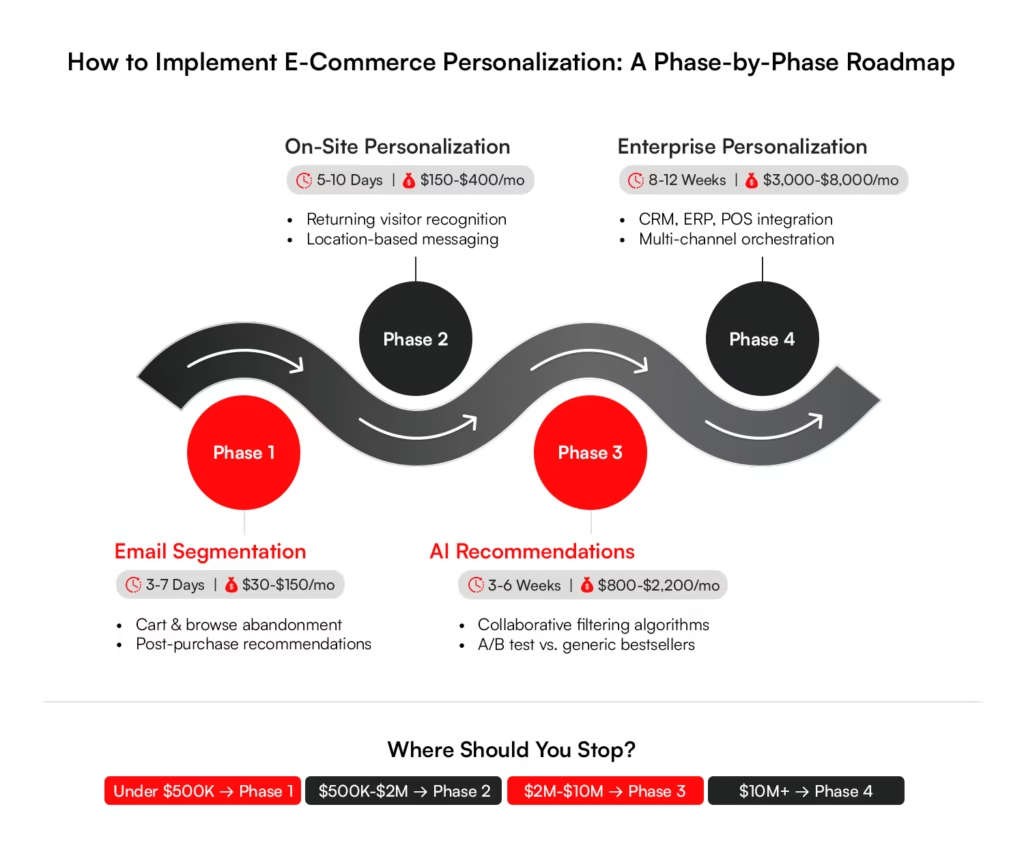
The ecommerce personalization step-by-step process and implementation timeline ranges from as few as 5 days for basic email tools to 12 weeks for a full enterprise platform deployment. The right starting point depends entirely on your store size and current revenue.
Phase 1: Email Segmentation (Months 1–3)
Cost: $30–$150 per month
Time to launch: 3–7 days
Who it’s for: All store sizes with $200K or more in annual revenue
Implementation Steps:
- Sync your email platform to your ecommerce store via one-click Shopify integration or API setup (1–3 hours)
- Create three core segments: cart abandoners, browse abandoners, and past purchasers (4–6 hours)
- Build abandonment email sequences with personalized product blocks (4–8 hours)
- Set up post-purchase recommendation emails (2–4 hours)
- A/B test subject lines and product recommendation placement (ongoing)
Expected Outcome: 18–25% email revenue increase within 30 days
Phase 2: Basic On-Site Personalization (Months 4–6)
Cost: $150–$400 per month
Time to launch: 5–10 days
Who it’s for: Stores doing $500K or more annually with at least 2,500 monthly visitors
Implementation Steps:
- Install tracking code across all pages (30 minutes)
- Configure returning visitor detection and welcome-back messaging (2–4 hours)
- Set up location-based shipping threshold banners (1–2 hours)
- Add a bestseller recommendation section to the homepage (2–4 hours)
- Create a recently viewed items widget for product pages (1–2 hours)
- Test across mobile and desktop (4–8 hours)
Expected Outcome: 8–12% conversion increase within 45 days
Phase 3: AI Recommendation Engine (Months 7–9)
Cost: $800–$2,200 per month Time to launch: 3–6 weeks
Who it’s for: Stores doing $2M or more annually with at least 5,000 monthly visitors
Implementation Steps:
- Sign contract and install platform tracking code (Days 1–2)
- Connect product catalog feed via automated daily sync (Days 2–3)
- Map customer data to the platform, including purchase history, email, and account data (Weeks 1–2)
- Configure recommendation algorithms covering collaborative filtering, trending, and related products (Weeks 2–3)
- Set recommendation placements across homepage, product pages, cart, and email (Weeks 3–4)
- A/B test recommendation widgets against generic bestsellers (Weeks 4–6)
- Expand to 100% of traffic based on results (Week 6)
Expected Outcome: 18–28% conversion increase
Phase 4: Enterprise Personalization (Months 10–12)
Cost: $3,000–$8,000 per month Time to launch: 8–12 weeks Who it’s for: Stores doing $10M or more annually with at least 25,000 monthly visitors
Implementation Steps:
- Complete technical discovery and integration mapping (Weeks 1–2)
- Connect all data sources including CRM, POS, ERP, and mobile app (Weeks 2–5)
- Build custom segmentation rules and algorithm configurations (Weeks 4–7)
- Set up multi-channel orchestration across web, email, mobile, and in-store (Weeks 6–9)
- Train staff across marketing, merchandising, and customer service teams (Weeks 8–10)
- Complete QA testing and security audit (Weeks 9–11)
- Execute phased rollout at 10% traffic, then 50%, then 100% (Weeks 10–12)
Expected Outcome: 12–18% incremental conversion increase on top of existing personalization
Decision Framework
Not every retailer needs all four phases. Use your annual revenue as the guide:
- Under $500K annually: Stop at Phase 1 and focus entirely on email segmentation
- $500K to $2M annually: Progress to Phase 2 and add basic on-site personalization
- $2M to $10M annually: Move to Phase 3 and implement an AI recommendation engine
- $10M or more annually: Pursue the full Phase 4 enterprise deployment
Starting beyond your current store size wastes budget and often underdelivers because the data volume needed to train algorithms simply is not there yet.
Cost to Implement E-Commerce Personalization for Enterprises
The cost to implement ecommerce personalization for enterprises breaks into four main categories: platform fees, integration work, staff time, and ongoing optimization. The tables below cover both enterprise and mid-market ranges so you can identify where your business fits before scoping a budget.
Enterprise Cost Breakdown
| Cost Category | One-Time Setup (Est.) | Monthly Ongoing (Est.) |
| Platform License | $10,000 – $25,000 | $3,000 – $8,000 |
| System Integration (CRM, ERP, POS) | $15,000 – $40,000 | $500 – $2,000 |
| Custom Development & Tuning | $20,000 – $60,000 | $2,000 – $5,000 |
| Staff Training & Enablement | $5,000 – $15,000 | $1,000 – $3,000 |
| Compliance Setup (GDPR, CCPA) | $5,000 – $12,000 | $500 – $1,500 |
| A/B Testing & Optimization Tools | $0 – $5,000 | $500 – $1,500 |
| Analytics & BI Reporting | $2,000 – $8,000 | $300 – $800 |
| Projected 3-Year ROI | Year 1: 2x – 3x | Year 3: 8x – 12x |
Mid-Market Cost Breakdown ($2M-$10M Revenue)
| Cost Category | One-Time Setup (Est.) | Monthly Ongoing (Est.) |
| Platform | $1,500 – $5,000 | $800 – $2,200 |
| System Integration | $2,000 – $8,000 | $200 – $500 |
| Staff Training | $1,500 – $3,500 | $500 – $1,000 |
| Compliance Setup | $2,000 – $5,000 | $300 – $800 |
| A/B Testing | $0 – $2,000 | $200 – $400 |
| Projected 3-Year ROI | Year 1: 4x – 6x | Year 3: 10x – 15x |
What Drives Enterprise Cost Higher
For mid-market retailers, the tables above are fairly predictable. Enterprise deployments, however, carry several cost drivers that can push budgets significantly beyond the baseline estimates.
Legacy system integration is typically the largest variable. Most enterprise retailers run SAP, Oracle, or custom ERP systems built 10 to 20 years ago. Connecting these to modern personalization platforms requires custom API development, with specialist rates running $150 to $250 per hour.
Multi-region operations add another layer of complexity. Each country or region may require separate algorithm configurations, language support, currency handling, and its own compliance framework. International retailers should budget an additional $10,000 to $30,000 per region.
Compliance complexity compounds quickly for retailers serving customers across multiple U.S. states and international markets, where privacy requirements overlap and sometimes conflict. Legal review alone can run $5,000 to $15,000 for a full enterprise deployment.
Change management is the cost most often overlooked in initial budgets. Moving hundreds of employees from manual merchandising to algorithm-driven personalization requires formal training programs, documented playbooks, and ongoing support well beyond the initial launch.
Compliance for E-Commerce Personalization
Compliances for ecommerce personalization in the U.S. center on three frameworks: CCPA (California), VCDPA (Virginia), and GDPR (EU). Understanding what each requires determines how your personalization infrastructure must be architected from the ground up. Ignoring these requirements exposes retailers to fines of up to 4% of global annual revenue.
CCPA (California Consumer Privacy Act)
Who it applies to: Businesses serving California residents with $25M or more in annual revenue, 50,000 or more consumer records processed annually, or 50% or more of revenue derived from selling data.
Requirements for ecommerce personalization:
- A “Do Not Sell My Personal Information” link must appear in the site footer
- Opt-out requests must be honored within 15 days
- All data categories collected and their purpose must be disclosed to consumers
- Customers who opt out cannot be discriminated against or offered reduced service
- A data deletion capability must be available, with deletion completed within 45 days
Impact on personalization: Between 12% and 18% of California customers opt out of behavioral tracking. Their experience defaults to contextual personalization based on device type, time of day, and referral source, without any behavioral data.
Penalties: $2,500 per unintentional violation, $7,500 per intentional violation.
VCDPA (Virginia Consumer Data Protection Act)
Effective: January 1, 2023 Who it applies to: Businesses processing data on 100,000 or more Virginia residents annually.
Key requirements:
- Data protection assessments must be conducted for all personalization systems
- Consumers have the right to opt out of targeted advertising and profiling
- Data minimization principles apply, meaning only data necessary for personalization may be collected
- Consumer rights requests must be responded to within 45 days
GDPR (EU General Data Protection Regulation)
Who it applies to: Any business serving EU residents, regardless of where the company is located.
Requirements for ecommerce personalization:
- Explicit consent is required before any tracking begins, with no pre-checked boxes permitted
- Data use must be explained in plain, accessible language
- Granular consent options must be available, for example allowing analytics while declining marketing
- Consumers have the right to access, download, and delete their personal data
- Data must remain within the EU unless adequate protections are in place
Penalties: Up to 4% of global annual revenue or €20 million, whichever is greater.
Cookie-Less Personalization for Compliant Targeting
When customers opt out of tracking, ecommerce personalization shifts to contextual signals that require no personal data:
- Time of day: Morning visitors see breakfast products, evening visitors see dinner items
- Device type: Mobile surfaces swipe-friendly interfaces, desktop displays hover menus
- Geographic location: Weather-appropriate products surface automatically based on region
- Referral source: Email traffic sees a different homepage experience than paid social visitors
- On-page behavior: Exit intent, scroll depth, and time on page all inform content delivery
This approach ensures that the 82% to 88% of visitors who do not opt out still receive full behavioral personalization, while compliant contextual signals serve the remaining 12% to 18% without any compliance risk.
Compliance Cost Estimates
- Legal review: $2,000 to $5,000 one-time
- Technical implementation via a consent management platform: $50 to $300 per month
- Privacy management software: $200 to $800 per month
- Cookie consent platform such as OneTrust or Cookiebot: $50 to $300 per month
- Annual compliance audit: $3,000 to $8,000
- Staff training: $500 to $2,000 annually
Total estimated first-year compliance cost: $7,000 to $18,000
Building compliance into your personalization architecture from day one is significantly less expensive than rearchitecting later. Treating it as an afterthought is one of the most common and costly mistakes mid-market retailers make, and one of the easiest to avoid with proper planning upfront.
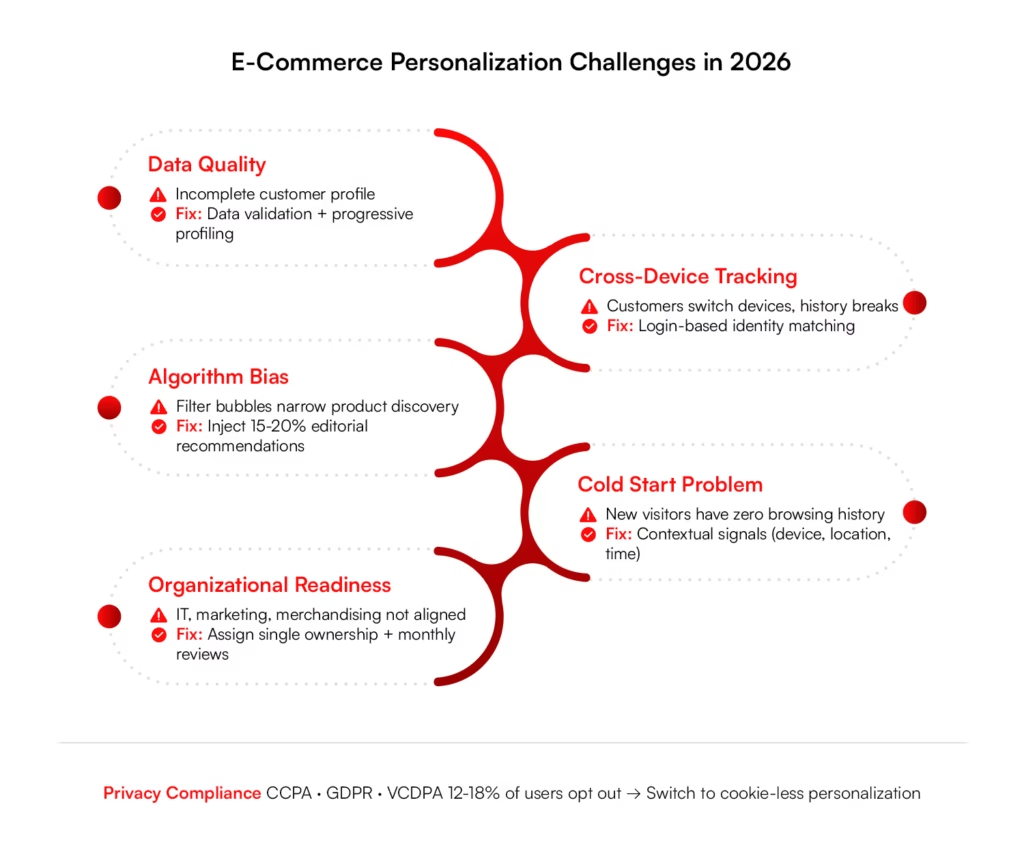
What Are the Biggest E-Commerce Personalization Challenges in 2026?
The three most costly personalization failures in 2026 stem from data quality problems, cross-device gaps, and algorithm bias rather than platform limitations. Understanding these challenges before implementation saves significant time and budget.
Challenge 1: Data Quality
A significant share of customer profiles at most mid-market retailers are incomplete or outdated. Recommendations miss by 30% to 40% when built on wrong or stale data, which means the personalization engine is working against you rather than for you.
Common causes:
- Multiple customer accounts created per email address
- Guest checkouts with no account linking
- Offline purchases not synced to ecommerce profiles
- Stale data from customers who have not shopped in 12 or more months
Solution: Implement progressive profiling to collect data incrementally across sessions, pair it with data validation tools running $200 to $600 per month, and establish regular data hygiene processes. Merge duplicate accounts through email-based identity matching.
Challenge 2: Cross-Device Tracking
U.S. customers use an average of three or more connected devices. Personalization breaks down the moment a customer switches devices.
Someone who browses on mobile at lunch can appear as a brand new visitor on desktop at home that evening, wiping out everything the algorithm learned about them.
Solution:
- Deterministic matching: Link devices through customer login for the highest accuracy
- Probabilistic matching: Use device fingerprinting and IP correlation, typically $300 to $800 per month
- Encourage account creation at checkout by clearly communicating the value to the customer
Impact of not solving it: 30% to 40% of returning visitors appear as new visitors, receiving a generic experience instead of personalized recommendations.
Challenge 3: Algorithm Bias
Personalization engines can create filter bubbles where customers see the same product types repeatedly, missing new arrivals or adjacent categories they would likely enjoy. Over time, this narrows product discovery and quietly reduces category exploration without any obvious warning signal.
Solution: Inject 15% to 20% random or editorial recommendations into every page. This disrupts filter bubbles while maintaining personalization relevance across 80% to 85% of displayed products. No additional platform cost is required, just a configuration adjustment.
Challenge 4: The Cold Start Problem
A large share of traffic at most stores consists of first-time visitors with zero browsing history. The personalization engine has nothing to work with, which is a problem that affects every retailer regardless of platform sophistication.
Solution: Use contextual signals for new visitors including device type, geographic location, time of day, referral source, and landing page. This approach delivers 60% to 70% of full personalization impact with no behavioral data required.
Challenge 5: Organizational Readiness
Personalization fails when merchandising, marketing, and IT teams do not coordinate. Algorithms get configured by IT but never optimized by marketing. Merchandising teams override algorithms manually, negating the personalization value that the platform was purchased to deliver.
Solution: Assign clear ownership, typically at the Director of Ecommerce level, establish monthly performance reviews across teams, and set governance rules that define when to override versus when to trust the algorithm.
RBMSoft helps retailers bridge all five of these challenges by connecting personalization platforms to retail systems and operational controls that scale well beyond initial pilots. Our Ecommerce IT Services cover the full implementation lifecycle, from system integration to team training.
E-Commerce Personalization Trends for 2026–2027
Ecommerce personalization trends for 2026 and 2027 center on three themes: predictive commerce, privacy-first personalization, and hyper-local experiences. Tracking future and market trends in ecommerce personalization helps retailers invest in the right capabilities before competitors do.
Trend 1: Predictive Personalization
AI systems are now able to predict purchases before customers actively search. Based on established purchase patterns, such as coffee every 18 days or diapers every 25 days, algorithms trigger reorder prompts before supplies run low.
According to Acxiom’s annual CX trends report, 51% of consumers appreciate when brands recommend offerings tailored to their personal preferences.
Current adoption: 18% of mid-market U.S. retailers Expected by 2027: 52% of retailers Platform support
Among emerging ecommerce site personalization trends, predictive commerce delivers the most measurable impact on incremental revenue.
Trend 2: Voice Commerce Personalization
Voice-based shopping through Alexa, Google Assistant, and Siri continues to grow as a commerce channel. According to Juniper Research, voice commerce is projected to reach $80 billion annually.
Personalization for voice uses purchase history and household patterns to pre-populate recommendations without requiring any visual browsing.
The challenge is significant: without visual product browsing, personalization must be highly accurate. Irrelevant voice recommendations get rejected immediately with no second chance to recover the session.
Trend 3: Hyper-Local Ecommerce Personalization
Hyper-local targeting is gaining the most traction in weather-sensitive U.S. markets and is emerging as a top-three priority for retailers operating across five or more states.
Recommendations adjust based on zip code inventory levels and regional consumer preferences in real time.
A Houston retailer can surface hurricane preparedness products to customers in ZIP codes along a storm path. A Minneapolis store can push cold-weather gear to customers 60 days before winter historically hits in that specific ZIP code. The relevance is immediate and the conversion impact is measurable.
Conversion lift: 35–45% during localized triggers
Trend 4: Generative AI for Ecommerce Content Personalization
Generative AI is reshaping ecommerce content personalization faster than any previous technology. For 2026, it represents the single biggest cost reduction opportunity available to retailers today. AI-generated product descriptions, email copy, and buying guides can now be created uniquely for each customer segment at scale.
A customer who bought camping gear receives an AI-generated email titled “5 Upgrades for Your Camping Kit” featuring products that complement their past purchases.
Current adoption: 12% of U.S. retailers Expected by 2026: According to Gartner, 41% of retailers will be using generative AI for personalization
Cost impact: Reduces content production costs by 40–60%
Trend 5: Zero-Party Data Personalization
As third-party cookies continue to disappear, retailers are shifting to zero-party data: information customers voluntarily share through quizzes, preference centers, and style profiles.
Sephora’s beauty quiz collects skin type, concerns, and budget before surfacing personalized recommendations. This approach delivers higher accuracy than behavioral tracking while remaining fully compliant with privacy regulations.
Current adoption: 28% of U.S. retailers using preference centers Expected by 2027: 65% of retailers
Implementation cost: $2,000 to $8,000 for quiz and preference center development
The direction is clear across all five ecommerce personalization trends: personalization is moving toward privacy-compliant, AI-driven, and predictive approaches.
Retailers who build first-party and zero-party data strategies now will hold a significant competitive advantage as third-party tracking continues to phase out.
Conclusion
Ecommerce personalization is no longer optional for retailers serious about growth. If you are doing $500K or more annually with 5,000 or more monthly visitors, every month without a personalization strategy is revenue walking out the door.
The path forward is straightforward: start with email segmentation, build toward on-site personalization, then scale to AI-driven recommendations as your traffic and revenue justify the investment.
The technology is accessible. The ROI is proven. The only variable is execution. Selecting the right platform, integrating disconnected data sources, maintaining compliance across CCPA and GDPR, and optimizing algorithms over time requires expertise that goes well beyond what any SaaS subscription provides on its own.
Contact RBMSoft to build ecommerce personalization systems for enterprise retailers across the U.S., from data architecture and platform integration to AI-driven recommendation engines that deliver measurable outcomes.
Unlock sustainable business growth with customized eCommerce solutions development tailored to your unique goals.
FAQs
1. What Is Ecommerce Personalization?
Ecommerce personalization is the use of AI and customer data to automatically deliver unique shopping experiences for each visitor in real time.
Systems analyze browsing behavior, purchase history, location, and device type to show each customer relevant products, content, and offers. The result is an 18% to 35% increase in conversion rates, driven by reducing the effort required to find relevant products.
2. What Is the Difference Between Ecommerce Personalization and Customization?
Personalization is automatic. AI decides what to show each customer based on behavioral data without any input from the customer. Customization is manual: the customer actively selects preferences or configures a product themselves. Amazon recommending products is personalization.
Nike letting customers design their own shoes is customization. Most retailers need personalization for scale; customization applies only to specific high-involvement product categories.
3. What Data Is Needed for Effective Ecommerce Personalization?
Effective ecommerce personalization requires six core data types: browsing behavior such as pages viewed and time spent, purchase history including items bought and frequency, product interactions like clicks, cart adds, and wishlists, demographic data covering location, device, and time of day, email engagement including opens, clicks, and email-driven purchases, and traffic source across organic, paid, email, and social channels.
Effective personalization for ecommerce requires a minimum viable data volume of 5,000 monthly visitors generating 50,000 or more behavioral data points per month.
4. How Does Ecommerce Personalization Increase Sales and Revenue for Businesses?
Ecommerce personalization increases sales and revenue by replacing generic storefronts with relevant, individually tailored experiences. Instead of forcing customers to filter through hundreds of unrelated products, personalization for ecommerce surfaces the 8 to 12 items each visitor is most likely to buy.
This reduces decision fatigue, shortens the path to purchase, and lifts both conversion rates and average order value. Retailers implementing personalization consistently report 18 to 35% higher conversion rates and up to 12% improvement in average order value within the first 90 days.
5. What Are the Biggest Ecommerce Personalization Challenges in 2026?
The biggest challenges in 2026 are data quality, cross-device tracking, algorithm bias, and privacy compliance. Incomplete or outdated customer profiles cause recommendation misses. Customers using multiple devices breaks behavioral history continuity.
Algorithm bias creates filter bubbles that narrow product discovery over time. And CCPA, GDPR, and VCDPA requirements add compliance layers that must be built into the architecture from the start. Each challenge has proven solutions, ranging from data validation tools to cookie-less personalization approaches.
6. How Long Does It Take to Implement Ecommerce Personalization?
Basic solutions will take upto 3 month. Mid-tier solutions like require 3 to 6 weeks. Enterprise platforms need 8 to 12 weeks. Legacy system integration, custom checkout flows, or multi-region deployments add another 1 to 4 weeks on top of the standard timeline.
7. What Are the Differences Between B2B and B2C Personalization in Ecommerce?
B2C personalization focuses on individual shoppers, using behavioral signals like browsing and purchase history to optimize immediate conversion. B2B personalization addresses organizational buyers through account-level data, role-based permissions, negotiated pricing, and multi-stakeholder decision processes.
B2C relies on collaborative filtering algorithms, while B2B requires deep integration with ERP and CRM systems. As a result, B2B ecommerce personalization development typically costs three to five times more than B2C due to system complexity and compliance requirements.
8. How Does E-Commerce Personalization Enhance Customer Experience?
Ecommerce personalization enhances customer experience by removing the friction that stands between a visitor and the product they actually want. Returning customers see a homepage that reflects their interests, search results matched to their buying patterns, and post-purchase emails recommending products that complement what they already own.