

Quick Summary:
- Retailers can reduce stockouts, overstock, and planning errors by replacing manual forecasting with intelligent, self-learning models.
- AI predicts demand shifts early and automates replenishment before problems occur.
- AI connects sales, supply chain, and external data to predict demand early and automate smarter replenishment decisions.
- Accurate demand planning improves product availability, reduces excess inventory costs, and strengthens customer satisfaction.
- Successful implementation depends on unified data, real-time analytics, system integration, and secure, scalable infrastructure.
- Retailers can align supply, marketing, and operations around predicted demand to drive long-term growth and resilience.
Retail today moves faster than ever. Customers expect products to be available instantly, channels are multiplying, and buying patterns shift in real time. Yet many retailers still rely on outdated, manual, or intuition-led processes to decide what to stock and when.
This gap between modern customer behavior and traditional planning is where inventory optimization and AI demand forecasting in retail are transforming outcomes.
Artificial intelligence brings measurable advantages to demand forecasting compared to traditional approaches. McKinsey reports that AI-based forecasting can reduce supply chain errors by 20–50%, lower warehousing costs by 5–10%, and cut administrative expenses by 25–40%.
Industries such as telecommunications, energy, and healthcare are already using AI forecasting engines to automate up to 50% of tasks, achieving 10–15% cost savings while strengthening operational resilience over time.
AI Demand Forecasting Future and Market Trends for the Retail Industry
The future of AI demand forecasting in retail is expanding rapidly as stores adopt intelligent systems to improve accuracy, optimize inventory, and respond to dynamic customer behavior. Across global research, the AI in retail market is projected to grow exponentially over the next decade.
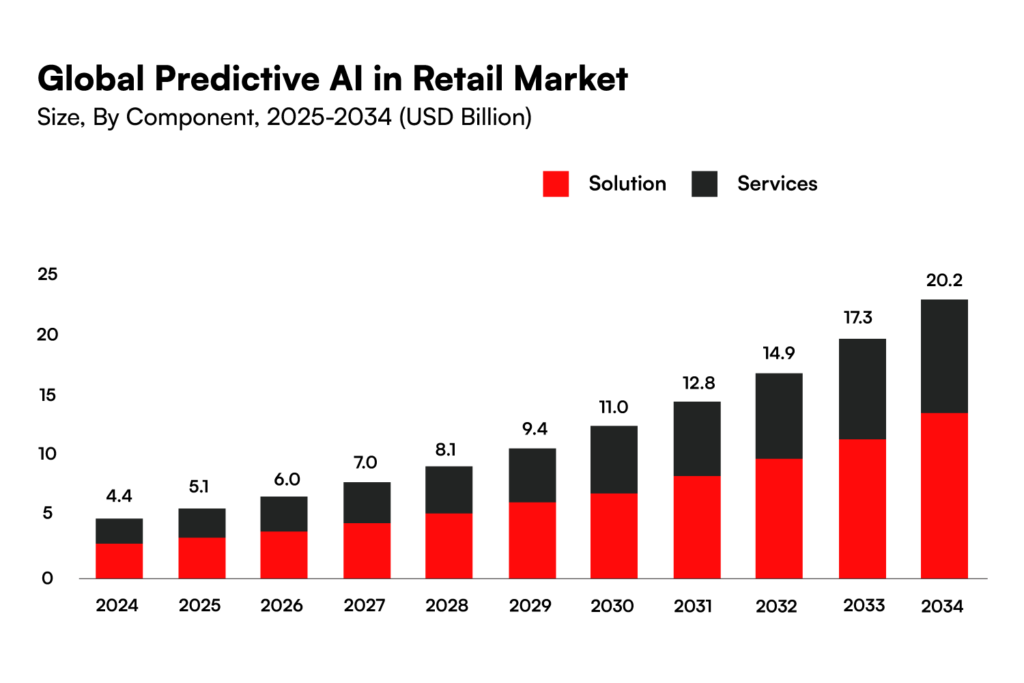
According to the Market.US report, the Global Predictive AI in Retail Market is expected to reach $20.2 Billion by 2034, up from $4.42 Billion in 2024, growing at a CAGR of 16.4% over the forecast period from 2025 to 2034.
- AI forecasting tools are also gaining broader business value as retailers shift from batch forecasting to real-time intelligence. Future systems are expected to leverage live data streams, enabling companies to react instantly to demand shifts instead of relying on weekly or monthly forecasts. A transition that strengthens responsiveness and operational resilience.
- Another major trend is deep integration across business functions. AI demand forecasting retail will increasingly connect with sales, marketing, finance, and supply chain systems to create unified, efficient planning processes that reduce silos and improve decision-making accuracy.
Future trends indicate that AI demand forecasting will not only become more accurate and automated, but also more integrated, real-time, and business-wide, enabling retailers to forecast with greater precision, adapt faster to consumer behavior, and manage inventory with minimal risk.
Ready to transform your retail forecasting with AI?
Discover how we can improve accuracy and inventory performance.
Connect With Us
Negative Business Impact of Inaccurate Inventory Planning and Stock Imbalances
Poor forecasting and inventory management don’t just affect operations. They directly affect revenue, customer trust, and business growth. When products are not available, retailers lose immediate sales. Customers who can’t find what they want don’t always wait; they move to competitors. Over time, this damages brand loyalty.
At the same time, money gets locked in excess inventory that doesn’t sell. Overstock increases storage costs, ties up working capital, and leads to markdowns and margin erosion.
The impact extends to customer experience:
- Customers become frustrated when items are unavailable
- Trust in the brand weakens
- Shopping journeys become inconsistent across channels
Internally, teams spend more time fixing stock problems than focusing on growth. Instead of planning promotions, improving assortment, or enhancing customer experience, teams are trapped in firefighting mode.
This creates a reactive business instead of a proactive one, and in modern retail, being reactive is expensive.
AI Retail Demand Forecasting and Inventory Management Approach
AI demand forecasting in retail changes the way businesses think about inventory, from guessing to predicting, from reacting to planning. The process of integrating AI demand forecasting inventory management in retail begins with smart tools that analyze historical sales and current trends.
This includes seasonality, promotions, price changes, regional differences, and channel behavior.
Retail Demand Forecasting AI models then predict what customers are most likely to buy in the future, not just based on past averages, but by recognizing complex patterns that humans cannot manually process.
Once demand is forecast, the system automatically calculates the required stock. It considers:
- Lead times from suppliers
- Minimum and maximum stock levels
- Safety stock
- Warehouse capacity
- Channel-specific demand
An AI demand forecasting inventory management system doesn’t stay static; it continuously improves forecasts as new data comes in, learning from actual sales, changing trends, and shifting customer behavior.
This approach replaces slow, manual planning with:
- Continuous intelligence
- Real-time recalibration
- Data-backed decisions
The result is not just better forecasts, but a more resilient and responsive retail operation.
Measurable Outcomes from AI Demand Forecasting in Retail and Inventory Management
Retailers that adopt AI retail demand forecasting and inventory management experience measurable operational improvements.
You can expect the following from integrating AI demand forecasting inventory management:
- More accurate stock planning, reducing reliance on guesswork
- Fewer out-of-stock and overstock situations, improving both availability and margins
- Faster response to changing customer demand, including seasonal shifts and trending products
- Better business decisions backed by real data, not assumptions
- Teams become more confident in their planning, operations become smoother, and customer satisfaction improves.
How AI-Powered Demand Forecasting Works in Inventory Management?
Inventory management is a highly sensitive activity that requires accurate forecasting and a balance between overstock and out-of-stock conditions.
This accuracy requires an artificial intelligence machine learning-based demand forecasting system that deploys advanced AI/ML models and constantly learns with the help of data to forecast the future demand of the products with significantly higher accuracy.
The AI-Powered Demand Forecasting operates in the following way, end-to-end:
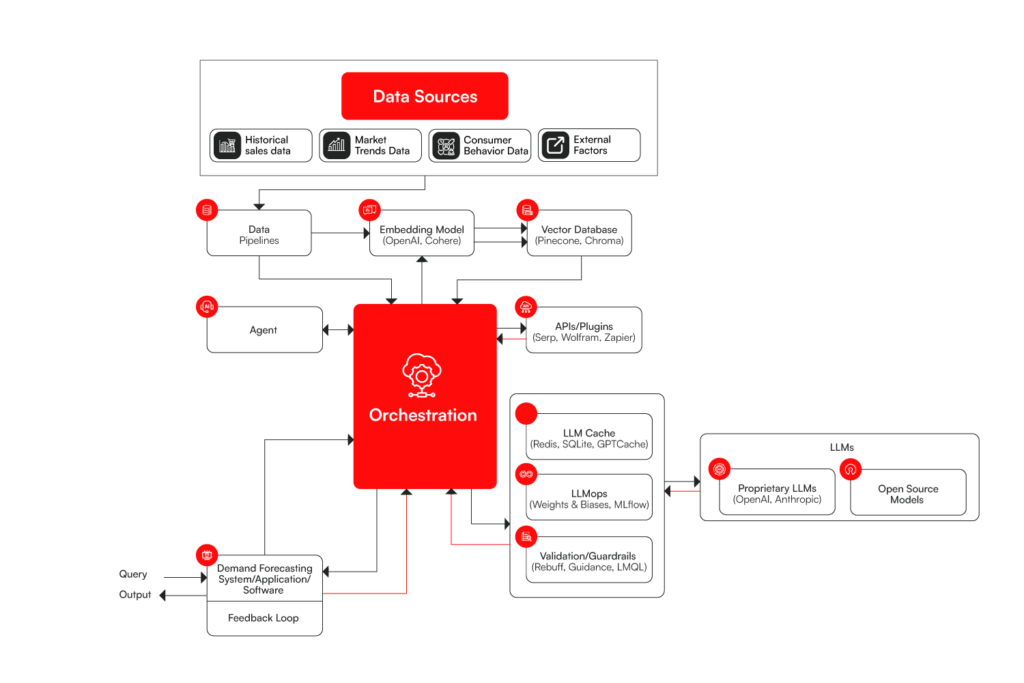
The Foundation: Data Ingestion & Vectorization
Effective demand forecasting relies on the robustness of your data sources and knowledge base.
- Various Data Sources: The system draws on internal silos, such as sales data and consumer behavior, as well as external indicators, including market trends, economic indicators, and competitor activity.
- The Pipeline: Raw data is purged and sent to an embedding model, such as OpenAI or Cohere, which transforms text and numbers into high-dimensional vectors.
- Vector Database: These vectors are stored in databases like Pinecone or Chroma, which enable semantic search rather than keyword matching
The Ploting: Orchestration Layer
The command center is the Orchestration Layer. It does not simply transfer data; it controls the logic.
- Prompt Chaining: It divides large, complex forecasting requests into small tasks.
- Context Retrieval: It retrieves the most relevant snippets from the Vector Database to provide the LLM with the context it needs to make a forecast.
- Memory Management: It retains past sections of the conversation to ensure the forecast remains consistent.
The Execution: Interaction & Tooling
When a user submits a Query through the Demand Forecasting App:
- Agents: If the query is complex, say, “How will a 2% interest rate hike affect our Q4 inventory?” In this case, an agent uses reasoning and planning to decide which tools to use.
- APIs/Plugins: The system can reach out to the real world using tools like Wolfram or Serp to enhance its internal data.
The Intelligence: LLMs & Optimization
The refined prompt is sent to the Large Language Models.
- LLM Selection: The system can toggle between Proprietary LLMs like GPT-4 or Claude for high-reasoning tasks and Open Source Models for cost-efficiency or data privacy.
- LLM Cache: Frequently asked questions are served from a cache (Redis/GPTCache) to improve efficiency and performance while reducing latency and costs.
- LLMOps: Tools like MLflow track performance and versioning.
- Validation/Guardrails: Before the user sees the output, tools like Guardrails or Rebuff ensure the forecast is factually grounded and free of hallucinations.
The Result: Output & Continuous Learning
- Actionable Insights: The app delivers the final forecast, including recommendations for supply chain adjustments or predicted market reactions.
- Feedback Loop: This is the most critical step for long-term accuracy. User corrections are fed back into the system, allowing the models and pipelines to “learn” from their mistakes over time.
Use Cases of AI Demand Forecasting in Retail
AI-powered demand forecasting is reshaping retail and eCommerce by driving sharper decisions, leaner operations, and stronger customer experiences.
- Retailers use AI to analyze large datasets, uncover patterns, and predict demand with far greater accuracy than traditional models.
- Beyond inventory planning, AI-driven demand forecasting in retail helps retailers strengthening revenue strategy.
- Retailers use predictive models to forecast revenue, identify high-potential sales opportunities, and dynamically adjust pricing in real time.
- Modern retailers also rely on advanced AI forecasting tools to better understand customer behavior, optimize stock levels, and prevent missed sales opportunities.
Key Applications of AI Forecasting in Retail
Omnichannel Inventory Optimization
AI analyzes demand across online stores, mobile apps, and physical locations to strategically allocate inventory. Retailers reduce stock imbalances and ensure high-demand products remain available where customers need them most.
How AI Demand Forecast Works:
- Data Aggregation: AI extracts real-time information across all touchpoints, including POS systems in brick-and-mortar stores, e-commerce flows, mobile app usage, and even social media trends.
- External Factor Analysis: Unlike the conventional approach, AI incorporates variables such as local weather forecasts, holiday seasons, and economic changes that affect purchasing patterns.
- Pattern Recognition (Machine Learning): The system tracks complex relationships, e.g., that when online browsing in a particular zip code surges, it often follows a rise in the number of requests to do business online or a pickup in-store (BOPIS) at a local branch.
- Dynamic Re-allocation: According to the forecast, AI would propose shipping a portion of stock from a slow-moving warehouse to a high-demand urban micro-fulfillment center before the stockout occurs.
- Lead-Time Optimization: It is the calculation of the different speeds of various shipping routes and carriers to ensure replenishment at the right time when safety stock levels are violated.
Outcomes:
- Reduced Stockouts and Overstocks: Retailers reduce the lost sales of empty shelves and the margin-killer of heavy end-of-season markdowns of excess inventory by predicting demand on a small-scale basis.
- Increased Fulfillment Flexibility: Retailers will have the confidence to offer services such as ship-from-store or BOPIS, since the AI has guaranteed the online order and will not leave walk-in customers without products when fulfilled at a physical store.
- Enhanced Capital Efficiency: Less dead stock translates to less capital held in inventory lying around warehouses, so that businesses are able to reinvest that money in their development or the development of new products.
Dynamic Pricing and Promotion Planning
AI evaluates price sensitivity, seasonal trends, and campaign performance to refine discount strategies. Retailers maximize revenue during peak seasons, flash sales, and promotional events without eroding margins.
How AI Demand Forecast Works:
- Price Elasticity Modeling: AI estimates how demand changes with varying prices. It establishes the sweet spot where reducing prices will lead to a significant increase in volume without a needless reduction in profit margins.
- Historical Promotion Analysis: The system uses information from previous campaigns to determine which types of offers have been most appealing to specific customer groups.
- Competitor Price Monitoring: AI scrapers monitor competitor pricing in real time. The prediction is based on whether a competitor is lowering your price or has gone out of stock, and you can increase prices once you have supplied all your stock.
- Inventory-Aware Pricing: The model is directly linked to existing stock levels. When projected demand is low and the item’s inventory is large, the AI initiates a specific promotion to clear the inventory, only for it to become dead weight.
- Sentiment and Trend Analysis: AI can predict hype cycles by examining social media buzz and search engine volume. It can advise against skimming an item when it is trending, rather than discounting it too soon.
Outcomes:
- Retention of Profit Margins: This is because retailers preserve their profit levels by not awarding blanket discounts and providing deep discounts only when they need to move products.
- Optimized Revenue in Peak Times: In high-volume situations, such as Cyber Monday, AI will be able to adjust prices on an hourly basis according to the demand velocity, and in this case, the retailer will get the maximum value per unit sold.
- Minimize Inventory Carry Costs: By strategically liquidating slow-moving products in line with demand, retailers can free up warehouse space and capital for higher-margin products.
Supply Chain Demand Sensing
AI processes real-time data from POS systems, website traffic, and mobile activity to detect demand spikes early. This AI-powered demand forecasting retail supply chain reduces the bullwhip effect, improves supplier coordination, and strengthens overall supply chain responsiveness.
How AI Demand Forecast Works:
- Real-Time Data Ingestion: AI does not require outdated batch processing; it processes data in real time from Point-of-Sale (POS) systems, e-commerce clickstreams, and IoT sensors in warehouses.
- Signal Extraction: Machine Learning is applied to extract signals (potential indicators of an actual trend) from the system, while noise (random spikes in sales) is discarded, enabling the supply chain to respond to changes in days rather than weeks.
- Cross-Functional Variable Analysis: AI will be used to predict adjustments to short-term forecasts in response to non-traditional data, such as unexpected weather changes, port congestion, and social media references.
- Automated Alerting & Adjustment: The AI will automatically issue a warning to planners or modify automated ordering systems to ensure they are in step with the new reality in the event of a substantial shift in the course of action.
- Downstream Visibility: It connects the shelf to the factory, giving suppliers a real-time view of consumer demand and enabling them to create more responsive manufacturing plans.
Outcomes:
- Reduction of the Bullwhip Effect: AI can detect consumer demand early, preventing small retail orders from being amplified and unnecessary, massive overcorrections at the manufacturing level.
- Increased On-Shelf Availability (OSA): Since the system detects spikes in mobile app usage or in-store traffic before the shelf is depleted, replenishment is done in advance, ensuring the product is available upon the customer’s arrival.
- Reduced Working Capital: Companies can hold smaller amounts of cash in products to maintain the same levels of service by decreasing the inventory required to hold the so-called safety stocks (the just-in-case inventory).
Real-Life Examples of AI Demand Forecasting for the Retail Industry
1. Amazon
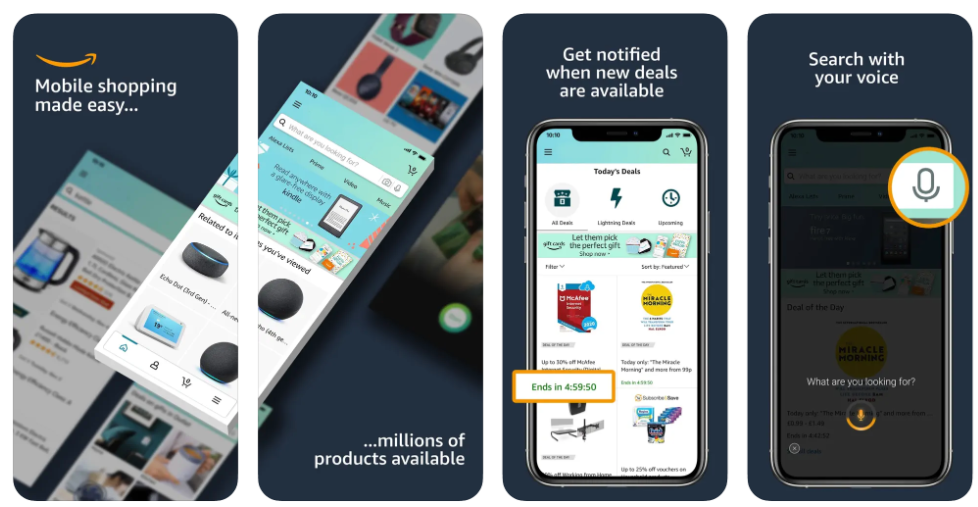
Amazon sets a global benchmark in logistics by using AI-driven inventory management. It applies machine learning, predictive analytics, and robotics to accurately forecast demand, optimize stock levels, and streamline warehouse operations.
Amazon uses dynamic stock replenishment to keep warehouses balanced, reducing both excess inventory and stockouts. Its robotic systems identify, move, and store inventory at high speed, enabling the company to efficiently process millions of orders, especially during peak seasons. These AI-driven innovations reduce transportation costs, lower emissions, and strengthen Amazon’s ability to deliver fast and reliable service.
2. Zara

Zara leverages AI-based forecasting to stay agile in the fast-changing fashion industry. It analyzes point-of-sale data, social listening signals, weather patterns, and trend analytics to predict demand at regional and store levels.
Zara adjusts inventory rapidly based on these insights, enabling faster restocking and preventing overstock. Its AI system strengthens the company’s just-in-time supply chain model, allowing it to respond quickly to emerging fashion trends while maintaining lean inventory and maximizing sales.
3. American Retail Chain Company
We at RBMSoft partner with a leading retail company based in the USA, holding a multi-channel ecommerce ecosystem to reduce stockouts and improve forecast accuracy. We built a custom AI-powered inventory management solution that leveraged predictive inventory forecasting and machine learning to deliver data-backed optimization.
This improved:
- Demand forecasting accuracy by 48%
- Automated inventory workflow by 80%
- Reduced excess inventory by 30%
AI Retail Demand Forecasting Architecture, Flow, and System Integration
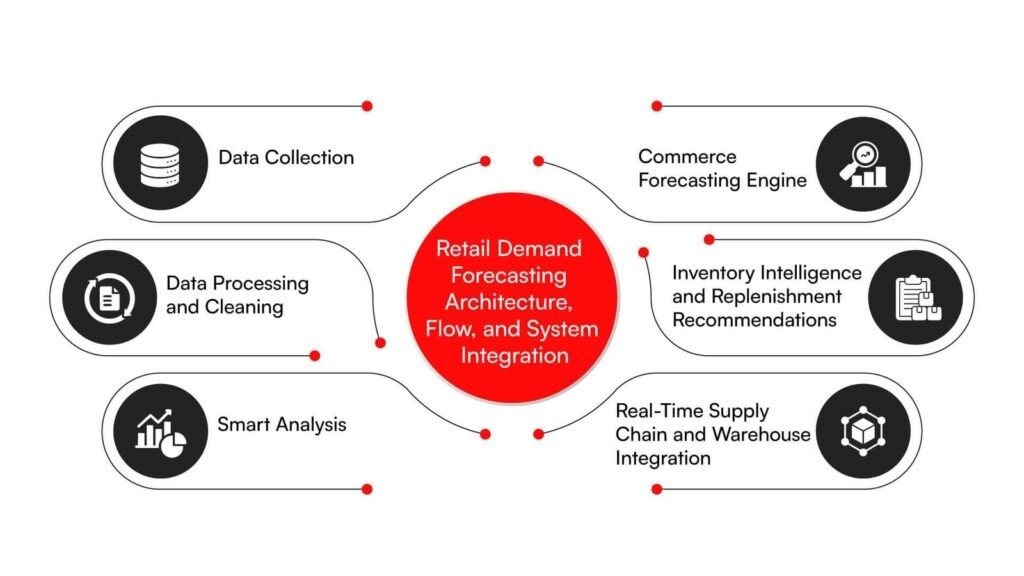
A strong technology foundation is what makes reliable forecasting possible. RBM Soft designs clean, practical, and scalable system architecture flows that ensure predictions are not just accurate, but usable.
The flow typically works like this:
Step 1: Data Collection
Sales data is collected from physical stores, e-commerce platforms, marketplaces, and mobile apps. This includes orders, returns, browsing data, and promotions.
Step 2: Data Processing and Cleaning
All incoming data is cleaned, standardized, and organized into a usable format. This ensures that forecasting is based on accurate, consistent data.
Step 3: Smart Analysis
A smart prediction system analyzes the organized data, identifying patterns, seasonality, trends, and anomalies.
Step 4: Commerce Forecasting Engine
The commerce forecasting engine creates detailed demand predictions across products, locations, and timeframes.
Step 5: Inventory Intelligence and Replenishment Recommendations
The inventory system then calculates:
- How much stock to hold
- When to reorder
- Where to position inventory
Step 6: Real-Time Supply Chain and Warehouse Integration
All systems connect directly with warehouse and supplier platforms, ensuring that recommendations flow seamlessly into execution.
This architecture turns forecasting from a report into an operational engine.
Stop losing margins to guesswork. We helped a leading US retailer achieve
Ready to transform your dead stock into working capital?
Get Service AssistanceChallenges of Implementing AI Demand Forecasting in Retail and How to Overcome Them
Retailers operate in an environment where timing and accuracy are everything. Yet many organizations struggle with basic inventory planning, not because of a lack of effort, but because of outdated systems and disconnected information.
Most retail businesses still guess how much stock they need using manual spreadsheets, basic historical averages, or human intuition. While experience is valuable, it is no longer enough to handle today’s complexity.
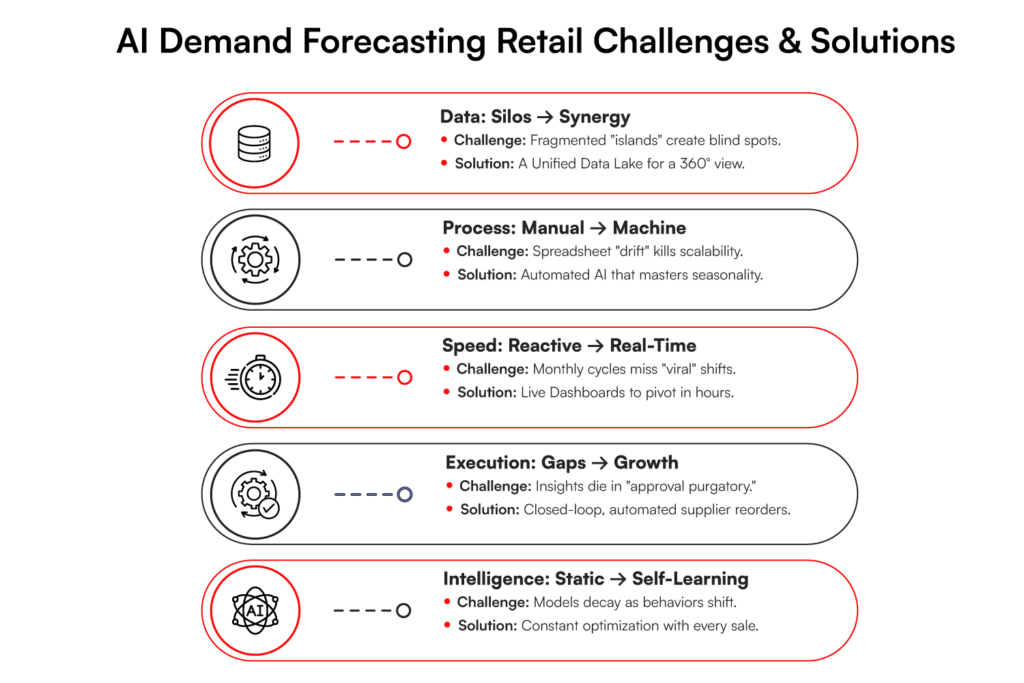
1. Silos and Fragmentation of Data
Challenge:
In most retail settings, information exists on islands. The POS system does not communicate with the warehouse, and the eCommerce environment is a stranger to the supplier’s inventory. AI requires a single source of truth to see the whole picture; otherwise, predictions are based only on partial information.
Solution:
Unify Data: Adopt a centralized data lake or platform that integrates POS, eCommerce, warehouse, and supplier systems. This will ensure that the AI model includes all customer journey touchpoints.
2. Manual Operated Processes
The Challenge:
Using outdated systems or spreadsheets leads to the so-called human-error drift. Standard formulas will not be able to keep up with the number of SKUs and the specifics of regional trends, resulting in either colossal overstock or aggravating out-of-stock signals.
The Solution:
Automate Forecasting: Forget manual entry. Substitute spreadsheets with AI models that can perform an analysis of complex variables such as seasonality, holiday spikes and particular promotional effects at the same time.
3. Slow Response to Market Changes
The Challenge:
The conventional forecasting can be described as mostly reactive- it takes the previous month to predict the coming month. A month-long wait is an age in a global world of TikTok virality and unexpected supply chain disruptions.
The Solution:
Enhance Live Intelligence: Implement real-time dashboards that monitor demand changes. This enables your team to shift inventory or marketing in hours and not weeks.
4. Lack of Coordination with the Action
The Challenge:
An ideal forecast will not help create an action unless it is perfect. When your AI tells you you will sell 500 units, and you still have 3 manual approvals and a fax to send to the supplier, the insight is discarded.
The Solution:
Integrate Replenishment: Tie the Loop: AI forecasts should be directly connected to your inventory management and supplier systems. This allows reorders to be automated based on forecasted requirements, reducing the time lag between insight and action.
5. Model Stagnation
The Challenge:
Consumer behavior is not unchanging. A model that would have been very effective during the winter holidays would not be effective in the summer heatwave or in an economic downturn unless it is updated.
The Solution:
Keep Optimizing: Reinforcement Learning or automated retraining loops. These models consume new sales information every day and learn to make fewer mistakes and be more accurate with every sales cycle.
Stop managing friction. Start scaling intelligence.
We eliminate operational friction by transforming fragmented silos into unified and automated ecosystems.
Consult Our ExpertsHow RBMSoft Can Assist in Developing & Implementing AI Demand Forecasting
We at RBMSoft deliver specialized IT services for the retail industry. We build scalable AI-based demand forecast and inventory intelligence systems tailored to the complexities of the retail industry.
Our solutions unify data, automate predictions, and strengthen operational execution.
1. Building Enterprise-Grade AI Demand Forecasting Solutions
The transition from a pilot program to the deployment of an enterprise-level program is more than a good algorithm. RBMSoft focuses on the integrity and cross-functional integration of the architecture required for global retailing and provides all the assistance needed for AI demand forecasting software integration for retail.
- Scalable Data Pipelines: We design high-performance ETL (Extract, Transform, Load) systems that ingest data from ERP, POS, and CRM systems to provide a single source of truth for the AI engine.
- High-Concurrency Infrastructure: Our solutions are designed to support millions of SKUs across thousands of locations in real time, with no latency.
- Adjustable Hierarchy Levels: We provide forecasting at any level, individual store / SKU to regional/national, where the individual store, SKU, and aggregate forecast can be micro-tactical or macro-strategic.
- Security & Compliance: All solutions are enterprise-grade, encrypted, with role-based access control (RBAC), and comprehensive audit trails to satisfy global data governance needs.
2. Performance Sustainability: Smart Operations
An AI model is not a set-and-forget model. Given the instability of the retail space, RBMSoft offers a Continuous Intelligence framework to ensure accuracy does not decline over time.
- Automated Model Retraining: Our systems run ahead of both predicted and actual results and automatically control retraining cycles when the environment changes, such as a sudden shift in customer behaviour.
- Anomaly Detection and Alerting: We use Human-in-the-loop triggers. If the AI identifies an important outlier, such as an online social media trend or a supply chain disruption, it sends notifications to the planners immediately with a suggested course of action.
- A/B Testing and Simulation: We run A/B Tests and Simulations using Digital Twin environments to simulate how the new model would have performed with historical data before rolling out the new logic to reduce risk.
- Intuitive Dashboards: Our visualization tools are easy to use and convert complex mathematical outputs into easily understandable KPIs: forecast accuracy, bias tracking, and stock-out risk levels.
3. AI Retail Demand Forecasting Methods
We design forecasting and inventory intelligence platforms that are built on proven, validated foundations. Our systems use trusted and proven forecasting methods, combined with modern machine learning, to handle complexity without sacrificing reliability.
To ensure accuracy and reliability, we integrate quantitative and qualitative forecasting methods into a single intelligent system.
- Quantitative AI Retail Demand Forecasting Methods
These methods rely on measurable data and mathematical modeling.
- Time Series Analysis: Uses historical sales patterns, seasonality, trends, and cycles to predict future demand.
- Regression Analysis: Examines how demand responds to variables such as pricing, promotions, and weather.
- Econometric Models: Combines economic theories and statistical techniques to understand how external factors influence demand.
- Qualitative AI Retail Demand Forecasting Methods
These approaches incorporate expert insights where historical data may be insufficient.
- Expert Opinion / Delphi Method: Structured expert consensus to forecast demand for new or unpredictable products.
- Market Research Studies: Surveys, customer insights, and behavioral data are used to understand future buying intent.
- Sales Force Composite: Forecasts are aggregated from the experience and judgment of sales teams closest to customers.
See how smarter AI demand forecasting in retail can improve your business. Whether you are looking to develop AI demand forecasting software for the retail industry or optimize existing models, our experts are here to help.
FAQ’s
1. How does AI improve demand forecasting in retail?
AI improves demand forecasting by analyzing large volumes of historical sales, promotions, seasonality, pricing, regional trends, and customer behavior data. It identifies complex patterns that traditional methods miss, continuously learns from new data, and recalibrates predictions in real time, resulting in higher accuracy and fewer stock imbalances.
2. How can AI assist with demand forecasting in retail?
AI assists retailers by automating data collection, cleansing, and analysis across stores, eCommerce, and supply systems. It predicts future demand at SKU, store, and channel levels, generates replenishment recommendations, and integrates directly with inventory and warehouse systems to support faster, data-driven planning decisions.
3. What are the benefits of AI in retail demand forecasting?
AI-driven forecasting reduces stockouts and overstock, improves inventory turnover, optimizes working capital, and enhances customer satisfaction. Retailers gain better visibility into demand trends, respond faster to market shifts, and align supply chain execution with predicted sales, leading to stronger margins and operational efficiency.
4. What is the role of AI in demand forecasting for retail and inventory management?
AI plays a central role by integrating sales data, supply chain inputs, and external factors into a single intelligent system. It predicts future demand, calculates optimal stock levels, manages safety stock, and automates replenishment planning, transforming inventory management from reactive correction to proactive, strategic control.
5. How long does it take to implement AI demand forecasting and inventory management in retail?
Implementation timelines vary based on data readiness, system complexity, and integration scope. A focused pilot can take a few weeks, while full enterprise deployment across channels and warehouses may take a few months, including data integration, model training, testing, and operational alignment.
6. How much does it cost to develop and integrate AI demand forecasting for retail?
Costs depend on scale, data quality, infrastructure, and customization needs. A pilot implementation may start in the mid five-figure range, while enterprise-grade, fully integrated solutions can reach six figures or more, depending on features, integrations, cloud architecture, and ongoing model maintenance.
7. What tech stack is recommended to build AI demand forecasting software for retail?
Most developers choose to build AI demand forecasting software for retail using Python-based frameworks like TensorFlow or PyTorch for the machine learning core. For the backend, cloud-native services such as AWS Forecast or Google Cloud AI Platform are often used to ensure the software can scale as the retailer adds more SKUs or locations.
8. Can AI demand forecasting retail inventory management reduce dead stock?
Yes, one of the most critical functions of AI demand forecasting retail inventory management is its ability to detect demand decay early. By identifying products that are no longer trending, the system can stop automated reorders and suggest strategic markdowns before the inventory becomes unsellable dead stock.