




Quick Summary:
- AI in e-commerce helps businesses understand customer behavior, demand shifts, and operational signals in real time.
- Key AI in ecommerce use cases include personalised discovery, real-time recommendations, and intelligent search that improve relevance and conversion rates.
- Predictive inventory planning, dynamic pricing, and demand forecasting are core AI use cases that optimize revenue and margins.
- Customer support, fraud detection, and retention rely on AI to automate response, reduce risk, and increase lifetime value.
- AI adoption often breaks down due to poor data quality, siloed systems, limited integration, and unclear decision boundaries.
- Successful organizations start with one high-friction use case, track outcomes, and expand AI across adjacent journey stages.
- The future of e-commerce AI focuses on proactive intelligence, privacy-first personalization, and tightly integrated operations.
Running an e-commerce business today isn’t getting any easier. Shoppers expect fast, personalized experiences. From finding the right products instantly to receiving timely, relevant support. At the same time, online stores are competing with global marketplaces and highly specialized niche players.
What’s changed is not just the scale of competition, but the volume and complexity of data involved in running an e-commerce operation. Every interaction generates signals– browsing behavior, purchase intent, pricing sensitivity, fulfillment constraints, and post-purchase feedback.
Traditional rules, dashboards, and manual decision-making can’t interpret this data fast enough or connect it across the entire customer journey.
So how do you deliver fast, personalized experiences without exploding costs or overloading your teams?
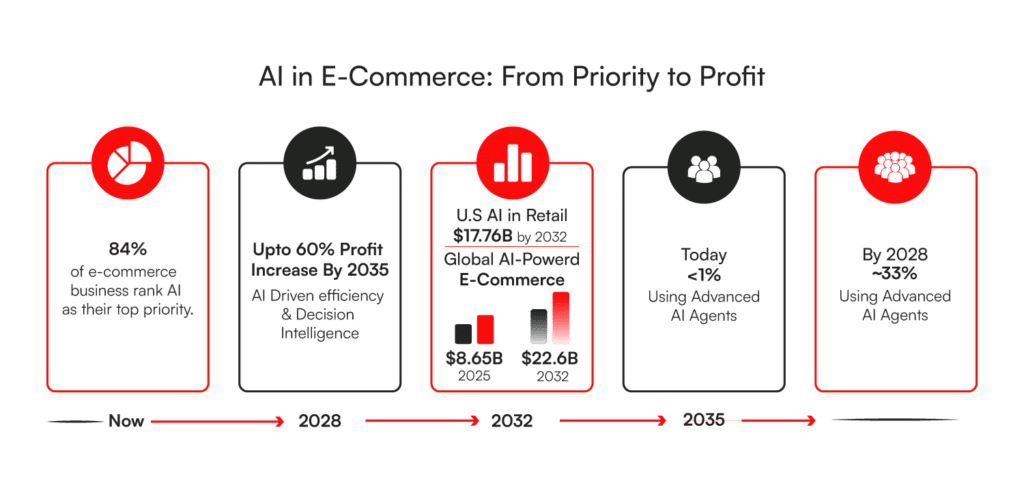
You do it with the use of AI in the e-commerce industry. Today, nearly nine out of ten companies use AI in at least one business function. It can be anything from shopping assistants and inventory planning to pricing and fraud detection.
In this article, we’ll explore the major use cases of AI in retail in 2026, understand how it impacts the customer journey, and look at future trends for AI in retail. So let’s get started.
The Future and Market Trends of AI in the E-commerce Industry
Looking ahead, the most meaningful advances will be about making AI more integrated, more human-centric, and more operationally intelligent.
- AI copilots will become standard in team workflows
One of the next big shifts we’re watching in the e-commerce industry is the rise of AI copilots. For example, instead of asking a marketer to manually segment audiences or write dozens of variants of an email, an AI copilot can suggest segments, draft personalized messages, and help refine based on real-time performance.
Similarly, a support copilot augments agents with quick context and suggested responses, reducing handling time and improving consistency without removing human judgment.
- Personalization will improve but use less data
Today’s customers want relevance, but they also care about how their data is used. AI is moving toward privacy-aware personalization.
Personalized outcomes are delivered with minimal data exposure and explicit consent. Techniques such as on-device inference, federated learning, and policy-driven data controls will let teams personalize experiences while meeting regulatory and ethical expectations.
- AI will move from prediction to prevention
The initial adoption of AI in e-commerce use cases centered on prediction. It used data to anticipate demand, guide product discovery, and flag retention risks early. The future will be about operational intelligence. AI will allow organizations to prescribe actions based on the input.
For example, AI will trigger inventory decisions that automatically balance cost, demand, and supplier constraints. Or it will power pricing systems that recommend strategic adjustments based on competitive signals and business goals.
- AI will be built into ecommerce platforms
The future will see AI embedded directly into e-commerce platforms, CRMs, inventory systems, and analytics tools. Instead of separate AI add-ons, these capabilities will be woven into the infrastructure itself, creating a smoother operational backbone.
How AI in E-commerce Impacts the Customer Journey
For most e-commerce businesses, AI isn’t limited to one tool or one team. It works across the entire customer journey. Here’s how that plays out at each stage.
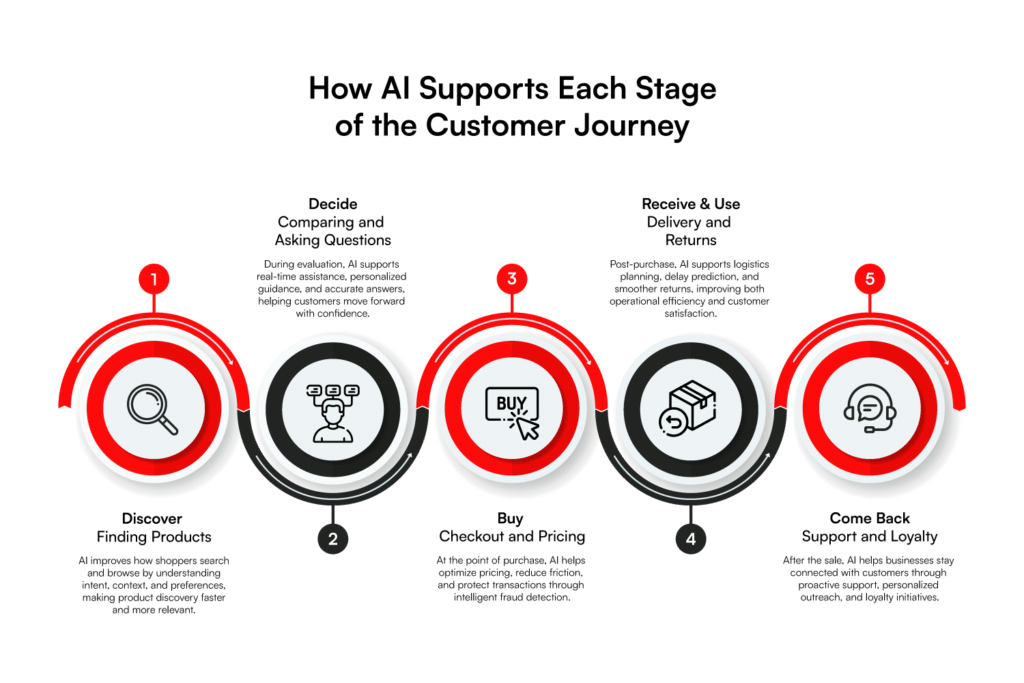
In the next section, we’ll explore the most common and high-impact AI use cases in e-commerce for various stages of the customer journey.
How You Can Apply Use Cases and Real Life Examples of AI in E-commerce
Here are AI in e-commerce examples that add insight into how leading companies deliver maximum value.
1. Personalized Product Discovery & Recommendations
Journey stage: Discover – Finding Products
At the discovery stage, the biggest challenge is relevance. AI helps shoppers quickly find what they want. It does so by understanding intent, behavior, and context. This goes far beyond basic “people also bought” recommendations.
AI-powered discovery uses browsing history, search patterns, real-time signals, and even visual or conversational inputs to surface the most relevant products. For a deeper look at how this works at the search layer, see our full guide on intelligent search use cases.
Business benefits of using AI in e-commerce
- Higher engagement and conversion rates
- Reduced bounce rates and faster path to purchase
- Better utilization of long-tail inventory
Real Life Example of AI in Ecommerce – Amazon’s AI Product Discovery
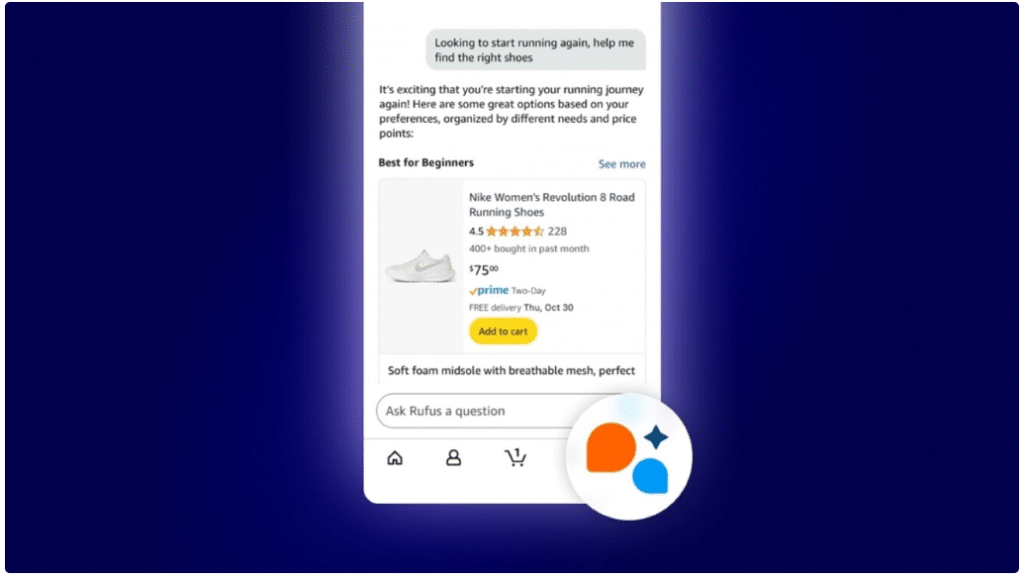
Amazon is one of the most well-known examples of AI-driven product discovery at scale. A central component of this effort is Rufus, Amazon’s AI shopping assistant. It can answer a wide range of natural language queries.
It offers tailored recommendations based on shopping history, tracks prices, and even acts on behalf of customers (e.g., adding items to the cart or purchasing when conditions are met). These capabilities are built on a mix of machine learning models and generative AI.
Amazon reports several strong customer engagement signals: over 250 million users, 140% annual growth in monthly usage, and 60%+ higher conversion rates for sessions involving Rufus.
2. AI-Powered Customer Support
Journey stages: Decide, Buy, Come Back
As customers compare options or face friction, response speed and accuracy become decisive. AI-powered customer support handles common queries instantly.
It answers product questions, shares delivery timelines, resolves order issues, and routes complex cases to human agents when needed. This reduces wait times while delivering consistent, always-on support across chat, email, and voice channels.
Behind the scenes, these systems use natural language processing (NLP) to understand customer intent. They are able to gauge urgency, and classify requests in real time.
Sentiment analysis helps detect frustration or dissatisfaction and triggers priority handling or human escalation. Integrations with order management and CRM systems ensure responses stay contextual, accurate, and personalized.
Business benefits
- Lower support costs without sacrificing experience
- Faster issue resolution for customers
- Improved customer satisfaction and trust
Real Life Example of AI in Ecommerce – Alibaba’s AI Customer Support
Alibaba uses AI-powered assistants across its e-commerce platforms to handle product discovery, comparisons, delivery queries, and order support at scale. These systems resolve common questions instantly and route complex issues to human agents, reducing wait times while maintaining consistent service.
More recently, Alibaba’s Qwen AI assistant has taken this further. With a single voice or text command, the assistant can find products and complete payments within the same interface. It’s a huge shift from reactive support to active guidance where AI chatbots guide customers through decision-making and purchase, not just respond to issues.
3. Smarter Inventory and Demand Planning
Journey stages: Discover, Buy, Receive & Use
E-commerce inventory planning is difficult because demand is volatile, promotions distort buying patterns, and supply chain data is often delayed or fragmented. This leads to stockouts that hurt conversions or overstocking that locks up working capital and erodes margins.
AI addresses this by continuously analyzing historical sales, seasonality, promotions, pricing changes, and external demand signals. Machine learning models update forecasts in near real time. This helps teams anticipate demand shifts earlier and align inventory, replenishment, and fulfillment decisions more accurately.
When integrated with supply chain and logistics systems, AI-driven planning improves product availability and delivery reliability while reducing operational waste. Studies show brands using AI for inventory and demand planning achieve 5-20% logistics cost reductions and 5-15% procurement savings, alongside higher inventory accuracy and fewer stockouts.
Business benefits
- Reduced inventory carrying costs
- Fewer stockouts and lost sales
- Improved supply chain efficiency
Real Life Example of AI in Ecommerce – Nike’s Predictive Inventory Analysis
Nike uses AI-driven demand planning and inventory intelligence to better align supply with real customer demand across channels. Nike applies machine learning and predictive analytics to historical sales, regional demand patterns, seasonality, and app engagement data.
This enables more accurate demand forecasting and smarter decisions about product assortment and inventory allocation. This reduces reliance on static planning models and manual forecasts.
These AI models also feed inventory and assortment decisions. It helps Nike minimize overstocking, reduce stockouts, and improve availability for high-demand products.
As a result of applying predictive analytics at scale, Nike has reported a 40% increase in customer retention. And also a 10% increase in direct-to-consumer sales, while also reducing returns and improving inventory efficiency.
RBMSoft provides retail software development solutions to connect AI-driven demand planning with ERP, OMS, WMS, ecommerce, and supply chain systems. We help retailers turn demand forecasts into inventory, replenishment, and fulfillment actions across channels.

4. Dynamic Pricing and Revenue Optimization
Journey stage: Buy – Checkout and Pricing
E-commerce pricing is difficult to manage at scale. Demand changes quickly. Competitors adjust prices constantly. Inventory levels rise and fall. Blanket discounts often hurt margins without improving conversions. Static pricing rules and manual updates can’t respond fast enough, which leads to missed revenue opportunities or unnecessary markdowns.
AI helps by reacting to these shifts in real time. It continuously analyzes demand trends, competitor pricing, customer behavior, and available inventory. Machine learning models estimate price sensitivity and recommend optimal prices or offers within predefined guardrails.
This enables dynamic pricing at checkout, improving conversion while protecting profitability. In high-volume e-commerce environments, AI-driven pricing has been shown to increase revenue by 2–5% and improve profit margins by 5–10%, according to industry research.
Business benefits
- Higher average order value and revenue per visitor
- Reduced cart abandonment
- Better margin control through data-driven pricing
Real Life Example of AI in Ecommerce – Airbnb’s Smart Pricing
Airbnb uses AI-driven dynamic pricing through its Smart Pricing feature, which automatically adjusts nightly rates in real time.
The system analyzes signals such as historical booking patterns, property attributes, local demand, seasonality, events, and guest search behavior to identify an optimal price for each listing on each date. This allows prices to stay competitive as demand fluctuates, without relying on manual updates.
For hosts, Smart Pricing runs with built-in controls. They can set minimum and maximum price limits, choose whether to prioritize occupancy or revenue, and override prices when needed.
In practice, hosts using AI-based dynamic pricing often see revenue gains of 10-40% compared to static pricing, making it a powerful lever for improving conversion and revenue without sacrificing margin control.
Ready to operationalize AI in your e-commerce business?
Let RBM Soft help you move from experimentation to execution
Get Started
5. Post-Purchase Experience and Return Management
Journey stage: Receive & Use – Delivery and Returns
Returns and refunds are a major challenge in e-commerce. Delivery delays frustrate customers, manual approvals slow resolution, and inconsistent handling drives up costs and fraud risk. Teams struggle to resolve issues quickly while keeping operations under control.
AI helps by analyzing shipment data, carrier performance, return reasons, and customer behavior. It predicts delays, flags high-risk returns, and detects abnormal refund activity.
Low-risk cases can be automated, while humans handle exceptions. This reduces processing time, lowers costs, and improves customer satisfaction.
Business benefits
- Faster resolution of returns and refunds
- Lower operational overhead
- Improved post-purchase satisfaction
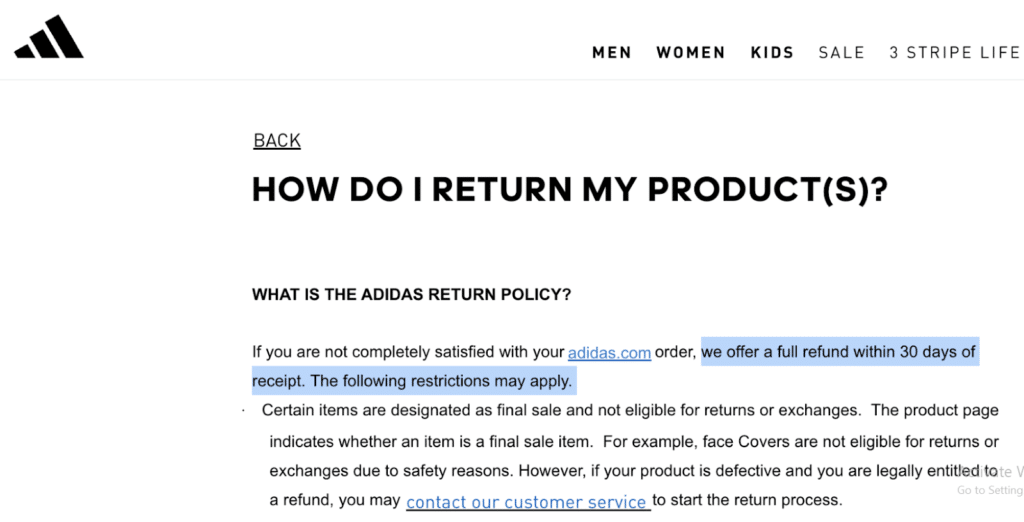
Real Life Example of AI in Ecommerce – Adidas Return Management
Adidas uses AI to transform how it handles post-purchase feedback and returns. By analyzing customer reviews with a GenAI system, the company extracts insights about product fit, quality, and customer preferences. This allows them to proactively address common issues like sizing, streamlining exchanges, and refunds.
The AI flags potential problem orders, automates low-risk returns, and guides staff on exceptions, reducing processing time and costs while improving satisfaction.
6. Marketing, Content, and Campaign Automation
Journey stages: Discover, Decide, Come Back
E-commerce marketing is complex. Customers expect personalized messages across multiple channels, and campaigns must be timely, relevant, and consistent. Manual processes struggle to keep pace, leading to missed opportunities and lower ROI.
AI helps by automating key parts of the marketing workflow. It can generate product descriptions, email copy, and ad variants tailored to different segments. It optimizes send timing, selects the right channels for each customer, and adjusts campaigns based on real-time engagement signals.
Some platforms also use AI to automate A/B testing, quickly identifying what resonates and scaling winning variations.
Business benefits
- Higher campaign ROI
- Reduced manual effort for marketing teams
- More consistent personalization at scale
Real Life Example of AI in Ecommerce – Sephora’s AI Personalized Marketing
Sephora uses AI to scale personalized marketing across customer journey stages. Interactive quizzes help shoppers find the right products, while AI-driven recommendations personalize on-site content, emails, and SMS campaigns.
This allows Sephora to deliver relevant messages at the right moment across channels without increasing manual effort for marketing teams.

7. Fraud Detection and Platform Security
Journey stage: Buy – Checkout and Payments
As e-commerce grows, fraud grows with it. Merchants lose billions each year to payment fraud, chargebacks, and refund abuse. Globally, e-commerce fraud losses are estimated at over $48 billion annually, with many merchants reporting that fraud-related costs consume nearly 3% of the revenue.
AI helps in ecommerce fraud detection by analyzing transactions in real time. It spots anomalies in behavior and purchases, adapts to evolving fraud, and reduces false declines. This makes checkout more secure, reduces chargebacks, and protects revenue without adding friction for genuine buyers.
Business benefits
- Reduced fraud losses
- Safer checkout experience
- Improved trust and platform reliability
Real Life Example of AI in Ecommerce – PayPal’s AI-driven Fraud Detection
PayPal uses AI-driven fraud detection to secure billions of e-commerce transactions globally. Its machine learning models analyze transaction behavior in real time, including payment patterns, login activity, device signals, and geographic location.
By continuously learning from new data, PayPal’s system adapts to emerging fraud tactics such as account takeovers and payment fraud.
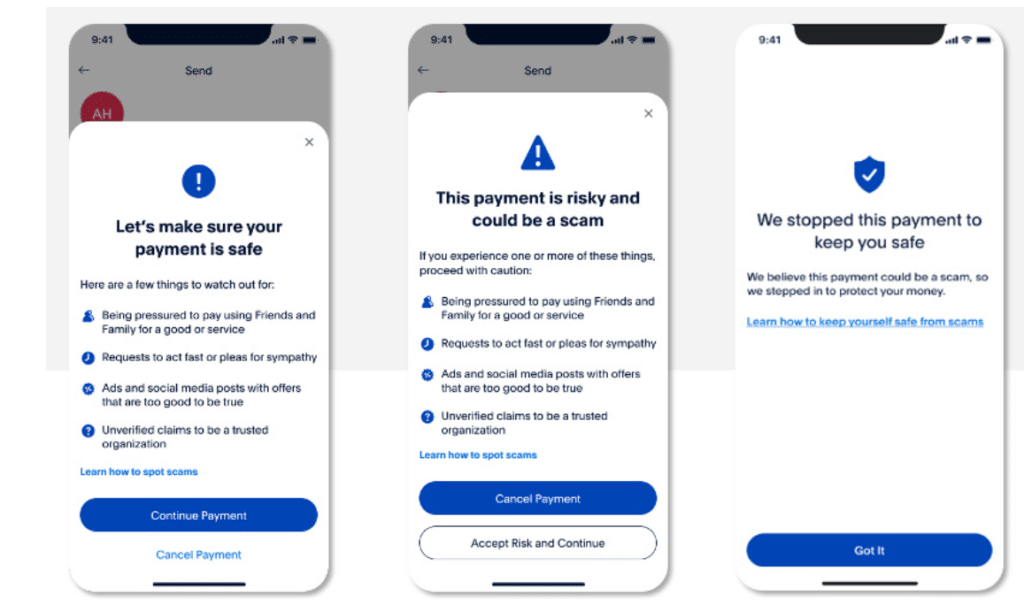
When unusual behavior is detected, such as a large transaction from a new device or location, the system flags the activity and triggers additional authentication steps. This real-time approach has helped PayPal significantly reduce fraudulent transactions and chargebacks.
8. Customer Retention and Lifetime Value
Journey stage: Come Back – Support and Loyalty
Customer acquisition costs are rising, making retention critical for sustainable growth. The challenge is that churn often goes unnoticed until revenue drops. Customers disengage quietly and without clear signals. This makes it much more difficult for teams to intervene at the right time.
AI analyzes behavior such as purchase frequency, browsing inactivity, support interactions, and return patterns to predict churn risk and lifetime value. These insights trigger timely, personalized actions like loyalty offers or proactive support. This helps turn one-time buyers into long-term customers and drives more predictable revenue growth.
Business benefits
- Higher customer lifetime value
- Stronger brand loyalty
- More predictable revenue growth
Real Life Example of AI in Ecommerce – RBM Software’s AI-driven Customer Retention System
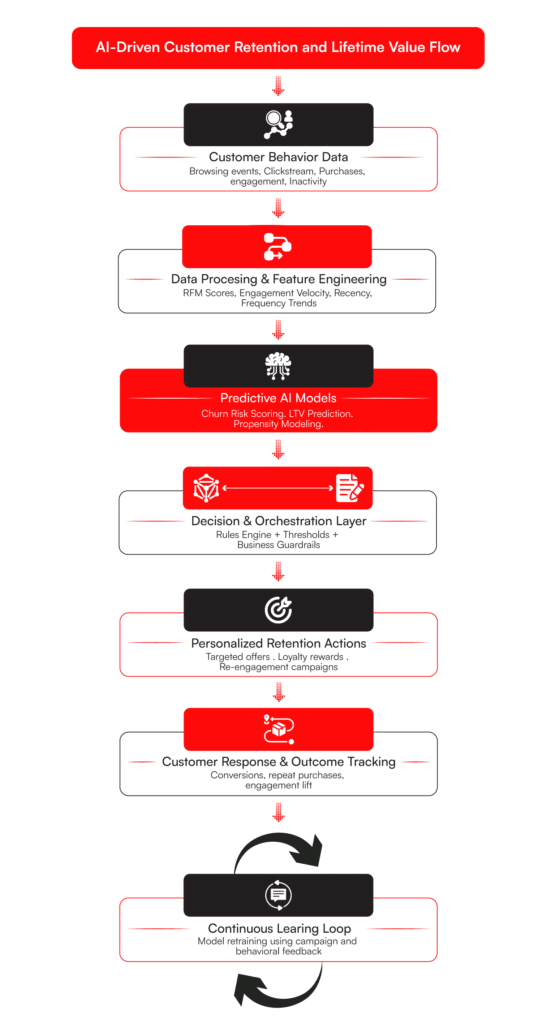
At RBM Software, we implemented an AI-driven customer retention system for an e-commerce brand facing high churn and inconsistent repeat purchases. The solution used supervised machine learning models trained on behavioral event data.
The training data included session activity, clickstream signals, purchase recency and frequency, engagement decay, and inactivity thresholds. We engineered features like RFM scores, time-to-next-purchase probability, and engagement velocity to generate real-time churn risk and customer lifetime value (LTV) predictions.
We integrated these scores into the brand’s CRM and marketing automation stack via APIs, then built a decisioning layer that translated predictions into actions. The layer triggered personalized offers, loyalty incentives, or proactive outreach at optimal moments.
The continuous feedback loops captured campaign response and purchase outcomes, allowing the models to retrain and improve over time. This AI-enabled workflow helped enable timely interventions without the need for any human oversight.
What it Really Takes to Make AI Work in E-commerce
There are multiple strong reasons to implement AI in ecommerce. However, the plan of action for the same can be tricky. Here are the 3 most important things you should be focusing on:
- AI depends on data quality. The success of your AI initiatives depends on the quality of data behind it. Inconsistent info, outdated inventory, or scattered customer information will lead to weak recommendations and broken customer experiences.
- The second challenge is integration. For the use of AI in e-commerce to deliver value, it must connect tightly with commerce platforms, inventory systems, CRM, and support tools. Without this foundation, insights get stuck in siloes and automation fails. In practice, this integration work is where most effort and complexity lie.
- Then come guardrails. AI systems need clear boundaries, pricing limits, brand voice controls, privacy and compliance rules, and defined points for human review. Especially since trust is easy to lose and much harder to gain in the e-commerce industry.
This is the difference between experimenting with AI and building it into your e-commerce infrastructure.
How to Optimize E-commerce with AI in 2026?
The next natural question is, where do you actually begin?
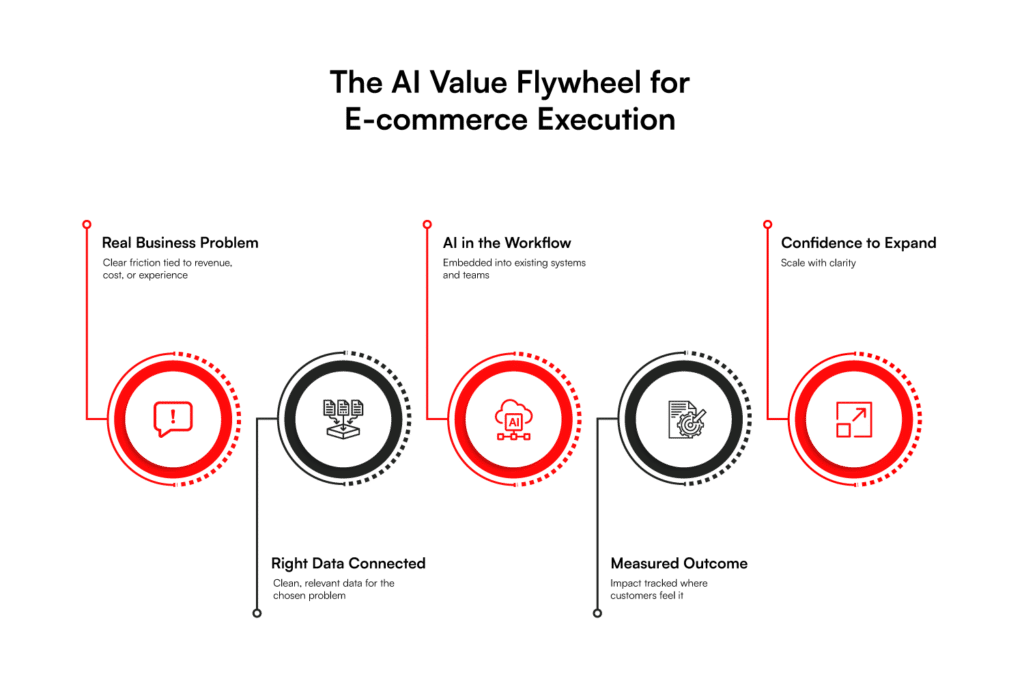
The most effective approach is to start small, anchored to a specific moment in the customer journey where friction is already hurting performance. Whether that’s poor discovery relevance, overloaded support teams, inventory mismatches, or declining repeat purchases, AI delivers the most value when it is introduced to fix one clear problem at a time.
1. Identify One High-Friction Moment in the Journey
Pinpoint a single event metric you want to improve. For example:
- Discover: high bounce rates or low product engagement
- Buy: cart abandonment or pricing inefficiencies
- Receive & Use: delivery delays or high return volumes
- Come Back: weak repeat purchase rates
This focus keeps AI tied to a business outcome, not a technology initiative.
2. Clean and Connect the Data
Product discovery depends on clean catalog data and accurate customer behavior signals. Rather than attempting to centralize all enterprise data upfront, focus on cleaning and connecting only the datasets required for your specific AI use case. This approach reduces complexity and speeds up deployment.
3. Pilot One AI Use Case in Production
Start by selecting a single AI use case within the identified journey stage. This could be a recommendation engine to improve product discovery. It can also be an AI assistant to handle customer queries, or predictive models to optimize inventory and demand planning.
Deploy the pilot in a controlled environment, and ensure it integrates seamlessly with existing systems and workflows. Set clear boundaries for automation, with human oversight for exceptions, so the system can learn without disrupting operations.
You should focus on testing, learning, and validating results at this stage. Use the information to understand how the AI interacts with real data and impacts customer experience.
4. Measure Impact on Outcomes
Focus on metrics that are closely associated with customer experiences: faster discovery, higher conversion, fewer support tickets, quicker refunds, or stronger retention. These metrics will help you connect AI performance directly to revenue and outcomes that matter.
5. Scale Across Adjacent Journey Stages
Once AI proves value in one stage, you can start planning for scale.. A discovery use case can extend into decision support. Or a support assistant can evolve into proactive retention.
This approach keeps AI features grounded in real e-commerce operations. Instead of being a This approach helps transform your AI initiatives into set of capabilities embedded across the customer journey.
Want to improve customer journeys across your e-commerce channels with intelligent Agentic AI workflows?
Get Free ConsultationConclusion
AI is continuously evolving, and its impact on e-commerce will only accelerate. It is becoming a core driver of smarter decisions, efficient operations, and meaningful customer experiences. When applied with the right strategy, AI can help businesses move faster, personalize at scale, and improve outcomes across the entire commerce journey. If you want to explore how AI fits into your strategy, RBM Software provides IT services for ecommerce industry.
We work closely with teams to integrate AI with existing platforms and systems, and ensure models deliver measurable business value. RBM Software partners with organizations to turn AI into a sustainable competitive advantage. Connect with our experts to explore how AI can power your next phase of e-commerce growth.
FAQ’s
1. How is AI changing the e-commerce industry?
AI in e-commerce examples show that businesses can predict demand, personalize recommendations, optimize pricing, and prevent fraud. AI helps teams work smarter, not harder, turning complex data into actionable insights. It improves operational efficiency and customer experience across the entire journey.
2. How to integrate AI in e-commerce with the existing tech stack?
Start with clean, connected data from your CRM, ERP, or commerce platform. Deploy AI applications in e-commerce as pilots in specific workflows. Use APIs to embed models into systems and monitor performance. Integration ensures AI insights flow directly into decision-making and operational processes.
3. How can enterprises use AI in e-commerce marketing?
AI in e-commerce marketing can personalize campaigns, optimize timing, and select channels automatically. By analyzing customer behavior, engagement, and preferences, AI generates tailored content and promotions. Marketers can scale campaigns efficiently while improving conversion, engagement, and ROI using AI-driven insights.
4. How to measure ROI on AI investment in e-commerce?
Track outcomes tied to business KPIs: revenue, conversion rates, repeat purchases, and operational efficiency. Compare AI-driven results against baseline performance. Use metrics like reduced cart abandonment, higher customer lifetime value, and lower operational costs. The cost to implement AI in e-commerce should be weighed against these measurable gains.
5. Which e-commerce tasks are best automated with AI?
Tasks suited for automation include product recommendations, dynamic pricing, demand forecasting, fraud detection, customer support, and marketing campaigns. These repetitive or data-intensive workflows benefit most from AI applications in e-commerce, freeing teams to focus on strategic work while reducing errors and delays.
6. How can AI improve revenue, conversion rate, and customer lifetime value in e-commerce?
AI predicts demand, personalizes experiences, and optimizes pricing in real time. By guiding customers with relevant product suggestions and loyalty offers, businesses boost conversion and repeat purchases. Examples of AI in e-commerce show measurable increases in revenue, average order value, and customer lifetime value.
7. How can AI solutions reduce e-commerce operational costs?
AI automates repetitive tasks, predicts inventory needs, and reduces errors in fulfillment and support. Fraud detection lowers losses, while predictive maintenance and demand planning optimize resource allocation. The use of AI in e-commerce helps companies cut labor, inventory, and error-related costs.
8. How can AI solutions improve e-commerce customer experience?
AI enhances discovery, support, and personalization. It answers queries instantly, predicts delays, and tailors recommendations. Sentiment analysis and predictive insights make interactions proactive, relevant, and consistent. AI applications in e-commerce create faster, smoother, and more satisfying experiences across the customer journey.