
Consumers expect search results that feel like they were curated just for them.
Generic product listings or “default sort” frustrate shoppers and drive them to competitors.
Surveys show that 80% of consumers want retailers to personalize their shopping experience, and 91% prefer brands that provide relevant offers and recommendations.
Personalization is no longer a “nice-to-have” – it is a baseline requirement that separates market leaders from laggards.
Personalized search can boost annual revenue by $1M to $5M for a site with 500,000 monthly visitors, assuming a baseline 2.5% conversion rate and $75 average order value. Gains come from higher conversions and better product discovery.
Why Personalized Search Matters
Personalized search aligns results with each shopper’s preferences, past behavior, and context, resulting in higher engagement, conversion, and loyalty. Real-world data proves the upside:
- Higher conversion rates:
- Baymard Institute reports an average 14.8% conversion lift after implementing personalized search.
- Some deployments achieve up to 50% higher conversions.
- Behavioral data-driven personalization can increase conversions by up to 20%.
- Bigger baskets: Average order value can rise by up to 50% by surfacing complementary products.
- Loyal customers:
- 56% of users return to websites that keep recommending relevant products.
- 44% of shoppers come back after experiencing personalization.
- Case studies:
- Jenson USA: +8.5% revenue per visitor.
- Hornby Hobbies: +10% conversion rate.
- MKM: +4% orders and +2% revenue.
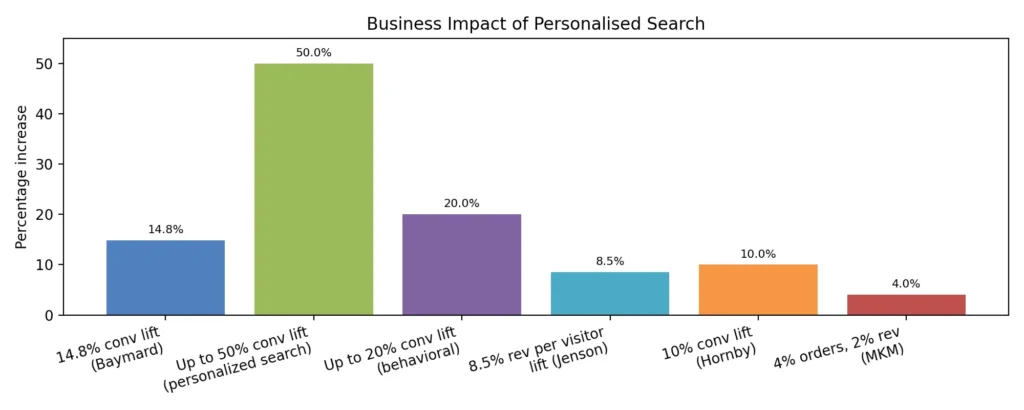
Personalization directly impacts revenue, customer lifetime value, and retention.
Technical Design: Personalization with Clickstream Data and OpenSearch
1. Capture Clickstream Events
Track search queries, product clicks, add-to-cart events, purchases, dwell time, and bounces.
Include user IDs, timestamps, query terms, product IDs, and metadata like device type or location.
Stream events in real time via Kafka or Kinesis.
2. Build the Clickstream Pipeline
Use Apache Flink or Spark Structured Streaming to:
- Clean and enrich data with user profiles and normalized product IDs.
- Aggregate user behavior: search history, category affinity, price sensitivity, brand preference, time-of-day activity.
- Generate user vectors from product embeddings to capture semantic preferences.
- Store features in a low-latency feature store (Redis, DynamoDB, or OpenSearch).
3. Personalize Ranking in OpenSearch
Combine BM25 lexical relevance with vector similarity and personalization boosts:
- Scripted boosts for matching brands, categories, or price ranges.
- Hybrid lexical–semantic search using reciprocal rank fusion or score normalization.
- Business rules for stock, promotions, and merchandising priorities.
Design indices with fields for category IDs, brand IDs, price buckets, vector embeddings, and rank features.
Use search templates or aliases for quick A/B tests.
4. Feedback Loop & Model Training
Capture clicks, purchases, and cart events to retrain personalization models:
- Train models (logistic regression, gradient boosted trees, neural networks) on historical data.
- Serve models via REST APIs at query time for re-ranking.
5. Monitoring & A/B Testing
Track CTR, conversion rate, AOV, and time-to-purchase.
Run control groups to validate lift and monitor latency and infrastructure costs.

Implementation Timeline
| Phase | Activities | Timeframe |
|---|---|---|
| Discovery & instrumentation | Define KPIs, set up tracking, select stack | 2–4 weeks |
| Pipeline & features | Real-time event processing, feature engineering | 4–6 weeks |
| Ranking integration | Implement boosts and hybrid search | 4–6 weeks |
| Model training | Build, test, and deploy ML models | 4–8 weeks |
| A/B testing & rollout | Experiment, monitor, scale | 4–6 weeks |
⏱ Total: A robust system takes 3–6 months.
A basic rules-based MVP can be live in a few weeks.
Business Impact and ROI
- Revenue growth: 8–10% gains are common, with up to 50% conversion lift in aggressive deployments.
- Customer lifetime value: +15% retention and +20% sales through preference-based recommendations.
- Lower churn and CAC: Bounce rate reductions and acquisition cost drops of up to 50%.
- Data-driven insights: Real-time clickstream analytics inform merchandising and marketing.
Cost vs. Return:
- MVP: $100K–$200K over 3–4 months.
- Full real-time system: $200K–$400K over 6+ months.
- ROI: $1M–$5M uplift for high-traffic sites.
Conclusion
Search personalization powered by clickstream data and OpenSearch delivers measurable lifts in revenue, conversions, and loyalty.
With a structured pipeline, open-source flexibility, and continuous optimization, retailers can match the capabilities of proprietary platforms without the licensing costs.
For e-commerce teams competing in a crowded marketplace, personalized search is the fastest path to higher conversions and stronger customer relationships.
Implementing personalized search with OpenSearch and clickstream data typically costs $100K–$400K in the first year, depending on scope. A basic MVP with a small team can be built in 3–4 months for around $100K–$200K, while a full-featured, real-time system with analytics, model training, and monitoring may take 6+ months and cost $200K–$400K including infrastructure. Despite the cost, the ROI is substantial—high-traffic e-commerce sites can see $1M–$5M in annual revenue uplift, making it a high-leverage investment.