

etail transformation today is less about launching new channels and more about orchestrating the systems behind them. As product catalogs grow, fulfillment models diversify, and customer journeys fragment across touchpoints, retailers increasingly find that their biggest constraint is not demand, but disconnected systems.
Retail systems integration sits at the center of this challenge. ERP platforms manage inventory and finance, OMS solutions coordinate fulfillment logic, CRM systems store customer context, and commerce platforms drive transactions. When these systems operate without tight, secure, and scalable connectivity, retailers struggle to deliver consistent experiences or respond quickly to change.
This is where integration engineering, not ad-hoc integrations, becomes a strategic capability.
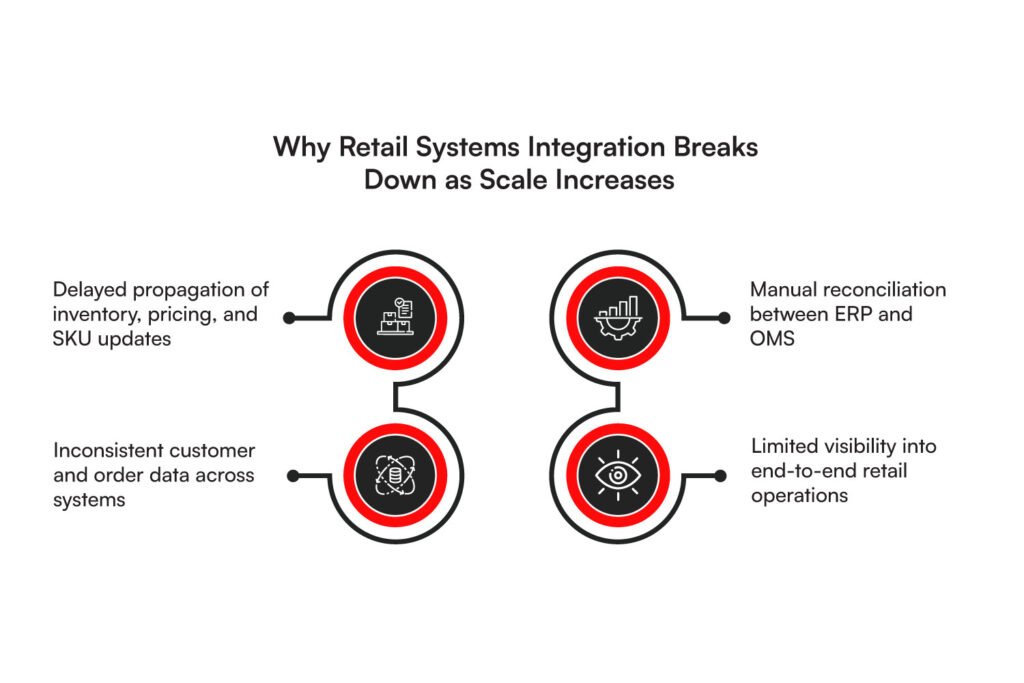
Why Retail Systems Integration Breaks Down as Scale Increases
Most enterprise retail stacks were not designed as unified platforms. ERP, OMS, CRM, POS, and supplier systems were implemented at different times, often to solve isolated operational needs. Over time, integrations were added tactically, point-to-point, batch-based, and tightly coupled.
At enterprise scale, this leads to:
- Delayed propagation of inventory, pricing, and SKU updates
- Inconsistent customer and order data across systems
- Manual reconciliation between ERP and OMS
- Limited visibility into end-to-end retail operations
As transaction volumes increase and channels multiply, these weaknesses surface quickly. What once worked becomes brittle, slow, and difficult to change.
ERP Commerce Integration as the Foundation of Retail Operations
ERP commerce integration plays a foundational role in retail system connectivity. ERP remains the system of record for inventory, pricing, procurement, and financial data. Commerce platforms depend on this data being accurate and current.
When ERP integrations rely on batch updates or synchronous calls:
- Inventory visibility lags behind reality
- Pricing changes fail to propagate consistently
- Digital channels operate on stale data
At scale, ERP commerce integration must shift toward event-driven patterns, where changes in inventory, pricing, or SKU attributes are published and consumed in near real time. This decouples ERP from downstream systems while maintaining data accuracy across channels.
OMS CRM Retail Connectivity and the Customer Experience Gap
Disconnected OMS CRM retail connectivity creates one of the most visible pain points in modern retail: inconsistent customer experiences.
Without real-time synchronization:
- Customer service teams lack accurate order status information
- Fulfillment events fail to update CRM records promptly
- Returns, exchanges, and cancellations introduce data mismatches
As omnichannel fulfillment models expand, BOPIS, ship-from-store, endless aisle, OMS, and CRM must operate with shared, timely context. Integration delays directly translate into poor customer interactions and higher operational effort.
Integration Middleware Retail: The Control Layer Retailers Overlook
As retail ecosystems grow, point-to-point integrations become unmanageable. This is where integration middleware retail platforms play a critical architectural role.
Middleware provides:
- A centralized layer for data transformation and orchestration
- Standardized interfaces between ERP, OMS, CRM, and commerce platforms
- Retry logic, error handling, and monitoring
- Security enforcement across all integration flows
Rather than allowing each system to integrate independently, middleware establishes architectural consistency, essential for scalability, resilience, and governance.
Building a Unified Retail Architecture Through Integration Engineering
A unified retail architecture is not about replacing systems, it is about coordinating them. Integration engineering focuses on how data flows, how events propagate, and how systems remain loosely coupled while working together.
Key architectural principles include:
- Event-driven communication for high-frequency updates
- API-first design for controlled system access
- Decoupling experience layers from core transactional systems
- Observability and governance are embedded at the integration layer
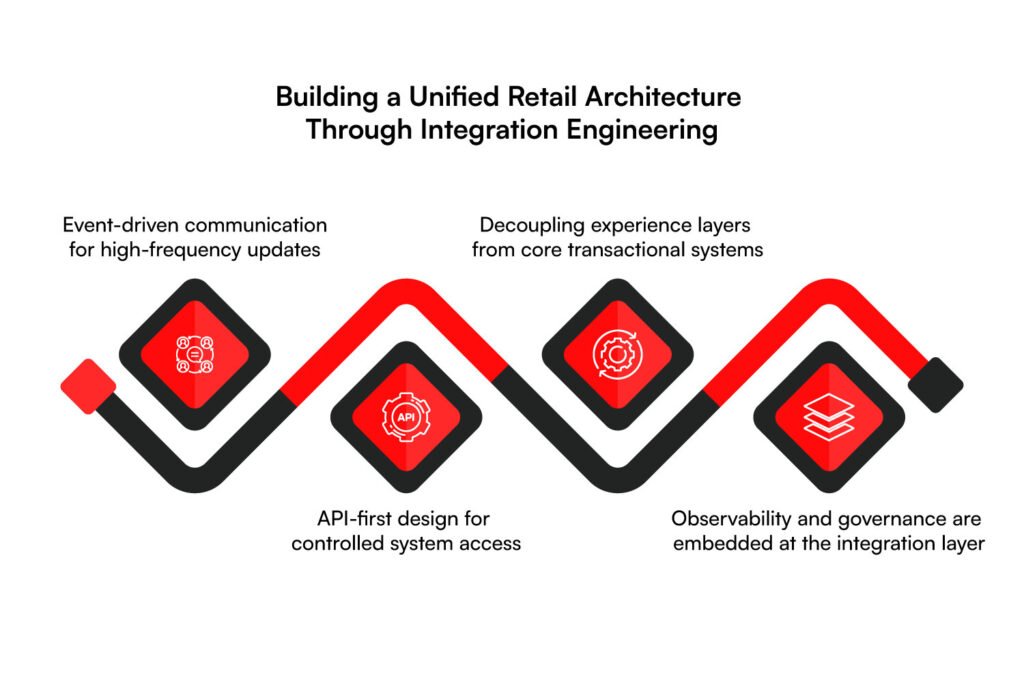
This approach enables retailers to evolve individual platforms without destabilizing the broader ecosystem.
Our Approach to Retail Systems Integration
We treat retail systems integration as an engineering discipline grounded in real retail operating conditions. The focus is not on tools alone, but on building integration architectures that scale under load, adapt to change, and remain secure.
Our integration engineering capability emphasizes:
- Architecture-led ERP commerce integration
- Real-time OMS CRM retail connectivity
- Event-driven middleware strategies
- Security, monitoring, and governance are built into integration flows
This ensures that integrations support both current operations and long-term growth.
Case Study: Retail Systems Integration Enabling Real-Time SKU Orchestration
A large home furnishings retailer managing over five million SKUs faced a structural limitation. Each product existed in multiple fabrics, colors, and size combinations, creating millions of potential variants. Manually generating and storing images for every variation was impractical.
At the same time:
- SKU data flowed from ERP systems, supplier feeds, and design platforms
- Updates needed to reflect instantly across customer-facing applications
- Query performance had to remain sub-second at enterprise scale
We design a retail systems integration architecture based on real-time, event-driven principles.
- Apache Kafka acted as the integration middleware backbone, ingesting SKU, pricing, and availability events
- Apache Flink processed and enriched SKU data streams continuously
- ClickHouse enabled high-performance querying across millions of SKU records
- A Java-based microservices layer exposed SKU data to commerce applications
This architecture allowed ERP commerce integration and downstream systems to remain decoupled while ensuring near real-time propagation of SKU changes. OMS and CRM platforms consumed consistent, validated data without direct dependency on ERP.
What this Use Case Demonstrates about Unified Retail Architecture
This implementation validated several critical principles of unified retail architecture:
- Event-driven integration scales better than synchronous point-to-point designs
- Middleware layers protect core systems from high-frequency frontend demand
- Real-time data propagation enables richer customer experiences
- Query-optimized storage is essential for enterprise SKU volumes
Most importantly, it demonstrated how integration architecture directly enables customer-facing capabilities.
Business Outcomes Enabled by Secure Retail Systems Integration
Retailers that invest in structured integration engineering consistently see:
- Real-time synchronization of inventory, pricing, and SKU attributes
- Faster, more reliable OMS CRM retail connectivity
- Reduced operational overhead through automation
- Improved resilience during peak demand
In the SKU orchestration scenario, update times reduced from minutes or hours to seconds, manual image creation was eliminated, and millions of SKUs were supported without performance degradation.
Validating Integration Middleware Retail Beyond Initial Deployment
Successful integration of middleware retail implementations must be validated under real-world conditions:
- Peak-season transaction volumes
- Continuous SKU and pricing updates
- Platform upgrades and vendor changes
RBM emphasizes load testing, observability, and ongoing optimization to ensure integrations remain reliable over time.
Preparing for Continuous Change with Retail Systems Integration
Retail platforms will continue to evolve, with new channels, partners, and fulfillment models emerging. Without a strong integration foundation, each change increases complexity and risk.
A unified retail architecture supported by secure, scalable integration engineering allows retailers to:
- Add capabilities without reworking core systems
- Scale transaction volumes without linear cost increases
- Maintain security and compliance as data flows expand
Integration becomes an enabler of innovation rather than a bottleneck.
Conclusion
Retail leaders evaluating integration strategies should look beyond immediate connectivity needs. The real question is whether existing retail systems integration can support growth, complexity, and continuous change.
We help retailers engineer integration frameworks that transform fragmented ERP, CRM, and OMS platforms into cohesive retail ecosystems, capable of scaling securely and efficiently. If your ERP commerce integration or OMS CRM retail connectivity is limiting growth, it may be time to rethink integration as a strategic capability rather than a technical afterthought.
Struggling with fragmented retail systems? Let us help you rethink retail systems integration with scalable, secure architectures built for enterprise growth. Talk to our experts.