



Table of Contents
Quick Summary:
- Scaling agentic AI shifts the focus from building agents to designing systems that can handle real-world complexity and execution.
- Most failures happen because enterprises try to scale too fast without fixing foundational gaps in data, orchestration, and control.
- A structured approach with phased implementation, guardrails, infrastructure upgrades, task-specific design, and observability is critical.
- Scaling challenges span output quality, decision reliability, execution control, and system-level coordination.
- Enterprise readiness depends on having the right data layer, system integration, governance, workflows, and visibility in place before scaling.
Many enterprises have already built systems that can plan, reason, use tools, and take action with minimal human input. The real challenge is scaling them in a way that makes them reliable and valuable in dynamic business environments.
Are you actually ready to scale it?
Initially, your pilot performs well, outcomes are controlled, and the agent does exactly what you expect. But the moment you try to expand it across teams, connect it to real systems, and handle more complex scenarios, things start to get messy.
You might assume that a successful pilot means you are ready for full rollout. That is rarely the case. Scaling agentic AI introduces a different level of complexity.
Your agent is no longer operating in isolation; it is making decisions in dynamic environments where consistency, control, and accountability matter a lot more.
Many teams also treat agentic AI like an upgrade to generative AI, focusing only on models and outputs. But you are not just scaling responses, you are scaling actions. And if that foundation is not strong, even the smartest agent will fail when it matters most.
This article breaks down what it actually takes to scale agentic AI, from fixing foundational gaps to building systems that can perform reliably in real-world conditions.
Strategic Framework for Scaling Agentic AI From Pilot to Production
As you add agents, tools, and workflows, coordination overhead and execution dependencies increase. Without the right architecture, performance can decline rather than improve.
What works at a small scale often breaks under higher orchestration demands, so scaling needs to be deliberate, not expansive. Below are the best practices to scale an agentic AI enterprise:
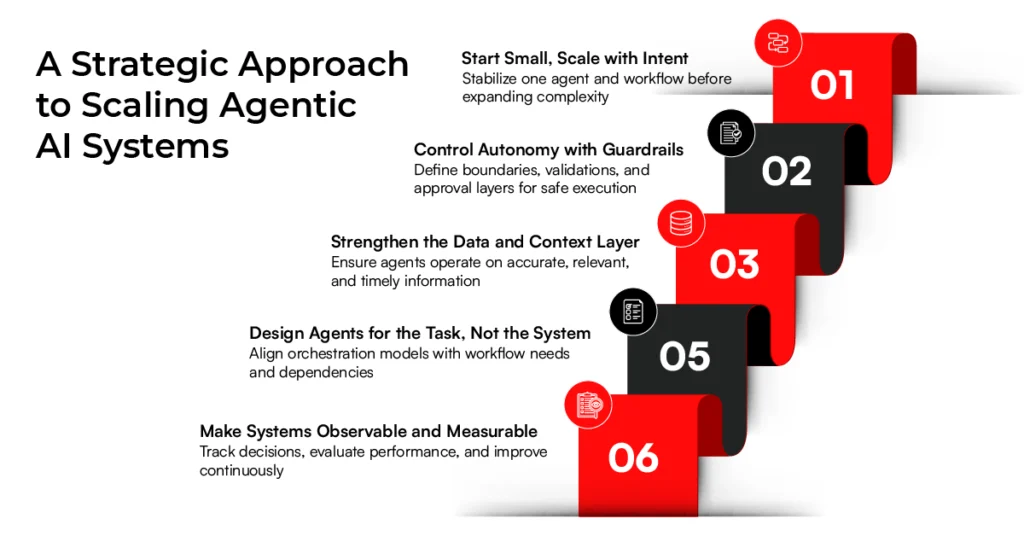
Step 1: Phased Implementation
One of the biggest mistakes teams make is scaling multiple agents and workflows simultaneously without establishing a baseline. You end up with several loosely connected systems, each calling different tools, sharing partial context, and introducing coordination overhead.
There is a known trade-off in multi-agent systems. As you add more agents and tools, coordination complexity increases, and performance can drop if the system is not properly structured.
On top of that, without a stable baseline, you cannot determine whether failures originate from the model, the tool layer, or the orchestration logic.
One of our clients operates in the retail and eCommerce space, managing large-scale customer interactions, order processing, and operational workflows. They had multiple pilots running in parallel, each with its own agent logic and tool chains.
When they tried to scale, errors began to compound across workflows because there was no single reference point for performance or behavior.
The fix was not adding more sophistication. It was simplified first. We started with a single-agent architecture tied to one well-defined workflow.
This allowed us to isolate planning, tool usage, and execution behavior. Once that system was stable and measurable, we gradually introduced additional agents and orchestration layers where needed.
This phased approach aligns with what we are seeing across the industry. Adding more agents does not always improve outcomes. There is a saturation point at which additional complexity yields diminishing returns.
By scaling one layer at a time, you avoid coordination overload, reduce error propagation, and create a system that you can actually debug and trust as it grows.
Your Pilot Success Can Mislead You
Get a clear breakdown of what will break in your system before you scale further.
Get Expert Guidance
Step 2: Governance and Guardrails
As this same system began to scale beyond the initial workflow, a new issue surfaced. The agent was making decisions that triggered downstream actions.
And without defined boundaries, those decisions started to go wrong. At scale, the risk shifts from incorrect responses to incorrect actions.
In this case, the client had allowed agents to operate with a high degree of autonomy, assuming the behavior observed in the initial phase would hold in production. It did not.
As more workflows were added, the agent began acting on incomplete context and executing steps without validation.
Since there were no checkpoints in place, these errors propagated across connected systems. The system needed control, not more intelligence.
We introduced governance at the execution level. Clear boundaries were defined around what the agent could handle independently and where intervention was required.
For high-impact actions, we embedded human-in-the-loop approval layers. For routine tasks, we added rule-based validations and constraints to be applied before execution. This brought structure to autonomy. The agent could still operate efficiently, but within a controlled framework.
As a result, the system became far more stable. Errors were contained early, and autonomous decisions no longer created cascading failures across workflows.
Step 3: Modernize Infrastructure
As the system expanded further, performance issues began to appear even in previously stable workflows. The agent makes decisions, but those decisions are often based on incomplete or inconsistent context.
And while scaling, agent performance is directly tied to the quality of context it receives. So the core problem lies in the underlying data and retrieval layer.
Our client’s data ecosystem was fragmented. Different agents were pulling from multiple sources, the retrieval logic was inconsistent, and there was no unified way to provide relevant context at the right time.
As a result, even well-designed agents began to underperform because they were operating on weak or outdated information. Adding more agents at this stage would have made things worse.
To fix the foundation, we redesigned the context and retrieval layer, deploying a structured RAG approach to ensure agents received accurate, task-specific information.
At the same time, we moved to a more modular, microservices-based architecture so that data access, retrieval, and processing could scale independently by the agents themselves.
This created a clean separation between intelligence and infrastructure. Once the context layer was stabilized, agent performance improved significantly.
Decisions became more accurate, workflows executed more reliably, and the system finally supported scale without degrading outcomes.
Step 4: Deterministic Agent Design
As more workflows were added, another pattern became clear. The same agent design was being reused across different tasks, regardless of how those tasks actually behaved.
What worked for one workflow started failing in another. Not all agent problems are the same, so the architecture cannot be either.
The client was using a uniform multi-agent setup across use cases. Some workflows required tight control and sequential execution, while others needed flexibility and parallel decision-making.
Applying the same orchestration model everywhere introduced unnecessary complexity in some cases and insufficient control in others. This mismatch began to affect both accuracy and efficiency.
The fix was to make agent design more deterministic and task-specific. Instead of imposing a single architecture, we mapped workflows to their requirements. For structured, high-dependency tasks, we used centralized orchestration to control execution flow.
For more dynamic, independent tasks, we introduced decentralized agents that could operate with greater autonomy. This alignment between task type and agent design reduced unnecessary coordination and improved clarity of execution.
The outcome was a noticeable improvement in reliability and efficiency. Systems behaved more predictably, and performance stabilized without adding complexity.
Step 5: Observability and Evals
As the system runs multiple workflows with increasing complexity, there is no clear visibility into what the agents are actually doing in production.
There was no structured way to trace decisions, measure performance, or identify where things are breaking. Consequently, the team has to rely on logs, assumptions, or delayed feedback.
For the client, visibility into agent behavior in production was extremely limited. They could see the outcomes but not the reasoning, tool usage, or intermediate steps that led to them. This made debugging slow and reactive, and improvement efforts inconsistent.
The focus shifted to building a proper evaluation and monitoring layer. We introduced continuous observability across the agent lifecycle, tracking inputs, decisions, tool calls, and outputs. On top of that, we defined use-case-specific benchmarks to measure performance, rather than relying on generic metrics.
User feedback loops were also integrated to capture real-world signals. This created a feedback-driven system instead of a black box.
The impact was immediate. The team moved from reactive firefighting to proactive performance management. Issues were identified early, improvements were measurable, and the system became easier to trust as it scaled.
From Fragile Pilots to Stable Systems
Know exactly what your agentic AI needs to run reliably in production, with clear architecture, governance, and execution mapped out.
Get Service AssistanceBenefits of Scaling Agentic AI for Enterprises
Does your current architecture truly support scaling agentic systems across diverse use cases?
Most enterprises reach this stage with working agents, but without the underlying maturity required to sustain them.
Adoption is increasing rapidly, yet critical layers like governance, evaluation, and system integration remain underdeveloped. This gap between capability and readiness is where efforts of scaling agentic AI typically break.
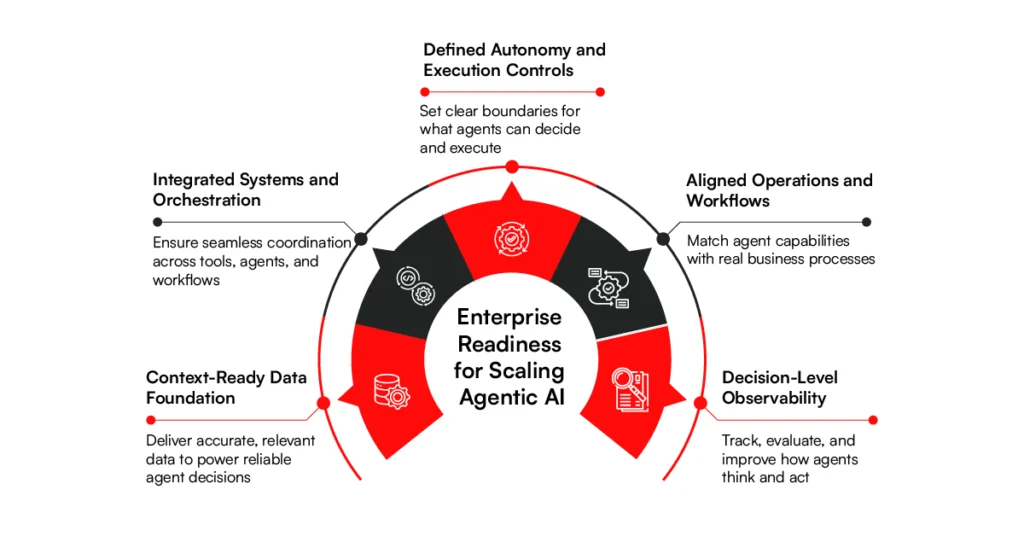
1. Context-Ready Data Layer
Agents do not operate on a curated, queryable context. If your data layer is fragmented across warehouses, APIs, and documents without a unified retrieval strategy, agents will produce inconsistent outputs.
Readiness here means implementing a structured retrieval layer, typically through RAG pipelines, semantic indexing, and context filtering.
Data should be versioned, access-controlled, and optimized for low-latency retrieval so agents can make decisions based on accurate and relevant context.
2. System-Level Integration and Orchestration
Scaling agentic AI fails when agents are loosely coupled to systems through ad hoc integrations. At scale, agents need deterministic access to tools, services, and workflows.
This requires API-first architecture, event-driven workflows, and orchestration layers that manage tool invocation, retries, and state transitions.
Agents should not directly interact with fragmented systems. Instead, they should operate through standardized interfaces that abstract underlying complexity.
3. Explicit Autonomy Boundaries and Execution Policies
Autonomous execution without constraints introduces systemic risk. You need clearly defined execution policies that govern agent behavior at runtime.
This includes scoped permissions, policy engines for decision validation, and conditional execution paths based on task criticality.
High-impact actions should trigger human-in-the-loop checkpoints, while lower-risk actions can follow automated validation rules. These controls must be enforced at the orchestration layer, not left to the model to implement.
4. Operational and Workflow Alignment
Agents operate within workflows, not in isolation. If workflows are loosely defined or highly variable, agent performance will be inconsistent.
Readiness means that workflows are decomposed into deterministic steps, allowing agents to operate with clarity. It also requires operational alignment, with teams understanding how to supervise agents, intervene when needed, and iterate on system performance.
This includes defining ownership across engineering, product, and operations for agent lifecycle management.
5. Observability at the Decision Layer
Traditional logging is not sufficient for agentic systems. You need observability into reasoning steps, tool calls, intermediate states, and final outputs. It requires structured tracing, step-level logging, and evaluation pipelines that measure performance against defined benchmarks.
Metrics should go beyond accuracy and include task completion rates, latency, tool success rates, and failure modes. Feedback loops must be integrated to continuously refine agent behavior.
Conclusion
Scaling agentic AI is where real enterprise value is created, but it is also where most initiatives fail. As you move beyond pilots, the focus shifts from building intelligent agents to engineering systems that can support autonomy at scale.
This requires the right architecture, governance, data foundations, and operational alignment working together. Without that, even the most advanced agents will struggle to deliver consistent outcomes.
At RBMSoft, we focus on what actually breaks when you try to scale. Our AI development services are built to help you move from isolated pilots to systems that can handle real workloads. We work on the layers that matter, starting with fixing fragmented data and building reliable retrieval pipelines.
We then set up orchestration, governance, and monitoring systems that can withstand production. The goal is simple. Your agents should not just work in controlled environments; they should perform consistently when exposed to real users, real data, and real complexity.
If you are looking to scale agentic AI beyond experimentation and drive measurable business impact, RBMSoft provides the expertise and execution needed to make that transition successful.
FAQ’s
1. What does scaling agentic AI solutions mean?
Scaling agentic AI solutions means moving from controlled pilots to systems that can operate reliably across multiple workflows, users, and real-world conditions. It involves integrating agents with business systems, handling higher volumes, and ensuring consistent decision-making.
At scale, the focus shifts from building agents to designing systems that support autonomy, governance, and performance without breaking under complexity.
2. What are the biggest challenges in scaling agentic AI systems?
Key challenges include fragmented data, weak orchestration, lack of execution boundaries, and poor observability. As systems grow, coordination overhead increases, making it harder to manage dependencies and track failures.
Many pilots also fail because they were not designed for production, leading to instability when exposed to real-world complexity.
3. What are the key factors of an enterprise agentic AI strategy?
A strong strategy includes a context-ready data layer, integrated systems, defined autonomy boundaries, and continuous observability. It also requires aligning agent capabilities with business workflows and ensuring governance is embedded into execution. Success depends on treating agentic AI as a system design problem, not just a model upgrade.
4. How are enterprises scaling agentic AI in 2026?
Enterprises are adopting phased approaches, starting with single-agent workflows before expanding to multi-agent systems. They are investing in RAG-based retrieval, API-driven architectures, and evaluation frameworks. The focus is on improving reliability, controlling execution, and ensuring agents perform consistently across integrated systems.
5. What does a scalable AI operating model look like?
A scalable model includes structured workflows, clear ownership, embedded governance, and continuous monitoring. Agents operate within defined processes, with escalation paths and performance benchmarks in place. Teams are aligned to manage, evaluate, and improve agent behavior over time.
6. How does scaling agentic AI control hallucinations in critical workflows?
Hallucinations are controlled through structured context retrieval, validation layers, and execution constraints. Agents rely on trusted data sources, and critical actions are gated with rules or human approvals. This ensures incorrect outputs do not translate into incorrect actions.
7. How much does it cost to scale agentic AI?
Costs depend on system complexity, integrations, infrastructure, and scale of deployment. Key cost areas include data pipelines, orchestration layers, model usage, monitoring, and ongoing optimization. The more complex the workflows, the higher the investment required to ensure reliability and control.
8. What does LLM observability look like at scale?
It involves tracking inputs, reasoning steps, tool calls, and outputs across the agent lifecycle. Teams use structured logging, tracing, and metrics like task completion, latency, and error rates to monitor performance. This enables proactive issue detection and continuous improvement.
9. How do you ensure AI security and compliance while scaling agentic AI?
Security is built into the system, not added later. Access is controlled. Actions are restricted based on roles and policies. Every decision is logged and traceable. This ensures compliance while maintaining transparency as systems scale.